




Fox News panel reacts to MSNBC guest comments on rising crime
'Special Report' All-Star panel reacts to idea that crime is actually 'fault of the police'
This is a rush transcript from "Special Report With Bret Baier," June 22, 2021. This copy may not be in its final form and may be updated.
(BEGIN VIDEO CLIP)
JEN PSAKI, WHITE HOUSE PRESS SECRETARY: Yes, we believe that essential driver of violence is gun violence and is the use of guns. We're seeing that statistically in a lot of areas. But he also believes that we need to ensure that state and local governments keep cops on the beat, that we're supporting community policing.
JAMES CRAIG, FORMER DETROIT POLICE CHIEF: We don't have a gun problem in the country. What we have is a criminal problem, and we need to address that.
JOE GAMALDI, FRATERNAL ORDER OF POLICE: I certainly hope as a part of his comments he is going to call out rogue prosecutors and activist judges, because everybody wants to talk about new gun laws. The fact of the matter is, we're not even enforcing the gun laws we have now.
(END VIDEO CLIP)
HEMMER: A little bit of a sample that's being talked about with crime in America, especially in big American cities on the rise now for some time. Tomorrow the president is going to announce his own crime prevention strategy.
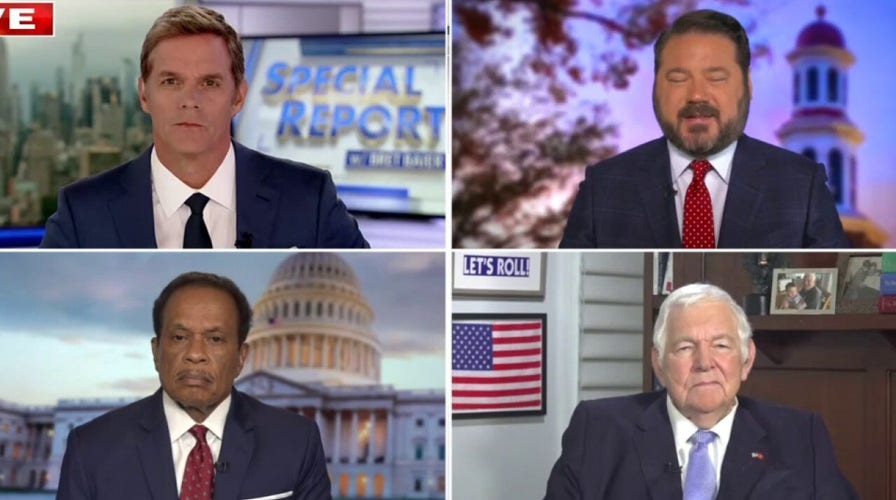
With that, I want to bring in our panel tonight, Ben Domenech, publisher of "The Federalist," Juan Williams, FOX News analyst, and Bill Bennett, former Education Secretary. Gentlemen, great to see you all tonight. Ben, what does the president say?
BEN DOMENECH, PUBLISHER, "THE FEDERALIST": Well, I think the president is going to say a lot of things that don't have a lot to do what has gone on in the country over the past year-and-a-half. Jen Psaki keeps emphasizing we have seen this rise in crime not just in the past couple of months but in the past year-and-a-half. If only there were a way to look back in time at things that were being said last summer, at things that were being promoted, ideas about the nature of policing and the way that prosecutors ought to drop various cases as being nonviolent acts, such as vandalism and robbing stores and the like. If only we could look back in time, and maybe then we would be able to know why we're seeing this type of rise in crime.
But of course, that's impossible. And so we're never -- it's just a mystery. It's just a mystery why all of this happened as opposed to being a reflection of the actual policies that the Democratic Party wants to put in place in America's great cities.
HEMMER: It seems as if we've been reporting on this for some time and a lot of others are catching up to it now. Juan, what does the president say tomorrow regarding this?
JUAN WILLIAMS, FOX NEWS POLITICAL ANALYST: I think the president's focus is on easy access to guns, Bill. But just to speak to this issue in general terms, first, I think we all have to keep in mind that crime overall in America is down according to FBI statistics. Murder, murder is the one crime that is up markedly. So it doesn't make sense to say oh, debate about police reform in the aftermath of George Floyd's murder is the cause for the rise in only one type of crime. FBI statistics show last year crime was down about six percent in the USA, but murder was up 25 percent. Most crime in the country is property crime. That's 85 percent of all crime, and that was down.
So what strikes me here is we have an effort to say if you discuss police reform, it might somehow impact crime. But it's not a clear line. And I might also add that disproportionately, in terms of that horrible rise that we've seen in murder, it's like black people are 12 percent of the population, but they're like 50 percent of the people who are impacted by this rise in murder. They are the victims. And I think that makes it very real, very personal for the black community. I think something is going on there.
HEMMER: OK, in a moment here I'm going to play this clip from another network. But Bill, go ahead and weigh-in where you think this goes from here, or even tomorrow or after?
BILL BENNETT, FORMER EDUCATION SECRETARY: I'll just try to pick up on what Juan said. Yes, there is something going on in that community, and unfortunately in these communities across the country -- black men killing other black men. And this is what we see. We see in Chicago, we see in Detroit. The general idea here that this is a chimera, that this crime is not increasing in these cities is wrong. This crime is increasing. We saw a dramatic drop in the 80s and 90s. We saw it pick up back again, and then it went down. And now in these mostly liberal cities, not all but mostly liberal cities, we see it going up.
I think the president will talk about guns. I hope he talks about the perpetrators of crime because they have something to do with it. Let me just put this proposition forward. What do you suppose happens if you have a national fever about the police and lots of people saying let's defund the police, the police are pigs, fry them like bacon, and at the same time you have got a bunch of prosecutors in big cities around the country refusing to prosecute people who are guilty of crimes unless they were in Washington on January 6th. I think the answer to these questions --
HEMMER: Ben, I think Bill hit all three. The gun, the police, the perpetrator. That came up on MSNBC with this comment. Watch and listen.
(BEGIN VIDEO CLIP)
UNIDENTIFIED FEMALE: This rising crime is not the fault of the movement. It's actually the fault of the police, and this has been our point all along. Why should we keep funding systems and institutions that keep rendering themselves ineffective? We should talk about gun control, livable wages, fair housing, education. That's where we should be moving the money to to ensure truly safe streets.
(END VIDEO CLIP)
HEMMER: The fault of the police. Ben, you want to weigh in on that?
DOMENECH: No one wants to actually deal with the fact that policy messages have ramifications. When you send the message that you're not going to prosecute people for these lower-level crimes, these nonviolent, generally, crimes, though I do think of theft as an act of violence personally, then you send the message that these are things that you can do. You can get away with them. And what you end up with is more criminals who are out on the streets as opposed to being prosecuted in the way they ought to.
In order to maintain order, and this is something that we learned in the 1980s as Bill made reference to, you have to be able to cut these things off before they escalate to the level of violence that results in the death of a fellow American. And I think in this instance, we have a real willingness on the part of a lot of progressives to look the other way as opposed to grapple with the ramifications of the policies they support.
HEMMER: We shall see what the president has to say on this tomorrow. We'll cover it when it happens. Gentlemen, stand by. In a moment here, voting rights and why one Democrat will not vote to end the almighty filibuster.
(COMMERCIAL BREAK)
(BEGIN VIDEO CLIP)
SEN. MICHAEL BENNET, (D-CO): Anti-democratic forces are stronger than any time since Jim Crow. And it's true. That's a fact. What I was reading about in the 1980s about laws that had been fought against in the 1960s, they're back in 2020.
SEN. SUSAN COLLINS, (D-ME): With the record high turnout in 2020, it is very difficult to make the case that this bill is necessary, as some have said, to save our democracy.
(END VIDEO CLIP)
HEMMER: A little bit of the sample, which was being spoken a bit earlier today on the floor of the Senate. The voting rights legislation has been stopped at 50-50.
And we are back with our panel, Bill Bennett, Ben Domenech, and Juan Williams, 50 yeas, 50 nays. And gentleman, that's the reality in Congress today. And it brings to light the argument over this filibuster. We have heard for six months now about D.C. statehood and the expansion of the U.S. Supreme Court.
Kyrsten Sinema, Senator from Arizona, Democrat, said she would not vote to break the filibuster, and that matters in this Congress. She wrote this today in "The Washington Post," "My support for retaining the 60 vote threshold is not based on the importance of any particular policy. It's based on what is best for our democracy. The filibuster compels moderation and helps protect the country from wild swings between opposing policy polls. I do not accept the new standard by which important legislation can only pass on party-line votes. If we eliminate the Senate's 60 vote threshold, we will lose much more than we gain."
To Bill Bennett on that as to where we stand tonight after that op-ed, Bill.
BENNETT: Yes, well, Senator Sinema, brilliant and beautiful. Will I get in trouble for saying that? Democrat Senator. I don't care. I want to pile as many positive adjectives as I can on a Democrat. I don't get to do it very often. But good for her. She is in the breach. She's Horatius at the bridge as is Joe Manchin. And good for those two Democrats. Elections matter, and close elections matter. And this is close, it's really close, 50-50.
And I agree with the assessment that if this bill, HR-1, now S-1, had gone through, you would not see a Republican elected any time in the future. And this would be unconstitutional. That would be a protection, I think, because the Supreme Court would say, no, the states do this. They control the matter of these elections, not the federal government. But good for them. Double kudos, triple kudos.
HEMMER: Juan, you care to weigh-in on the kudos?
WILLIAMS: I think the filibuster is safe if that's Bill's point. I think that what we saw in the Kyrsten Sinema op-ed in "The Post" this morning, I think we know Joe Manchin has made his position quite close. And I don't think they're alone. I think there are other Democrats standing aside and letting them be the point of the spear here.
But my point to both you and to Bill is that what you get today is the refusal of Republicans to even have a debate over protecting voting rights in the country. And I just think that's a sad state of affairs. The reality is that the Democratic Senate Majority Leader Chuck Schumer was able to get Joe Manchin, the man we were just talking about, to join him and say yes, we should have this debate.
Joe Manchin gave Republicans their big talking points. Yes, let's have a national voter I.D. mandate. Let's not have any reform in terms of public financing of campaigns. Let's make a deal with Republicans. Republicans wouldn't even vote today to have a debate on that. I don't know what you can make of that except that Joe Manchin called their bluff, and they got called out. They were exposed as simply wanting to stop any manner of protections for voting rights in this country.
HEMMER: Ben, in response, Republicans have been saying throughout the week that most Americans don't even understand what is in this bill, and a lot of the items that are contained in it are not popular.
HEMMER: One of the things that is contained within it that we haven't really discussed is really an elimination of the kind of donor privacy that has been a goal of a lot of different leftists over the course of the past several decades. And that's something that has been opposed in a bipartisan fashion by literally hundreds of groups out there, including ACLU, who understand the danger of an era in which we could see a type of harassment of donors based on simply the candidates they give to in a way that is really unprecedented. We've seen the poll data that talks about support for firing people, colleagues who you work with based on their political donations.
This is the kind of toxic thing that we don't want to see in this country and I think that we ought to be opposed to as Americans. And the fact that so many in the Democratic Party seem willing to try to push something this extreme forward on a party line vote in order to try to attempt and eliminate the filibuster, push this thing through, that just shows you I think how desperate they are.
And there is a report today in "Politco" which I think should really give them pause. A major Democrat counselor to one of the major Democrat donors saying that in fact, you have -- they have made a mistake as a party in investing so much effort in trying to push this through that they really ought to have put things forward that could actually pass as opposed to being such a partisan attempt.
HEMMER: Gentlemen, I'm out of time for the moment, but thank you for yours. Stand by, OK? When we come back, tomorrow's headline.
(COMMERCIAL BREAK)
HEMMER: Breaking tonight a few moments ago, FOX News confirming Defense Secretary Lloyd Austin saying the Pentagon will work with Congress to remove the prosecution of sexual assault from the military's chain of command. Austin says he supports letting independent military lawyers handle those cases. Breaking right now, follow up on this coming up tonight and tomorrow on AMERICA'S NEWSROOM.
Finally tonight, a look at tomorrow's headlines. And Ben, we begin with you. What is going to happen tomorrow?
DOMENECH: If Sheldon Whitehouse were the host of "The Bachelor," he would be gravelling for his job already. Unfortunately, the standards are a little bit higher when you're host reality shows than it is to be a U.S. senator.
HEMMER: We're watching that. Juan, what about you?
WILLIAMS: I think there's going to be a headline tomorrow, Bill, that says we are not alone. Aliens are found, and they're selling bitcoin, as we see the turmoil in the market for bitcoin in the country right now.
(LAUGHTER)
HEMMER: I like that. Can you top it, Bill?
BENNETT: Well, I was going to try to be serious. The most interesting policy action in America right now, not in the president's office, not in the Congress, not the Supreme Court -- the American school board. The local school board. This is where the future of America is ground out and determined. Very, very interesting places these days around the country. Glad to see folks there.
HEMMER: We've seen hundreds turn out all over the country. Thank you, gentlemen. Ben Domenech, Juan Williams, Bill Bennett, thank you.
Content and Programming Copyright 2021 Fox News Network, LLC. ALL RIGHTS RESERVED. Copyright 2021 VIQ Media Transcription, Inc. All materials herein are protected by United States copyright law and may not be reproduced, distributed, transmitted, displayed, published or broadcast without the prior written permission of VIQ Media Transcription, Inc. You may not alter or remove any trademark, copyright or other notice from copies of the content.
