


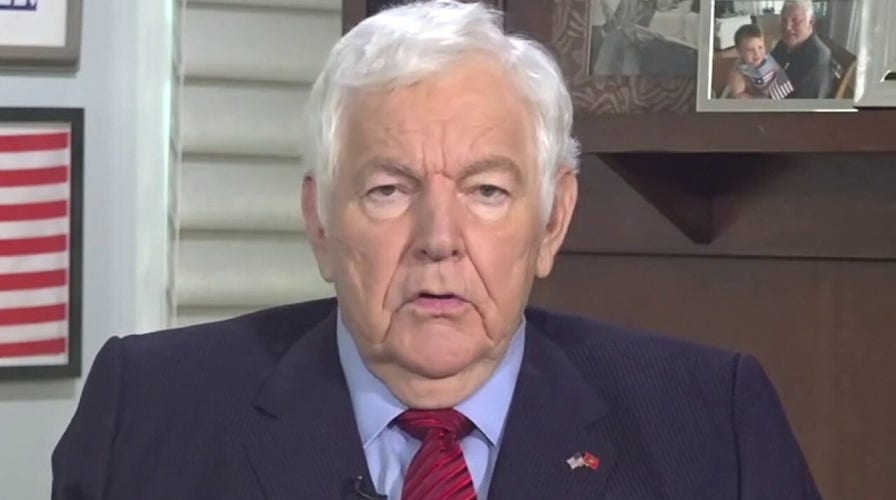
Afghanistan crisis is one of the worst blunders in US foreign policy: Bill Bennett
All-Star panel weighs in on Biden's handling of the crisis in Afghanistan on 'Special Report'
This is a rush transcript from "Special Report" August 31, 2021. This copy may not be in its final form and may be updated.
(BEGIN VIDEO CLIP)
JOE BIDEN, (D) PRESIDENT OF THE UNITED STATES: We reached out 19 times to Americans in Afghanistan with multiple warnings and offers to help them leave Afghanistan, all the way back as far as March.
My predecessor had made a deal with the Taliban. When I came into office, we faced a deadline, May 1. The Taliban onslaught was coming.
The people of Afghanistan watched their own government collapse and their president flee amid the corruption of malfeasance, handing over the country to their enemy, the Taliban.
(END VIDEO CLIP)
BAIER: President Biden this afternoon at the White House, his critics saying that the president promised the Taliban that America would be out of Afghanistan on August 31st. He kept his promise, but they say he also promised that American troops would be on the ground until all Americans were gone at one point, and he did not keep that.
Let's bring in our panel, former Education Secretary Bill Bennett, Mara Liasson, national political correspondent of National Public Radio, and Guy Benson, political editor, host of "The Guy Benson Show" on FOX News Radio. Bill, a lot of the reaction I've seen, and it's not partisan, just analysis here in Washington on both sides, noticed that the president's speech was in a kind of defensive stance. Your thoughts on what was said?
BILL BENNETT, FORMER EDUCATION SECRETARY: Yes. I'm reminded of the judge who called the lawyer to the bench and said your argument is bad. It doesn't get any better by being louder. People have talked about it being firm and focused and so on. It was loud. That's all. And it was very defensive. The defensiveness of the president is obvious.
Look, this was a disgrace. This did not have to happen. Our honor as a country was besmirched, not our soldiers, but our honor as a country, as a country that gives its word. Just very briefly, I spoke with Ryan Crocker, former ambassador to Afghanistan, Bing West, marine colonel, boots on the ground, 10 years ago, 10 years ago, Bret, we had 100,000 troops in Afghanistan and the Taliban controlled no provincial capitals. Three weeks ago, we had not 100,000, but 2,500 troops in Afghanistan, and the Taliban controlled no provincial capitals. We gave up all that. Twenty years ago, we defeated the Taliban. This time they ran us out. They got a victory, they got our weapons, and they have hostages, and we have a broken promise by a president in one of the worst blunders in American foreign policy history.
BAIER: Some, like Bill, are calling them hostages. Mara, we don't know. The administration is saying that they are working with the Taliban to get them out, each one of them. There has been back and forth about calling them stranded Americans. Take a listen.
(BEGIN VIDEO CLIP)
JEN PSAKI, WHITE HOUSE PRESS SECRETARY: First of all, I think it's irresponsible to say Americans are stranded. They are not.
UNIDENTIFIED MALE: How does diplomacy get those people out of the Taliban controlled Afghanistan?
JOHN KIRBY, PENTAGON PRESS SECRETARY: It's not completely unlike the way we do it elsewhere around the world. We have Americans that get stranded in countries all the time, and we do everything we can to try to facilitate safe passage.
(END VIDEO CLIP)
BAIER: Mara?
MARA LIASSON, NATIONAL POLITICAL CORRESPONDENT, NATIONAL PUBLIC RADIO: Yes, I think this is one of the most important questions going forward, because the narrative is already forming among Republicans that these people are hostages. This is like Jimmy Carter who couldn't get Americans out of Iran. So the question is Joe Biden says there is something like 100 or 200 Americans who might still want to get out. He pretty much made a promise today that he would get them out one way or another. We're not exactly sure what he hands to do to get them out. But I think going forward this is really important. Does the Taliban refuse to let them go? Then they start to look like hostages. Can he get out every single American who wants to leave, because he has made that commitment over and over again, and he made it again today.
BAIER: But there was a little reframing, Mara, in that the president today said that the outreach had happened and a lot of these people didn't want to leave, and they put the number at about 100.
LIASSON: Right.
BAIER: Yesterday, the secretary of state said there were 100 to 200 who wanted to leave Afghanistan.
LIASSON: Yes, who wanted to leave. Whether they didn't want to leave when they first started reaching out to them in March doesn't really matter. If they want to leave now, it seems to me that the administration has made a commitment to get them out. And even if they haven't, this is a big point of vulnerability for the Biden administration if they can't get them out.
BAIER: Not talked about a lot, Guy, are the Afghan allies who are at big risk on the ground, in addition to the risk facing the Americans. One of them actually saved Senator Biden in 2008 when his Blackhawk helicopter went down in the mountains with Senator Chuck Hagel, Senator John Kerry, an interpreter. "Thirteen years Afghan interpreter Mohammed," this is from "The Wall Street Journal," helped rescue then Senator Joe Biden and two other senators stranded in a remote Afghanistan valley after their helicopter was forced to land in a snowstorm. Now Mohammed is asking President Biden to save him, quote, "Hello, Mr. President. Save me and my family." Mohammed, who asked not to use his full name while in hiding, told "The Wall Street Journal" as the last Americans flew out of Kabul on Monday, don't forget me here." Guy?
GUY BENSON, POLITICAL EDITOR, https://urldefense.proofpoint.com/v2/url?u=http-3A__TOWNHALL.COM&d=DwICAg&c=uw6TLu4hwhHdiGJOgwcWD4AjKQx6zvFcGEsbfiY9-EI&r=kJ8f_Q6dvX3AsDP-NC79Q-X4IyH70YKVhyH4eVON4dc&m=txf3PwLa1mA1oJpmY2uvnseKQXSoNEp3ICbcfQSi2TU&s=FhqBvn2UbNysYrUvJKWSaUSC7MH9YZAQFjfPRQuAhx8&e= : He also said he was very scared. His family is in hiding. The Taliban is trying to hunt them down, and Mohammed, who helped rescue President Biden back when he was a senator, is now begging the White House not to be forgotten. Mohammed was promised by this president that he would not be left behind, and tens of thousands of people like him who helped us for years would not be left behind, and they have been left behind. They have been abandoned.
It's not just hundreds of thousands of Americans, "The New York Times" reported today, there could be thousands of U.S. green card holders and legal residents who are still stranded in Afghanistan. And it's just amazing to see the back-to-back clip that you just played for Mara, Bret, where the administration, the White House has gone from saying don't you dare call these people stranded to oh well, Americans get stranded all the time, and then we're going to deal with it that way. It's not really that big of a deal. The moving of goalposts has been head-spinning.
And it's just amazing to see the president double down on the proposition today that the United States of America could not have executed this withdrawal any better or started any of the evacuations any sooner. It's obviously untrue and it's insulting.
BAIER: Bill, a lot of political watchers are saying this is going to not be an issue come November, 2022, and that America essentially operates in chapters and this chapter will close, and voters won't remember any of this. Your thoughts on the political implications?
BENNETT: Well, it's entirely possible. We change our minds. The Afghans, the terrorists, the Taliban, I should say, they often don't change their mind and they persist. But this isn't about politics. This is about our country. You remember that phrase our lives, our fortunes, our sacred honor. And these things have to matter whatever the politics. I am glad to see some bipartisan agreement here on just what a terrible thing this was.
BAIER: All right, panel, stand by. Up next, the pandemic eviction ban, mask mandates, and civil rights, next.
(COMMERCIAL BREAK)
(BEGIN VIDEO CLIP)
LARRY ELDER, (R) CALIFORNIA GUBERNATORIAL CANDIDATE: So if you have not been vaccinated and you assume the risk that you might contract the coronavirus, you're going to be wearing a mask to protect yourself against other people who have also assumed the same risk? It doesn't make any sense. It's anti-science, and that's one of the reasons why so many people were upset with the way this guy shut down this state.
GOV. GAVIN NEWSOM, (D) CALIFORNIA: They also all support eliminating mask mandates in our public schools, eliminating vaccine verifications. Leading candidate Larry Elder says he will do that day one. So I have no interest in taking us off the COVID cliff.
(END VIDEO CLIP)
BAIER: California Governor Gavin Newsom facing a recall September 14th. We'll have a story on that explaining how that works later this week.
Meantime in Los Angeles, they say "Almost since the inception the effort to oust Governor Gavin Newsom has been inextricably tied to the pandemic's impact on schools. Now as recall ballots dropping in mailboxes, children are returning to school amid heated battles over mask mandates and skyrocketing cases of the highly transmissible Delta variant. Leaders of the effort to remove Newsom for office are confident that women, exasperated by the effect of Newsom's policies on their children, are the reason they will prevail."
Back with the panel. Mara, obviously the battalion in California, we know the battle is ongoing in Florida, school districts and Governor Ron DeSantis. Thoughts on how this is playing out.
LIASSON: Yes, it's really interesting. Clearly the one proven way to stop the spread of COVID is to get everyone vaccinated. And to the extent that governors are seen as being antivax, in some states, including Florida, they are getting a bit of a backlash. Ron DeSantis was a very popular governor, and his numbers have slipped because he is seen as being someone who doesn't want to do the things you have to do to prevent COVID. He isn't an anti-vaxxer, but I think it has hurt him.
But I do think that the bottom line is still vaccinations are the answer. Even more than masking, vaccinations are the answer.
BAIER: Guy, the Department of Education has launched investigations in Utah, Iowa, Oklahoma, Tennessee, South Carolina, about mask mandates, saying that it's a civil rights issue.
BENSON: Well, they might want to start their investigation in the United Kingdom and Europe where a lot of our European allies have looked at all of their data and a lot of their experience, including during the Delta surge that they've had over there, and they've decided that masks on pupils, especially younger kids in schools, do not have a helpful effect and they don't have those mandates in place. So if they are going to say it's a problem or a public health risk to children here, they should look at the data over there. It seems like for some reason they keep refusing to do so.
BAIER: Meantime, a big ruling by the Supreme Court, Bill, about evictions, siding with landlords, saying that they can't have this lack of rental evictions because they don't pay rent. And now the attorney general is saying we need legal help to defend these people.
BENNETT: Yes, despite TV dramas and movies, landlords are people, too. And they have rights. And good for the Supreme Court in affirming that. It seemed to me a little weasely, the attorney general making this appeal to get around in spirit if not in law the Supreme Court ruling. It's something the Supreme Court has handed down. Let's adhere to it, let's observe it. There's still plenty of things called tenants' rights out there, but this is the law. It has to be respected. It's fundamental to property rights.
BAIER: Mara, do you think that this school mask battle is going to play out for months on end here politically?
LIASSON: I do. I think this is something that is a real culture war frontline. And it is going to play out until COVID starts going down in these states because vaccination rates go up. We have seen vaccination rates go up, and that's a good thing.
BAIER: All right, panel, stand by. When we come back, tomorrow's headlines with you all.
(COMMERCIAL BREAK)
BAIER: Finally tonight, a look at tomorrow's headlines with the panel. Bill, first to you.
BENNETT: Tomorrow's headline, more cries from many who risk their lives to help us were heard through the night in Afghanistan. Will those cries be heard?
BAIER: Mara?
LIASSON: Mine is after Afghanistan withdrawal, Biden says he is still committed to getting remaining Americans out. I think that's the new bottom line for Biden.
BAIER: Guy?
BENSON: Mine is similar to Bill's, Bret. Taliban reprisals target U.S. allies. It's already been happening. It will continue to happen, and perhaps for quite some time. And it's very, very hard to watch.
BAIER: Panel, thank you.
Content and Programming Copyright 2021 Fox News Network, LLC. ALL RIGHTS RESERVED. Copyright 2021 VIQ Media Transcription, Inc. All materials herein are protected by United States copyright law and may not be reproduced, distributed, transmitted, displayed, published or broadcast without the prior written permission of VIQ Media Transcription, Inc. You may not alter or remove any trademark, copyright or other notice from copies of the content.
