







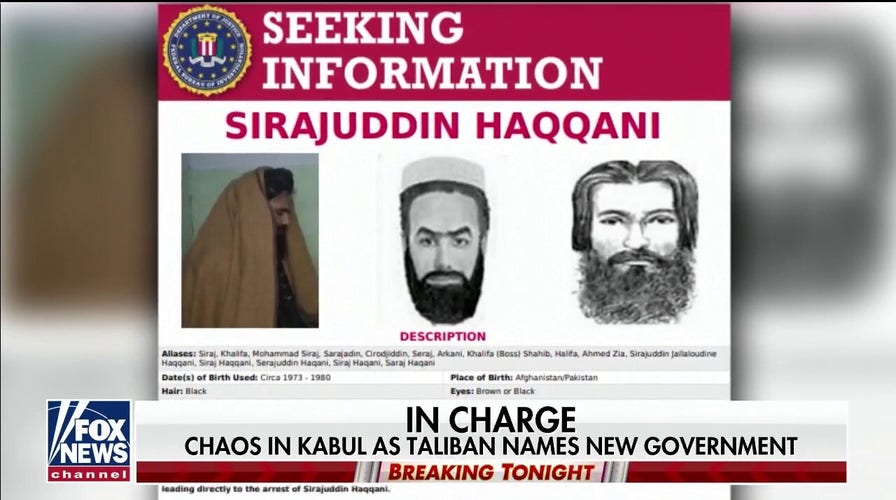
Taliban government interior minister wanted by FBI for ties to al Qaeda
Fox News correspondent David Spunt has the latest on the Taliban's new government in Afghanistan on 'Special Report'
This is a rush transcript from "Special Report with Bret Baier," September 7, 2021. This copy may not be in its final form and may be updated.
EMANUEL: So there we are. Some Americans were able to get out through that heroic rescue effort. Some blaming the State Department, saying they took a little too much credit for those folks getting out.
With that let's bring in our panel, Kimberley Strassel, a member of the editorial board at "The Wall Street Journal," Amy Walter, publisher and editor in chief for the "Cook Political Report," and Jonah Goldberg, editor in chief of "The Dispatch." Panelists, welcome.
Kimberley, is Secretary of State Blinken putting a little too much faith and confidence in the Taliban, or is that just the terrible hand he has to play right now?
KIMBERLEY STRASSEL, "WALL STREET JOURNAL": When you think about this, Mike, the Biden administration doesn't want anyone to really notice this, but this has to be one of the most stunning and disquieting political transformations in U.S. history. The Taliban, a group that helped Al-Qaeda and has been killing Americans for 20 years, the Biden administration is now turning to as a trusted ally? In all of this we're depending on them to give us the information and help get Americans out as well as to be our eyes and ears on the ground against terrorists. It really strains credulity.
And if they were really helping us, they'd allow us to be operating in a theater on the ground. We'd have a list of all those Americans. There would be an orderly plan. The fact that that is not happening suggests that they are not necessarily living up to anything that they have so far promised.
EMANUEL: Amy, what's your sense of the effort to get Americans and Afghan partners out?
AMY WALTER, NATIONAL EDITOR, "COOK POLITICAL REPORT": Well, this is a situation that you're in when you leave the country, you no longer have control of the airspace. And you know longer have any ability to know who is and who isn't holding any of those valid, whether they are passports or other documents that would get you out of the country. So this is pretty much where we are situated right now.
I think the other thick to thing to remember is it's not just the Americans. There are somewhere around 100 Americans, apparently, who are still in country who are trying to leave. But Afghans who are our allies, like the folks that you all have shown in the show previously, who we're going to hear stories about from now for, well, for a long time to come, who are desperate to get out, may have documents, but the Taliban will decide whether those documents are valid in their eyes or not.
EMANUEL: Today White House Press Secretary Jen Psaki said don't call it a hostage crisis. Take a listen.
(BEGIN VIDEO CLIP)
JEN PSAKI, WHITE HOUSE PRESS SECRETARY: No, that is not what we would characterize it as. Those are points -- those are comments made by a Republican congressman this weekend. So let me be very clear. We are in touch with American citizens. We are working to get them out there. There are four who were able to depart over land. Our secretary of state is in Qatar right now working on a range of options, including getting flights up in operational and going. And what we have seen is that individuals who have documentation are able to depart.
(END VIDEO CLIP)
EMANUEL: Jonah, your thoughts?
JONAH GOLDBERG, "THE DISPATCH": I think this is all nonsense. I think that, look, Jen Psaki, what, two weeks ago said we shouldn't refer to these people as stranded. And now she is saying we are moving heaven and earth to get these people out of there who want to leave? Does that mean they are stranded now?
It goes to this larger problem that the administration seems to see this primarily as a messaging problem, that if they could just use the right words and prevents the media from using the wrong words, everything would be fine, when in reality, the problem that they have is they handed over a government of an entire nation state to a bunch of people who were behind the 9/11 attacks, Haqqani, the head of the Haqqani Network I think is the interior minister. The new supreme leader of Afghanistan is such a moderate that he allowed his own son to be a suicide bomber. The entire government is infested with pre-9/11 Taliban retreads and Al-Qaeda aligned people. And if it was possible to get Americans out, if they just had the right paperwork and all these kinds of things you wouldn't have things like digital Dunkirk. You wouldn't have these planes sitting there on end.
It's because you're not supposed to use the word "hostage," but that's, again, the problem they have is they don't like the words rather than the reality on the ground that makes those words applicable. And I don't know what else you are supposed to call tease people that the government won't let leave unless certain accommodations are made, which sounds to me like cash. But we'll see.
EMANUEL: Meanwhile, President Biden was in New York and New Jersey today talking up his build back better agenda and climate change. Kimberley, is he going to be able to change the subject?
STRASSEL: Well, he wants to desperately. And it's remarkable the speed with which they have changed gears, and now all of us -- just want all of us to focus completely on a domestic agenda. But as long as these stories continue to come out about Afghanistan, about the Americans who are not out, against our allies who are not out. And, again, Antony Blinken said the world is watching. The Taliban might behave itself for a while, but it's not going to be able to repress the stories of its ultimate brutality, which is built in to its entire structure. So these headlines are going to continue coming out, and we'll see if Democrats can hold themselves together. But it's definitely a distraction that they did not want and they have now got.
EMANUEL: All right, panelists, you're off to a fast start. We have to leave it there for now. Up next, the dominance of the Delta variant and getting children back to school.
(COMMERCIAL BREAK)
(BEGIN VIDEO CLIP)
DR. MARTY MAKARY, JOHNS HOPKINS SCHOOL OF MEDICINE: The data are now in, and there's no benefit to a cloth mask in the formal studies. If masks do help, it ranks as number five and six in strategies after ventilation, vaccination, teen vaccination, and potting and distancing.
RACHAEL POTTER, PARENT: For the vast majority of children, having an open school, having mask optional would be ideal.
DR. ANTHONY FAUCI, WHITE HOUSE CHIEF MEDICAL ADVISER: In order to protect those who can't get vaccinated, there are certain simple things you have to do. Universal masking in the school, and even though there are some government leaders locally who are trying to push back on that, we have got to get the school system masked in addition to surrounding the children with vaccinated people.
(END VIDEO CLIP)
EMANUEL: So children are back to school. My children are wearing masks full time. Your kids may be as well. And we are back with our panel, Kimberley, Amy, and Jonah. Amy, mask confusion, your thoughts?
STRASSEL: We're now finally seeing some polling on this. And it seems that the debate really is much more, or at least the divide is much more over vaccination than it is over masking, at least requiring vaccinations for things like schools or going back to work. That's pretty -- Americans are somewhat evenly divided, with a little more favoring mandated vaccines.
When it comes to masking, though, what we are seeing in the polling is that most parents are OK with the idea of their child or people who are working in the schools, teachers and otherwise, putting a mask on. I think the big challenge ahead of us, though, is, as we are starting to see, children who then come down with COVID who then have to be quarantined, it not only impacts the schools, but it impacts the parents who then have their schedules once again up in the air, like we saw back in 2020, unable to potentially go back to work or to keep the schedule that they have been planning on.
EMANUEL: Jonah, your thoughts?
GOLDBERG: Yes, I think one way to think about this, the masking stuff at this point, I'm kind of exhausted by the topic in the sense that I'm both anti-mask-ophilia and mask-ophobia. Where masks are appropriate, wear masks, where masks aren't appropriate, don't wear masks, and don't be a jerk to people who do things differently than you.
But more broadly, there is a lot of data come in. One of the points I try to make as a conservative about public policy is that complexity is a subsidy. The people with the resources that allow them to get around problems are going to get around problems. And we have now seen something like a million families just pull their kids out of school, millions of hours of lost learning that are going on here, and it's disproportionately affecting people who don't have access to high speed Internet, who really need schools to be able to go to their jobs. And it feels to me that it's worth keeping schools open even if you have to amp up the mitigation on other fronts.
EMANUEL: So the Delta variant seems to be dominant variant in terms of patients across the country right now. There's now new concern about the Mu strain of the virus and trying to figure out how bad that will be. Take a listen to this.
(BEGIN VIDEO CLIP)
DR. ANTHONY FAUCI, WHITE HOUSE CHIEF MEDICAL ADVISER: That's the good news about our vaccines. If you get the level of antibody high enough, which boosters actually do, then you can feel pretty confident that you're going to be protected against virtually any variant.
DR, WILLIAM SCHAFFNER, VANDERBILT UNIVERSITY: You don't know exactly how contagious it is, and there are some early studies to suggest it may not respond quite as well to our vaccines. But that is early data, and we need much more information about that.
(END VIDEO CLIP)
EMANUEL: Kimberley, take it away.
STRASSEL: We just honestly don't know. And you can see right there, there is a dispute. There's going to have to be more studies done. Look, there's also an argument out there we haven't really settled on the booster science yet. We have found out that some of the vaccine companies haven't even turned over the data to regulators.
But I think what this all does highlight is that there is going to be many more strains coming. And I think society is going to have to figure out a way to adjust to that reality and move on in some of these debates, because this was never one and done. This is now a long-term reality.
EMANUEL: A lot of us thought when we were vaccinated it was story over, throw out the masks. And now we are talking bring back the masks and don't forget a booster any time soon, and the dilemma continues. Panelists thanks so much.
When we come back, tomorrow's headlines tonight.
(COMMERCIAL BREAK)
EMANUEL: Finally tonight, a look at tomorrow's headlines with our distinguished panel. Kim, lead us off.
STRASSEL: California Governor Gavin Newsom consolidates support in the recall election. Things were looking tight, but Democratic groups and unions are now pouring money and grassroots support into it. He could pull it off.
EMANUEL: Amy, you are up next.
WALTER: Well, school has begun, and as we discussed, the quarantine issue is real. It's going to be hurting parents as much as children, especially when we look at consumer and economic confidence.
EMANUEL: All right, Jonah, bring us home.
GOLDBERG: Taliban rejects claims they are holding hostages, says they are merely charging a $10 million flight rebooking fee.
EMANUEL: Panelists, well done, thanks very much.
Content and Programming Copyright 2021 Fox News Network, LLC. ALL RIGHTS RESERVED. Copyright 2021 VIQ Media Transcription, Inc. All materials herein are protected by United States copyright law and may not be reproduced, distributed, transmitted, displayed, published or broadcast without the prior written permission of VIQ Media Transcription, Inc. You may not alter or remove any trademark, copyright or other notice from copies of the content.
