





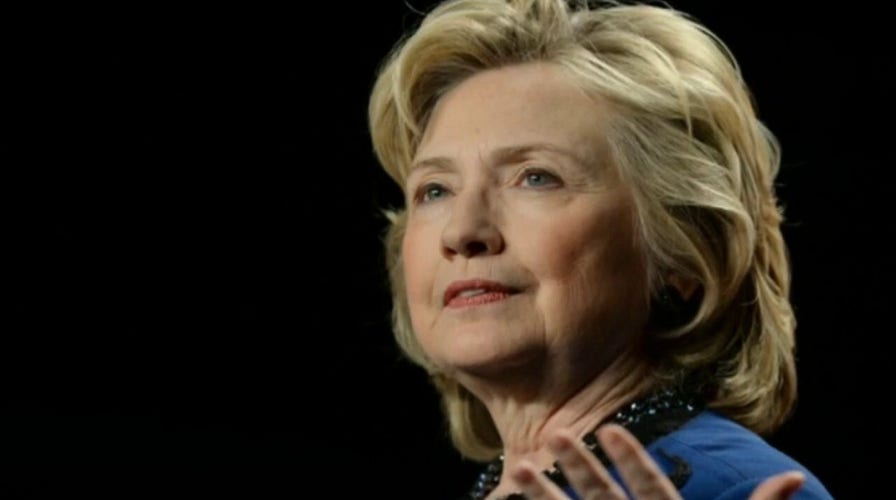
Steve Hayes says the Durham probe is a 'bad development' for the Clintons
'Special Report' All-Star panel discusses the Durham probe, the Milley investigation, and Biden's Afghanistan exit
This is a rush transcript from "Special Report with Bret Baier," September 16, 2021. This copy may not be in its final form and may be updated.
(BEGIN VIDEO CLIP)
BAIER: If you had to characterize the Durham report as you know it now, is it going to be eye-opening for Americans, or is this going to be a blip on the road?
WILLIAM BARR, FORMER U.S. ATTORNEY GENERAL: I'm very troubled by what has been called to my attention so far, but I'm not going to characterize it beyond that.
ANDREW MCCARTHY, FORMER ASSISTANT U.S. ATTORNEY: I think that Durham's hand is being forced here because the statute of limitations is five years, so it's going to run on Sunday if they don't indict a false statements case. But I don't think he is looking at the false statement as the be all and end all of everything. My sense is they are probably looking at how much culpability did the Clinton campaign have.
(END VIDEO CLIP)
BAIER: It feels like a "Whatever Happened To" segment here in SPECIAL REPORT, but this is John Durham. Remember, he is the special counsel looking into the investigation and what was happening through the FBI, the Justice Department, in the early stages of the investigation into former President Trump and the alleged ties to Russia and all of that. Now there has been an indictment. His name is Michael Sussmann, and here's how the Office of Special Counsel reads it. "The indictment alleges that Sussmann, his law firm, and the technology executive coordinated with representatives and agents of the Clinton campaign in these efforts. It's further alleged that Sussmann's false statement misled FBI personnel and deprived the FBI of information that might have permitted it more fully to assess and uncover the origins and relevant data and analysis, including the identities and motivations of Sussmann's clients."
Bottom line here, just to translate all of that, John Durham essentially is indicting this guy, Michael Sussmann, who it appears was working for the Clinton campaign, said he wasn't, didn't disclose that to the FBI, and then gave them bad information about Trump and Russia.
So where is this? Let's bring in our panel, Kimberley Strassel, a member of the editorial board at "The Wall Street Journal," Steve Hayes, editor of "The Dispatch," and Harold Ford Jr., former Tennessee Congressman, CEO of Empowerment and Inclusion Capital. I would venture a guess, Kimberley, you are not going to see this topic discussed on others and other places, but your thoughts on this development and what it means big picture?
KIMBERLEY STRASSEL, "WALL STREET JOURNAL": Yes, you already see others dismissing this and suggesting that this somehow shows that Durham is coming up short without much, much as they predicted. But the reality is this is kind of an important deal because, let's not forget that the DNC and Hillary Clinton used this law firm to essentially hide the payments that they were making to Fusion GPS in this opposition research. And so what you essentially have is an indictment of an operative here of the Clinton campaign being indicted for going to the FBI, lying to them in an effort to manipulate the FBI into investigating a rival campaign. I think if this was flipped on its head and this was Republicans who did this, it would be front pages everywhere. But it should be treated as an important moment.
BAIER: Steve, where do we think this is going? For a lot of these investigations there is, for people who follow it, frustration that it never ends up in anything. Is this something?
STEVE HAYES, EDITOR, "THE DISPATCH": We need to know more. Certainly, this is something. It's never a good idea to lie to the FBI. It's certainly not a good idea to lie to the FBI in an effort to conceal the fact that you are working with a political campaign that may have been feeding bad information to the U.S. government. We'll see where this goes. Obviously, his attorneys have put out a statement saying that this is wrong, that he hasn't committed a crime. I'm very interested to learn, to see if we see from John Durham something that attempts to put this puzzle piece in a broader picture so that we can properly understand it. But the story itself is certainly not a good development for the Justice Department, for Michael Sussmann, for the Clinton campaign.
BAIER: Harold, we are told that Durham, as the way he operates, is very deliberate. Sometimes we it takes time. Sometimes it takes years. That's obviously not satisfying for the Trump folks who wanted it to happen before the election. But, politically, the upside for the Biden folks, perhaps, is the Merrick Garland attorney general is letting this go forward. It doesn't seem like they are stepping in the way of any of this.
HAROLD FORD JR., FORMER TENNESSEE REPRESENTATIVE: It appears that way. Thanks for having me on. I don't disagree with anything that's been said, and don't know much that I can add other than just echo that this is a serious charge. I have heard those on our network a little earlier, perhaps even a few days ago, say that they didn't think that Mr. Durham would bring just this charge, that he was probably angling for something else. But this is the charge that he has brought. We'll see the defense from Mr. Sussmann, and we'll let it go from there. But I would imagine, to your point, Bret, that attorney general is allowing this to proceed without any interference.
BAIER: I want to turn to Afghanistan and these questions about who made the final decision. Was President Biden kind of out on a limb on this decision about the exit and how it happened? Take a listen to the White House briefing today.
(BEGIN VIDEO CLIP)
UNIDENTIFIED FEMALE: Did the president hear specifically the recommendation from the commander on the ground in Afghanistan that he feared that a full withdrawal would be devastating and should not happen?
JEN PSAKI, WHITE HOUSE PRESS SECRETARY: He was provided a range of advice. It is crystal clear that 2,500 troops would not have been sustainable on the ground. It would have been either increased troops on the ground or withdrawal troops on the ground. He was not going to send thousands and thousands more troops to fight a war the Afghans did not want to fight themselves.
(END VIDEO CLIP)
BAIER: But, Kimberley, that's the strawman. That wasn't the offer. And from everything we are getting about General Miller, the commander on the ground, and what he recommended and perhaps what other military advisers were recommending, it was something short of that.
STRASSEL: Yes, the disconnect here all along is that President Biden has been blaming the military for decisions that were made, or saying, hey, this was the best advice, and I was just doing what they told me do. It's on them if it went wrong.
But the reality is, and this puts it in better context, is that the president is always in charge of setting the mission. And essentially what the military is saying is that within the parameters he had given us, we didn't have any choice. We had to make -- that there weren't any options. Now, we told him you can do it this way instead, and he said no, that won't fit with the mission. And so that's where we got where we got. It's on Biden. He made the call.
BAIER: And obviously that hearing we will get to September 28th with Chairman of the Joint Chiefs Mark Milley. Steve, this will be a major question, but as will, obviously, the Woodward-Costa book and all the allegations there.
HAYES: Yes, I think we can bet on a number of questions about the Woodward- Costa book and the firestorm over the past 36 hours.
On this question, look, the U.S. military leadership on the ground in Afghanistan made plenty of mistakes, and I think gave plenty of bad advice. Over the years they downplayed the existence of Al-Qaeda in country. They whitewashed some of the Taliban. They did that in public setting. They did that certainly in private settings.
But I think Kimberley is right. This is ultimately Joe Biden's call. And there were certainly intelligence assessments that said to the president if you withdraw U.S. troops, if you reduce the American presence on the ground in Afghanistan, it will have negative effects on what's happening there and will hurt our ability, certainly, to collect more intelligence. So that's on Joe Biden.
BAIER: Yes. Up next, the politics of social media.
(COMMERCIAL BREAK)
BAIER: Increasing pressure on social media giants tonight over allegations their platforms have too much power and influence. President Biden is expressing his opinion, shared by many of all political persuasions left and right, that the situation is actually growing worse. This comes on the heels of a report that Facebook is putting good business ahead of good practice. Edward Lawrence of FOX Business joins us tonight from the White House with this story. Good evening, Edward.
EDWARD LAWRENCE, FOX BUSINESS NETWORK: Good evening, Bret. As Facebook tried to make its service a healthier place, "The Wall Street Journal" found documents, internal documents that show it actually made it more angry. The report shows that the new algorithm that Facebook had would push more and more divisive content because it was driving engagement. When employees worked to change that, "The Wall Street Journal" reports that Mark Zuckerberg resisted some of the changes because it would reduce that user engagement. So tech experts say that they don't hold Facebook accountable for society's divisions, but for being cynical about them.
(BEGIN VIDEO CLIP)
VIVEK RAMASWAMY, BIOTECH ENTREPRENEUR AND AUTHOR: What I do hold them to account for is lying about it, consciously knowing about their effects, creating this do-good smokescreen as they are taking steps to actually make the world and America a better place, while, in fact, knowingly doing the opposite and creating this smokescreen that ultimately prevent the public from seeing it. That, I think, is the real case of arguable fraud on the public here.
(END VIDEO CLIP)
LAWRENCE: Now a Facebook spokesperson tells me that the new algorithm ranks post that inspire interactions. That spokesperson adds this, that "Research shows certain partisan division in our society have been growing for many decades, long before platforms like Facebook even existed. It also shows that meaningful engagement with friends and family on our platform is better for people's well-being than the alternative."
Further, "The Wall Street Journal" reports that Facebook knew Instagram gives one in three teenage girls a worse self-image of their bodies yet did nothing about it. About this, White House Press Secretary Jen Psaki says that the president believes that social media companies in general hold too much power. So on Capitol Hill a bipartisan group of senators will probe into this. And, Bret, I can tell you that since January of 2019, Mark Zuckerberg has testified five times in front of Congress, and nothing has changed. Back to you.
BAIER: Edward Lawrence at the White House. Edward, thanks.
We're back with our panel. Harold, listen, I'm concerned about how much time I spend on social media let alone my kids who are young. This seems to cross party lines about concerns about this on a number of different fronts.
FORD: And I have a seven-year-old daughter, so the last part of Edward's story was that much more disconcerting. I think what this probably increases, obviously, is the likelihood of some regulation and oversight from Congress. And I hope one of the questions that they might ask anew of all of these social media CEOs and even maybe even bringing some of their deputies to testify as well, is to how many of you -- how many of these other companies have had memos written or things suggested to them that somehow they are fostering and encouraging engagement is having a negative effect on society. If they can't police themselves, they should understand that attorneys general and/or Congress will have to step in and do it, especially if you know it and you choose not to police it.
BAIER: Yes. Kimberley, this is a -- I'll play devil's advocate here -- a double edged sword because when you go down the road of regulation and you go down the road of what Congress can possibly do, are you killing the goose that is laying the golden egg for America's economy?
STRASSEL: Yes, correct., I'm in the camp of those that doesn't -- I mean, thinks that people and users have to make their own decisions about social media. That's not necessarily government's call. But at the same time, more established, long established companies have long understood that one of the reasons you really care about best practices is so that you do not give government and opportunity or a reason to come regulate you. And you have got to wonder who is advising and running these teams at these social media platforms which just continue to land in it again and again, and, like wave a red flag in front of Congress saying please, some step into our businesses. And they really need to think about that.
BAIER: That's true. And when you are ahead of an election, Steve, it's really appetizing for some of these politicians to get into this black hat mentality because it's an easy target, some of these companies.
HAYES: Sure. Yes, look, it is sort of a vicious cycle, right? You have the exacerbation of our polarization problems by the media companies, by the social media companies. And then the politicians use that to further divide us. It's sort of a never-ending cycle.
I think what was most striking about "The Wall Street Journal" reporting about Facebook is it has long been clear to anybody who has spent any time on social media that it has these effects, that it encourages this virality and this false information and this polarization. And what you had particularly in the case of Instagram was senior Facebook officials testifying and saying, yes, we are not really aware of these bad effects, or the external studies say that it could be good for young women to spend time on Instagram. And, in fact, what their internal research was saying was just the opposite. I think that's troubling. And that's what I think will be the focus of questions going forward as these media executives, social media executives come before Congress once again.
BAIER: Yes. And, Harold, going back to your point, some of these social media executives, their kids, they don't have smart phones. They have got flip phones.
FORD: Without question, I don't disagree with anything that's been said. But all of them need now to come forward and be proactive and share what do they now about how their content, how their engagement, how deleterious and how damaging it can be, and what are they doing to protect and guard against that? And if they can't do it, then they should expect what we have all said. Someone else will, and it likely will be government.
BAIER: Panel, stand by, if you would. When we come back, tomorrow's headlines with the panel.
(COMMERCIAL BREAK)
BAIER: Finally tonight, a look at tomorrow's headlines with the panel. Harold, first to you.
FORD: Bret, charges are coming, federal charges. I'm still amazed at what seemingly is collusion between the FBI and USA Gymnastics to protect and enable a child molester who was molesting U.S. gymnasts.
BAIER: Steve?
HAYES: Jihadist trickle to Afghanistan becomes a flood. We have heard in recent days that jihadists are heading back to Afghanistan. We are going to hear a lot more about a lot more of them heading to Afghanistan.
BAIER: And Kimberley?
STRASSEL: Biden continues to ignore science. Even after the FDA has now said boosters are not necessary for most of the population, White House wants to look like it's doing something, so count on it to plow ahead.
BAIER: All right, panel, thanks very much.
Content and Programming Copyright 2021 Fox News Network, LLC. ALL RIGHTS RESERVED. Copyright 2021 VIQ Media Transcription, Inc. All materials herein are protected by United States copyright law and may not be reproduced, distributed, transmitted, displayed, published or broadcast without the prior written permission of VIQ Media Transcription, Inc. You may not alter or remove any trademark, copyright or other notice from copies of the content.
