


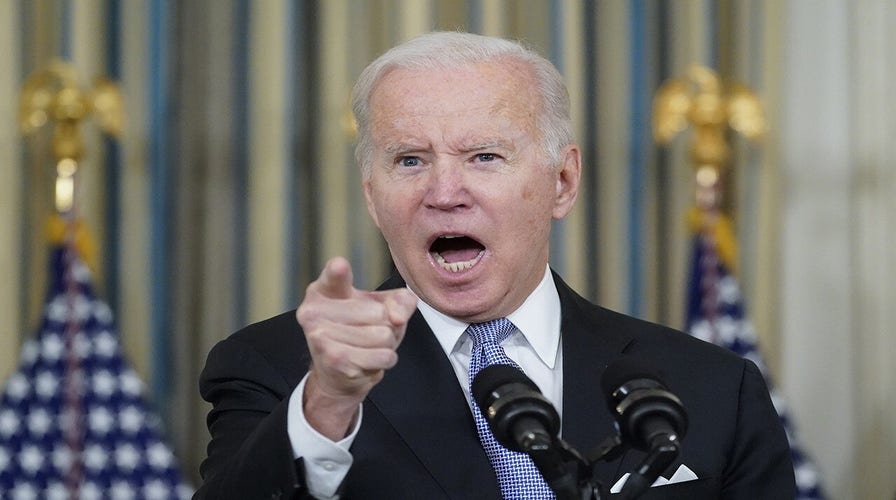
Joe Biden is extremely unpopular: Guy Benson
'Special Report' All-Star panel discusses the president's sinking approval ratings.
This is a rush transcript of "Special Report" on November 8, 2021. This copy may not be in its final form and may be updated.
(BEGIN VIDEO CLIP)
JEN PSAKI, WHITE HOUSE PRESS SECRETARY: We are still going through a hard time in this country, and people are tired of fighting a pandemic.
REP. JAMES CLYBURN, (D-SC) HOUSE MAJORITY WHIP: I don't know that anything has gone wrong. The country is in a bad place. It's a real tough time to become president of the United States.
REP. KAT CAMMACK, (R-FL): The Biden administration is just in total chaos and disarray, and every time you turn around you are slapped with a new crisis.
KARINE JEAN-PIERRE, WHITE HOUSE DEPUTY PRESS SECRETARY: We are confident that our policies will improve the lives of nearly every American. The components of the bipartisan infrastructure deal and the Build Back Better framework are very popular, and that's important to note.
(END VIDEO CLIP)
BAIER: Well, the infrastructure bill is across the finish line, has not been signed into law as of yet. And now the second piece of that puzzle for the administration is still kind of stalled and will be worked on on Capitol Hill for a couple of weeks, at least. This as new poll numbers come in from the "USA Today" Suffolk University poll. The president's approval rating 38 percent in this poll. How about this? The vice president, Kamala Harris, do you approver disapprove -- 28 percent approval. Do you hope Joe Biden runs for another term as president in 2024, yes or no? And 29 percent yes, 64 percent no. Those are bad poll numbers. And most of it was taken before the infrastructure bill, obviously, passed. Will that effect it? We don't know.
Let's bring in our panel, a little smaller tonight so far, Guy Benson, political editor at Townhall.com, host of "The Guy Benson Show" on FOX News Radio, and Jeff Mason, White House correspondent for Reuters at the White House. Guy, let me start with you. By the way, you are in studio here, which is a new element.
GUY BENSON, POLITICAL EDITOR, TOWNHALL.COM: It's very exciting. I forgot what this felt like.
BAIER: Yes. So welcome back. Baby steps. We are going to get one panelist at a time.
BENSON: I'm delighted to be here. What a treat.
BAIER: When you look at those poll numbers and see where the president is, what do you take from the 30,000 feet?
BENSON: The president is extremely unpopular. To be in the 30's with 21 points under water at this stage in your presidency, that's not a great place to be. And that final number that you flashed up on the screen about sort of enthusiasm about another Biden term or another Biden run is obviously not great news for him.
But let's just say, because a lot of those people saying no were not into round two of Joe Biden, a lot of them are actually Democrats who are not terribly excited about the prospect of nominating him for a second time. So then you start to wonder, OK, who would be waiting in the wings potentially, who is the heir apparent? The first name that would come to mind the vice president. You saw her numbers, which are 23 points under water.
So I don't know how you can spin this poll in particular, which is similar in trajectory to some of the other numbers that we are seeing if you are the Democrats. And I would add one more nugget from that poll, the congressional ballot heading into next year, we're now one year out from the midterm elections. Republicans plus eight on a metric that they almost never lead on in any poll. So this is maybe a two or three alarm fire poll for the Democratic Party still smarting and hurting from last week.
BAIER: Jeff, you're at the White House there. They are dealing with all of the fallout here, all of these poll numbers. But success in getting the infrastructure bill through. How do you think they see it as they head into this next kind of morass? I don't know who is screaming there. Hopefully it's not somebody with the administration. I bet they are outside the front gate though.
JEFF MASON, WHITE HOUSE CORRESPONDENT, "REUTERS": You are right about that. It's somebody on the other side of the gate.
But to your broader question, Bret, first of all, they see polls as temporary, and you played that clip from Karine earlier, which was actually a response to my question about these. She is playing down the polls. And that's what White Houses do. And the truth is you are just nine months in to this administration. The time when they are going to be talking about a second Joe Biden run is two or three years away. The midterm elections, though, are just one year away. And so the polls do matter.
And I would share with you that I spoke with a Democratic lawmaker last week who said they are all in Congress, the Democrats are watching the president's approval ratings because it has an impact on whether or not they will likely be able to hold control of the House and control of the Senate. If he is able to bring those approval ratings up, it's going to help the Dems, the Democrats. If he is not, it's going to hurt them writ large.
But, in general, to get to your question how they are feeling, they are focused on his policies. And they are confident that this infrastructure bill, the Build Back Better bill if they get it passed, despite their being some confusion among the public about the benefits, that eventually it will go to their favor once it's law.
BAIER: We can bring in our third member, Jason Riley, "Wall Street Journal" columnist, senior fellow at the Manhattan Institute. Jason, it's interesting to see the reaction from the administration, from Democrats, to the Virginia win to the narrow Republican loss in New Jersey, to the other things that we saw from the election last week and what's yet to come on this battle with the Build Back Better bill. What are your thoughts?
JASON RILEY, COLUMNIST, "WALL STREET JOURNAL": It's not just interesting, Bret. It's fascinating the way they are trying to spin this. If the American people didn't like how fast the Democratic agenda was progressing, why did they reward the party that was opposing it? That's what we saw happen last week. And the administration, the White House, Democrats in general, are trying to spin this otherwise.
And it's not just Biden's approval rating falling generally across the board. It's falling with those specific groups that helped him win office in the first place -- independents, suburban voters, suburban women, and so forth. So I think this is a reality check that the Democrats have to realize is going on here. And I'm kind of fascinated that they have failed to come to grips with reality.
BAIER: Yes. This is a "New York Times" editorial, "New York Times" editorial. It says "Bill Clinton saved his presidency and here is how Joe Biden can, too. Senator Joe Manchin and Senator Kyrsten Sinema are not outliers in the Democratic Party. They are, in fact, the very heart of the Democratic Party, given that 53 percent of Democrats classify themselves as moderates or conservative. You can't dismiss a clear electoral trend. The flight from the Democrats was disproportionately in the suburbs, and the idea that these home-owning, child-rearing, taxpaying voters just want more progressive candidates is not a sustainable one."
Guy, that's pretty clear, but if you look at AOC's tweets or other members of the squad, they say the reason Terry McAuliffe lost was because he wasn't progressive enough.
BENSON: And that's the consensus among progressive Twitter broadly, which seems to be driving so much of the conversation at the elite level in our politics, including at the White House. We are seeing a dominance of progressive Twitter right now, which is not serving the administration political ends very well, I think it's safe to say.
And by the way, the quote that you played from the White House deputy press secretary saying that we're confident that our policies will help the overwhelming majority of Americans, I'm paraphrasing, this poll that we were just citing from "USA Today" asked that question. One out of four voters agreed that they would be helped by the policy. That's in line with a recent ABC News poll. That is not a good number for them. The people are not clamoring for this Build Back Better bill, no matter how often they say they are.
BAIER: Yes. And inflation factors into all of this.
All right, panel, stand by. Up next, the growing concern over China's military buildup.
(COMMERCIAL BREAK)
(BEGIN VIDEO CLIP)
JOHN KIRBY, PENTAGON PRESS SECRETARY: I haven't these images. We are focused on developing the capabilities, the operational concepts, making sure we have the resources and the right strategy in place. We have been nothing but transparent and clear about our growing concerns over the kinds of capabilities that the Chinese military is continues to develop.
We need to take this threat seriously, and platitudes from the Pentagon about this simply aren't going to get it done and aren't going to convince Xi Jinping, the leader in China, to behave differently.
GEN. JACK KEANE (RET), FOX NEWS SENIOR STRATEGIC ANALYST: It indicates the seriousness of the military and what they see as a centerpiece of the United States maritime strategy, which is an aircraft carrier and the surface ships around it. And certainly they recognize full well that they have got to defeat that in any conflict they would have in the Pacific, whether it's over Taiwan or the South China Sea.
(END VIDEO CLIP)
BAIER: So what are we talking about here? This is China with mockups, according to satellite images, of U.S. aircraft carriers and other naval vessels that the U.S. could operate. We can show those satellite images on the screen. Mockups of the aircraft carriers for exercises.
And add this to the current mix of what we're looking at. You have the hypersonic missile test that caught the intelligence and the Pentagon off guard. You have aggressive flyovers of Taiwan increasing, not decreasing. And some very belligerent language coming from the Chinese.
We are back with the panel. Jeff, where do you think this is on the White House alert, you know, as far as what they talk about, what they care about on the national security front?
MASON: I think it's high. And I think, Bret, that it just underscores the extent to which China and the relationship with China is sort of the underpinning all of President Biden's foreign policy. When I was -- when he was at the G-20 and I was traveling with him last week, he was asked about China. And, of course, he has this virtual meeting coming up with the President Xi, and he said something along the lines of he does not want conflict with China, and he also doesn't want there to be an accidental conflict with China. And it really is at the core of virtually all of the decisions that they are making on all sorts of things, on everything from climate change to economic policy to defense.
BAIER: Jason, when it comes to, for example, the investigation into the coronavirus, this administration does not seem to be that aggressive on that front, not like the last administration. But, they have, this administration, has left a lot of the tariffs in place from the last administration.
RILEY: They have. And that's an indication that they see China as somewhat of a threat, a sort of grudging acknowledgment that Trump and the Trump administration was on the right track there. But I think they need to step up their game.
China, we also have to remember that a lot of times with these autocracies, a lot of what we see is a reflection of what is going on internally in these countries. And right now China is worried about Taiwan independence. They are worried about energy issues in terms of working with Australia, for example, to make sure their energy needs are met in China. So this is a reflection of all of that.
But at the end of the day, what we don't want is for China to perceive any sort of weakness in the U.S. And that's what concerns me. And whether that weakness is displayed in how eager we are over climate issues, how eager we are in terms of getting out of Afghanistan, how eager we are in terms of a nuclear deal with Iran, that is what we are projecting right now under the Biden administration. And China is paying attention to that.
And so that's where I think the Biden administration really, really needs to be careful in its dealings with China right now. They have their own internal issues, but how they respond to those internal issues will be in part a reflection of how the Biden administration is responding to how we're projecting our might militarily and otherwise, economically and otherwise, American might worldwide.
BAIER: Now you have the Olympics coming up which will be a P.R. coup eventually for the Chinese president, depending on how we play that. where do you see it, Guy?
BENSON: It's actually astounding to me that the Olympics just seem to be just moving forward next year in communist China given the last two years. You just ticked off a whole list of the increasingly, I'd say brazen military provocations. There was also this report about antisatellite weapons being tested by the Chinese that could affect our satellites. Then you throw on top of that the COVID origins and the cover-up and lies about that, the destruction, slowly and systematically of Hong Kong's democracy in violation of international law, the genocide against the Uyghurs, you put all of this together, and the global community is going to just say OK, let's give this big P.R. win to Chairman Xi and the CCP in 2022? What message would that send the Chinese aside one of very weakness and a lack of resolve in the international community really do to do anything serious. I think that would embolden the Chinese, and I fear that's exactly what's going to happen.
BAIER: Jeff, I only have a few seconds, but do you think the line-up for that virtual meeting is already set? And do you think that this administration is really considering the Olympics moving forward?
MASON: I think they are not entirely set yet on that lineup, although I think it's coming up soon. We actually asked about that today in the briefing. It's going to be a critical meeting, and we are going to be watching it closely.
As far as the Olympics is concerned, they have been saying repeatedly that the U.S. is still going to participate, and I suspect they are going to stick with that line.
BAIER: All right, gentlemen, thank you very much. When we come back, tomorrow's headlines with the panel.
(COMMERCIAL BREAK)
BAIER: Finally, a look at tomorrow's headlines with the panel. Guy, first to you.
BENSON: My headline is, teachers union do battle with Eric Adams over school mask mandates. The New York City mayor elect says he'd like to see schools get rid of mask mandates for students. I personally hope that he and science prevail on that one.
BAIER: Jeff, your headline?
MASON: Mine is Obama urges young people to take the reins in climate fight. That comes out of President Obama's speech in Glasgow today, which was a real barn burner with regard to climate change.
BAIER: All right, Jason?
RILEY: The media headline will be the fake Russian collusion story isn't our fault. I think there is a lot more to come from Special Counsel Durham's investigation into the Russian collusion story. And most of the Washington press will continue to deny the central role it played in helping the Clinton campaign spread lies about Donald Trump.
BAIER: That's a story we will follow. Thank you, gentlemen.
Content and Programming Copyright 2021 Fox News Network, LLC. ALL RIGHTS RESERVED. Copyright 2021 VIQ Media Transcription, Inc. All materials herein are protected by United States copyright law and may not be reproduced, distributed, transmitted, displayed, published or broadcast without the prior written permission of VIQ Media Transcription, Inc. You may not alter or remove any trademark, copyright or other notice from copies of the content.
