









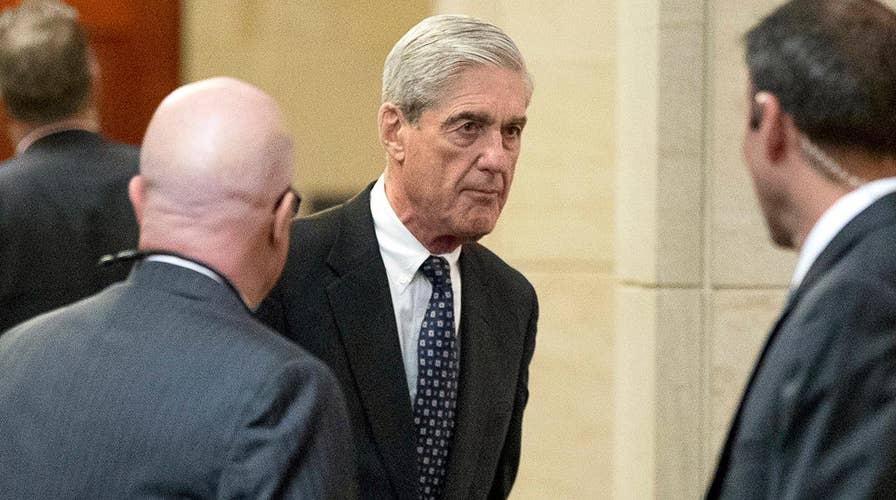
Should Mueller probe documents be released to the public?
Former Eastern District of Virginia federal prosecutor Gene Rossi and former Whitewater Special Counsel Robert Ray weigh in on the imminent release of the Mueller report.
This is a rush transcript from "Your World," March 7, 2019. This copy may not be in its final form and may be updated.
CHARLES PAYNE, ANCHOR: You're looking live at the House floor. Lawmakers were set to vote on an anti-hate resolution this hour, but there has been a new delay.
This was all sparked by controversial comments about Israel from freshman Democrat Ilhan Omar. But this resolution does not name her. Why not? And why another delay?
I'm Charles Payne, in for Neil Cavuto.
Let's go straight to Mike Emanuel on Capitol Hill on why there's yet another delay on this vote -- Mike.
MIKE EMANUEL, SENIOR POLITICAL CORRESPONDENT: Well, Charles, there's no question this has been a struggle for House Democratic leadership all week long.
FOX is told they do expect a vote on this resolution sometime this hour. They're just waiting on the final text on the House floor. Here's some of what it says -- quote -- "That the House of Representatives encourages all public officials to confront the reality of anti-Semitism, Islamophobia, racism and other forms of bigotry, as well as historical struggles against them, to ensure that the United States will live up to the transcendent principles of tolerance, religious freedom and equal protection, as embodied in the Declaration of Independence and the First and 14th amendments to the Constitution."
It does not call out Minnesota Congresswoman Ilhan Omar by name. She's been under fire, accused of making anti-Semitic remarks. Omar has suggested those who support Israel have dual loyalty, after previously saying support for Israel is all about the Benjamins, a reference to $100 bills.
Speaker Nancy Pelosi explained it is different now that Omar is an elected lawmaker.
(BEGIN VIDEO CLIP)
REP. NANCY PELOSI, D-CALIF., SPEAKER OF THE HOUSE: When you cross that threshold into Congress, your words weigh much more than when you're shouting at somebody outside.
And I feel confident that her words were not based on any anti-Semitic attitude.
(END VIDEO CLIP)
EMANUEL: Still, plenty of her colleagues are offended.
(BEGIN VIDEO CLIP)
REP. JOSH GOTTHEIMER, D-N.J.: I know what I feel about what was said. And that's what I can speak to. It's unacceptable. Questioning anyone's loyalty in Congress to the United States of America because of their faith is unacceptable.
And we just -- we just have to make sure that people understand in this country that there's no room for it in our rhetoric.
(END VIDEO CLIP)
EMANUEL: Republicans are watching as Democrats deal with this internal struggle.
(BEGIN VIDEO CLIP)
REP. MIKE JOHNSON, R-LA: I don't know how Nancy Pelosi could know the heart of Representative Omar. I don't think they have known one another long. And God only knows our hearts at the end of the day.
But I will say this. We need to raise the level of public discourse around here.
(END VIDEO CLIP)
EMANUEL: Some sources say this battle all week long suggests the next two years in the House of Representatives is going to be quite complicated -- Charles.
PAYNE: Mike, thank you very much.
And we do have some breaking news on this. In fact, text of the new clause added to this resolution, it goes as this: "Whereas white supremacists in the United States have exploited and continue to exploit bigotry and weaponize hate for political gain, targeting traditional prosecuted people, including African-Americans, Latinos -- Latinos, Native Americans, Asian Americans, Pacific Islanders, and other people of color, Jews, Muslims, Hindu, Sikhs, the LGBTQ community, immigrants and others have verbally -- verbal attacks and incitement and violence."
I mean, again, this is broadening out from what began as an anti-Semitic resolution, to an anti-hate resolution, to condemnation of supremacists, white supremacists in this country.
So we're going to have a lot more on this, of course. We will bring you -- bring this all to you, particularly as his vote happens, perhaps through this hour.
Also, we're going to take you down and take a look here at Alexandria, Virginia, because there, in the U.S. district courthouse for Eastern Virginia, you have former Trump campaign chairman Paul Manafort awaiting his fate at a sentencing hearing.
Now, he's been convicted on eight counts of tax and bank fraud and he could get up to 80 years in prison.
Fox's Doug McKelway is outside that courthouse with the latest -- Doug.
DOUG MCKELWAY, CORRESPONDENT: And, Charles, we're on standby right here, things running a little bit slowly here at the courthouse.
The sentencing hearing was set for 3:30 this afternoon. But we had one of our runners inside the courtroom just come out about five minutes ago to say that Judge T.S. Ellis is not yet present in the courtroom.
Our runner did, however, tell us that Paul Manafort is in the courtroom and, in his words, is not looking well. He was apparently wheeled in a wheelchair into the courtroom, also had a cane with him. And our runner describes him as having to literally pick up each of his individual legs to get out of the wheelchair and into a courtroom seat there.
Let's run through what the charges he has been found guilty of are and what are the possible sentencing here, five counts of filing false income tax returns, one count of failing to file reports of foreign bank accounts, and two counts of bank fraud.
As you said, Charles, Manafort could face potentially, technically, 80 years in jail, but that's not -- that's a bit of a misnomer, I should say. The reality is that sentencing guidelines mean that he will, realistically, face anywhere from 19 to 25 years in jail.
But also keep in mind that federal Judge T.S. Ellis has wide, wide-ranging latitude here. He can shorten that sentence or lengthen it, depending on how he sees it.
Earlier this afternoon, we tried to talk to Manafort's attorneys as they struggled past us, asked how he is doing. One reporter said he received an answer, "We are about to find out."
I also met with some of the attorneys at a restaurant just across the street from the courthouse. All of them refused to comment either on or off the record. And it's fully understandable, because after this sentencing hearing is done next Wednesday, there will be another sentencing hearing in the District of Columbia.
And the judge in that case, Amy Berman Jackson, has been arguably tougher on Paul Manafort. It was she who imposed solitary confinement. Protective was the word they used, solitary confinement on him. He has remained in solitary confinement for nine months now, which certainly would help to explain why he doesn't look so well, according to our runner.
We're on standby here watching for the sentence, which could come down at any moment. We will be with you when it happens.
PAYNE: Doug, thank you very much.
Now let's get reaction from attorney Gene Rossi, former Eastern District of Virginia federal prosecutor. Now, he's argued seven cases in front of Judge Ellis. We also have former Whitewater prosecutor Robert Ray in studio.
Gene, let me start with you. What do you expect...
GENE ROSSI, FORMER FEDERAL PROSECUTOR: Sure.
PAYNE: ... particularly what your experience here?
ROSSI: Well, Charles, as you just said, I had seven trials in front of Judge Ellis, hundreds of sentencings. He treated me like a son. And at times, he can be very compassionate.
Tasseography, reading of the tea leaves, the Victorian area practice, I predict seven to 10 years in prison, for several reasons. One, he's 70 years old as of April. Two, he's in a wheelchair. And it's funny, I had a trial with the defendant in a wheelchair in front of Judge Ellis, and he got seven years.
The other thing is, Judge Ellis, I do not think is enamored with this case. And, lastly, Judge Ellis knows that, next week, Judge Jackson in D.C. is going to sentence him -- sentence him. So, my prediction, my reading the tea leaves, is seven to 10 years. I could be wrong.
PAYNE: Robert, your thoughts?
ROBERT RAY, FORMER INDEPENDENT COUNSEL: Well, in this situation, I might defer to someone who has more experience that I do in the Eastern District of Virginia, although given the fact that the sentencing guidelines are rather high, meaning starting at the bottom of -- with 19 years, upwards of the middle 20s, I would be surprised if the sentence is that low.
Now, yes, there are compassionate reasons where leniency would be considered, given his health.
PAYNE: Right.
RAY: But I have -- my experience with federal sentencing, both as a prosecutor and now as a defense lawyer, is that they are factors, but they are very rarely dispositive. And I wouldn't necessarily think so much that Judge Ellis will defer to what will ultimately happen in the District of Columbia.
He's obviously going to make his own judgment about what an appropriate sentence is here. And bank fraud is serious and is largely driven by the numbers involved in this case, which were large.
PAYNE: And to that point -- I'm glad you brought that up -- five counts of filing false income tax returns, one count failing to file reports on a foreign bank and financial accounts, two counts of bank fraud.
You are saying the bank fraud is the part here that really -- is the one that really will hurt Manafort the most?
RAY: That's the driver under the sentencing guidelines. That's -- and that's not unusual. This is not to say that this case is significantly different than any other bank fraud prosecution in the federal system.
That doesn't mean, by the same token, that Judge Ellis doesn't have discretion to move that sentence around, if he thinks it's appropriate to do so in the interest of justice. And, again, there are other sentencing factors besides just simply the loss number.
But to understand why the sentencing guidelines come out the way they do, Charles, you are absolutely correct. That's the reason why.
PAYNE: Gene, you talk about the compassion that could be on display today from the judge.
ROSSI: Yes. Yes.
PAYNE: By the same token, throughout this trial, we heard of the largess, the ostrich clothing and the wardrobe, and just the spending.
Those kind of things, I think, offended at least the public, on top of the crimes, the lifestyle that was led here. Does that counterbalance the fact that now the defendant shows up in a wheelchair?
ROSSI: Well, first off, I got to -- I got to say that the judge could conclude that Paul Manafort is feigning these injuries. He may not.
But Robert is right. The guidelines are so high on this case, and the bank fraud is such an important charge.
(CROSSTALK)
PAYNE: Hold on. One second, Gene.
Give me a second, because the judge has gaveled in. And I want to go to Doug McKelway right now -- Doug.
MCKELWAY: Yes.
Just to bring you up to date on the latest now, we understand why things are a little bit late in proceeding here. Judge T.S. Ellis did show up in the courtroom and told the parties that he's participating in a naturalization ceremony a couple of floors down. He will be back.
He wanted to make sure that both sides were aware of the charges and what is at stake and what was happening here today. They all agreed to that. And then he made some reference.
Sarah (ph), if you would come up here for a sec, just come over here for a sec.
He made a reference to Russian collusion, the judge said. What was that all about again?
UNIDENTIFIED FEMALE: Yes, he said...
MCKELWAY: Yes.
He said that they are not here for collusion, Russian collusion allegations, which is an interesting thing, that he would make any reference to that in the first place, given the fact that none of these charges, none of these convictions have anything to do with Russian collusion.
It suggests that -- I know -- I know that he flies -- what's the proper way to put this? Sometimes, he's quick on the draw, Judge T.S. Ellis is, and speaks his mind quite freely. Perhaps it was some statement about Russian collusion, or lack thereof, that he was trying to impart to all the parties in the courtroom.
But that's why things have not gotten under way here thus far -- back to you, Charles.
PAYNE: Doug, thank you very much. Thanks a lot, Doug.
And I want to go back to Gene on this, because, listen, obviously, from a media political point of view, this is extremely important. This has nothing to do with Russian collusion. Let's get that out of the way.
Your thoughts?
ROSSI: Well, this is classic Judge Ellis.
Go back to the hearings before the trial started, and also some of the comments Judge Ellis made during the trial. He is not enamored with this case, period, because in his view, he feels that Paul Manafort had to eat charges in EDVA and in D.C. only because he was campaign manager and affiliated with the president of the United States.
That troubles Judge Ellis greatly. That's why my tasseography, my prediction, is seven to 10 months (sic).
But I want to go back to this. One -- one factor that could weigh against Paul Manafort greatly -- and maybe Robert would comment on this, too -- is when, you plead guilty to two charges, two counts, two areas, and you start cooperating with the prosecutor, and then you start lying like a rug, Robert will tell you he's probably had cooperators like that.
That really angers the prosecutors. And it just -- it betrays the entire process. So, that could be weighing against Paul Manafort.
PAYNE: Right.
ROSSI: But that comment about the collusion, that tells me the judge is kind of going towards my seven to 10 years.
PAYNE: Robert, your thoughts?
RAY: Well, Gene is right about that.
I mean, I think Judge Ellis, from public reports, expressed very early on that he had a distaste for this case. That doesn't mean that he still won't rule appropriately as to what the sentence should be.
But he well understands that the huge amount of public interest here and that the pressure that was brought to bear by the special counsel's office was designed intentionally to select this person for prosecution in order to induce his cooperation.
So, from that standpoint, I think he is prepared, the judge seems to be signaling that he's prepared to be somewhat lenient. The complicating factor, though, is the other one that Gene mentioned, which is in equal measure one that prosecutors take seriously, but judges also do as well.
And that is, if somebody commits to travel down the road of cooperation and then does what they shouldn't do, which is to pretend to cooperate, but actually not provide truthful information, that, independent of the bank fraud charges...
(CROSSTALK)
PAYNE: Betraying the system like that, obviously, is...
RAY: Yes.
Playing the system in a situation in which you are a convicted defendant as the result of your own guilty plea, I don't care what kind of case you're facing or in what jurisdiction anywhere across this country. Judges have a problem with that, as they should.
PAYNE: Right. Right.
Folks, we're going to stay on this throughout the hour, of course. The judge has gaveled in. And we expect more breaking news on this throughout the hour.
Gentlemen, we hope you stay with us as well.
Meanwhile, the House is debating that anti-hate resolution after making more changes, and, of course, this on top of a lot of Democratic infighting.
We're on that, the very latest with that, when we come back.
(COMMERCIAL BREAK)
(BEGIN VIDEO CLIP)
SEN. JOSEPH LIEBERMAN, I-CONN., FORMER SENATOR: I think the House could do better.
And if it was up to me, I'd say, OK, put out a foundational resolution condemning all forms of bigotry, and particularly saying that if members of the House of Representatives, elected members of Congress, get involved in that kind of bigotry, they're going to be specifically condemned by their colleagues who won't tolerate it, and then to pass another resolution if they want specifically condemning, criticizing Congresswoman Omar for her anti-Semitic comments.
(END VIDEO CLIP)
PAYNE: Well, now we know that last part is not going to happen.
Despite urging from certain lawmakers, like former Democratic V.P. nominee Joe Lieberman, House Democrats now debating on a resolution opposing hate, but freshman Congresswoman Ilhan Omar is not named in it.
To Fox News' Ed Henry.
Ed, will this be enough to tamp down this new controversy?
ED HENRY, CORRESPONDENT: Well, Charles, the controversy, it seems like, is going to remain, no matter.
It seems like, though, there may be enough votes to get two-thirds of the House to sign on to this, because we're expecting a vote now at the top of the hour. It's been delayed yet again, but about 5:00 p.m. Eastern or so.
You see the House floor there now. They're getting ready. But the reason why there's been an another delay and that vote pushed back is Democratic leaders went back to the drawing board and rewrote this resolution yet again.
They have added a new paragraph.
I will quickly read it and tell you the significance. They add: "Whereas white supremacists in the United States have exploited and continue to exploit bigotry and weaponize hate for political gain, targeting traditional prosecuted peoples, including African-Americans, Latinos, Native Americans, Asian Americans, Pacific Islanders, and other people of color, Jews, Muslims, Hindu, Sikhs, the LGBTQ community, immigrants and others with verbal attacks, incitement and violence."
So, why is that being added? Well, Charles, Democrats want to see this broadened out but beyond Congresswoman Omar. So they want to say this is not just about her comments about Israel and Jews. It's about what is going on in America, about Sikhs and Muslims. And so they want to have a broader conversation.
That's in their interests. Republican Congressman Collins of Georgia a few moments ago said, look, he's looking at the resolution. It appears to him, this is what we learned in kindergarten. Be nice. Everybody wants to be nice. Everybody should denounce hate of all kinds.
But what's interesting is that, in this case, the politics has intervened, because it was supposed to be about that woman, Congressman Omar, this freshman Muslim American, and her comments that were seen anyway as being anti-Semitic.
She has insisted she's not anti-Semitic. But the point is that because of some Democrats rallying around her, Speaker Nancy Pelosi has faced political pressure to not make it about Omar, not name her in a resolution that was designed to be talking about her comments, Charles.
And now it's not just about anti-Semitic comments. It's about anti-Muslim comments. It's about -- I'm looking at this. It goes back to how Japanese folks were treated in internment camps in World War II.
Again, this is stuff that should be denounced. This is stuff that's wrong, but why this is all being added to something that was supposed to be about one congresswoman and her comments that were seen by -- anti-Semitic tells you about the politics swirling around Capitol Hill, Charles.
PAYNE: And, Ed, you mentioned one congresswoman. We should also bring up that I think the AOC, Alexandria Ocasio-Cortez, factor.
She came to the aid of her fellow freshman and has seemed to turn the tide, to the point where now you have some Democrats saying, hey, it was just a misunderstanding. Others are saying that, listen, her own personal experiences outweigh the damage that was done by her comments.
And it just feels like within that party the shifting tide is toward a new leader. And it's not Nancy Pelosi.
HENRY: Right.
Instead of just saying, look, the comments were wrong, whether she understood the magnitude or didn't, they were wrong, let's denounce them, like, by the way, you saw Republicans do in a painful case for them, which was Steve King of Iowa. And, by the way, they stripped him of his committee assignments, because they said he made painful comments, controversial comments, inappropriate comments about white supremacists.
And so Republicans dealt with their business, took him off his committees. And so you see some Republican saying, well, why is Congresswoman Omar allowed to not just keep her committee assignments in general, but she's on the House Foreign Affairs Committee, which obviously deals with Israel and all these issues that are being talked about?
So you're right to mention Congresswoman Alexandria Ocasio-Cortez. She has risen to the defense of Congresswoman Omar. Look, they're both freshmen. They're both women of color. They're working together. You can understand why they have a good relationship. That's all well and good. This is America. They're free to speak out as they wish.
But it's interesting that rather than denouncing the comments, you see Democrats in some cases sort of circling the wagons. And, again, that gets to, as you pointed out, the pressure that is on Speaker Nancy Pelosi, which, by the way, Pelosi campaigned in those midterms a few months ago about, well, if Democrats take power, we're going to be focused, Charles, on jobs, the economy, we're going to be focused on health care.
And instead they're dealing with their internal business like this.
PAYNE: It's serious stuff.
Thank you very much, Ed.
HENRY: See you.
PAYNE: So, what do folks on the Senate side make of this upcoming vote in the House?
Alabama Republican Senator Richard Shelby joins us now.
Senator, thank you so much for joining us on.
SEN. RICHARD SHELBY, R-ALA.: Thank you.
PAYNE: Your thoughts on how this initially was an internal fight amongst Democrats to -- with one particular member, and it was strictly focused on anti-Semitic comments and the outrage that not only Democrats felt, but a lot of other Americans felt as well?
SHELBY: Well, I will tell you what. It's always best to respect people, respect each other, and not say something that would be offensive or pejorative, because it gets you nowhere, it divides people.
It's not a positive thing.
PAYNE: That's -- there's no doubt about that, but here's the thing.
Let's go with Clyburn, comments from Clyburn, who says this about Ilhan Omar: "I'm serious about this. There are people who tell me, well, my parents are Holocaust survivors. My parents did this."
It's more personal to her, he says, because he's spoken with her. And she's actually lived through pain. So, therefore, her pain, having lived through this now, supersedes the pain of survivors of Holocaust victims.
SHELBY: Well, I don't know about that.
I have tried all my life to get along with people, to respect people, to -- not to be offensive to people, because, as I said earlier, it is a dead end. It gets you nowhere. It divides people.
What we need to do is be working together for the betterment of this country.
PAYNE: Senator, we're moments away from the sentencing of Paul Manafort.
The judge has already gaveled in. And he made one specific comment. This is not about Russian collusion. Let's get that out of the way.
That being said, though, your thoughts on today?
SHELBY: Well, I don't know what's going on down there at the courthouse.
I know Mr. Manafort, not well, but I met him years ago. But we have to see how things played out, follow the facts, and see what happens.
PAYNE: Yes, there's no doubt about that.
But this was another high-profile associate of President Trump. And he ran the campaign for a moment. Democrats said that, initially, when this whole thing began, that he would be a key figure with respect to proving collusion with Russia.
That's already off the table. And yet you get a feeling, once this sentence is announced, it will be politicized and perhaps politically weaponized before tomorrow morning.
SHELBY: Well, that's -- that's probably true by the media.
But I think what I have seen thus far is a lot of stuff on the periphery, a lot of things on about their -- failing to file as a foreign agent, failing to do taxes right, and things like that.
But I haven't seen, myself, yet any evidence of a real collusion between President Trump and his campaign and the Russians. If it's out there, they ought to bring it up.
PAYNE: Senator, speaking of issues within political parties, within the Republican Party, there is a divide -- and perhaps it's growing -- with respect to President Trump and the national emergency.
I think we have got four declared no's on this -- on this action. There's scuttlebutt that there could be even 10 or as many as 15 Republicans who are ready to go against President Trump on his -- on his use of the national emergency in part to build the border wall.
What are your thoughts there, and how are you looking to vote on this?
SHELBY: Well, I'm going to vote with the president. In other words, I'm going to vote no on disapproval, because I believe the president has some constitutional rights and some statutory rights to do some things in an emergency.
And if we have got 87,000 people a month or some months coming across the border illegally, maybe a million a year, we have got an emergency. We got some problems. And we -- we -- I wish we could have addressed it all legislatively.
I tried to. I tried to get the money. The Democrats wouldn't do that. So, I'm going to support the president. This could come down to a -- somebody's going to have to choose whether they support Speaker Pelosi or they support the president and national security at the border. That might be the issue, ultimately, the way we frame it.
PAYNE: That's ultimately, but is that the way it's being framed to your colleagues in the Senate, your Republican colleagues?
SHELBY: Well, I hope so, because I think that would resonate a little better than worrying about somebody's issue of their abstract powers, or the power of this and that.
We have got a crisis at the border. And we better realize that. And we ought to do something about it legislatively. But we didn't do enough, so the president has acted here. I think he's got some constitutional grounds.
PAYNE: Now, there's a -- some breaking news on this as well.
Senators want to see a specific list of spending projects the administration will mine for money to pay for this national emergency.
Your thoughts on that?
SHELBY: Well, I asked that question today. This morning, I was at the Pentagon with a number of the people dealing with appropriations of the armed services.
And I asked the acting secretary defense for their particulars. In other words, what are you going to spend, what are you going to take? And looking down the road, if they take it, and it has to do with national security, I believe we will backfill it or replenish it, whatever you call it.
PAYNE: So, again, perhaps this ultimately will go through the legal system. Many think it ultimately will be adjudicated in the Supreme Court.
But this notion that this is a Pandora's box, that once you have opened it, eventually, a Democratic president will be able to use these same powers and abuse it, you're not concerned about that?
SHELBY: I'm not concerned about it, because I think that you have to look at each thing and see and evaluate it and see if it is a crisis.
I believe we do have a crisis here. I believe that president is absolutely right. As I said, I wish we could have addressed all of it and funded what we need to protect the country, protect our border legislatively.
But politics is involved in it now. It's a political -- more of a political question than anything else now.
PAYNE: It also feels like it's more of a philosophical question with some of your colleagues. Perhaps a Rand Paul will not change his mind. He's pretty rigid in his thinking.
But are there others now who are on the fence, since we have seen these numbers swell, that may be persuaded to stick with the president?
SHELBY: Well, we hope that we have got enough that we hope that we will not vote for the disapproval, not the Republican Senate.
But if they do, I believe that the president will veto anything that came forth like that. And I would do everything I could to sustain his veto.
PAYNE: There would be some political damage, though, wouldn't there?
SHELBY: Always is.
PAYNE: Senator, thank you very much. Appreciate it.
SHELBY: Thank you.
PAYNE: Thank you very much.
Well, we're going to go back to Alexandria, Virginia, with the latest on the Paul Manafort sentencing.
The judge reminding everyone that this has nothing to do with Russia collusion. But for Paul Manafort, he awaits his fate.
(COMMERCIAL BREAK)
PAYNE: We're waiting to hear the sentencing for Paul Manafort, who arrived at the Alexandria courthouse wheelchair-bound. He could face as many as 80 years, the government seeking 19-and-a-half years.
We will be right back.
(COMMERCIAL BREAK)
PAYNE: Fox's Doug McKelway is outside the courthouse in Alexandria, Virginia, with the latest -- Doug.
MCKELWAY: Yes, the judge gaveled in at 4:00 this afternoon. He apologized to the parties in the courtroom, saying that he was running a bit late because of a naturalization ceremony which was happening elsewhere in the courtroom.
But he did gavel in at 4:00. So it's, what, 35 minutes now. These kinds of sentencing hearings take normally an hour, perhaps a bit less. So we could find out what the sentence is it at any time now.
When the judge did gavel in at 4:00, Paul Manafort, who was in the courtroom, tried to stand, was having difficulty doing so. He leaned against the table. Judge Ellis told him he didn't need to do that, apparently aware of his physical incapacities at that point.
Ellis then read all of the accounts that Manafort is facing. And then after that, something very, very interesting happened. Judge Ellis said to Manafort that he is not here before the court today because of allegations of Russian collusion in 2016, despite all of the discussion that's been ongoing about that.
We know that Judge Ellis is often in the habit of shooting from the hip a little bit. He speaks off the cuff, and been known to apologize later for speaking off the cuff. That happened early on in this trial, last spring, in the spring of 2018, when he vociferously admonished the U.S. government for making continued reference to Paul Manafort's wealth, to his lavish spending, to the number of homes he owned, to the lawn services that he employed, to the florist that he used.
He told the government that Paul Manafort is not on trial because of his wealth, he's on trial because of alleged crimes that he committed.
But, in any event, the proceedings are now under way. We expect to know what the sentence for Paul Manafort is at any time -- Charles, back to you.
PAYNE: Back with us, former Whitewater prosecutor Robert Ray and attorney Gene Rossi.
Robert, let me ask you about that, the judge here. He's been on the bench 30 years, appointed by Ronald Reagan. And it's -- he's known to be colorful, but fair also. What do you think is running through his mind?
RAY: Yes, I think what's running through his mind is that those comments are directed for public consumption, so that there's no misimpression, as you suggested earlier, about what the storyline is going to be for tomorrow.
And this is not the first time that he's done that. But I would suggest, also -- perhaps Gene would agree -- that that's cold comfort, I think, for Paul Manafort. I mean, there's no question that what remains here, separate and apart from the absence of any trial or proceedings about Russia collusion here, is the fact that he's facing a serious sentence of a number of years, where the government's asking for a 19-and-a-half-year sentence.
And it involves bank fraud, very high numbers involving what was alleged to have gone on here, and also false tax returns. So, this case independently would have merit, I guess, is sort of my take on this. And it's going to warrant a substantial sentence.
I guess what we should be looking for here, is it going to be a sentence, I guess sort of the first threshold, over 10 years or under 10 years?
PAYNE: Right. Right.
RAY: But no matter how you cut it, it's going to be a substantial sentence.
PAYNE: And, Gene, of course, a substantial sentence could also mean a life sentence, considering Paul Manafort's age and perhaps his physical condition.
ROSSI: Right. Right.
PAYNE: Now, I do also want to ask you -- Paul Manafort's wife has just entered the courthouse as well -- just how much all of this will influence -- potentially influence the judge with the sentencing.
ROSSI: Well, first off, I agree with Robert about the Russian collusion comment. It's more for public consumption.
But in all the times I was in front of Judge Ellis in sentencings and seven trials, I got to tell you, I got a lot of war wounds from Judge Ellis. He can be tough. And he can really go after the prosecutors.
But I got to say this. Judge Ellis has a heart of gold. He doesn't like people to know it. And he will show compassion. I'm not saying that the 19 years will become three years of probation. But I think Paul Manafort's age, his apparent health, that his family has been through a lot, and that this -- and that this case is not about Russian collusion, it's about greed and bank fraud.
I think he's going to show compassion. And, at the end of the day, when you're 70 years old, and you have been sentenced to seven years or 10 years, that's almost a life sentence. And I think it -- I think we're going to see about a seven- to 10-year sentence.
PAYNE: So -- and, Robert, of course...
RAY: It's a good point. Look, it's a fair point. I mean, that's what justice is. That's why we have judges making sentences and not prosecutors, with the benefit of 30 years of experience and some perspective.
I don't know Judge Ellis personally. Gene obviously does. I mean, I expect all judges -- and it appears that particularly this judge -- intends to deliver what he believes to be a fair sentence. And that's the right thing.
Look, I will also say, just with the benefit of having had independent counsel experience -- I have said on many other occasions I would never wish my worst enemy to be on the other side of a special counsel or independent counsel investigation. It's a very tough place to be and it's very hard, particularly on the defendant's family.
(CROSSTALK)
PAYNE: Because it's unlimited in the scope that they have.
And, I mean, they could start -- they start out as one thing. And as history tells us, they can become anything after that.
RAY: Well, that's right
And then all of your conduct, particularly if you're the focus of attention by a special counsel investigation, is on not just what you may have done that is relevant to the mandate under review, but obviously any federal crimes that come to the attention of the special counsel in the course of that investigation.
So that when the spotlight shines brightly, that's a very, very difficult place to be. And Judge Ellis is going to have to weigh all those factors now in deciding what an appropriate sentence should be.
PAYNE: I think anyone would wither under the notion that their entire life could possibly be on trial.
Gentlemen, hold there, please.
One of Michael Cohen's attorney saying that his client did indeed ask about a presidential pardon, but that doesn't contradict his sworn testimony that he never did. What?
(COMMERCIAL BREAK)
PAYNE: Michael Cohen's attorney, Lanny Davis, today confirming that Cohen did inquire about a presidential pardon, even though he testified that he did not, and that his client's testimony is still accurate.
Our Catherine Herridge is here to try to explain it all -- Catherine.
CATHERINE HERRIDGE, CHIEF INTELLIGENCE CORRESPONDENT: All right. Thank you, Charles. Good afternoon.
Earlier today, President Trump brushed off questions about his former personal attorney, Michael Cohen, who faces new allegations he may have perjured himself again before Congress.
(BEGIN VIDEO CLIP)
MICHAEL COHEN, FORMER ATTORNEY/FIXER FOR DONALD TRUMP: My testimony certainly does not diminish the pain I caused my family and friends -- nothing can do that. And I have never asked for, nor would I accept, a pardon from President Trump.
(END VIDEO CLIP)
HERRIDGE: Cohen's lawyer, Lanny Davis, who sat through the seven hours of testimony last week, issued a clarifying statements a day that, in fact, before July 2018 -- quote -- "Cohen directed his attorney to explore possibilities of a pardon at one point with Trump lawyer Rudy Giuliani, as well as other lawyers advising President Trump."
On Twitter, Giuliani called out the apparent inconsistencies, writing: "Never means never, ever, not after July 2018, which is the latest deception. Another perjury," he wrote, "and more prison time."
Contact between Cohen and staff for Adam Schiff, the Democratic chairman of the House Intelligence Committee, is also under scrutiny. Two sources tell FOX News there at least four meetings in New York totaling more than 10 hours before the seven-hour public hearing last week.
And in this letter, House Republican Mike Turner said it's important for the public to understand whether this was genuine unvarnished witness testimony or well-rehearsed theater -- Charles.
PAYNE: Catherine, thank you very much.
HERRIDGE: You're welcome.
So, is Michael Cohen in more legal trouble or not?
Former assistant U.S. attorney Andrew McCarthy is with us.
I mean, it sounds like it, that he perjured himself again, Andrew.
ANDREW MCCARTHY, CONTRIBUTOR: Yes, I wouldn't have guessed that he would have even more credibility problems, Charles, after his testimony than before.
We knew that going in, he had a -- not only a well-deserved reputation for not being trustworthy. He had actually pled guilty to several felonies involving fraud and lying. But it seems like he only finished testifying five minutes ago, and now this is just the latest.
I think this is two or three times involving things that he said in his testimony that it turns out that just a little bit of checking, you find out he wasn't being straight.
PAYNE: So, Lanny Davis weighing in. It felt like word mumbo-jumbo kind of stuff, if I can baffle what is in these words.
MCCARTHY: Right.
PAYNE: I don't think it works.
And, of course, there was also the CNN footage, to your point, where he said he wanted a job. And, then, of course, he said he didn't. I mean, there are a few of these instances just in the last week when he said, I'm no longer a liar, even though I have lied in the past, it just -- it's sort of the antithesis of what he went in there saying in the first place.
MCCARTHY: Yes.
I think he's not an honest guy. But he's also not the brightest guy. And that's -- that's a not a great combination. But I do think we're seeing why the Southern District of New York prosecutors, for example, never signed him up to a formal cooperation agreement.
They made very clear in the sentencing memorandum that, very shortly before his sentencing in U.S. district court in Manhattan, he was still lying and minimizing about the bank fraud and tax fraud charges he had pled guilty to. So this really isn't much of a surprise.
PAYNE: Andrew, we heard from Chad Pergram that the House now considering a nonbinding resolution to make the Mueller report public once it's released. Your thoughts on that?
MCCARTHY: Yes, it's nonbinding. You know, I mean, there's regulations that say that the report is supposed to be a confidential report from the special counsel to the attorney general.
It's a counterintelligence investigation, which means there's going to be classified information issues. There is strong and important Justice Department policy about not going public with the evidence that's collected against people who end up not being charged with crimes.
There is executive privilege issues that have to be weighed. So there's a lot to be -- a lot that's legally intricate that has to be sorted out. And they can't waive that away by just saying here's a nonbinding resolution, we want to see it all.
PAYNE: Andrew, thank you very much. Appreciate it.
MCCARTHY: Thank you.
PAYNE: Back with us, former Whitewater prosecutor Robert Ray and attorney Gene Rossi.
Gentlemen, I want to ask you about this, the Mueller report, its imminent - - its imminent release, and whether or not it should be released to the public, taking into account, of course, things that Andrew just mentioned. There will certainly be redactions.
But it's going to be an explosive political document.
And, Gene, what are your thoughts on whether or not the public should see it?
ROSSI: Well, I go back to the Watergate days. I think the public should see as much as possible in the report -- and I hope Robert comments on this too -- as long as the information is not going to compromise ongoing investigations, number one, and unnecessarily besmirch the reputations of individuals who have no criminal exposure.
But other than that, I think that the attorney general, Bill Barr, who -- for whom I have a lot of respect for -- I worked under him back in '91 and '92. I think he's going to do the right thing and release parts of the report. He's not going to release the whole report, but he will release parts of it. That's my prediction.
PAYNE: Robert?
RAY: Well, it's hard to say, because it depends, obviously, first what's in that report.
You can imagine -- and Andy McCarthy, my former colleague from the Southern District of New York, I think, has touched on the right issues. You may potentially have national security information in the report, which obviously would be problematic to release.
PAYNE: But assuming that's the case, you can -- those things can be redacted.
RAY: Well, but it's also difficult to do that, and not provide appropriate context.
You also have the possibility or potential that there may be grand jury information that's contained in the report. That would require a court order to release it. And you have the potential of an executive privilege assertion as well.
PAYNE: Let's put that on hold for one second.
RAY: Sure.
PAYNE: Because we have got new developments on the Manafort situation.
I want to go right back to Fox News' Doug McKelway. He's outside the courthouse with the latest -- Doug.
MCKELWAY: Yes, Charles.
And this is proving to be a little bit more complex of a sentencing hearing than we initially expected it to be.
And a lot of that has to do with the fact that Mr. Manafort is facing a sentencing hearing in the District of Columbia on charges which are crossing over with some of the charges that he's facing here in Virginia as well.
Right now, they're going over restitution. They're comparing the two sides, the government side and the defense's side, over how much Paul Manafort would have to repay for money that was mis -- for the convictions that he faces.
For instance, the U.S. government says that he spent $16 million in unreported income, $6 million in federal taxes are owed, $55 million hidden in foreign bank accounts, $25 million secured from financial institutions through lies.
So they're going over it right now, through restitution. How much of that would have to be repaid by Paul Manafort? In addition to that, because Paul Manafort is facing these other charges in the District of Columbia and has made a plea deal with the government in the District of Columbia, it raises questions about the 10 other charges here in Virginia for which the jury was hung, because there's some crossover between those hung jury charges here and the charges which he's pled guilty to the District of Columbia.
The judge admitted there's -- this is very, very confusing. One of our courtroom reporters -- producers, I should say, Kelly Phares, who has been up there, is going to join me right now to help shed a little bit more light.
Let me take my microphone off here, Kelly.
So, explain to me this crossover problem that the judge has concerns about and is himself confused a little bit about.
KELLY PHARES, PRODUCER: Yes.
So the judge wants to be sure that he understands that the government -- or that Paul Manafort accepted responsibility for some of these charges that he was -- that the jury was hung on here in Virginia. And so, because of that, the judge just wants to be clear that, if he is going to sentence Paul Manafort, today that the charges in D.C. or the -- what he pled guilty to in D.C...
MCKELWAY: I think I understand that.
PHARES: Yes.
MCKELWAY: Basically, he's trying to have it both ways.
PHARES: Yes.
MCKELWAY: He's accepted in D.C. his culpability for these charges, but the jury was hung, so there was no ultimate decision here. And that's confusing everybody up there, suggesting that this sentencing hearing will go on considerably longer.
There's -- they're talking about a recess. The courtroom officially closes at 5:00. So get back into the courtroom, Kelly, before you get locked out, OK?
PHARES: Thanks, Doug.
MCKELWAY: And we expect to hear more from you later.
That's it from here, Charles.
PAYNE: Doug, thank you very much.
Gentlemen, I want to go back to you with these new developments.
Gene, I will start with you.
A lot of confusion here. What are your thoughts?
(LAUGHTER)
ROSSI: The day before Thanksgiving a few years ago, I was in Judge Ellis' courtroom until 8:00 p.m., the day before Thanksgiving. Get out your hand warmers. You could be in that courtroom until midnight. That's number one.
Regarding the hung counts, there's a Supreme Court case that says you can consider hung conduct or even acquitted conduct at a sentencing. And, of course, Mr. Manafort took responsibility for those hung counts, so that shouldn't be an issue.
This is classic Judge Ellis. He's trying to make sure that he has everything clear. And he's sort of testing each side to make sure that he has the right equation for the issuance of the restitution order.
What's remarkable is, he's basically putting the cart before the horse. Usually, you have the sentencing, the imprisonment, done first. Then they do the restitution at the end. He's doing a cart before the horse, which is very interesting.
PAYNE: Robert, $6 million in tax, federal taxes evaded, $55 million hidden, $25 million in financial lies, it is a tangled web and a lot of money here, a lot of numbers.
RAY: Sure. And I was also -- I mean, Gene is right. I was wondering how these two cases were going to run together.
Obviously, a judge in this situation, where there are two pending cases, would not want to be operating in a vacuum. And Judge Ellis clearly wants to understand the consequences of his sentence here and how that will relate to the sentence that will ultimately be imposed in D.C., so that the two work together and he understands what he's sentencing.
PAYNE: Right.
Just moments ago, Nancy Pelosi was speaking on the House floor. That vote is imminent.
I'm sorry.
Let's go to Chad Pergram for the latest there.
CHAD PERGRAM, SENIOR CAPITOL HILL PRODUCER: Well, we're going to have a vote on this anti-Semitism resolution condemning anti-Semitism probably starting some time in the next 10 or 15 minutes.
House Speaker Nancy Pelosi on the floor now. They usually give the speaker of the House a little more time to talk. This should pass. It needs a two-thirds supermajority to pass.
But in the past 20 minutes, Louie Gohmert, Republican congressman from Texas, said that he will vote no because the resolution is too watered down. He said it should be focused just on defending Israel and questions of anti-Semitism there.
And also, Doug Collins, Republican of Georgia, he is the ranking Republican on the Judiciary Committee. He said here's the problem for him. He said, why didn't they include bias against Jehovah's Witnesses or Mormons or somebody else?
Something I want to read you. And this is one of the key provisions in this resolution. It does not mention Ilhan Omar, the Democratic congresswoman from Minnesota, by name.
What is the key provision here, though, it addresses some of the remarks by Ilhan Omar. Let me get to the right page of my notebook here. I thought it was right here. Here it is.
It says; "It rejects the perpetuation of anti-Semitic stereotypes in the U.S., including the pernicious myth of Jew loyalty and foreign allegiance."
So even though this does not address some of the remarks by Ilhan Omar which have been controversial, this is the section of the text of this revamped resolution which will be considered this afternoon which goes directly at the heart of Ilhan Omar.
And keep in mind that this is the second time that the House of Representatives has voted on a provision that deals with anti-Semitism sometime in the past couple of months. This is a real hot topic here in the House of Representatives. House Speaker Nancy Pelosi this morning said that it's important that Congresswoman Omar consider the -- quote -- "weight of her words."
You can say some of these things when you're not a member of Congress, but when you become a member of Congress -- and she was just sworn in a little more than two months ago -- people pay attention.
Congresswoman Omar, according to Nancy Pelosi, she does not think that she is anti-Semitic, though, Charles.
PAYNE: Chad, let me ask you this.
If this is passed -- and, to your point, it looks like it will be -- what happens if there's another infraction?
PERGRAM: Yes.
PAYNE: What happens if there's another -- another confusing comment or innocuous comment, well, however, people may describe it, that violates this resolution? What would happen to any congressperson?
PERGRAM: Yes. Well, two points. Yes, two points there.
I talked to a number of members of Congress who are afraid that every time somebody says something that's a little bit out of bounds, do they introduce a resolution? Keep in mind, there was a resolution in January that was targeted at Steve King, the Republican congressman from Iowa, on some of his comments about race.
Somebody said, why don't we call out Kevin McCarthy? This was a senior House Democratic congressman who said to me yesterday -- asked to be kept anonymous -- but said, why don't we call out Kevin McCarthy because of some of the things that he said about George Soros?
That is kind of a Pandora's box that people could be opening. And that was the point that Doug Collins, the Republican from Georgia, made. He said, these are things that we should have learned in kindergarten, be nice to one another. And the fact that they have to keep going back to the well, that's where some wonder if maybe Ilhan Omar does this again, do they start to question whether or not she should have committee assignments, like Steve King?
Keep in mind that the Republicans stripped him from his committee assignments. He has no committee assignments. But then you're going to get a real firestorm from certain wings of the House Democratic Caucus.
I spoke just a few moments ago with Karen Bass. She's the chair of the Congressional Black Caucus. I said, are you satisfied with the resolution? She said yes. She put up a fight, saying that Ilhan Omar should not be named in this resolution. She's not.
But then do people start to jump off the bandwagon and say, maybe we should target her or someone else specifically? That's the worry. And that's the point that Collins brought up.
PAYNE: Right.
PERGRAM: He said, what happens if something else is said tomorrow or next week or next month?
PAYNE: And, also, not just the Congressional Black Caucus. Senator Kamala Harris yesterday saying she shifted it back to the CBC, saying that: "My colleagues there and I are concerned that the spotlight being put on Congresswoman Omar may put her at risk."
This -- the tables have become completely been turned here. It feels like Congresswoman Omar has somehow become the victim.
PERGRAM: That's a little bit of the chatter that I heard here on Capitol Hill when I talked to senior sources yesterday.
There was even some question as to whether or not -- she's a Muslim member of Congress -- would there be possibly a security threat involving her? I spoke with some sources yesterday who said there's nothing direct about that.
But that is a concern, when you start mentioning someone by name. And even if you look at the resolution that dealt with Steve King, it only mentioned some of the things that Steve King had done. It was not a direct form of discipline in the House of Representatives.
Keep in mind, Charles, that there are three formal ways to discipline a member. You can -- you can have a formal reprimand. You can do that. You can have a censure. Or you can kick them out.
This is not that. So this is kind of a tweener, as you might say.
PAYNE: Right.
PERGRAM: It's something that kind of goes at Congresswoman Omar, but it doesn't really. It kind of went at Steve King, but it didn't really.
I could imagine that if there was something else that was said that was intemperate, that it could be referred to the Ethics Committee, and then you would have the formal process potentially start, because they might say that that doesn't fit in with the language that's appropriate if you're a member of the House of Representatives.
PAYNE: Chad, we have got less than a minute.
I have got to ask you about Jim Clyburn's defense of Ilhan Omar, saying that her experience is more personal than Jews who have had parents who were in the Holocaust.
PERGRAM: Right. And -- go ahead.
PAYNE: No, go ahead.
PERGRAM: Yes. And that's the issue too.
Keep in mind -- and this is why this is a challenge for the House Democratic leadership. They have always said, we're a big tent in the Democratic Party.
Well, they have a very big tent, and people are bringing in different voices. And that's a challenge in the first two months of governing.
PAYNE: Right.
Chad Pergram, there's a lot to cover. We appreciate all of your help there.
Thank you very, very much.
PERGRAM: Thank you.
PAYNE: Folks, also, you should know that the Manafort hearing, sentencing hearing, is currently in recess.
Check me out tomorrow at Fox Business at 2:00 p.m. on "Making Money."
Now here's "The Five."
Content and Programming Copyright 2019 Fox News Network, LLC. ALL RIGHTS RESERVED. Copyright 2019 ASC Services II Media, LLC. All materials herein are protected by United States copyright law and may not be reproduced, distributed, transmitted, displayed, published or broadcast without the prior written permission of ASC Services II Media, LLC. You may not alter or remove any trademark, copyright or other notice from copies of the content.
