





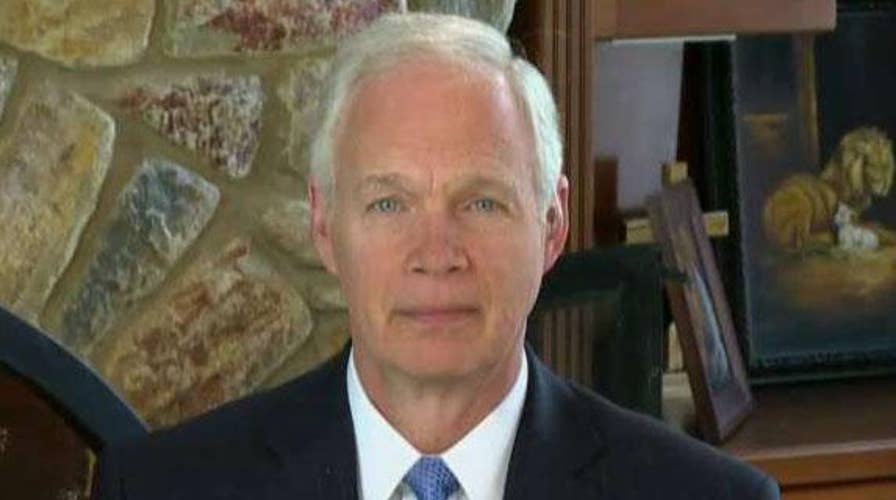
Sen. Ron Johnson commits to reforming the National Emergencies Act
Wisconsin Republican Sen. Ron Johnson says he hopes Democrats will support his efforts to reform the National Emergencies Act.
This is a rush transcript from "Sunday Morning Futures," March 17, 2019. This copy may not be in its final form and may be updated.
MARIA BARTIROMO, HOST: Good Sunday morning, everyone. Thanks so much for joining us. I'm Maria Bartiromo.
And joining us straight ahead right here on "Sunday Morning Futures": President Trump issues his first ever veto, after the Senate revokes his national emergency.
Senate Homeland Security Chairman Ron Johnson is here on what happens now, plus his reaction to North Korea's threat to walk away from nuclear talks.
Congressman Doug Collins is the ranking member of the House Judiciary Committee. He just released transcripts of closed-door testimony from Peter Strzok and Lisa Page. What else might he have in store to shed light on what was going on at the Justice Department and the FBI leading up and through the 2016 election? He is here, exclusive.
Democratic Congressman Harley Rouda weighs in on the Democratic oversight of the Trump administration, as well as Mitch McConnell's plan to hold a procedural vote on the Green New Deal.
All that and a lot more right here, right now on "Sunday Morning Futures."
And we begin this morning with President Trump issuing his first ever veto in response to a congressional resolution that would have blocked his national emergency on the southern border.
The move tees up an override vote in the House scheduled for March 26. That is not expected to pass.
Joining me right now, in an exclusive interview, Republican Senator from Wisconsin Ron Johnson. He's the chairman of the Senate Homeland Security Committee. He also sits on the Foreign Relations, Budget and Commerce committees.
Senator, it is good to have you on the program this morning. Welcome.
SEN. RON JOHNSON, R-WIS.: Good morning, Maria.
BARTIROMO: So, we knew that some Republicans were going to go against the president. We didn't know that it was going to be 12, vs. five.
What's happening in your party that so many Republicans didn't stand with the president for his national emergency?
JOHNSON: Well, there was a pretty robust inside our conference.
But, from my standpoint, as soon as the House voted with a total that was well below a veto-proof majority, this vote, from my standpoint, turned into a purely political vote, the whole issue of whether or not you support the border or whether you support the president in trying to secure it, secure our homeland.
And, so for me, it was a pretty simple vote. I understand why my other colleagues were concerned about the constitutional issue. I am as well. I have the benefit of being chairman of the committee of jurisdiction. And we will take up a fix to the National Emergency Act to return that authority to Congress that was taken away by the Supreme Court and later codified by Congress.
So, yes, we will bring that up. Hopefully, Democrats will support us. Hopefully, they will express the same concern about any executive having that kind of broad emergency powers, which this president had, and he exercised.
BARTIROMO: Right.
JOHNSON: So, in the end, I didn't believe that the president was operating outside his authority.
BARTIROMO: So, Senator, as the chairman of the Homeland Security Committee there on the Senate, I want to get your take on basically the situation today at the border.
But, before I do that, we know that the president, as soon as he got the bill, he vetoed it. And now they're trying to override it on March 26. Tell us what happens now.
JOHNSON: Well, they will not be able to override the veto.
And, so, again, what I will do is, using my committee's jurisdiction, will actually bring up that National Emergency Act and amend it to return the authority that, again, the Supreme Court took away and Congress codified.
So we will just flip this on the head. We will allow the president to declare an emergency for 30 days. And if a majority of both chambers agree to have that emergency extended, that should pass constitutional muster.
So we will return that constitutional authority, which I think is appropriate. Past Congresses have given way too much of their constitutional authority away to the executive branch. And we should claw it back.
BARTIROMO: So, characterize the emergency as you see it today. We have got a chart here of apprehensions at the southwest, the southern border, and we had a huge spike in the month of February.
So the yellow color is unaccompanied minors between ports of entry. The blue color is in family unites between ports of entry. Then we have got red, unaccompanied minors claiming asylum at ports of entry, and in family units claiming asylum at ports of entry. Tell us what this chart says.
JOHNSON: Sure.
Well, first of all, you have to understand that the record apprehensions back in 1986 and the year 2000 were really Mexican economic migrants coming back here, apprehended sometimes multiple times in the same day.
The problem has completely changed. Now we're dealing with unaccompanied children and people coming in this country illegally as family units, claiming asylum. And our laws are such that, once they get into America, they basically stay.
We only return probably less than 3 percent of unaccompanied children. And so it is a huge incentive for more people from Central America coming up here either as unaccompanied child or more now as family units, because it's really rewarded.
So what we saw in 2014 is, President Obama declared that a humanitarian crisis, when 120,000 children and people coming as family units across the border illegally and were apprehended. Last year, that number was 145,000. In the first five months of this year, 175,000 unaccompanied children, but now mainly people coming in as family units across the border illegally or presenting themselves at ports of entry claiming asylum.
All we can do, Maria, is, we can apprehend, we can process, and then we disperse. And these people, by and large, are staying in this country long term.
BARTIROMO: Yes, we're looking at a picture now of the wall within California, Nancy Pelosi's state, the wall that separates San Diego from Tijuana.
And, by all accounts, this wall has worked.
JOHNSON: No, where we have installed four sections of better barriers, we have cut illegal immigration by about 95 percent.
That is a huge benefit to barrier structures. But that's not the only thing that we have to do. We have to amend these laws that provide the incentives. We have to maintain our asylum standards. And we have to make sure that we can apprehend and detain individuals. And those who don't have valid asylum claims, we have to quickly remove them to their home country, because that's, right now, what we don't have the capability. And is what is the huge draw coming particularly from Central America.
BARTIROMO: Well, I don't understand. Why hasn't this been dealt with before? When we have your colleagues on the left on, they continue to say that they are for border security, and yet they don't -- they didn't vote for Kate's Law, they didn't vote for an end to sanctuary cities, they didn't vote for the wall.
So, obviously, their votes do not correspond with what they're saying. But I'm just under -- I'm just trying -- I'm having a hard time understanding why, if this is such an incredible emergency, as these numbers bear out, why nothing has been done about this before.
JOHNSON: Well, here is a news flash. Democrats are being hypocrites on this issue.
They pay lip service to try and secure the border, but then they will do nothing to help us change the laws that would help us do just that. And it really is an amendment under the human trafficking law in 2008 that created a disparity in terms of how we treat unaccompanied children from Central America vs. Canada or Mexico. That's increased the incentive, and then a court decision.
When President Obama began detaining families and their children, so they could do expedited removal, somebody challenged that in court. And the Flores agreement was reinterpreted to include children that were also accompanied. That began the full catch and release.
And that's what we're in right now, because President Obama -- or President Trump tried to enforce the law. But that required separation, because we can't keep children more than 72 hours in CBP custody or more than 20 days in general. And so we have to disperse them.
So we're back into full catch and release.
BARTIROMO: Right.
JOHNSON: And that really is the state of play Democrats want.
BARTIROMO: Right.
JOHNSON: I have no idea why they want open borders, why they won't outlaw sanctuary cities, but that's what Democrat policy is. It's very unfortunate.
BARTIROMO: Well, we know that they did vote for a wall in the past, but now that President Trump has said it, this is in step with their resist movement, resist everything the president tries to do.
Let me ask you about North Korea and get your take on this from a foreign affairs standpoint. North Korea threatened on Friday to walk away, suspend negotiations altogether with the Trump administration over its nuclear arms program. And they are saying that Kim Jong-un is going to decide soon whether to resume nuclear and missile tests.
What's happening here?
JOHNSON: A number of members of the Foreign Relations Committee met with Secretary Pompeo last week for an early morning breakfast, and very interesting to listen to him talk.
First and foremost, Chairman Kim simply hasn't made that decision to disarm and integrate his economy, improve his economy. That's the first thing he has to do, but it also sounded like he was given some pretty bad advice by his advisers that what he offered would be accepted by President Trump.
They offered that right up front. President Trump, Secretary Pompeo utterly rejected it. I don't know what Kim thought -- or Chairman Kim thought had changed in terms of the president accepting this, but President Trump was absolutely right in walking away from those negotiations.
But, apparently, it shocked Chairman Kim, because his advisers said that it would be accepted. It's unacceptable. So the bottom line is, President Trump continues to try and offer that deal, but it's got to be a big deal.
Chairman Kim has to accept the fact that he's going to give up his nuclear capability, his missile capabilities, in exchange for what would really be good for North Korea and his people and his regime, integration with the modern economies of the world.
BARTIROMO: Do you think him walking away from North Korea and saying, look, this meeting is over, was a moment that China was watching?
Was there anything that China has taken away from that, given the fact that we are still waiting on a meeting between the president of China and President Trump at Mar-a-Lago, which we thought was going to happen at the end of March, but now Secretary Mnuchin says probably not until April?
JOHNSON: Well, what China and, quite honestly, all of our trading partners need to realize about President Trump is, he won't be snookered into a bad deal. He's going to make sure that, for example, in trade, we're going to have fair and reciprocal treatment.
But, as it relates to North Korea, we're going to continue to impose sanctions. From my standpoint, I would say even ratchet up those sanctions, make sure that China maintains these U.N. resolutions that impose sanctions, that Russia does, start returning some of these guest workers that are providing an awful lot of hard foreign currency into North Korea and keeping that regime afloat.
BARTIROMO: Yes.
JOHNSON: What brought Chairman Kim to the negotiating table were these sanctions. We need to ratchet them up. Let's not make the same mistakes as we made in Iran, where sanctions brought to the table, but then we relieved those and we didn't actually force Iran into negotiating in good faith.
Right now, Chairman Kim is not negotiating in good faith. He has to come to different conclusions.
BARTIROMO: All right, I want to take a short back.
But, when we come back, we are awaiting word on whether the Trump administration will reach a trade agreement with China. Joint Chiefs Chairman General Dunford made some news, saying that Google's work in China is indirectly or directly benefiting Beijing's military. Meanwhile, they walked away from the Pentagon.
I want to get your take on that, Senator.
So, Senator Ron Johnson joins us once again when we come right back.
Follow me on Twitter @MariaBartiromo, @SundayFutures, on Instagram as well @SundayFutures and @MariaBartiromo.
We're taking a look ahead on "Sunday Morning Futures" this morning, and we will be back.
Let us know what you want to hear from Congressman Doug Collins as well.
(COMMERCIAL BREAK)
BARTIROMO: Welcome back.
We are back with Wisconsin Senator Ron Johnson.
And, Senator, let me ask you what a deal with China should look like, because I know the Chinese are willing to buy more soybean from the U.S. and they're willing to open up their markets a little, at least to financial services companies, among other industries.
What about the big-ticket items, like the I.P. theft, the forced transfer of technology, the espionage that we now know exists, given Huawei's performance? Will we be able to put enforcement in place to ensure that the Chinese keep their promises when it comes to these things?
JOHNSON: Well, enforcement is going to be the key.
Now, part of the problem is, how do you enforce an agreement, things that the Chinese deny, for example, the cyber-theft, the espionage? So I'm afraid the cyber-theft and the espionage will probably have to be enforced through criminal justice, through potential cases with WTO.
But in terms of forced technology, the intellectual property transfers, that can be handled through an agreement. And it can be enforced through those agreements as well. But we need to absolutely demand reciprocal treatment. And that's what this administration is completely dedicated to achieving.
And it's unfortunate you have to take it to this level, you have to provide this kind of brinksmanship, but I think China and our other trading partners have taken advantage of the situation far too long. And they're having to be shocked to the reality that this administration is not going to stand for it.
Hopefully, they will come to that conclusion and we can conclude these trade deals, because the president has done a great job, as you were talking earlier on "FOX & Friends," about relieving the regulatory burden, or at least having a pause.
BARTIROMO: Right.
JOHNSON: That has created a great deal of certainty in our economy.
But the whole trade war and tariffs, that type of thing creates a lot of instability and uncertainty.
BARTIROMO: Yes.
JOHNSON: So, the sooner we can get our trading partners to come to the table in good faith, offer fair and reciprocal treatment, the better the entire world economy will be.
BARTIROMO: So, real quick, do you think we will get a deal with China?
JOHNSON: The administration officials are sounding pretty positive about it.
BARTIROMO: OK.
JOHNSON: They have got agreement across the board on so many of these snarly, hard issues.
BARTIROMO: You know, it's interesting.
JOHNSON: And they're trading paper on the other agenda items, so that they are really uniformly sounding quite positive about it.
BARTIROMO: You know, you -- yes.
JOHNSON: Listen, this trade war is hurting China a whole lot more than it is us. So it's in China's best interest to come to the table in good faith.
BARTIROMO: Yes, the economy has certainly slowed down quite a bit in China as a result of these tariffs.
Let me ask you about these technology companies, because, in China, you have got the Chinese government telling its companies, do it this way.
So, the defense companies are doing what the Chinese government wants them to do. The technology companies are doing what the Chinese government wants them to do.
In America, it's obviously a little different. You have got some of the leading technology companies in the world -- take a Google, for example -- saying, we're not going to work with the Pentagon. We don't want to work with this U.S. government. We're pulling out of this contract to work with the Pentagon. And then you look at China, and they actually are working in China.
I want you to listen to what the acting defense secretary, as well as the chairman of the Joint Chiefs of Staff, Dunford and Shanahan, said this week about Google working in China. Listen to this.
(BEGIN VIDEO CLIP)
SEN. JOSH HAWLEY, R-MO: You're telling me that Google, an American company, supposedly, is refusing to work with the Department of Defense, but is doing work in China -- with China in China in a way that at least indirectly benefits the Chinese government; is that correct?
PATRICK SHANAHAN, ACTING DEFENSE SECRETARY: I haven't heard the word refuse, but there's a lack of willingness.
GEN. JOSEPH DUNFORD, JOINT CHIEFS OF STAFF CHAIRMAN: The work that Google is doing in China is indirect -- is indirectly benefiting the Chinese military. And I have been very public on this issue as well.
In fact, the way I described it to our industry partners is, look, we're the good guys, and the values that we represent, and the system that we represent, is the one that will allow and has allowed you to thrive.
(END VIDEO CLIP)
BARTIROMO: I mean, do Google employees understand what they're doing?
JOHNSON: Possibly not.
Obviously, through their chat room, they were outraged that Google was working with the Defense Department to actually help save lives, from my standpoint, in terms of drone technology, to more precisely target. They didn't -- they weren't willing to use Google resources to help the United States military.
And yet Google is working on Project Dragonfly -- now, apparently, suspended it. I know a number of Google employees were concerned about that as well, about the human rights abuses in China.
But I thought it was rather shocking. It certainly got my attention when General Dunford talked about directly helping China's military.
I will certainly be looking into that. I will be asking for a briefing from the Joint Chiefs. And we will also be asking Google to find out exactly what they are doing. They're an American company. They have to be loyal to America and to our values. I think the general was absolutely correct in the way he laid that out.
BARTIROMO: That's just incredible. So you're going to -- you're going to hope to do hearings on this, then?
JOHNSON: Well, I'm certainly going to be sending oversight letters and asking for briefings and find out exactly what is happening.
BARTIROMO: OK. Yes.
Senator, we have got to go. But, real quick, is USMCA going to get ratified? A lot of Dems come on, and they say they are not going to vote for it in its current form.
JOHNSON: I mean, I hope so. We need that trade deal. It's good for all three countries.
BARTIROMO: So, you're going to vote for it?
JOHNSON: We were trying to press the administration to ratify it when we had Republicans in the House. It's going to be a heavy lift, I fear.
BARTIROMO: Yes, all right, we will leave it there.
Senator, it's good to have you on the program this morning. Thanks so much.
JOHNSON: Have a great day.
BARTIROMO: Coming up: the top Republican on the House Judiciary Committee releasing a series of transcripts of revealing testimony from former FBI and Justice Department officials accused of political bias in their investigations into President Trump and Hillary Clinton.
The lawmaker is here. Doug Collins is next.
(COMMERCIAL BREAK)
BARTIROMO: Welcome back.
Recently released House Judiciary Committee transcripts are shedding more light into FBI investigations into then candidate Donald Trump and Hillary Clinton's e-mails during the 2016 presidential election.
The third and most recent transcript comes from former FBI agent Peter Strzok's closed-door testimony before Congress from June of last year. It follows transcripts of testimony from former FBI attorney Lisa Page and Justice Department official Bruce Ohr.
Joining me right now is the top Republican on that committee who made those transcripts public, Georgia Congressman Doug Collins.
Congressman, it's good to have you on the program this morning. Thanks very much for joining us.
REP. DOUG COLLINS, R-GA: Glad to be here, Maria. It's good to see you.
BARTIROMO: And, in looking at these transcripts, it's pretty clear of an issue that our viewers know very well, and our viewers have followed this for upwards of a year-and-a-half.
And they know, from the beginning, that there was no collusion, and that these transcripts show an incredible amount of bias.
Let's talk about some of the transcripts that you released, Peter Strzok's -- Peter Strzok's hatred of Donald Trump influenced the investigation and evidence against Donald Trump.
This was John Ratcliffe interviewing Peter Strzok. And this was after the text that said -- Lisa Page says to him: "We -- he's not going to win, right?"
"No, we will stop him."
And after that, Ratcliffe says: "Did Peter Strzok's hatred of Donald Trump influence the investigations and evidence against Donald Trump? Guess we will never know," because he was never asked by the special counsel if, in fact, his hatred of Donald Trump influenced the way he handled this investigation, correct?
COLLINS: I think what we got to do is look at this as you're going to know, because you can look at the proof. And that's why we're laying out the transcripts as we have.
Peter Strzok was a man who thought he was untouchable. He became a hero in his mind's eye in thinking that he was going to be able to control and sometimes maybe showing off for his mistress at the time, Lisa Page. Let's never forget that.
But also in his own role to grow up in the department. Peter Strzok was central, going back to the e-mail investigation, into the Russia investigation, into what became the Mueller investigation.
So what we're seeing here is, yes, we see the bias. The transcripts reveal the bias. And when we see that Mr. Mueller actually got rid of him based on, you know, his actions and those texts, so I think when we look at this together, we get a picture of someone who was brought up or allowed to grow, if you would, under the Department of Justice under President Obama, in which politics became the first, foremost word, not justice.
BARTIROMO: Yes, I understand.
So, in other words, they were very heavy-handed with the investigation into Donald Trump on flimsy evidence. And yet they were very light on the investigation of Hillary Clinton.
Another tweet that your colleague John Ratcliffe put out was after he interviewed Lisa Page. And you released this transcript as well. And he says -- Ratcliffe writes: "Lisa Page just confirmed to me under oath that the FBI was ordered by the Obama DOJ not to consider charging Hillary Clinton for gross negligence in the handling of classified information."
Walk us through this tweet. So they all thought Hillary Clinton was guilty, but they were told from the DOJ, don't even think about it?
COLLINS: This is there what -- there were two things that really came out of this.
And I think one of the things was, we just spoke about, and that would seem to be of that corrupt triumvirate of Page, McCabe and Strzok. Strzok seemed to stand out as his very aggressive nature on what he thought about the president and his political bent.
The second thing that really came out from this Lisa Page was, let's -- as I said -- and I put out another tweet the other day that says, Loretta Lynch has some explaining to do, because what we have seen now is that, beforehand, she was giving -- she not only told Mr. Comey that this wasn't an investigation, to consider it a matter, which is an interesting way of putting it, but also now we're seeing from Lisa Page's own testimony that the Department of Justice, which she headed, was saying gross negligence is not the standard that's going to be used here.
They began to import what's called intent, which is not part of the law. So really from the -- early on, from April/May -- and we know from May, when Mr. Comey started writing -- the group together came together and they were going to look at gross negligence, but then began to write an exoneration of Mrs. Clinton long before they ever even interviewed her.
So we know this was coming from the top. So we now have a pattern here. Look at the pattern. You have Department of Justice and FBI on their own agenda with a political bent hoping for Mrs. Clinton to become president. That's sort of the takeaway over these first three transcripts.
BARTIROMO: And this was way before Loretta Lynch, then the A.G., had a meeting on the tarmac with Bill Clinton just a few days before Hillary had her interview with the FBI, right? This was even before that.
COLLINS: Oh, very much so, Maria.
We -- look at this. That was even -- that was closer to the time when she said, I won't be a part of the prosecutorial decision, which all of a sudden in many ways has become evident now gave James Comey what he believed was his Superman cape to go do whatever he wanted to do.
But she was already -- this was already in the works. Lisa Page's transcripts confirm this. This is why we released these in the way we're releasing them, so that people can begin to see what's happening here.
We were making -- we were in this investigation. Democrats and others were saying, why are you going back, why are you doing this? You know, they made fun of the investigation the whole time. Well, now they have got a problem.
I believe Mr. Mueller's report is going to come back and show that there was no collusion, which, by the way, is not a crime. But there's no collusion, nothing with the Trump administration that they're going to find and the president himself.
But what they are going to have to deal with now is the reality of influence and collusion among DOJ and FBI employees in an e-mail investigation which was handled badly, that moved into a Russia investigation that was handled even worse, and then into a Mueller investigation.
So these are the kind of things that the American people deserve to see, and that's why we're putting them out.
BARTIROMO: Now, Jim Baker was the key lawyer for the FBI. You have got transcripts on him as well.
He had a closed-door meeting. And my sources say that, in one of his meetings, he admitted that he wanted to charge HRC, he thought Hillary Clinton was -- should be convicted of gross negligence.
Now, are you going to be releasing that transcript soon?
COLLINS: There will be more transcripts released. Baker will be one that we're looking at releasing.
And, yes, there's been some leaked information that Mr. Baker actually had that, exactly what you talked about. This is why this is important, Maria. And I don't want any of your -- the folks watching today to forget this. This is a pattern. This is not something that randomly happened.
I'm tired of really the mainstream media saying the FBI was investigating Ms. Clinton. No, there was a group that was investigating and told that they couldn't do their job. Remember, she wasn't even interviewed until late, after they had already started this discussion with the DOJ officials, probably including the attorney general -- she headed it -- saying that we can't charge gross negligence.
So they already knew the outcome, but went through the process.
And Lisa Page's transcripts also revealed the fact that this was, you know, sort of unusual. We also saw that with Strzok. We have heard it with many of these. Why would they interview a key witness, Ms. Clinton at the time, with key witnesses or fact witnesses in the room who have been granted immunity?
BARTIROMO: Yes.
COLLINS: This just goes back to show the two layers of justice. There was a layer for Ms. Clinton and then there was a level for Mr. Trump that were not equal. And people understand it, whether you're a Republican or Democrat or independent or don't care.
BARTIROMO: Oh, sure. But my...
COLLINS: You can't have a Department of Justice like that.
BARTIROMO: My audience wants to know what happens now.
COLLINS: Great question.
BARTIROMO: Jerry Nadler has subpoena power. And he's the chairman of your committee.
So, let's take a short break. And then we have got get to where the accountability is.
Plus, I want to talk to you about the House vote to make the Mueller report public by a vote of 420-0. I'm hearing that's going to drop any day now.
We will be right back.
(COMMERCIAL BREAK)
BARTIROMO: Welcome back.
We're back with Congressman Doug Collins.
And, Congressman we just talked about the malfeasance going on with this cabal of people at the top of the FBI and the DOJ. Will we see accountability?
COLLINS: I believe we can. And I think that's in the new attorney general.
He has been -- we -- through his confirmation hearings, what he said when asked questions about this from Senator Graham, he said that he was willing to look into these issues that many of us have been talking about, which we got nothing on before under the previous attorney general or anything else.
BARTIROMO: So you think we will see prosecutions? Will we see prosecution? COLLINS: I mean, look, some -- my hope is, if there's wrongdoing, that they will be prosecuted, because if it's simply not prosecuted -- look, two of the guys, McCabe and others, have been fired for cause, were fired. They were also under indictment.
We understand these kind of things going on, so hopefully we will see this actually prosecuted out.
BARTIROMO: So, you were among those who voted for transparency with the Mueller report. As I understand it, the Mueller report will be out within the next two weeks.
What was that 422-0 vote all about?
COLLINS: It was a political stunt by the Democrats, who thought that they could divide Republicans in the voting no upon it, because, at the end of the day, after I looked at it when they dropped it, we looked at it and they said, this is nothing but simply a first-year law student's restatement of what the regulations say that Mr. Barr is going to have to do.
This is the sad part we're at right now, Maria. They have no agenda. They have nothing that they can actually put on the floor. So they wasted an entire week of the American taxpayers' dollar to actually put a report on the floor that said nothing, basically except the same thing the regulations say that Mr. Barr needs to do.
So we just called their bluff and just said, fine, we can vote for this, because this is exactly what Bill Barr said he's going to do.
BARTIROMO: Yes, but...
COLLINS: Why are we wasting the American people's time?
BARTIROMO: But you have a structure in place, we have a structure in place whereas, under the rules, the attorney general sees the report from the special counsel, and then gives it to the chairman of the Judiciary Committee on the House side and the Senate side, so that every congressman doesn't have -- it's like you're giving it to every congressman and every senator.
That's basically like giving it to The New York Times, right? If somebody is not charged with something, the police don't say, hey, we're not charging them, but guess what, there's all this other stuff that we were looking at, maybe there's this fraud, maybe there's that fraud.
Doesn't this open a can of worms for the president?
COLLINS: No, it doesn't.
I think what we got to understand here and I think what we understand is, let's go back exactly what has to happen. Mueller will present some kind of report. All the paperwork says that it can be a report on what he's found, what his prosecutions were and what his declinations were, the ones he declined to prosecute.
That is given to Bill Barr. Bill Barr at that point, then he makes what's called an explanation to basically four people that have to be notified. It doesn't say that we're the only ones or at the same time have to be notified, but we have to be notified.
BARTIROMO: Right.
COLLINS: So it can be released to the public, as long as we're notified.
And I think what we have to look at is what he said in his confirmation hearings, that he wants to release as much as possible, to make sure that this gets behind us and we move forward.
BARTIROMO: Right.
COLLINS: We know and you know, as you said earlier, that there's not going to be collusion here. This is where it's going to be put very hard for the Democrats.
So, all this was -- and don't be fooled by this -- this was simply a stunt, because they thought they could divide Republicans to make -- quote -- "us look bad."
BARTIROMO: Yes.
COLLINS: It's not being transparent.
I have no problem being transparent when what we see is coming forward and it's within the regulation itself.
BARTIROMO: Right. All right.
COLLINS: So, this was nothing more than a political stunt.
BARTIROMO: Well, Adam Schiff continues to say he has more than circumstantial evidence that there was collusion. We will see what he says after this drops.
Is the Mueller report going to come out within the next two weeks, do you think? And what are you going to do about the fact that you don't have subpoena power? Jerry Nadler's in charge. He's going to bring down for questioning who he wants . So where are all these investigations going, Congressman?
COLLINS: Well, I think two things.
First thing is this. Adam Schiff is the new Joe McCarthy from the Senate. He has got -- always said, oh, I have got this evidence of collusion. We have it all here.
Yet he never shows it. In fact, he actually has to back up. When we released the Bruce Ohr transcript, it showed his own explanation of when some of this actually was dropped was wrong. It wasn't August. It wasn't after the election.
Adam Schiff is just one, you know, again process away from spinning his own yarn. Jerry Nadler has subpoena power. He sent out 81 letters recently asking for information ranging on wide topics. You almost know that they are concerned about Mueller not having what they want, because only 30 of these letters actually had anything to do with Russia.
When we come to this part, it's going to be very obvious that Mr. Nadler and others are responding to their base. They're responding to the pressures of their base, who want to impeach the president and have wanted to since November of 2016.
You're seeing a politically motivated agenda to impeach the president, to make the president look bad for the 2020 elections. And we're going to be fighting against this. We're going to be fighting the overreach.
BARTIROMO: Yes.
COLLINS: We're going to be fighting to do what Congress is supposed to, do not the fishing trip that they want to be on.
If Jerry wants to -- if the chairman wants to come down and have a fishing trip, I have got some great trout streams in North Georgia. I will be happy to let him fish there. But he shouldn't be fishing with the American people's money on wasted topics.
BARTIROMO: All right, we will be watching this. What a story. Incredible.
Congressman, good to see you. Thanks very much.
COLLINS: Thank you.
BARTIROMO: We will be waiting for your next drop of the transcripts, probably Jerry -- Baker -- Mr. Baker or whomever else.
Thank you, Congressman. Appreciate your time this morning.
COLLINS: Just be following the Twitter account. We will do it.
BARTIROMO: OK.
And we just heard from the Republican on the House resolution calling for the Mueller report to be made public.
Now for the Democratic perspective on that, want to bring in California Congressman Harley Rouda. He serves on the House Oversight Committee. He's a member of the New Democratic Coalition.
Congressman, it's good to have you this morning. Thanks very much for joining us.
REP. HARLEY ROUDA, D-CALIF.: Good morning.
BARTIROMO: So, you voted for the Mueller report to be public. Was that a political stunt, as you just heard?
ROUDA: No, I don't think it was a political stunt at all.
What we saw leading up to that vote was the president making -- suggesting that perhaps it didn't need to be released, and concerns with the answers by the attorney general to be spot on in saying it would be released.
And Congress did what it's supposed to do, take action to make sure that this very important information that the public really wants to see and provide the appropriate transparency into that investigation is into the hands for all of us to digest, understand and contemplate what needs to take place next.
BARTIROMO: So what do you think about all of this that has taken place?
I would imagine, whether you're on the right or on the left, you want to make sure that our democracy stays secure and stays truthful. These cabal of people, Peter Strzok, Lisa Page and others, Andrew McCabe, who has gotten criminal referrals, they put their finger on the scale to change the election and take down a duly elected president.
You have seen all of the evidence. What can you tell us?
ROUDA: Well, you're right. We look at that evidence, and it does require additional due diligence and investigation.
But, also, we can't use bad actors from the Clinton administration or otherwise as justification for not doing our job if there are bad acts taking place under the current administration.
We are required, under the Constitution, to provide oversight. And I sometimes feel like this is like middle school kids that are trying to justify their behavior by pointing to past behavior of others and saying, well, they did it too, so I'm allowed to do it, or why are you picking on me, when you should be looking back at them?
BARTIROMO: Yes, I think that's a fair point, yes.
ROUDA: All of this needs appropriate oversight.
BARTIROMO: But we're looking at the oversight of the Hillary Clinton e- mail scandal, and, yes, you're going back several years in terms of looking -- looking in the backdrop.
But was Hillary Clinton treated the way that you would like to see someone who did exhibit gross negligence with classified information? Was she treated fairly? Was that investigation a fair one?
ROUDA: Well, I just got to Congress. So I will point this out.
Republicans have held the House for the last 10 years. They have had oversight authority.
BARTIROMO: That's a good point.
ROUDA: They had full authority to oversee that investigation of the e- mails and Hillary Clinton.
BARTIROMO: Yes.
ROUDA: And look at what's concluded.
There were no indictments. There were no convictions. And you look at what's going on, the Mueller investigation. We almost have 40 convictions and indictments already, and the report hasn't even been released. So, it's good that we're having appropriate due diligence.
BARTIROMO: But, just to be clear, those convictions -- those convictions have nothing to do with collusion or Donald Trump.
ROUDA: That's correct. That's exactly correct.
So that's why we need to get through the report. And, by the way, you also need to remember too that the Mueller report is only one of three investigations going on right now. And it's focused primarily on what transpired during the campaign.
You also have what's going on in the Southern District of New York and the Eastern District of Virginia. So we tend to focus on the Mueller report being released, and that that is going to answer all questions. It's not. It's one of three major investigations going on.
BARTIROMO: All right, I want to talk to you about what's going on within the Democratic Party, Congressman, because there seems to be a lot of division.
Senate Majority Leader Mitch McConnell planning a procedural vote on the New Green Deal. How do Democrats feel about that?
Stay with us, Congressman Rouda. We will take a short break and come right back with the division within your party.
Back in a minute.
(COMMERCIAL BREAK)
BARTIROMO: And we're back with Democratic Congressman from California Harley Rouda.
Congressman, let me ask you about this upcoming vote. Mitch McConnell has followed through on his promise to call a test vote on the resolution supporting the Green New Deal. Are you going to vote for it?
ROUDA: I would prefer to vehicle us on Ted Lieu's legislation, which is going to be 100 by 35 that is going to submitted to the 116th Congress.
But I do think Mitch McConnell certainly is doing this for showmanship. He wouldn't put certain votes that are very important to reopening the government, but he wants to put this vote on the table to get people on record, in hopes of embarrassing them.
BARTIROMO: Well, I don't know about showmanship and getting people on record to embarrass them.
It is important for the American people to understand who backs something like this, right? You have got reports that the Green New Deal is going to cost $94 trillion, and that it makes no sense that you could do away with fossil fuels in 12 years.
Wouldn't it be important for the American people to understand who actually believes that this is actually doable and who actually knows that it doesn't make any sense?
ROUDA: What I think is important, that we all recognize that climate change is real and that we have to take action.
And while you can point to any legislation, or proposed legislation, and point out the faults of it, we cannot deny that climate change is impacting every citizen of our country around the world.
BARTIROMO: Right.
ROUDA: And so let's quit focusing on areas where we have clear disagreement and focus on the task at hand.
And I wish Mitch McConnell would say, yes, climate change is real. Mr. President, you're wrong. Let's get together and figure out how to solve this.
BARTIROMO: Well, what about -- is there a big pressure? Do you feel pressure within your party to go along with some of these pie-in-the-sky ideas?
I mean, you have got the Green New Deal. You have got Medicare for all, which wipes out the private insurance industry. You have got a tax on wealth idea from Elizabeth Warren, which is unconstitutional. And you have got a tax -- 70 percent tax that AOC wants.
How much pressure are you feeling to go along with some of your freshman colleagues like AOC, even though many of the moderates don't believe that any of these things would actually materialize?
ROUDA: I don't feel any pressure at all. And I will tell you why.
The citizens of Orange County who elected me here recognize that I have moderate views. I come from a business background. I have built companies up to 10,000 people. I believe in capitalism, and I believe in good government, and I believe they can work together.
So, whether the outlandish idea is on the left or right, I'm not going to support it. I'm going to work with my Republicans and Democrats who believe that most Americans are between the 20-yard lines and get good legislation accomplished.
BARTIROMO: Right, which is why you believe in border control.
ROUDA: Exactly.
BARTIROMO: Yes.
Congressman, it's good to have you on the program this morning. Thanks so much.
ROUDA: Thank you.
BARTIROMO: We will see you soon, sir.
Lindsey Graham blocked a Senate vote on a House resolution that would require the Justice Department to publicly release the full findings of the Mueller report. He wants a second special counsel to look at how the DOJ handled the Clinton e-mail investigation and the FISA warrants.
Former Clinton adviser Mark Penn is with me next to discuss that, when we continue. Stay with us.
(COMMERCIAL BREAK)
BARTIROMO: Welcome back.
Senate Judiciary Committee chairman Lindsey Graham blocked a Senate vote on the House measure that called for special counsel Robert Mueller's final report to be made public.
Let's bring in Mark Penn. He's a former Clinton adviser and pollster. He's also managing partner at The Stagwell Group.
Mark, your reaction to Lindsey Graham blocking this most recent procedural vote? What's going on in Congress these days?
MARK PENN, FORMER CLINTON CAMPAIGN STRATEGIST: Well, first of all, not much is going on in Congress these days. There's a lot more show votes than there are real votes on the matters that people want done.
But I think senator Graham here was really saying, yes, I want the Mueller report to be transparent, but I also want a second independent counsel to be appointed to investigate what was going on with the FBI and the DOJ during all of these investigations.
And I think that's the point he's making. There's obviously going to be and have to be significant transparency about what Mueller did. But, likely, there already is significant transparency, since Mueller has brought the cases that he's going to bring.
BARTIROMO: Right. And we have talked about this for a year-and-a-half, Mark. You have written about this a lot. We're not expecting collusion in the Mueller report. The Mueller report should be out in the next two weeks.
What are you expecting? And what is your reaction to what you heard from Congressman Doug Collins earlier and Congressman Rouda?
PENN: Well, look, what am I expecting?
I'm expecting a report that dwells significantly on what the president did relative to the obstruction of justice. I don't see obstruction of justice here, but I think the report could dwell on that.
And then, on collusion, I think, ultimately, the report has brought not a single case related to that in any clear manner. So how could the report itself actually focus on that or find it? It can't. Nothing was brought.
So I think we know the conclusion. And we know also, increasingly, as these transcripts come out, that the underlying foundation for this investigation never really existed, that the Steele dossier was never verified, and never should have been the basis for this.
And the firing of Comey that triggered the independent counsel also had no basis in fact or law to create an independent counsel.
BARTIROMO: Yes, so the special counsel should never have been there in the first place.
And we know how they handled the Hillary Clinton investigation. Jim Baker apparently testified that he wanted to charge her with gross negligence, but the DOJ said no.
Your reaction to these directives coming from Loretta Lynch and Barack Obama's DOJ?
PENN: Well, the Lisa Page transcript really is quite stunning, because what Lisa Page is saying is that the Justice Department, before the investigation was really done, said that they were not going to prosecute.
Therefore, the fact that Comey then says no one knows the conclusion, right, is a lie. It's a laughing matter, because of course he knew the conclusion. The conclusion had been dictated before the investigation began.
BARTIROMO: Yes.
PENN: This is really significant testimony from Lisa Page. I don't understand why the inspector general didn't understand this.
BARTIROMO: Yes. Without accountability, nobody is going to trust the DOJ and the FBI for a long time.
Mark, good to see you, sir. Thanks very much, Mark Penn.
Thanks for joining us on "Sunday Morning Futures." I'm Maria Bartiromo.
I will see you next week on "Mornings With Maria" on FOX Business.
Content and Programming Copyright 2019 Fox News Network, LLC. ALL RIGHTS RESERVED. Copyright 2019 ASC Services II Media, LLC. All materials herein are protected by United States copyright law and may not be reproduced, distributed, transmitted, displayed, published or broadcast without the prior written permission of ASC Services II Media, LLC. You may not alter or remove any trademark, copyright or other notice from copies of the content.
