


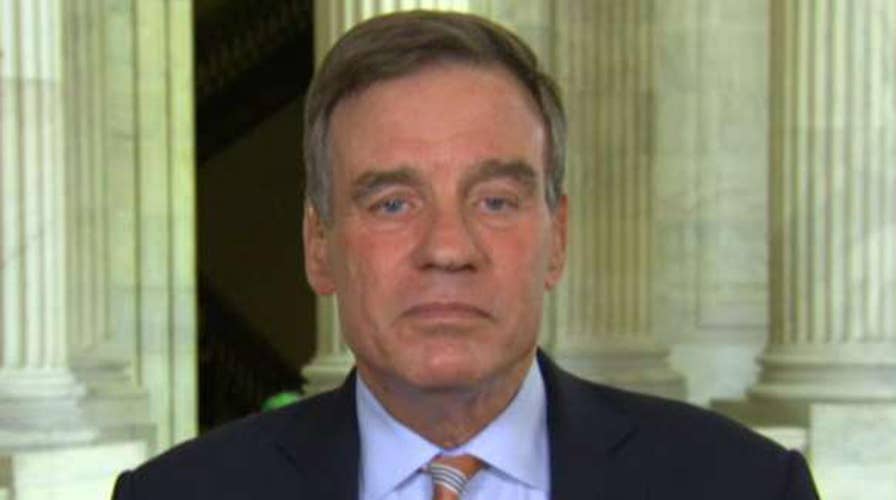
Sen. Mark Warner: Let's not take our eye off the ball of what really happened
Virginia Democrat Sen. Mark Warner says he wants to work on bipartisan legislation to stop foreign governments from interfering in U.S. elections.
This is a rush transcript from "Your World," May 29, 2019. This copy may not be in its final form and may be updated.
NEIL CAVUTO, HOST: The message? Well, you know it already from the special counsel, Robert Mueller, his job is over.
And Democrats are pushing impeachment, saying that is why theirs is just beginning. And forget China. Is that the real reason why investors on Wall Street are worrying? We're all over it.
Welcome, everybody. I'm Neil Cavuto. This is "Your World."
And while Mueller didn't say anything that wasn't already in his report, maybe it was his emphasis. It's the door he left wide open for Democrats that could mean it will soon be open season on one President Donald Trump.
So, this hour, while Senate Judiciary Committee Republican Thom Tillis is not worried, why the top Democrat on Senate Intelligence, Mark Warner, says, maybe he should be, and why stocks on Wall Street already are.
First to Catherine Herridge in Washington on what's going on right now.
Hey, Catherine.
CATHERINE HERRIDGE, CHIEF INTELLIGENCE CORRESPONDENT: Thanks, Neil. And good afternoon.
A short time ago, in fact, within the last hour, we heard from the House speaker, Nancy Pelosi. And it's important to listen to her choice of language. She commended House Democrats for pursuing issues of impeachment. But then she said if they proceeded, they needed to make such a solid case that even Republicans in the Senate would have buy-in.
Here's a speaker.
(BEGIN VIDEO CLIP)
REP. NANCY PELOSI, D-CALIF.: Nothing is off the table. But we do want to make such a compelling case, such an ironclad case, that even the Republican Senate, which at the time seems to be not a -- an objective jury, will be convinced of the path that we have to take as a country.
(END VIDEO CLIP)
HERRIDGE: Special counsel Robert Mueller spoke for almost 10 minutes today. I want to emphasize he didn't take questions from reporters that might have clarified some of the issues and gone to his motivation for making a public statement.
He talked about Russian election interference. He talked about that being systematic and broad, but the emphasis has been on the obstruction issue. He talked about something called the OLC opinion. This is the Office of Legal Counsel. It's like the internal lawyer to the executive branch. It's housed in the Justice Department.
And he said that opinion says you can't indict a sitting president. And Mueller told reporters, this was a major stumbling block in the investigation.
(BEGIN VIDEO CLIP)
ROBERT MUELLER, RUSSIA PROBE SPECIAL COUNSEL: Under longstanding department policy, a president cannot be charged with a federal crime while he is in office. That is unconstitutional.
Even if the charge is kept under seal and hidden from public view, that, too, is prohibited.
The special counsel's office is part of the Department of Justice, and by regulation, it was bound by that department policy. Charging the president with a crime was therefore not an option we could consider.
(END VIDEO CLIP)
HERRIDGE: Mueller went on to say that, under the regulations, his team was able to gather information that could be used in the future. He didn't reference Congress or impeachment.
But that seemed to be the subtext, Neil. But what's important is that this does appear to conflict with what we heard from Attorney General William Barr on the issue. The attorney general testified that, when he had a conversation with Mueller, and about the failure to reach a decision on the obstruction charge, that Mueller, according to Barr, had put this legal opinion to one side, and that there are also underlying facts that wouldn't go to a criminal prosecution.
(BEGIN VIDEO CLIP)
WILLIAM BARR, ATTORNEY GENERAL: Special counsel Mueller stated three times to us in that meeting, in response to our questioning, that he emphatically wasn't saying that, but for the OLC opinion, he would have found obstruction.
He's said that, in the future, the facts of a case against the president might be such that a special counsel would recommend abandoning the OLC opinion. But this is not such a case.
(END VIDEO CLIP)
HERRIDGE: Two final points.
The special counsel gave the strongest indicator yet that he doesn't plan to testify publicly or privately to Congress. And there was another development that kind of flew under the radar with the special counsel statement.
We have got something from the inspector general at the Justice Department, and they have confirmed now a second former senior FBI executive was guilty of unauthorized leaks to the media, and, more importantly, accepting gifts from the media.
This goes to the ongoing probe of what people like to call the investigation of the investigators, those who were involved at the genesis of the whole Russia case, Neil.
CAVUTO: Yes, I keep forgetting about the inspector general and what he's going to release and when he releases it.
HERRIDGE: That's right.
CAVUTO: Thank you, Catherine, very much, Catherine Herridge.
HERRIDGE: You're welcome.
CAVUTO: Case closed, that's what the president is saying of Mr. Mueller's remarks.
To FOX News Channel's Kevin Corke with the very latest -- Kevin.
KEVIN CORKE, WHITE HOUSE CORRESPONDENT: Neil, to be with you.
The president's opinion about this is clear, right? No obstruction, no conspiracy, no collusion. But, for the first time today since the genesis of the Russia probe, we got a chance to hear from the special counsel himself, who was, dare I say, decidedly less clear about those very topics.
Let me share a bit of what the president himself had to say today online. He was on Twitter, didn't say a whole lot today, which may have surprised some people.
He tweeted this: "Nothing changes from the Mueller report. There was insufficient evidence and, therefore, in our country, a person is innocent. The case is closed. Thank you."
All right, case closed, because, they argued, Mueller said as much in his report and did again today, didn't have the goods, Neil, to accuse the president of anything specific, even though he had some evidence that made it impossible to -- quote -- "exonerate him."
Still, Mueller said today it's over. And Sarah Sanders agrees.
(BEGIN VIDEO CLIP)
SARAH HUCKABEE SANDERS, WHITE HOUSE PRESS SECRETARY: We consider this case closed. He completed his investigation. Now he's closed his office and it's time for everybody to move on. He's going back to his private life, and we think everybody else should too.
(END VIDEO CLIP)
CORKE: But I think Catherine Herridge actually gave you a really good nugget a moment ago.
Mueller seemed to throw the Democrats a bit of an olive branch by suggesting the main reason he couldn't go forward, Neil, with an allegation perhaps of obstruction was because of that long-established rule against it.
The president's lawyer Rudy Giuliani, meanwhile, isn't buying that.
(BEGIN VIDEO CLIP)
RUDY GIULIANI, ATTORNEY FOR PRESIDENT DONALD TRUMP: When a prosecutor can't reach a decision, that's the decision. So there's no case on obstruction. There's no case on collusion. I did it for years. I never exonerated anyone. I found, is there enough evidence to bring a charge or isn't there?
If there's not enough evidence to bring a charge, end of case.
(END VIDEO CLIP)
CORKE: End of case, says Rudy Giuliani.
Ah, not so fast, says Jerry Nadler. He says: "Given that special counsel Mueller was unable to pursue criminal charges against the president, it falls to Congress to respond to the 'crimes, lies and other wrongdoing of President Trump,' and we will do so. No one, not even the president of the United States, is above the law" -- that from Jerry Nadler.
As for Mueller, doesn't look like he will testify, short of a subpoena. And I doubt that will happen. Of course, time will tell -- Neil, back to you.
CAVUTO: All right, Kevin Corke at the White House, thank you, my friend.
Well, here's the line from the special counsel Mueller the president's critics are having a field day with. Take a look.
(BEGIN VIDEO CLIP)
MUELLER: If we had had confidence that the president clearly did not commit a crime, we would have said so.
We did not, however, make a determination as to whether the president did commit a crime.
(END VIDEO CLIP)
CAVUTO: All right, we should be clear here. Robert Mueller didn't say anything today that wasn't already in his report.
So what are we to make of all of this?
Former Whitewater independent counsel Robert Ray to do that.
Robert, what's interesting is, neither did the final report say, if we had confidence that the president clearly did commit a crime, we would have said so as well. So they couldn't conclude either way. So what do you make of that?
ROBERT RAY, FORMER INDEPENDENT COUNSEL: Well, what has gotten the White House and White House lawyers and the president's own lawyers apoplectic about that is just what Rudy Giuliani said, how unfair it is, essentially, to once again throw that out there by a prosecutor, in a situation in which -- how is the president supposed to respond to that?
And the only thing that you can say is, look, a prosecutor's job, just what Mr. Giuliani suggested, is to decide whether you have sufficient evidence to bring a case, something that Bob Mueller could have done in a recommendation to the attorney general.
Ultimately, I think it would be the attorney general's call, no matter what happened, to decide whether or not, even notwithstanding the OLC opinion, whether to change that result and to...
CAVUTO: Was he bound by that?
Did we know -- like I thought, if we were two-thirds through this process, even before Barr was appointed as attorney general, and we had a heads-up that there will be not only any indictments, any prosecutions, anything that suggests even the word guilty of any of this, wouldn't people have said, all right, then why are we doing this?
RAY: Well, exactly.
I think that's what the president's lawyers have also said. What, are you kidding me? You have got a special counsel appointed. Obviously, everybody understands that other people...
CAVUTO: Well, how did you handle yours with the whole Whitewater stuff?
RAY: Other people may come within the sights of the special counsel, but nobody should be under the illusion or delusion that this was anything other than the appointment of a special counsel to investigate conduct involving the president of the United States.
And so it would be, I think, natural for someone to assume and for the public to come to expect that the special counsel was going to resolve that question, all questions involving the president.
CAVUTO: And he didn't.
RAY: And he didn't.
CAVUTO: Now, how did you resolve these issues when you were dealing with Bill Clinton and the real estate...
RAY: And to answer your own -- and to answer your prior question, again, I think even special counsel Mueller suggested that if he felt strongly about the fact that the OLC prior opinion should be revisited, he certainly could have recommended that to the attorney general.
CAVUTO: And he didn't.
RAY: And the attorney general said in his testimony that that issue came up, and that Bob Mueller expressly said that that this was not the appropriate case on which to do that.
CAVUTO: But could he have used different words, Robert?
Could he have said, all right, I can't indict a sitting president, whatever, but I can find this behavior -- he seems guilty of this behavior?
(CROSSTALK)
RAY: Well, he was mindful -- no, look, he was mindful of exactly what got Jim Comey into trouble.
I mean, you're not going to charge somebody, but on the way out the door, you're going to say, well, the conduct was extremely careless. And similarly...
(CROSSTALK)
CAVUTO: That can be even worse.
RAY: Well, exactly.
So, I mean, I have to tell you, with regard to the Mueller report, I have never criticized anything about it, except that one sentence. I don't think that sentence ought to be in the report, because I don't think that - - even if you felt that way, I don't think that that...
CAVUTO: The one sentence being, we couldn't...
RAY: We couldn't -- we couldn't exonerate him.
CAVUTO: Right.
But you also couldn't indict him. You couldn't -- there wasn't enough material there for you.
(CROSSTALK)
RAY: And it's fine -- and it's fine...
CAVUTO: It's OK with the indicting.
(CROSSTALK)
RAY: It's fine to say that, but it's not fine to say, if you're not going to recommend the charges be brought, at the same time in a report to say, we didn't find the ability to be able to say that we could exclude the possibility that -- that...
CAVUTO: But you also didn't find the possibility that he was guilty.
RAY: Right.
CAVUTO: So, to emphasize just the one without the other isn't fair or fair and balanced.
RAY: Well, I have to say, I mean, again, my takeaway from today is, did you learn anything new from this press conference that wasn't otherwise in the report? No.
The only thing that we learned today is that the office is closing and that he's resigning and he's returning to private life. There's nothing in that statement that varies from what was already disclosed in the report.
And, finally, I guess the other piece of news is that he has no intention of testifying. And I, frankly, agree with that. I mean, I have thought for the longest time that the country, in the nation's best interest, should accept Bob Mueller's determination that it is not appropriate for him to testify, because he shouldn't have anything further to say than -- other than what's already in the report.
CAVUTO: Robert Ray, thank you very, very much.
Now, stocks were already down on China concerns. That didn't help matters any. But all of the uncertainty around this didn't help matters any either.
FOX Business Network's Susan Li on a day that was at least confusing, to say the least.
SUSAN LI, CORRESPONDENT: Definitely. That's a good way to put it, Neil.
So, yes, we hit the lowest point of the session after Mueller's press conference, and we had the broader S&P 500 finishing at its lowest point in close to two months, while the Dow at its weakest in three-and-a-half months.
But here's the good news. When markets actually started to sell off on the Mueller press conference, investors went in to buy, which is encouraging. It sets a floor, as we call it. And markets, as you know, Neil, are news- sensitive. And that includes political unknowns, like impeachment threats, and hence we have investors running to the safety of U.S. government bonds, and that's depressing bond yields.
That's the amount of interest that you get back for holding U.S. treasuries, with the most widely held 10-year treasury note you its lowest interest in 20 months. And this is causing a concerning sign for investors, a phenomenon on the markets called a yield curve inversion, where short-term rates, in this case a three-month treasury, now higher than the 10-year note.
And yield curve inversions are important, because they have virtually preceded every recession since the 1960s. Also adding to the flight to safety, U.S.-China trade tensions heightened overnight, with threats of retaliation coming from China.
China's propaganda mouthpiece, The People's Daily, had an op-ed piece warning the U.S. to not underestimate China's ability to strike back in this trade dispute, threatening to cut off exports of rare earths, which are needed in defense, energy, electronics and cars.
So with all these uncertainties out there, that's why markets are now pricing in and betting there's an over 80 percent chance that the Federal Reserve will be cutting interest rates this year, cutting interest rates, Neil.
That's interesting -- back to you.
CAVUTO: It is interesting.
Susan Li, thank you very, very much.
All right, now back to the Mueller drama. Where is all of this heading? Two key senators on both sides of the aisle are heading here to help explain.
(COMMERCIAL BREAK)
CAVUTO: All right, you are looking live at Senator Kamala Harris. She is speaking right now in Greenville, South Carolina, had earlier said that Bob Mueller's comments today, his final before stepping down from his Justice Department position, were all the proof that she needed to get impeachment proceedings going.
She sits on the Senate Judiciary Committee, as does Cory Booker, also a presidential candidate, also a Democrat who said that this warrants impeachment proceedings, and the sooner, the better.
Now, a Republican who sits on that committee joins me right now, Senator Thom Tillis of North Carolina.
Senator, thank you for taking the time.
SEN. THOM TILLIS, R-N.C.: Good to be with you, Neil.
CAVUTO: They both say, sit on your same committee, let the impeachment proceedings begin. You say?
TILLIS: Look, I just got this e-mail about an hour ago from Cory Booker.
This is clearly politics, fund-raising and presidential campaign politics. Cory Booker tried the same tactic against Brett Kavanaugh in the Supreme Court hearings. They put out baseless allegations and tried to keep that story alive. It didn't go well for him. He even had a Spartacus moment.
They're trying to do the same thing again. There is no collusion. There is no obstruction. Mueller didn't produce anything new today. And we need to move on.
CAVUTO: Now, what's getting a lot of attention are Mueller's lines again, that if we had confidence the president clearly didn't commit a crime, we would have said.
So, now you could just as easily argue that, if we had confidence the president clearly did commit a crime, they would have said so as well. But that's what's getting the attention. It was essentially an inability to come to a conclusion either way.
TILLIS: Well...
CAVUTO: So, normally, that means that you can't take action against someone because you don't have enough proof. But that is not how it's being presented.
TILLIS: That is exactly right.
At a Judiciary hearing, when Attorney General Barr came before us, I asked him, was it common for, at the conclusion of an investigation, to actually seek to exonerate somebody? He said no. He found those passages very odd.
What the Department of Justice was tasked to do is to determine if a crime was committed. They found insufficient evidence to prove that there was a crime that was committed.
The underlying crime that had to do with the election meddling, and then the other, which was the allegation that somehow justice had been obstructed, neither of them rose to a level to where they felt like they had an indictable offense, which is exactly why the impeachment process is pure theater.
The fact of the matter is, we have a 400 -- almost 450-page report that found no evidence of wrongdoing. That's what the House would act on. And when it comes to the Senate, it's clearly not going to go anywhere. So it will be theater, more of these fund-raising e-mails from all the candidates who are running, a lot of politics.
But, at the end of the day, I think that these -- Bookers, the Harrises, the Warrens are really misleading the public and trying to make something out of nothing.
CAVUTO: As you're speaking, we're monitoring -- and we're not going to go to it right now -- but Nancy Pelosi is being questioned about the need for impeachment proceedings to begin.
She's obviously walking a fine line here. She's no fan of necessarily diving head first into something like this. But she has still made it clear that there's enough to raise this very issue.
What do you think Democrats end up doing. I mean, in the House, is it your sense they're going to pursue this? And then what do Republicans do?
TILLIS: Well, I believe, if it was left up to Speaker Pelosi, she would trust her instincts and know that the American people are getting fed up with basically revisiting the same facts and trying to draw a different conclusion.
She may be forced, because of the pressure from the presidential candidates and from members of our caucus, to move forward. But I don't really sense that that's something that she wants do, because it's going to give us more opportunities to point out that there was no collusion, there was no obstruction, and this is pure, raw Politics.
I see it played out on Judiciary Committee virtually every week. And I think the American people are getting fed up with it. We need to move on, let the president continue to do the good work he's doing, and let them find something meaningful on policies to run on, vs. the politics of personal destruction.
CAVUTO: But do you worry that if the president weren't the president, and this was, for all I know, a U.S. senator or just an average citizen, that the treatment wouldn't have been as hands-off as it was in this report?
TILLIS: No, I don't think so, Neil.
I think, if the -- if the special counsel and the dozens of people who worked on this full-time for almost two years found evidence of a crime and substantial evidence to indict, that they would have brought that up to the attorney general.
CAVUTO: All right.
TILLIS: And then it would have been left up to the attorney general to decide how to dispose of the case. But they didn't find it.
CAVUTO: OK. All right, Senator Tillis, tell us thank you, sir, very, very much.
TILLIS: Thank you, Neil.
CAVUTO: Fair and balanced, a top Democrat, vice chair of the Senate Intelligence Committee.
Why wasn't any reference to impeachment in that press release today?
Senator Mark Warner after this.
(COMMERCIAL BREAK)
CAVUTO: All right, even after today, the president saying the case is closed -- his words, his tweet -- as more Democrats ramp up efforts to start impeachment hearings against the president following Robert Mueller's statement on the Russia investigation.
Senate Intelligence Committee Vice Chair Mark Warner joins us right now.
Senator, always good to have you.
SEN. MARK WARNER, D-VA: Thank you, Neil.
CAVUTO: I notice you did not, at least in your first public statement on this, take that route immediately. Why not?
WARNER: Well, Neil, I think the most -- the biggest takeaway for me from Mueller was where he started his statement and ended his statement about the Russian intervention in our elections. Let's not take our eye off the ball about what really happened. And how do we make sure it doesn't happen again on a going-forward basis?
So I think, when Congress comes back, because the White House hasn't been willing to acknowledge and take action on their own, I think we ought to go ahead and pass bipartisan legislation to secure our elections, make sure there's a paper trail after -- after every voting machine, so we have got an ability to audit.
Let's make sure we put some rules of the road in place for Facebook, so that Russia or others don't manipulate with fake accounts our elections going forward. And let's go ahead and pass legislation that would say, in the future, if any foreign government tries to intervene in our election, and I don't care for who, there ought to be an obligation that that campaign they're trying to help has an obligation to tell the FBI, tell law enforcement.
My biggest interest, and why I have got the only bipartisan investigation still going, is to, how do we make sure that what the Russians did in 2016, they don't do again in 2020, for whatever candidate they choose?
CAVUTO: Does that explain why you called back and the chairman has called back Donald Trump Jr., to clarify things in that regard, or what?
WARNER: Listen, we always said to people who had testified before, if there were inconsistencies or other items, we reserve the right to bring them back.
I'm not going to talk about any specific witness, although I will say that other members of the Trump family have come back and testified. That's been public really reported.
CAVUTO: Because of inconsistencies, Senator? Is that what you're trying to clarify?
(CROSSTALK)
WARNER: We're going to go ahead and finish this investigation.
Ours is not been a criminal investigation. It's been a counterintelligence investigation. And I'm, candidly, proud of the fact that we have got unanimous conclusions about the way our voting system was manipulated, about what the Russians did, about their use and misuse of social media.
And my hope is, again, on a going-forward basis, Russians may have helped one candidate I didn't I agree with in 2016, but that doesn't guarantee that, in 2020, they might not help somebody else. We need to make sure our systems are safe.
CAVUTO: So when your House colleagues are moving aggressively now on impeachment, not all of them, but certainly those who are on or head key committees, they want to pursue that, do you think that's a mistake?
After all, it would go, if they succeed, to the Senate. It would go right to you. Then what?
WARNER: Well, again, that will be up to the House.
But I actually agree with your earlier speaker, Thom Tillis, that I think Nancy Pelosi has been navigating this appropriately. She's saying, hey, let's get more information. Let's only look at this on a methodical basis. And I think that process ought to continue.
The one thing I would say that also came out of today, where I would probably disagree -- clearly disagree with the White House was, I think Mueller was pretty clear. He reached no conclusion about whether the president broke the law or not on obstruction.
Now, House Judiciary Committee will pursue that. But he was quite clear that, if they had felt like the president was in the clear, they would have exonerated him. Mueller chose not to do that.
CAVUTO: But he could have just as easily made a decision, if he felt he had enough compelling evidence, to charge him with something there, and he didn't do that either, right?
WARNER: Well, Neil, I didn't hear it that way.
I thought he went out of his way to say that he felt the Department of Justice rules prohibited the indictment of a sitting president. Again, we can leave that to legal scholars.
But I think it would be hard to believe Mueller's statements today was an exoneration.
CAVUTO: But it doesn't you from saying, we think you are guilty of this offense. It might not go anywhere because of these rules and standards that have been set up, but unlike the Ken Starr report that used the term guilty a number of times, a prosecutable offense, a high crime and misdemeanor, no such terms were used here.
I -- I'm not here to vindicate one or the other, Senator.
WARNER: Sure.
CAVUTO: I'm just curious where you see it going, because it just doesn't seem to have an endgame.
WARNER: Well, our committee, the Senate Intelligence Committee, we have an endgame.
We're going to finish our investigation. We're going to put forward ideas and put forward legislation, most all of it bipartisan, to make sure that our systems are not attacked again in 2020.
I mean, I -- that was my biggest takeaway from Bob Mueller today, both at the beginning of his statement, at the end of his statement. That's what Chris Wray, the FBI director, warned us two or three weeks ago. And I really wish Congress would spend a little more time trying to make sure we protect the integrity of our democratic process.
And I actually think there'd be pretty broad-based agreement, bipartisan. I wish we had a White House that would lean in on this as well. We have not. We actually had a White House that my understanding was, the homeland security secretary wanted to have a Cabinet meeting on election security in 2020, and she was told not to.
That disappoints me. So, I think it really is up to Congress.
CAVUTO: So, you want to see more action there.
But I just want to be clear and to get your thought on this, if I can, sir.
WARNER: Sure.
CAVUTO: Many of your colleagues are intimating or outright saying that, say what you will of the Russian involvement in 2016, that Donald Trump really isn't the duly, legitimately elected president of the United States.
And I'm thinking, after all this time, that they can't let go of that. Do you share that view? Or do you see Donald Trump, whatever you personally think of him -- I know, politically, you don't align with him -- as the duly elected president of this country?
WARNER: Neil, I have said repeatedly on this show I'm not here to re-litigate 2016.
I'm here to make sure that, in terms of foreign intervention in our elections, it doesn't happen again.
CAVUTO: All right.
WARNER: In 2016, clearly, the Russians favored Trump. They could favor somebody else going forward.
This is not a Democrat or Republican issue.
CAVUTO: But he won that election fair and square?
WARNER: He is -- he is the elected president of the United States. I'm not here to re-litigate.
CAVUTO: All right.
Senator, thank you very, very much. Very good having you.
WARNER: Thank you, Neil.
CAVUTO: Mark Warner, Democrat of the beautiful state of Virginia, the Senate Intel Committee vice chair.
We're following those developments, also following Kansas, the latest right now to be hit with a tornado. It's really a nightmare going on in Ohio.
The state's governor, Mike DeWine, on what he is just discovering himself - - after this.
(COMMERCIAL BREAK)
CAVUTO: They're still cleaning up, but trying to figure out now, with Mother Nature, what new things could be up.
Ohio Governor Mike DeWine on the storm recovery and maybe storms to come. It's not all over -- after this.
(COMMERCIAL BREAK)
(BEGIN VIDEO CLIP)
UNIDENTIFIED MALE: Guys, this thing is freaking huge, huge tornado, absolutely huge.
UNIDENTIFIED MALE: God, that thing is rotating like crazy.
(END VIDEO CLIP)
CAVUTO: Can you imagine being in the path of that?
Tornadoes ripping through Kansas last night, Ohio still reeling from deadly storms that slammed the state this week. It's not over either.
Ellison Barber in Trotwood, Ohio with the very latest.
Hey, Ellison.
ELLISON BARBER, CORRESPONDENT: Hey, Neil.
This is one of the areas where one of the more severe tornadoes hit here. Officials with the National Weather Service say that they have confirmed 11 tornadoes touched down in Ohio overnight on Monday.
We're driving around here with Samantha and Taylor. They live nearby. Their homes were impacted by the tornado as well. They were here, but instead they have been here handing out water to the people that live in this neighborhood, trying to help people who were -- suffered more, their homes were hurt or damaged more than where they live.
If you look a little over here, you can see some of what we have seen in this area of Trotwood, a lot of homes missing their roofs, missing the sides of their house. It almost is like doll houses, where you can see into them so perfectly, that you could reach in and touch whatever you would like.
Again, officials say that they have confirmed 11 tornadoes touched down in Ohio overnight on Monday. People who were here say, when that -- when those tornadoes came through, it sounded like a freight train. Listen here.
(BEGIN VIDEO CLIP)
RICHARD MANUEL, TORNADO SURVIVOR: It was raining pretty bad. Winds were going kind of crazy. But, all of a sudden, it was just like a massive freight train just coming through the area. And they were kind of deterring us that you want to go out there.
(END VIDEO CLIP)
BARBER: A lot of people are still without power. They say they are trying to deal with insurance and also figure out where to stay, because, as you can see, Neil, staying in a lot of these homes right now is just not an option.
We have spoken to people here who have lived in these homes for decades. And now they're having to pick up their lives and try and start over brand- new -- Neil.
CAVUTO: That's incredible.
Ellison Barber, thank you very, very much. Stunning coverage.
The Ohio governor, Mike DeWine, on know how his state is trying to recover from all of this -- after this.
(COMMERCIAL BREAK)
CAVUTO: All right, the damage looks like something you would see in a Third World country. This is Ohio.
The state's governor, Mike DeWine, joining me now on the phone.
Governor, thank you for taking the time.
How's your state looking?
GOV. MIKE DEWINE, R-OH: Well, your reporter had it right.
Trotwood was really hit very, very hard. Fran and I were there yesterday, my wife, Fran, and I, and talked to a number of the residents. We were hit really hard, damage north of Dayton, Mercer County, and then two right to Dayton area of Greene County and Montgomery County.
But people are resilient. They -- can't tell you how many people we have walked up to their homes, and they start telling us their story. And one of the common things was, many of them, that they did not have a basement.
They got -- they got in the bathroom and they got in the tub. And when you walked into the house, about all you saw that was standing was that bathroom.
So people were really tuned in to the news media. They were following this storm, these storms, on their apps. They were doing it on TV, on radio.
And I think, if I had just walked up and looked at all these homes without knowing anything, I would have thought a lot of more people were killed.
My wife and I were in the (INAUDIBLE) tornado that hit Xenia, Ohio, where a number of people were -- dozens and dozens of people were killed.
So I think we're blessed. But, tragically, one person died in Salina. But if you looked at these houses, you would have thought a lot more people would have died.
CAVUTO: And it's interesting too, Governor, as you reported, some of them had very little warning, but were able to find safety, to the tub story you just told there. So it could have been a lot worse.
DEWINE: Well, it could have been a lot worse.
The (INAUDIBLE) did a great, great job, I think, in tracking this -- these different tornadoes. Now (INAUDIBLE) we have -- we think there was 15 to 20 that actually hit in 10 different counties in all.
CAVUTO: Wow.
DEWINE: In Montgomery county, it was (INAUDIBLE) we think three hit.
So, it was -- and it came at night. And I think this is much more terrifying. My wife, Fran, and I were -- were in Columbus, but we are from the Dayton area. We're from Greene County.
And we were -- Fran was texting back and forth with some of our adult children who live near us. And one daughter does not have a basement. So she went over to another daughter's house who does have a basement.
And so these people were doing whatever they could just to make sure that they stayed alive. And thank heavens most people did -- just did a great job.
And what they're doing now -- and when you talk to people, you just see how resilient people are and how tough Ohioans are. I mean, so many people looked at me and said, look, we have lost everything, but we're alive. We have each other and we have our kids.
CAVUTO: They got it right, as do you, Governor.
Thank you very, very much, Mike DeWine, the governor of Ohio, trying to bring a state back together.
Much more after this.
(COMMERCIAL BREAK)
CAVUTO: All right, everyone talking about Robert Mueller.
I showed the point in the day early this morning when we got word that he was going to talk to the press, make a statement. Then he made the statement. A lot of people were reading into that, an already down market, down a China concerns. It went, now we have this new uncertainty of impeachment hearings, and God knows where we go from there.
By days's end, we were still down a lot to, 221 points.
To former economic adviser to President Ronald Reagan Art Laffer.
Art, it's interesting that this noise, whatever you want to call it, and the uncertainty that comes with it, it's weighing on stocks. What do you think?
ART LAFFER, FORMER WHITE HOUSE ECONOMIC ADVISER: It is.
I mean, they obviously like what Trump has done. The Trump economy has been very good. And they're worried about it not continuing. I mean, anything that would distract Trump from doing the great job he's doing on the economy, I think, is a negative.
CAVUTO: And we should say this is not a red or blue -- they like green, making money.
LAFFER: I like green.
CAVUTO: That's why they didn't want to go see Bill Clinton go in the late 1990s, because they liked what was happening under his watch.
LAFFER: I thought it was completely inappropriate to impeach Bill Clinton, myself, personally, at the time...
CAVUTO: Right. Right.
LAFFER: ... because Bill Clinton was a great president. He may have been a flawed man, but as long as the markets are doing well and all that, if they'd have knocked him out of office, Neil, he still would have been a flawed man, only not president.
CAVUTO: So, you don't want to see anything that disrupts this ride we have been on, right?
LAFFER: Zero.
I think it's really important that we have a president of the United States who's focused on growing the economy, focused on providing prosperity, jobs, output, employment. And leave him alone and let him do his thing.
He's doing all these wonderful things, the tax bill. Now it's paying for itself, as they know. The numbers are now in. They are -- they yelled about it.
CAVUTO: And the economy is on fire and all that.
LAFFER: Yes, it's doing really well. The deregulation.
He's got that one, which is a surprise billing. He's gotten that one through, which is really wonderful. I think he's looking at some other stuff on that area of medical free -- having good information, transparency.
CAVUTO: So, there are great possibilities here.
Working with the other side is going to be problematic. But I also asked you during the break about hearings that can go in their own direction. Now, of course, with Richard Nixon, both the House and Senate were under Democratic control. So it was a tough environment, and we were in tough economic times.
But I do remember the summer starting out, before they really got rolling. Most people dismissed that they would go anywhere. And, in fact, they were seen to be a nuisance. Then things evolved, like the emergence there was a taping system in the White House, John Dean, the cancer at the White House.
And it accelerated.
LAFFER: Well, you know, I was in the White House at the time.
CAVUTO: What was the mood like then?
LAFFER: The mood like at first was it was nothing. It was just a couple burglars going into the Watergate.
CAVUTO: Right.
LAFFER: But if you look at the election of 1972, Nixon won 49 out of 50 states, only losing Massachusetts. The reason he won wasn't because he was so popular.
It really was that McGovern was like the crazy candidate is running on the other side. No. I mean, they think it's new, but it's not.
CAVUTO: But it morphed into something worse.
And I'm wondering, you don't see the comparison here, right?
LAFFER: I don't see a comparison.
I think Nixon really was, in that case, a criminal.
CAVUTO: Yes.
LAFFER: And I think those things were really massive violations. They were...
CAVUTO: And we didn't have a report to precede it. You know what I mean? Like we do now with the Mueller report.
LAFFER: Well, but also it wasn't just Watergate.
I mean, there were the backdating of the vice presidential papers.
CAVUTO: Right.
LAFFER: There was going into Fielding's office. Those were the plumbers.
(CROSSTALK)
CAVUTO: Oh, there was a lot of stuff.
LAFFER: But all different.
CAVUTO: Yes.
LAFFER: And like there were seven or eight separate events that were looked at in that time.
CAVUTO: A lot of people are using that comparison. I just don't buy it. I just don't buy it.
(CROSSTALK)
LAFFER: You shouldn't buy it. It's just not appropriate.
I mean, what Nixon did that was great was China, opening up the United States, doing all that. But he wasn't a good president for the economy. I mean, he put on tariffs.
CAVUTO: And this president is, and you don't want to see that...
(CROSSTALK)
CAVUTO: This president is great for the economy. And I like green.
(LAUGHTER)
CAVUTO: Well, you're honest about it.
LAFFER: Thank you.
CAVUTO: Art Laffer, the former Reagan economic adviser, a lover of green. I guess that's not just the color green, just -- you know.
All right, well, President Trump says case closed, as does Art Laffer. But many Democrats are opening fire with calls to impeach the president of the United States, based simply on now a statement over a report that was issued weeks ago.
How far does this go?
After this.
(COMMERCIAL BREAK)
CAVUTO: All right, you're looking live at Hillary Clinton.
She's speaking at Hunter College in New York. She might have something to say about today's developments on the Mueller report or Bob Mueller himself commenting on that report. So we will be listening to that.
You have heard from a number of Democrats and Republicans on this show where they think this is going.
Let's hear from Turning Point USA founder and president Charlie Kirk, has the ear of the president, to say the least, The Wall Street Journal's Bill McGurn, who probably has the respect of the president and a lot of other people, as does Iona College professor of political science Jeanne Zaino.
So, Professor, end it with you, begin with you.
Do you think that impeachment proceedings now are inevitable? At least in the House, it's looking that way. What do you think?
JEANNE ZAINO, IONA COLLEGE: I hope that they are not inevitable.
I think it is a bad strategy. I think it's a bad policy for Democrats to pursue this. But I think Nancy Pelosi has found herself caught between a rock and a hard place. They're increasing the rhetoric about impeachment. And liberals and progressives are right to say, if you think we're in a constitutional crisis, then you darn well better file impeachment -- or begin the impeachment proceedings.
So I think this is a dangerous game for a leadership that has not wanted to pursue impeachment, but doesn't quite know how to maneuver and manipulate with this really, really thundering energy from the progressive left on this.
CAVUTO: I get a sense of that as well. And when we had Senator Mark Warner on, of course, dealing with a separate investigation on the Intelligence Committee, he wanted to move forward to making sure the Russians don't do this sort of thing again, but leave it at that.
CHARLIE KIRK, FOUNDER, TURNING POINT USA: It would be a lot easier to go forward with impeachment if the economy wasn't doing as well.
If we were in a '08 or '09 kind of financial calamity, they would be able to intersect people's frustration with their livelihoods with their own political objectives. But the fact we have one of the greatest economies in American history, and we're still creating wealth and jobs at the record rate we are, it's a really tough sell.
CAVUTO: So you don't mess with that. That is the argument here.
I mean, Richard Nixon wasn't helped by, of course, having a Democratic House and Senate, but also a lousy economy. Bill Clinton, I still argue, in retrospect, was saved by the fact that he had a good market and a good economy going for him. But where do you think this sorts out?
BILL MCGURN, THE WALL STREET JOURNAL: Well, I think there's something bigger with Donald Trump. I don't think he's guilty of any of the crimes, like some of the other ones, right?
(CROSSTALK)
MCGURN: That's the thing. There was no collusion. We had this huge investigation, and no collusion.
CAVUTO: Right.
MCGURN: And I think, when there's no underlying crime, what was he covering up?
So I think it's outrageous that they go -- I think it's outrageous that Mr. Mueller declined to be -- the only decision a prosecutor is supposed to make is whether I prosecute or not, not to go out there and say, I'm not going to prosecute, I will leave that decision to someone else, but here are all the bad things they do.
CAVUTO: Well, you do raise a very good point.
And one of the things I noticed, Jeanne, is that we made a big deal of the fact, if we had confidence that the president clearly didn't commit a crime, we would have said so.
By definition, then, you could just say, if we had confidence the president did commit a crime, we clearly would have said so. And he didn't.
ZAINO: He didn't.
And I think what he did today was, he put more pressure on the Democratic leadership. He buttressed the argument of the progressives and the liberals who said, Bob Mueller, special investigator two years, he's saying this now is in the lap of the Democrats in Congress.
But think about Nancy Pelosi. This is somebody who is a master vote counter. She never puts up a vote unless she knows she's going to win. You do not impeach unless you know not only bipartisan or bicameral.
(CROSSTALK)
CAVUTO: It would win in the House, but it's going to go nowhere in the Senate, right?
ZAINO: Nowhere.
MCGURN: Let's just say, first of all, it's outrageous for a prosecutor to say, I didn't exonerate. It's not their job.
I don't know what it is about former FBI directors that they feel their job is to look into someone's soul and exonerate.
KIRK: I totally agree.
MCGURN: We're presumed innocent until found guilty in charges.
CAVUTO: Right.
KIRK: Yes.
MCGURN: And this is -- it's an outrageous abuse for him to do that. He pulled a James Comey, what James Comey did to Mrs. Clinton. We're not going to prosecute.
CAVUTO: And to say that he was limited constitutionally what he could say or not do...
(CROSSTALK)
MCGURN: Then don't take the job. Then don't take the job.
(CROSSTALK)
CAVUTO: And, by the way, don't take the job, but you're not limited in forcefully stating your opinion that he would be guilty of this or this is prosecutable.
MCGURN: Exactly. Otherwise, he wouldn't take the job.
CAVUTO: Otherwise, don't do it, right?
MCGURN: Right. Why would you take the job if you can't go anywhere?
KIRK: It's an excellent point, because who gave him the authority to act as if he's guilty until proven innocent, as if the special prosecutor was put forth to prove Donald Trump's innocence?
It's the exact opposite. They had...
CAVUTO: And I wonder, too.
If we went into this knowing that, all right, he was going to report like this and would be limited in what he could say, wouldn't any of you have just said, well, then why are we doing this?
ZAINO: Well, exactly.
And I will tell you, the problem is the -- how the special prosecutor law is written. It was rewritten after the impeachment of Bill Clinton. It is a mistake. And it needs to be rewritten or gotten rid of completely. That is the problem.
You don't put somebody -- and I appreciate what you're saying, but you don't put somebody in a position of investigating, and then tying their hands. If that's how Bob Mueller felt...
(CROSSTALK)
CAVUTO: He could have said. He could have said.
MCGURN: He could have said. Then he shouldn't have taken the job.
ZAINO: Then he shouldn't have taken the job.
MCGURN: It's on him. It's totally on him.
Look, independent counsel's corrupt, absolutely, and special counsel's corrupt.
CAVUTO: All right.
MCGURN: This is a terrible way to do things.
At least impeachment has some political accountability, and they have to weigh that.
CAVUTO: But be clear, be focused, and say something, and don't keep it so vague.
MCGURN: Right.
CAVUTO: Guys, thank you all very, very much.
Hard to make sense of this, but we will continue doing it on this network and FBN.
Here comes "The Five."
Content and Programming Copyright 2019 Fox News Network, LLC. ALL RIGHTS RESERVED. Copyright 2019 ASC Services II Media, LLC. All materials herein are protected by United States copyright law and may not be reproduced, distributed, transmitted, displayed, published or broadcast without the prior written permission of ASC Services II Media, LLC. You may not alter or remove any trademark, copyright or other notice from copies of the content.
