








Sen. Manchin doesn't back Bernie for president, refuses to answer if he would vote for Trump
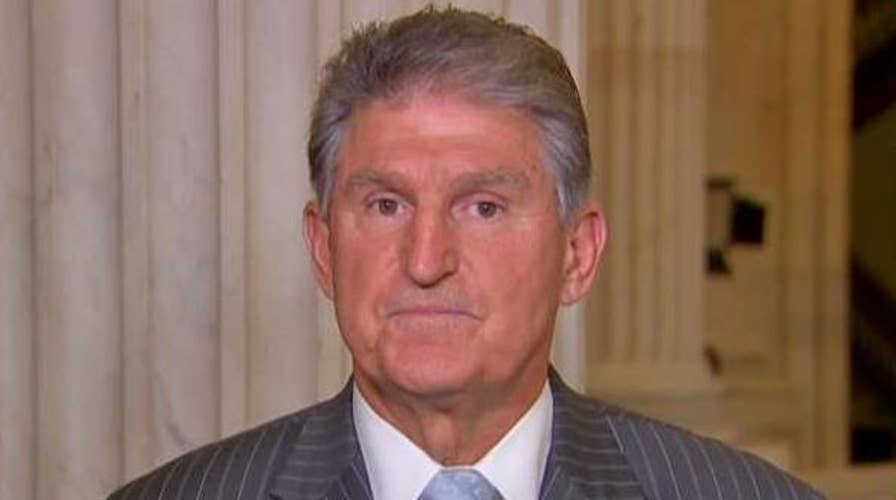
West Virginia Democrat Sen. Joe Manchin says that if Bernie Sanders is the 2020 Democratic nominee he will not vote for him. When questioned if he would vote for President Trump he responded that he would not vote for Bernie.
This is a rush transcript from "Your World," October 30, 2019. This copy may not be in its final form and may be updated.
NEIL CAVUTO, ANCHOR: Well, thank you, Mr. Wallace.
I'm Neil Cavuto, and this is "Your World."
And grab it while you can, because if you are looking to refinance the home you're in, or buy a new one, or get a car loan, well, your ship has come in, presumably for the last time, because it just got cheaper today.
However, if you have got a savings account or a C.D., you're not going to like this news. Your rate of return, no doubt already paltry, just got paltrier.
And therein lies the rub of a Federal Reserve cutting interest rates yet again, the third time it has done so this year, and maybe, just maybe, the last time it does so this year and into next year.
Hard to say. This much is not. Markets were sprinting ahead on this development, and the S&P 500 hitting an all-time high in the process.
We're going to be speaking with Senator John Thune how this should be the story, he says, we're talking about, and not impeachment.
First to our market pros, including Scott Martin, Danielle DiMartino Booth, and Jonas Max Ferris.
Scott, it's always a split read on a cut in interest rates. If you're in debt, you love it. If you're trying to save, you don't. How's this going to spill out for the economy?
SCOTT MARTIN, KINGSVIEW ASSET MANAGEMENT: Yes, and I think that's kind of the situation that the Fed is in, Neil.
You know, the Fed wants to be accommodative. They want to help this economy, but they also want to watch out for things like inflation, which is what low interest rates should propagate. So they're in a tough spot.
And then, of course, they have got the political pressure too on the side of that. So what's interesting to me, you mentioned it in the jump there, three straight rate cuts in a row, after a Fed, mind you, that, last December, made a huge policy mistake and thought they were going to be raising rates most of this year.
So it goes to show you, this is anybody's guess, but so far, so good. I think the Fed has made the right decision the last three times they have cut.
CAVUTO: You know, now I begin to wonder whether we have a lot of room if the Fed -- if everything hits the fan and everything goes bad, Danielle, because they don't have a lot more arrows in their quiver.
This reverses a third of the nine hikes we saw since this process of going from near zero interest rates began in late 2015. So then, if things really get bad, what do we do?
DANIELLE DIMARTINO BOOTH, FORMER FEDERAL RESERVE ADVISER: Well, that's a good question, Neil.
I mean, right now, the Fed is also conducting, effectively, quantitative easing. It's growing its balance sheet by $60 billion a month in treasury bills. So this is indeed a separate form of easing.
But, to your point, the Fed doesn't have a lot in terms of further interest rates cuts that it can make. It has indicated that, if the data were to change, deteriorate, or not, that it would assess the situation and make changes as need be.
But I would remind you that we're coming into an election year, Neil, and never in the history of the Fed have we seen, within seven months of an election, the Fed cutting rates because it doesn't want to be viewed as currying political favor.
CAVUTO: All right.
Well, I don't think they have to worry about trying to curry favor with this administration, because Donald Trump not a fan of Jerome Powell. I don't know if he's tweeted anything today.
But, Jonas, I'm wondering if the president will feel that this is enough to secure this economic recovery that has continued almost unabated now for the better part of a decade, and that nothing will endanger it before a year from now, when I think there's an election.
JONAS MAX FERRIS, CONTRIBUTOR: Probably not, because the Fed seemed to say they're not going to lower rates anymore unless things get really bad.
So this was the three times and it's done, basically. And I think the president's going to think, you should cut a couple more times. He's going to say that anyway, whether it's true or not. It might be true, by the way. He was actually right about rates needing to go down in the first place when the Fed was back in raising-rates mode, and we had some issues in the market.
The other point, the market, everything is pretty good right now. Nothing -- there's nothing spectacular going on in the GDP numbers that just came out. But inflation is muted. Everything the Fed says is great.
The problem -- the only real fear is, what are they going to do when the recession comes? And what is the -- what's the government going to do, because we're also running deficits like it's a stimulus program?
So there's not going to be another tax cut package and a Fed package. So that's the only -- the real downside. We're going to have to go into like a European zero percent rate thing mode. And that's -- that's where it would if we get a recession.
(CROSSTALK)
CAVUTO: Yes, that gets a little scary.
Scott, I was reviewing a lot of just the economic news just today, the 1.9 percent third-quarter GDP, I mean, that -- we're running at a good clip, stronger than the consensus estimate there. We're also seeing private payrolls rocket up 125,000 latest month. That's 25,000 better than folks thought, strong consumer activity, strong earnings thus far, beating estimates handily, three out of the four that we have seen.
That's a nice backdrop. What do you make of it?
MARTIN: It's not bad. And I hate to kind of pull out the party punch here, but I will tell you what.
If you look at those numbers, Neil, over the course of while the Fed has been cutting those last three times, that data is weakening. We're weak on payrolls. We're weak on wage growth. We're weaker on consumer and business sentiment even.
So, if you're an alien, and you come down to Earth, as hopefully they may come for us all at some point here, as the Fed keeps kind of cutting the zero, because they're going to look at this and say, well, if the Fed is cutting rates, that's hurting economic data.
And so Danielle's interesting point was about quantitative easing, or maybe even quantitative sneezing, as it is now, is, maybe that's making the economy a little sick and maybe needing more medicine, more medication, which is more rate cuts, which eventually go to zero, and then there's no bullets left.
CAVUTO: Yes.
Danielle, what's interesting about this, through it all, the consumer has been remarkably strong, and not at all dissuaded by the reticence of corporate CEOs and CFOs, purchasing managers, who are being very conservative with their cash.
When it comes to average shoppers planning for the upcoming holiday season, Katy bar the door. What do you make of that?
DIMARTINO BOOTH: Well, look, Neil, we do still -- somebody was tweeting earlier today -- and I said, look, credit card spending has slowed down appreciably. Wage growth has slowed down appreciably, but it's still growing.
So consumers still sense that their paychecks are growing. And I don't think they have clued into what executives right now are pondering. And that is the slowing that they're seeing, the vestiges of the trade war beginning to filter through to the big gigantic services economy that is the U.S. economy.
So I'm not so sure that, when you get the unemployment rate down at these low levels and executive confidence is tanking, that we don't necessarily have layoffs right around the corner. And we did indeed see weakening in this morning's ADP report.
CAVUTO: All right, guys, I want to thank you.
I apologize for cutting this a little short here.
With us now, the Senate majority whip, John Thune.
Senator, I'm sure you would rather, Republicans would rather, certainly, be talking about news like this, on the strong economy, interest rates coming down, a Goldilocks environment. You have heard that before, but it's all impeachment, impeachment, impeachment.
What do you think of that?
SEN. JOHN THUNE, R-S.D.: I'd rather be talking about the economy, Neil, for sure.
And I think the -- there's really good news out there, notwithstanding the Fed's action today, if you look at unemployment, again, historically, 50- year lows, 6.4 million jobs created since President Trump took office, and wage growth is still strong.
CAVUTO: Are you surprised, Senator, the president and your fellow Republicans are not getting much of a bow for that from those who are polled?
Now, the polls could be way off, but that, given this, he should be off to the races, right?
THUNE: I think part of it is, people will factor it in. They factor it in when it comes time to vote. And most people make decisions based upon how they're affected in their personal economy, those kitchen table issues that we always talk about.
And I think part of it is, we need to talk more about it. This is a remarkable record. And it's built upon good tax policy, good regulatory policy, good energy policy. Those all affect and influence what's happening out there in terms of growth in the economy, job creation and wage levels, all of which are in a very positive place right now, largely as a result of efforts made by this president, working with this Congress.
CAVUTO: Senator, tomorrow, we're going to get this House vote on due process or how -- an impeachment process, if you will.
They're not calling it an inquiry vote, but it sounds like that is what's going on, but not much Republican support.
What do you think about this, if it formalizes what committees handle what, coordination with Republicans talking to, subpoenaing witnesses and the like? What do you think?
THUNE: I think the problem the House Democrats have right now, Neil, is, the genie is already out of the bottle. I mean, I think they have done this in such a politicized way, highly partisan way.
And I think most Americans have a basic sense and threshold of fair play, which the Democrats in the House have not met. And so now they're kind of trying after the fact to go back and say, well, gee, let's let the other side have some due process here.
But the resolution they're going to vote on tomorrow doesn't do that. And they are a long ways afield of a process that represents anything that I think the American people would consider to be fair. And that's going to splash back on them.
I think this is -- when it's been rigged, as this process has from the very beginning, and I think, largely, again, built upon a premise that the Democrats started with when President Trump was elected, and that that is they were on their -- they were already on their mission to impeach him, that that makes where we are today, I think, a very difficult position for them to defend.
And, as we go forward, I think the American people are going to increasingly sour on what they see happening.
CAVUTO: Senator, there are a lot of people who are already baking into the proverbial cake the House going ahead and impeaching the president later this year, maybe around Christmastime, and it will be only Democrats voting to do so, but that the 218 votes, at a minimum, are there.
If it does happen that way, and it goes to the Senate, can you think of any of your Republican colleagues right now who go along?
THUNE: I think, because of the way the House has done this, and because, like I said, they sort of tried to orchestrate the outcome of this before they ever gave an opportunity for the president or his team or Republicans to be heard -- this has been a closed-door process, as you know, very much a secretive-type approach.
And I think that is going to make it very, very difficult for them going forward. In the Senate, if it gets here -- and I hope that it doesn't -- I hope that the House will decide not to move forward with the articles of impeachment. But let's assume that they do.
And if it does get over here, obviously, we have a responsibility, under the Constitution, to hear the argument. But I think the way that this case was constructed, the way that the House has gone about it is going to make it very, very difficult to see this as anything but a partisan play by Democrats in the House, who have always had in their hearts and minds a desire to try and impeach this president from the very first day that he took office.
CAVUTO: That might be behind some of their efforts, Democrats' efforts to block additional funding for the Defense Department.
How do you feel about that?
THUNE: I think it's a really bad idea.
And you're right. They have now on multiple occasions tried to block funding for the military. We have a vote tomorrow. They will have an opportunity to vote for the defense appropriations bill.
But in light of what happened last weekend, a very successful takedown of a major terrorist figure and much of his operation, it would seem that you would want to support what our military is doing. They're keeping Americans safe.
Democrats are standing in the way of that. They are obstructing it. They're making it very, very difficult for the American -- the men and women in uniform who defend our country not only to get a pay raise, which would be the biggest pay raise that they have had in a decade, but also to give them the tools, the weaponry, all the equipment and training they need to continue to keep our country safe.
CAVUTO: All right, Senator, it's always a pleasure. Thank you, sir, for taking the time.
THUNE: Nice to be with you. Thanks, Neil.
CAVUTO: All right.
As the senator were chatting, a couple of big earnings came out.
Facebook, better than expected, that stock is jumping after-hours.
Lyft with results better than expected, that stock jumping after-hours.
The granddaddy of them all is going to be coming out in about 20 minutes, the most valuable company on planet Earth for the time being. That is Apple. We will watch that one closely. It's sort of a good proxy for the economy and what it says going forward and the effects on trade and China and how many phones are selling and gadgets, period. All that coming up in the next 20 minutes.
In the meantime, a war zone this morning, and guess what's right in the middle of it? These fires in Northern California that now have the Reagan Presidential Library in its sights -- after this.
(COMMERCIAL BREAK)
CAVUTO: All right, we just got news from Twitter right now.
And these are tweets from Jack Dorsey, its heads, saying: "We have made the decision to stop all political advertising on Twitter globally."
Of course, this occurs the same -- over the period of the last week, Mark Zuckerberg of Facebook had said that they're not going to proof or copy- edit political ads for their accuracy or whether they're -- they're even telling the truth.
Twitter's gone one step further. We're not going to bother at all, Twitter saying no political advertising on its venue.
Now, of course, one of the biggest purveyors of Twitter is no less than president of the United States, no less. Any comments in that regard from Mr. Dorsey?
In the meantime, very close call for the Reagan Presidential Library. This is -- I misstated. This is in the Los Angeles area, so Southern California, but fires coming within mere yards of that library.
William La Jeunesse is following all of this from Simi Valley, California - - sir.
WILLIAM LA JEUNESSE, CORRESPONDENT: Hey, Neil.
Yes, we're about 40 miles northwest of Los Angeles. That is the library right there. And it is safe right now, thanks to an all-out attack by firefighters from the ground and in the air.
The fire, as you can see here -- we're going to do a 360 for you -- was literally racing up these hillsides, until it got hammered by helicopters.
You can see, as we go along this area here, you see some hand crews there. They basically put dirt around the edges to try to stop in the form of kind of a containment line.
We're going to come over to this area. When I arrived, Neil, two hours ago, this hillside was ablaze, literally engulfed in flames, and then suddenly two air cranes came on top of us with these huge water drops and stopped it cold, literally.
High winds basically driving these flames from one -- the point of origin about 6:00 a.m. this morning. We have got sustained winds over 40, 60 miles an hour. We have humidity under 10 percent. And last night, well, this could last, they say, until Thursday evening, several thousand under evacuation.
(BEGIN VIDEO CLIP)
CHAD COOK, VENTURA COUNTY FIRE DEPARTMENT ASSISTANT CHIEF: It's not always the wind. Our low relative humidities, the drought that we have suffered in Southern California, our warm, dry air mass that is over the area, rates of spread can easily outpace initial attack resources and the fire engines that are responding to even new starts later in the day.
(END VIDEO CLIP)
LA JEUNESSE: Basically, Edison has already taken a blackout of 62,000 people. They plan rolling blackout to de-energize other areas as these flames move into Westlake and Thousand Oaks, Neil.
So we are not out of the woods. Air quality is pretty bad. So, for some kids, Halloween probably not so happy -- back to you.
CAVUTO: William, thank you. Be safe, my friend, William La Jeunesse in the middle of that.
You think an impeachment trial will be inconvenient for the president? Try the six senators who want to be president.
(COMMERCIAL BREAK)
CAVUTO: All right, the timing of this is curious.
2020 Democrats who are running right now for president -- and there are six senators doing so -- facing a possible campaign crunch early next year. If the impeachment trial happens along the timeline that many Democrats hope, if this passes, this impeachment move in the House, that's when it would be arriving in the Senate.
What do they do?
Karl Rove on all of that.
Karl, what happens then? They're in more of a box than the president.
KARL ROVE, FORMER SENIOR ADVISER TO PRESIDENT GEORGE W. BUSH: Yes, they have to show up.
This is a trial, as you may remember from 1998 or even earlier, the hearings in 1974.
CAVUTO: Sure.
ROVE: I mean, this is going to get the attention of the country.
CAVUTO: And don't get me started on the ones I covered in 1868.
But I hear what you're saying.
ROVE: Yes, well, I didn't want to mention that, because I wasn't around then. I came a few years later.
CAVUTO: That's all right. Right.
ROVE: But they're going to have to show up. And they're going to have to be there and they can't go campaigning in Iowa.
And this is likely to start, perhaps if it passes by -- if impeachment passes House by Christmas, then this will begin shortly after Christmas or shortly after the 1st of the year. And they start voting on February 1 in Iowa.
So, for some period of time, whether it's a week or two weeks or three weeks, those six members are going to be stuck. And that's going to give a little bit of a tactical advantage to those that are not members of the Senate, like a Joe Biden or like a Mayor Pete Buttigieg or maybe even Robert Francis O'Rourke some of these others who are pretenders...
(LAUGHTER)
ROVE: ... but don't really have a chance. But it'll give them a slight tactical advantage.
CAVUTO: I assume you're talking about Beto O'Rourke there. I forgot the Robert Francis thing. I always get a kick out of that.
ROVE: Well, I'm just reading what's on the ballot in Texas.
CAVUTO: What's on the ballot.
ROVE: I didn't see that other guy.
CAVUTO: No, I hear you.
I am curious, though. Democrats might rue the day pushing this, because, to your point, the timing could be tough. I'm just wondering how they handle. The consensus seems to be building, whether justified or not, and not playing politics one way or the other, that that would be the timing.
If the House where to push impeachment, which it seems to be, it would be a December event, and then it would move to the Senate, assuming that they had the votes for that, right?
ROVE: Yes.
Well, and, look, we don't know exactly what the timing is going to be, obviously, because this is an unusual process. They have not gone in regular order. There's been no vote on the House of Representatives floor to authorize a formal inquiry.
It's -- what is being done for an impeachment hearing is being done not by the Judiciary Committee, but by the Intelligence Committee. They're going to eventually have to somehow or another deflect it over to the Judiciary Committee, and we don't know how long that's going to take.
But, yes, it looks like it's going to be not sooner, it's going to be later, which is not what they set out to do. Originally, they were talking about trying to get this thing done well in advance of Thanksgiving. They will be lucky to get it by Christmastime.
And, yes, it's going to kick it over into the first of the year. And it's going to rivet our attention. But it's going to be hard for them to sort of hotdog like they have done in some of these hearings, when they go around and everybody gets five minutes to ask questions.
It's going to be a little bit harder to do that when you have 100 members of the Senate and the Supreme Court chief justice presiding over what is constituted as a trial.
CAVUTO: We shall watch it carefully, my friend. Thank you very much, Karl Rove, joining us out of Austin, Texas.
You're looking live right now on Capitol Hill here. And a lot of people say, we are in divisive and very threatening, damning times.
Forgive David Rubenstein, who just wrote a great book, "The American Story: Conversations with Master Historians," to remind us, with some precise examples, been there, done that, got through that -- after this.
(COMMERCIAL BREAK)
CAVUTO: Bernie Sanders said more moderates than you know would support his program and spending agenda. Among them, he said was West Virginia Democratic Senator Joe Manchin.
We couldn't reach Senator Sanders, but we do have Senator Manchin -- after this.
(COMMERCIAL BREAK)
CAVUTO: All right, when we heard this, it raised our eyebrows, Bernie Sanders saying, yes, even more moderate members of his party, like Joe Manchin, the West Virginia Democrat, would support his agenda.
So, we thought we'd bounce that off Joe Manchin himself. The senator joins us.
Senator, thank you for taking the time.
SEN. JOE MANCHIN, D-W.V.: Thanks for having me again, Neil.
CAVUTO: Always a pleasure, sir.
Now, a lot to talk to you about, if would indulge me on this, the Bernie Sanders thing.
MANCHIN: Sure.
CAVUTO: Would you support his agenda?
MANCHIN: Absolutely not.
And Bernie and I have had many conversations. I think that Bernie brings a lot to the table that makes you think a little bit, kind of just get the blood going and stirring and everything. But it's not practical where I come from.
Bernie keeps saying Medicare for all. I says, Bernie, we can't even put for Medicare for some. I says, right now, the trust fund is going to go broke by 2026.
And these are people that paid into it and earned it. Now you want to expand it. What happens? So it doesn't make sense at all.
CAVUTO: What if he were your nominee for president and it's him vs. Donald Trump? Who do you vote for?
(LAUGHTER)
MANCHIN: Well, it wouldn't be Bernie.
CAVUTO: All right, so it would be the president, unless you leave it blank?
MANCHIN: It wouldn't be Bernie.
CAVUTO: But would it be Donald Trump?
MANCHIN: Let's just say I'm going to make decisions based on what's best for my country and my state.
CAVUTO: OK. All right.
MANCHIN: OK.
CAVUTO: Let's go back and forth.
Many Democrats, some Republicans, certainly, a good many Republicans, I should add, Senator, very concerned about, despite getting al-Baghdadi, that our troop departure from Northern Syria, and it's still sticks in their craw. And many are still looking at punishing Turkey as well, even though they have not re-invaded.
Where do you stand on that?
MANCHIN: Well, let me tell you, we just had a briefing, as you know, secured briefing. Just got out of that, Neil. It's a very complicated thing.
Turkey cozying up to the Russians is absolutely wrong. NATO -- basically, NATO's -- purpose of NATO is to stop the Russian aggression. And here Turkey is making deals with them.
So we're -- Turkey is going to have to make a decision where they want to be. Going to be in NATO and be a trusted ally, or are they going to play games and footsie and think they can go all around this?
So I think they have a real decision to be made here. But it's a very complicated situation. I don't want to drive Turkey into the hands of Russia. If that's the direction they want to go, then fine. Make your commitment, make your choice, and we will go from there.
But, right now, Turkey buying the weapons they bought, the missile defense, and then wanting us to basically give them the F-35 Strike Fighter or sell it to them, absolutely not. So you got to be very careful on how we handle them. It's a very challenging area.
Now, what we're saying is what we...
CAVUTO: Would you kick them out of NATO if you had your druthers? Do you think they should even be in NATO, when they team up with Russia, and now there are Russian soldiers where ours used to be?
MANCHIN: Well, Neil, here's the thing.
Our -- the whole purpose of NATO was to stop the Russian aggression.
CAVUTO: Right?
MANCHIN: OK?
And that was the allies of NATO. Turkey's an ally, a NATO ally. And that should have been their mission too. But they're not doing that. They're doing absolutely the opposite.
They're going to have to make that decision. Erdogan, under this leadership, it seems like they want to have their cake and eat it too.
Now, I don't know, as the regime would change -- all regimes change after - - after a while, a little bit longer than what our process works because of our election cycle. But still, yes, change will come.
So are we going to be premature? Are we going to have a chance to later on, anybody in the wings, if you will, that will come back to normality and bring Turkey back into the fold? They have been a good ally in the past, I'm told, much better than what they are now.
So, we will see.
CAVUTO: You know, Senator, the House is working on getting ready for tomorrow, this process vote, inquiry vote. It's not an inquiry vote. I understand that.
But it's meant to mollify some Republicans' concern it's a rigged process, a kangaroo court, to quote the president.
MANCHIN: Sure. Yes.
CAVUTO: If the House were to vote on impeachment one way or the other, let's say, by Christmastime -- I think that was the goal, to have it resolved, by Steny Hoyer, by then -- and it comes to the Senate, if the House moved on that to impeach the president, would you?
MANCHIN: Well, no, here's what I have said, Neil.
I think a lot of senators I have heard say the same and feel as committed as I do. We have a rule of law. We have a Constitution. We have the separation of powers, but also we have to have the facts.
Whether the people like the president or not, the bottom line is, the facts have to be there to support whatever the articles are. If they just have a political vote on articles of impeachment, whether it be one or more, and there's no facts to substantiate that removal of office, then we will see that.
But I'm going to wait until the facts come out before I make any decisions, and I'm going to be part of that trial. And I take it very seriously. And no person is above the law, me, the president, or anybody else.
But on the other -- on the other hand, everyone's innocent until proven guilty. And we haven't seen any facts to date. There's a lot going on right now. The House has -- under the Constitution, the House has the right to do what they're doing.
CAVUTO: Right.
MANCHIN: I'm understanding a lot of the procedures have been done the way it's been done. Just because you're on one side or the other, you might not like it as well.
But people have asked me to get involved. I says, I want to make sure that we operate in the Senate in the realm of what we're supposed to do, not in the realm of telling somebody else such as the House what they should do.
CAVUTO: Do you think, Senator, for the six senators who are running for president right now, that their obligation is to be in Washington for those impeachment hearings and that trial, as it would be, if it came to that?
MANCHIN: Oh, I definitely think we all should be here.
I mean, the rules that we have for an impeachment -- I have only been sitting through one impeachment. It was a judge -- nominee for a judge. And we were required to sit there. We had to sit there.
And there's a structure that you go through, a procedure that you go through, in order to make an informed decision, based on the facts that are presented, and as the case is laid out.
How in the world can you do that? They sure just can't run in and vote on the day to vote and not sit there and hear all of the proceedings.
CAVUTO: All right, this Stop Looting Americans Pensions, this is a...
MANCHIN: The SLAP Act.
CAVUTO: ... big cause for you -- right, the SLAP ACT.
Where does that stand? Because that's almost routinely happening. Now, those who raid them always argue the funds are protected, but you're worried.
MANCHIN: Well, I'm not worried. It's just the fact.
CAVUTO: Yes.
MANCHIN: Basically, the wage earner, the worker, whether it be a miner, or whether it be any worker who's paid into a fund, they lose everything. They're the first that gets raided. All the assets are taken. There's nothing left.
So all we're doing is reversing and putting the wage earner on the front line, front of the line, not the back. Look at what happened with Murray industry last night. You think that's not going to happen? Our pensions are going to start rolling down. Now we have got...
CAVUTO: You're talking about the big coal producer that went out of business, yes.
MANCHIN: The big coal producer Murray Energy. And the United Mine Workers, we have been fighting for their pensions.
CAVUTO: Sure.
MANCHIN: And we're imploring Mitch McConnell to put it on the bill that I have had out there for five years now.
It'll fix the problem that we have. We use the AML excess money. But we're talking in the SLAP Act, Stop Looting America's Pensions. That's for every worker.
CAVUTO: All right, Senator...
MANCHIN: And that's what we're trying to prevent from happening.
CAVUTO: I apologize, sir. I was jumping on you. We got some news in here.
Thank you, as always. We covered a lot of ground. I apologize for hop, skipping on all of that.
MANCHIN: OK, Neil. No problem.
CAVUTO: Thank you, Senator.
Apple, as I promised, is out with better-than-expected numbers.
The stock advancing right now as well on better earnings, better revenue, and, when it came to just a services business, north of $100 billion.
Think of that, a staggering sum for a company that just seems to print money and now even more -- after this.
(COMMERCIAL BREAK)
CAVUTO: All right, House Democrats are preparing to vote on these rules of impeachment.
That's the best way I can explain it. It's not looking into sort of a formal vote to begin the impeachment process, but a way to at least advance a process. I think that's what they're doing.
Maybe Republican Senator John Kennedy can help me out with this.
Senator, what do you think? What are they doing? Are you supporting it?
SEN. JOHN KENNEDY, R-LA: I think they're just playing games, Neil.
The new resolution, I interpret it -- well, I'm not sure what to make of it, except that I liken it to putting -- trying to put paint on rotten wood.
Now, no fair-minded person with an intellect above a single-cell organism believes that, from the very beginning, these impeachment proceedings have been anything but rigged.
I mean, does anybody really believe that Speaker Pelosi is impartial, or Chairman Schiff? Their judicial philosophy is clearly guilty. And there's no rule of law. There's no due process.
And now, after a number of people, not just Republicans, American people said, hey, wait a minute. Whether you like President Trump or not, I thought we had due process and the rule of law in this country.
(CROSSTALK)
CAVUTO: But if this offers that possibility -- I definitely see and hear what you're saying, but if it offers a chance for Republicans to question and subpoena documents and witnesses and that sort of thing, albeit with -- you're quite right -- with the chairman's permission, it's better than what you got right now.
What do you think?
KENNEDY: Not -- not -- not much.
CAVUTO: OK.
KENNEDY: They say, well, we're going to give the Republicans the opportunity to call witnesses.
They just don't bother to tell you they have got to get Adam Schiff's permission. Now, Adam Schiff's not calling the shots. Nancy Pelosi is.
If you took Speaker Pelosi and turned her upside-down and shook her, Adam Schiff would fall out of her pocket, bam, hit the floor. OK? She's calling these shots. She is saying, now Republicans can call witnesses.
(CROSSTALK)
KENNEDY: Only with her permission.
CAVUTO: But she's shrewd about it, right, Senator?
I mean, she must be realizing here that this backs up to a potential House impeachment vote during the holidays, this goes into the Senate during the new year, when Iowa caucuses are starting and everything else, New Hampshire, what have you. It will imperil those six senators running for president.
It's a mess, right?
KENNEDY: Do you think -- do you think, Neil -- you're a bright guy now.
You think that is a coincidence?
CAVUTO: No, I think I'm that single-cell guy, yes.
KENNEDY: I don't. I don't think it's a coincidence.
We were originally told that the impeachment -- the articles would be sent to us by Thanksgiving. So, I'm figuring we will be here over Christmas doing our part in the Senate.
Now, all of a sudden, they have been delayed until January. Maybe it's a coincidence. But I don't believe in coincidences up here.
CAVUTO: Well, wouldn't they be hurting themselves doing that with the ones who have a good...
(CROSSTALK)
KENNEDY: No, who does that help? Let me finish my point. Who does that help?
CAVUTO: So, you think it helps Joe Biden in that case?
KENNEDY: Amen, brother.
CAVUTO: All right, so you think this entire process is actually -- this is kind of Machiavellian on your part -- meant to help Joe Biden?
KENNEDY: I'm not accusing anybody of anything.
I'm just saying it's been my experience up here there are very few coincidences. And I know, with the Iowa caucuses starting in February, you're going to have Senator Warren, Senator Sanders, Senator Klobuchar, Senator Booker. Let me go down the list.
All of them are going to be in the Senate six days a week Monday -- most of the day Monday through Saturday.
Now, you don't have to be Mensa material to figure out who that helps.
(LAUGHTER)
CAVUTO: That's very interesting.
Senator, thank you very...
KENNEDY: Maybe it's just a coincidence, but I doubt it.
CAVUTO: No, no, no, no, no. You're doing that Columbo thing, right, You're shaking your -- all right, thank you very much, Senator.
Good seeing you.
KENNEDY: Good to see you, Neil.
CAVUTO: Interesting read on things.
And it does seem like the middle of a political crisis, but there's an interesting book out talking to historians of their view of times where we had bigger crises, much bigger crises, and we got through them, each and every single time.
David Rubenstein on that and history and, I guess, us -- after this.
(COMMERCIAL BREAK)
CAVUTO: You know, we always say this. And we look at the troubles of the White House now, another constitutional crisis, and we're all going to hell in a handbasket.
Sometimes, you need to step back, way, way back, and say, been there, done that, we got through that.
David Rubenstein is out right now with a fascinating book. It's sort of a read at our story, "The American Story: Conversations with Master Historians," their reflections on some key figures throughout history.
David Rubenstein and I have something in common. We both worked -- I should say, I was an intern for Jimmy Carter. He was a bigwig during the Carter administration. I don't know what became of him since, but he runs this company called the Carlisle Group. He's a multibillionaire, yadda, yadda, yadda, does some stuff on Bloomberg, whatever.
DAVID RUBENSTEIN, AUTHOR, "THE AMERICAN STORY: CONVERSATIONS WITH MASTER HISTORIANS": I'd rather have my own show on FOX.
CAVUTO: Yes.
(LAUGHTER)
CAVUTO: How are you? It's very good to see you.
RUBENSTEIN: Thank you for inviting me. And thank you for reading the book.
And many people that interviewed me about it haven't actually read the book. I can see you have read it. So, thanks for doing that.
CAVUTO: Well, I love history. And I know you're a lover of history and actually preserving it too.
And you spent a good deal of your fortune trying to preserve not only major areas, Monticello, and, of course, anything connected with our great past, but even documents. You have bought copies of the Constitution, the Declaration of Independence.
What's crazy about you, though, is, you don't keep them. You share them with the world. You have them on display. That's a problem.
RUBENSTEIN: Well, what I'm trying to do is educate people a little bit more about American history.
If you don't know the past, you're not going to be able to be prepared for the future, in my view and the view of many others. It's sad to say, but, right now, three-quarters of Americans cannot name the three branches of government. And one-third of Americans cannot name even one branch of government.
CAVUTO: Wow.
RUBENSTEIN: And a test, a citizenship test, which is basically a civics history test, you have to take that if you're a naturalized citizen and want to become a U.S. citizen; 91 percent of the people who take that test pass after some study.
That same test was given to native-born Americans recently, and only one state, Vermont, could a majority of citizens pass that test. We don't really teach civics anymore. We don't teach history.
CAVUTO: No, you're right.
RUBENSTEIN: So what I'm trying to do in this book is this.
I -- not that members of Congress don't know history, but I thought maybe they could learn a little bit more. So, for the last six years, I have -- once a month, when Congress is in session, I would interview a great historian about American history, Doris Kearns Goodwin, David McCullough, and then, in front of members of Congress, give them a sense of what these books are about.
And then they ask questions. And it's a good way for members to bond with each other, because we ask them to sit with people from the opposite party, which they normally don't do.
CAVUTO: But are those closed to media events?
RUBENSTEIN: They are closed to media. And that's why the members are willing to do it.
CAVUTO: Absolutely.
RUBENSTEIN: Because, if media was there, they wouldn't want to be sitting with people from the opposite party, perhaps.
But it's a very nice bipartisan, nonpartisan event. And we're doing about 40 of some of the interviews, and I have taken about 18 of them and put them in this book.
CAVUTO: They're excellent. They're very good. And for any lover of history, I mean, they're very revealing.
I had mistakenly said Bernstein when I was talking about Bob Woodward and your conversation with him and Richard Nixon. I only mention the context. His was a long, drawn-out impeachment process. Many say that Woodward and Bernstein made that possible.
But I was interested when you were questioning him about presidents. He goes: "We have had lots of presidents, lots of disagreements, and there's a lot going on. I tried to write about and understand some of the other presidents, but none of them were haters like Nixon."
RUBENSTEIN: Yes, I think people didn't realize until the tapes came out that Nixon really didn't like certain types of people. And he had some fairly anti-Semitic comments, among other things.
I don't think people realized that until those tapes came out. Now, why did he not destroy the tapes? I think many people think he wanted to use the tapes to write his memoirs.
CAVUTO: Right.
RUBENSTEIN: And he never thought the Supreme Court would ask them to be turned over.
CAVUTO: And other -- and his predecessors had all had tapes, nothing to the degree he did, also, I think, in John Kennedy's case, for eventual memoirs.
RUBENSTEIN: Johnson had tapes. And Kennedy had tapes and so forth.
So what I have tried to do in this book is simply this. I would like to write an American history book that covers some of the great figures in American history, but it's relatively easy to read.
So there's a little summary of each of the interviews, but then a transcript of the interviews distilled a bit to make it easily understood. This is not an epic book on American history.
There's a book out now by Jill Lepore called "These Truths." It's a 900- page book on American history, a great textbook and a nonfiction book about American history. This isn't that.
If you would like to read a couple hundred pages on American history from George Washington through Ronald Reagan, this is a good book to do that with.
CAVUTO: What I did notice -- and I'm making this leap, David -- you're probably not -- that the ones you interview, the historians you argue with, Chernow looking at Hamilton, Doris Kearns Goodwin looking at Lincoln, Isaacson, Ben Franklin, they were inspiring and intellectually stimulating individuals.
And they grew -- Benjamin Franklin a different sense, not a president.
RUBENSTEIN: Right.
CAVUTO: But they grew in that role, FDR in particular.
I think when you were going back to look at what he was when he was up for election in 1944, and he was barely holding onto his health and what have you, that's when you realized, that's dealing with pain and difficulty and hardship.
RUBENSTEIN: Well, he -- probably, he shouldn't have run for reelection, but he never really considered not running for reelection. He only lived a few months after he was sworn in.
One of the questions that was very interesting is, the early people we talked about in this book, Washington, Madison, Jefferson, so forth, when our country was started, we only had three million Americans, three million, half-a-million slaves, and they weren't allowed to participate in government.
And then you had 1.25 million women who couldn't participate in government. So out of 1.25 white male Christian individuals, you had George Washington, Benjamin Franklin, Alexander Hamilton, James Madison, James Monroe, with only 1.25 million people.
CAVUTO: Wow.
RUBENSTEIN: Now we have 330 million people.
Where are the George Washingtons, Benjamin Franklins and so forth?
CAVUTO: You never mention Donald Trump. Making passing reference, I believe, to those you were speaking to at the time, including Woodward.
Where do you think he will be in the historic sense?
RUBENSTEIN: Most historians would say you can't really know until a president is gone for quite some time.
Remember, Harry Truman wasn't very popular when he left office, and now he's lionized.
CAVUTO: That's right.
RUBENSTEIN: Jimmy Carter wasn't very popular. Now he's respected much more than he was before.
So you don't really know.
CAVUTO: More as an ex-president, right?
RUBENSTEIN: Yes, but his presidency was pretty impressive too.
CAVUTO: Absolutely. Absolutely.
RUBENSTEIN: Your contributions were no doubt vital to it, right?
CAVUTO: Well, I got coffee.
RUBENSTEIN: So I don't think you can tell.
For example, if there is an impeachment and a conviction, which doesn't seem to be the case, it'd be -- go one way. If there's no impeachment, it would go another way, or an impeachment and no conviction.
So we don't know what all the facts are. And most presidents...
CAVUTO: But it doesn't depend on whether he gets a second term or not?
RUBENSTEIN: That's correct. Most presidents are measured by whether they got reelected.
Three presidents in recent history didn't get reelected, Gerald Ford, George Herbert Walker Bush, and Jimmy Carter. And so they're considered less successful because they didn't get reelected.
If you get reelected, and your second term isn't so great, you're still considered reasonably successful. So, I think, to some extent, his record in history will be whether he gets reelected or not.
CAVUTO: But you left out James Polk.
(CROSSTALK) RUBENSTEIN: That's true.
CAVUTO: There could be authors there, but they're long gone.
You mentioned -- I don't know whether it was the MLK historian or the JFK historian, Reeves, or what have you, but on his famous speech in the Washington Mall, and how John Kennedy -- I didn't realize this -- didn't want to go to it.
And -- but he was so impressed by Martin Luther King later that he wanted to have an audience with him. Right?
RUBENSTEIN: I was inspired to go into public service by John Kennedy, his famous inaugural address.
But when you go back and look at the facts, the facts were that John Kennedy didn't want the March on Washington. He thought it would lead to violence. And maybe he had a good reason of thinking that.
So, also, the Justice Department controlled the microphone, and they were prepared to cut the microphone off if people said something that was too violent.
CAVUTO: Really?
RUBENSTEIN: John Lewis, in particular, his speech had been toned down because it was seen as too violent in those days.
Martin Luther King's speech was prepared in advance. He had a speechwriter, but when he was giving the speech, Mahalia Jackson was behind him and said, "Martin, remember the dream, the dream, the dream."
And then he got rid of the speech, the prepared speech, and he gave his "I Have a Dream" speech, which had given many times before. Whites had never heard it. Blacks had heard it, and they were mesmerized by it.
And then, when he went to the White House afterwards, John Kennedy greeted him by saying, "I have a dream."
CAVUTO: Yes. And I want to meet you. I want to talk to you.
RUBENSTEIN: Right.
CAVUTO: All right.
You have interviewed a lot of famous people. Jerome Powell comes to mind. I love that chat. And it was very kidding and irreverent. Ruth Bader Ginsburg. Bill Gates.
Who's your favorite?
RUBENSTEIN: Well, they're all good, because like you have three children. How many children do you have?
CAVUTO: Three.
RUBENSTEIN: Three children.
Who's your favorite?
CAVUTO: Depends on the day.
(LAUGHTER)
RUBENSTEIN: So I love all the people I interview.
Obviously, some people are better at being an interviewee than others. There's no doubt, when I interviewed Oprah, I thought she had a good future in television. I told her that.
Jeff Bezos, we'd interviewed in front of 2,000 people. He was -- had a great sense of humor. He did a terrific job.
CAVUTO: He does have a great sense of humor, great laugh.
RUBENSTEIN: He's very, very funny, and great laugh. And it was great.
So, I love everybody I'm interviewing.
CAVUTO: All right. It's a great book. I highly recommend it.
It's just a reminder that, every time we get down on ourselves, David comes along to tell us, been there, done that, and we can get through this each and every time, mimics the view of Doris Kearns Goodwin, who said of Abraham Lincoln, one crisis at a time.
We will have more after this.
(COMMERCIAL BREAK)
CAVUTO: You know, so many great reads from David's book, but an interesting reflection on Ronald Reagan, who, if you think about, had twice failed to get the Republican nomination, before he ultimately did win the presidency, two back-to-back landslide terms, believing throughout that anything was possible, and everything was.
Hope springs eternal.
"The Five" starts now.
Content and Programming Copyright 2019 Fox News Network, LLC. ALL RIGHTS RESERVED. Copyright 2019 ASC Services II Media, LLC. All materials herein are protected by United States copyright law and may not be reproduced, distributed, transmitted, displayed, published or broadcast without the prior written permission of ASC Services II Media, LLC. You may not alter or remove any trademark, copyright or other notice from copies of the content.
