


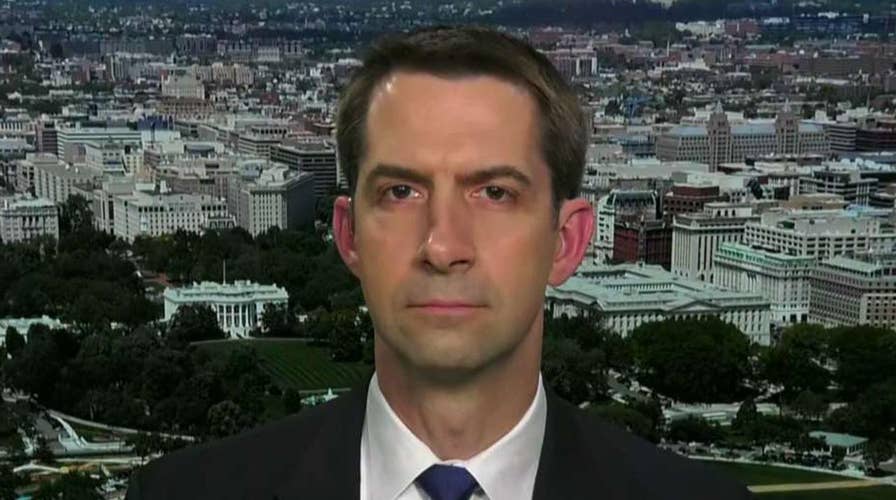
Sen. Cotton on sending troops to Iran amid rising tensions
Trump says he would send military to Iran 'if we need them'; reaction from Armed Services Committee member Sen. Tom Cotton.
This is a rush transcript from "The Story," May 23, 2019. This copy may not be in its final form and may be updated.
MARTHA MACCALLUM, HOST: Thank you. Thank you. Thanks, Bret. Good to see you. All right, what do we do at these extra seconds tonight? What is going on in Washington? Is this ever going to end or is it going to be like this all the way to the election?
Even then-Speaker Newt Gingrich and Bill Clinton found a way to pass a budget and then they went on to reform welfare, all while the House was impeaching Bill Clinton. Newt joins us in just a moment, but this thing keeps escalating in a brawl of words after the infrastructure meeting imploded yesterday and the president said basically call me when you're done investigating and then we will get some work done. Nancy Pelosi did not like that so she called him basically unwell.
(BEGIN VIDEO CLIP)
REP. NANCY PELOSI, D-CALIF., HOUSE SPEAKER: I pray for the President of the United States. I wish that his family or his administration or his staff would have an intervention for the good of the country.
UNIDENTIFIED FEMALE: You're prayer comments almost suggest you're concerned about his wellbeing.
PELOSI: I am.
(END VIDEO CLIP)
MACCALLUM: So the President was not happy about that, ever the counter- puncher. Late today, he let her have it over the inaction on the new trade deal with Mexico and Canada that he very much wants to get signed.
(BEGIN VIDEO CLIP)
DONALD TRUMP, PRESIDENT: She's a mess. Look, let's face it. She doesn't understand it and they sort of feel she's disintegrating before the -- crazy Nancy, I tell you what I've been watching her and I have -- I have been watching her for a long period of time. She's not the same person. She's lost it. It was sad when I watched Nancy all-moving the movement in the hands and the craziness and I watched it. That's, by the way, a person that's got some problems.
(END VIDEO CLIP)
MACCALLUM: So “The Story” begins tonight with White House Deputy Press Secretary Hogan Gidley who was in the room during the President's fiery press conference today. Hogan, good to see you. Thanks for being here tonight. I mean, you know, I think people look at this and they say, what about us? You know, what about the people of America who would very much like everybody to stop squabbling and maybe get some of this stuff done?
HOGAN GIDLEY, DEPUTY WHITE HOUSE PRESS SECRETARY: Well, you're right. And that's exactly what the American people should be asking. This is the Russia collusion hoax, witch-hunt 2.0. They first accused this president of colluding with a foreign power without proof, without evidence, and now Nancy Pelosi is saying that the president is engaged in a cover-up without proof and without evidence.
At some point, the media has to ask these Democrats, where's the proof. And if you have all this proof, why are we going through with these investigations? It's not the president who's suffering here. He's doing quite well. It's the American people who deserve their elected officials to roll up their sleeves and get to work and Democrats refuse to do that.
They let our borders become open, they won't touch infrastructure as we're trying to do this week, it's in bad need of repair, they won't touch the health care system. These Democrats refuse to do anything in the first 100-plus days of their control and won't work with the President on a single topic.
MACCALLUM: I want to ask you about what the president going to do next, but I do want to ask you a quick question because there was an interesting moment when he was asking all of you, you know, the recollection of what happened in the room because she obviously characterized it very differently than the President did.
He said he was very common at one point. He said is there a tape of what happened in there and Kellyanne Conway said, nodded, yes. So is there a tape of what happened in there?
GIDLEY: Yes. If there's a tape, I've not seen it, but that doesn't mean there isn't one. Listen, we know how the president acts in those closed- door meetings. He's always very calm. He always has the interest of the American people at heart. And instead Democrats come in there and they want to use the White House and the West Wing to grandstand and try to score cheap political points.
What we've got to do is decide. Two I-words we're at stake this week. It was infrastructure and impeachment. The Democrats chose impeachment and it's a shame for the American people.
MACCALLUM: So what does the president do now? I mean, what's his strategy because it feels like they're trying to pull this all the way into the 2020 mode where everything is just on lockdown, nothing's going to happen, and it's going to be all about investigation after investigation.
GIDLEY: Well, look, no one's a better brander and no one's a better communicator than Donald Trump. And what he's going to do is take it directly to the American people. We've now seen some even in the mainstream media find religion on immigration. We have been crowing about this for two plus years.
The president took it directly to the American people from the Oval Office, from the White House briefing room, from the diplomat reception room, and finally the media starting to say hey there might be a problem on the southern border.
The impact across this country has been great. We felt it, the President has been talking about it. He's going to have to use the bully pulpit of the presidency to take it to the -- to the people because they deserve to know what's going on and Democrats won't come to the table and we're going to expose that time and time again.
MACCALLUM: So with regard to immigration, there was an announcement today that basically, people who had sponsored immigrants to come into the country are going to be responsible for repaying any of the benefits that they take advantage of. How is that going to work?
GIDLEY: Well, absolutely. It's actually already codified into law. It was passed in 1996 signed by Bill Clinton, it just hasn't been enforced. Shockingly the swamp takes over again. But this president says no more. It's time for those sponsors who said that they would pay for dollar for dollar matches to any federal program that paid for immigrants. It's time for them to have some skin in the game here.
It's a kickstart actually to the merit-based system we've talked about before. We want immigrants in this country. We're not even changing the 1.1 million immigrants that come here every year. We're not changing that number. But we're changing the construct of those who come. We want people to contribute -- not to be a drain on the American economy or our social safety net programs that the American people deserve.
Right now, immigrants are taking advantage of it and the sponsors by law are supposed to pay for that and it's time for them to put in their fair share.
MACCALLUM: So let me ask you this. You know, obviously, we've watched what happened over the last 48 hours. That level really can't be -- I don't think -- it can't be sustained, right indefinitely. Does the President -- maybe he cannot work with Nancy Pelosi because they seem like they don't get along at the moment. What about Chuck Schumer? Does he think there's a possibility that maybe he and Chuck Schumer can work together?
GIDLEY: Well, it's so interesting. I believe so but we were working with Chuck Schumer on immigration for example and Nancy Pelosi stepped in and pulled her puppet strings and said you can't work with him. Let's not forget. After our first immigration meeting, we all came out with a kumbaya let's work together --
MACCALLUM: The infrastructure meeting.
GIDLEY: Correct, like three weeks ago. And then we set up a meeting with Secretary Mnuchin at the Treasury and Chairman Neal on House Ways and Means. Guess what, Nancy Pelosi also pulled that meeting as well.
We were going to set up funding mechanisms so that we would have something substantive to discuss yesterday. Nancy Pelosi has no intention of working with this president and no intention of doing something for the American people.
MACCALLUM: All right, I'm going to talk to somebody who might have some more information on that right now. So thank you, Hogan. Good to see you tonight. Hogan Gidley from the White House. Next up is Democratic Congresswoman Debbie Dingell from Michigan. Debbie, Congresswoman, great to have you with us. Thank you for being here tonight.
REP. DEBBIE DINGELL, D-MICH.: Martha, it's great to be with you.
MACCALLUM: So what's your reaction to that? I mean, in terms of you know, the new version of NAFTA, in terms of immigration work, in terms of infrastructure and you look back and you know, see that in the past it's been possible to get stuff done even under the worst circumstances. But you heard Hogan Gidley say that he believes that Nancy Pelosi is the one who is preventing that progress from happening.
DINGELL: So I'm going to tell you the American people expect us -- sorry - - expect us to do something, and we've got to do it. It's unacceptable to me when the president walked in and said I'm not going to work with you an infrastructure. We got to work together. That is the reality.
Our American people expect us to do something on drugs, the pharmaceutical cost, health care, infrastructure, trade --
(CROSSTALK)
MACCALLUM: Congresswoman, he said that he said that because you know, moments before she chose the moment right before she was about to walk into that meeting to say that the president is engaged in a cover-up, I mean that is not a great way to go in and start working on the work of the American people. That's a game-changer.
DINGELL: But I'm also going to tell you that the President had already had printed signs to walk out in the Rose Garden and have a press conference. So what I'm going to say to everybody is Congress has a responsibility for oversight. They've got to follow the facts and wherever the facts go. Nobody's above the law.
But at the same time, we've got committees that are looking at this and looking at different issues, they've got a responsibility to do that. But we've got to work and have been working to lower prescription drug prices. We passed seven bills. When he says that we haven't done anything, we've been passing a whole lot of bills.
We've got to pass some bills, the Senate has got to start to take them up. Violence against women act, it's been more than 30 days since that bill went to the Senate. Nobody is bringing it up. There are a lot of things that we've got to keep working on and I'm committed to working with both sides of the aisle.
MACCALLUM: But it doesn't sound like Nancy Pelosi is. I mean, she says that you know, that -- she's talking about impeachment. She's saying that the environment looks like --she was asked today in her news conference you know, what are you going to do, what can move on to. She, you know, she's sort of hemmed and hawed and said we need to find out what this president did.
Two years of investigation that the special counsel that Democrats very much wanted in order to get this thing figured out, looked at 19 lawyers, you've heard a million times, how many subpoenas, all the documents. Why reopen the whole thing and go through all that again? Is that really what Democrats think the American people want?
DINGELL: I'm going to tell you that they've got a responsibility. When you read the Mueller report --
MACCALLUM: I have.
DINGELL: There are things that need to be preserved. Like I have, we both have. Why doesn't anybody talk about the fact that Russians are trying to divide us as a country, that they're attacking the fundamental pillars of our Constitution?
MACCALLUM: I think that's very much talked about on both sides. And you know what I think? I think the Russians probably watched this exchange we've all witnessed over casual days and they say to themselves, wow, this is the gift that keeps on giving. We wanted to create chaos and these -- I mean we need -- you know, I think the best defense at this point would be to you know, to put it aside at this point. But they love the fact that the investigations are endless.
DINGELL: Congress has responsibility for oversight. We are equal branches of the government. We're not going to abdicate --
MACCALLUM: But doesn't that mean a two-year Special Counsel investigation, isn't that oversight? I mean, isn't that -- the report was presented to them.
DINGELL: But what the report does, they did -- talk to Mueller. I think it's really important that Mueller come up and testify because Mueller reported the facts and then expects Congress to consider it. That's part of what those committee chairmen have the responsibility to do and those committees do. But the president can't walk into a meeting and say I'm not going to work with you.
Both Bill Clinton and Richard Nixon -- I'm old enough, young enough. I was an intern in college and a Republican at the time working for Senator Bob Griffin who followed the facts and ultimately. But you know, when President Nixon was president, a lot of important pieces of legislation were done in those months before he ended up resigning.
MACCALLUM: I think that's a great example. And Newt Gingrich is going to talk about that in just a moment. I spoke with him just a few minutes ago and he says exactly the same thing. And I think that the American people have very little tolerance for watching this, you know, this sort of frozen --
DINGELL: I'm going to tell you something, Martha. I believe the president got elected and you'll remember that I told people he could become elected because people were tired of partisan bickering. They want to see us get things done. He's in danger and our side is in danger. The American people are worried about a lot of things, three of the issues we just talked about, family, roads, and bridges. People can't afford their medicine and we do need a trade bill --
MACCALLUM: Yes, get it done.
DINGELL: But we need a trade bill that's going to keep General Motors from putting plants in Mexico and paying the $1.50 an hour so --
MACCALLUM: Which is obviously of great importance to you in Michigan. And Congresswoman Dingell, thank you very much. Great to have you with us tonight. I hope you'll come back.
DINGELL: Thank you.
MACCALLUM: You bet.
DINGELL: Thanks, Martha.
MACCALLUM: So last time that there was talk of impeachment, we were just talking about that and it was back in 1998, then Speaker of the House Newt Gingrich often had tough words about President Clinton.
(BEGIN VIDEO CLIP)
NEWT GINGRICH, FORMER SPEAKER OF THE HOUSE: There's no administration American history with less moral authority than the Clinton and Gore administration.
(END VIDEO CLIP)
MACCALLUM: Well that sounds pretty tame, right, compared to what we have heard over the past couple of days. Joining me now Newt Gingrich, former Speaker of the House, Fox News Contributor and author of the new book Collusion, which is a word that we've heard quite a bit over the past couple years. Newt, how are you doing? Good to see you. Thank you for being here.
You know, it was interesting to us knowing that we're going to talk to you today listening to some of the reflection over the last 48 hours on that period of time. And I just want to play this little montage you'll recognize David Gergen and others here.
DAVID GERGEN, FORMER WHITE HOUSE STAFF ASSISTANT: I can well remember when President Clinton was dealing with Newt Gingrich, a new Republican majority. He was under investigation on Whitewater, and what did he do with the Republicans, they worked out but major overhaul on welfare.
UNIDENTIFIED MALE: But at the same time, he was working with Speaker Gingrich in getting legislation passed, important legislation on the budget and on health care.
UNIDENTIFIED MALE: At night they'd have private meetings to balance the budget, to deal with all sorts of other fiscal issues on behalf of the American people.
(END VIDEO CLIP)
MACCALLUM: So in the current environment, the question is how did you do that? Your impeaching in one part of the day and working and putting two steps together because we've just heard from the President and Nancy Pelosi, that's not happening.
GINGRICH: No. And look, when the president a couple weeks ago offered Speaker Pelosi everything she'd asked for in the budget, if she would give him a little bit for the wall and her answer was never, well, you can't negotiate with a never. And I think the president's doing the right thing.
The second thing is we didn't -- we had a very specific focused problem. We had Ken Starr had issued a report and said Bill Clinton had brought -- was guilty, used the word guilty on 11 counts. We didn't then run amok and try to bring in everybody who ever knew Bill Clinton and try to get to their taxes and try to get to this, try to get that. So I think there's a different tone.
I mean, we knew we were in a tough situation. He knew we were in a tough situation. He also knew and this is part of difference. Clinton, I think really deep down knew he had done it and ultimately he you know, he loses his license to practice law, gets to pay a fine, so he's kind like a guy who's going, I'm getting punished but you know, I did it.
So we put that over to one side and said all right, what are we going to do for America while we're doing this. And he and I, I remember literally the very day they were debating on the floor of the House he called me and he wanted to talk about Saddam Hussein. And it was almost surreal.
I mean, I'm in the Speaker's office talking to President States about Saddam while on the floor they're debating whether or not to impeach him. But I think that ability to compartmentalize -- I mean, if Pelosi could give the president anything, they'd have the beginning of a conversation because Trump is a natural negotiator.
Schumer could do it. I mean, Schumer I think in fact has indicated several times now he'd like to do it whether it's on infrastructure or it's on some other things, but Pelosi I think is in a hard line San Francisco liberal driven further to the left by her younger new members and I think that she's so rigid. You know, I can't -- Bill and I used to be able to -- I shouldn't say Bill, the President.
President Clinton and I used to be able to sit out in the evening, have a drink, talk and we're both kind of graduate students so you know, have a policy B.S. kind of session. And I can't imagine how President Trump and Nancy Pelosi could have that kind of conversation.
MACCALLUM: You make such an interesting point because you're saying Bill Clinton knew he was -- knew he had done something wrong. So in his mind, he's thinking, all right, I'm going to just push this off to the side, let them go through their process, guilty on however many counts you just said. And then if I can distract everybody by actually getting stuff done -- you did welfare reform, you got a budget through. In his mind that that worked for him right?
GINGRICH: And it did work for him.
MACCALLUM: And you wanted to get something done as well.
GINGRICH: And it did work for him. And I think he offered this view, look, I want to let create the biggest -- I mean, what if he had gotten convicted by the Senate? I want to create the biggest possible mound of real achievements so -- and so we were actually negotiating for example. The only balanced budgets in your lifetime Clinton and I negotiated when people thought it was impossible.
MACCALLUM: I'm going to you quickly though because politically it didn't work out for you that well in the end. So Nancy Pelosi looks at that and everybody is clamoring for impeachment and she says I'm not going there.
GINGRICH: Well, look, I think from her narrow, selfish, maybe she's right. But I'd also point out. We kept the House. I stepped down because I was like a football coach who had a ten in one season and I was supposed to go 11-0. And so I was happy to leave. I had done four years of changing the country with the president.
But I also would say, I would hate to think that it's a pure -- that as Speaker of the House, you know, the only legislative office in the Constitution that she would selfishly say I would rather screw up the country for two years and then I get to be re-elected speaker, maybe, or maybe she sets the Democrats up to lose control of the House at which point her career is over.
MACCALLUM: Newt Gingrich, always good to see you. Thanks for coming tonight.
GINGRICH: You too.
MACCALLUM: You bet. Coming up next, the American Taliban spent seventeen years behind bars. He was working for the Taliban. And tonight the father of the American CIA officer Michael Spann who was killed in the prison uprising where John Walker Lindh was joins me in a STORY exclusive next.
(BEGIN VIDEO CLIP)
UNIDENTIFIED MALE: Mike was a loyal and patriotic American and he loved his country very much. And our family wants the world to know we were very proud of our son Mike and we consider him a hero.
(END VIDEO CLIP)
(COMMERCIAL BREAK)
(BEGIN VIDEO CLIP)
TRUMP: Here's a man who has not given up his proclamation of terror and we have to let him out. Am I happy about it? Not even a little bit. The lawyers have gone through it with a fine tooth comb. If there was a way to break that, I would have broken it in two seconds.
(END VIDEO CLIP)
MACCALLUM: That was President Trump earlier today expressing frustration about the release of the man known as the American Taliban. John Walker Lindh is now a free man, walked out of a federal prison in Indiana this morning after serving 17 of the 20 years that he was sentenced to. He was let out early for good behavior but there are still serious concerns that he still supports Islamic extremism after all these years.
A newly released letter reveals that as recently as 2015, he wrote this from prison about ISIS saying "They're doing a spectacular job. The Islamic State is clearly very sincere and serious about fulfilling the long-neglected religious obligation of establishing a caliphate through armed struggle which is the only correct method."
Lindh joined and fought alongside the Taliban in 2001. He was 18 years old when he was captured in Afghanistan months after September 11th when this whole war was so fresh in everyone's minds from what happened on 9/11.
So then there was an uprising where he was being held. And during the uprising, CIA officer Johnny Mike Spann was killed. He was the first American to be killed after 9/11 in the effort in Afghanistan. We're going to talk to Mike's father Johnny in just a moment, but first my next guest has personally interrogated some of the most notorious terrorists including Khalid Sheikh Mohammed, architect of 9/11.
Here now is Dr. James Mitchell, author of Enhanced Interrogation. Dr. Mitchell, great to have you back on THE STORY tonight. Thank you for being here this evening. What does that letter tell you about where his head is now and do you believe that he poses a risk to Americans?
JAMES MITCHELL, AUTHOR, ENHANCED INTERROGATION: OK, I'll answer like this. We have to remember that the story -- in the story that he's telling himself about who he is and his role in the jihad, he's the hero and we're the villains. So if you look at what he says said in prison and what he's written in prison, and then you look at it from his perspective, what you see is that several times he's been asked to reject that violent Islamic religious ideology to essentially turn his back on his God.
And each time he has refused to do that, if I were him, I would be thinking it's not the benevolence of the American people that's letting me out early, it's that my God wants me to release so I can go back to spreading that violent jihadist ideology. And that's how I think our major concern with his release.
MACCALLUM: That's frightening. And you know, when you look at -- yes, go ahead.
MITCHELL: I was just going to say, you have to imagine that he's -- anybody that he has contact with that he has a chance to talk to about his violent Islamic beliefs, he's going to poison their minds. You know, his conditions of release should require that he not engage in any kind of violent extremists, trying to recruit people for that sort of stuff. And he certainly shouldn't be allowed to get on the internet or go to any radical mosque. And if he is, he should be put back in jail.
MACCALLUM: Well, he has three years. They're going to -- he can only communicate in English on the internet and they are going to be watching what he's doing and who he's talking with. But I think it's very interesting what he actually says in that letter because you know, they're -- obviously, you know, there's all different levels of extremism.
He's saying that he wants -- he's happy because ISIS and everybody you know remembers those pictures of people's necks getting slashed on the beach in Egypt and you know, people downing cages, he's saying, that's the way we need to go.
MITCHELL: Right. For him, that's not murder, that's an act of worship. That's them spreading their religious ideology and that's not just perfectly acceptable, that's required. And I think that what we have to do is be careful about looking things from our perspective instead of his perspective because as I said, I think his release and his mind is going to be his God telling him that he needs to go back to trying to spread that ideology.
MACCALLUM: Well, as President Trump said, there didn't appear to be much that could be done about keeping him in any longer so they're going to have to keep a close eye on him, and we hope they do based on what you said. Dr. Mitchell, thank you. Good to see you tonight, sir.
MITCHELL: Thank you. Joining me now by phone Johnny Spann, the father of CIA officer Mike Spann who was killed in Afghanistan in 2001. Johnny, thank you very much for joining us by phone tonight. What was today like for you?
JOHNNY SPANN, FATHER OF MIKE SPANN: Martha, today was sort of a hard day in a way. It's just another day in the life of Mike and his family, I guess you could say. You know, the hardest thing I guess is to know that after all these years and all the things that we've known has been ignored.
The fact -- the matter of fact that this guy went to al-Qaeda, went to Afghanistan, that he trained in the al-Qaeda training camps and stay there when he knew that terrorists have been sent to the United States to kill people, and then he continued to play there. When he knew that 9/11 had taken place, and there's been 3,000 people died, and he continued to stay there in al-Qaeda training camps, and then he took up arms and went over on the -- to call in the front lines and fought until they surrendered and was captured and took into the basement house (INAUDIBLE)
It just hard for me to understand how that you can have somebody that does those things and number one, only get a 20-year sentence. But you know, when he was -- when he was given the 20-year sentence, I accepted that as the law because that was the sentence that was passed for him. And if today had been the day of his last day of his 20-year sentence and there was no red flags, there was no reports of him being anything except a model prisoner then, I wouldn't be saying anything other than well, I hope he's changed because he's fulfilled his obligation according to sentence. But that's not the case.
All these reports that's came out, I have written letters, I've called, begs for somebody to start an in-depth investigation to see if those things are true. And if those things are true, then surely our government would not put him back out in society. And I guess I wasn't able to do that. And I heard what President Trump said today that he tried -- that he talks his attorneys and they tried to figure out a way.
You know, I don't want to say anything. I loved him. I'm a Trump supporter for the whole time, but you know, I can't accept that. As the executive officer, as the president of the United States, as a congressman, as a senator, I want to say somebody jumped up and down on the White House bells and demand that there be an investigation done to see if it was true or not. And if it was true, so take the appropriate action.
MACCALLUM: I don't blame you. Thank you very much, sir. Johnny Spann, thank you for joining us. I know that one of the last pictures that was taken of your son Mike, he was talking with John Walker Lindh and you all believe that there was a moment there where that American 18 year old could have said to him there's something up. This place is about to blow and that is not what he did. Sir, thank you very much.
SPANN: Martha?
MACCALLUM: Yes, go ahead.
SPANN: Can I say one more thing?
MACCALLUM: Yes, sure.
SPANN: I'll say it really fast.
MACCALLUM: Thank you.
SPANN: I would like to -- I know there's a lot of American people listening tonight. And I'd for them to ask themselves one question. The question I'm going to ask, if every male American followed in the footsteps of John Walker Lindh and did the things that he did, would you be free? Would America be free? I don't think so.
MACCALLUM: Yes. We would not.
SPANN: But if you followed in the footsteps of Mike Spann, you'd be free nation and you would be free. And you wouldn't have to sit down and tell your grandkids and great grandkids years down the road that this is what it used the be like to be free in America.
MACCALLUM: Your son was a hero, sir. And we thank you very much for being with us tonight. You and your family. We're thinking about you. Thank you very much.
SPANN: You're welcome.
MACCALLUM: Coming up next, we're going to talk to Senator Tom Cotton about the Trump administration on whether they should deploy troops 10,000 is the discussion right now to the Middle East in terms of the way to deal with Iran. He's with us next.
(COMMERCIAL BREAK)
MACCALLUM: So, President Trump had a very important meeting this afternoon with his top national security officials at the White House amid reports that the administration is considering sending up to 10,000 troops to the Middle East in response to the escalating tensions with Iran.
Earlier today, acting Defense Secretary Patrick Shanahan called those reports inaccurate. Here's how the president responded.
(BEGIN VIDEO CLIP)
DONALD TRUMP, PRESIDENT: I would certainly send troops if we need them. Iran has been a very dangerous player, a very bad player. They're a nation of terror. And we won't put up with it. I don't think we need it. But if we need it, we'll have, we'll be there in whatever number we need.
(END VIDEO CLIP)
MACCALLUM: Here now, Republican Senator Tm Cotton of Arkansas. He is the author of "Sacred Duty: A Soldiers Tour at Arlington National Cemetery" which is a very interesting book and we will talk to him more about that later.
But Senator Cotton, for tonight, your response to this story that they're considering sending 10,000 troops. And the president essentially saying if we need to, we will.
SEN. TOM COTTON, R-ARK.: Martha, I don't want to get into what's happening at a classified level about troop level debates. But the president is right. If the local commanders in the Middle East say that they need more personnel, then that request will be passed up through the joint chiefs and on to the president and he'll make the decision as the commander in chief.
We've already sent more aircraft carriers and bombers and patriot missile system. It might need that. There are weapons there needed to deter an attack by Iran. Those systems don't operate by themselves. They need pilots. They need mechanics. They need support personnel.
So, any request coming from commanders in the Middle East would be very well considered given the threats they face and the president would ultimately make that decision as the commander-in-chief.
MACCALLUM: So, you know, I mean, at the heart of all of this, it's about Iran having or not having nuclear weapons. That's what the whole Iran deal was about, to prevent that from happening. We pulled out of that deal. Now we have sanctions on Iran, to put pressure on them with that, to that end.
Where do you see all of this going? You know, if the goal is that, is this going to get to us that goal and can we do it peacefully?
COTTON: So, Martha, the greatest threat in the long run is a nuclear Iran. But the more immediate threat the intelligence has indicated over the last three weeks are attacks against American personnel or facilities in places like Iraq or Saudi Arabia against our civilians there at the Middle East, a maritime attack in the Persian Gulf itself.
That's why we've sent those troops and those weapons to the Middle East already. Not to launch an attack against Iran but to deter an attack by Iran in the first place. And if necessary, to retaliate ferociously should Iran's leaders miscalculate.
MACCALLUM: Yes. And the word is that that has happened to some extent. That some of that has been deterred according to the defense secretary and the secretary of state.
I want to ask you one more question about a brand new story that came out this evening from The New York Times and also reporting from the A.P. that the White House may be looking for a national security waiver that would allow President Trump to circumvent Congress to send $7 billion worth of weapons in the form of precision guided munitions and also combat aircraft to Saudi Arabia that is likely to, you know, sort of, to upset some members of Congress. Potentially on both sides of the aisle.
COTTON: Martha, I can't speak to what the administration may do in the future or not. I don't know about the truthfulness of those anonymously sourced articles.
I will say this. Our arms export laws do have provisions that allow the president to declare an emergency. President Bush did that for Israel in 2006. We should a long ago approve the export of many of these munitions and aircrafts not just to Saudi Arabia but also to the United Arab Emirates, one of our closest allies in the region. two countries that are squarely in the crosshairs of Iran.
It's really Congress' fault for not having approved these transfers of weapons to two long standing allied much earlier than now.
MACCALLUM: All right. Thank you very much, Senator Cotton. Good to see you tonight. We hope to see you soon.
COTTON: Thanks, Martha.
MACCALLUM: Coming up next, a live update on the devastating tornadoes that tore through Missouri leaving catastrophic destruction. We have a brand-new update on what's going on there on the ground and new images for you right after this.
(COMMERCIAL BREAK)
MACCALLUM: Very tough time for folks in Missouri. Violent tornadoes tore through there leaving three people dead, trapping dozens more Wednesday night into Thursday morning. One victim saying that his neighborhood looks like a war zone.
You know, you always hear that in these situations. And until you walk around them, then you get it. The worst could still be discovered as the rescue crews go door-to-door, go through this wreckage, look for people who may still be there.
Chief meteorologist Rick Reichmuth is here with the details. Hi, Rick.
RICK REICHMUTH, CHIEF METEOROLOGIST: Hi. You know, sometimes in weather, there's a pattern that sets up. And you get stuck into a pattern and it just repeats. Like if you're at a beach and the waves are a certain size all throughout the day. And then another day you go and they're kind of smaller size.
You get into a pattern and we're in that right now. There's really active pattern of tornadoes. There's been about 140 of them in the last five days.
MACCALLUM: Wow.
REICHMUTH: So, it's an incredible amount of tornadoes over there, three fatalities yesterday.
Fortunately, there hasn't been that much damage with them. A lot of them have been happening in places that aren't as populated. But then the one last night hitting in Jefferson City a town of about 55,000 people. So certainly, a number of people.
You can see some of the damage from there. If you look at the weather map, have that up, you can see a pretty widespread area dealing with these tornadoes over the last couple of days. And we have threat tonight one little area across parts of the Ohio Valley. This is probably going to be some strong winds. Not as much of a concern for tornadoes.
But right back into that same spot where we've been dealing with it the last few days, tornado threat again with us today. And that is going to continue for probably about the next say, three to four days.
My bigger concern to be really honest with you is, one thing is the severe weather. You see Friday, Saturday, Sunday. All across the Central Plains. It's the amount of precipitation that's going to fall because we're locked in this same pattern. If you're in the southeast by the way, it is about 100, 105 degrees. We're breaking records with high temperatures.
MACCALLUM: In May.
REICHMUTH: In May. Then where that cold air out across the west -- I was just in the west. And we had a bunch of snow in Flagstaff, Arizona. That cold and heat is causing this what's happening in the central part of the country. And we're going to have another four to six inches of rain and the flooding story is going to continue for us. And a really rough for the farmers right now.
MACCALLUM: We'll keep on it as we head into the weekend. Rick, thank you so much for being here tonight. So, coming up next, the unbelievable story of how America solidified its place in the great space race. And accomplished the unthinkable. Sending a man to stand on the moon.
(BEGIN VIDEO CLIP)
UNIDENTIFIED MALE: Yes, indeed. They have the flag up now. And you can see the stars and stripes on the lunar (Inaudible).
UNIDENTIFIED MALE: Beautiful, just beautiful.
(END VIDEO CLIP)
(BEGIN VIDEO CLIP)
JOHN F. KENNEDY, FORMER PRESIDENT: We choose to go to the moon and this decade and do the other things, not because they are easy, but because they are hard. Because that goal will serve to organize and measure the best of our energies and skills.
(END VIDEO CLIP)
MACCALLUM: One of President John F. Kennedy's most enduring legacies was the inspiring push for American dominance in space. The U.S. was losing the space race against the Soviets until President Kennedy delivered that famous moonshot speech in 1962 where he challenged Americans to put a man on the moon by the end of the decade.
Seven years later, more than half a billion people around the world watched as Neil Armstrong made history.
(BEGIN VIDEO CLIP)
UNIDENTIFIED MALE: I'm going to step off the lam now. That's one small step for man, one giant leap for mankind.
(END VIDEO CLIP)
MACCALLUM: I mean, we can't watch that without getting choked. Still, all these years later, presidential historian Douglas Brinkley, new book, "American Moonshot; John F. Kennedy and the Great Space Race" ahead of the 58th anniversary of the moon landing. He joins me now. Congratulations. It's a wonderful book.
DOUGLAS BRINKLEY, PRESIDENTIAL HISTORIAN: Thank you.
MACCALLUM: You've uncovered a lot of really amazing things there. You know, talk about what John F. Kennedy wanted to do and how it was good for him as the president and how it also helped him to achieve that goal of beating the Russians into space.
BRINKLEY: When he ran against Richard Nixon, Vice President Nixon in 1960, at one point in those debates, Kennedy said to Nixon, if you're elected, I see a Soviet flag on the moon. I see an American flag on the moon. So, he became really a voice of the space exploration.
But lo and behold, on Kennedy's watch, Yuri Gagarin the first human in space was a Soviet with Jack Kennedy in the White House. He did not like that a bit. And he green lit on May 5, 1961, Alan Shephard, our first American astronaut in space, the Mercury astronaut 15 minutes back.
And then in May of '61, on the 25th, Kennedy went to a joint session of Congress and said let's all go to the moon. And the clip he played from September of 1962, my university, Rice University, that choose to go to the moon is the speech when he really pulled the American people together and said we can do it. And that year of '62, John Glenn had become this endurable hero for orbiting the earth five times.
MACCALLUM: And you remember, you know, looking back in it as well, the people who died in the quest of this. And the selflessness and their sense of adventure and their sense of wanting to be part of this amazing adventure. But some of them never made it.
BRINKLEY: It is a really high-risk venture, space exploration. Neil Armstrong at a time of Apollo 11 thought they had a 50/50 chance of it being successful. And remember, these guys were being shot up in space like that. Not one thing could go wrong.
And yet, the first Apollo, Apollo 1, blew up on the launch pad at Cape Canaveral in 1967. We loss Gus Grissom, we loss Ed White, we loss Roger Chaffee. Three astronauts, yet the future Apollo missions kept going forward because they wanted to fulfill Kennedy's moon mission by the end of the decade.
And when we finally retrieved from the Pacific Aldrin, and Armstrong and Collins as NASA's mission control on a big board, Martha, they put up the same of John F. Kennedy from, you know, with the moon pledge and then task accomplished July 1969.
MACCALLUM: You think about all of those scenes in the NASA control room and they're sweating it out as they watch all of this. You know, it's hard to imagine, the country point together that way across party lines for a common goal like that. Does it make you wishful as you write this for that time? And will be ever get back there again?
BRINKLEY: It does make me wish we could do a new moonshot when we can all be Americans together instead of just beating each other, you know, over policy issues. But a lasting, the timing was right then in the 60s. We have just gotten the computer chip. The Soviets as you mentioned were beating us with Sputnik, the first satellite. They had put the first human in space.
And Kennedy was able to get a bipartisan effort. NASA was created in 1958. Then the early 60's, Kennedy's big word was leap frog. We've got to go big. And he makes sure that he brought all the American people with him. And it wasn't just Kennedy. Lyndon Johnson and Richard Nixon all deserve credit for keeping the Apollo program going in. Congress kept funding it.
MACCALLUM: You told me something when we talked earlier that I didn't know that's in the book about what they left for the cosmonauts on the moon for guys.
BRINKLEY: Yes, we left a packet. When Armstrong and Aldrin, basically Armstrong said, Buzz, did you leave a packet? And they left on the moon medals commemorating our Apollo 1 dead, Chaffee, White, and Grissom, but also medals honoring Soviet cosmonauts who had died in their Soviet space program including Gagarin who had died in an airplane test crushed. And so, they're on the moon right now, and they're at an American, sacred American site or also memorials to dead Soviet cosmonauts.
MACCALLUM: Twenty seconds left. Will we go to Mars? Will we go to the moon? President Trump and Vice President Pence have talked about it.
BRINKLEY: Both. I hope eventually. I mean, we have the private sector working companies who work with NASA. The idea is to get back to the moon in four or five years. We will be back certainly within the decade and then it's Mars exploration after that.
MACCALLUM: More of “The Story” coming up next. Thank you, Doug.
(COMMERCIAL BREAK)
MACCALLUM: That is “The Story” of this Thursday, May 23. But “The Story” goes on. As you know, we'll be back here tomorrow night.
Until then, Tucker Carlson is coming up, and then the director of homeland security is with Laura tonight.
Content and Programming Copyright 2019 Fox News Network, LLC. ALL RIGHTS RESERVED. Copyright 2019 ASC Services II Media, LLC. All materials herein are protected by United States copyright law and may not be reproduced, distributed, transmitted, displayed, published or broadcast without the prior written permission of ASC Services II Media, LLC. You may not alter or remove any trademark, copyright or other notice from copies of the content.
