


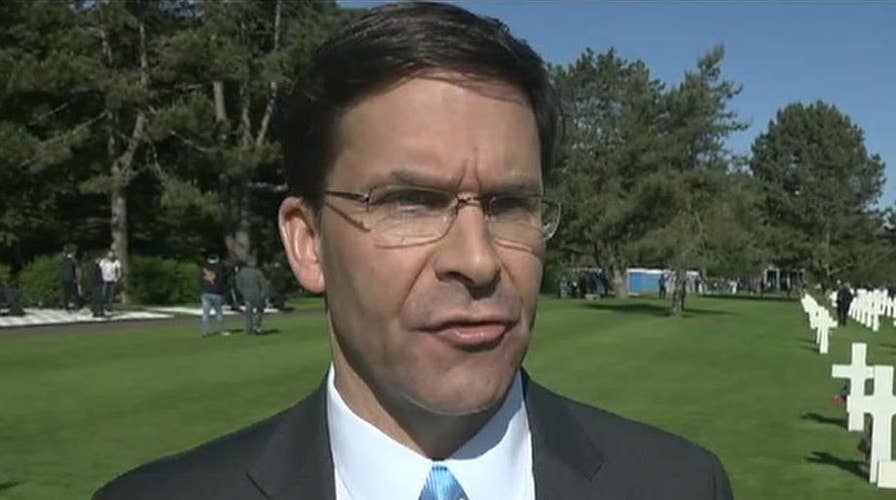
Secretary of the Army reflects on service of America's greatest generation
Secretary of the Army Mark Esper commemorates the soldiers who served during D-Day.
This is a rush transcript from "The Story," June 6, 2019. This copy may not be in its final form and may be updated.
MARTHA MACCALLUM, HOST: Thank you very much, Bret. Stick around. We're going to see you in just a few minutes. But first tonight.
We are live here in Paris, France. Looking back in 1940, Hitler and his men toured this city after France signed the armistice, effectively giving Hitler control of Paris and of France. Nearly four long years of occupation later, the allies then began -- the beginning of the end at Normandy.
Today, veterans, world leaders, grateful citizens, gathered to mark 75 years since that momentous battle began.
(BEGIN VIDEO CLIP)
DONALD TRUMP, PRESIDENT: From across the earth, Americans are drawn to this place as though it were a part of our very soul. We come not only because of what they did here. We come because of who they were. They were young men with their entire lives before them. They were fathers who would never meet their infant sons and daughters because they had a job to do. And with God as their witness, they were going to get it done.
More powerful than the strength of American arms was the strength of American hearts. These men ran through the fires of hell, moved by a force no weapon could destroy. The fierce patriotism of a free, proud, and sovereign people.
(END VIDEO CLIP)
MACCALLUM: Those American heroes the president spoke up today were led by General Dwight D. Eisenhower, supreme commander of the Allied forces, who nine years later, would become president of the United States. He was the architect of D-Day. Essentially bearing the weight of the world on his shoulders in that moment as he led 150,000 allied soldiers to a victory over Hitler's march toward world dominance. Turning the tide of the war, and then, of world history.
(BEGIN VIDEO CLIP)
DWIGHT D. EISENHOWER, FORMER PRESIDENT: Soldiers, sailors, and airmen of the Allied Expeditionary Force, you are about to embark upon the Great Crusade toward which we have striven these many months. The eyes of the world are upon you.
The hopes and prayers of liberty-loving people everywhere march with you. In company with our brave allies and brothers-in-arms on other fronts, you will bring about the destruction of the German war machine, the elimination of Nazi tyranny over the oppressed peoples of Europe, and security for ourselves in a free world.
(END VIDEO CLIP)
MACCALLUM: Today, his granddaughter Susan and I walked in the cemetery high above Omaha Beach. Here she is.
(BEGIN VIDEOTAPE)
MACCALLUM: I'm just curious what goes through your mind when you look out at the sea and you think of where your grandfather was at this moment, 75 years ago today.
SUSAN EISENHOWER, GRANDDAUGHTER OF DWIGHT EISENHOWER: Well, at this very moment, he was back at headquarters. And ironically, after making the enormous decision to take a gamble on the weather. There was really nothing he could do after that. It was in the hands of the people who had been well trained, and their commanders and he stayed in close touch with everybody who's coming ashore.
There's another interesting aspect too is that he had received a terrible assessment about the potential fatalities of the paratroopers and he had to make that terrible decision to deploy them anyway. And -- you know, it wouldn't -- we wouldn't have gotten off Utah Beach if he hadn't taken that decision. So --
MACCALLUM: Incredible.
S. EISENHOWER: Yes.
MACCALLUM: And I know, you know you've done so much work on policy over the years.
S. EISENHOWER: Right.
MACCALLUM: And leadership. You know, what lessons do you take away from your grandfather's leadership that helped you to explain what leadership means to others?
S. EISENHOWER: Well, I think there are obviously a range of different types of leaders. But he had almost special capacity to both make really tough decisions. And also to show heart while he was doing it.
After he made that airborne decision, he actually had the courage to go out and look those young guys in the eyes and wish them well. Knowing that or, at least, being told that he would be responsible for the loss of 50 percent of those troops.
MACCALLUM: Yes.
S. EISENHOWER: As it turned out, the number was nothing like that. And they did a remarkable job behind the beaches of Utah which was essential for us making our objectives in Cherbourg.
MACCALLUM: Right.
S. EISENHOWER: Yes.
MACCALLUM: I always think that when I look at the photograph of him, looking right into their eyes and talking to them before the mission began.
S. EISENHOWER: Right.
MACCALLUM: And you can't look at those photos without thinking about the fact that he knew that some of them would never make it through that day.
S. EISENHOWER: That's the pain of warfare, and that's the pain of being a commander. But it's something that had to be done. And I think he was quite fatalistic about making that decision.
Somebody was going to have to make that decision and he understood there was going to be him. So --
(CROSSTALK)
MACCALLUM: And he wrote a statement as if it went wrong. You know, what he was going to say if the mission failed, which we actually read last night on the program.
S. EISENHOWER: Right. Yes.
MACCALLUM: So, just the fact that he was thinking through all of those different scenarios and being ready for them is --
(CROSSTALK)
S. EISENHOWER: Well, good to be ready for it, in case, the worst happens. But, I think, he also wrote that note for himself as well that he wasn't going to blame anybody else. And I think what's rather ironic about that is that he was taking responsibility even for the weather, over which he had no control.
But he was right, I mean, he decided to go under those weather conditions. And so, it would still be his responsibility.
MACCALLUM: So, obviously, there's a very personal side of all of this to you. He was your grandfather. And the Wall Street Journal wrote a piece today. The Wiesenthal Center just released a letter that your grandfather wrote to his wife, Mamie Eisenhower, right before the mission began.
And he said, "I have a series of trips that I'm going to be taking over the next few days. So you may not be hearing from me."
S. EISENHOWER: Yes, a series of trips.
MACCALLUM: And I would love for you to read this --
S. EISENHOWER: Certainly, I'd be delighted.
MACCALLUM: Susan, thank you.
S. EISENHOWER: Well, he says, "Darling, starting tomorrow I have a series of trips that will last without interruption for six to 10 days. So, if you have elapsed in arriving letters don't jump to the conclusion that I don't want to write, I simply have no opportunity to pick up a pen.
Anyway, the real purpose of this note was to say, I'm well, I love you as much as ever all the time, day and night, your picture and guilt frame is directly in front of my desk, and I look at you all the time. Another is in my bedroom, loads of love always. Yours, Ike."
You know, he sent a number of these letters just before big campaigns. And in another letter, rather similar to this, he said, "The weather is classified." And rightly so, he says, "It's frustrating that I can't even give you -- tell you whether the sun's out today or not."
MACCALLUM: You know, when you look back at this generation that were talk about so much here today, and -- what kind of country -- what shape do you think our country is in right now?
S. EISENHOWER: I think with respect to the courage that was displayed here at Normandy, we're not -- you know, we don't have the word selflessness and self-sacrifice in our vocabulary. So, if I were teaching a middle school class on this subject, I would say there was a time when people were called upon to do things they didn't necessarily want to do or couldn't be spared to do.
And they reported for duty, they put their best selves in it, and they discovered that when they hit the beaches that they were more than they ever thought they could be.
(END VIDEOTAPE)
MACCALLUM: I love the end of what she said there. That "They discovered that in the end, they were more than they thought they ever could be." That whole idea of self-sacrifice that was so evident during World War II, when you look into the eyes of these then-young men.
Our chief political anchor Bret Baier has been studying and writing about this period for a long time, and writes about D-Day in his upcoming book, Three Days at the Brink: FDR's Daring Gamble to Win World War II.
Bret, thank you for sticking around to talk to us about this, this evening. You know, your thoughts on that period when they were formulating the plan, and there were a lot of different ideas about whether or not it should be Normandy or whether the approach should be from somewhere else.
BAIER: Yes, Martha. But first of all, great job over the past few days over there with long hours.
MACCALLUM: Thank you.
BAIER: Some amazing images and stories that you bring to us from there. What I looked at was a conference in Tehran. November of 1943 between FDR, Winston Churchill, and Joseph Stalin, the Soviet leader.
And it was their first get-together where they essentially planned D-Day. And it was a lot of back and forth. Stalin was really pushing for that to go forward, there was a lot of concern from Churchill whether they could trust Stalin and really buy into the Soviets.
But the concern and FDR's concern was that the Soviets could go the other way. That Hitler could go towards the Soviet Union and somehow co-opt their cooperation. So, there was a lot of back-and-forth in this -- in this Tehran meeting that laid the groundwork for the decision that was then put on General Eisenhower.
And the agonizing of that decision go-no-go, and the weather, and the behind-the-scenes stories of getting people together General Eisenhower at 3:30 in the morning. And having each one make a decision, should we do it or not? Should we do it or not?
But it was -- it was Eisenhower who had to make the final call, and he said that we're going to go.
MACCALLUM: It's fascinating. Just thinking about him in the middle of the night, going over it again and again in his mind. And then, bringing them together and realizing that, that window was closing, that the tides that they depended on, the low tide, that they wanted for that landing was not going to be a window that was around indefinitely to be sure. And, you know, you just have a fascinating take on it in your writings.
You know, when you look back now, everything's in retrospect. Right? And I put myself in the current moment that we live in. Covering politics and covering what's going on in the world. And you think about the tensions and the escalation from China. You look at what's going on with Iran. And you know the realignment of nations in many ways that we are witnessing and you just wonder, Bret, you know, what it's going to be like when we look back 20 years from now and look, for example, at China, which clearly in this moment has an aspiration at world dominance.
BAIER: Yes, I mean, think about this. As world leaders are meeting there to commemorate in Normandy D-Day at 75 years, the Chinese president was meeting with the Russian leader. Xi Jinping and Vladimir Putin.
You know, what that means for the big picture of things is really a big question as far as geopolitical, three-dimensional chess, if you will. That's what today's speech, I think, for President Trump was such a big deal.
It kind of was 30,000 feet. It was bigger. It was -- it met the moment. And as I said on "SPECIAL REPORT" earlier, I think it was one of his best speeches if not the best of his presidency. And he's had some big ones.
If you look back at Warsaw, Poland, Riyadh, Saudi Arabia. The State of the Union Address that we covered the last time that was filled with a kind of rhetorical moment. History is going to look at big speeches as it looks back.
Obviously, it'll look at the presidency overall. But in the lens of history, speeches are big moments, and this was a big moment for President Trump.
MACCALLUM: Yes, indeed it was. I -- you know, I agree when I was listening to it this afternoon and it's a very high bar. You look at some of the speeches that have happened in this spot. You think of Reagan at Pointe du Hoc. And it -- it's an opportunity these moments for presidents to speak to in his case. You know, what does it mean to make America great again? What kind of greatness are you talking about?
That idea has been challenged in him. And I think he laid it out today in a way that -- and that was very specific, Bret.
BAIER: Yes, and the personal stories, and the fact that you heard these amazing stories and then suddenly the person in the story was right behind him. You know, gave you goosebumps at times.
Also, the hat tip to the allies, and the French, and the British, for all the talk about the president being a bull in the China shop when it comes to European allies and relationships.
This speech was focused on that, on establishing that. And the big hug from Macron after the speech was a big moment as well.
MACCALLUM: Indeed it was. The president did an interview with Piers Morgan, this week where he got it to hat that looks like Churchill and he got him to put it on. For a split seconds, kind of a -- you know, a funny moment and -- you know, just what did -- what do you think about that?
BAIER: Well, listen, you know, he is a fan of Churchill. The fact that Piers got them to put it on is pretty, pretty good because usually, you can't get politicians to put on hats after Michael Dukakis put the tank helmet on.
(CROSSTALK)
MACCALLUM: No, there's something about politicians had hat. He had it on for just a split second and took it off. Bret, great to see you tonight. Thank you for joining. We were really appreciate it.
BAIER: Great job, Martha.
MACCALLUM: Looking forward to the book. Thank you very much. So ahead tonight, the secretary of the army joins me as our coverage continues. Who are the next generation of warfighters and what weapons will they be using? Very interesting insight from him.
Plus, 2020 Democrats turn on Joe Biden over abortion.
(BEGIN VIDEO CLIP)
JOE BIDEN, D-PRESIDENTIAL CANDIDATE: Regard to abortion, I accept my church's position on abortion as a -- we called they feed a doctor. Life begins at conception, that's the church's judgment. I accept into my personal life.
(END VIDEO CLIP)
(COMMERCIAL BREAK)
(BEGIN VIDEO CLIP)
CHRIS HAYES, HOST, MSNBC: Former Vice President Joe Biden came out and said that he would not support repealing the Hyde Amendment. Is Joe Biden wrong?
SEN. ELIZABETH WARREN, D-MASS., PRESIDENTIAL CANDIDATE: Yes.
BETO O'ROURKE, D-PRESIDENTIAL CANDIDATE: He's absolutely wrong on this one. Perhaps he doesn't have all the facts.
(END VIDEO CLIP)
MACCALLUM: A lot of agreement there. Former Vice President Joe Biden at odds with some of his fellow 2020 field over his continued support of a Hyde Amendment which is a measure that's hailed by a lot of Republicans because it prevents federal funding being used for abortions.
Now, Biden's campaign says that he is open to the idea of repealing that law, but for now, they say, his position has not changed. Here now Marc Thiessen, American Enterprise Institute scholar and Fox News Contributor and Ed Rendell former DNC Chairman and Pennsylvania Governor. Great to have both of you with us this evening.
MARC THIESSEN, CONTRIBUTOR: Good to be with you, Martha.
MACCALLUM: Governor Rendell, let me start with you on this -- thank you. Let me start with you on this, Governor Rendell. What do you think Joe Biden should do, because it sounds like he's a little bit on the fence here?
ED RENDELL, FORMER GOVERNOR, PENNSYLVANIA: Well, I was one of the supporters of the repeal of the Hyde Amendment. That was part of our platform in 2016 and I voted to support our platform. I think anytime you have a constitutional right guaranteed by the Supreme Court it shouldn't be denied people because they can't afford it.
I think the Vice President should take a re-look at this because as the Planned Parenthood clinics are being closed in many southern and western states, then poor women have absolutely no access towards abortion, and I think that's their right under the Constitution. And I think in light of that, I hope the vice-president does reassess his position.
But I'm for Joe Biden regardless of whether I disagree with him on this issue because I don't think there's one out of the 25 candidates who I agree with on every single issue. I think Joe Biden is a good man. I think he would be a great president. I hope he rethinks this.
MACCALLUM: So Marc, what do you think? You know politically, you know, it's interesting politicians leave the door open on an issue like this, and he said quite clearly back in 2012 and the sound bite that we showed before the break you know, that it didn't line up with his faith and that he doesn't believe that federal funds essentially should be used for abortion. But now he says he would consider being in favor of that repeal. What do you think is the wiser move for him as a candidate?
THIESSEN: Well, I actually think this controversy is great for Joe Biden because it's kind of his Sister Souljah moment. The -- we now know that it with the exception of Joe Biden, every Democrat running for president supports taxpayer-funded abortion on demand up until the moment of birth. That is an extraordinary statement, an extraordinary position because the fact is the majority of Americans do not support taxpayer-funded abortion on demand up until the moment of birth.
So Joe Biden is allying himself with the majority of Americans and even the majority of Democrats. There are only 29 percent of Americans who support taxpayer funding and only 13 percent that support abortion on demand. So the fact is most Americans look at abortion as to some extent a necessary evil rather than celebrating it and they -- and they draw a line somewhere. They don't want to completely eliminate it, but they want to put reasonable restrictions on it.
And the line Joe Biden has drawn which is reasonable to most Americans is that he doesn't want to pay for it. He actually takes seriously a statement that a lot of people throw out there and don't really mean it that I personally oppose abortion. He says if I personally oppose abortion, I shouldn't be forced to pay for it and I think most Americans and most Democrats will see that as reasonable.
MACCALLUM: Yes. I mean, Ed, it just raises a -- you know, aside from the moral issues here, it raises that interesting political question. When you look at the polling in America, it appears that the majority of Americans are not where so many of these candidates are on this issue. So does it strengthen Joe Biden's hand here to say no, actually I'm on the side of 51 percent of Americans.
RENDELL: Well, I think when Planned Parenthood was available in every state and had access to abortion for women who wanted it and that's their constitutional right under the Constitution and this court hasn't changed that. I think most Americans realized that those constitutional rights shouldn't be given based on your ability to pay.
So I think it's changing and the circumstances are changing. And a good elected official always has a viewpoint but that viewpoint can be changed by circumstances. So I would urge him to look at the circumstances. In one state, there's absolutely no Planned Parenthood clinic anymore. So what's a poor woman to do if she wants to exercise her constitutional right?
MACCALLUM: Marc, what do you say about that?
THIESSEN: Well, I thought -- what I say is that this is going to actually help Joe Biden with winning over working-class voters in that -- which is what the Democratic Party actually has to do. Because again, the American people don't look at it as a -- first of all, the Supreme Court hasn't said that it is a constitutional right abortion on demand taxpayer-funded up until the moment of birth. The Supreme Court has said that you can have --
RENDELL: Nobody's talking about abortion at the moment of birth.
THIESSEN: No. The Supreme Court has said that you can have reasonable restrictions on abortion.
RENDELL: I'm not. I didn't vote for it.
THIESSEN: And so Joe Biden is proposing a reasonable restriction on abortion which has been -- had bipartisan support since Roe v Wade. And you've got -- his job as running for president is to try to win back those Obama-Biden voters in your state, in states like Ohio, and Michigan, the industrial Midwest that defected to Donald Trump. And those people are not -- are pretty socially conservative. They don't support abortion on demand taxpayer-funded up until the moment of birth.
So I think the Democratic Party is putting himself in a bad position by taking such an extremist position on abortion and Joe Biden is dialing that back just a little bit. And it's -- and it's like it's a controversy that you know, he's going to be excommunicated for it. And I think that just shows the extremism of the Democratic Party when it comes to abortion.
MACCALLUM: Yes, and Ed, we're going to see this plan quite clearly. I'm sure -- go ahead.
RENDELL: No, I disagree with that. Look, most Democrats take the position I take. Even if we disagree with Joe on this one issue, that doesn't mean we're going to be against him because again, I don't think there's one of those 25 candidates that I would check the box on every issue with and I think that's a reasonable approach.
I think Joe Biden would make a great president. He and I may disagree on this issue but I'm still for him and I'm still for him than the most -- a lot of the vast majority of Democrats are still formed right now.
MACCALLUM: Yes. It's easy to imagine how this plays out on the debate stage. And before it comes to that moment, the former vice president is going to have to decide where he is on this topic. Whether or not he wants to put the stake in the ground that you know, as a purely political perspective, you would encourage him to do or whether or not he's going to stand up there and say, you know what, I've thought about it. Let's take a look at what he said on May 4h in this campaign. Watch this.
(BEGIN VIDEO CLIP)
UNIDENTIFIED FEMALE: Will you commit to abolishing the Hyde Amendment which hurts poor women and women of color.
BIDEN: Yes. Right now it has to be (INAUDIBLE).
(END VIDEO CLIP)
MACCALLUM: I mean, you can see the discomfort at playing out in that moment.
THIESSEN: Yes. He said that he misunderstood the question. He thought that she was asking about Mexico City and has subsequently said that he stands by a position on the Hyde Amendment. Look, there's a -- the Democratic construction for Catholics like Joe Biden who really should be any Catholic by their faith should be completely pro-life.
But his position is that I personally opposed it but I'm not for -- but I'm not for imposing my views. He actually believes that whereas most people use that as a fig leaf. And so good for him for at least come in that far.
MACCALLUM: Gentlemen, thank you. Governor Rendell, Marc Thiessen, great to see you both tonight. Thank you, gentlemen.
THIESSEN: Thank you.
MACCALLUM: Coming up right here from Paris this evening, President Trump's D-Day address getting some praise in some unlikely places today. Laura Trump joins me next on that. She's on the campaign right after this.
(BEGIN VIDEO CLIP)
JIM ACOSTA, WHITE HOUSE CORRESPONDENT, CNN: But he stayed on script, stayed on message, and I think rose to the moment. And as he was talking about those men gathered behind him, he described them as being among the greatest Americans who have ever lived.
(END VIDEO CLIP)
(COMMERCIAL BREAK)
MACCALLUM: President Trump's tribute to the heroes of D-Day widely seen as a strong speech by many who watched it today and commented on it, even some of the toughest critics. Watch list.
(BEGIN VIDEO CLIP)
UNIDENTIFIED MALE: President Donald J. Trump delivering what I believe is most powerful speech that he has given as president of United States.
UNIDENTIFIED FEMALE: Trump's speech itself was very good and measured up to the moment and really was a true salute to the unity of this day.
UNIDENTIFIED MALE: He did the right thing at Normandy. He really hit all the right, I think, moments in that speech.
And I think this is perhaps the most on message moment of Donald Trump's his presidency today.
(END VIDEO CLIP)
MACCALLUM: So, the praise comes amid some numbers that are not that great and they knew polling we're seeing. The president is about 12 points behind both Joe Biden and Bernie Sanders in Michigan, a state he won by only 10,000 votes over Hillary Clinton and 2016.
So, joining me now is senior campaign adviser, Lara Trump, to talk about both of those. Lara, good to see you tonight. Thank you for being with us this evening.
I think the first thing I would like to ask you about is the reaction that we heard from Joe Scarborough and others who generally can find something negative to say even when there are positive things to say. So, why do you think it was that they struck a very different tune today?
LARA TRUMP, TRUMP CAMPAIGN SENIOR ADVISER: Well, I would love to know that. And Martha, wouldn't it be nice if we could always have this kind of positivity around this president, really uniting all of us as Americans and really the world, the allies, that we have around the world that we had there with us today, Britain and France, who fought alongside our brave soldiers and World War II. They're on D-Day. But it was such an incredible speech. I mean it was hard to watch that speech without tearing up several times.
Now, I am almost seven months pregnant, but I think most people who watched it obviously felt the emotion and felt the gravity of the day and the president's words were spot on.
MACCALLUM: There was an extraordinary amount of emotion out there really across the board today. And you know -- but I do think it's interesting to hear the comments of those folks and I wonder, you know, if the president - - I mean, clearly, he wanted to give a great speech today and it's not about politics in that moment. It's about honoring those heroes. But do you think that he is making an effort to be sort of, you know, to win over some people who perhaps have seen his behavior as something that they might say as unpresidential, things along those lines? Is there an effort being made about -- towards that?
L. TRUMP: I mean, I don't know that I would necessarily say that. I mean Donald Trump is Donald Trump. He is a very genuine person. But being the president is something that no one gives you a handbook and says this is how you do it. He has never been a politician before in his life. He is figuring it out all along the way.
And so, I think it was very clear how passionate he is about our country, how passionate he has about veterans and those people who without giving their lives, we probably wouldn't be here today. We wouldn't be living in the same world. So, I think that may be what's shown through there. But he's certainly figuring it out every day and he's going to get better and better at it.
MACCALLUM: Yes. It was very interesting today to watch him with Macron, someone he has had some differences with over time. They seem to do very well together. I think it's also beneficial to Macron and his current political environment to also, you know, sort of treat President Trump perhaps in a little bit more open way.
But you know, the polls that I mentioned at the top, I want to take a look at these because obviously it's very early, but take a look at Michigan. Now, take a look at Texas where the president is under water in a Quinnipiac Poll against Joe Biden, Biden at 48 percent, Trump at 44. That's an unusual poll coming out of Texas, Lara.
L. TRUMP: Yes. I mean -- and you just said it, Martha. It's very early. Listen, the election is not tomorrow. There's a lot to happen between now and then. Who even knows if Joe Biden is going to be the Democrat who runs against Donald Trump in 2020. We don't know who it will be yet.
But the polls -- and I always say this -- but they have never been accurate when it comes to Donald Trump. Even days before the election in 2016, we saw that they had Hillary Clinton up by huge margin and yet Donald Trump still won. So, we still feel very confident here at the campaign and we're looking forward to the Democrat debate so we can really get a handle on who might be his opponent.
MACCALLUM: Yes. That's going to be -- that's going to be very interesting. Well, it was a very strong day out there in Normandy for the president. Lara, always good to see you. Thank you very much for coming in and talking about how it's going on in the campaign. We'll see you soon.
L. TRUMP: You got it. Thanks.
MACCALLUM: Thank you. Coming up next, an update on the awful training accident that killed a West Point cadet today. We were out there speaking with the secretary of the Army. Is the next generation going to step up the way that the greatest generation did? We're getting update on what happened with West Point and my conversation from earlier in the day with the Army secretary after this.
(BEGIN VIDEO CLIP)
MARK ESPER, SECRETARY OF THE ARMY: What did I do to prepare themselves? How did they train? What was their equipment? So, as I think about how we man train and equip the Army, we can capture those same qualities to make sure that our future soldiers can really embrace those attributes that those young men had to win the day -- so we can win the day.
(END VIDEO CLIP)
(COMMERCIAL BREAK)
MACCALLUM: A tragic story out of West Point. Today, one cadet was killed and at least 21 were injured in a military vehicle crash. Spokesperson for the U.S. Military Academy says the tactical vehicle overturned near the Camp Natural Bridge training site in New York. The cadets involved were seniors with the class of 2020. No word yet on the cause of this crash.
And this week, we follow the life-changing journey of World War II veteran, Jack Gutman, as he returned to Normandy for the first time since serving as a Navy corpsman on D-Day. As he looked upon the rows of white crosses, he saluted and he wept for those he served alongside, the man he wished he could have saved.
It was one of the many moving moments as our nation pays tribute to the brotherhood of selfless, humble and incredibly brave man who risked it all for us, and Jack is one of them. I wrote a piece about him that is posted tonight on foxnews.com. I hope you'll take a look at it when you can.
Earlier today in Normandy, I spoke exclusively with the secretary of the Army, Mark Esper, about what this day means for him and the soldiers of today. I should mention that at this point we were not aware of the West Point accident. Let's watch.
(BEGIN VIDEOTAPE)
MACCALLUM: So, you know, a lot of people talk on this occasion, of course, about the greatest generation and the qualities that they had, the humility, the patriotism. How do you compare that to what we you see and should people be encouraged or discouraged by the generation that we have now?
ESPER: I think people should be encouraged. Obviously, that generation, the greatest generation, sets a very high benchmark. We will remember today and forever what they did on D-Day and throughout World War II. But the young men and women we have coming into the Army are also fantastic. I'd like to call them the elite 1 percent. That's the 1 percent of America's youth who decided to raise their right hand, swear to the constitution and decided to protect the other 99 percent of us. So, I really have a lot of faith in them.
MACCALLUM: We saw statistics recently that a lot of young Americans aren't eligible because for the draft because they're overweight or because they don't have the right level of education. I think that those numbers really shocked a lot of people that 71 percent are not even eligible to join the military.
ESPER: No, you're exactly right, 71 percent don't qualify for either physical, behavioral, intellectual and other reasons. And if you take that same cohort and you ask who is qualified and who has a proclivity to serve, it's less than 4 percent. And it's really -- it's really alarming for me and I'm concerned about the trends. And a big part of it is that more and more of today's youth don't grow up with parents, uncles, aunts, cousins, serving in the military, which is different than my generation. So, that has a big impact on our future as well.
MACCALLUM: You know, in terms of weapons we have seen a new antiballistic missile from Russia that was being tested and sort of shown off the other day. What goes through your mind when you see that?
ESPER: Well, I know we have to be prepared to fight, possibly the Russians and the Chinese as told to us by the National Defense Strategy. And one of my biggest concerns these days are that the weapons and equipment we are using today are the same weapons we used when I joined the Army out of the academy in 1986.
So, we need to lead to a new generation of weapons systems. The Army has outlined six modernization parties that begin with what's called long-range precision fires all the way down to (inaudible) number six. And a big number five in there or number four is integrated air missile defense. We need the capability to defend -- to defend against Russian cruise missiles, Russian ballistic missiles, you name it, in order to protect our troops on the battlefield and in order to protect our nation.
MACCALLUM: And so, we're hearing about these hypersonic missiles. What are they? What's their capability?
ESPER: Yes. So, they have a tremendous capability. They're launched into - - just beyond a space and they can fly a great distances, thousands of miles, skipping across the atmosphere, and maneuvering along the way. And then they can hit and impact with incredible speed and velocity. So, it creates great damage just by the impact alone and because they can maneuver they're difficult to defend against.
Now, the good news is the three services have gone together, the Army, Navy, and Air Force, and are working together on our own hypersonic systems that we each would employ. The Army is aiming to develop and fill its first one in the next few years and it will provide us a great capability to deal against near peer adversaries such as Russia and China.
MACCALLUM: Do they have the same capability or are they working on the same hypersonic weapons?
ESPER: They are working on it. We're always reluctant to speak about what their capabilities are, but I assure you we will be ready and we will get there first.
MACCALLUM: So, you were part of the 101st Airborn --
ESPER: Right.
MACCALLUM: -- this is obviously a very important anniversary for them.
ESPER: Sure.
MACCALLUM: They came in, paratroopers, in the night before D-Day and there's many of them or some of them that we've met here and talk to. What goes through your mind as you think about this 75th anniversary?
ESPER: Well, they are the greatest generation. And I feel privileged because I not only served in the 101st and in Desert Shield and Desert Storm, but I served in the 82nd over here in Europe and I served in the 29th Infantry in the National Guard. The 29th Infantry are the ones -- part of the -- with the first infantry division that stormed the beaches here bloody Omaha.
And so, when you walk these grounds and you talk to some of the old soldiers that are here, it just -- it lifts your spirits. If you know what these young men at that time did, how they sacrificed, they climbed the cliffs at Pointe du Hoc, where I was yesterday. The paratroopers are in, like you said, amidst the gunfire and a great deal of uncertainty.
It just -- it stirs your soul. And what I try to do as Army secretary is look back and look at what did they do to prepare themselves? How did they train? What was your equipment? So, as I think about how we man train and equip the Army, we can capture those same qualities to make sure that our future soldiers can really embrace those attributes that those young men had to win the day so we can win the day in the future.
MACCALLUM: Yes. I mean we had such a cross section America that served in World War II and there was a draft then, of course. Do you think we will ever have a draft again in America?
ESPER: It's hard to see. We have exceptional quality through our volunteers and they bring us a good deal of diversity as well. And again, these young men and women we see today joining the military are fantastic. I believe they will be ready when the time comes. But I think the Army right now is very capable. We continue to grow the Army because we need to put capabilities back into it or we need to add capabilities. And I think we're ready. We are ready I know for sure. And I think we'll be ready in the future as well.
MACCALLUM: Secretary Esper, thank you very much. Good to see you here today.
ESPER: Thank you. Thanks, again, Martha. Thank you.
MACCALLUM: Thanks for being with us.
(END VIDEOTAPE)
(COMMERCIAL BREAK)
(BEGIN VIDEO CLIP)
MACCALLUM: Our whole set here was shaking when these plans just stormed over where we are. And as you pointed out, it reminds you -- it gives you a sense of what it sounded like for these villagers and friends nearby when these American planes started soaring over their -- over head through these skies. And I -- a lot of the people that I have talked to talked about how loud war is.
(END VIDEO CLIP)
MACCALLUM: That was a chilling moment this morning as the flyover was really one of the incredible moments of our D-Day coverage. It all began three days ago with the actors from the hit show, Band of Brothers, who so many people have watched. Many of them were so moved and inspired by the events depicted in the series that they worked so hard on. They traveled to Normandy to pay tribute to the men who actually did it. Here's a look back of this week's really memorable moment. Let's watch.
(BEGIN VIDEO CLIP)
SHANE TAYLOR, ACTOR: This goes above and beyond anything we have ever done. And so -- and it's important to keep, you know, carrying the torch. Doc Roe (ph), the character I played, I mean, he had passed away two years before we shot.
UNIDENTIFIED MALE: You're OK, man. Everything is right where it should be.
TAYLOR: I met the families for the first time. I mean Chris (ph) is in here and he is the grandson of Doc Roe and he and I are best friends and the connection to the family is just so huge. You cannot help but get emotional. Every time we see each other, there were tears and -- but it was great. It made the whole thing makes sense.
UNIDENTIFIED MALE: He knew he was portraying not only a real man but a man very special to the other men. So, we were extremely proud. He is family. I call him my brother Shane. So, he is one of us.
JACK GUTMAN, D-DAY VETERAN: Get this patch and get all of this done. By the way, an interesting thing, I need a passport now to go back to France. But 75 years ago, I didn't need a passport. They just let me right in without it.
I have people coming up and hugging me and running to meet me and take pictures of me and I was just -- it was like euphoria. Then I went to the gravesites and walked to the graves and emotion took over and I just -- I didn't realize I broke down. I said once then, when I was there, I'm going to salute them, pray for them, and I cried. I have to cry, but I did all of those things that I promised I would do.
MACCALLUM: One of the main attractions here today is a man named Tom Rice. Tom is 97 years old and he has jumped every year for the past six years to remember those who were lost and to make sure that everyone remembers the sacrifice that was made on that day.
What were you thinking about?
TOM RICE, 97-YEAR-OLD D-DAY VETERAN: My body was in one place and my mind was in another place. I didn't get both together until I left the aircraft. I'm going to keep on going as long as I --
MACCALLUM: Keep on going.
RICE: Yes. I'm not a dead man walking yet.
DONALD TRUMP, PRESIDENT: Today, we express our undying gratitude. The lives that they gave, the sacrifice that they made did not just win a battle. It did not just win a war. Those who fought here won a future for our nation. They won the survival of our civilization. You are the glory of our republic and we thank you from the bottom of our hearts.
(COMMERCIAL BREAK)
MACCALLUM: Here is our quote of the night from President Ronald Reagan. He spoke on this day in 1984 to commemorate the 40th anniversary of D-Day and honor the boys of Pointe du Hoc, the courageous second ranger battalion scaled the 100-foot cliffs to seize German artillery and prevent American landing troops at Omaha Beach and Utah Beach being fired upon. He is President Reagan.
(BEGIN VIDEO CLIP)
RONALD REAGAN, FORMER PRESIDENT: You were young the days you took these cliffs. Some of you were hardly more than boys with the deepest joys of life before you, yet you risked everything here. Why? We look at you and somehow know the answer. It was faith and belief. It was loyalty and love.
The men of Normandy had faith that what they were doing was right, faith that they fought for all humanity, faith that a just God would grant them mercy on this beach end or on the next. Strengthened by their courage, hardened by their value, and born with their memory. Let us continue to stand for the ideals for which they lived and died.
(END VIDEO CLIP)
MACCALLUM: That is “The Story” on June 6, 2019.
Content and Programming Copyright 2019 Fox News Network, LLC. ALL RIGHTS RESERVED. Copyright 2019 ASC Services II Media, LLC. All materials herein are protected by United States copyright law and may not be reproduced, distributed, transmitted, displayed, published or broadcast without the prior written permission of ASC Services II Media, LLC. You may not alter or remove any trademark, copyright or other notice from copies of the content.
