








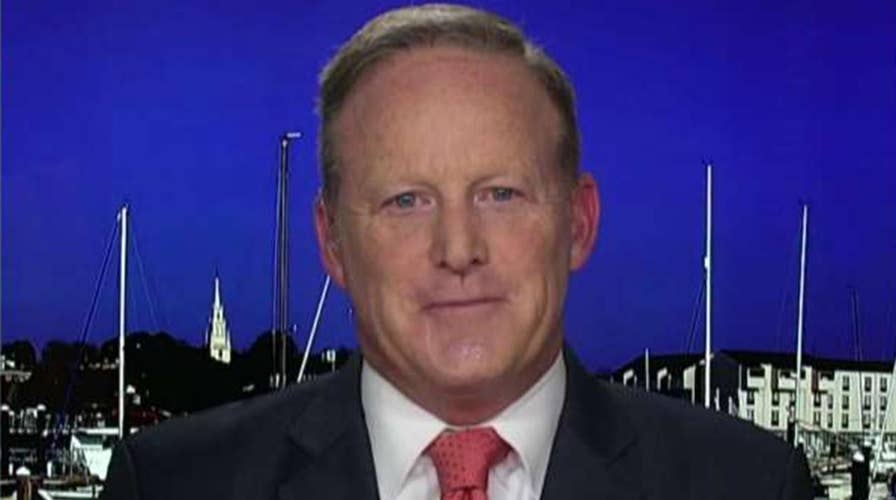
Sean Spicer reacts to Mueller's testimony: The Democrats didn't get what they wanted
Former White House press secretary Sean Spicer says Democrats wanted to ramp up the pressure on other Democrats to make the case for impeachment.
This is a rush transcript from "Your World," July 25, 2019. This copy may not be in its final form and may be updated.
NEIL CAVUTO, HOST: Thank you, Shepard, very much.
You're looking live on Capitol Hill right now. The House is taking up that two-year debt ceiling measure that seemed to be sliding just easily.
Here's the problem, though. A lot of Republicans are the ones balking, saying, we're spending ourselves into oblivion. And a lot of them are pointing the finger at the president.
Welcome, everybody. I'm Neil Cavuto. And this is "Your World."
And it's all about the debt and getting something done, so, for the next two years, we don't have to worry about it, minus that little minor issue of driving trillions of dollars more into red ink over that same period of time.
To Chad Pergram on Capitol Hill on where this thing stands right now -- Chad.
CHAD PERGRAM, SENIOR CAPITOL HILL PRODUCER: Well, in about 45 minutes, they will start this roll call vote to approve the budget caps deal and also suspend the debt ceiling until July of 2021.
And you're right. There's not going to be a lot of Republicans who vote for this. Democrats are going to carry the freight. Listen to this comment from Mike Johnson. He's a Republican congressman from Louisiana. He chairs the Republican Study Committee, which is the largest bloc of conservatives in the House.
He says -- quote -- "Our nation is more than $22 trillion in debt, and simply cannot afford reckless measures like this one."
We would expect the House minority leader, Kevin McCarthy, and the whip, Steve Scalise, to vote for that bill later this afternoon. But look at the lower-tier members of the Republican leadership team. We think there's going to be a lot of people who jump off there.
The reason that they have to raise the debt ceiling early is that Congress is going to go on recess here, the House, specifically tomorrow. And one of the reasons that Steve Mnuchin, the treasury secretary, was appealing to deal with the debt ceiling now is saying they might hit this sometime in August or September.
Now, I challenged Kevin McCarthy this morning about the tax bill, because that's one of the reasons why federal revenues are lower right now. He disagreed with my premise as to why they have to raise the debt ceiling on that issue so fast, because he thinks the tax bill has been -- has been pretty good.
But that's an issue. That's one of the reasons why revenues are down.
Now, here's the dirty secret about this bill, Neil. This doesn't fund the government. All this does is establish a level, a spending cap level for the next two years to help them deal with appropriations bills. Those will come up in September for this fiscal year. That's where you're firing with live ammo.
And Steny Hoyer, the House majority leader, said this yesterday: "This doesn't mean that everything will be hunky-dory in September."
You can see where there could be fights over funding the Department of Homeland Security, ICE, a wall, all of that in September -- Neil.
CAVUTO: And, you know, a lot of those Republicans who don't like running into debt and even more of it, right?
PERGRAM: Yes.
And that's been the break here in the Republican Party. There was one senior Republican I spoke to earlier in the week who said they were willing to get on board with the president on other policy issues, but this member said, the wind has changed, meaning if the president's going to be for more that, they're going to jump off.
CAVUTO: All right, Chad, thank you very much, Chad Pergram.
PERGRAM: Thank you.
CAVUTO: Now to the president holding this what he's calling a pledge to Americans workers event at the White House, just as his poll numbers are achieving a little bit higher because of more people having more jobs, the economy. You have heard that.
Susan Li with more.
Hey, Susan.
SUSAN LI, CORRESPONDENT: Hey, Neil.
So, we are looking at the best jobs market in 50 years, more than five million jobs added so far under the Trump administration, with more than a year now with the jobless rates under 4 percent, and manufacturing jobs are being brought back to the U.S., more than half-a-million being created so far in the past two-and-a-half years, and the best year for manufacturing jobs in 2018 in two decades.
And that's probably why American voters are feeling the most confidence that they have felt about the U.S. economy in close to 20 years, according to our latest FOX polling.
So what are they going to do about the economy at the ballot box in 2020? Well, according to this, it's very interesting. They actually think that it's a tie between Trump or the Democrats. But in terms of who's going to handle it better afterwards, they actually give the check to Democrats, believe it or not.
And our analysis of the FOX voter poll suggests that maybe border security, health care and immigration are the net negative contributors as to why President Trump's approval rating is still below 50 percent, close to 46 percent at this point.
But let's take a look at the markets, because we did hit another record high this week. We were down today because of European growth concerns. But, so far, it's been a great earnings season. We have corporations making a ton of money still.
Of the third that have reported earnings so far, three-quarters have beaten. And that's pretty good, since a lot of people were talking about an earnings recession.
Now, in terms of the main stock drag today, it was Boeing once again. And it's because Southwest Airlines that says that they will not be able to fly the aircraft until January next year, and they're also losing money. And that's why they're shutting down their Newark, New York operations and consolidate at La Guardia instead -- Neil, back to you.
CAVUTO: All right, Susan, thank you very, very much.
So the president's marks are inching up just a little bit here. We have the economy again the wind at his back here, the markets, today notwithstanding, still helping him.
But will it be enough to tip everything in his favor for the election in 2020?
Let's ask Melissa Armo with The Stock Swoosh. We have Democratic strategist Max Burns, and last, but not least, Republican strategist Noelle Nikpour.
That's the hope right, Noelle, that this is the momentum that closes the deal for him four another four years at the White House?
NOELLE NIKPOUR, REPUBLICAN FUND-RAISER: It should be.
And the reason it should be is because the -- not only is the momentum on his side, but this is also going to do another thing. And I look always at the money angle on this. This is going to allow President Trump's super PAC and President Trump, for those who haven't maxed out, are -- to feel free to give more donations, to really amp it up, because when you're on top, when you have got the momentum on your back, and you have got the economy and job -- unemployment, you have got all these factors into play, this will translate into people giving donations to this.
And this is really going to make his stockpile big, whereas the Democrats are having to divide that amongst like 20 candidates, so it's going to also help in two ways with the reelection.
CAVUTO: One of the things I see, Max is, as the White House is having this jobs event, to focus on that, focus on all of that, and pay little attention 24 hours later to whatever happened at the hearings yesterday.
And maybe it's registering, because I haven't seen a lot more Democrats come out and push impeachment today. Are they just dismissing it or what?
MAX BURNS, DEMOCRATIC STRATEGIST: I think it definitely wasn't the knockout that Democrats hoped.
And this message on the economy is -- it's good news whenever -- for the president, whenever his poll numbers go up. You would expect him to be significantly higher. But as the FOX News poll shows, the president gets in his way on immigration, on attacking Alexandria Ocasio-Cortez.
That poll also showed 63 percent of voters think he went too far in attacking them. So these are really things that are holding him down, when any other candidate...
CAVUTO: So, you think he would doing -- and you have kind of argued that - - he'd be doing much better maybe without some of this noise.
But, Melissa, one of the things I am startled by here is that the across- the-board nature of these economic gains. Now, they don't necessarily have to hold. But why isn't he doing better, given all of that?
Because this is a pretty strong economy, pretty strong markets. This jobs thing today is a reminder that there are positions that are going begging to be filled.
MELISSA ARMO, THE STOCK SWOOSH: Listen, those people aren't always going to say the truth sometimes in these polls. That's number one.
I mean, people were shocked when Trump won. They thought they were going to vote for. Hillary people lied and said different things in the polls. The polls showed that she was going to win.
But also I think that people don't like some personality aspects of President Trump. He's kind of, this is who he is, and you either love it or you don't love it. And that's the kind of thing.
But I think at the end of the day, I do think Trump's going to win reelection, but it's never over until the fat lady sings. And Hillary, we thought she was going to win. So Trump is still going to have to fight forward, even though there's all these candidates. He's still going to have to go gangbusters to get back into the White House and win another four years.
NIKPOUR: Plus, we're talking about this today. So these are the issues at hand today. And everything is fat and happy today.
When we go right on up to election, that could be a different story. But who knows...
(CROSSTALK)
CAVUTO: By the way, the politically correct term is calorically challenged.
(LAUGHTER)
CAVUTO: But let me ask you, Max, on that.
ARMO: Right.
CAVUTO: One of the things that just makes me wonder -- you don't know until you have a nominee and you can build a campaign around how that's going to go.
But Joe Biden said something interesting. He wants to address the president's tax cuts, raise the corporate rate that was slashed to 21 to at least up to 28 percent. The president's been of the view that any one of these Democrats who espouse getting rid of the tax cuts, hiking them, whatever, it's going to be damaging.
And that's how it's going to be pounded. Obviously, if you want to address this, you're going to reverse what the president's doing, and it's going to be played in ads as, here come the tax-hiking Democrats. What do you do?
BURNS: Well, I think we have had one of the longest economic expansions in history, I think, under Trump now, largely because Republicans have gotten rid of this whole fiscal conservatism thing, and they're spending like Democrats.
So it's no surprise the economy is doing better.
CAVUTO: It is odd that the president's finding the challenge he is among fellow Republicans. I have talked to a number of Freedom Caucus members on FOX Business, which, Melissa, if you don't get, you should demand.
ARMO: Yes, I saw it. I watch you.
(CROSSTALK)
CAVUTO: Oh, great. Oh, terrific. Love you. Come back.
ARMO: Yes. I have you on when I...
(CROSSTALK)
CAVUTO: But, anyway, to a man or woman, they all say the same thing. Enough already. You're killing us with this.
ARMO: Yes.
Well, I mean, I qualify myself as a conservative, but when you got to spend, you got to spend. So, I mean, it's a catchphrase.
I mean, to say that we wouldn't have the tax cuts and get out of debt, I mean, we -- the government is so, so much in debt. I really don't know what the answer is to that. That's like you go to the big, big experts that look at the economy and say, how are we going to get out from under...
(CROSSTALK)
CAVUTO: But I don't mind saddling Max with it.
ARMO: Well, you were talking about the Social Security earlier today.
That -- I mean, you were talking about yourself. What about me? What about him?
CAVUTO: I'm OK. Max, dicey.
ARMO: I mean, so that's the thing. There might not be any money left for us.
NIKPOUR: One of the things that I would like to look at are groups like the Club for Growth, which kind of made their name on reducing the national debt and no pork in these bills and frivolous spending.
So it's going to be interesting. And they hold their candidates that they support in primaries. Sometimes, they -- that's why we have Ted Cruz. He was sent to challenge somebody in a Republican primary.
So one of the key things they do is, they will fund people. They want them to be economically and conservative. And this is not part of that.
CAVUTO: Are you surprised by all of that, with everything going on, that no one seems to care in the Republican Party about this issue?
NIKPOUR: I'm very surprised, because this was kind of our...
CAVUTO: It doesn't show up anywhere in the top 10 issues for voters either. So I want to posit that.
So, they maybe they figure there's no -- no harm, no foul.
NIKPOUR: It's nowhere really on the list. It's like the national debt is over here, and then here are the issues at hand.
It's like it just doesn't exist. And it will. It's going to come back full circle. And it will exist. But right now, no one's mentioning it. No one's campaigning on it.
But I want to -- I'm interested in what these groups are doing, like the Club for Growth, funding these candidates that are just going to be voting with it. And let's go. Let's see what they see do.
ARMO: I think people are worried about right now.
CAVUTO: Yes.
ARMO: And, right now, things are going good. The market has rallied over 40 percent since the day after Trump was elected. The economy's doing well. People are back to work.
So I think people can -- like regular people, like, right now, what do I have to worry about right now, today?
CAVUTO: For now, not a worry, this other stuff.
Guys, I want to thank you all very much.
Sorry about the Social Security thing, but you seems very talented, a lot of other venues you can pursue.
(LAUGHTER)
CAVUTO: In the meantime, if money isn't your worry, how about missiles? How about North Korea? It's at it again. Again.
(COMMERCIAL BREAK)
CAVUTO: All right, well, so much for the beautiful relationship.
In fact, it still might be beautiful, but this news is not, that North Korea was performing two short-range missile tests over a period, we're told, of a couple of hours.
Jennifer Griffin at the Pentagon with more on that and what we're doing now -- Jennifer.
JENNIFER GRIFFIN, NATIONAL SECURITY CORRESPONDENT: Neil, it's notable that, when the president was here earlier today at the Pentagon to review the troops, that neither he, the vice president, nor the new defense secretary mentioned North Korea.
A U.S. defense official who reviewed the latest intelligence assessment of today's missile launch says North Korea test-fired a new type of short - range ballistic missile. The first missile flew 270 miles early Thursday morning, local time.
But the second missile fired just 30 minutes later is the one officials are most concerned about. It flew roughly 430 miles, putting all of South Korea in its range.
(BEGIN VIDEOTAPE)
UNIDENTIFIED MALE: The missiles that North Korea fired just a few hours ago are considered to be first strike weapons, so clearly South Korea has got to be concerned.
(END VIDEO CLIP)
GRIFFIN: U.S. official say the new North Korean short-range missiles are similar to the ones fired off in May.
But the missiles launched early this morning appear more powerful, the first since early May, and the first since President Trump met North Korean leader Kim Jong-un at the DMZ last month.
The missile launches come two days after Kim Jong-un was photographed at a North Korean shipyard where a new type of submarine is being constructed. The launch took place as President Trump's National Security Adviser John Bolton wrapped up a visit to Seoul, South Korea.
The Kim regime is trying to drive a wedge between the president and Bolton, who they called a warmonger and human defect following comments he made in May after North Korea's last missile test.
(BEGIN VIDEO CLIP)
JOHN BOLTON, U.S. NATIONAL SECURITY ADVISER: There are many challenges out there, some in this part of the world, some in other parts of the world. But I'm confident that the ROK and U.S. will work very closely together to resolve them.
(END VIDEO CLIP)
GRIFFIN: The president didn't condemn North Korea after the last missile launch, which was a breach in longstanding U.N. Security Council resolutions. So far, no word from the White House -- Neil.
CAVUTO: All right, it's going to take more than a beautiful letter to fix this.
Jennifer Griffin, thank you very, very much.
Let's get the read on what it's going to mean right now for us and for the North Koreans with Lieutenant General David Deptula, the retired Air Force patriot with us.
General, technically, they haven't violated anything they said they were going to do or not going to do, but they are pushing the point. So what do we do?
LT. GEN. DAVID DEPTULA (RET.), U.S. AIR FORCE: Well, Neil, the first thing I would suggest is that we all kind of pause and breathe through our nose here on this one, because the launches of the missiles by North Korea, these were not long-range intercontinental ballistic missiles that could reach the United States -- or the continental United States or Hawaii.
These were short-range missiles, as Jennifer indicated. And what I would take away from this is that Kim is still showing a willingness to moderate his behavior, but, at the same time, he's also demonstrating that he's prepared for conflict with South Korea.
But what we need to do is kind of put this in context, because he is doing a degree of signaling here. I think, as Jennifer mentioned, Mr. Bolton is wrapping up a trip to South Korea.
What your audience might not be aware of is, just five days ago, the U.S. and South Korea agreed to return to some military exercises.
CAVUTO: True. True.
DEPTULA: And while these were short-range missiles, they can range South Korea and threaten U.S. and South Korean interests.
But, look, what Kim is also doing is, because he's a despotic ruler, he needs to show his own internal populace and regime that he's flexing his muscles and doing something. And, quite frankly...
CAVUTO: And that, you think, is going to -- his way of saying, let's get back to the table and do something?
You could just as easily argue we'd be less inclined to do it if he's doing this to be provocative. You argue, in this case, he's not. This is within the things he could be doing. But the fact that this is the third time since the last summit we have seen something like this makes you wonder what's going on.
DEPTULA: Well, again, I think this is for internal consumption.
CAVUTO: Right.
DEPTULA: And, clearly, as others have spoken about, North Korea doesn't do anything without China's OK. And this doesn't push the United States to take any sort of dramatic action.
And it's just a bit of posturing internally for Kim to demonstrate that he's doing something to flex his muscles.
Now, I would also add, Neil, that every time Kim does a launch like this, it provides the United States intelligence an opportunity to learn more about just what his capabilities are.
CAVUTO: All right, General, thank you very, very much. We will see where they go and what happens from here.
By the way, as I have been saying here, we're in the middle of earnings season here. We don't want to get too bogged down in names you don't know or those that aren't trendsetters.
I think it's safe to say Amazon certainly falls in the latter category, one of those sort of gigantic retail concerns online and elsewhere, beating in its latest earnings period the revenue estimates of the company.
But it's not making as much money as they thought it would. Now, don't cry for Jeff Bezos or Amazon in general. But that stock, which has been a high-flyer, clipped a little bit today, falling just a tad.
We're going, meanwhile, right back to the House of Representatives, the House floor, this vote going on to increase spending. Again, it is expected to pass without much difficulty.
But what -- something that we are following is this revolt within the Republican Party, particularly some of the conservative members, who are saying, we, the party of fiscal discipline -- discipline, are botching it. We're signing off on something that is going to add a lot of red ink.
It's expedient. It's helpful. The fact that everyone wants this done, so that they don't have to go back and visit this for two years, is propelling all of this, but that's the problem, with these conservatives saying, we're punting again. And we're hoping that we don't have to worry about this for two years, by which time we will have added another $2 trillion in debt.
(COMMERCIAL BREAK)
CAVUTO: All right, if you're a high-tech concern, the wagons are circling.
We're showing the floor of the House right no. But this seems to be building up bipartisan steam on the part of Democrats and Republicans. We're now getting word that eight state attorneys general were meeting with the U.S. attorney general, Bill Barr, today, about concerns about the big tech companies stifling competition on the Internet.
By the way, that is the same approach that Bill Barr has raised about them. Some of the names seem familiar to you. They include Alphabet, the Google parent, Amazon.com, of course, Facebook, potentially Apple, that they have simply gotten too big for their britches.
And now state A.G.s are involved. The attorney general is involved, a number of Democrats and Republicans in agreement that something has to be done about their what they call non-competitive behaviors. It's one of those areas in which they find mutual agreements. Whether that's a good or bad thing is in the eye of the investment holder.
In the meantime, this budget deal that really does seem to have bipartisan support as well. It's a way to sort of keep the government lights on, or that's the goal, for two more years, not worry about addressing the debt ceiling in a few months or another year from now, more like two years from now.
But some conservative Republicans are saying, this is getting ridiculous. This isn't any sign of fiscal discipline. This is something expedient. And it's killing the party's credibility on just the one issue that was near and dear to them, spending, and getting too involved in that.
Republican Texas Congressman Chip Roy with us right now.
Congressman, you're not a fan of what you see going on here, right?
REP. CHIP ROY, R-TX: Neil, thanks for having me on.
No. When I ran for Congress 18 months ago, the people of Texas who sent me here wanted me to focus on balancing the budget and restoring fiscal order, in addition to making sure that we secure the border and have health care freedom again.
You and I are both fans of previous President Ronald Reagan. In 1964, in his famous time for choosing speech, he was lamenting $17 million of debt - - of deficit spending per year. That's about $140 million in today's dollars.
We are racking up $100 million of deficit spending per hour. That's what we're doing today. And this bill, which would spend $320 billion over the caps over the next two years...
CAVUTO: Over the caps, you're right, over the caps, right.
ROY: Right. And the cap level spending, Neil, would still leave us with trillion-dollar deficits.
But, no, that's not -- that's not what this Congress can do. They can't even just stick to the caps. They have got to blow it by $320 billion.
CAVUTO: All right, so you don't like it. I understand many other members in the caucus, your Conservative Caucus, don't like it. That's about 40- some-odd men and women strong.
ROY: Right.
CAVUTO: Do you think all will vote against this? Because the president says he's OK with it. Might have some qualms about spending levels, but, because it provides more for defense and our veterans, it's OK by him.
ROY: Well, a couple points.
Number one, the Freedom Caucus is against it. But you know what? The RSC, which is a big bloc of the conference, also came out against it. I think we're going to have numbers. Probably a majority of the Republican Conference are probably going to be opposing this in the end.
With respect to defense, I understand what the president's trying to do in the face of recalcitrant Democrats. But I will tell you this. I represent Fort Sam Houston, about 90,000 veterans. I represent the Army Futures Command in Austin, Texas.
Not one of them, not one, have asked that we mortgage the future of this country on the backs of their hard work defending this country. And if we don't take care of our fiscal discipline, then we aren't going to be able to defend this country.
In 2024, we will be spending more on interest than we are on national defense. That is the real crisis. As Jim Mattis said, the biggest security threat to the United States of America is our national debt.
CAVUTO: Now, normally, when those in your party challenge the president on this issue, even though you're with him on everything else, he doesn't take kindly to it.
I can't imagine him taking kindly to so many Republicans not signing off on this.
ROY: Well, look, the president is doing the best he can, in the face of the House of Representatives, which refuses, under Democrat leadership, to do their job.
They wasted time today with hearings going after Ivanka Trump's e-mails. We had a spirited exchange in the Oversight Committee about that.
CAVUTO: Well, to be fair, you guys were very good at doing the same thing when you were in the majority, right?
I mean, everyone plays games.
ROY: Well -- well, yes, but, look, here's what's important, doing what the American people sent us here to do, balance the budget, secure the border.
Democrats refuse to do either of those things, fight for health care freedom to drive down the cost of health care.
CAVUTO: But most in your own party, sir, have decided to bolt on this one.
I commend you for sort of going against the grain, but the fact of the matter is, no one seems to care about this.
ROY: Well, you have got a lot of people here in Washington who care more about power than they care about doing the right thing. And that happens to be the case in both parties.
And I didn't run as a partisan. I ran as somebody to represent the 21st District of Texas. I applaud the president when he does the right thing, which is a lot. I applaud Republicans when they do the right thing and Democrats when they do the right thing.
But you know what? This isn't doing the right thing. You don't rack up another $320 billion, on top of an already devastating amount of debt and deficit spending. Our children and grandchildren deserve more. Our men and women in uniform deserve more than being -- having the future of this country mortgaged on their backs.
And I think the people -- American people are tired of that.
CAVUTO: Congressman, we will see what happens. Thank you very much, sir.
ROY: Thank you, sir.
CAVUTO: All right, we're already realizing that, after the whole Bob Mueller disappointing performance on Capitol Hill, that now Speaker Pelosi is trying to thread the needle ever so carefully.
But it's members in her own party who aren't being, let's say, quite as careful -- after this.
(COMMERCIAL BREAK)
CAVUTO: Is there such a thing as being too successful?
This is among the reasons why the government wants to rein in high-tech powerhouses that are getting, it says, too big for its britches, Alphabet among them, buying back $25 billion worth of its stock and soaring and after-hours on a great report.
(COMMERCIAL BREAK)
CAVUTO: All right, we're getting some behind-the-scenes sort of view among Democrats, after the Bob Mueller event, yesterday.
The House Judiciary chief, Jerrold Nadler, reportedly wanted to begin drafting articles of impeachment against the president, but House Speaker Nancy Pelosi, we're told, pushed back, calling it premature.
Mueller's testimony was supposed to unite Democrats, but not a one has rallied to increase the number of those Democrats who are interested in pursuing it, behind the -- beyond the 90 or 95 who presently are of that mind-set.
What does Sean Spicer think of this? The former press secretary with his read on things.
Sean, what do you think?
SEAN SPICER, FORMER WHITE HOUSE PRESS SECRETARY: I think, if yesterday's hearings were the Democrats' attempt to make the movie out of the Mueller report, then the best they're going to get is a Razzie Award.
This was an utter optical failure.
I think whoever prepped Joe Biden for his first debate prepped Bob Mueller for this hearing. The Democrats didn't get what they wanted. Mueller looked flustered at times, didn't give them much of what they wanted at all.
And so I think, at best, that number may shrink, not grow.
CAVUTO: Well, sometimes, we can argue over optics and substance and all that.
But the bottom line is, if you really had a gangbusters performance or the substance of his remarks had registered beyond what people had known was in the report, you would have seen a lot more Democrats rushing to the impeachment line today. And no one did.
And I'm wondering what that means. Is this a dead issue? There are going to be those who will keep arguing it. Virtually all the presidential candidates are. So what do you think?
SPICER: Well, again, go back to what they wanted.
I mean, these guys were doing mock hearings and having people play Jim Jordan and Bob Mueller. The goal that they wanted was literally the visual adaptation of the Mueller report. So, by the standard in which they set, it was an utter failure.
That being said, I think if you're a Democrat that's on the fence and trying to put your finger in the air and figure which way momentum was blowing, it clearly -- the wind got taken out of your sails big time yesterday.
They wanted this to sort of ramp up the pressure on other Democrats to jump on board, make the case for impeachment. And so I think, if that was the test yesterday, it's making it harder for other Democrats to jump on board, because, as people hear about -- I mean, it's literally like hearing a movie review.
And that's what they wanted. They wanted to create the movie version of the Mueller report. Well, if you think about it, when you talk to your friends and say, hey, how was the latest movie that came out, if they say, oh, it was horrible, it was a disaster, I got up and left, not many more people are going to go want to see the movie.
And what they literally did in this case was create a situation in which other Democrats were saying, let me figure out where I can go on this politically. And with everybody panning it and panning the performance, saying it didn't bring anything new to light, it makes it much harder to create an environment in which more people are going to get on board, never mind winning the middle and bringing more of the American public on their side.
It created more doubt than anything else. We're now questioning who actually wrote the report. That's not something that Democrats would have wanted. There was a lot of legitimate questions put forward by the Republican members last night that I think took the Democrats for a big curve in what they expected the outcome and headlines to be this morning.
CAVUTO: Well, who is ever right on this subject, the proof would have been in either you're going to have a lot more Democrats rallying around impeachment, or you won't -- or you don't.
And right now, the reality, for now, is, you don't.
Sean Spicer, thank you. Very good seeing you again.
SPICER: You bet, Neil.
CAVUTO: All right, the clock ticking, of course, for a Brexit deal.
The new British prime minister, Boris Johnson, just said, you know what, we're going to get one come hell or high water.
(BEGIN VIDEO CLIP)
BORIS JOHNSON, BRITISH PRIME MINISTER: We are not going to wait until the 31st of October to begin building the broader, bolder future that I have described.
We're going to start right away.
(END VIDEO CLIP)
(COMMERCIAL BREAK)
(BEGIN VIDEO CLIP)
JOHNSON: I believe that, if we bend our sinews to the task now, there is every chance that in 2050 -- and I fully intend to be around, though not necessarily in this job -- we will be able to look back on this period, this extraordinary period, as the beginning of a new golden age for our United Kingdom.
(END VIDEO CLIP)
CAVUTO: All right, think about what Boris Yeltsin (sic) was doing there, unbridled competence that he's going to get Brexit done, that Britain is going to see its greatest days in the future.
Now, I know there are a lot of people who compare the prime minister to President Donald Trump. And there are a lot of similarities. But there's something uniquely contagious about his positivity, if you will, his willingness to galvanize a country around that goal.
Tell me if this rings a bell.
(BEGIN VIDEO CLIP)
FRANKLIN DELANO ROOSEVELT, FORMER PRESIDENT: Let me assert my firm belief that the only thing we have to fear is fear itself.
WINSTON CHURCHILL, FORMER BRITISH PRIME MINISTER: We shall fight on the beaches. We shall fight on the landing grounds. We shall fight in the fields and in the streets. We shall fight in the hills. We shall never surrender.
JOHN F. KENNEDY, FORMER PRESIDENT: We choose to go to the moon in this decade and do the other things, not because they are easy, but because they are hard.
MARGARET THATCHER, FORMER BRITISH PRIME MINISTER: We have set a true course, a course that is right for the character of Britain, right for the people of Britain, and right for the future of Britain.
RONALD REAGAN, FORMER PRESIDENT: We, as Americans, have the capacity now, as we have had in the past, to do whatever needs to be done to preserve this last and greatest bastion of freedom.
(END VIDEO CLIP)
CAVUTO: All right, the common theme with all of them, and much like Boris Johnson -- I think I said Yeltsin -- I apologize for that -- we're going to get this done. Hook or crook, we're going to get this done.
Professor Jeffrey Engel on the importance of winning over people and, more importantly, winning them over with a positive message, and relentlessly telling them it will be all right. I'm not going to scare you. I'm not going to beat this over your head. I'm telling it will be all right. Just go with me.
Jeffrey Engel is the director of the Center for Presidential History at Southern Methodist University.
Way too soon, I'm sure, Professor, to put Boris Johnson in that camp of illustrious leaders on the right and left. But the one quality I see is this. This will happen. This will get done. This Brexit thing that's been dragging on for more than three years, we are going to do this.
What did you think?
JEFFREY ENGEL, SMU PRESIDENTIAL HISTORY DIRECTOR: Yes.
And as a matter of fact, I would actually put Boris Yeltsin in that category, as someone who...
(LAUGHTER)
CAVUTO: Good. There you go.
ENGEL: ... knew the direction that -- yes, knew the direction that he wants to go, and, frankly, was less concerned with the dynamics of how they got there than the end result.
For Churchill, for Kennedy, for Reagan, each of them had a vision of how to inspire nation and, more importantly, each of them knew that the inspiration itself had value. That is to say, if people felt better about the future, if people felt more confidence, if people felt the confidence radiating from the -- from the leader, they themselves would make the country move faster and better.
CAVUTO: You know, one thing that might help -- but we showed some of the examples, Winston Churchill, who had famously a great sense of humor, JFK did, Ronald Reagan did.
I don't know Maggie Thatcher quite as well in that historical respect, but Boris Johnson pounding on that as well, even making fun of the fact that his fellow Conservatives might have chosen the wrong guy, but laughing at himself in the process and sort of reminding people that, with a laugh, you can push them all the more, right?
ENGEL: Well, not only can you push them all the more. You can get them to look the other way.
President Roosevelt, Franklin Roosevelt, was a master of this, that, whenever he didn't want to answer a question, he would offer a quip. And it didn't necessarily have to be funny. It just had to be awkward, so that people forgot the question that they were asking in the first place.
It's really a wonderful way of diverting attention and also have -- showing that you have the confidence to laugh at yourself.
One of my favorite examples, actually, comes from President Dwight Eisenhower, who, of course, had one of the greatest resumes in history. When you have on your resume "saved Western civilization," it looks pretty good in terms of competence.
And he was able to from time to time to, I kid you not, speak gibberish into the microphone during press conferences, because he knew that was going to both frustrate the Soviets,, and also give nothing of value of information out to the American public that he thought was too sensitive to reveal.
So he was more than willing to have the confidence to look silly in many ways in order to get his agenda across.
CAVUTO: There is an advantage too, in Boris Johnson's case, and, by extension, I would say for President Trump, to being unpredictable, to being someone who might want to challenge you to wonder, gee, what will he do in response?
Now, Boris Johnson has already told the Europeans that, look, we're out of here. We can either make a new deal, or we will leave without a deal.
And I know he's kind of left the Europeans scratching their heads, thinking, he won't really do that. But he's making them think about that, right?
ENGEL: Yes, there's a little bit of a crazed factor that is useful in this regard, that when we used to talk about nuclear weapons strategy, relying upon the fact that we had rational actors on all sides.
If you're able, like Johnson, and to a certain extent like Trump, to convince your adversary that you are unpredictable, well, then they might actually choose a more conservative line. They might choose a more predictable line.
It really gives a sense that Johnson is trying to essentially seize the -- and catalyze the high ground from a very weak position at present in Britain. If nothing else, he can exude the confidence that he appears to know what he's doing, even if he doesn't.
CAVUTO: I always find, like, a positive attitude is contagious. And if you're around someone who says, yes, we can get this done, or, like JFK, yes, we can land on the moon, just as rockets at the time he was making that speech were crashing at the launch pad, you can believe in anything.
Ronald Reagan with that and taking office in the middle of an economic horror show and just saying, we're going to be fine. We got -- I see the best days of America ahead.
Sometimes, you're just -- you're so beaten up, you just say, wow, sign me up for whatever he's taking.
ENGEL: Yes.
And it really does also help to be a good speaker. When we think about President Reagan, we think about Franklin Roosevelt, we think about Barack Obama, there's a sense in which you can exude confidence simply by the fact that the words sound good coming out of your mouth.
I mean, the record for Ronald Reagan in his first term in particular was full of ups and downs and the economy not necessarily doing what he wanted, even up to 1984, by his reelection, yet he managed to convince Americans that he had the plan to give them confidence where they were going, after the recession, after the dismal '70s, after Vietnam, that he had a new vision.
And that, as you said, was exactly contagious. I think that's actually Reagan's greatest accomplishment, is being able to reinvigorate the American psyche.
CAVUTO: And laugh at himself.
I love what Boris Johnson said about his hair. If I combed it, none of you would -- would talk about me.
So who knows. Maybe it will all work.
Professor, thank you very, very much.
ENGEL: Neil, thank you.
CAVUTO: All right, we have a lot more coming up, including a look at what happened today, why stocks might have been on a tear, but some are worried that, well, something could happen.
(COMMERCIAL BREAK)
CAVUTO: All right, this debt ceiling measure being discussed and voted on in the House of Representatives.
Cody Willard, my buddy, you might remember him from FOX Business not that many years ago, a very good read of the markets, wrote a bestseller on investing, period.
And, Cody, I'm wondering, does something like this or should something like this and them -- they made the agreement, bipartisan agreement, to essentially keep us in the red deeper for two years.
CODY WILLARD, EDITOR, TRADINGWITHCODY.COM: Well...
CAVUTO: Does that affect investing?
WILLARD: Near term, it's great, right?
The more you borrow and spend in the economy near term, especially when interest rates are really low, which they are, that boosts economic production.
CAVUTO: Right.
WILLARD: It boosts earnings, certainly.
And, yes, I mean, eventually, we have to pay for all this. But in the near term, yes, more spending is great.
CAVUTO: So, the one good aspect of this -- and I don't mean to belittle our politicians on either side -- is that they found a way to come together on this to keep things going.
And they seem to show some bipartisanship on more transparency and drug prices and all. So they can work together. But does it give you any different vantage point from an investment point of view? Like, if this were not happening, if they were not cooperating on anything, if it was all impeaching all the time, would you say now is not the time to be in the markets?
WILLARD: Not necessarily, because, again, in the near term, it's probably bullish that they get along and that they can raise the debt ceiling and keep this thing moving.
But, eventually, you probably do want to have some of this -- we have got to stop increasing the debt. At some point, they have to stop either giving tax cuts or spending or both.
CAVUTO: It's a joke. It's out of control, yes.
WILLARD: And you just can't -- but -- so, yes, eventually, it matters.
But, as an investor, a trader near term, this is just noise.
CAVUTO: All right, it looks like this will have more than enough votes, as we suspected, to pass here.
But moving on to what Morgan Stanley, some of these other firms are saying, there's going to be more than a hiccup. There's going to be a recession. There's going to be a hit.
Now, eventually, you're always right on that stuff. But they say, we have been getting too cocky, too confident, thinking that you buy on every dip, you're richly rewarded, which you have been.
So what do you do?
(LAUGHTER)
WILLARD: Well, if they'd been saying that at any point, and a lot of them were -- I call them perma-bears. And J.P. Morgan's analysts today is not necessarily a perma-bear.
But they will sit there and for -- like you said, for five, six, seven, eight years in a row, they're telling you and warning you, like Elizabeth Warren is, that the economy's about to crash, the market's about to crash.
CAVUTO: She says another one's coming. She says, real estate, they're going to have it again.
WILLARD: And she will be right eventually.
CAVUTO: Yes.
WILLARD: Again, I don't think that's necessarily in the next six months or in the next year or two.
The bubble-blowing bull market dynamic that we have had for the last eight, nine, 10 years, since 2008-2009, when we came out of the crisis, those dynamics are still very much in place.
And when you layer in corporate tax cuts, which, again, maybe Main Street didn't benefit at all from that, but if you're an investor, you certainly benefited by the giant corporations in this country not paying as much in taxes.
(CROSSTALK)
CAVUTO: And if you work at those corporations, you would rather see your boss happy than not. That's a good rule of thumb.
(CROSSTALK)
WILLARD: It's always been a rule of thumb. You want your boss happy, I think, not just at corporations.
CAVUTO: So, are you bullish now? Or how would you describe it?
WILLARD: I call myself defensive, which I'm still bullish.
CAVUTO: OK.
WILLARD: I'm still long. I'm still net long. I will buy stocks when I see something that looks great.
But I am not aggressively long, like I have been in years past. I am not loaded up or more than 100 percent long. I'm probably about 60 percent net long right now.
CAVUTO: In other words, you expect stocks to go up, but you -- building up a cash business just in case, right?
WILLARD: Just in case.
CAVUTO: Just in case.
All right, Cody, thank you. Very good seeing you. We have got to catch up again, my friend.
WILLARD: Thank you, Neil.
CAVUTO: I have always loved about Cody he has a head and a heart.
(LAUGHTER)
CAVUTO: You don't -- it's one or the other, sometimes, with the investment community that I talk to, but he has both.
All right, in the meantime, a spending bill that now has enough votes to pass, so how do the parties play off of this, after all this impeachment stuff?
After this.
(COMMERCIAL BREAK)
CAVUTO: All right, done, or close to done, I think.
Mike Emanuel on Capitol Hill with this debt ceiling spending measure.
Where do we stand, buddy?
MIKE EMANUEL, SENIOR POLITICAL CORRESPONDENT: Well, Neil, we expect the gavel to drop any time now.
The latest tally is 279-149, mostly Democratic votes. The pitch for Republicans to support this measure was, it boosts funding for the military in a dangerous world.
(BEGIN VIDEO CLIP)
REP. MAC THORNBERRY, R-TX: The right thing to do is to pass this.
I know members can find some excuse about what is in the bill they don't like or what's not in the bill that they wish it were.
Any sort of legislation that is a result of compromise between two parties, two houses of Congress, two branches of government is going to yield that sort of result.
(END VIDEO CLIP)
EMANUEL: The agreement was hammered out by House Speaker Nancy Pelosi and Treasury Secretary Steve Mnuchin.
It would boost spending, both domestic and military, and it would suspend the debt limit, the government's ability to borrow money, for two years.
But there are Republicans and some Democrats who would like to see an effort to get a handle on runaway spending.
(BEGIN VIDEO CLIP)
SEN. MARK WARNER, D-VA: But I'm very concerned about the fiscal irresponsibility in this proposal.
And to layer this on top of a $2 trillion tax cut that mostly went -- focused at the very top, unpaid for, raises some real concerns to me in terms of what we're doing to our kids and grandkids.
(END VIDEO CLIP)
EMANUEL: Next stop, it goes to the Senate for votes on it next week -- Neil.
CAVUTO: All right, thank you, Mike, very much.
Well, if you don't like it because of the tax cuts, or you don't like it because of the spending, then don't vote for it. If you're concerned about those kids and grandkids, don't vote for it.
If you're concerned about adding a trillion dollars to the deficit each year, every year, and you're running at a record pace doing that, then don't vote for it.
But you do. You did vote for it. Oy.
Here's "The Five."
Content and Programming Copyright 2019 Fox News Network, LLC. ALL RIGHTS RESERVED. Copyright 2019 ASC Services II Media, LLC. All materials herein are protected by United States copyright law and may not be reproduced, distributed, transmitted, displayed, published or broadcast without the prior written permission of ASC Services II Media, LLC. You may not alter or remove any trademark, copyright or other notice from copies of the content.
