


Schumer demands testimony from four key witnesses in Senate impeachment trial
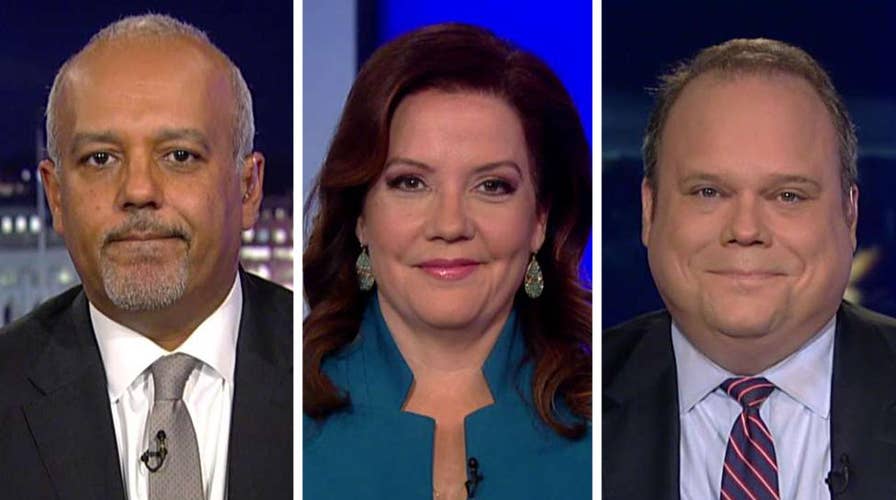
Reaction and analysis from the 'Special Report' All-Stars.
This is a rush transcript from "Special Report with Bret Baier," December 16, 2019. This copy may not be in its final form and may be updated.
Bret Baier: Good evening and welcome to Washington. I'm Bret Baier. Breaking tonight: as the House gets ready for an historic vote to impeach the president of the United States, another record day on Wall Street today. All three major indices closed at new record highs. as investors are optimistic over trade deals here in North America and with China: the Dow gaining 101 today, the 16th record close of 2019; the S&P 500 up 23, the 29th record of the year; and the NASDAQ finished ahead 79, number 24 this year. As the I's are being dotted and the T's crossed for the official impeachment vote here in Washington, the bulls are still running on Wall Street. Susan Li from Fox Business Network is in New York with the market optimism, despite all the political turmoil. Good evening, Susan.
Susan Li: Good evening, Bret . As you said, it's been a banner year for U.S. stock markets. And one notable milestone crossed today: the Dow gaining its 10,000th point since the presidential elections in 2016. So, for the year, it's been one of the best over the past decade, with the Dow now up 21 percent, the best year for the S&P 500 in six years and counting. The NASDAQ, the best performer so far in 2019, led by gains in tech giants' Apple and Microsoft, optimism that's been further fueled by expectations that USMCA, which is the new NAFTA trade deal, will be approved by Congress on Thursday. A last-minute dispute threatening to snag USMCA approval, though, with Mexico complaining about rules installing U.S. inspectors, complaints that seemed to be resolved after discussions today with Mexico's representative now saying that he's very satisfied.
[begin video clip]
Chuck Schumer: To the extent that we will work through with Mexico and Canada on workers' rights, and union rules, and so forth, I don't think that's going to be difficult. And I know it's not going to stop this successful passage of USMCA.
[end video clip]
Susan Li: Despite this year's strong stock market performance, Wall Street predicts further gains for next year, with USMCA approved, along with the China Phase One trade deal, and now Brexit cleared. The average Wall Street prediction calls for another 5 percent gain. JPMorgan pointing out that, historically, stock markets tend to advance in the 12 months prior to presidential elections. Sounds pretty bullish, Bret.
Bret Baier: Susan Li in New York. Susan, thank you. The president said two weeks ago he doesn't talk about the markets, but he's tweeted about it 15 times in the past three weeks. Turning now to impeachment, Senate Minority Leader, Chuck Schumer, is demanding four current and former White House officials be issued subpoenas to testify in an impeachment trial in the U.S. Senate, if the full House passes the two articles of impeachment it has on the docket, as expected. Chief White House correspondent John Roberts is following that story from the North Lawn as we await a response from the president. Good evening, John.
John Roberts: Bret, good evening to you. Considering that within 48 to 72 hours, President Trump could become just the third president in American history to be impeached, the White House was pretty low-key about it all today. But behind the scenes, preparations for what may lie ahead after the Christmas break. President Trump took no questions on impeachment at a meeting with several governors this afternoon. His only comments about his looming fate on Twitter this morning: "Read the transcripts," he wrote. "The impeachment hoax is the greatest con job in the history of American politics." A new Fox News poll finds that the impeachment investigation and public hearings have not had a significant impact on public opinion. Support for impeaching and removing the president about where it was in late October: 50 percent of respondents favor impeachment; it was 49 percent in late October; 46 percent oppose impeachment now, compared to 45 percent in October. At the same time, President Trump's job approval rating has ticked up, now 45 percent, compared to 42 percent in late October. Now the battle is turning toward the Senate and an impeachment trial expected to begin in January. Minority Leader Chuck Schumer sending a letter to Senator Mitch McConnell asking to call four current or former White House witnesses: acting chief of staff, Mick Mulvaney; his top adviser, Robert Blair; former National Security Adviser, John Bolton; and Michael Duffey, the deputy director for national security at the Office of Management and Budget.
[begin video clip]
Chuck Schumer: The four witnesses we propose have direct knowledge of why the aid to Ukraine was delayed.
[end video clip]
John Roberts: Twenty years ago, during the Clinton impeachment, Schumer argued against bringing witnesses into the Senate trial. Today, he insisted this impeachment is different.
[begin video clip]
Chuck Schumer: Here's what I said at the time. The witnesses in '99 had already given grand jury testimony. The four witnesses we've called have not been heard from.
[end video clip]
John Roberts: Schumer says he wants to ensure the trial in the Senate is fair, prompting a sharp response from the White House press secretary. Stephanie Grisham tweeting: "Let us hope that fairness will prevail." A laughable quote from Senator Schumer this morning after Dems released an impeachment report in the middle of the night: "Thankfully, the people of this country continue to see the partisan sham that this is." President Trump did talk today about Rudy Giuliani, who recently traveled to Budapest in Kiev to meet with former Ukrainian officials and produce a documentary aimed to undercut the impeachment proceedings. Giuliani was at the White House last Friday. The president said today Giuliani didn't talk much about his trip, but President Trump had high praise for him.
[begin video clip]
Donald Trump: He does this out of love, believe me. He does it out of love. He sees what goes on. He sees what's happening. And he's a he's a great gentleman.
[end video clip]
John Roberts: The White House today mocked Senator Schumer's call for new witnesses to appear at the Senate trial, saying it's just more proof that the proceedings in the House produced evidence that only means that the president did nothing wrong. Bret?
Bret Baier: John Roberts, live, on the North Lawn. John, thank you. As the impeachment vote looms on the House floor, Democrats in swing districts are picking sides. And one is expected to switch parties over this vote. Chief congressional correspondent, Mike Emanuel, is watching the moving pieces on Capitol Hill.
Mike Emanuel: With a full House set to vote on the articles of impeachment as soon as Wednesday, the time is coming for Democrats sitting on the fence to pick a side.
[begin video clip]
Elissa Slotkin: I will be voting, "Yes," on obstruction of Congress.
[applause]
[end video clip]
Mike Emanuel: Swing district Democrat, Elissa Slotkin, of Michigan told her constituents today at a town hall.
[begin video clip]
Elissa Slotkin: I made this decision out of principle, and out of a –
Multiple Speakers: [unintelligible]
Elissa Slotkin: -- duty to protect and defend the Constitution. I feel that in my bones, and I will stick to that, regardless of what it does to me, politically.
[end video clip]
Mike Emanuel: Utah's Ben McAdams says he's also a "Yes," but recognizes it won't remove the president from office.
[begin video clip]
Ben McAdams: The Senate will likely acquit the president in a display of partisan theater that Republicans and Democrats in Washington perform disturbingly well.
[end video clip]
Mike Emanuel: Since the GOP appears to be unified, a Republican on the Judiciary and Intelligence Committee says pressure is on Speaker Nancy Pelosi and her team.
[begin video clip]
Male Speaker: The vote will be on Wednesday, despite what a Democratic scholar called the "fastest, thinnest, weakest impeachment in U.S. history." And the real question is, "How big will the jailbreak be by the Democrats?"
[end video clip]
Mike Emanuel: One Democrat who has been a "No" on impeachment is not expected to be a Democrat for long. New Jersey's Jeff Van Drew's expected to become a Republican, and at least five senior aides quickly resigned. On the Senate side, Democratic leader Chuck Schumer's proposing his wish list for a Senate trial that would begin the first full week of January, with having the case presentation start January 9th, then giving 24 hours to each side for opening statements and rebuttals, and 16 hours for questioning by senators, and concluding with 24 hours of deliberations.
[begin video clip]
Chuck Schumer: if Leader McConnell doesn't hold a full and fair trial, the American people will rightly ask, "What are you, Leader McConnell -- and what is President Trump -- hiding?"
[end video clip]
Mike Emanuel: Fox has confirmed a push by more than 30 freshmen Democrats in the House, led by Minnesota's Dean Phillips, to have Republican-turned-independent, Justin Amash, serve as one of the impeachment managers in a Senate trial, the suggestion being that Amash could speak to conservatives in a way Democrats cannot, potentially strengthening the Democrats' argument with at least some of those voters. Bret?
Bret Baier: Mike Emanuel, live, on the Hill. Mike, thanks. Former FBI director James Comey concedes he was overconfident when he backed the agency's use of surveillance of an adviser to then-candidate Trump's 2016 campaign, and then, when he gave the process, his full-throated defense afterwards. Correspondent Kristin Fisher has the story.
[begin video clip]
James Comey: I was wrong.
[end video clip]
Kristin Fisher: Former FBI director, James Comey, admits there were major problems with the Foreign Intelligence Surveillance Act, or FISA applications, used to obtain a warrant to surveil a former adviser to President Trump's 2016 campaign, warrants which formed the basis for special counsel Robert Mueller's investigation.
[begin video clip]
James Comey: I was overconfident in the procedures that the FBI and Justice had built over 20 years. There was real sloppiness: 17 things that either should have been in the applications or, at least, discussed and characterized differently. It was not acceptable. And so, he's right.
[end video clip]
Kristin Fisher: "He" is the Justice Department's inspector general, Michael Horowitz, who testified last week before Congress that the now infamous dossier compiled by former British spy, Christopher Steele, and paid for by Democrats, was the centerpiece of the FBI's FISA application to monitor Carter Page.
[begin video clip]
Michael Horowitz: We concluded that the Steele reporting played a central and essential role in the decision to seek a FISA order.
[end video clip]
Kristin Fisher: But on "Special Report" last year, Comey said the Steele dossier was not critical to the FISA application.
[begin video clip]
James Comey: My recollection was there was a significant amount of additional material about Page and why there was probable cause to believe he was an agent of a foreign power.
[end video clip] Kristin Fisher: Now, Comey says Page was treated unfairly. And the number two Democrat in the Senate says Page deserves an apology from the U.S. government.
[begin video clip]
Dick Durbin: This isn't the first and won't be the last time that the FBI misrepresents evidence before this court and proceeds.
Female Speaker: Someone else who wants an apology is President Trump, who said on Twitter, "So now Comey's admitting he was wrong? What are the consequences for his unlawful conduct? Could it be years in jail? Where are the apologies to me and others, Jim?"
[end video clip]
Kristin Fisher: Now, to be clear, the inspector general report found no evidence that Comey did anything unlawful or criminal. It also did not find any intentional misconduct by the FBI. But remember, there is another ongoing internal investigation, the Durham probe, and it has already been elevated to a criminal inquiry. Bret?
Bret Baier: Kristin, thank you. For some analysis on impeachment and the inspector general's report, let's bring in senior political analyst Brit Hume. Good evening, Brit.
Brit Hume: Hi, Bret.
Bret Baier: Good to have you here.
Brit Hume: Thank you.
Bret Baier: Just what Kristin was talking about there, the James Comey interview with Chris Wallace over the weekend. What was your take? I mean, a lot of people said they were surprised by how much he said he didn't remember or didn't know.
Brit Hume: Right. Well, I agree with that. I think he gets credit for doing the interview, and I think he gets credit for saying that he was wrong about one thing at least, which was that the FISA process that he discussed, it wasn't as robust as he previously claimed repeatedly. Beyond that, though, it seems to me that he still tried, wherever and in any way he could to exonerate himself and the senior leadership of the FBI, which the IG report manifests, so he did not do. So I think, you know, we know a little bit more about how slippery he can be. But Chris did well to get that confession from him, and hurray for Chris, and hurray for you for the previous interview you did with elicited some information about Comey that was clearly not true.
Bret Baier: Yeah. It's been a lot of information over these past couple of years. The other interview on Fox News Sunday was Adam Schiff, the chairman now of the House Intelligence Committee. Here, he's talking about his response to Devin Nunes and this report about the FISA process.
[begin video clip]
Adam Schiff: I'm certainly willing to admit that the inspector general found serious abuses of FISA that I was unaware of. Had I known of them, Chris, yes, I would have called out the FBI at the same time. But I think it's only fair to judge what we knew at the time, not what would be revealed two years later. But, yes, there were very serious abuses of the FISA process. They need to be corrected. We need to make sure they never happen again.
Bret Baier: That seems, Brit, on its face, to be a fine answer right now. But if you look back in time --
Brit Hume: Oh, absolutely.
Bret Baier: -- at what was happening then --
Brit Hume: He says he didn't know about that. What utter nonsense. One of the most striking things about this IG report, Bret, as I'm sure you've noted, is how closely it mirrors what the Devin Nunes investigation, when Nunes was still chairman and Schiff was ranking member on the Intelligence Committee, what Nunes found and what he said about the FISA abuses and so on, to which this very same Adam Schiff issued a report in rebuttal which disputed the Nunes findings, findings now confirmed by the IG report. And now he claims he didn't know about those things. Of course, he knew about them. He wrote a rebuttal to them, and the rebuttal was full of falsehoods. So, you know, it's striking to me that having said, for however many -- two years that he had additional -- all this additional evidence on collusion, and that turned out not to exist, or it was at least unfindable by the Mueller team, he now is claiming that he didn't know about the FISA abuses, which he most certainly did. And yet here is the guy appointed by Nancy Pelosi to lead the impeachment inquiry. Remarkable.
Bret Baier: Well, you know, that part of that interview didn't get picked up a lot. And back in -- when he issued that response to Nunes, the media lifted up that response as --
Brit Hume: Oh, the media treated Schiff's response like this was the official report; these are the facts. And I -- you know, I looked to see if any reporters are now acknowledging that they had that wrong. I think I've counted one.
Bret Baier: Last thing very quickly. Do you think there's any shoe to drop in this process of impeachment that we don't yet know?
Brit Hume: Well, you know, as you've often said, Bret, about all these things, we don't know what we don't know. But I would say this: I attribute this desire to bring on additional witnesses that weren't called by the House or were not reached by the House as an attempt to try, at long last, to breathe some life and to engender some real public interest in what is being charged here. It hasn't worked so far. Public opinion has barely moved. And I don't think, you know, that Democrats think they have much to lose by calling in witnesses. But I would say this about one witness in particular, John Bolton, who, throughout much of the time in question, not all of it, but much of it, was the national security advisor and thus privy to the deliberations in the Trump administration about how to handle Ukraine, and somebody who is a Ukraine, you know, supporter and hawk.
Bret Baier: Yeah.
Brit Hume: If they want to call John Bolton, they should be careful what they wish for because I don't think anybody has any real idea what he will say. And it is by no means guaranteed that he will be a witness against Trump.
Bret Baier: Brit, as always, thanks.
Brit Hume: Thank you, Bret.
Bret Baier: There have already been five Democratic debates in 2019. The sixth is actually still up in the air as the selection criteria for the next bunch, set to take place after the new year, has some candidates raising red flags. Correspondent Peter Doocy reports from Des Moines on the potential debate debacles.
[begin video clip]
Peter Doocy: This week, the debates stage will shrink to seven Democrats if there is a debate. Do you think that there is going to be a debate in California on Thursday night?
Male Speaker: I sure hope so.
Peter Doocy: There won't be if the host university's food service company can't negotiate a new contract with striking workers, because none of the candidates will cross a picket line. And the DNC has a problem with their debate next month, too. All this month's qualifiers signed on to a letter from Cory Booker, who didn't make it, asking to lower qualifying thresholds, writing, "Many of the candidates excluded due to these thresholds are the ones who have helped make this year's primary field historically diverse." The DNC disagrees.
Female Speaker: -- polling threshold and our thresholds for our debate to say that they are somehow leaving people of color off this stage is not only wrong, but it's insulting.
Peter Doocy: But Elizabeth Warren is all for a bigger stage.
Elizabeth Warren: We ought to have a more open field.
Peter Doocy: If Warren and Bernie Sanders split up the progressive vote, it could clear the way for a moderate to win the nomination. So the New York Times reports, "Representative Ro Khanna of California, a cochairman of Mr. Sanders' campaign, said the solution would be to create a Sanders-Warren ticket. The latest Fox News poll of Democratic primary voters finds Biden in first with Sanders solidly in second and Warren in third, followed by Pete Buttigieg and Michael Bloomberg.
Male Speaker: I think it's three weeks today that -- ago, that we started the campaign. And I think we've done very well.
Peter Doocy: Like Bloomberg, Tom Steyer has spent millions on ads to reach voters. But his campaign has been most impacted by an Iowan desperate for better mental health care policies after several members of her family took their own lives.
Tom Steyer: It's like, I'm a competitive person. I view that lady as being on my team. I don't want someone doing that to people on my team.
[end video clip]
Peter Doocy: Steyer is also now starting to move beyond the "Need to Impeach," the group he spent millions promoting before he was a presidential candidate. He told me today the presidential election is separate from the impeachment process. Bret?
Bret Baier: Peter, thank you. Up next, the U.S. responds to a North Korean-set deadline to reboot the stalled nuclear negotiations. First, here's what some of our Fox affiliates around the country are covering tonight. Fox 2 in San Francisco, where about 4,000 mental health professionals are on strike across California. The union workers at Kaiser Permanente facilities are demanding a new contract after more than one year without one. Hospitals and medical offices will remain open, but non-urgent appointments may be rescheduled. Fox 8 in New Orleans, where a trail of tornadoes broke out across Louisiana and Mississippi late this afternoon damaging homes and churches and, according to local officials, killing at least one person. Forecasters said more than 1 million people had a moderate chance of experiencing dangerous weather there. And this is a live look at Seattle from our affiliate Fox 13. The big story there tonight, Boeing will halt the production of the embattled 737 Max jet starting in January. The Federal Aviation Administration said last week it would not approve the plane's return to service before 2020. Boeing says no layoffs or furloughs are expected at this time. That's tonight's live look outside the beltway from Special Report. We'll be right back.
[commercial break]
Bret Baier: Lindsey Graham says President Trump will announce an American troop drawdown from Afghanistan this week. The South Carolina Republican says more than a quarter of the 12,000 troops on the ground could be withdrawn beginning in 2020. Senator Graham has opposed a full withdrawal and says, "Any partial drawdown must be conditions-based, and the Taliban must keep the promises they make during peace negotiations." The U.S. is not going to accept a U.N. deadline set by North Korea to make concessions in stalled nuclear talks. Senior Foreign Affairs Correspondent Greg Palkot looks at the lack of negotiations and the potential retaliation from the north.
Greg Palkot: Here they go again, North Korea rattling sabers and refusing to talk. U.S. special representative for North Korea, Steven Biegun, in Seoul, South Korea with a message for Pyongyang.
[begin video clip]
Steven Biegun: Let me speak directly to our counterparts in North Korea: It is time for us to do our jobs. Let's get this done. We are here and you know how to reach us.
[end video clip]
Greg Palkot: Despite two meetings this year between President Trump and North Korean leader Kim Jong-U.N., there's been no real progress toward the denuclearization of North Korea. All four meetings between Biegun and the North Koreans of the DMZ hasn't happened. He was left talking with allies.
[begin video clip]
Male Speaker: I'm in South Korea, and the U.S. have agreed to continue making efforts under close cooperation of the complete denuclearization of the Korean Peninsula.
[end video clip]
Greg Palkot: This comes after what North Korea called a "crucial test" this weekend of a long-range missile engine, the second in 10 days at a launch site north of Pyongyang. The head of the North Korean Army saying it was aimed at "the development of another strategic weapon of the DPRK, or North Korea, for definitely and reliably restraining and overpowering the nuclear threat of the U.S." A New Year deadline set by Pyongyang for Washington to come up with a new offer or else was rejected by Envoy Biegun. The latest talk from the north about a possible nuclear clash with the U.S. is only upping the stakes.
[begin video clip]
Male Speaker: We may be going back to a crisis, if the North Koreans go back to long-range missile testing or nuclear testing. That'll put us, put us back in crisis mode.
[end video clip]
Greg Palkot: North Korea says, "It's up to Washington to decide what kind of Christmas present it gets from Pyongyang." The chances of yuletide glee on this foreign front are looking decidedly less likely. Bret.
Bret Baier: Greg, thank you. Up next, we look at the man who would preside over a potential Senate impeachment trial of President Trump. First, Beyond Our Borders tonight, at least five people are dead after a magnitude 6.9 earthquake in the Philippines, a city and four towns without power and schools are closed in the area to give time for inspections. Army troops, police, firefighters, and volunteers continue at this hour to search for survivors. Thousands of university students flooded the streets of India's capital today to protest a new law giving citizenship to non-Muslims who entered India illegally in order to flee religious persecution in several neighboring countries. The government says the law will make India a safe haven for Hindus and other religious minorities. Critics say the legislation violates the secular constitution of the world's largest democracy.
A remarkable scene commemorating the 75th anniversary of the Battle of the Bulge. World War II veterans from Germany and the allies gathered in Belgium to mark one of the battles that turned the tide of the war. Today, on December 16, 1944, 200,000 German soldiers were turned back after a surprise offensive by wearied U.S. troops. U.S. Defense Secretary Mark Esper was in attendance and paid tribute to more than 19,000 Americans who died during that battle. Just some of the other stories Beyond Our Borders tonight. We'll be right back.
[commercial break]
Bret Baier: Our top story at the bottom of the hour, the impeachment process is likely to move from the House of Representatives to the U.S. Senate by the end of the week. And if that happens as expected, Supreme Court Chief Justice John Roberts will fill the unique role of presiding over the Senate trial. Correspondent David Spunt looks at the role, and the man, who will try to stay above the politics.
[begin video clip]
Male Speaker: People need to know that we're not doing politics.
[end video clip]
David Spunt: A straightforward view of the role of the United States Supreme Court by the man at the helm.
[begin video clip] John Roberts: I, John G. Roberts –
[end video clip]
David Spunt: Chief Justice John Roberts rose to take the top spot following the death of William Rehnquist in September 2005.
[begin video clip]
John Roberts: When you're holding the reins of leadership, you should be careful not to tug on them too much: you'll find out that they're not connected to anything.
[end video clip]
David Spunt: Now, an impeachment trial of President Trump looms in the United States Senate, a trial that would be run by Roberts himself.
[begin video clip]
John Roberts: I think what he can expect is a largely scripted trial that's going to be run by the Senate leadership.
[end video clip]
David Spunt: Robert Schaffer served as a clerk to Chief Justice William Rehnquist during the Bill Clinton impeachment trial of 1999.
[begin video clip]
Robert Schaffer: Can the managers object to a question?
[end video clip]
David Spunt: Though usually referred to as Chief Justice of the Supreme Court, Roberts' official title is Chief Justice of the United States, and part of the job is to oversee impeachment trials of the President of the United States. Chief Justice Salmon P. Chase did the same for President Andrew Johnson in 1868. Known to be someone who stays out of the spotlight, Roberts found himself in the crosshairs of Donald Trump just four years ago.
[begin video clip]
Donald Trump: Justice Roberts really let us down.
[end video clip]
David Spunt: Trump referred to Roberts as a -- quote -- "disappointment, and a -- quote -- "nightmare." Last year. when President Trump referred to a federal judge as a -- quote -- "Obama judge," Roberts issued a rare statement rebuking the commander-in-chief, writing in part -- quote -- "We do not have Obama judges or Trump judges, Bush judges or Clinton judges. That independent Judiciary is something we should all be thankful for." Schaffer says Roberts has to toe the line between being chief justice and the judge in President Trump's impeachment trial.
[begin video clip]
Robert Schaffer: He has a history of being a very impartial, fair, almost umpire-like justice, who calls them as he sees them. I don't think he'll treat this trial any differently.
[end video clip]
David Spunt: But it won't be easy. Chief Justice Roberts could be tied up for weeks with a Senate trial. And while he has no plans to give up his regular duties across the street, here at the Supreme Court, he could miss oral arguments in at least eight cases if there is a Senate trial. In that case, Associate Justice Clarence Thomas would preside. Bret?
Bret Baier: David Spunt, outside the U.S. Supreme Court. David, thank you. Congress and the White House appear to have reached a spending deal ahead of a possible government shutdown this weekend. The two year-end packages were unveiled this afternoon, weighing in at 1,773 pages. The legislation would raise the tobacco purchase age to 21; three Obamacare taxes would be repealed: the Medical Device tax, the Cadillac tax, and the health insurance tax; military members would receive a 3.1 one percent pay increase; and nearly $1.4 billion is earmarked for the border wall system, with flexibility on where the president can build that wall. The panel is next on the looming impeachment vote, the IG fallout, and the politics on the Hill.
[commercial break]
[begin video clip]
Male Speaker: He poses a continuing threat to national security and to the integrity of our elections, to our democratic system itself. We cannot permit that to continue.
Male Speaker: I think it's going to come to the Senate, we're going to have fair proceedings, and then it's not going anywhere because the facts aren't there.
Male Speaker: If President Trump is overwhelmingly acquitted in the Senate, is that a failure?
Male Speaker: No, it isn't a failure; at least it's not a failure in the sense of our constitutional duty in the House.
Male Speaker: I have nothing but disdain for this. I'm trying to make myself clear what you're doing in the House is bad for the presidency. I think this whole thing is a crock.
[end video clip]
Bret Baier: Well, just some of the sound about the impeachment as it moves forward. This, as the Senate minority leader, Chuck Schumer, is really targeting some GOP senators, specifically Mitt Romney, Susan Collins, Cory Gardner, Lisa Murkowski, potentially, to get witnesses during a Senate trial. These people would have to vote on that decision, and it could affect whether it happens or not. What about that? Let's bring in our panel: Christopher Stirewalt, politics editor here at Fox News; Mollie Hemingway, a senior editor at The Federalist; and Mo Elleithee, executive director of the Georgetown Institute of Politics. Okay, Mollie, what about this Schumer effort?
Mollie Hemingway: Well, I guess he's playing the best hand he can. He's looking at the senators that might, conceivably, fall away from the Republican party vote on this. The problem is what the House did already. When they had a chance to do this in a fair manner, in a way that people would think of as legitimate, they chose not to do that pretty much every step of the way. So, it's very hard to now ask the Senate to go out of their way to be helpful to the Democrats, as they try to have some chance with this impeachment, when they didn't do that when they were in control in the House.
Bret Baier: All right. Here is Chuck Schumer explaining new witnesses.
[begin video clip]
Chuck Schumer: I haven't seen a single good argument about why these witnesses shouldn't testify or these documents be produced, unless the president has something to hide. Trials have witnesses -- that's what trials are all about -- and documents.
[end video clip]
Bret Baier: Here's who they're trying to get: Mick Mulvaney, John Bolton, Robert Blair, Michael Duffey. Those are senior advisers to Mulvaney and an associate director for national security, for Michael Duffey. Chris, he spent some time, Chuck Schumer did, explaining why he said exactly the opposite in 1998 –
Chris Stirewalt: [laughs]
Bret Baier: -- saying that a lot of those witnesses had already testified in grand jury testimony.
Chris Stirewalt: Yeah. Look, Schumer stuck because Nancy Pelosi was in a hurry. She could have waited for the Supreme Court to make a decision about the power of the House to call witnesses and the supreme power of the House under impeachment and all of those things. And there was going to be some -- potentially some interesting new case law made, and it would have been cool. But that did not fit the political timetable for Democrats because that could have taken us well into 2020 and pretty close to election day. So she said we're going to go ahead without the rulings, and then the Senate has the power to compel it. But it's not even in Chuck Schumer's interest. He is almost going through the motions here because it's in no senator's interest to have a wiz-bang, gee wiz, week's long goat roping on national television in the Senate.
Bret Baier: All right. Here's a couple Fox polls. First Fox poll one, this is about, should the president be impeached and removed from office? You see atic up there from late October in this particular poll. However, the president's job performance also takes a tick up, Fox poll two, from 42 to 45 in this latest poll. In the RCP average of recent polls when it comes to impeachment, Mo, it does seem like it is going a little bit upside-down. It's kind of shift -- shifted "oppose" and "support." Of course, everybody over the weekend was saying, "Even Fox News poll." They love to say that, even though we're just like every other poll anyway. Go ahead.
Mo Elleithee: Right. Yeah, no, it's kind of -- you know, there's been a little bit of a seesaw there, but all within the margin of error. What's amazing is -- to me, is just how remarkably static it's been in terms of the country being fairly evenly divided. Sometimes it's a little bit above, sometimes it's a little bit below. People seem to -- you know, the cake may be baked, which is why I think you do see Democrats pushing for the witnesses, because I think it's going to take some new information. And these guys that you just had up on the screen, they are the ones who have the potentially new information to inject into the conversation that could, you know, break the fever a little bit in terms of the approval ratings on this.
Mollie Hemingway: Well, when you look at these numbers, they really are stagnant, not just from recent months, but really going back to March, the same percentage of people wanted impeachment then as they do now. I think the reason why Democrats wanted to do it was because they just wanted to tarnish Donald Trump's name leading up into the election. So that's why these approval polls showing that he is, in some cases, at an all-time high, that really shows what didn't go well for the Democrats more than any shift in impeachment numbers, although that's also significant.
Bret Baier: And remember, Tom Steyer had a whole campaign about impeachment before they even got to impeachment.
Mo Elleithee: Right, but you didn't see the numbers start to break in favor of impeachment until much, much later in the process. And remember, there's -- you know, it wasn't until very, very late, right before he left office, that you started to see mass public movement towards -- in support of Richard Nixon's impeachment. People tend not to like it. They never liked it with Bill Clinton. These numbers are stronger.
Bret Baier: There was also John Dean and some tapes that made --
Mo Elleithee: And that was new information that came up there towards the end that started to catalyze support.
Bret Baier: All right, I want to look at Jim Comey's interview with Chris Wallace and the "then and now" sought on FISA.
[begin video clip]
James Comey: I think the notion that FISA was abused here is nonsense. I was wrong. I was overconfident in the procedures that the FBI and justice had built over 20 years. I thought they were robust enough. It's incredibly hard to get a FISA. I was overconfident in those because he's right, there was real sloppiness. 17 things that either should have been in the applications or at least discussed and characterized differently.
[end video clip]
Bret Baier: Chris, what do you make?
Chris Stirewalt: This guy. I just -- I like -- I can't -- I can't with this guy anymore. And --
Bret Baier: "I can't with this guy."
Chris Stirewalt: This -- and the sport coat just is perfect for him. He's entered this like --
Bret Baier: He just came out of hunting and fishing or something?
Chris Stirewalt: You could say this lounge act deal that he's got going on, oh, poor him? Like he was -- oh, boy, I cared too much, I trusted too much in these institutions. Gee, patee, when is it enough with him, and when does he retreat from the stage and say, "I blew it. It was not successful. I'll see you later."
Bret Baier: What was remarkable is the mistakes -- he kept oncoming back to mistakes, all 17 of these major things, including one where a lawyer adjusts an email to exactly the opposite, go against President Trump, against Carter Page, every one of them.
Mollie Hemingway: Just struck by how, when this report came out, James Comey actually put an op ed out saying he had been vindicated. The actual facts in this IG report are anything but that. Not only is he not vindicated, I think it's worth remembering there's actually a criminal investigation going on into some of these things that were done. And the Horowitz report, which could only talk to people at the Department of Justice who agreed to speak with Horowitz had -- is limited. What this criminal probe can do is look into people who used to work there, like Comey, and other who are not even in the FBI or Department of Justice. We don't know what that's going to find out. We were told for years, "We don't know what's going to be in the Mueller report." Well, we found out that there was no Russia collusion. And when the IG report came out, we saw major malfeasance from the Department of Justice and FBI. And there's still more coming. We still have more investigations coming.
Bret Baier: Mo, on Adam Schiff, he says, "You know what? I didn't know that two years ago when I put out that really aggressive report responding to Devin Nunes." Now he says, "Well, I just made a mistake." Back then, it was like he was -- they were lifting up the perfect report in the media.
Mo Elleithee: Yeah. Look, I think two things can be true, and I think it does a disservice to all of this for us not to acknowledge that two things can be true, that the president is wrong when he says that this was all politically motivated from the get-go, which the IG report said was not true.
Bret Baier: Could not find -- could not find --
Mo Elleithee: Could not find that it was politically motivated.
Bret Baier: But he explained that like 7 billion times under Republican questioning.
Mo Elleithee: But also says that -- that there were some serious problems with the FISA report. Both those things can be true. Both sides are very happy to cherry-pick one or the other. But I think it is in the interest of our justice system to acknowledge both, not push -- not push --
Mollie Hemingway: I just -- this is actually important. This has been said so many times, and it's just not true. The IG did not say he found that there was no bias. I mean, he did say -- he said -- he said that there is no bias --
Mo Elleithee: He found no evidence of --
Mollie Hemingway: -- conclusively.
Mo Elleithee: He said he found no evidence of bias.
Mollie Hemingway: But he himself said in his testimony -- you know, it would -- you know, yeah, all the -- all the errors went in the same direction. He just didn't find anybody saying, "Not only am I biased. The reason why I'm doing this is because I'm biased." He found them saying that they were biased, and he found the wrongdoing. He just found nothing, no smoking gun linking those two things.
Mo Elleithee: He said there was -- he said there was no --
Mollie Hemingway: So, I don't think we should overplay that.
Bret Baier: Let's not -- let's not go around this -- this bush because we've been -- I mean, literally, entire hearing I sat here watching it as Republicans tried to get him to say it a different way, and Democrats tried to get him to go the other way. And the bottom line is, we are where we are in the IG, and the question is where we go from here.
Mo Elleithee: Okay.
Bret Baier: And, okay. We'll leave it there. Next up, Democratic debate debacle. We can agree on this.
[commercial break]
[begin video clip]
Male Speaker: Do think that there's going to be a debate in California on Thursday night?
Male Speaker: I sure hope so. I think it's important that people get a chance to hear what the different candidates have to say.
Male Speaker: I've not heard anything yet from the DNC, but I'm confident that they will resolve these issues. I'm planning on being in Los Angeles and I am excited for the debate.
Bernie Sanders: I think there is not going to be a debate so long as it remains a labor dispute. But I hope and expect that the DNC will resolve that.
Elizabeth Warren: I hope they do because I'm not going to cross a picket line. I never have, and I'm not going to start now. And I don't think any Democrat should.
[end video clip]
Bret Baier: Well, that debate Thursday is really in jeopardy. We're back with the panel. I just want to note, I think Tom Steyer only has one tie. I'm pretty sure Andrew Yang was dancing there, but I'm not --
[laughter]
-- positive. But as we are tonight, there's no debate. Is that right?
Male Speaker: Well, it --
Bret Baier: There's a union dispute.
Male Speaker: -- yeah.
Bret Baier: The food service company can't negotiate a new contract with the striking workers. And now the candidates say -- and these are the ones that have qualified for the debate -- "We're not crossing the picket line if it doesn't get resolved."
Mo Elleithee: Yeah. Folks at the DNC are pretty optimistic that it will get resolved. This is where, you know, having the former secretary of labor as chairman of the DNC could be a good thing. He's been, he's been on the phone. He's been trying to bring both sides to the table. They're pretty optimistic they'll get it done.
Bret Baier: If you're a striking worker and they're bringing in the DNC chair to do the negotiating, you're feeling pretty good.
Mollie Hemingway: You could not get better timing for your strike than to have a DNC debate coming in. But you know, they want so desperately to have this debate because it, because of how long they have to wait before their next debate and some issues that need settling. So, I imagine that pressure will be heavy for them to resolve it.
Bret Baier: Yeah. The other issue that needs settling is more inclusive. There's a push for that, take a listen.
[begin video clip]
Male Speaker: I sent an open letter to the Democratic National Committee asking them to relax the rules about letting candidates on the stage because I wanted more, a more diverse group of people.
Male Speaker: To me, having a more inclusive debate is a positive thing.
Cory Booker: So, we're just asking the DNC to be more thoughtful about these thresholds to allow for a more robust conversation up there on the debate stage.
Female Speaker: To say that they are somehow leaving people of color off the stage is not only wrong but it's insulting. It's insulting as a woman of color and someone who's involved in the debate process.
[end video clip]
Bret Baier: Right. But just to put up the people who did qualify for the debate, there is something missing from that and that's African Americans, Julian Castro, it's -- for a DNC, this is not -- they want to be more inclusive than that? Is that what they're saying?
Chris Stirewalt: Well, look, the amount of guilt and handwringing, it's just, it's so sad. I mean, the whole thing, the spectacle of Democrats trying to run debates this cycle has been beyond sad. They should have let the networks do it. They did it themselves, now they're ending up hoisted on the intersectionality petard and, well, Pete Buttigieg is in a same-sex marriage. Does that one know because he's white -- oh well, but Andrew Yang is Asian. I don't think that qualifies. It's so, it's so far removed from the actual work of what a political party does, which is to choose a nominee.
Bret Baier: But you, eventually you have to get to so many people on the stage, right?
Mo Elleithee: Right.
Bret Baier: I mean, 12 doesn't work.
Mo Elleithee: Yeah. And look, the DNC actually is doing exactly what Chris is talking about. The DNC set thresholds that -- and everyone knew what they were.
Bret Baier: Yeah, but they don't like it. Their own candidates don't like it.
Mo Elleithee: But that's -- candidates always complain about debates. As a guy that's been involved in this process in past cycles, candidates always complain about the rules for the debates. The ones who are complaining right now are the ones who didn't make it on. Every candidate had equal opportunity to hit these thresholds; some did, some didn't. Kamala Harris hit the threshold for this debate. Her campaign stopped, but she hit the threshold for this debate. Cory Booker --
Bret Baier: Can she --
Mo Elleithee: -- has been on every debate up until now.
Bret Baier: -- can she pass her ticket to Cory Booker?
[laughter]
Mo Elleithee: He was there on stage on every [unintelligible].
Bret Baier: All right. Last word, very quickly.
Mollie Hemingway: The coalition really -- this is an important issue the Democrats have to deal with. And the coalition that makes up the Democratic Party is changing. This isn't the Clinton Party, it's, you know, more the Obama Party. They need the enthusiasm that -- they need enthusiastic, non-white voters. And when they see a stage like that, I think they get nervous that they're not going to have that in the eventual outcome.
Bret Baier: We will cover it either way, whether it happens or not. Thanks, panel. When we come back, bringing Christmas to children in the hospital.
[commercial break]
Bret Baier: Finally tonight, getting in the Christmas spirit, a grieving father honoring his daughter's memory by bringing a Christmas tree farm to a children's hospital in Alabama. The kids were able to pick out their own tree, decorate it with homemade ornaments. Mark Miller, whose daughter Mary Beth died at the age of seven said he knows the difficulty and toughness of bringing the holiday spirit to a loved one in the hospital. Miller, along with his Ace Hardware colleagues, delivered more than 340 Christmas trees, a whole winter wonderland, to that hospital. That is awesome. That's it for this Special Report, fair, balanced, and unafraid. The Story hosted by Martha MacCallum starts right now. It's just the little things, Martha, that's it.
Martha MacCallum: Yeah, that's what Christmas is all about. All right. Thank you so much, Bret.
Bret Baier: We’ll see you.
Content and Programming Copyright 2019 Fox News Network, LLC. ALL RIGHTS RESERVED. All materials herein are protected by United States copyright law and may not be reproduced, distributed, transmitted, displayed, published or broadcast without the prior written permission of CQ-Roll Call. You may not alter or remove any trademark, copyright or other notice from copies of the content.
