








Reps. Zeldin, Gaetz respond to Iranian missile attack on US forces in Iraq
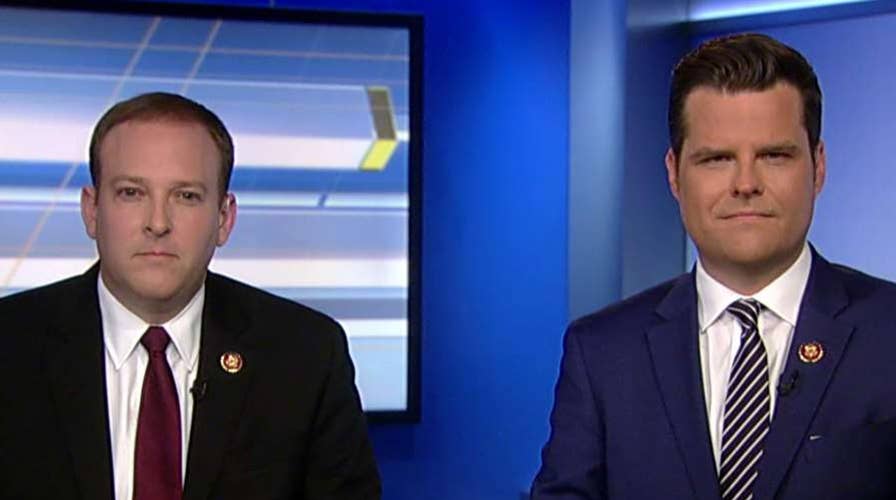
Republican congressmen Lee Zeldin and Matt Gaetz join Laura Ingraham on 'The Ingraham Angle.'
This is a rush transcript from "The Ingraham Angle," January 7, 2020. This copy may not be in its final form and may be updated.
LAURA INGRAHAM, HOST: We're on all aspects of the breaking news as it comes in and we certainly do pray for our troops. I'm Laura Ingraham. This is "The Ingraham Angle."
On a major news night, Washington. We have it all covered. Multiple fronts, Iran, impeachment and a lot more. And of course, Iran did launch more than a dozen missiles, the U.S. military forces in Iraq, a retaliation they say for last week's targeted killing of General Qasem Soleimani.
Now at this hour, the Pentagon is telling us that the ballistic missiles were fired from Iran and targeted at least two Iraqi bases that host U.S. military personnel. Now it's still too early to assess all the damage. But a U.S. official is telling Fox News tonight as Sean said, there are no American casualties.
We'll be bringing you updates, important analysis throughout the hour from multiple perspectives. But first, I want to go to Fox News Foreign Correspondent Trey Yingst, who is live from Baghdad where the sun has just come up. Trey, you've been up all night. What can you tell us at this early hour?
TREY YINGST, FOX NEWS CORRESPONDENT: Laura, good evening. We saw the expected response from the Iranians, no one knew exactly what it was going to be, but it ended up being more than a dozen ballistic missiles fired from Iranian territory towards that military base. The al-Assad base in western Iraq. This is a base that does house many U.S. forces.
According to our Lucas Tomlinson, over at the Pentagon, a total of 15 ballistic missiles were fired, four of them failed. One of them landed in the city of Erbil, the rest hitting that base. But as you said, no reports of American casualties. The good news out of this ballistic missile strike attack tonight from the Iranians.
What is different about tonight's attack from previous ones that we saw for example earlier this week in Baghdad's Green Zone to the left of me, there were some rockets fired by Iranian backed Iraqi Shia militia groups. These are smaller rockets and they're fired from within Iraqi territory often towards U.S. backed bases, but not from Iranian territory. This is a major escalation to what the Iranians have been doing before.
What we have seen here in Baghdad tonight though a lot of helicopter activity overnight in Baghdad's Green Zone, a number of countries including the United States patrolling that area to ensure that none of those militias would launch a similar attack during the same time.
According to Iran's Foreign Minister, Mohammad Zarif, it does appear that this round of retaliation is over the ball is now in President Trump's court. He has participated in this back and forth with the Iranians all week. Even today though, Iranian President Hassan Rouhani and top leadership there have said, they are going to spill American blood. Again though, it does appear that this round of retaliation is over, but make no mistake, there are Iranian proxies across the Middle East.
We've spoken with many of them in places like Gaza that you have Hamas, Islamic Jihad, also in Lebanon, Hezbollah and Iranian backed militias in places like Iraq and Syria. They all threatened U.S. troops in the region or allies such as Israel. So, while this round of retaliation may be over, U.S. troops in the region and in Kuwait where President Trump has deployed more than 3000 American forces are still on high alert. Laura.
INGRAHAM: Trey, thanks. And remember, there are 5000 U.S. troops in the region tonight in Iraq. Here to react to all this news, Retired Lieutenant Colonel Daniel Davis, Senior Fellow and Military Expert for Defense Priorities. Also, with us Jim Hanson, former U.S. Army Special Forces operator.
Colonel Davis let's start with you. Can we expect more from the Iranians or is this it for now?
LT COL DANIEL DAVIS, MILITARY EXPERT, DEFENSE PRIORITIES: I think right now, this is probably going to be it for now. And I think they're going to wait and see what we do as a result, because we've already heard from the correspondent right there and other sources that I've heard also is that many of these Hezbollah tops and Khatib Hezbollah people in Iraq and Iran and in Syria have all independently threatened to attack United States as well.
So, the question is going to be, can they be controlled from Tehran or might some of them acting rogue or might they be directed. So, we're not out of the woods yet.
INGRAHAM: Now Jim, if they wanted to kill Americans, they could have. Correct. They know where they are basically on these bases. If this report is correct and it looks like so far, we have no reason to doubt it that no American service personnel have been killed, could this have been their way to kind of save face with their anxious radicals, within their population?
JIM HANSON, FORMER U.S. ARMY SPECIAL FORCES: And their honor and culture. So, they had to retaliate in some way, or they would lose face. So, I think you're absolutely right that that's a distinct possibility and the choice of ballistic missiles as opposed to another.
INGRAHAM: Explain that for us.
HANSON: Ballistic missiles are long range. They require guidance and to be perfectly frank, the Iranian missiles suck. All right, they're not good. They don't know where they're going to land. They lob them hundreds of kilometers and they land in a general area. So, it's not like you know people think U.S. launches ballistic missile strike.
We know pretty much--
INGRAHAM: Pinpoint accuracy.
HANSON: Yes, we're going to hit a desk in a building.
INGRAHAM: So, they couldn't - then they - you are saying something different than they - they could have tried to kill U.S. forces, but missed?
HANSON: I think what they were doing is taking the least likely to create a mass casualty incident. But they took a chance, you know by doing it, by launching in that direction, about launching them at the bases. If they hit and kill an American, then they're in trouble. But they were - they knew the chances were slim of that. And it makes them look tough, because ballistic missiles sound like a tough guy move.
INGRAHAM: Well, Nancy Pelosi, Colonel Davis, you'll be happy to know is closely monitoring the situation. Here's a tweet. She's following the bombings targeting U.S. troops in Iraq. We must ensure the safety of our service members, including ending needless provocations from the administration and demanding that Iran cease its violence. America and the world cannot afford war.
And then we have a picture of her, she's actually closely monitoring the situation from a rather high-end D.C. restaurant, which looks she just happened to be out to dinner. I'm not going to crucify her for that. But she's criticizing the President as American, the Commander-in-Chief, as American forces are in harm's way, as Jim said.
DAVIS: Yes, well, I mean what else is she going to do? Right. I mean she has to say something to dress down relevant, I suppose. But there is a bigger issue involved here. And it's something I've actually said on your show several times here and over the last several months is that, we need to get our troops out of there, because right now they are serving absolutely no positive outcome for the United States. Our security is not at risk. Actually, the missions that we had been given, which was train the Iraqi troops and counter ISIS stuff, have now both been suspended.
So, right now, all they're doing is sitting in the desert--
INGRAHAM: They're sitting ducks. Our military sitting ducks in Iraq waiting for Iran maybe to strike.
DAVIS: That's correct. And we don't need to have that kind of exposure. We need to pull them out. President Trump has talked about this several times, and I strongly advise that, I strongly agree with that, because it doesn't help us. It gives us a lot of strategic risk. I'd love to see him move us out of there.
INGRAHAM: Jim, do you agree with that? I mean, I am worried about mission creep here. I'm worried that this President, who in part won election, the election by being the anti-Bush. He did not want to do what Bush did. And I don't think that's where he's going here. I really don't. I think his instinct is for peace but can't also allow terrorists to run roughshod over American interests.
HANSON: Can we do peace through strength? Can we admit that taking out one of the world's deadliest terrorists? The guy, the kingpin of Iran's terror network and all their proxies around the world may actually make us safer, because now they're disrupted. All right. Trump didn't do that because he wants to have World War III with those guys. He did it because Soleimani asked for it. And we would have put all our people at risk by not responding. Now we did. Now their networks in Iraq, in Syria, in Yemen and in Lebanon are all in chaos.
The Russians called Assad to their airbase to meet with Putin today. All right. Assad was Soleimani's guy. All right. They were buddies. So, now the Russians are moving in there. There are all kinds of bad things going on. And Iran has plenty on their plate. They don't want to beef with us. So, I think this ends up being a net positive.
DAVIS: Although, I don't agree with that. I'll say I have a different view on that.
INGRAHAM: This is why I love these discussions, because this is not necessarily a clear conversation about this.
DAVIS: Right. So, we took out Soleimani. Well, he was the top of a very large apparatus. And if we thought that there was an imminent strike come in, the actual operational people are still untouched, and they immediately replaced Soleimani. So, all those things still exist. But now you've added on top of that a lot of emotion on top of that for retaliation. So, the risk is actually higher, in my view.
But now, President Trump and I think that there is a red line, when an American is killed, I mean, how could he not retaliate and respond. But that's why we need to get those troops out of there, because by getting them out of there, that reduces our strategic risk. And it makes it harder for Iran to do something because if we don't have those targets there. What else are they going to do? Because their reach is very short, and our global reach is unrivaled in the world. And we can reach out from anywhere.
INGRAHAM: And I go back, and I think about 2006, early 2006 in Iraq, and I was there only for a week. But I said this last night. They enlisted men who kept telling me, Iran, Iran, Iran, you've got to focus on Iran, because they're making these IEDs that blew up my buddy two weeks ago. And remember, General Casey, who didn't want to - he didn't want to talk much about Iran back then.
But if Trump is in this situation, because this is what he was dealt, he was dealt the situation by both Obama and Bush. And it's a hard clean up act to deal with.
HANSON: Obama's cringing capitulation for the entire time, he was in office out of a desperate attempt to gain a legacy for his foreign policy, left us with a place where Iran was dominant. All right. They were dominant in the region and we weren't responding. Now, President Trump has responded in a very important way. And I'll agree with Colonel Davis. I. believe that this may, in the short-term, put us at more risk, but in the long-term, it can create a wedge between Iran and their proxies and also at home, it reminds the Iranian people that they're buying guns for militants in Iraq and Syria, not eggs and butter for their own people. And I think that matters.
INGRAHAM: Elizabeth Warren speaking out tonight as well. And you sense that the candidates on the trail, the Democrats, are trying to recapture that anti-war mantle that Trump had successfully wrestled away from the Democrats. Watch.
(BEGIN VIDEO CLIP)
SEN. ELIZABETH WARREN, D-MA., PRESIDENTIAL CANDIDATE: The Iranian government has announced that it has sent missiles to attack our military bases in Iraq. This is a reminder why we need to deescalate tension in the Middle East. The American people do not want a war with Iran.
(END VIDEO CLIP)
INGRAHAM: Jim.
HANSON: Nobody wants a war with Iran. Iran especially doesn't want to war with Iran, because they can't go force-to-force against us and they know it. So, they have the ability to asymmetrically hit us. They can do things. They could attack shipping again. They can do things like that. But they don't want the United States particularly riled up against--
INGRAHAM: Here's my thinking. If we are now in a position in Iraq, where we're supposed to not respond when we have Soleimani parading around the Baghdad airport, obviously planning something behind the attack on the embassy, they would have torched that whole embassy if they could have. So, if we're in a position where we can't do anything because it would trigger Iran, then why are we there? Then the situation is truly hopeless.
If a country that is a sixth of our size, we have - 326 million people in United States. they have about 80 million. They are sixth of our size. If we can't retaliate, then what are we doing there? That's another way of looking at it. It kind of illustrates, I guess, Colonel Davis, what you're saying here. But it also is your point like, we're there. We thought we'd be out of there, we're still there. We get threatened. He's parading around the airport and we're supposed to just say, well, we're nothing.
DAVIS: And no president in our history would ever stand passive in the face of an attack on American people. So that is unquestionable.
INGRAHAM: Didn't they attack our embassy. They attacked our embassy. That's sovereign U.S. territory.
DAVIS: But we have to also recognize that didn't happen in a vacuum that happened after we killed 25 of their people. We call them bad, but they were Iraqi citizens in the PMF and 50 more were wounded. That was what drove them. And no one was injured and wounded. So, we can deal with that.
INGRAHAM: They don't need an excuse to--
DAVIS: As long as nobody was hurt in that time. But here's the biggest issue for President Trump. Earlier today, the Iranians said that they're now stopped abiding by any capacity of the JCP away. So that's another big issue, meaning that they're moving back toward now openly, potentially nuclear stuff.
What we don't want to get into is a situation where we have our troops there, which can be targeted by either the Hezbollah or by some of these other groups that there, we need to pull them out, so that now we can just deal with that issue there, because Trump, I think must avoid an unnecessary war while defending us without--
INGRAHAM: You see what the Democrats are doing though, Jim. You see that like he really had an edge on us? He was like so hard to deal - he was asymmetrical in the last election. They didn't see anything like him. And so, now they're trying to say, no, no we're NTC. He's just like the war hawks. He's like the neocons wanting to throw all this money away in this godforsaken place.
HANSON: And it's not going to work for him for one reason. Trump doesn't want a war. Trump wants a deal. Trump's still a dealmaker. And what he wants to do is put Iran in a corner. And right now, they're broke. They don't have money to pay their proxies. Now they're going to need their proxies. They can't pay them. They don't have the money to do it. They have lost their main, you know, kingpin puppet master who was running all those things. And he was a very charismatic guy.
He may have been a scumbag, evil, terrorists.
INGRAHAM: Murderer.
HANSON: But he was good at it. And consequently, the guy they replaced him with is not as good and he's not as charismatic. And he doesn't have those personal relationships. So, we have at least for the short-term, an opportunity to put them on their heels and Trump's going to use that not to start a war, but to avoid one.
DAVIS: But I'll tell you also, there's an issue here with this maximum pressure and I'm going to allow in here, and I'll admit that right off the top here. But when all we do is put pressure on them, we say we want to negotiate a better deal. That's what Trump said. But if we don't offer the possibility for Iran to have something that they want out of it, there will never be a negotiation. They'll continue to move towards - to nuclear. And then we may have to come to a point to where there is a war, whether we want it or not. That's hard for people in America to--
INGRAHAM: This is why we have different voices on the show. It's really important. This is important moment for this presidency and for the country, our troops. I really appreciate both of you coming on tonight. Thanks so much.
And now we're going to the White House, where our Chief White House Correspondent, John Roberts is standing by with the latest. John, now, the President just tweeting moments ago that he is going to address the nation tomorrow morning. Any clues about what we might expect?
JOHN ROBERTS, FOX NEWS CORRESPONDENT: You know, I think you could draw a lot of clues from what we saw tonight, where initially there was what looked like mayhem unfolding in Iraq with all of these ballistic missiles fired at Iraqi bases that housed U.S. military forces. And then as we found out throughout the night that it didn't look as bad as what had been initially expected.
The President tweeting a short time ago, "All is well. Missiles launched from Iran at two military bases located in Iraq. Assessment of casualties and damage taking place now. So far, so good. We have the most powerful and well-equipped military anywhere in the world by far. I will be making a statement tomorrow morning."
We have no idea the timing of the statement or really what the president is going to say. But there is a belief among some high-ranking administration officials that what we saw from Iraq, Iran here tonight may have been an intentional miss, that they knew where the U.S. forces were housed. And even though they hit the al-Assad air base with 10 missiles and hit the base in Erbil with one, that those missiles fell far away from where U.S. forces were being housed.
And while there may have been some casualties among Iraqi forces, there were no casualties among American forces, which really would have changed the equation. So this is being potentially seen here and this is still in the early going as a potential face saving measure on the part of Iran to say, we did something here, but they didn't do enough that would invoke a really harsh and wide ranging retaliatory response from the United States.
Now, that said, the President could announce tomorrow morning that he is going to respond in some way, shape or form, certainly in the Oval Office this afternoon. The President said, he was ready to do that. Listen here.
(BEGIN VIDEO CLIP)
PRESIDENT DONALD TRUMP: I will say this, if Iran does anything that they shouldn't be doing, they're going to be suffering the consequences. And very strongly. We're prepared. We're totally prepared. And likewise, we're prepared to attack if we have to as retribution.
(END VIDEO CLIP)
ROBERTS: Now, of course, today Iran was talking about all of this. This attack against Soleimani, which killed him on Saturday night and - Friday night in that airstrike, is an act of terrorism, an act of war. There was even some suggestion by the Iraqi Prime Minister and the Iranian Foreign Minister, Javad Zarif, that Soleimani was there on some sort of diplomatic peace mission that Iraq was trying to broker a new relationship between Iran and Saudi Arabia. The Secretary of State basically laughed that off this morning and listen to what President Trump said about it this afternoon.
(BEGIN VIDEO CLIP)
TRUMP: They weren't there to discuss a vacation. They weren't there to go to a nice resort someplace in Baghdad. They were there to discuss bad business. And we saved a lot of lives by terminating his life. A lot of lives have said, they were planning something and you're going to be hearing about it, or at least various people in Congress are going to be hearing about it tomorrow.
(END VIDEO CLIP)
ROBERTS: Now again, we're going to hear from President Trump on this tomorrow, before the secretary, state, secretary of defense, the CIA director and the chairman of the Joint Chiefs of Staff go over to Capitol Hill to brief members of Congress on all of this. But the initial assessment this evening, Laura, the thinking is among many administration officials that this could have been a deliberate miss on the part if Iran fire some missiles out into the Iraqi desert, hit around the air base from which they say the attack against Soleimani was launched.
And Javad Zarif himself tweeted out that Iran undertook and concluded its response. It does not want escalation, according to Zarif, but it will respond when attacked. So, we'll see where this goes from here. But the early betting may be that it doesn't go too much further unless the U.S. decides to respond against potentially some Iranian infrastructure. But the fact that there were no U.S. casualties tonight, Laura, I think is a good sign of where this may be headed in the future.
INGRAHAM: John, excellent analysis. I appreciate it so much. And here now is Lee Zeldin, House Foreign Affairs Committee member, and Matt Gaetz, House Judiciary Committee member. Congressman Zeldin, let's start with you. The House was set to vote to limit Trump's war powers this week. But do the attacks today change the calculus?
REP. LEE ZELDIN, R-N.Y.: I would certainly hope so. I mean, I'm a member of the House Foreign Affairs Committee. There hasn't been any type of a hearing, any markup of any resolution. Get this, there isn't even text yet. So, here we are back in D.C. They're talking about having a vote this week on something to undercut and handcuff the President of the United States. They still haven't yet figured out what their text looks like.
So, I would say it's the wrong answer. I think Speaker Pelosi putting out her statement and instead of thinking about our troops, hoping there's no casualties, sticking together as Americans first to take that political partisan shot at the President was wrong. I think she needs to do some self-reflecting tonight and as we go through the rest of this week, we should be working together as Americans first in our response and not going forward to her plan to undercut and try to take out the President.
INGRAHAM: Congressman Gaetz, I think the President and especially hearing John Roberts, this is very important too in what he just said.
REP. MATT GAETZ, R-FLA.: Very.
INGRAHAM: They could have hit that or those military bases in a much more strategic, in an accurate way, even if they're not as advanced as we are. But they could have done it.
GAETZ: Well, the Iranians certainly were able to draw a bead on their target when they were shooting into Saudi Arabia. And so, I think John's point is well taken. Remember, General Soleimani, the terrorist was trying to pull the United States and Iran into war. That's why it was the right thing to do to kill him. However, we should not give General Soleimani in deaf, what he could not accomplish in life, and that is a war with the United States and Iran.
I'm hopeful this was an intentional miss. I do believe if the United States seeks war with Iran, which the President doesn't, the American people don't. That, of course, congressional authorization would be required. That's in the Constitution, certainly not for self-defense. I think the President has been measured and let's hope that restraint wins the day.
INGRAHAM: I mean, if he wanted to respond tonight, they could have responded tonight, the light of day there or hours ago.
GAETZ: If the President wanted war with Iran, he's had plenty of opportunities. He has chosen to exercise restraint. And I think we're seeing the Trump doctrine is one where we strike and then move. We don't invade and then try to persuade.
INGRAHAM: I said last night, Congressman, that while Bush might have been idealistic when it came to what was possible in Iraq and we had defeatism on the part of Obama, we have a realism of this President that I think when you see an action right now, you're seeing it in action.
ZELDIN: You saw it taking out Qasem Soleimani. You have - the Quds Force is a designated foreign terrorist organization, Qasem Soleimani is a designated - was a designated terrorist. He was sanctioned by the United States, the EU, the United Nations. And when Nancy Pelosi said that it was disproportionate--
INGRAHAM: Tonight, when she says tonight needless provocations from the administration as - at that point we didn't know if there are American casualties.
ZELDIN: I would love to as her at what point is it proportionate when you have 600 U.S. troops who get killed and thousands more, they get wounded? And she calls it disproportionate to take out the person who is responsible for it. Take one trip to Walter Reed where we serve with Brian Mast. You have these young men, young women who had their whole lives in front of them and because of Qasem Soleimani, they end up wounded permanently. I'm happy that he can rot in hell with al-Baghdadi and bin Laden. I think that's a huge win for the President.
INGRAHAM: I think Pelosi's comments were disgusting. It's disgusting in any way, even tip toe to the edge of equating what the mullahs wanted with what Trump did here. Unbelievable.
GAETZ: Well, but I think you in your last segment raised the right question. So, what now? What is the strategic objective for our troops in Iraq? It seems as though the Iraqi parliament has taken a different view on whether or not we even should be there at all.
And yes, maybe we ought to take them up--
INGRAHAM: Maybe we ought to leave. Maybe we ought to do what Trump has said we should do for years, get out of Iraq--
ZELDIN: And focus on our country.
INGRAHAM: Yes. I mean, I think that's where his people are. Stay in Kuwait. That base there, I have been there, it's very nice. We can operate out of there. All right. I have to share this with you. This was Biden earlier today. This is, by the way, after he mixed up Iran and Iraq. No big deal. He said that Iran voted to kick us out of the country. Now, this is what he was saying could be done to calm down the situation. Watch.
(BEGIN VIDEO CLIP)
JOE BIDEN, D-PRESIDENTIAL CANDIDATE: Haphazard decision-making process, not good. The failure to consult with our allies or Congress. And the reckless disregard of the consequences that would surely follow was in my view dangerously incompetent.
(END VIDEO CLIP)
INGRAHAM: He went on to say, if he wanted to resolve this, we should get back into the Iran deal.
ZELDIN: You've been given $150 billion to Iran and then you're financing Hezbollah in Lebanon and Assad in Syria and helping the Houthis take out the government in Yemen, test firing intercontinental ballistic missiles. You remember when they embarrassed or detained and embarrassed our Navy sailors and in John Kerry's response was, thank you, and then delivering $1.7 billion on pallets of cash.
INGRAHAM: He actually said the way to deescalate is for us now to go to Iran and say, oh, please, sir, may I have another? I want to go - we want to go back to the Iran deal after they use this as an excuse to not abide by the Iran deal, if they even were.
GAETZ: It is obvious that the violence that Iran has undertaken has been animated by the Iran deal. It has been funded by the Iran deal. And thus, we are in this circumstance because of the failures of the Obama-Biden policy.
But let's make sure that the Trump doctrine is not a continuation of the Obama Bush doctrine. Let's make sure that we're able to match our military might with the right strategic decisions to get out of the Middle East, a place - think about what China is thinking right now. They're probably laughing and hoping that we get another two-decade long war.
INGRAHAM: How much money have they spent in the Middle East?
GAETZ: Yes. They have not spent trillions of dollars and they have not spilled the blood of their bravest patriots the way we have.
ZELDIN: They're investing strategically. I mean, they put Huawei into certain countries and they're getting into the cell phone towers and--
INGRAHAM: We don't want Huawei.
ZELDIN: On to the ports. It's important to note, we mentioned some of the non-nuclear bad activities of Iran. But on top of that and what Joe Biden and these other Dems won't tell the American public is this sunset provision. The Iran nuclear deal was about to end, the flaws with the verification regime. President Obama, Joe Biden and John Kerry, they said this bill, this deal is not built on trust. It's built on verification. But then they put the entire verification regime into a secret deal between the IAEA and Iran. And we as members of Congress, the American public, they still haven't seen it.
INGRAHAM: Well, I have to place on, this is getting into another point here is and I'm going to touch on this later on in THE ANGLE. We're going to talk to Eric Trump and Sara Carter. We've got a great show.
But Chris Matthews was on tonight on MSNBC and this was as we were learning new details about the missile attack. Watch.
(BEGIN VIDEO CLIP)
CHRIS MATTHEWS, MSNBC HOST: We killed this guy. We assassinate him with Mike Pence in the room, with Mike Pompeo in the room. Real hawks almost religiously so. Are we counting on the fact that the people on the other side are less hawkish, the people on the other side are less religious in this confrontation?
(END VIDEO CLIP)
GAETZ: What a false equivalency, I think that in sort of the Left's approach to this, you really see a departure from the way that the Middle East fundamentally works. Obviously, they respond to our expressions of strength. The fact that we took out Soleimani limits their capability to build this Shia crescent that threatens Israel, that threatens the United States ultimately. And so, I think that, we've made the right decision and taken Soleimani out. And tonight, hopefully with the lack of casualties, we'll be able to move forward in a way that doesn't draw us into war.
ZELDIN: And where John Kerry was applying to be the President of the Tehran Chamber of Commerce and the way he was negotiating a deal. It seems like Chris Matthews, Richard Engel, Andrea Mitchell with the way they are approaching the reporting today, it's like they want Zarif's job after Zarif.
And let's just be Americans first. They hate the President so much that's distorting their reporting and the people who wanted, if they're tuning into Chris Matthews show, you wonder what kind of result they're looking for. Soleimani is a terrorist who killed Americans and wounded thousands of others.
INGRAHAM: We can't even agree on that. Isn't that amazing that we can't even agree, forget on what the right action was. We can't even agree, apparently, that he was a murderous, evil individual, even though Obama branded him a terrorist, but now Obama branding him a terrorist is invalid.
GAETZ: When we label someone a terrorist under a Democrat administration, does that mean that it's not our goal to kill them anymore? I would hope we would want to get rid of the terrorist.
ZELDIN: And all the drone strikes with President Obama in 2011.
INGRAHAM: You've got no notice then.
ZELDIN: Nancy Pelosi said that it was totally legal. But then here you have the situation with Qasem Soleimani, and you have Article 2, you have the 2002 AUMF, which we can have whole conversation about. But the double standards, the hypocrisy with the way the Left is engaging this debate because--
INGRAHAM: Trump is a political and I've said it. I'm going to say it until the election. He has revealed the dirt of this city from the deep state to the media elites and what they've done to this country and the false reporting. He's revealed that - and the Republican establishment, who has made boatloads of money off of the defense industry, I'm sorry, I think he's exposed all of this. And it's realism. I think, Gaetz you hit it, Zeldin, you hit it tonight. Such a great night to have both of you on. Thank you so much.
GAETZ: Thank you, Laura.
INGRAHAM: And I want to stop now, and I want to show you in the audience what's happening right now in Iran. OK, this is a live look at Soleimani's funeral. How many funerals kind of guy have? And you can see thousands of people are there lining up in the streets, praying over his casket. They're chanting. They're singing. I'm sure Death to America is part of that tune.
And as reported last night, a lot of these folks are compelled to show up to these types of events. Now, this is all happening just hours after the country launched an attack. Whether it was a temped to save face and purposely miss or not, we don't know yet. But, you know, trying to at least pretend to look like they're reacting to the killing of Soleimani.
Now, if you're just joining us, Iran fired 15 ballistic missiles at U.S. forces in Iraq that were at Iraqi bases. And a U.S. official told Fox tonight, there are no casualties. Now, Iran's Foreign Minister tweeting this during the attack after calling the U.S. strike cowardly. He said, we do not seek escalation or war, but will defend ourselves against any aggression." This is -- Trump also said he didn't want to escalate this or have war today either.
Now, I also don't remember the Democrats having so much difficulty declaring someone a terrorist come out when Obama declared him a terrorist.
They had no problem then, but now it's Trump, so anything is on the table.
Joining me now, Alan Dershowitz, Harvard law professor emeritus, and James Carafano, 25-year U.S. Army vet and vice president of Foreign Policy and Defense Policy Studies at Heritage. Also with is Sara Carter, host of "The Sara Carter Show" podcast and Fox News contributor. All right, Alan, did Trump need to go to Congress and request permission to kill Soleimani?
ALAN DERSHOWITZ, HARVARD LAW PROFESSOR EMERITUS: It would've been absurd for a president to go to Congress, which is filled with leaks, and disclose in advance that he was going to conduct a surprise attack on a terrorist who could easily changed his itinerary. Of course not. Presidents don't need to get approval from Congress for anything, other than declaring war.
And in this case, this person was the paradigm of someone who could be targeted for killing under the law. He was a combatant. He was a killer with a past history. He was going to kill other people. We were properly in the country and had permission to defend our troops and our citizens in the country. There could be no clearer case of a president as commander in chief having the legal authority to conduct this operation.
Whether it was the right thing to do, that is for people to debate, and that is for us to look at over the long-term. We hope that maybe this is all Iran is going to do in response. But don't confuse or conflate the legal acceptability, which is 100 percent positive here, with possible disputes over policy or politics.
INGRAHAM: I want to play, just so people know what we're talking about here, for James Carafano, Democrats repeating this mantra about the president acting, both implicitly and explicitly they said, illegally.
Watch.
(BEGIN VIDEO CLIP)
SEN. CHUCK SCHUMER, D-N.Y., SENATE MINORITY LEADER: I don't believe the president has authority to go to war in Iraq without congressional approval.
UNIDENTIFIED MALE: He says they do.
SCHUMER: Well, I don't believe that.
UNIDENTIFIED MALE: No consultation with Congress, that is a violation of the War Powers Act.
UNIDENTIFIED MALE: You are one of the few Democratic lawmakers who have been briefed after the fact.
UNIDENTIFIED MALE: After the fact. There is usually a congressional consulting period. It is constitutionally required.
(END VIDEO CLIP)
INGRAHAM: Did they care when Obama droning everyone and their dog?
LT. COL. JAMES CARAFANO, (RET) 25-YEAR U.S. ARMY VETERAN: First of all, Schumer is the master of disinformation. He knows the U.S. is not seeking to go to war with Iraq. So what he is complaining against is not what the U.S. is doing. 2002, AUMF, Authority for the Use of Military Force, that is what Bush, Obama, and Trump have operated in, it's exactly the same.
And even if it wasn't, an American president when American troops are imminently in danger of attack, has the right to authorize self-defense.
INGRAHAM: Sara?
SARA CARTER, FOX NEWS CONTRIBUTOR: That is absolutely true, and when you think about this, Qasem Soleimani, for decades, has been a threat to the world. He ran proxy organizations across the globe, in South America, right next door in Mexico as well. We know his operations against the Israeli state through Hezbollah, through Hamas.
So President Trump knows this. He had the authority to do so because he was in direct threat to the United States, to U.S. forces, to our embassy in Iraq. And, by the way, a direct threat here in the United States because Qasem Soleimani had made insinuations that he had people here in the U.S. that were prepared to attack the United States. What the president did was bold. He aggressively went after Iran without causing a war, and sent a message to the rest of the world, you are not going to do this to us. We are going to put America first and we're not going to allow this to happen here.
INGRAHAM: I think you're making a great point, and it's one I hadn't thought of, and I hate that, when you think of something before I do.
(LAUGHTER)
INGRAHAM: But I actually think, Alan, that is an excellent insight. This, in an interesting way, it is kind of advancing the America first policy, mantra, belief system of Donald Trump. He could've rushed to escalate tonight. They're waiting to see what really is going on here, and he will speak to the nation tomorrow. Not bad.
DERSHOWITZ: The president has the right as the commander in chief to make these decisions. Whether they are right or wrong, the absurd notion that it's an impeachable offense to make a decision that you disagree with, this was legally authorized more than any single strike conducted by the Obama administration, much more lawfully authorized than the killing of Usama bin Laden, the drone attacks, the killing of the American who was a propagandist. This was preventive, and this was a militant. This was a terrorist. This was in uniform. Everything that international law requires was satisfied here, and everything that the United States constitutionally requires was satisfied here.
The previous congressman who was saying the Constitution requires consultation with Congress -- where? Show me anything in the Constitution that says that. The only thing Congress has the authority to do is to fund the military and to declare war. But they have no authority to be consulted by the president, who engages in a military act as commander in chief.
INGRAHAM: I also think, again, real quick from both of you, this idea, I'm going to ask every single guest tonight, I hope, this idea that he is using this to distract from impeachment when I would say impeachment has been such a positive for Trump. He wants to stay on impeachment because his numbers are going up.
CARTER: It's actually going to get him reelected.
INGRAHAM: This is a joke.
CARAFANO: This is the problem with this story. Everybody is making it all about Trump, and look what this says about Iran. They just conducted a massive fireworks demonstration in the desert, risking killing Iraqis, attacking Iraqi soil. That is unbelievably reckless and provocative. And we're talking about the president's conduct when we have the most egregious act in modern memory. This is incredible.
INGRAHAM: Real quick.
INGRAHAM: Fifteen ballistic missiles, and let's not forget, let's not forget that Iran was responsible for a lot of soldiers' deaths in Afghanistan and in Iraq.
INGRAHAM: All right, panel, thank you so much. And in moments, Eric Trump's exclusive response to the Iranian attacks, and the left's continued efforts to smear his father. Stay tuned.
(COMMERCIAL BREAK)
(BEGIN VIDEO CLIP)
BIDEN: The seeds of danger were planted by Donald Trump himself on May the 8th, 2018, the day the president tore up the nuclear deal against the advice of his own top national security advisor.
(END VIDEO CLIP)
INGRAHAM: Oh, is that what happened? Joe Biden, the Democrat front- runner, went on to say that the only way forward now for Donald Trump and for America is diplomacy and rejoining the deal.
Here to respond, Eric Trump, executive vice president of the Trump Organization. Eric, Biden hasn't gotten a foreign policy decision right in my calculation, I think in about four decades, including the Iraq War. Now he is lecturing your father?
ERIC TRUMP, EXECUTIVE VICE PRESIDENT, TRUMP ORGANIZATION: Iran thought they could get away with murder like they had for the last eight years under he and Obama. It didn't make any sense. Remember, these are the two individuals that gave Iran $150 billion, including, as you remember, Laura, planes full of cash, pallets worth of cash that they flew over there to try and appease this country. The country hasn't dealt with strength in a very long time, until my father came along.
And how many more oil tankers need to be captured? How many more drones have to be shot out of the sky? How many more U.S. embassies have to have Molotov cocktails thrown over their walls? I could go on and on and on, but somebody finally has to punch back, and my father did that very effectively. And he did it with a man who has killed hundreds and hundreds and hundreds of Americans, and I'm very proud of him doing that.
But also, make no mistake, Laura, my father is a very calculating person.
He's very, very measured, and it's going to be interesting to see what comes of it. And he might actually surprise you.
INGRAHAM: I think a lot of folks who voted for him were rejecting the idealism of George W. Bush in going into Iraq. We are going to democratize it. That ended up empowering Iran. Your dad is trying to clean up that mess. And also, Obama's defeatism in the region, basically just trusting Iran. Some verification, but most smart people thought that was ridiculous.
So he's kind of left to deal with both administrations' messes here, yet there is also the concern that your dad was really popular, in part because he wanted to get out of this mess. He didn't want to waste blood and treasure in the Middle East, yet we still have 5,000 American troops there who are now, apparently, dealing with incoming missiles.
ERIC TRUMP: Listen, my father didn't want to go into Iraq, as you said.
He said at the time it was the worst foreign policy mistake, and here we are, what, $7 trillion later still dealing with the mess that we are dealing with right now. He didn't want to fight a lot of these wars. He doesn't believe that America should be nation-building other countries. We should be taken that $7 trillion and investing it in our own infrastructure and our own country and our own education system.
At the same time, he's not going to let jerks around the world push America around. And he also realizes that with so many of these nations, you actually have to deal with them using strength and not appeasement. And that is one of the things Biden never got right and Obama never got right.
Again, sending $150 billion, do you know what, Laura, you know what that $150 billion did? It probably paid for the missiles that were just launched at one of our sites today. It didn't make them friendly people.
They are still on the streets chanting "Death to America." It got us absolutely nothing. You know what gets this country something? Strength.
And that is what my father does very, very well. He doesn't want to go to war. He doesn't want to occupy countries. He wants strength.
INGRAHAM: There's some tonight, Eric, people tonight are saying we are already at war. We don't call it war, but we killed their top general, who was a terrorist thug. They come back and retaliate missiles at our bases that we built. So what is this?
ERIC TRUMP: It's so much more than that, right? Look at the sailors that were captured under Obama who were held at gunpoint because their boats floated three feet into Iranian water, supposedly. Look at the oil tankers that are captured. Look at the drones that are shot out of the air. Look at the nuclear programs and all the things that go into that. Look at just the general spreading of terror across the world, which Iran funds. At some point you have to put an end to it.
And again, appeasement didn't work. And listen, my father was willing to take a very decisive shot the other day. I'm very glad he did. I think the world is glad he did, and he probably stopped a lot of terrorist attacks from happening. And so I thought that was very strategic, I thought that was very surgical. But clearly the other methodology, which is trying to treat them with kid gloves, wasn't working, Laura.
INGRAHAM: Clearly. Today Warren was trying to recapture that mantle that I think your dad had successfully taken from the Democrats, saying that we are the antiwar party. Bernie Sanders, Elizabeth Warren both saying that, we shouldn't rush to war, we didn't like Soleimani necessarily but we shouldn't rush to war. So they are trying to take that political leverage away from your father. So it will be interesting to see how that plays out.
But Eric, aside from that, the Democrats are actually accusing your father of using the Soleimani strike as a wag the dog situation. Watch.
(BEGIN VIDEO CLIP)
UNIDENTIFIED MALE: President Trump doing exactly that, trying to distract from the news of the day.
REP. DEBBIE WASSERMAN SCHULTZ, D-FLA.: This action was taken more and President Trump's self-interest, rather than our national interest.
JAKE TAPPER, CNN ANCHOR: Do you believe president Trump pulled the trigger on this operation as a way to distract from impeachment?
WARREN: I think it is a reasonable question to ask.
(END VIDEO CLIP)
INGRAHAM: Biden basically said the same thing behind closed doors, according to our producer in New York today, saying he was worried that he was going to get us into war when the walls started closing in on your father. Eric, your reaction tonight?
ERIC TRUMP: Don't you find the word "distraction" so ironic, right? The only thing that the Democrats have been trying to do is distract, whether it be the Russia investigation, the impeachment hoax, everything else they do, when in fact this country has the greatest economy we've ever seen. We have the lowest unemployment we've ever seen. We have the best numbers, the best consumer confidence. We're leading the world in just about every metric.
It is so ironic that now they are the ones coming out saying, somebody is trying to distract. If there is one party that is trying to distract, it is the Democrats, who haven't been focused on a single thing other than trying to impeach my father for the last three years. Laura, this country is doing great, my father is doing great. He is projecting strength around the world. We, again, have the best economy. Listen, we are the pride of this world right now, and people are jealous of the U.S. And America is back, and I'm very proud that he is in that seat. He's doing a great job for this nation.
INGRAHAM: Eric, when you look at just the totality of this impeachment fiasco, and the news tonight that Nancy Pelosi is not going to send the articles of impeachment now to the Senate until she has a full understanding of what the rules in the Senate are going to be, as if that is required. She doesn't have any right to dictate the rules or even know about the rules until the articles are delivered. Is she blinking tonight?
ERIC TRUMP: It is fun to watch her squirm, and I mean that sincerely. If she sends them over, she loses. If she doesn't send them over, she loses.
All the while the campaign is raising so much money on this because the American people are sick of it. Our poll numbers are going to through the roof. My father's popularity has never been better. People realize the Democrats are the shams that they are, and she is trapped.
And listen, if she didn't do this whole impeachment hoax, she probably would've lost her speakership, Laura. If she did do it, she also knew that the polls were getting tank, meaning for her, that we would raise insane amounts of money and it would put my father in the driver's seat going into 2020, and she was kind of in between a rock and a hard place. It's fun to watch. And I don't think they have a game plan. I don't think she has a game plan. I think the whole thing was incredibly stupid, and I think it's coming back to bite them as we're all seeing in real time.
INGRAHAM: I think she made a calculation that this has been a loser. If anyone wants to distract from impeachment, Eric, it's Pelosi and the rest of the Democrats who miscalculated.
ERIC TRUMP: And by the way, Laura, you know who we get to call? We get to call Hunter Biden, we get to call Joe Biden, we get to call the front runners. We will see.
INGRAHAM: Well, it is never going to happen. It is never going to happen.
It's a loser for them. She made the calculation, trying to couch it as something else. Hey, Eric, we really appreciate you joining us on this big breaking news night. Thanks so much.
ERIC TRUMP: Thanks, Laura.
INGRAHAM: As the Iranian missiles fly, a look at their American propagandists. That's the focus of tonight's ANGLE.
For as long as he has been on the political scene, Donald Trump has been jousting with the media, because they pose, after all, as the gatekeepers of democracy. But he exposes them as leftwing pundits masquerading as reporters.
(BEGIN VIDEO CLIP)
PRESIDENT DONALD TRUMP: I want you all to know that we are fighting the fake news. It's fake, phony, fake.
That was just fake news by NBC, which gives a lot of fake news.
UNIDENTIFIED MALE: If I may ask one other question. Mr. President, if I make ask one other question, are you worried --
TRUMP: That is enough. That is enough.
UNIDENTIFIED MALE: Mr. President.
TRUMP: When you report fake news, which CNN does a lot, you are the enemy of the people.
(END VIDEO CLIP)
INGRAHAM: Media elites saw it as their duty to take out this president, and they considered his criticism a threat to their fiefdoms.
(BEGIN VIDEO CLIP)
UNIDENTIFIED FEMALE: This idea that the press is not just covering him unfairly in his eyes but that he actually sees us as the enemy.
UNIDENTIFIED MALE: Harsh words usually reserved for tyrants.
UNIDENTIFIED MALE: It started off as an act where he would taunt and troll us and call us fake news and even the enemy of the people has really spiraled out of his control.
UNIDENTIFIED MALE: Calling journalists traitors or calling them enemies of the people is, inevitably, going to increase the risk of violence and hostility towards journalists. And it's irresponsible. And he shouldn't do it.
(END VIDEO CLIP)
INGRAHAM: You know what has really increased hostility towards journalists is that Americans are sick and tired of only getting their news from people who hate the president and can't set aside their own biases at "The New York Times," CNN, NBC, et cetera. But in the wake of Soleimani hit and on tonight's missile attacks on U.S. facilities in Iran, the media is validating Trump's criticism because their analysis, basically the enemy of my enemy is my friend.
(BEGIN VIDEO CLIP)
UNIDENTIFIED FEMALE: On the ground, his image everywhere. More than a million united in their cry for revenge.
UNIDENTIFIED MALE: Revenge must happen, and it is certain.
UNIDENTIFIED FEMALE: What is your message to America?
UNIDENTIFIED MALE: I'm saying, we love Americans, but not your president.
UNIDENTIFIED FEMALE: I asked if civilians would be taken off the target list.
UNIDENTIFIED MALE: Iran has never put U.S. civilians on its target list to take them off its target list. We obey rules of international law.
(END VIDEO CLIP)
INGRAHAM: How does Martha Raddatz not challenge the Iranian foreign minister's assertions there? It's ridiculous. Last November, thousands of Iranians were in the streets protesting their government, the biggest civil demonstration in 40 years. And 1,500 of them were killed by Iranian forces, including Revolutionary Guard forces led by Soleimani himself. But now we are supposed to believe that the whole country is united over the death of someone who, not only ended up helping engineer the deaths of Americans in Iraq, but who oppressed the Iranians. You will think that if you watch CNN and MSNBC.
(BEGIN VIDEO CLIP)
UNIDENTIFIED MALE: Tens of thousands of Iranians flooding the streets. It would appear that the U.S. has lost the hearts and minds, to use the phrase, lost the hearts and minds of the Iranian people.
UNIDENTIFIED FEMALE: The scenes inside Iran, the sea of people not just to mourn this man, who was beloved by so many, but really they are rallying around a regime that had been unpopular. To me, it looks like a message of unity.
(END VIDEO CLIP)
INGRAHAM: Amazingly, though, despite Iran's brutal repression of true democracy, the left is portraying Trump as the tyrant.
(BEGIN VIDEO CLIP)
UNIDENTIFIED FEMALE: The American president made a serious miscalculation.
He made a serious mistake by assassinating, by taking this terrorist action against Commander Soleimani.
UNIDENTIFIED MALE: Here we are in the assassination business again. I'm sorry, this is a top general. He wasn't operational. He was a leader. We killed this guy. The president of the United States, the used to hide from assassination responsibility. This president is bragging about it.
(END VIDEO CLIP)
INGRAHAM: Take a breath, Chris. They are actually now parroting Iranian talking points. Let's compare the words used by Iran's foreign minister with those of the leftist media.
(BEGIN VIDEO CLIP)
UNIDENTIFIED MALE: He is showing to the international community that he has no respect for international law, that he is prepared to commit war crimes.
UNIDENTIFIED MALE: And I can't imagine our military targeting cultural sites in Iran in defiance of international law. But that doesn't seem to matter to Donald Trump. He doesn't seem to care about international law.
UNIDENTIFIED MALE: But has he made the U.S. more secure? Do Americans feel more secure?
UNIDENTIFIED MALE: Of course, Americans are less safe today than they were before Qasem Soleimani was killed.
(END VIDEO CLIP)
INGRAHAM: Is this really journalism? Maybe the phrase "the enemy of the people" is harsh. Yes, it's harsh. But ignoring inconvenient facts isn't what real journalists are supposed to do. If they're loathe to give Trump the benefit of the doubt, why are they so willing to afford Iran that luxury? And that's THE ANGLE.
Joining us now is Lara Logan, veteran war correspondent, host of the lone new show on FOX Nation, "Lara Logan Has No Agenda," along with Dinesh D'Souza, conservative author and filmmaker. Lara, let's start with you.
The liberal media is asking more like state run TV at times than David Brinkley or any of the greats, like Peter Jennings. So why are they carrying the water for the Iranian regime on this one?
LARA LOGAN, VETERAN WAR CORRESPONDENT: It is kind of depressing, Laura, to listen to the Angle and see that, because that's not in my experience appeared -- I've been a journalist for more than 30 years, and I've honestly never seen anything like it. What about the voice of the Iraqi people? What about the voice of the Yemenis and the Syrians and all of the people across the region who have been celebrating Qasem Soleimani's death?
You won't see them out on the streets of Tehran. You are not going to see this great display because they are afraid. They are still afraid of what Iran's proxy forces and what the Revolutionary Guards are capable of.
INGRAHAM: Dinesh, this is quite something. You have been cataloguing the media's assault, sadly -- not everyone in the media. I want to say that.
There are still some good reporters out there. But this does take it to an entirely new level, does it not?
DINESH D'SOUZA, CONSERVATIVE FILMMAKER: Yes, there's a little part in all of us that wants to believe that when there is this sort of an international crisis and when there's this sort of monster, in the case of Soleimani, that the United States will come together and that we can leave politics at water's edge. I think we've reached a point where that is not the case.
I don't think that the press is so much sympathetic to Iran or sympathetic to Soleimani so much as they are hostile to Trump. So they view, you may say, Soleimani as the far enemy. If Obama had taken him out there would be hosannas, celebrations, Obama is a genius. But since it is Trump, they want to mobilize the Soleimani assassination against Trump. So they are, in a way, willing to go to bed with the far enemy to defeat the near enemy who is a greater threat to their agenda here at home.
INGRAHAM: And the Twitter accounts for two American news outlets also pushed to the Iranian line. "The New York Times" tweeting this sympathetic testimonial, "Knowing Soleimani was out there made me feel safer, said a student about the commander killed in the American drone strike. He was like a security umbrella above our country." "Time" magazine writing something similar. "If you need help talking with the children in your life about the aftermath of Iranian General Soleimani's killing, Time for kids has a guide to explain the topic."
Lara, you've spent so much time in the region. You've sacrificed personally at the hands of some of these brutal thugs. Is this imaginable to you? We do have people in the media who have integrity, but this is just, as Dinesh said, the marinating in the hatred of Trump subsumes everything else.
LOGAN: Perhaps what American journalists are forgetting at this moment is things like, for example, when I was living in Baghdad for five years right. One of the Revolutionary Guards proxy forces, one of the Iranian militias in Iraq, their task was to hunt down every Iraqi pilot that flew missions in the Iran-Iraq War. And that commander who was trained in Iran, who was loyal to Iran, who was run by Qasem Soleimani, he killed, according to the U.S. embassy, 2,500 Sunnis. And his preferred method to kill them was to drill holes in their heads while they were alive.
We would go into mosques, Shiite mosques where there would be meat hooks on the wall that the Iranian militias used to hang people there. And I remember interviewing a young Iraqi boy whose father was taken in the night by an Iranian militia, an Iranian backed militia, and I will never forget him holding my hand and saying, when they took his father from his bed, he had no shoes. And he ran and got his father's shoes and he ran after him.
And the Iranian militia who were leading his father out said he won't need shoes where he's going. And the body of their father and a number of other Iraqis, like so many, turned up in a dumpster the next day. I lost count of the number of bodies that we covered turned up in dumpsters all across Baghdad.
So what's odd to me is that there are many of reporters who have worked in the region, there are reporters who have been to Syria who know what the people of Syria have suffered. And Qasem Soleimani, one of the things he did, Chris Matthews said he wasn't operational. What is that based on?
Based on what? Because Qasem Soleimani like to put up pictures of himself.
The Iranians released pictures of him on the battlefield of Syria, on the battlefield in Yemen, on the Battlefield in Iraq. This was part of it.
There wasn't an Iraqi or a person in the Middle East that didn't know the name of Qasem Soleimani. And perhaps the strength of the reaction from Iran is kind of an indication of how significant he was, because the Iranian government uses terrorism as a form of statecraft. They're the only government in the world that does that to that degree. That is why they were designated as a foreign terrorist organization. Why designate them if you're not going to treat them as terrorists?
INGRAHAM: Bingo. Dinesh, really quickly, we are up against a hard break, final thoughts?
D'SOUZA: Yes, I think that Soleimani was, in many ways, even more dangerous than bin Laden because bin Laden was a rogue operator of a ragtag group, whereas Soleimani represented the state terrorism of a national state. Trump's decision was critical. The media's response is abominable.
It shows that they will get into bed with anyone out of a mad hatred of their own president.
INGRAHAM: Lara, Dinesh, fantastic analysis. Thank you so much.
That's all the time we have tonight.
Content and Programming Copyright 2020 Fox News Network, LLC. ALL RIGHTS RESERVED. Copyright 2020 ASC Services II Media, LLC. All materials herein are protected by United States copyright law and may not be reproduced, distributed, transmitted, displayed, published or broadcast without the prior written permission of ASC Services II Media, LLC. You may not alter or remove any trademark, copyright or other notice from copies of the content.
