




Report: Donald Trump Jr. didn't call father about Trump Tower meeting with Russians
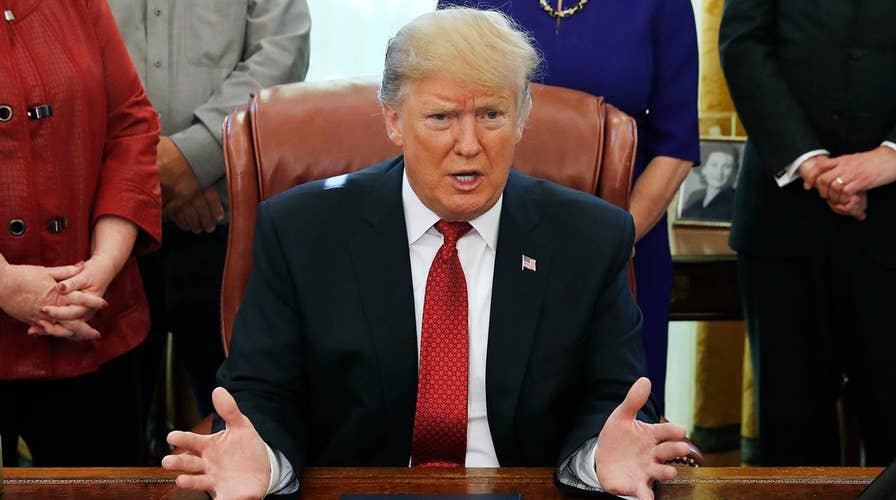
Don Jr.'s mysterious phone calls ahead of the 2016 Trump Tower meeting were not to the president; reaction from Fox News contributor Trey Gowdy.
This is a rush transcript from "The Story," January 31, 2019. This copy may not be in its final form and may be updated.
MARTHA MACCALLUM, HOST: I heard up. Thank you, Bret. All right, big show tonight, everybody. Excluding my exclusive interview with President Trump's 2020 campaign manager Brad Parscale. Stick around for that.
Also, Congressman Trey Gowdy, who now has a new title that you will hear, first here, tonight. But first, the devastating polar vortex spreads its misery as you have been watching. Bone-chilling temperatures out there. Midwest, all the way to the Northeast. 15 deaths now blamed on the cold.
This, prompting Massachusetts senator and presidential hopeful, Elizabeth Warren to tweet this. "Our children and grandchildren should grow up in a world where they can breathe the air and drink the water and go outside without risking their lives in extreme temperatures. #polarvortex2019.
Warren is just one of many Democrats who are lining up between something called a green new deal. An economic overhaul that is aimed at fighting -- at fighting climate change. It's led by the newcomer, Democratic socialist Alexandria Ocacio-Cortez and by Massachusetts Senator Ed Markey.
(BEGIN VIDEO CLIP)
REP. ALEXANDRIA OCASIO-CORTEZ, D-N.Y.: I do not think that for the future of humanity and for our country to continue to prosper that we cannot have another presidential cycle where climate change is not being asked about at almost every debate. Of course, it would be amazing to see Green New Deal talked about. And it's, starting too, and so, that's really exciting.
(END VIDEO CLIP)
MACCALLUM: So, at this point, there are very few specifics on the actual plan which is expected to roll out shortly. But there's plenty of support already among the highest-profile members of the party.
(BEGIN VIDEO CLIP)
SEN. KAMALA HARRIS, D-CALIF.: I support a green new deal and I will tell you why. Climate change is an existential threat to us and we have got to deal with the reality of it.
REP. TULSI GABBARD, D-HI: We continue to ignore our planet, we will face dire consequences.
REP. RASHIDA TLAIB, D-MICH.: We have a right to breathe clean air. I don't give -- if it's the Republicans or the Democrats that are in control. You have a right to hold all of us accountable.
(END VIDEO CLIP)
MACCALLUM: Those beliefs are becoming familiar from that individual. Joining me now, former Utah Congressman Jason Chaffetz. Townhall.com editor Katie Pavlich. Both are Fox News contributors. And Austan Goolsbee, economics professor at the University of Chicago's Booth School of Business, previously served as President Obama's chief economist.
So, you know, I -- rather than -- you know, I don't necessarily want to debate climate change, whether or not it is a -- you know, scientifically real or to the extent that some people think it is.
But in terms of the politics of this, Jason Chaffetz, let me start with you on this. Because it is clearly like healthcare, going to be a central part of the Democratic side of the equation. Is that wise and do you expect that it will be dealt with in a way that resonates with voters?
JASON CHAFFETZ, CONTRIBUTOR: Well, I think everybody cares about what they throw into the air and in the water. But the Democrats approach to this has been by force. You know, they spent nearly $800 billion on a -- you know, this stimulus package. And they poured billions of dollars into companies that put no end in result. They've put forward a cap-and-trade, they did all of these other things where they tried to force it.
So, when I see Green Deal, I know that means a whole lot of greenbacks because it's going to be very, very costly what they're forcing people to do.
MACCALLUM: You know, when you look back, Austan at the Obama administration. And there was a big push for this that we should basically -- you know, that it's almost -- it was an economic stimulus program to be coming up with lots of companies who could do things in a greener way and new forms of energy. And, you know, one of those and some of it -- you know, was a good idea, obviously. Some of it wasn't. This obviously is the Solyndra moment that everybody remembers from that era. Watch this.
(BEGIN VIDEO CLIP)
BARACK OBAMA, FORMER PRESIDENT: And we can see the positive impacts right here at Solyndra. Less than a year ago, we were standing on what was an empty lot. But through the Recovery Act, this company received a loan to expand its operations.
(END VIDEO CLIP)
MACCALLUM: So, I mean obviously, Austan, that loan -- that company went bankrupt. But overall, is this good economics for the government to get involved in the business of a Green New Deal?
AUSTAN GOOLSBEE, FORMER ECONOMIC ADVISER TO BARACK OBAMA: Well, it depends what a Green New Deal is, obviously. One of the biggest advocates of our involvement are the generals at the Pentagon, who say that the changing of the climate is one of the biggest national security threats to the U.S. military. Both to our bases which may be damaged as the -- as the sea floor -- the seawater rises. As well as the displacement of peoples and the extreme weather events that we experience in the United States.
Now, we have seen over the last 10 years, much of which came out of that stimulus, a big rise of wind power, a big rise of solar. And I think the more extreme weather events take place, the more on the minds of the American voters it is. So, if you look in polls, people are really quite surprisingly concerned about these issues of climate change. And when they have big hurricanes and they have big weather events that makes them more prone to be angry at the dismantling of EPA.
(CROSSTALK)
MACCALLUM: Yes, understood.
KATIE PAVLICH, CONTRIBUTOR: The vortex.
MACCALLUM: The new -- I -- you know, the question is the U.N. panel finds there's no observable increase in hurricane frequency likewise extreme weather is killing fewer people now than at any point in the last 100 years. Extreme weather killed about half a million people annually back in the 20s.
Now, despite being four times as many people, it kills fewer than 20,000. And, of course, you know, you'd like to see that number be zero. But Katie, we -- you know, just in terms of the realistic picture here and what this kind of deal would mean?
PAVLICH: Well look, they call it a Green New Deal, but this is really just a massive redistribution and confiscation of wealth by socialists who say that's exactly what they want to do. I'm not sure how they're going to pay for any kind of Green New Deal after they get through Medicare for all and have to confiscate all of the wealth from billionaires in this country to pay for that alone and then, increase taxes on the middle class.
There is an argument to be made, of course, about how you can clean up the environment further. The United States is the most responsible country in the world when it comes to adhering to our own policies and principles about the environment.
We got out of the Climate Paris Accord, we're still complying with some of the emissions standards of that Accord. And yet, a number of the countries who are still bound by it, who haven't left the deal are not complying. And so, when you look at the policies that environmentalists have pushed over the last 10 years when it comes to flooding, these organizations or these companies like Solyndra, with taxpayer money because they can't stand up and produce without off on their own -- on their own merit, unlike fossil fuel companies.
You have to ask what the return on investment is and whether it actually does do anything to clean up the environment. As we've seen, the cost has been very, very high in terms of what they want to do.
MACCALLUM: Jason, what do you -- what's just your thought on that?
CHAFFETZ: No, I agree with Katie. Absolutely. We're -- you -- they're taking away straws. That's not going to fall to solve the problem. I want to be able to get a plastic straw when I go to McDonald's and order a drink. And what the Democrats are trying to do is force this among the American people.
But they ignore some of the greatest things that are out there. You can't have a discussion in this country about electricity for instance without talking about nuclear. But you can't build a nuclear plant in this country because of all the environmental regulations are out there.
So, they've got to get real on this stuff. They said they're going to put root beer and all the drinking fountains, everything's going to be great. But you can't figure out the economics of it. And they want to force people to do things that the American people don't want to do, and that's why they overstep and they're having such a hard time selling this.
MACCALLUM: If do you think it's a mistake, Austan that you know, some of these candidates have already jumped on this phrase, that the New Green Deal before it's even been rolled out, before they even know -- you know exactly what the plan is by this by the congresswoman and the Senator? Yes, that's probably a risk. You know, because if you say, "Yes, I'm for it," and then, you find out there's something in it that people don't like that would be a risk.
But look, I'm telling you, when you see the EPA changing the rules so that power plants can dump more mercury into our drinking water, when they're changing various environmental regulations that are deeply unpopular -- when they're doing it, anybody who gets on the wrong side of that issue, I think the voters are going to hold them accountable.
So, we should -- to agree with some of the aspects of what the -- what the previous speaker said, we should be mindful of doing things in an economically strategic way, but we need to form both national security grounds and on public safety grounds, keep our eye on the environment and do everything we can to improve that.
MACCALLUM: All right. Thank you all. Great to see you tonight.
PAVLICH: Thanks, Martha.
MACCALLUM: So, coming up next an exclusive with the Secretary of Health and Human Services Alex Azar, speaking out for the first time on President Trump's plan to lower your prescription drug prices in a meaningful way as these new costs come out in January.
Plus, the untold story of Brad Parscale. His ascension from a small-town boy in Kansas, not involved in politics, to now running the Trump campaign in 2020.
BRAD PARSCALE, RE-ELECTION CAMPAIGN MANAGER FOR DONALD TRUMP: Being a campaign manager has kind of adapted for some campaigns into being a spokesperson, and a comms director. That's not what I'm trying to be. I'm trying to be a guy that's actually the CEO of this organization.
(COMMERCIAL BREAK)
(BEGIN VIDEO CLIP)
PRESIDENT DONALD TRUMP: They're all saying, "Oh, let's do this, but we're not giving one dime to the wall." That's OK. But if they're not going to give money for the wall, it's not going to work. And if it's not going to work, then the politicians are really wasting a lot of time.
(END VIDEO CLIP)
MACCALLUM: President Trump today as the bipartisan commission tries to strike a deal to keep the government from shutting down again. And meanwhile, the drugs keep coming across the southern border.
(BEGIN VIDEO CLIP)
TRUMP: We're allowing people to come into this country and sell drugs and human traffic. And to all of these horrible things that if we had the simplicity of a well-constructed, beautiful barrier or wall, they wouldn't be able to come into our country.
UNIDENTIFIED MALE: Border crossings down 90 percent of the drugs coming through the legal ports of entry.
UNIDENTIFIED MALE: We're talking about drugs. Most -- the vast majority comes in at ports of entry, not between the ports of entry, not anywhere that a wall would be.
(END VIDEO CLIP)
MACCALLUM: Absolutely true, but that doesn't mean it's not a problem. In fact, tonight we can report the biggest bust ever of fentanyl which killed about 18,000 Americans last year and was blamed in the death of music star Prince, a produce truck came across the border from Mexico and on the second round in a secret compartment, they found this, 254 pounds of deadly synthetic opioid, street value $3.5 million estimated to be enough to kill 57 million people because it takes that tiny an amount in some cases for some people to be killed by this substance.
So the truck as I said was undergoing a secondary scan, dogs picked up the scent, the rear floor of this tractor-trailer as it came through one of these ports of entry was ripped up. They found more drugs on the Mexican driver in the forms of bags of pills.
So joining me now on that and other big news tonight in the prescription drug arena Health and Human Services Secretary Alex Azar. Secretary Azar, thank you very much for being here tonight. This is precisely the kind of thing that the President talks about when you look at the drug trade that does come across at these ports of entry.
ALEX AZAR, SECRETARY OF HEALTH AND HUMAN SERVICES: You bet, Martha. And I am very grateful to our colleagues and the Border Patrol for their efforts that led to this historic interdiction. I'm also grateful to President Trump for fighting for border security and for fighting to reverse this horrible opioid crisis. You know, this fentanyl, that's a historic amount of fentanyl. Think of how many Americans could be killed by that. Fentanyl is already killing so many Americans every single day as part of this opioid crisis.
MACCALLUM: What do you say to those who -- you know, we played a little bit of it in the intro who say you know, it's not a border wall that is needed, it's -- these drugs come through the port of entry so that wouldn't -- that wouldn't have any impact on that.
AZAR: Well, drugs come through everywhere just like people do. You need border security. You can't just declare that here's the one place to bring your illegal drugs across. We need border security and that's what President Trump is fighting for.
MACCALLUM: All right, tell me about the big change that came the president and you have worked on the issue of rising drug prices in this country and these crazy questions of why people end up paying more and more every single year when January comes. What did you do today and what's the impact on regular Americans?
AZAR: Well, Martha, I'm going to let you know a little secret as well as your viewers. When you show up at the pharmacy to buy a drug that has a price of $300 and you're paying $300 or a percent of that $300. There's somebody in the background called a pharmacy benefit manager or a middleman and they're getting a kickback from the drug company based on your purchase and that might be $60.00, $80.00, or $100.
And what President Trump is proposing tonight is that you the patient should get that discount when you buy the drug at the pharmacy so you save that money not the middlemen.
MACCALLUM: How is he going to achieve that? I mean, won't they just find another way to move that money around so that they're still benefiting from it?
AZAR: No. See, what we're doing is we're proposing to change the rules of the road that say right now you can as a drug company give these kickbacks to for these pharmacy benefit managers and we would under this proposal outlaw that. And instead, you would have to provide those discounts to the patient when the patient shows up at the pharmacy so you the patient get these savings.
So think about how many drugs that you're buying now in January after your deductible reset in the calendar year, the issue you just talked about, Martha. You show up and you're bearing the full cost of that drug. Well, someone in the back they're getting a discount on that, you're not getting it. You're paying full price.
Next year, January 1st, under this proposal, you would get that discount. You wouldn't pay as much out of pocket when you walk in the pharmacy.
MACCALLUM: And you know, the proof of that may be in the fact that CVS and Cigna shares both tumbled on the news of this because they benefit from these pharmacy management programs. Just a quick question before I let you go. Kamala Harris wants to do away with all the insurance companies. Would that have any impact on this? And do you think that's a good idea?
AZAR: Well, you know, I just take it as a general matter. These ideas of Medicare for all will threaten to undermine those of our senior citizens on Medicare, the sacred promise that we have to them in their program, as well as to really undermine or even take away the private insurance that over 140 million Americans have through their employer and they're quite happy with, you know.
When they came up with ObamaCare, they falsely promised that if you liked your insurance you could keep it. Nobody is even making that promise with these Medicare-for-all slogans.
MACCALLUM: Secretary Azar, thank you very much. Good to have you on THE STORY tonight. So do you remember this?
(BEGIN VIDEO CLIP)
TRUMP: We're going to end the government corruption and we're going to drain the swamp in Washington D.C.
(END VIDEO CLIP)
MACCALLUM: Sure you do. And our exclusive untold story with Trump's 2020 campaign manager who says the President is delivering on that message for voters.
(BEGIN VIDEO CLIP)
PARSCALE: I don't think this President did anything wrong other than actually try to fight with the system that was broken and that was a swamp. And I think when you're the shark in the swamp, all the other animals in the swamp want to kill you.
(END VIDEO CLIP)
(COMMERCIAL BREAK)
(BEGIN VIDEO CLIP)
NICOLAS MADURO, PRESIDENT OF VENEZUELA: (Speaking Spanish)
(END VIDEO CLIP)
MACCALLUM: Yes. Those are the people to blame. That is the message that the Venezuelan people are seeing from their President Maduro as the government blocks any coverage really of the opposition leader Juan Guaido who claims tonight that Maduro's National Police showed up at his home to intimidate him and his family as 20-month-old daughter was there, his grandmother was at home. He is warning them saying do not cross the red line when it comes to my family. Here he is earlier this week.
(BEGIN VIDEO CLIP)
JUAN GUAIDO, OPPOSITION LEADER, VENEZUELA (through translator): Yes, they have threatened my physical integrity, my families, and unfortunately I'm not the only one. We -- there's over 300 political prisoners.
(END VIDEO CLIP)
MACCALLUM: Maduro's police have already arrested or expelled 13 journalists from the country by early this count tonight as the situation could easily go either way here. The United States has a lot at stake and Maduro is backed by Russia and by China who also have a lot at stake in this.
Joining me now, Wall Street Journal Columnist Mary O'Grady. Mary, good to see you tonight. Where do you think this stands right now?
MARY O'GRADY, EDITORIAL BOARD MEMBER, WALL STREET JOURNAL: Well, I think actually that the opposition is in good shape which is not to say it's over but having been recognized by scores of governments around the world. The international community is really strongly with the opposition. And that's because the photos, the evidence, I mean, it's so stacked against this dictatorship.
Really the only ones that are backing him are some Democrats in the U.S. and China, Hezbollah, Russia, Cuba, Iran, you know, that small sort of axis of evil but most of the world is supporting him. And the other thing that's good that's happening is this financial squeeze that is in the Bank of England refused to send $1.2 billion in gold reserves to Maduro when he asked for it last week.
The U.S. government has said that they can send all the oil they want from the state-owned oil company but the payments for that oil will go into an escrow account which will be used by the new government to help the Venezuelan people.
And that's really where the rubber will hit the road because when he no longer has the money to pay his military, they're going to start to feel that their interests are not in a good place in sticking with him. And I think that's where he might end up saying you know, I'm better off if I retire on a beach in Cuba.
MACCALLUM: Possibly. You know, obviously, he's tried very hard to hang on to power. He hasn't cared -- you know, a lick about the Venezuelan people. They don't have any medicine, toilet paper, electricity as you say. I mean, they've already been through hell and they're hoping that there is some way out of this. But you know, I think about the days that continue where we heard Assad's days are numbered, Assad is about to leave and it's interesting when you have the support of places like Russia that sometimes these people are able to hang on.
O'GRADY: Well, Russia -- I don't think Russia has really the capability to do anything big there. They had the capability to kind of launch a kind of asymmetric war. Cuba is the one that really has the interest. And you know, you say that he's hanging on, Cuba is telling him to hang on. He doesn't run Venezuela, Raul Castro runs Venezuela.
And Cuba to give up Venezuela would be an ideological loss because they use that real estate in South America to push their ideology all over the continent but also because of the oil reserves that they've been so dependent on. I have said from the beginning the Cubans are not going to just put down their guns and walk out.
You know, it's going to be a fight and what I'm really worried about is not so much that Maduro will hang on, but then in the aftermath you're going to have a lot of irregular groups and maybe like I said this kind of asymmetric fighting and you could even have kind of a Civil War type of an environment which of course is the kind of thing the Russians would really like to see. They can't succeed in anything but they love to ruin other people's lives.
MACCALLUM: We'll see. Mary, thank you very much. Good to see you tonight.
O'GRADY: Sure. Thank you.
MACCALLUM: Mary O'Grady from The Wall Street Journal. Coming up, Trey Gowdy with a big announcement that you will hear only on the story. Plus, we are on the brink perhaps of Roe versus Wade and insurgence over this discussion here in America as we're heading to 2020 after Virginia becomes the latest state to propose sweeping changes to late-term abortion.
(BEGIN VIDEO CLIP)
TODD GILBERT, R-VIRGINIA HOUSE OF DELEGATES, VIRGINIA: She has physical signs of -- that she is about to give birth, would that still be a point at which she could request an abortion if she was so certified?
KATHY TRAN, D-VIRGINIA HOUSE OF DELEGATES, VIRGINIA: My bill would allow that, yes.
(END VIDEO CLIP)
(COMMERCIAL BREAK)
(BEGIN VIDEO CLIP)
GOV. RALPH NORTHAM, D-VA: I can tell you exactly what would happen. The infant would be delivered. The infant would be kept comfortable. And then a discussion would ensue between the physicians and the mother.
(END VIDEO CLIP)
MACCALLUM: That was Virginia governor in a comment that has him facing a firestorm. And today, Virginia lawmaker Kathy Tran tried to clarify the bill that she was fighting for in Virginia after she got some fierce backlash. Watch this.
(BEGIN VIDEO CLIP)
TRAN: Right now, women are able to access an abortion in the later stages of pregnancy under certain conditions with the approval of medical doctors. I have done nothing to change that.
(END VIDEO CLIP)
MACCALLUM: Today, Speaker Nancy Pelosi was asked about all this.
(BEGIN VIDEO CLIP)
UNIDENTIFIED MALE: Considering the comments from Governor Northam yesterday, how does that make it harder for pro-life Democrats in the party? Does that cause problems at all?
NANCY PELOSI, D-CALIF., SPEAKER OF THE HOUSE: I'm sorry. I just don't know what he said yesterday.
(END VIDEO CLIP)
MACCALLUM: But are there pro-life Democrats left in the party? Remember, Democrats used to say this.
(BEGIN VIDEO CLIP)
HILLARY CLINTON, FORMER SECRETARY OF STATE: We can support a woman's right to choose that makes abortion safe, legal, and rare and reduces the number of abortions.
(END VIDEO CLIP)
MACCALLUM: In 2017, DNC chair Tom Perez said this in a statement. "Every Democrat, like every American, should support a woman's right to make choices about her own body and her health. That is not negotiable," he said.
New York, Virginia, Louisiana, Rhode Island now are all debating easier access to third term abortions in their states. So, what is going on here? Perhaps, this, a Supreme Court that now leans solidly right may be firing up liberal states who want to push the existing law as far as they can.
Here now Margot Cleveland, a senior contributor to The Federalist. Margot, good to have you with us tonight. Thanks for being here. You know, this --
(CROSSTALK)
MARGOT CLEVELAND, SENIOR CONTRIBUTOR, THE FEDERALIST: Thank you so much.
MACCALLUM: This question of whether or not Democrats, whether they would - - they are accepting of Democrats who are pro-life anymore as Hillary Clinton was, you know, clearly much more inclusive on this issue.
CLEVELAND: Right. And I don't think you see that. You see that the Democrat Party is going extreme from not pro-choice but pro-abortion. You are seeing it with these extreme bills in Virginia and New York which they were cheering.
MACCALLUM: So, you know, in terms of that, what do you think is the motivating factor? Is it the fact that the court is now leaning more right? Is that what is sort of firing up the legislative actions in these states?
CLEVELAND: I think they are using that as an excuse and that it gives them an opportunity to push the legislatures, the legislators that they are supporting. I don't think that Roe v. Wade has anything to do with what their view is because it doesn't prohibit this now and if it was overturned it wouldn't prohibit it.
So, I think what you are seeing is that they are using this as an excuse to push as extreme abortion measures as they can.
MACCALLUM: I think a lot of people, you know, watch this debate and they're kind of shocked, no matter what -- whether they are pro-choice or pro-life. I mean, clearly if they are pro-life, they are shocked.
I think some pro-choice people are also kind of shocked when they hear the reality of some of these procedures and the concept that a baby could be born alive and then a decision would be made about whether or not the doctor and the parent would allow it to continue living.
You know, I remember Kamala Harris the other day asking the other day what kind of country do we want to be? And that, you know, that's where this whole thing comes back to.
I want to show you this moment that was -- with congressional testimony it was tweeted the other day by Ashton Kutcher, the actor. It's from about a year and a half ago, I believe. Let's watch this.
(BEGIN VIDEO CLIP)
UNIDENTIFIED MALE: I am a man. See me as a human being. Not a birth defect. Not a syndrome. I don't need to be eradicated. I don't need to be cured.
(END VIDEO CLIP)
MACCALLUM: That was not from that. That's Frank Peters not from the congressional testimony but from another really powerful statement that he made that I think really makes a lot of people think.
CLEVELAND: Absolutely. And I think that one thing that's very helpful in this debate is to understand this really hasn't changed as the representative said in clarifying. New York law already allows that. It's just that they were changing some of the parameters of how many doctors had to certify mental health.
And that is what is horrifying for Americans to discover that you can have up to the point of birth an abortion that will kill the fetus, even though the fetus is viable and completely healthy if a doctor will say it's in the best interest of the mental health of the mother. And that is allowed currently. So, she was just making it easier, not changing the substance of the law.
MACCALLUM: Yes. I mean, it appears that there has been push back that some of these procedures, you know, were not easy enough to come by and that people were denied them for reasons that they thought were not fair and that has sparked this push to make it easier.
And we saw the big applause in the New York State assembly and the pink lights on the Freedom Tower celebrating that now it would be easier. Margot, thank you very much. Good to have you with us tonight.
CLEVELAND: Thanks.
MACCALLUM: Coming up next, Trey Gowdy on reports that Nellie Ohr was digging for dirt when she was working on opposition research on President Trump's wife and on his children. Also, the untold story of Brad Parscale, President Trump's 2020 campaign manager on his boss.
(BEGIN VIDEO CLIP)
BRAD PARSCALE, CAMPAIGN MANAGER, TRUMP 2020 REELECTION: He's already wealthy. He was already famous. He already had power. He is doing this --he is doing this for this country. That's why I stick with him every day.
(END VIDEO CLIP)
(COMMERCIAL BREAK)
MACCALLUM: There is a new story out there tonight on the Senate's investigation about the mysterious phone calls that were made by Donald Trump, Jr. ahead of the infamous Trump tower meeting.
Now, you may remember from the reporting on this that some congressional investigators wanted to know who a blocked phone number was and whether or not he had made a call to his father before that big meeting, then candidate Donald Trump.
(BEGIN VIDEO CLIP)
UNIDENTIFIED MALE: Shortly after arranging the meeting, Don Jr. made an 11-minute phone call to a blocked number. Asked if he remembers who that call was with, Trump Jr. said I don't.
UNIDENTIFIED FEMALE: There were questions about a phone call he made to a blocked number and it has been pointed out that his father has a blocked number.
ANDERSON COOPER, CNN HOST: It would be hard to believe that Don Jr. didn't mention it to his father.
JOHN DEAN, CNN CONTRIBUTOR: It's counter intuitive to think he didn't tell his father.
(END VIDEO CLIP)
MACCALLUM: Well, the real question is whether or not he did, right? He has said that he didn't. Now, this. We got this ABC News report that is coming out tonight that cites, investigators on the Senate intel panel who say that those blocked phone calls were not between Donald Trump, Jr. and his father. They were actually calls that were made to two friends and business associates according to the early reporting on this.
Here now on this and other things tonight, Trey Gowdy, former South Carolina Republican Congressman and House oversight committee chairman, now a partner at Nelson Mullins law firm in South Carolina.
And tonight, he makes his debut as a Fox News contributor and we hope that we are going to see him on a weekly basis here on The Story. So, good to see you tonight. Trey Gowdy, thank you very much.
TREY GOWDY, CONTRIBUTOR: Yes, ma'am.
MACCALLUM: And congratulations.
GOWDY: Yes, ma'am.
MACCALLUM: And welcome to the family.
GOWDY: Thank you. Thank you for the job. I appreciate it.
MACCALLUM: Absolutely. It's great to have you here. So, first of all, your reaction to this. You know, because it strikes me and, you know, we are still learning about this story as I mentioned. It's an ABC report that I just cited. But what it strikes me is that you see all of the sort of hyperbole and all the guessing about what it was before anybody knows what it is. And we have seen a heck of a lot of that.
GOWDY: It's the biggest distinction between what I call serious investigations and political investigations where you speculate rampantly. The first thing I wanted to do was called Richard Burr who is the chairman of Senate intel committee and thank him for running a serious investigation where they actually figure out the facts before they make allegations because sometimes, some folks do it in the reverse order.
They make these wild allegations and all of your viewers may not be around to see the truth. They heard the accusation but they may miss the truth. And that's why you don't do that in serious investigations.
MACCALLUM: Yes. I think one of those people that you are referring to is Adam Schiff who you have been very critical of in this whole process saying that he made up his mind before he saw any of the evidence. Is that true? Is that your feeling on it?
GOWDY: Well, I'm just quoting him. He had evidence that rises above the level of circumstantial evidence but not quite direct and, of course, there is no such thing that President Trump colluded with Russia.
I think Adam also said there is a very real chance Donald Trump is going to be indicted and/or arrested the day he leaves office. Adam uniquely was both a federal prosecutor and now he is a member of Congress.
I like the Adam Schiff who was a federal prosecutor better where you are actually presumed innocent and you have to go in a courtroom and prove these things as opposed to just speculating and accusing people.
MACCALLUM: I also want to ask you about this Nellie Ohr story that she was investigating when she worked for Fusion GPS. She was doing opposition research and campaigns do this stuff. They look into the family members. They try to see if they can dig up any dirt and looked into Melania Trump and they looked into the Trump children as well.
But what you say is that you've never seen a federal investigation, the kind of circle that also involved her husband Bruce Ohr who was at the Department of Justice which, of course, was investigating the Trump campaign.
GOWDY: It's the strangest fact pattern I think I have ever seen. You have a private entity in Fusion GPS and they are working with Chris Steele who was an FBI source but then was terminated for violating his FBI agreement.
And you are kind of laundering this information, this private information to the world's premier law enforcement agency and to the Department of Justice and you are using a DOJ official as the conduit of that information.
So, it's really surprising. I would think in a different political environment everyone would be outraged because you are running the risk of privatizing crime. If you can hire a group to dig up information and then use a DOJ official who gets his information from a terminated FBI source and it still winds up in the hands of the federal government, that should alarm all of us and I hope we get back to a time in our lives where it is alarming to everyone.
MACCALLUM: Very interesting. Last thought, Roger Stone, there is a lot of discussion about the raid of his house and whether or not it was disproportionate to what they are looking for from him. They said today they got terra bites, which I guess is tons and tons of information from his house. And, you know, perhaps to sort of shore up the notion that this was all necessary. What do you think?
GOWDY: I want to make sure I don't do the very thing that I started off your show by being upset that others do, which is speculate. I think they should bring in Chris Wray. Chris is a Trump appointee. He was a federal prosecutor. He is a serious guy whether you like President Trump or not. Chris Wray is a serious guy.
Bring him in and ask him why he, the bureau thought that amount of force was necessary, whether or not they were going to execute a search warrant while they were there if they had any evidence that Roger Stone might be a flight risk ask Chris Wray.
It is not Bob Mueller's fault. The prosecutor does not decide what weaponry to use when you effectuate an arrest.
MACCALLUM: Good point.
GOWDY: The FBI does. So, bring him in and ask him.
MACCALLUM: Yes. They use what they think they need. So, we'll see. Trey Gowdy. Great to have you with us. And welcome to the family.
GOWDY: Yes, ma'am.
MACCALLUM: Thank you so much.
GOWDY: Thank you. Yes, ma'am.
MACCALLUM: We'll see you soon. All right. Coming up next, the untold story of Brad Parscale, the conductor of the Trump train.
(BEGIN VIDEO CLIP)
PARSCALE: I've also done a good job of not trying to be a train on a train track. Instead of being the conductor of the Trump train, someone had to be the one to make sure it gets there on time to make sure all the pieces stay together and I chose that role.
(END VIDEO CLIP)
(COMMERCIAL BREAK)
MACCALLUM: Brad Parscale got his start as a web designer in a little bookstore in Kansas. In short order, he became candidate Trump's digital wizard in the 2016 campaign. Now he is in charge of 2020. This is his untold story of Brad Parscale.
(BEGIN VIDEOTAPE)
PARSCALE: Sometimes I'm just probably lucky than good as my father always said. You know, I started off in a bookstore learning how to become a web designer and web marketer, you know, almost 20 years ago and I got lucky that my first customer a guy who knew a girl and eventually that person knew somebody and I got a phone call one day.
And that person gave me a chance to bid on a project for the Trumps and I have spent the last decade nearly working my way up in that family. And when the blessing came to be asked to help this country and to help the president help save it, I was asked to help.
And that contract started at $1,500 to make a splash page and eventually I took over all the marketing advertising and then eventually Jared is deputy in the way and now I have the blessing to be campaign manager.
MACCALLUM: The work has made you a wealthy man. Some estimates say you made about $90 million on the campaign.
PARSCALE: No.
MACCALLUM: Is that true?
PARSCALE: No. All that money went through pass through my company for advertising. I actually made very little off the campaign and have sacrificed a lot of income working for this camp, working for it because it's been more about this country than it has been. I sold my company and I actually walked away from all my business.
MACCALLUM: How would you describe your role? Because some people say, you know, there is a lot of slings and arrows in Trump world. And you seem to sort of ride above them for the most part. Why is that?
PARSCALE: Well, I think first of all, I built a relationship with all the parties that need to. I have a good relationship with the family, you know, I have a great relationship with all the I call the children since I'm older than all of them I can say that.
I've also done a good job of not trying to be the train on the train track, instead of being a conductor on the Trump train. Someone had to be the one to make sure it gets there on time to make sure all the pieces stay together. And I chose that role, and I think that's the strongest thing I can do.
MACCALLUM: There are some that say, you know, you don't have enough political experience to run the campaign. There were three campaign managers the last time around as we all remember. Do you think that you will be the campaign manager all the way through to election night?
PARSCALE: Well, I hope so. I think it's best for this campaign for that to happen. I think I have four years of great political experience now. I also think I have been campaign manager longer than anybody now with all the days if you go out since early 2016.
You know, I think that being a campaign manager has kind of adapted for some campaigns into being the spokesperson and a coms director that's not what I'm trying to be. I'm trying to be a guy that's actually the CEO of this organization and manage it and make sure all the teams have the assets and the things needed to be as strong as possible.
I'm not going to be the coms director. I'm not going to be the political directors. Those are people that I hire. My job is to keep it all well- oiled and all working together as one team unified with the Republican Party, unified with the White House to provide the best asset and infrastructure for the president to get done what he needs to get done.
MACCALLUM: Is there any part of you that thinks that the president could be impeached before you get to that point?
PARSCALE: No. I don't think this president has done anything wrong other than actually try to fight a system that was broken and that was a swamp. I think when you are the shark in the swamp, all the other animals in the swamp want to kill you.
MACCALLUM: You think they want to kill him?
PARSCALE: Yes. They want him, they want him gone. They want him gone. Yes. He is defeating the system that was broken for multiple decades. He is fighting back. He needs nothing from it. He is already wealthy. He was already famous. He already had power. He is doing this -- he is doing this for this country. And that's why I stick with him every day.
MACCALLUM: What do you think people don't get about President Trump who you've work with and know personally?
(CROSSTALK)
PARSCALE: That he is selfless. He is selfless. I really truly believe it. I know him better than almost anyone. He actually really cares about everybody.
MACCALLUM: But the tweeting and all of that he talks about himself a lot. He talks about, you know, running the greatest and having the greatest campaign win in history. So, I think a lot of people have a very different impression of him than that and maybe that's partly his own fault?
PARSCALE: No. I think the fake news media when they actually figured out that he was going to change the status quote from them having power and be able to dictate how the U.S. government and the way they felt about what their job was, had felt like they had to fight back against him because they were part of that structure that was broken.
The president felt he had to fight back against it. And I think Twitter finally gave him the tool to do so. They couldn't convert his message. They couldn't change it. They couldn't know how to adapt. So, you see when he started tweeting and doing those things, they didn't know what to do and they start running in circles. And that's because finally the president didn't need them.
He could talk directly to the people. That's the reason why I don't talk to much media, and I don't trust them because most of them have an agenda and they have an agenda that I clearly see and I'm glad that every day he fights against it.
MACCALLUM: You feel like you have his 100 percent confidence.
PARSCALE: I believe so. I mean, I think I've proven that, you know. I mean, look, he does things -- he always makes his own choices. But am I person that he listens to? Of course, does he listen to the data, yes. He is a very highly intelligent man.
MACCALLUM: Did you ever imagine growing up as a little boy, I was going to say, you're a very tall boy in Kansas that you would one day be working for the president of the United States?
PARSCALE: No, never. I just wanted to have a family and have a good job. I didn't come from a lot. So, you know, my expectations were not, you know, to be sitting here with you.
MACCALLUM: How has it changed you.
PARSCALE: It's a humbling experience. You know, the first day you are called every name in the book just because you chose a side, it's a humbling experience.
MACCALLUM: Brad Parscale, thank you.
PARSCALE: Good.
MACCALLUM: Always good to talk to you. Thanks for being here today.
PARSCALE: Thanks.
(END VIDEOTAPE)
MACCALLUM: Don't forget to subscribe to the Untold Story podcast on Foxnewspodcast.com, or wherever you listen Brad Parscale's full interview will be posted there on Monday morning. I encourage to you listen to that. We are going to be back here tomorrow night as always. We'll see you at 7 o'clock. Tucker Carlson is warming up to get going in D.C. Have a good night.
Content and Programming Copyright 2019 Fox News Network, LLC. ALL RIGHTS RESERVED. Copyright 2019 ASC Services II Media, LLC. All materials herein are protected by United States copyright law and may not be reproduced, distributed, transmitted, displayed, published or broadcast without the prior written permission of ASC Services II Media, LLC. You may not alter or remove any trademark, copyright or other notice from copies of the content.
