


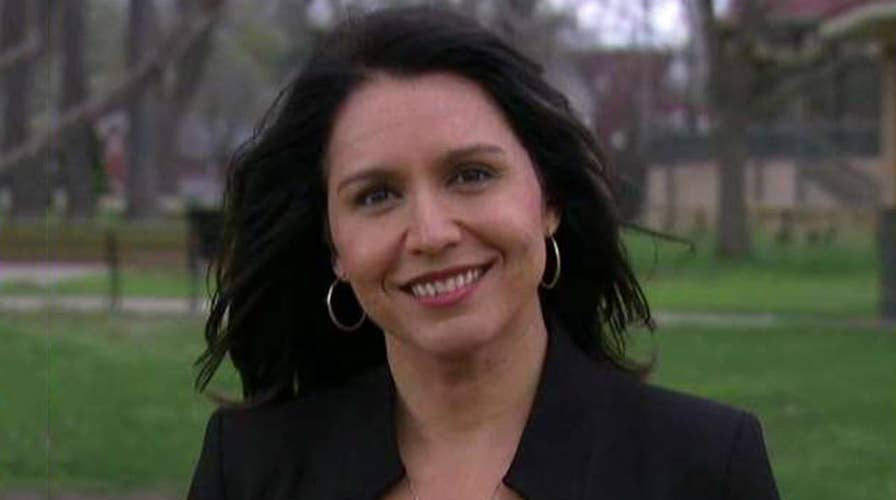
Rep. Tulsi Gabbard battles to build momentum in crowded field of Democratic presidential candidates
Hawaii Congresswoman Tulsi Gabbard campaigns in Iowa and New Hampshire.
This is a rush transcript from "Special Report with Bret Baier," April 16, 2019. This copy may not be in its final form and may be updated.
BRET BAIER, ANCHOR: We're all over the 2020 Democratic presidential race this week on Special Report. Monday, of course, we hosted that live town hall with Senator Bernie Sanders. Tonight Hawaii Congresswoman Tulsi Gabbard joins us live from Fort Madison, Iowa. Congresswoman -- thank you for being here.
REP. TULSI GABBARD, D-HAWAII: Aloha Bret -- good to talk to you.
BAIER: You -- I want to start with the breaking news. And I don't know if you heard it earlier in the broadcast. It appears that a missile has been fired at North Korea, some sort of tactical guided missile. It's not confirmed by the Pentagon or the administration yet but their citing South Korean news agencies over there.
That would mean, if true, that 591 days have passed since the last missile was fired. You are on House Armed Services. Your thoughts if that turns out to be the case.
GABBARD: Well look, Bret -- obviously we need to determine the facts and get the details of what has actually happened here. But I think it's important to address the larger issue, which is that we still need to continue to pursue our efforts with negotiations with North Korea to denuclearize the Korean Peninsula and finally bring about an end to the Korean war.
I think in this connection it is also important to note why it is that we have not made progress on that deal. And we can look to the policies being pushed by this administration that are directly undermining their ability to negotiate this deal. Those policies that are continuing to further regime change wars and regime change efforts in other countries like Venezuela and Iran that make it impossible for Kim Jong-un to believe them when they tell him don't worry, get rid of your nuclear weapons. We're not going to come after you.
BAIER: So how would you end differently?
GABBARD: They're undermining their own credibility and the ability -- by changing our policies. This is not something that can happen overnight but it begins with ending our regime change wars in other countries, ending our regime change efforts as we're seeing in these countries like Venezuela and Iran.
So that when we negotiate with North Korea, with Kim Jong-un and we tell him that we will not come after you. We will not seek to topple your regime if you get rid of your nuclear weapons understanding that this is why North Korea has nuclear weapons as the only deterrent against regime change.
BAIER: So basically --
(CROSSTALKING)
GABBARD: Then we begin to have that credibility to be able to have that agreement and keep that objective of denuclearization.
BAIER: -- basically you're saying you would do what the administration is doing. You would be talking to Kim Jong-un but you wouldn't do what they're doing in other places so that you would send the right signal to Kim Jong-un? I'm just trying to get what you would do differently with North Korea, understanding the situation.
GABBARD: Yes, yes. Of course. Of course. Look -- absolutely. I've served in Congress now for over six years and on the Armed Services and Foreign Affairs Committees. And under the Obama administration I encouraged them to have direct talks with North Korea to achieve this objective of denuclearization, encouraged the Trump administration to do the same and agreed when Trump decided to meet with Kim Jong-un.
We must be willing to meet with those who may be potential adversaries or adversaries in the pursuit of peace and security. So yes, this is the correct move. However, this administration is undermining their own efforts by continuing to further these regime change efforts and wars in other parts of the world making it so they have got no credibility as they are trying to barter and negotiate with North Korea and get them to denuclearize.
BAIER: Ok. Obviously The administration says it differently trying to put the screws to some of these dictators that are doing bad things. I want to turn the topic --
GABBARD: Ultimately they're trying to topple the dictators in these other countries, topple the leaders of these other countries, which is the point that I'm trying to make --
BAIER: All right. Congresswoman, I want to turn to the --
(CROSSTALKING)
GABBARD: -- which is they cannot in good faith make that point to Kim Jong-un.
BAIER: -- the other breaking news which is we're waiting for this release of the redacted Mueller report tomorrow. The attorney general -- the deputy attorney general will hold this press conference at the DOJ at 9:30. Are you looking for anything specifically?
GABBARD: Look, I've been calling all along for this report to be made public. There is not much that I can say. We'll be looking through that report. I would like to highlight an issue that really speaks to the vulnerabilities within our election system that unfortunately has not been addressed by Congress and really hasn't been talked about often enough even though we have incredible vulnerabilities in our elections infrastructure that must be addressed before we head into the next 2020 election.
I've introduced legislation called the Securing America's Elections Act that would require paper ballots or a voter verified paper backup to make sure that if anyone whether it's a bad actor, an individual or a country comes in and tries to manipulate our votes, change our vote count and therefore manipulate the outcome of our election we will have an auditable paper trail to make sure that our voices and our votes are counted accurately and represented.
Otherwise if there is any question at all in 2020 about any kind of shenanigans or manipulation or anyone messing with this election it could undermine -- it could undermine everything.
BAIER: Right. And I think there are a lot of --
(CROSSTALKING)
GABBARD: This is so important.
BAIER: -- concerns on both sides of the aisle --
GABBARD: Congress needs to act and pass this legislation.
BAIER: -- on that. I apologize for the delay in the satellite.
You said on March 28 that it was time to put aside partisan interests. And that now that the President is not guilty of conspiring with a foreign power, now must be the time to stand together and move beyond this divisive issue that has taken up enough of the national conversation. Did your party not get that message?
GABBARD: Yes.
Look -- this is a message for the country and it is unfortunate for those who are continuing to put partisan politics ahead of the interests of the people of this country.
To know that the President of the United States did not collude with another country's government, with a foreign government to interfere in our elections is a good thing for all of us. It's a good thing for our country.
We've got to come together and work towards solving the very real challenges that people here in communities like this at Fort Madison, Iowa and communities all across the country are struggling with and dealing with. And we can only do that when we come together and put people ahead of politics.
BAIER: I want to ask you a specific question. In 2017 you visited Syria. You met with Bashar al-Assad. Recently you were asked if he was a war criminal and you couldn't really say. Can you say it tonight?
GABBARD: Look, like I said earlier, we have to be willing to meet with people who may be adversaries or potential adversaries or dictators or others in the pursuit of peace and security. What is more important than the question that you're asking right now is to focus on the cost of this regime change war on our country, the trillions of dollars that we've spent on waging a regime change war that has undermined our national security. Strengthening terrorist groups like SIIS and al Qaeda. Al Qaeda being stronger today in Syria than ever before. But to speak of the death and destruction that has been caused.
BAIER: Sure.
GABBARD: Let's focus on the costs and the consequences of these regime change wars and work for the interests of our country, work for the interests of the American people, what to speak of the interest of the people in the country where we're waging these wars and stop.
BAIER: Yes.
GABBARD: That's why I'm running for president and that's what I will do as president is end these regime change wars.
BAIER: You served two tours of duty in the Middle East. You're a major in the Army National Guard. But there are people inside the U.S. military, many of them and inside the U.S. intelligence agencies that believe that Assad was behind the gassing of his own people. You just don't buy that?
GABBARD: No. What I have said and I've said this numerous times is that the Assad government, the Syrian government, there have been other actors, terrorist groups like al Qaeda and others -- other jihadist groups in Syria have unfortunately used these chemical weapons in this war that's currently being waged.
My point is -- and I will keep saying this over and over and over again -- because these destructive regime change war policies in our country have cost us so much. We must bring about an end to them.
BAIER: Ok.
GABBARD: And many people in Washington who are part of the military industrial complex and the foreign policy establishment don't want to debate this issue. They don't want to talk about how costly and destructive these policies have been and so they end up bringing up other issues that distract away from our urgent need to bring about an end to these regime change wars.
BAIER: Sure.
All right. I want to turn to politics. You are in a race where there could be more than 20 other candidates. In 2016 you endorsed, wholeheartedly Bernie Sanders. Why are you running against him now?
GABBARD: I'm not running against him or anyone else. I'm running to serve the American people. To serve them as president and commander-in-chief. Bringing the experience that I have serving for 16 years now in the Army National Guard as a solder, deploying twice to the Middle East, serving in Congress for over six years on the Armed Services and Foreign Affairs Committees, bringing this experience to this most important job that the President has as commander-in-chief and change the priorities in our country to bring about an end to these regime-change wars.
This new Cold War that we are in with ever-escalating tensions --
BAIER: Yes.
GABBARD: -- between the United States and other nuclear armed countries like Russia and China, end this the nuclear arms race and bring the trillions of dollars that we're spending on these wars and these weapons and bring it back into the pockets of the American people. Bring it back to invest in serving the very real needs that we have in this country.
BAIER: You know, in the 2016 DNC convention you said that Bernie was the voice for millions and that you were truly honored to endorse him. So what happened between then and now?
GABBARD: Once again, I announced my candidacy long before Bernie Sanders announced his run. I am not running against him or any other candidate in this country. I am running for the American people.
BAIER: Sure, but you say you're better than him.
GABBARD: I am running to serve the American people, serving the American people as president and commander-in-chief and the unique experiences that I just outlined are what I bring to the forefront and make me best qualified to serve as commander-in-chief.
BAIER: Last thing, are you satisfied with the new leadership at the DNC? Last time you quit the race because you said the DNC was putting the finger on the scale against Bernie Sanders specifically. But are you convinced someone like you can operate in this DNC environment?
GABBARD: Two things. To be clear, I stepped down as vice chair of the DNC at that time in 2016 because I saw some very stark differences between the two major candidates in that race at that time. Secretary Clinton, who had a very hawkish, interventionist foreign policy, and Bernie Sanders who was largely the opposite of that, more non-interventionist foreign policy.
BAIER: Like you.
GABBARD: And as a veteran and someone who has seen the cost of war, I felt it was important to be able to step down and make that endorsement, to be able to bring these issues to the forefront.
Obviously now there has been a lot that we have learned about what went on in the DNC at that time. I think there is a lot more transparency and some important changes that have been made. But there are many of us who are going to continue to keep watching to make sure that this process is fair and transparent, and that the wishes of the voters are what are carried through and will decide this election.
BAIER: Congresswoman, we appreciate your time. You are campaigning in Iowa and thanks for making time for FOX News Channel.
GABBARD: Thank you, Bret, good to talk to you. Aloha.
Content and Programming Copyright 2019 Fox News Network, LLC. ALL RIGHTS RESERVED. Copyright 2019 CQ-Roll Call, Inc. All materials herein are protected by United States copyright law and may not be reproduced, distributed, transmitted, displayed, published or broadcast without the prior written permission of CQ-Roll Call. You may not alter or remove any trademark, copyright or other notice from copies of the content.
