






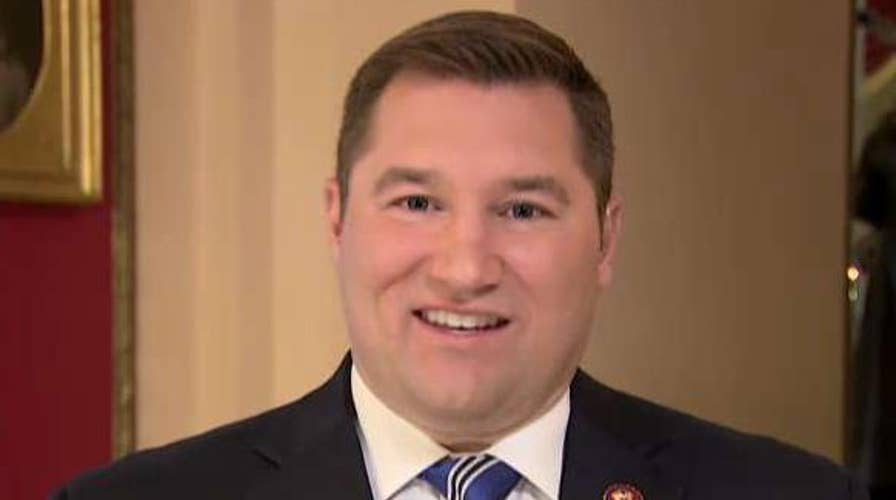
Rep. Reschenthaler on Iran’s missiles attack targeting US forces in Iraq
Pennsylvania Republican Congressman Guy Reschenthaler discusses the defense officials’ briefing on the Iranian threat.
This is a rush transcript from "Your World with Neil Cavuto," January 8, 2020. This copy may not be in its final form and may be updated.
(BEGIN VIDEO CLIP)
DONALD TRUMP, PRESIDENT OF THE UNITED STATES: Iran appears to be standing down, which is a good thing for all parties concerned and a very good thing for the world.
(END VIDEO CLIP)
NEIL CAVUTO, FOX NEWS ANCHOR: And the markets shaken, but not stirred too much. President Trump says that Iran appears to be standing down, after firing off at least 15 missiles at our troops overnight in Iraq. That had stocks moving up, the relief part of that, because, when they first got wind of that, Dow futures were down more than 400 points. Turns out much ado about, well, nothing as scary. Welcome, everybody. Happy to have you. I'm Neil Cavuto. All of this is going on as lawmakers are being briefed at this hour on Capitol Hill about the airstrike that took Iran's top general out, and Iran's fiery response, well-choreographed, some say even telegraphed. John Roberts at the White House, where the president appears to be trying to tamp all of this down, Jennifer Griffin on how it all went down. We begin with John -- John.
JOHN ROBERTS, FOX NEWS CHIEF WHITE HOUSE CORRESPONDENT: Neil, good afternoon to you. The president choosing an off-ramp, a road to de-escalation here, the president holding off on any retaliatory military action against Iran, but, at the same time, upping the pressure on America's allies in other nations to put an end to Iran's exportation of terror and destabilizing activities across the Middle East and parts of Central Asia. Here's what the president said this morning:
(BEGIN VIDEO CLIP)
TRUMP: The civilized world but send a clear and unified message to the Iranian regime. Your campaign of terror, murder, mayhem will not be tolerated any longer.
(END VIDEO CLIP)
ROBERTS: The fact that no Americans were killed in the missile strikes last night allowed President Trump to try to ease tensions, rather than escalate militarily. But he is turning the screws on Iran economically and diplomatically, increasing the maximum pressure campaign and urging the remaining signatories to the Iranian nuclear deal to abandon it and pursue a broader, tougher new deal with Iran. Listen here.
(BEGIN VIDEO CLIP)
TRUMP: The United States will immediately impose additional punishing economic sanctions on the Iranian regime. These powerful sanctions will remain until Iran changes its behavior. And we must all work together toward making a deal with Iran that makes the world a safer and more peaceful place.
(END VIDEO CLIP)
ROBERTS: The president also said that any new deal with Iran should also lead to prosperity in that country. The president also leaning on NATO to take a greater role in the Middle East, speaking by phone today with the NATO secretary-general, Jens Stoltenberg. In a readout of the call, a NATO spokesman saying -- quote -- "They agreed that NATO could contribute more to regional stability and the fight against international terrorism." And FOX News has learned that, after the airstrikes on the Al Asad Air Base and in Irbil last night, there was an exchange of messages between the United States and Iran through the Swiss, who often act as intermediaries. I'm told that the message from the United States was not one of diplomacy, but a message to try to deter further attacks against U.S. targets -- Neil.
CAVUTO: All right, John, thank you very, very much. The senators who have had this briefing are now taking to the microphone to talk about what they learned, including what I was just looking at a second ago, Connecticut Senator Murphy, now Senator Chuck Schumer. Let's listen into this.
(JOINED IN PROGRESS)
SEN. CHUCK SCHUMER (D-NY), MINORITY LEADER: ... questions that they did not answer. We did not see a plan, a satisfying plan for the future. We had 97 senators there; 15 got to ask questions. As the questions began to get tough, they walked out. I have asked for a commitment that they all come back within a week. We have not yet gotten that commitment. Thank you.
UNIDENTIFIED MALE: One of the things that was very troubling is, there was no indication that there was due thought given to the consequences of the action. Before the action against Soleimani, we had massive protests in Iran against the Iranian government. And now we have massive protests against the U.S. No clarity that this was understood how it would affect the unity for the radicals and undermine the moderates.
CAVUTO: All right, we are monitoring largely Democratic reaction to this. You heard Chuck Schumer say that -- and, again, this falls along party lines -- Democrats not impressed with the so-called evidence. They say that was lacking here to justify the attack on this general that started all of this. Republicans, by and large, standing by with the president. Meanwhile, the president is crediting an early warning system for protecting our troops. Jennifer Griffin at the Pentagon with more on that -- Jennifer.
JENNIFER GRIFFIN, FOX NEWS NATIONAL SECURITY CORRESPONDENT: Neil, the Iranians are known to have about 2,000 ballistic missiles. They now have 15 fewer ballistic missiles; 10 hit Al Asad Air Base. One hit Irbil. Another four failed. And we now have satellite images showing the damage to Al Asad Base. One hangar appears to have been hit. But, as the president noted, the damage appears minimal. A senior U.S. official tells us Iranian officials warned Iraq ahead of time about the pending missile strike because Tehran did not want to kill Iraqi forces. Iraqi officials later warned their American military counterparts. But by the time the Iraqi warning came, the American military had already known for hours that Iran was planning to launch the missile strike last night. They even knew the approximate time of attack, the official said. "That warning was not a surprise to us," the U.S. official added. "We already knew it was coming." How did the U.S. know? It intercepted chatter and knew when and where the missile strike would come. They just didn't know the exact magnitude of the strike. According to a senior Pentagon official source, the early warning that the president referenced in his speech included layers of surveillance that included satellites that can detect the second the missile motor sparks, infrared images that can alert U.S. forces immediately. The flying time from Iran to Irbil, for instance, is between three to five minutes, the flying time to Asad Air Base in Western Iraq about 15 minutes. Four missiles failed. They did not reach their target, crashing short, perhaps due to motor failure, according to this military official. Some of these missiles are using decades-old ballistic missile technology. These were not the most state-of-the-art Iranian missiles, according to this source -- Neil.
CAVUTO: Jennifer Griffin, thank you very, very much. Again, we have been updating you on now senators responding after their own briefing to whether that evidence was compelling. By and large, it has gone along party lines, Democrats largely not convinced, Republicans very much convinced. Earlier in the day, this was the same situation with the House, including my next guest among those hearing the justification for taking out this general, Pennsylvania Republican Congressman Guy Reschenthaler, by the way, a member of the very important House Foreign Affairs Committee. Good to have you back, sir. Thank you.
REP. GUY RESCHENTHALER (R-PA): Neil, thanks for having me on.
CAVUTO: Were you convinced, because it seemed like many of your Democratic colleagues were not?
RESCHENTHALER: Well, I'm not going to talk about the particulars of a classified briefing, but I will say this. I believe that Soleimani was what, as a former JAG, I would call an enemy combatant. So he was a lawful target. And President Trump had the legal authority, I'd say he had the moral obligation to protect American life, and he had the duty, as our commander in chief, to take out that strike on Soleimani. The world is a safer place, America is a safer place, and, certainly, that region, Neil, is much safer after the bold action from the president.
CAVUTO: All right. So I guess what Democrats are saying, sir, if I'm hearing them correctly -- and not all, but many -- that there wasn't compelling enough evidence to say he was about to do something big. I know you can't give away what was revealed in that room. I understand that, but why are they, to a man or woman, saying that?
RESCHENTHALER: Neil, I hate to be cynical here, but I think that the Democrats, especially those on the really far left, the social justice Democrats, are putting their hatred for the president, their disdain for this administration, they're putting their party above country. We should all be celebrating the death of a terrorist, somebody who -- who has the blood of countless Americans on his hands, someone who spread chaos and violence all through that region. Everyone should be celebrating this and cheering this for a win for our country. Unfortunately, the Democrats can't help themselves but to criticize the president and second-guess our intelligence and the actions of our military.
CAVUTO: As you know, Nancy Pelosi had originally pushed back upwards of a week this vote on limiting the president's war powers. Now we're told it's re-slated for possibly as soon as tomorrow. What do you think of that?
RESCHENTHALER: Well, it just got e-mailed to me a few minutes ago before coming on. I got to take a look at it. But, for me, I'm not going to be convinced. We have the authority of self- defense. We have bases in Iraq. And let's not forget that, just days ago, the Shia militias were attacking our U.S. Embassy in Baghdad. I served right across the street from that -- Baghdad -- when I was stationed in Iraq. And a week before that, the Shia militias were firing rockets into U.S. Iraqi bases in Iraq. So there's -- there was a threat there. We have the ability to defend ourselves. And when an Iranian general, their top dog, comes over to plan attacks, further attacks on U.S. diplomats, U.S. service members and our Iraqi allies, we have the right, responsibility, and the legal authority to take action.
CAVUTO: All right, Congressman, thank you very, very much. I know this has been a crazy day for you. All right, you know the sort of rule of thumb on Wall Street, they hate uncertainty. The uncertainty that they got yesterday when we first had wind of these Iranian attacks on this Iraqi military base used by the United States, futures were selling off big time. Everything recovered. In fact, some records were scored today. Why is that? After this.
(COMMERCIAL BREAK)
CAVUTO: All right, a FOX Alert for you. We got word by -- from Trey Yingst a little while ago that there were sirens going off presumably in Baghdad. That seemed to herald the possibility of follow-up explosions. It's way too soon to tell, but it did take a little bit of the steam out of the markets on just, just that report of sirens. We have got Gary B. Smith with us, Scott Martin, Kristina Partsinevelos. Gary B., if this doesn't prove that the pros and cons and the back and forth of what's happening in Iraq and Iran are dictating where the market goes these last 48 hours, it did it again, didn't it?
GARY B. SMITH, FOX NEWS CONTRIBUTOR: Yes, exactly. If we had done the show at, say, 10 minutes before the top of the hour, I would have been a lot more bullish.
CAVUTO: You're right.
SMITH: it sold off exactly on that kind of news. It got down 100 points in five, seven minutes. Yes. It's kind of that world on edge kind of thing. I think Trump did a good job this morning of kind of placating the market. It's business as usual. That's why you saw the rally. I think if things kind of stay at that even keel, Neil, we will see probably further upside.
CAVUTO: All right, now, we hope to go to Trey Yingst very shortly on all of this, Kristina. But the issue for the markets is, what are these sirens about? They're -- obviously, the markets, traders are on tenterhooks here, hoping that it was resolved today with the -- with the way the president presented it as Iran standing down, essentially the United States standing down. That's kind of what these guys want to see. Right?
KRISTINA PARTSINEVELOS, FOX NEWS BUSINESS CORRESPONDENT: Of course, and we saw the reaction in the market. They liked what he said today. And even on Friday, when the news first broke, we had that, there was barely a reaction in the markets. The markets closed positive. So why are you seeing all this? The fact that right now in the United States there is -- we're such a strong producer of oil, that is allowing the president to move ahead with more aggressive Middle Eastern policies, which I really do think it's helping him in this case, which is why you're not seeing as much of a reaction. But, Neil, I think the other major factor too is, you have this giant fear of missing out, so what we would also call a melt-up. So a lot of the stocks that people are familiar with, Apple hitting over 300, Tesla climbing higher as well, Microsoft, all the typical names doing quite well.
CAVUTO: All right. Got it. I assume those bells are tolling at the CME, where you are, Scott, right? I mean, is that what's going on?
SCOTT MARTIN, KINGSVIEW ASSET MANAGEMENT: Well, I will tell you, Neil, if Iran is up to more hijinks, maybe they're tolling for them, because I will tell you what.
Gary B. is right. He brought up some very good points about the markets and the reactions. I mean, remember, this is a market that, through many phases of the last several years, has loved what the -- what the Trump economy has done and has loved what the administration has done. But it's such a rare thing these days, isn't it, guys, when you can give someone or something hundreds of billions of dollars, and they can still hate your guts? And so, to me, that's why we should not trust Iran still, whether they're calming down or maybe executing some diplomacy here, because the markets, to me, are still going to be rather jittery as this progresses.
CAVUTO: Let's go to Trey Yingst, if I can, on these alarms that were going off, or sirens, more to the point. He joins us from Baghdad. Do you know any more about what that's about, Trey?
TREY YINGST, FOX NEWS CORRESPONDENT: We do, Neil. And good afternoon. As you and I talked about earlier, the possibility of these Iranian-backed Iraqi Shia militias firing rockets, despite the fact that it did appear there was some progress being made between the Trump administration and the Iranians, earlier this evening, I heard a loud explosion, came outside, and then you could hear sirens around Baghdad's Green Zone, indicating that there was incoming rocket fire, those sirens saying, "incoming, incoming, incoming," very loud throughout Baghdad's Green Zone. There was an additional rocket that landed somewhere a little bit further from where we are at. Local media reports indicate that there were no direct hits, but we're still trying to confirm exactly where those rockets landed, but, again, that breaking here in Bahamas tonight, at least two rockets fired into Baghdad's Green Zone. This follows multiple rockets being fired in a similar location earlier this week, and, of course, last night, when those 15 ballistic missiles were fired by the Iranians towards that base in Western Iraq that does house American forces. The concern tonight and earlier today, as we were reporting on your show this afternoon, you could hear American Apache helicopters circling the Green Zone. They were trying to look for potential threats to American officials that are currently operating out of the U.S. Embassy there in that location, and those threats, like we have seen tonight, rockets that can be fired by these militia groups that are operating around Baghdad -- Neil.
CAVUTO: Trey, thank you very, very much, again, with the latest from Baghdad on these sirens that, again, might not be anything to worry about, but, for the time being, people are antsy about it. And, Gary B. Smith, as we were saying at the outset here, it is still a tense environment here, but it seemingly is a sense that people are returning to the view that this is all back to pre-taking this general out kind of environment, right?
SMITH: Yes, exactly. I think, over the years, Neil, since you and I have been following the news in the war on terror, we have become -- I don't know if it's good or bad. Maybe the American public has become a little inoculated to terrorism, to threats of terrorism. We take it more in stride now. I'm not saying we -- the threat is mitigated, by any stretch. I mean, if there was a terrorist attack in New York City, you would see a completely different reaction, but kind of overseas, it's kind of like, oh, OK, yes, it's kind of business as normal. And, again, Trump is playing his cards correctly at this point. We don't want to see the war-mongering Twitter Trump at all.
CAVUTO: All right, I want to thank you all. I apologize for the brevity of this, given the latest developments out of Baghdad. In the meantime, we are going to hear from General Boykin on what we have to look for now, what we're worrying about now, and where this whole situation goes from here -- after this.
(COMMERCIAL BREAK)
CAVUTO: All right, back to Capitol Hill right now. Utah Republican Senator Mike Lee is addressing what he learned at this briefing from military officials about what prompted the attack on the general. Next to him is Rand Paul. Let's dip into this a little while, guys.
(JOINED IN PROGRESS)
SEN. MIKE LEE (R-UT): ... further military involvement against the government of Iran. Now, I find this insulting and demeaning, not personally, but to the office that each of the 100 senators in this building happens to hold. I find it insulting and I find it demeaning to the Constitution of the United States, to which we have all sworn an oath. It is, after all, the prerogative of the legislative branch to declare war. Article 1, Section 8 makes that very clear. Alexander Hamilton in Federalist Number 69 made clear that this was a sharp contrast from the form of government that we had prior to the revolution, a form of government in which the executive, the king, had the power to take us to war. He did not need the parliament to weigh in on it, to support it. That was the parliament's job after the fact, after we had gone into war. This, Hamilton explained in Federalist 69, is exactly the reason why this power was put in Article 1, Section 8, in the branch of government most accountable to the people at the most regular intervals. When we send our brave soldiers, sailors, airmen and Marines...
CAVUTO: All right, we will continue to monitor this. Every senator is coming out now and giving us their take on all of this. We have got the former Green Beret Commander, retired Lieutenant General Jerry Boykin, in the meantime, to weigh in on this. General, what happens now, you think?
LT. GEN. JERRY BOYKIN (RET.), U.S. ARMY: Well, I think that your report from Trey Yingst is a good indication of what we're going to see. And I have said this on this network yesterday. I don't think we're going to see any more attributable attacks, not -- certainly not in the short term, out of Tehran. But I think that you're going to see Kataib Hezbollah and the Shia militias and some of the other groups that have been created and supported by Iran, I think you will see them doing exactly what Trey was describing there. They will be firing rockets. This is more of the same. This is not new. But I think that that's what you will see. But what we will not see as a cessation of the friction between the United States and Iran. This has been going on since February of 1979, the first time they entered our embassy, and then, in November, they entered our embassy and took a group of hostages, ultimately, 52 of them. And, in fact, I was there on the night of the 24th of April, 1980, when we tried to rescue those hostages. And we lost eight good Americans.
CAVUTO: That's right. BOYKIN: Eight great, heroic Americans died in that desert there trying to rescue our hostages in the embassy in Tehran. So this has been going on for 40 years. This is not going to end just because it is de-escalating right now. There will continue to be tension.
CAVUTO: I don't want to make a general statement on this. The senators and a lot of the congressmen who are coming out of their own briefings earlier, it's fallen largely along party lines, Democrats not convinced that the efforts to take out Soleimani -- he's a bad guy. They acknowledge that, but Democrats think there was no compelling evidence to say that we had to take him out now, Republicans just the opposite. What do you think of that?
BOYKIN: Yes, think about this. If the president knew that there was even a reasonable probability that this guy was about to perpetrate an attack on -- that would kill Americans, and he didn't do anything, he didn't make that call to take him out, what would that have been? I would have called that malfeasance. I would have called it irresponsibility on the part of the commander in chief. He has that responsibility, first and foremost, as the president and the commander in chief, is to protect Americans.
CAVUTO: Let me switch gears very quickly, if you will indulge me, sir, this notion that this plane, this Ukrainian plane that crashed, originally, the Ukrainians and the Iranians were saying it was engine fire, engine trouble. The Ukrainians have since pulled back from that, saying, we will have to wait and see. What do you think happened there?
BOYKIN: I have no idea, Neil. I have heard the reports that an engine overheated or whatever, but what I do know is that that was not as a result of any American operation or activity that brought that plane down. I suspect that it was probably explainable in terms of some kind of malfunction of the aircraft itself. But I -- America didn't do that.
CAVUTO: No, no. And even the Iranians aren't saying that. They did say, at least, that they're pretty convinced it was essentially a Boeing issue. They didn't say as much, but that it was not even accidentally hit by Iranian missiles.
BOYKIN: Yes.
CAVUTO: But, obviously, the drama is building up around this thing, isn't it?
BOYKIN: Yes. And given where the Democrats seem to be right now in terms of giving Donald Trump credit for anything, it's only a matter of time until he would potentially be blamed for that, too, for some nefarious act. But the reality is that the president has played this very well. It's de- escalating rapidly now. And I think he's -- I think he's called the shots exactly right.
CAVUTO: General, thank you very, very much.
BOYKIN: Thank you, Neil.
CAVUTO: We're going to go back to Washington right now, where Rand Paul, who has a slightly different view than the general, is addressing reporters on this issue. He was not a fan of this action. Let's dip into this.
(CROSSTALK)
QUESTION: ... saying this to you, that you shouldn't debate this? Was it all of them? Was it a specific Cabinet member or agency director?
LEE: Before I comment on that publicly, I'd really like to have a conversation with the president, so I can make him aware of what we were told and by whom. But I will say that the messages we received didn't get any pushback internally from the briefers. What we were told over and over again was, look, this action was necessary, this was a bad guy, we had to do it, and we can't have division, we can't have dissension within our ranks within our government, or else it sends this -- the wrong signal to the Iranians. And I just -- I think that's completely wrong. They were asked repeatedly what, if anything, would trigger the need for the administration to come back to Congress for a declaration of war or an authorization for the use of military force? At one point, I believe one of the briefers said something along the lines of: I'm sure we could think of something. But they struggled to identify anything. They were asked specifically, what about if you concluded -- well, it's not my point to get into that here. I don't want to accidentally say anything classified. My point is, they were asked a number of hypotheticals about situations in which they might have to, appropriately, come and ask for authorization from Congress. Not once did they say, yes, we would need to do it in that circumstance. At one point, one of the briefers said something like: Don't worry, we will consult you. Well, with history as our guide, consultation isn't necessarily the same thing as authorization for the use of military force. A declaration of war or an AUMF is what the Constitution requires. And drive-by notification or after-the-fact lame briefings, like the one we just received, aren't adequate.
QUESTION: Do you think the president should have carried out this attack against Soleimani?
LEE: Look, I'm still agnostic as to that, Manu. I still haven't had the questions answered that I came into that briefing expecting to ask. They left after 75 minutes. Now, I understand these are busy people. They have got a lot of demands on their time. They're appearing before a coordinate branch of government, a coordinate branch of government responsible for their funding, for their confirmation, for any approval of any military action they might undertake. And they had to leave after 75 minutes, while they're in the process of telling us that we need to be good little boys and girls and run along and not debate this in public. I find that absolutely insane. I think it's unacceptable. And so I don't know what they had in mind. I went in there hoping to get more specifics as far as the factual, legal, moral justification for what they did. I'm still undecided on that issue, in part because we never got to the details. Every time we got close, they would say, well, we can't discuss that here because it's really sensitive. We're in a SCIF. We're in a secure underground bunker, where all electronic devices have to be checked at the door. And they still refused to tell us. I find that really upsetting.
QUESTION: Did you get a sense that they were not taking it seriously, almost like they didn't want to be there?
LEE: No, I -- look, the fact that they were here shows they were taking it seriously. But some of the underlying questions...
CAVUTO: All right, there is an exception to the party rule. Senators Mike Lee and Rand Paul were not impressed with some of the evidence that they supposedly got to argue for taking out Soleimani. They are also in favor of that measure that would sort of rein in the president's war power responsibilities and check first with Congress. They are an exception to the Republican Party rule, which, by and large, has been in lockstep with the president in justification for this attack. Rand Paul among those who said that it was a mistake and got us in deeper in a region we shouldn't be getting in deeper. We will have more after this.
(COMMERCIAL BREAK)
CAVUTO: All right, it looks like, Congress, they're going to go ahead and move on this war powers resolution to limit the president's actions in the future when it comes to doing anything without congressional consultation. It's divisive -- after this.
(COMMERCIAL BREAK)
CAVUTO: All right, also remember that plane crash in Iran. Western intelligence agencies are said to believe that the Ukrainian airliner that crafted in Tehran was due to technical malfunction, not from a missile. Other reports say it was flying just fine for the first two minutes, and then a catastrophic event, and then the crash, all 176 people on board dead. Aviation expert, commercial pilot Rob Mark joins me right now. Rob, on the phone here, I'm just curious what you make of that. Others have pieced together what they can, because the Iranians are not interested in sharing the black box certainly with Boeing or anyone else, that this was unusual, that everything seemed normal for the first two minutes, then this so-called catastrophic event, and it crashed. Do you know any more?
ROB MARK, AVIATION SAFETY EXPERT: Well, we don't know any more really than that, Neil. But, I mean, I have to tell you that an airplane on departure, climbing at a normal rate at a normal air speed that just suddenly takes a nosedive into the ground is -- was pretty catastrophic. I mean, something went on instantaneously with that -- I'm sure that crew had absolutely no time to react.
CAVUTO: Now, many -- obviously, it brings out all sorts of black helicopter-type thoughts that maybe this thing was accidentally shot down, not by us, because the Iranians were not fingering us, but maybe, during the missile attack itself, one of those missiles hit that plane.
MARK: Well, I don't know the time frame. I know they were -- they were close. But, again, it would take something unbelievably catastrophic to knock -- essentially knock the airplane out of the sky, which is what it sounds like it did right at this point.
CAVUTO: Right.
MARK: I know there were reports of engine problems. But we can fly a 737 on one engine. The chances of both of them quitting are pretty slim. But, even then, the airplane doesn't drop like a rock. It becomes a glider. It has to come down pretty quick. But they still have control. But it doesn't sound like they had any of that.
CAVUTO: Yes, Rob, we did try to get a timeline ourselves early on when I was reporting this on the FOX Business Network, that it was within an eight-minute time frame that did parallel the missile attack. We don't know that for sure. They're trying to look into that. But, be that as it may, there were warnings that were put out to forbid commercial flights in and around the air over Iran, Iraq and a large swathe of the Middle East. I don't know when that was put into place, presumably after this crash. But is that still advisable today, you think?
MARK: Oh, I believe the FAA still has those -- we call them notice to airmen essentially to warn pilots of Western European- and U.S.-registered airplanes to stay out of the area. And, primarily, that comes from going back to the Malaysian accident in -- years ago, where an airline was shot out of the air by mistake. And so they're trying to avoid that. But, of course, why they were doing what they were doing is beyond me.
CAVUTO: All right, Rob, I know I threw a lot at you there, and you very calmly you sort of went line by line through it all. We will see what happened there, Robert Mark, aviation safety expert and a commercial pilot. Just in case you thought that any of this was, you know, holding off in impeachment, think again -- after this.
(COMMERCIAL BREAK)
CAVUTO: All right, you would think, with all the fuss about what's going on in Iran, and whether things have actually calmed down, and now with reports of sirens going off in Baghdad, that at least there would be a slow push toward impeachment here. But, no, the calendar still says it's on. The question is exactly how soon it will be on. FOX political analyst Gianno Caldwell joins us, Axios political reporter Alayna Treene, Democratic strategist Robert Patillo. Gianno, begin with you. What is your sense about the timeline here? Because no matter where people are in this debate, whether we should have taken out this Iranian general or not, it has not dissuaded those who are seeking to keep the impeachment process going even in the Senate to get it happening and to get it done. What do you make of that?
GIANNO CALDWELL, FOX NEWS POLITICAL ANALYST: Well, I mean, we honestly know what this push has been all about. It has been a vehicle in the Democrats' P.R. messaging campaign for the 2020 election. I imagine they would like to hold those articles as long as possible, then get it done as close to the election as possible. We know what this is all about. For them, it's all about public support and to change the public's opinion about this president, in spite of his accomplishments that have been much more beneficial to...
CAVUTO: Well, I understand, but think about it, though. And, Robert, I will take this up with you. The Senate could just as easily, and Mitch McConnell could just as easily say, we have a lot more pressing front-burner issues, like what's happening in Iran and Iraq right now, to put this off. He has not done that. And maybe I'm reading into that that they have what they have, they're going to proceed with it. There might be witnesses, likely not, depending on some wayward Republican senators. So, that is still on. And they want this done. What do you think?
ROBERT PATILLO, DEMOCRATIC STRATEGIST: Well, I think, one, just to go back to Gianno's point about Democrats wanting this to be in the public spotlight, let's understand, after the Nixon fiasco in 19 -- Republicans did not -- or Democrats lost every election, except for 1976, until 1992. After Clinton, Republican -- or Republicans, after they impeached Clinton, they have lost the popular vote every single election cycle, except for 2004. So the idea of the impeachment somehow improves your chances of winning an election are ridiculous. That's not why this is happening. We -- it is a front-burner issue whether or not the president of the United States abused his power.
CALDWELL: Front-burner?
CAVUTO: I'm sure I don't have to remind you that the Republicans were shellacked in the '74 midterms. And, of course, you saw, obviously, what happened to Richard Nixon.
PATILLO: And led to the Reagan Revolution in '80 and then Bush in '88, all the way until '92.
(CROSSTALK)
CAVUTO: Fair enough. I will go there. But, Alayna, my only issue -- and I respect all of you guys, and Robert as well -- I think that damage is to the party that pushes it too far here, but where do you see this going?
ALAYNA TREENE, AXIOS: Well, as you said, the Senate and the House both have been still very focused on impeachment, even with Iran going on, although I did speak to several members on the Hill of both chambers this week, and they have said that Iran is still the number one issue that everyone's paying attention to. But they do want to wrap up impeachment as soon as possible. That's certainly what the Senate wants. And we have seen now...
CAVUTO: Do you say both sides want that, though, Alayna? I mean, it's in their interest, to Gianno's point earlier, to try to get it done, right?
TREENE: Right. Well, so I think now, from people I have spoken with on the House side as well, Speaker Pelosi is still holding onto these articles. And, of course, the Senate trial cannot happen until she does appoint House managers and transmit the articles to the Senate. I have spoken with people on her team today, who said that she's still not prepared to send the articles over until she knows exactly what the rules will look like and exactly what a trial will look like. Of course, we did see Senate Majority Leader Mitch McConnell yesterday kind of lay out much clearer that he has the votes to move forward with setting up these rules without consulting Democrats and agreeing to some sort of negotiation with Chuck Schumer. And that's what he plans to do.
(CROSSTALK)
CAVUTO: I'm sorry.
TREENE: No.
CAVUTO: Gianno, on that, you could argue right now that McConnell just wants this all to go forward. He's going to take up the issue of whether there are witnesses, whether John Bolton testifies, and what have you. Is it your fear here that there might be just enough Republican senators to push for a hearing from Bolton, for example, because all you need is 51 votes for that.
CALDWELL: Right. But even with this plan, you have people who are kind of the wild cards, like Mitt Romney, Susan Collins. You got senators who are actually in line with Mitch McConnell on his plan to move forward as he sees fit. And for Democrats like Nancy Pelosi to be trying to dictate to the Senate, the United States Senate, how things should go or let me hold the -- hold the articles until you tell us what your plan is, it's pretty ridiculous at this point. They have had their opportunity. I think it was Chuck Schumer who basically said just that yesterday, that that phase was done over in the House. And it is the Senate's turn. And, yes, we should move forward and we should move forward quickly, because we're talking about the presidency of the United States of America.
CAVUTO: All right, guys, thank you very much. Cutting this a little short here, because we're getting some big news out of her majesty's kingdom, that Prince Harry and Meghan Markle want to sort of give it the royal wave -- after this.
(COMMERCIAL BREAK)
CAVUTO: Could it be? Prince Harry and Meghan Markle are now saying ta-ta for now? The duke and duchess of Sussex announcing plans to step back as senior members of the royal family in an Instagram post, saying they will work to become financially independent. Wow. Spectator USA's Dominic Green joins me now on the phone. What does this mean, Dominic? What does financially independent mean?
DOMINIC GREEN, SPECTATOR USA: Well, it depends who you ask. It makes it -- and being financially independent is completely impossible if you are Harry and Meghan, because the scale on which they live can only be accomplished if you're an extremely successful businessman or movie star, or if you have an enormous amount of family money supporting you. And if they are really going to do without the family money, then they're going to be stuck.
CAVUTO: So, what are they going to do and why now?
GREEN: Well, they want to make a difference, which is admirable, but they basically want to lecture us about how we're terrible about the environment and about racism. And they want to use their status as a soapbox from which to hector us from. This is what they have said they want to do. They seem to be wanting to have their cake and eat it, though, because you can't have it both ways. If you're the duchess of Sussex, you are meant to be in Sussex, not Malibu.
(LAUGHTER)
CAVUTO: By the way, that expression, I don't know whether it started with you Brits and all, but the cake, if you have it, you might as well eat it. But I digress.
(LAUGHTER)
CAVUTO: Is it your sense that -- was this run by the queen? Some had reported it wasn't.
GREEN: Well, I have got the memo here. It says that: "Discussions with the duke and duchess are at an early stage. We understand their desire to take a different approach. But these are complicated issues that will take time to work through." In other words, you're not going anywhere, kid. No one leaves the royal family.
(LAUGHTER)
GREEN: The only way out is via the guillotine or a state funeral.
CAVUTO: Wow. Well, hopefully, that will not be necessary. But there's always been some rough edges here and some concerns here. It's a big family. It's obviously, in many respects, a dysfunctional one, but it's the lifeblood of Britain, right? I mean, if they were to take this sort of distant role, what would it be like? I mean, they can't sever all relations with the royal family. So how do you envision it?
GREEN: Well, they can't sever them. You're right. And so, really, they're talking about exchanging a lifetime contract with the world's greatest soap opera for a sort of day-by-day reality TV spot. They can't have it both ways, simply. You're either in or out with the royals. And once you're out, you're fully exposed to the press. And remember what happened to Harry's mother when she was out. Princess Diana was hunted down by the press. And this is a very risky move for them to make, in that sense.
CAVUTO: I'm also curious about what happens to the rest of the family. Does it put pressure on the rest of the family to sort of pick up the publicity slack?
GREEN: Well, it definitely does. They're saying they want to make the royal family progressive. But you can't have a progressive royal family. Well, you can if you get rid of it. I mean, that's what it means. So the rest of the family are now going to be put under pressure and criticized, in effect, for not being progressive enough. The queen is in her 90s. She's progressive by the standards of the 1940s. And that's fair enough. But it's a crazy thing to ask.
CAVUTO: All right, Dominic, you were great. Thanks for educating us on all of this.
GREEN: Thank you.
CAVUTO: But, man, oh, man, you guys put us to shame on the soap opera part. Dominic Green following all of this. More after this.
(COMMERCIAL BREAK)
CAVUTO: All right, want to keep advancing and updating you on this story that warning sirens heard in and around Baghdad. Trey Yingst is there with the very latest. Hey, Trey.
YINGST: Hey there, Neil. We have got some updates for you. We have confirmed that two rockets did land in Baghdad's Green Zone, exploding in the perimeter of the U.S. Embassy, but not actually striking the compound. According to officials that we spoke with, one of the rockets landed near the Tigris River behind me, the other one hitting a building that is under construction. No casualties are being reported. But these officials say they believe they are Katyusha rockets, likely fired by Iranian-backed Iraqi Shia militias that are operating near Baghdad. This is not the first time this week that this has happened. Earlier in the week, we also saw five rockets landing in Baghdad's Green Zone. But, tonight, we did hear that one large explosion, and then the sirens blaring "incoming, incoming, incoming," indicating that there was an attack towards the Green Zone. All of this, though, painting a larger picture about what the region may deal with as the proxy issue does continue. It's important to differentiate for our viewers, though, the difference between the rockets that we saw tonight and the rockets that we saw last night. Last night, there were ballistic missiles fired from Iran, 15 of them, into Iraqi territory. The rockets that we saw fired tonight, they're not missiles. They're rockets. They're fired by militia groups. It's a much smaller type of attack, but still an attack nonetheless that could threaten U.S. forces or personnel that are operating in Baghdad in the surrounding region -- Neil.
CAVUTO: Trey, do we know whether the Iranians have indicated, or best you can get from them, that this is it, that this -- what they did last night was it for the time being?
YINGST: Well, what we saw last night appeared to be finished, for now, the large response by the Iranians avenging the death of their top general, Soleimani, Qasem Soleimani, that was -- he was killed outside of Baghdad's International Airport last week, after the president made that decision to order a drone strike. But the issue here when it comes to the militias operating in the area is, they do receive direction and funding from the Iranian regime, whether it serves them politically or not. Sometimes, you will see Iran's supreme leader, the Ayatollah Khamenei, or you will hear the president of Iran, Hassan Rouhani, say that they can or they can't control the actions of these militias operating in Iraq. But the reality on the ground is that most of what happens here is somehow linked to Iran. So it's important to remember that in the larger picture - - Neil.
CAVUTO: Thank you, my friend, very much. Be safe, Trey Yingst, in Baghdad. By the way, tomorrow, they are still going to take to the floor that war resolution effort to try to limit the president's powers here. "THE FIVE" is now.
Content and Programming Copyright 2020 Fox News Network, LLC. ALL RIGHTS RESERVED. Copyright 2020 ASC Services II Media, LLC. All materials herein are protected by United States copyright law and may not be reproduced, distributed, transmitted, displayed, published or broadcast without the prior written permission of ASC Services II Media, LLC. You may not alter or remove any trademark, copyright or other notice from copies of the content.
