






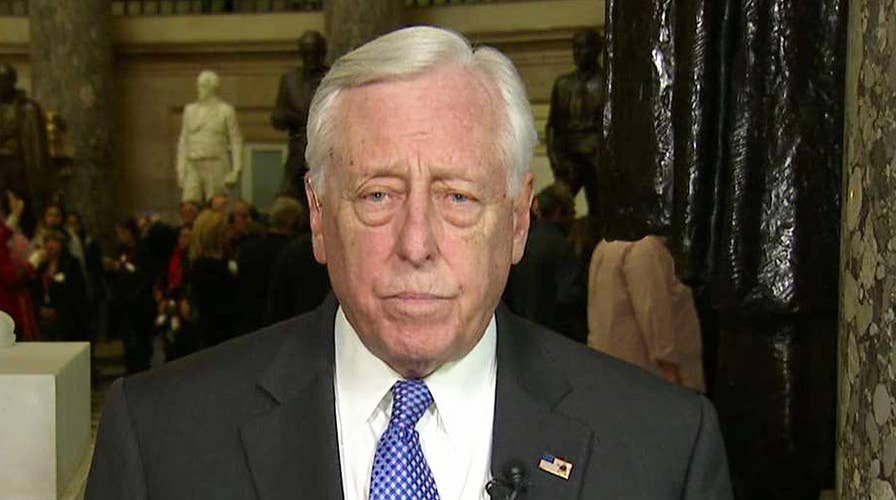
Rep. Hoyer on shutdown: It is a step forward to have votes on funding
use majority leader Steny Hoyer on the continuing battle over border wall funding and the partial government shutdown.
This is a rush transcript from "Your World," January 22, 2019. This copy may not be in its final form and may be updated.
NEIL CAVUTO, HOST: All right, more on that big pitch by Mitch slated for 2:30 p.m. on Tuesday -- on Thursday, I should say.
We're going to hear the Senate leader's chance to try to get this shutdown, well, shut down, to get things going. But he's got to get some Democrats to go his way. As Shep was pointing out, you need 60 votes. We're a long way from that.
Welcome, everybody. I'm Neil Cavuto.
On "Your World" today, just a messy world, the government still shutdown, into its 32rd day, but a possibility 48 hours from now it could be dwindling, that is, the shutdown.
The read from Peter Doocy at the Capitol with the very latest.
Hey, Peter.
PETER DOOCY, CORRESPONDENT: Neil, just a few minutes ago in the chamber they still control, Republicans had enough support to move forward.
So they set their schedule. Thursday afternoon will be the day that they move forward with the president's proposal to reopen the government and a Democratic proposal to reopen the government.
The one that is going to go first, this one that was just introduced by Mitch McConnell, is the one that trades border wall money for temporary protections for DACA recipients brought to the country illegally as little kids.
(BEGIN VIDEO CLIP)
SEN. MITCH MCCONNELL, R-KY., MAJORITY LEADER: To reject this proposal, Democrats would have to prioritize political combat with the president ahead of federal workers, ahead of DACA recipients, ahead of border security, and ahead of stable and predictable government funding.
(END VIDEO CLIP)
DOOCY: They need 60 votes in the Senate for that, and they need it to pass the Democratic-controlled House.
But the speaker of the House, Nancy Pelosi, told us today no new negotiations until after President Trump opens back up the government. The House plans to just keep passing their own shutdown-ending spending bills, and they are not yet considering anything that could come from Senate Republicans.
Then again, neither are Senate Democrats.
(BEGIN VIDEO CLIP)
SEN. CHUCK SCHUMER, D-N.Y., MINORITY LEADER: The president didn't ask what Democrats needed in a bill to achieve our support. He simply laid his proposal down on the table and proclaimed it a compromise.
You can't have a compromise when one side declares, this is what we want, and this is what you want.
(END VIDEO CLIP)
DOOCY: We're also waiting this afternoon to hear back from Speaker Pelosi, whose request for President Trump to postpone the State of the Union address until after the shutdown has apparently been ignored, because the White House sent a letter to the sergeant at arms, saying they are ready for their security walk-through ahead of a scheduled speech a week from tonight -- Neil.
CAVUTO: so, they're going to force that issue, I guess.
All right, Peter, thank you very, very much.
Stocks are down today. We can take a look at this. They were down a lot, but they had been down a lot more than that.
Now, the shutdown is playing into this. China weakness is playing into this. On-again/off-again trade talks are playing into this. But on that shutdown, the numbers are staggering.
In fact, because of the shutdown, they could have paid for the wall at the right they're going.
Deirdre Bolton has more on that -- Deirdre.
DEIRDRE BOLTON, CORRESPONDENT: Yes, Neil.
Humblingly enough, we are on day 32, the longest shutdown in history. And the chief U.S. economist for S&P Global estimating that every week of the shutdown may shave $1.2 billion from U.S. GDP.
Now, since we're in the fifth week, that equals about $6 billion. Other economists basically publishing reports, and they are essentially saying just think of it as a drop of 0.1 percent off GDP per week as the shutdown continues.
Now, part of the effect and the expected effect is due to federal workers, who are bracing now for a second missed paycheck this week if they're not paid by Friday, 800,000 workers, as we have been reporting on, not going to spend extra money, especially if they're not getting paid.
Consumer spending, as we know well, two-thirds of our economy, that is part of most economists' equation for GDP. President Trump, as we know, signing a bill last week. It ensures back pay for those furloughed employees. But that money will not be distributed to them until after the shutdown ends.
Some other parts of the shutdown affecting specific parts of the economy, mortgage applications, one example. Buyers are facing longer wait times, especially for loans that require income verification through the IRS.
And according to National Association of Realtors' analysis, more than 20 percent of home loans have been affected so far. The U.S. is facing these challenges, of course, but other regions in the world are also slowing. So the IMF lowering its 2019 global growth forecast. That's mostly about concern about European growth. Recently, China anything its economy has grown at its slowest pace in at least a decade.
So, Neil, all of this adding up to extra macropressure onto our economy -- in the meantime, back to you.
CAVUTO: All right, thank you very, very much.
BOLTON: Sure.
CAVUTO: So, between the slowdown and the shutdown, we're going to give you the lowdown.
We have trader Chris Robinson joining us, market watchers Kathryn Rooney Vera and Lee Munson.
Lee, end it with you.
What is dominating your thinking right now, as you continue to trade? You look at the shutdown, you look at this dragging on, you get hopeful when you hear they're going to at least do some vote in the Senate on Thursday. What do you think?
LEE MUNSON, PORTFOLIO WEALTH ADVISORS: Well, I'm hopeful about a lot of things, because I'm an investor, so I try to figure out how things could work.
So the first thing is, remember, all this housing data, we already knew housing was going to be soft. It's already been soft. Right now, you can get a 30-year fixed at the price last spring. So it's about a half a percent lower. Once the shutdown comes to fruition, that 20 percent lagging that we were just talking about, that's going to get done.
Also, I don't really care about the International Monetary Fund bringing down global growth from 3.7 to 3.5. That's still a positive 3.5.
My hope -- and I know that sounds awful -- I would love to see people panic a little more and maybe get the market to come down 2 or 3 more percent, because that's where I'm going to be a buyer.
Fundamentally, where are the banks' bad earnings? It's not there. Housing soft, it's not a disaster. I say you can buy this weakness.
CAVUTO: All right.
Well, Kathryn, in the meantime, the shutdown gets in the way of that.
KATHRYN ROONEY VERA, BULLTICK CAPITAL MARKETS HOLDINGS: Yes.
CAVUTO: The shutdown gets in the way of closing home loans, because the FHA that backs a lot of these loans is stymied. The SBA, a big loan lender to small and medium-sized businesses, that is stymied. So that's hurting those biz guys.
Do you worry that a shutdown that most investors kind of properly in the beginning dismissed, maybe not so much now?
ROONEY VERA: Neil, let's look at the numbers, just kind of very easy, back of the envelope, because when the audience hears economists say this is going to shave off X Y, Z amount of points, it's very -- quite a simple calculation.
Just so everyone knows, 20 percent of GDP goes -- is government spending, of which 20 percent is unfunded right now. So it's a partial government shutdown. It does have an impact. By my own calculation, Neil, it will take 1 percentage point of GDP if it lasts for the entirety of the year.
So, of course, the duration of the shutdown is equivalent -- is going to -- it's going to be the main influencer of how much this affects GDP, because government spending is still a big portion of the GDP, as I said, 20 percent, so it is big.
What I'm most scared about, Neil, is self-fulfilling prophecy. I liked your last guest's comments. I agree with him. I think that if this combination of negative forces continues to weigh on consumer sentiment and small business sentiment, then you can have the following happen, self- fulfilling prophecy.
Guys get scared. They say, I'm not going to buy that house. I'm not going to buy that car. And that slows down economic activity. So that's where I'm starting to really get cautious. The numbers are strong, and I do agree it's still an opportunity to buy, because this market fall is based on fear.
CAVUTO: All right, Chris, one of the things that people had been sort of getting ahead of themselves with is this market.
The start of January, the January effect, whatever want to call it, has a very strong. In fact, through the shutdown, we have had double-digit advances in all the major averages. So, obviously, they are looking at this, Chris, and saying, we can deal with this. Can you?
CHRIS ROBINSON, CME TRADER: Oh, absolutely.
I mean, this is where the rubber meets the road as far as risk management is. Right behind me, they trade a million-seven contracts of (INAUDIBLE) very day. One contract covers $130,000 worth of stocks.
So people don't necessarily have to be wondering, where's the bottom, how can I get out? This is why this place is here. Now, the stock market's closed, but the futures market is continuing to go. It will trade all night long.
And I don't think to have -- we had 17 days in a row where we rallied. We were up over 15 percent, close to 15 percent.
CAVUTO: Very true.
ROBINSON: So, today, we dropped 50 points in the S&P. That's not that big a percentage drop. We could drop further and still be OK.
But I think that's what people didn't like today was the news that we may have hit a bump in the trade negotiations with China, number one, and also you saw us turn lower after the housing information came out.
CAVUTO: All right, real quickly, Lee Munson, another factor is China, on- again/off-again talk, that maybe the talks aren't going to happen or that there might be a hissy fit between Washington and Beijing.
I don't know where that stands. But it seems like the talks are on, people optimistic a deal can be had. Are you?
MUNSON: I am optimistic.
Here's the thing. We already know that China was soft last year. Its own economy was down over 20 percent, almost 30 percent. So this isn't really new news. The only policy thing I care about, the only thing I care about in the White House is a trade deal with China.
You know what? Like, my old friend Larry Kudlow, he's in there. I know he's a great negotiator. He's a great statesman. I know they're in the backroom right now trying to figure out, how can we get a deal with China and how can we make it look good to the U.S. people?
So I have a lot of confidence. We can't just put up a wall between trade in China. It's ridiculous.
So, like I said, if this lasts a few more months, if this causes more uncertainty, it only gives me better prices to buy for my clients.
CAVUTO: All right, we will watch closely, guys.
In the meantime, we are getting word that the president is looking to have a State of the Union address, if he can and, ideally, in the House.
What does the House majority leader, Steny Hoyer, think of that? He's next.
(COMMERCIAL BREAK)
(BEGIN VIDEO CLIP)
REP. NANCY PELOSI, D-CALIF., SPEAKER OF THE HOUSE: Cannot have the president, every time he has an objection, to say, I will shut down government until you come to my way of thinking.
HOGAN GIDLEY, WHITE HOUSE DEPUTY PRESS SECRETARY: She has a standing invitation here, any time she wants to come and any time she wants to talk to the president. The American people deserve that.
(END VIDEO CLIP)
CAVUTO: All right, so they're still at loggerheads on this.
Let's get the read from Maryland Democrat in the House Majority Leader Steny Hoyer on all of this.
Leader, it's very good to have you. Thank you.
REP. STENY HOYER, D-MD, MAJORITY LEADER: Thank you, Neil.
CAVUTO: Where do you think this stands right now, and the vote that obviously -- two different votes, obviously, a Democratic vote and a Republican vote, being tested in the Senate for Thursday, is this the making of something?
HOYER: Well, it's certainly a step forward to have votes.
And it's my understanding, although I haven't heard specifically about it, but it's my understanding that one of the bills that we sent over which opens up the government until February 8 will be put on the floor.
I'm sure every Democrat will vote for that bill. And, hopefully, the senators will as well.
This taking hostage the government of the United States, the people's government, first of all, is wrong in terms of the 800,000 employees, secondly, is wrong in terms of the predictions as to what the results will be, as you just heard in an earlier segment, are not very sure. And it creates instability and doubt.
And, thirdly, I think -- I agree with Speaker Pelosi when she just said, what's to stop the president from, two weeks from now, or a month from now, having an objection to something we want to do or won't sign something, and he says, again, I will take credit for shutting down the government?
(CROSSTALK)
CAVUTO: Well, he says -- said the same of you guys.
I guess what I want to be clear on...
(CROSSTALK)
HOYER: Oh, Neil, Neil, Neil, that's not fair. Neil, that's just not fair.
(CROSSTALK)
CAVUTO: OK, I'm sorry if I offended you.
HOYER: The president said he would shut down the government.
CAVUTO: Let me ask you, though, do you think right now that the measure that Mitch McConnell wants to advance, which is the president's idea to provide DACA funding, as long as, you know, included in that is $5.6 billion for a wall...
HOYER: Right.
CAVUTO: If they were able to peel off some Democrats for that, what would you think of them voting for that?
HOYER: I don't think he's going to peel off any Democrats.
They think the government ought to be open, number one. Number two, then there ought to be integration.
When you say he made a DACA offer and a TPS offer, those with temporary protective status and those children who came here as infants or small children by their parents, he created those problems. He created problems. Now he says, well, I will solve them for you, or temporarily or partially solve them for you. That's not a negotiation.
And, very frankly, when you say...
CAVUTO: Well, you did say it was a big mistake when he did that.
HOYER: I did.
CAVUTO: And you're right. He caved to the right in his party. Now he's trying to make right with that, you could argue.
HOYER: Well...
CAVUTO: So, would you meet him on that? If he's saying, you know, I made a mistake with that, I think we should include that, would you be open to that?
HOYER: I think that's moving in the right direction.
CAVUTO: OK.
HOYER: But, very frankly, he's not saying that.
What he's saying is, I will give a three-year extension on both TPS and DACA. I think that's a step in the right direction. But we ought to get DACA done. And we ought to get TPS done.
CAVUTO: So, you wouldn't be angry at any Democratic senator -- I know it's not your House -- but any Democratic senator who voted for that?
(LAUGHTER)
HOYER: I don't think any Democratic senator is going to vote for it because of the context in which those two proposals are made.
CAVUTO: I see.
HOYER: And it's not a negotiation. It's -- if he wanted to negotiate, make an offer. But he didn't make an offer.
He said, this is going to be the bill. Vote for it or vote against it. That's not a negotiation. It is like taking the government hostage and saying, if you don't agree with my $5.7 billion, I'm going to keep government shut down.
That's -- that's not the way to legislate. It's not the way any other country does...
(CROSSTALK)
CAVUTO: Would you, Steny Hoyer, be open, you, yourself, be open for wall funding?
HOYER: Look, I think physical barriers are part of the solution.
CAVUTO: So, you don't share Nancy Pelosi's view that a wall is immoral?
HOYER: Look, I think it depends upon what a wall is used for whether its moral or immoral.
If it's protecting people, it's moral. If it's imprisoning people, it may well be immoral. But that's not the issue.
The issue is, we want border security. We want to make sure that people who come into the United States of America authorized to do so, and we know that they have come in. We don't want contraband. We don't want drugs coming in. We don't want dangerous people coming into the country.
CAVUTO: Understood.
HOYER: So, we're for border security. And I think we can get there.
But, very frankly, creating the environment of hostage-taking, i.e., the -- not only employees, but people who rely on government, and then saying, either you negotiate with me, as I want to do, or I'm going to keep the hostages, very frankly, Neil, remember -- remember the president asked...
(CROSSTALK)
CAVUTO: I understand.
And you're saying he's not budging, and that his people argue you guys aren't budging now that he's made these offers.
But I do want to ask you this. They're insistent, apparently, in planning for a State of the Union address...
(LAUGHTER)
CAVUTO: ... and even sort of getting an opportunity to scope things out there to have that address.
Do you think the president is within his right to have a State of the Union address in the well of the House?
HOYER: Within his right? Now, that's a technical term, and the answer that is no.
The president comes here at the invitation of the Congress, and particularly the House, to address the Congress of the United States.
(CROSSTALK)
CAVUTO: But Nancy Pelosi didn't disinvite him.
HOYER: No, I understand that.
CAVUTO: She just said she didn't think it was a good idea, right?
HOYER: Neil, I'm not conversing with the -- apparently, the president said something. And I didn't hear that. And I don't know what response has been.
(CROSSTALK)
CAVUTO: I'm sorry. I wasn't clear. And that's my fault.
HOYER: Yes. But that's all right, Neil.
(CROSSTALK)
CAVUTO: Nancy Pelosi didn't disinvite him. She just didn't think it was a good idea, would actually prefer, during the shutdown, that he deliver it in writing, if he delivered it at all.
(LAUGHTER)
CAVUTO: Do you think that the president, if he said, no, I want to go there in person and address everybody, would you, Steny Hoyer, be open to that?
HOYER: Sure.
CAVUTO: And do you think Nancy Pelosi would?
HOYER: Look, I don't know what the discussions have been, because -- so I don't want to say.
But, very frankly, keeping the government shut down -- I know we -- you get bored of hearing that, but you got 800,000 people who now for a month have not gotten paid.
What way is that to treat any employee, much less a federal employee who's working for the people of the United States? It is wrong to do that. The president is using it as a strategy. And he ought to change that immediately.
And he ought to tell McConnell, sign one of those bills.
We have sent 10 bills. As of tomorrow, we're going to send 10 bills to the Senate that would have accomplished opening up the government. They haven't taken up one of them. I understand they're going to take up one possibly tomorrow or on Thursday. I think that's good news.
CAVUTO: All right.
So, when you hear reports, sir, that 10 percent of TSA staffers are not showing up for work, they can't do that, even though they're not getting paid. Should they be punished?
HOYER: Absolutely not.
Now, the question is, how do you expect people to come to work if you don't pay them? Now, the good news is, 90 percent...
(CROSSTALK)
CAVUTO: I understand that.
The idea, once the shutdown is over, that they're paid back that money. But do you think that is dangerous to set a precedent? I understand how you feel about the shutdown. Many do.
(CROSSTALK)
HOYER: I think it's dangerous to shut down the government of the United States -- Neil, I think it's dangerous to shut down the government of the United States.
It is inappropriate. It is something that no other country pursues, no other free country pursues. And it is a stupid thing to have this president have done.
And there is no doubt he shut it down. He took credit for it, said, I'm going to shut it down. And he said, a good shutdown may be good for the country.
He was dead, flat wrong. We ought to open up the government, create an environment in which two co-equal branches of government can have a rational discussion to achieve the objective I think that we all agree with, and that is making our country secure and our borders secure.
That's what ought to happen, Neil.
CAVUTO: All right.
HOYER: And I would hope it would happen.
CAVUTO: Steny Hoyer, thank you very much for taking the time.
HOYER: You bet.
CAVUTO: It's always good catching up with you.
HOYER: Thanks.
CAVUTO: The House majority leader, Steny Hoyer, you heard him right there open to the president of the United States addressing Congress in the well of the House.
The fallout from that, and what Republicans are planning as we speak -- after this.
(COMMERCIAL BREAK)
CAVUTO: All right, this is a Florida delegation meeting, having just wrapped up a meeting with the president of the United States.
They were talking about the shutdown. You might notice Rick Scott behind the representative here, also Ron DeSantis, the newly minted governor of Florida. They're saying that the president is right to stick to his guns on this.
You just heard Steny Hoyer on air saying that he would be open to the president addressing Congress, that it wasn't exactly a you can't speak to Congress that Nancy Pelosi told the president when she said that a State of the Union address was probably ill-advised, but he'd be open to hearing the president.
So whether that marks new ground amid signs that there's going to be a vote on Thursday, a Democratic vote which pushes their initiatives to end the shutdown and a Republican vote that hopefully cobbles together, Republicans say, some Democratic votes to end the shutdown -- we're a long way from there, though.
Let's get the read from FOX Business Network's Charlie Gasparino and Susan Li, and former UBS America CEO Robert Wolf.
Robert, the fact that they're talking, even past each other, is more than they have been doing. So I found that kind of hopeful.
ROBERT WOLF, FORMER CHAIRMAN, UBS: Yes, I think it's helpful. It's ridiculous we have a shutdown. It was ridiculous in 2013. It's more ridiculous today, because it's about seven times the number of days.
We could right now, if this was a mediation, the six or seven agencies would all open up, and you would have a continuing resolution just for Homeland Security to discuss border security. Everything else...
CAVUTO: But neither side trusts the other, right?
WOLF: But before the -- before Christmastime, the Senate voted unanimously to pass what the House is voting today, to open everything up and have a continuing resolution until February 8 just for the Homeland Security discussion.
So I'm not sure why that isn't what we're doing.
CAVUTO: Well, a couple of new developments now, Susan.
And I'm not here to finger-point on it, but Nancy Pelosi then added the wall is immoral, it better not be part of the discussion. Steny Hoyer seemed very open to that. So I did notice ice melting a little bit here.
But I could be misinterpreting it.
SUSAN LI, CORRESPONDENT: Well, I would say that the economy probably needs it at this point, since right now we're looking at the economy be impacted by point 0.1 percent every week.
If we get to the end of this month, that...
(CROSSTALK)
CAVUTO: That's an impact of every week we have the shutdown, we're washing this quarter.
LI: Right, and multiplier effects, because it's not just the furloughed workers not getting their pay. Then that extends to consumer confidence and it extends to consumer spending.
And we might reach a point where the U.S. economy has lost more than the cost would have been for the wall.
CAVUTO: But you know what is interesting, Charlie?
We're now at the point, whatever people's opinions on this matter, that each side is dug into the base of their respective party, the Democrats with the far left, or whatever you want to call it, and Republicans, it was the far right that dragged the president back and said, on that first Mitch McConnell idea, no, no, no.
Now -- you know what I mean? And it's locking them into positions.
CHARLIE GASPARINO, CORRESPONDENT: And it's over immigration.
And what you get the feeling is that the Republicans believe -- and it's the flip side what the Democrats believe -- the Democrats really do believe that they need unfettered immigration. It is an existential threat, unfettered immigration, to Republicans ever winning the presidency again, OK?
If we -- if they could just keep immigrants coming in, they tend to vote Democratic for the first two generations.
(CROSSTALK)
CAVUTO: But they already have that through legal immigration. You got...
(CROSSTALK)
CAVUTO: ... 1.25 million who become legal Americans.
GASPARINO: Right.
But he's looking for caps on that as well, Trump. And the Republicans rightly say, no, that it is a threat to them. And so that's why you have both bases digging in.
I think the one problem that the Republicans have right now, I think, is the economy. And this is going to show up in economic numbers very fast. There are some economic numbers that are going to come out.
(CROSSTALK)
CAVUTO: It's already affecting the housing data, right?
(CROSSTALK)
CAVUTO: It's already very...
(CROSSTALK)
WOLF: Housing.
CAVUTO: Yes.
WOLF: Consumer confidence was at their low. And I would say most economists are talking about third-quarter.
CAVUTO: But how is this shutdown affecting it? Or when a shutdown drags on, do people then say, all right, I hate both you guys? What do they do?
WOLF: Well, I would say people are not enamored with Washington to begin with.
CAVUTO: Right.
WOLF: But I really think that the president owns this shutdown.
He's the president of the United States. He owns the shutdown.
CAVUTO: Has he made it overtures to you, and talked about revisiting something like the DACA thing and all that, just to at least get Democrats to move?
WOLF: So, let me preface, I was never for this shutdown. I would have a deal.
I'm for border security. I don't think the deal on the table with temporary DACA and temporary status is meaningful, because he's the one that brought it to forefront.
(CROSSTALK)
CAVUTO: Just to be clear, was there enough bending on his part for Democrats, if you were to advise -- and you have been in many a negotiation, financial and otherwise -- to do something in return?
WOLF: I think there's a deal to be put on the table, but I don't think it's for temporary status.
CAVUTO: Susan, what do you think of that?
LI: Well, I think they should be making a deal at this point.
Don't they have some six bills on the table to reopen government while they negotiate the border wall? Let's do that.
WOLF: So, you agree with me.
LI: Well, I know. It's surprising.
(CROSSTALK)
WOLF: I like that.
(CROSSTALK)
WOLF: ... anyone agreeing with me.
GASPARINO: Yes, I'm not. I'm not. I'm not.
(CROSSTALK)
CAVUTO: I think they're more in common than they know. There was an openness for the wall on the part of Democrats with Barack Obama. There was an openness certainly on the part of Republicans as recently as the first six months of this administration for what the president wanted to do on DACA.
So there's more common ground.
(CROSSTALK)
GASPARINO: Yes, there's some common ground.
But the bottom line is this. The Democrats know that they need immigration to remain at certain levels in order to maintain their -- to keep their majority, to keep the presidency, and maybe become almost unbeatable in the future.
The Republicans know right now, because the cat is out of the bag, that unfettered, nonstop immigration from these countries, apparently poor people that always vote Democratic, or usually vote Democratic, and guess what? They usually feed off the welfare state, that they have to stop that. And I'm telling you that that's why both sides are dug in.
CAVUTO: So, let's look at the economic impact in the meantime.
Larry Kudlow on the wires indicating right now, you get a predictable snap- back when people return to work.
GASPARINO: Right.
CAVUTO: Do you bought that, Susan? It does happen with hurricanes and other disconnects and all, but what do you think here?
He's saying, whatever we're feeling now will be made up for when things resume.
(CROSSTALK)
LI: I feel the markets are pricing that in, aren't they? Because we had the worst December since the '30s. And now we have the best start to the new year since 1987.
I feel like the markets are pricing in a snap-back.
CAVUTO: But I remember how 1987 ended.
So, Robert, how do you look at this as far as the impact?
What's more of a factor for you, looking at the markets and investment and the economy?
WOLF: Well, I think this definitely puts the Fed on a pause into March.
So that -- there's a -- there's no question that the market, part of the reason it feels good is because they don't think the Fed's going to do anything come March.
CAVUTO: So we have a year without hikes?
GASPARINO: Yes.
And -- but you also have a global slowdown. I mean, the market was off 300-whatever points today because -- not just because -- not because of the shutdowns, because the global slowdown is going to impact us.
And that...
(CROSSTALK)
CAVUTO: So, that's the fear?
GASPARINO: And that's really the fear.
CAVUTO: All right, guys, I want to thank you all very, very much.
We're going to keep on top of that.
And we're getting to the point now where the economy is good enough that people are willing to pay thousands of dollars for a Super Bowl ticket.
WOLF: For my Patriots.
CAVUTO: Exactly.
And Robert is the only guy I know who can do that. But there are others who are looking at doing it, like Charlie.
(CROSSTALK)
GASPARINO: I'm going. Dude, I go for free.
CAVUTO: Oh, that's great. Good to know.
(LAUGHTER)
(COMMERCIAL BREAK)
CAVUTO: All right, stocks banged up today, but something that might help them tomorrow, IBM shares rallying after-hours, handily beating earnings and sales estimates.
It's that guidance that was also deemed bullish, so that could help tomorrow. Just didn't help today.
More after this.
(COMMERCIAL BREAK)
CAVUTO: Unless you know Charlie Gasparino, you're not going to make it to the Super Bowl.
And if you do want to go to the Super Bowl, you better be prepared to shell out some big bucks. The average price for a ticket right now to see the Los Angeles Rams and the New England Patriots, it's now over $7,000. That's according to TicketIQ.
FOX News Headlines reporter Carley Shimkus on that.
That's incredible. How does that -- is that a record number at this stage?
CARLEY SHIMKUS, CORRESPONDENT: At this stage, it ties the record.
CAVUTO: OK.
SHIMKUS: The low -- the cheapest ticket you can get on StubHub right now is about $3,300.
But if you have money to burn, you definitely can, because there is a $550,000 30-suite still available, food, drinks, restroom, private bathroom included.
So, Neil...
CAVUTO: Right there.
SHIMKUS: I'm thinking...
CAVUTO: Well, there we go.
SHIMKUS: ... we get 28 more people to go. Tickets on you.
CAVUTO: Done, yes. Well, I -- Gasparino, he's always says, oh, yes, they comp my ticket.
SHIMKUS: That's the only way that I would go to the Super Bowl, though, is if I was doing the private room thing.
CAVUTO: Really?
SHIMKUS: Because why spend the Super Bowl outside, shell out all this money, when you could watch it at home on the couch with a bowl of bean dip, a blanket, glass of wine?
CAVUTO: What's generated this? Because the rap against it, it's two controversial teams. Like, everyone loves to hate the Patriots, which I don't think is fair, but it's probably justified.
SHIMKUS: Yes, everybody from Massachusetts is like, click.
CAVUTO: And the Los Angeles Rams, who certainly haven't won any warm, fuzzy feelings among the New Orleans Saints.
So, it might be a battle of the Darth Vaders.
SHIMKUS: Oh, the Darth Vaders.
CAVUTO: See what I did there?
SHIMKUS: Well, listen, I am...
(LAUGHTER)
SHIMKUS: "Star Wars" reference.
I'm a big Tom Brady fan.
(CROSSTALK)
CAVUTO: Well, actually, it was a Don Imus reference.
(CROSSTALK)
SHIMKUS: Oh. Oh. We love some Don Imus.
CAVUTO: Yes.
SHIMKUS: Ticket prices aren't supposed to be record-breaking this year, though, because of what you just mentioned.
CAVUTO: Yes.
SHIMKUS: Patriots fatigue is a very real thing.
And I don't think that everybody knows in Los Angeles that they're going to the Super Bowl, because they do need to build up the fan base with the Rams.
CAVUTO: They always do.
SHIMKUS: If you are interested, though, in going to the Super Bowl, usually the Tuesday before the game is the cheapest time to buy a ticket.
CAVUTO: Is that so?
SHIMKUS: Just wait a couple more days.
CAVUTO: All right, you can also see like Buddy, who's outside the stadium, and see if he has...
SHIMKUS: Yes, scalp a couple tickets?
(CROSSTALK)
CAVUTO: A couple of tickets.
Do you think now that the football has overcome the whole kneeling controversy and everything else that was hurting attendance figures and ratings? It seemed that this was the comeback year.
SHIMKUS: It was a fascinating way that the season played out, because the narrative before the season started was that it was going to be exclusively focused on the anthem controversy, and then it kind of just disappeared.
It reappeared when Maroon 5 signed on to be the Super Bowl halftime performers. And there was this viral petition going around first asking them not to perform because of the national anthem controversy. And now it's changed, and they want Maroon 5 to kneel during their performance.
CAVUTO: Oh, really?
SHIMKUS: So, if that happens, can you imagine the fallout from that?
CAVUTO: It would be back to the controversy and all.
Just enjoy the game.
SHIMKUS: Just enjoy the game.
CAVUTO: Enjoy the game.
All right.
SHIMKUS: I like the commercials too.
CAVUTO: Some of them are very, very good.
SHIMKUS: They really are.
CAVUTO: Very, very good.
Carley, thank you very, very much.
SHIMKUS: Thank you.
CAVUTO: We will see what happens.
Are you going?
SHIMKUS: Are we going to go together?
CAVUTO: No. No.
SHIMKUS: I thought we were doing that 30-person suite.
CAVUTO: The History Channel has a special on vice presidents.
(LAUGHTER)
CAVUTO: That's how boring I am. You forgot the boring thing.
SHIMKUS: I'm going to call you. I'm going to say, turn on the game!
CAVUTO: Yes. What are you watching? Yes. Turn down that vice presidents...
(CROSSTALK)
SHIMKUS: Get off my lawn!
CAVUTO: Exactly.
(LAUGHTER)
CAVUTO: You know me well.
Carley, thank you very, very much.
In the meantime, talk about big bucks. What if I told you, to get to be the Democratic nominee, you have to start via small bucks, $25, $30, $40, $50 at a time? It worked for Barack Obama. Will it work for any of these guys?
After this.
(COMMERCIAL BREAK)
CAVUTO: All right, before you get the big money from big money backers, it helps to show the big money crowd that you can attract, well, small denominations.
It worked for Barack Obama who, in the early part of his campaign and using something ingenious at the time, online funding, was able to get donations, 10, 20, 30, 40 bucks at a time, by the thousands, eventually by the millions.
And that attained the attention of big money backers, who said, there must be something to this guy.
Democratic Senator Kamala Harris' presidential campaign has already raised $1.5 million just since announcing on -- yesterday. What am I talking about? It was this week, right?
As more Democrats start to throw their hats into the ring and to show that the donations they're getting start small, so they're thinking big, Axios Caitlin Owens on why this is important.
Well, Caitlin, I was thinking, knowing you were coming today, that it certainly helped Barack Obama. It didn't hurt that he also did have big money interest in him concurrently, but it was those small denominations that were like fuel to a rocket that just kept coming in and never stopped.
CAITLIN OWENS, AXIOS: Right.
And, I mean, let's think about some other prominent Democrats that have had a bunch of small-dollar donations, Bernie Sanders, Beto O'Rourke.
CAVUTO: Absolutely.
OWENS: Money signifies excitement. And I think that's one thing that we're going to keep looking for.
I mean, I think we can add Kamala Harris to that list, at least for the first 24 hours of her campaign, that there's excitement about her because of this small-dollar donation surge.
CAVUTO: So that $1.5 million, that was in small denominations, right? That wasn't like one big half-a-million dollar guy plunking some dough down, right?
OWENS: Right, right.
CAVUTO: OK, so I remember -- I'm old enough to remember this -- this is sad -- when Jimmy Carter was running for president. He also was able to get, when he was going through the fields in Iowa, money, five, 10 bucks at a time, and emerged as this guy who knocked on every door in Iowa.
And before they knew it, they'd realized this guy's put up a lot of signs, he's been to a lot of homes. People are giving him money, not a lot of money, whatever they can afford, and, boom, the next thing you know, he didn't win Iowa. He was actually behind undecided. But that -- that victory greased the skids for his presidential run.
OWENS: Right.
Well, Neil, I think you might remember Jimmy Carter a little better than I do.
But...
CAVUTO: Oh, don't get me started on Millard Fillmore. Don't get me going.
(LAUGHTER)
OWENS: I think that this is a relevant analogy, though.
I think that, as we head into what's guaranteed to be a very crowded primary, voters and donors and party officials, everyone's going to want to know, who are Democrats most excited about? Who will generate the kind of energy needed to beat Donald Trump?
And so I think, as I was saying, these donations, these small-dollar donations, are going to be a very important measure of excitement over the next several months.
CAVUTO: Caitlin, the Beto O'Rourke example you used, the guy who challenged -- the Democratic representative who challenged Ted Cruz, came within two points, did that start out in small denominations?
Then I knew that outside money was flooding into that race, and it got the attention of all sorts of big groups, but did it start out with small donations, or what?
OWENS: I believe so. Yes.
And think about it. I mean, that race, it was Texas. It was the Texas Senate race against Ted Cruz. I mean, this was not on anyone's radar at first.
And I think that, when we started to see all of the money flowing into that race, not to mention the kind of crowds that O'Rourke was drawing, that's when national -- national politicians and national pundits in the media, we all started looking at it and kind of being like, oh, wow, something's happening there.
CAVUTO: Yes.
And the money denotes the buzz, which creates more money and all that.
OWENS: Right.
CAVUTO: I know it's very early. And I don't want to pin you down on a name. But who's getting that kind of buzz right now?
OWENS: Oh, gosh, you're putting me on the spot here, Neil.
I think that, again, Harris -- Harris is getting the attention today for the $1.5 million. And, as far as -- I don't know. We're going to see so many candidates entering the field.
I think that, obviously -- not in terms of money, but there's a lot of talk about Joe Biden. He's widely seen as kind of the moderate, experienced politician that could beat Trump.
There's the questions of whether Bernie Sanders is going to run again and whether he will generate the same kind of excitement, or someone like Beto O'Rourke is going to run and we will see kind of a repeat of his Senate race on the national stage.
I think, right now, I mean, I think it's way too early to tell who is going to emerge as the most exciting candidate.
CAVUTO: Yes, we will watch closely.
But, I'll tell you, it's never too early for us to come up with graphics packages and music and all that of drama thing that we love to build.
(LAUGHTER)
CAVUTO: Caitlin, thank you very, very much.
OWENS: You're right, Neil.
CAVUTO: I will regale you with the Millard Fillmore story on another time.
All right, in the meantime, there are a lot of TSA walkouts. They're calling in sick. Now, they might genuinely be sick, but a lot of it might have to do with the fact, look, they're sick of not getting paid. But does that increase the danger when you fly?
After this.
(COMMERCIAL BREAK)
CAVUTO: You remember when Ronald Reagan fired the air traffic controllers because he said you can't go out on strike?
The difference here with TSA workers is, they can't go out on strike, but, then again, they're not getting paid. And so we're seeing an unusual spike in absences, sick-outs, as they're called, in the latest period, about one out of 10 TSA workers taking off from work.
The fallout from that and your safety right now with Laura Ingle -- Laura.
LAURA INGLE, CORRESPONDENT: Hey, Neil.
Well, some of these TSA agents say they're calling out for a cause, some of them taking that opportunity of a sick day to go and try and find a job that will actually pay them. A lot of people wondering, how's this going to impact me?
Well, here we are at La Guardia. Take a look behind me. There is one of the TSA security lines, but a growing number of agents have been calling out, as you mentioned, over the last few days, which has given some travelers concerns over how it might impact them.
What we can tell you is this, the TSA reporting 7.5 percent of the agency's work force called out yesterday. Those are the most recent numbers, more than double the number from the same day last year. And, according to the TSA, many of their workers say the financial hardship of missing a paycheck is what's making it difficult for them or impossible to get to work.
And it's not just TSA agents, air traffic control workers also having a very hard time getting to work and having a level of anxiety. Listen.
(BEGIN VIDEO CLIP)
ANTHONY GRUBIC, AIR TRAFFIC CONTROLLER: We know it's a stressful job, but we know where the stress is coming from. We know where the hot spots are at the airport, whether we're on ground control or in the air and working the final and things like that.
And that's -- it's a known quantity, and we accept that, and we work around that. But not knowing when you're going to get paid or when your mortgage is going to be done, there's a breaking point for everyone.
(END VIDEO CLIP)
INGLE: They're getting the job done, but it's just getting more and more difficult as these days are wearing on, which is wearing on them and their families -- Neil.
CAVUTO: To put it mildly.
Laura, thank you very much, Laura Ingle at the La Guardia International Airport.
In the meantime, you heard that the president and his people still want him to deliver and State of the Union address to Congress, despite the shutdown. Did Steny Hoyer just hint in an interview with us earlier that he's open to it, even though Nancy Pelosi might not be?
After this.
(COMMERCIAL BREAK)
(BEGIN VIDEO CLIP)
CAVUTO: Nancy Pelosi didn't disinvite him. She just didn't think it was a good idea, would actually prefer, during the shutdown, that he deliver it in writing, if he delivered it at all.
(LAUGHTER)
CAVUTO: Do you think that the president, if he said, no, I want to go there in person and address everybody, would you, Steny Hoyer, be open to that?
HOYER: Sure.
(END VIDEO CLIP)
CAVUTO: Sure, he'd be open to it, House Majority Leader Steny Hoyer telling me earlier that he would be open to the president of the United States delivering a State of the Union address to Congress in the well of the House, as per usual, as per other presidents.
Capitol Hill senior producer Chad Pergram.
Chad, what do you make of that?
CHAD PERGRAM, CORRESPONDENT: Well, it's hard to say.
I mean, at the end of the day, the president is not going to come here and deliver a State of the Union message unless the House and the Senate approve what's called a concurrent resolution. They have to move this through both bodies.
That authorizes the House and Senate to meet in the same place, a joint session of Congress, and authorizes the president to come here and actually deliver a speech.
They do this in almost a fait accompli, pro forma matter every year. I have never even looked at one of these until today. I went back and looked through several of them to see if there was any difference in them. Sometimes, they have even approved them on the day of.
But so long as the House and Senate doesn't approve that, then President Trump can just not barge in here and deliver his State of the Union address. Now, there was some talk maybe he could do this just before the Senate.
But guess what? You would have to have the Senate approve a separate resolution there, and that would be subject to a filibuster. You would have to get two rounds of 60 votes to cut off a filibuster twice over there. So that's probably not going to happen.
At the end of the day, this is Nancy Pelosi's call. And, Neil, she doesn't even need to resend the invitation. All that has to happen is the House never moves that piece of legislation, that resolution, and that's it for the president.
CAVUTO: I'm getting a little crazy here, but if you will indulge me, what if the president insists, I'm going to go, it's the people's house, the people voted for me, I'm going to go over there, I'm going to bang the door down, I'm going to speak to the American people? Then what?
PERGRAM: Well, we're into uncharted territory at that point.
CAVUTO: Right.
PERGRAM: George Washington initially delivered this message in person. Thomas Jefferson stopped that. It was said he thought that this was too much like a message from the throne. He was shy. He didn't like to give speeches. And then Woodrow Wilson rejuvenated the practice in 1913.
I'm going to point out something here in the Constitution for just a minute. So, also in Article 2, Section 3 of the Constitution that talks about State of the Union, delivering these messages from time to time, it talks about, Neil, how he can, on occasion, convene the Congress for an extraordinary session.
Now, some people have whispered, said maybe that's what he will do.
At the end of the day, the House and Senate both have to be out. Harry Truman last did this in 1947 and 1948. And just because you recall the Congress, if they're in fact out of session -- that would be the first issue -- it doesn't guarantee that the president would get to speak.
Harry Truman did not get to speak in those instances. So, even though President Trump might explore that option also in Section 2 -- Article 2, Section 3 of the Constitution, that doesn't mean that he gets to come up here.
To be clear, he does come here on a regular basis, presidents of both parties do, to talk with leaders, talk to the House Republican Conference, the Senate Republican Conference.
But to go into the House chamber, that's the legislative branch's domain. It's a co-equal branch of government, the same way that Nancy Pelosi and Steny Hoyer and Chuck Schumer can't go down to 1600 Pennsylvania Avenue and bang on the door there.
CAVUTO: But they could go to any IHOP they wanted, right?
PERGRAM: Absolutely. Absolutely.
CAVUTO: That's fair game.
PERGRAM: Get the Rooty Tooty Fresh 'N Fruity or something, the unlimited set.
CAVUTO: There you go.
PERGRAM: Or is it IHOB now, with the hamburgers?
CAVUTO: It could be worse. It could be worse, my friend.
(LAUGHTER)
CAVUTO: I'm just throwing these ideas out, basic cable.
PERGRAM: And he could -- he could go to a hockey arena, deliver a speech.
CAVUTO: Absolutely.
PERGRAM: He could also deliver it from the White House, an Oval Office address.
CAVUTO: Sure.
PERGRAM: He did that for the first time a couple of weeks ago.
CAVUTO: You never know. You never know.
I'm watching it closely, Chad. Thank you for the update on the Constitution and all that stuff.
PERGRAM: Thank you.
CAVUTO: But I do see some ice melting here. I might be overstating this, looking at the half-full glass, but a little bit, a little bit.
"The Five" is now.
Content and Programming Copyright 2019 Fox News Network, LLC. ALL RIGHTS RESERVED. Copyright 2019 ASC Services II Media, LLC. All materials herein are protected by United States copyright law and may not be reproduced, distributed, transmitted, displayed, published or broadcast without the prior written permission of ASC Services II Media, LLC. You may not alter or remove any trademark, copyright or other notice from copies of the content.
