




Rep. Gaetz: We don't need to rewrite entitlements while dealing with coronavirus
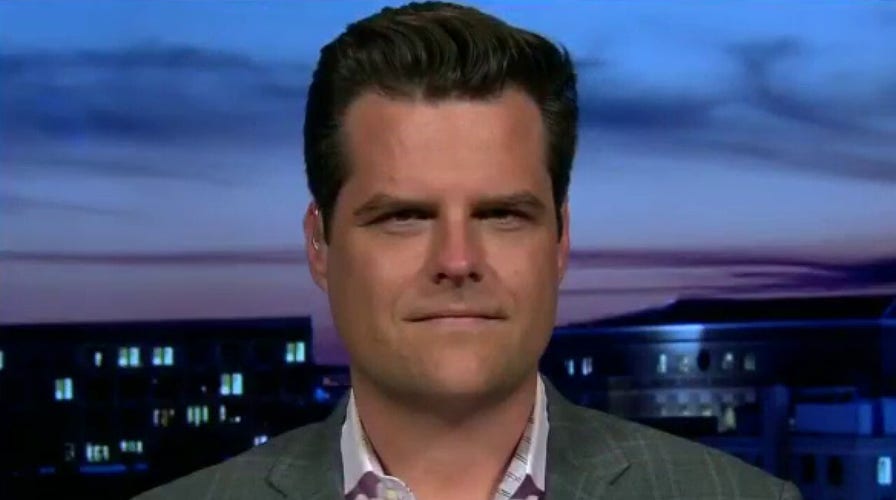
House Democrats reach deal with White House on coronavirus bill; Florida Republican Rep. Matt Gaetz reacts.
This is a rush transcript from "The Story with Martha MacCallum," March 13, 2020. This copy may not be in its final form and may be updated.
BRET BAIER, FOX NEWS ANCHOR: Thanks everybody for entering us into your home tonight. That's it for this "The Special Report". Fair, balanced and still unafraid "The story" hosted by Martha MacCallum starts right now. Hey, Martha.
MARTHA MACCALLUM, FOX NEWS ANCHOR: Hey there Bret, good evening to you. Thank you. Have a great weekend. Good evening everybody. I am Martha MacCallum in New York, and this is "The Story." We begin with the President's address in the Rose Garden today.
(BEGIN VIDEO CLIP)
DONALD TRUMP, PRESIDENT OF THE UNITED STATES: We used the full power of the federal government in this effort today; I am officially declaring a national emergency. The action I am taking will open up access to up to $50 billion up to half a million additional tests will be available early next week.
We have been in discussions with pharmacies and retailers to make drive- through tests available. We want to make sure that those who needed tests can get a test very safely, quickly, and conveniently. The next eight weeks are critical. We can learn and we will turn a corner on this virus.
(END VIDEO CLIP)
MACCALLUM: So those are the measures that are being taken tonight as the number of cases here in the United States now over 1600 137,000 cases worldwide. Just shy of 70,000 people have already recovered from the virus. It impacts almost every aspect of everybody's life tonight.
So how are we doing? How long is going to take? And how long can Americans stay home? That's the big question. So the lockdown in Italy may be starting to have an impact. Singapore, more authoritarian route has actually been successful. So what can we learn from both of those?
We are going to look at all of that tonight appeared in a straightforward manner seeing what we can learn knowing that sacrifices will have to be made on the part of every American to make this work. From the workplace to our school system to how many people we can gather with, our Presidential Elections even being affected as primary voting in at least one state is likely to be postponed.
Tonight we are waiting action from Congress. A deal has been reached as we understand it on a package for relief. So as we await that vote, Texas Governor Greg Abbott is standing by, he has declared the state of emergency Texas and Doctor Amy Compton-Phillips is also here, she was involved in treating the first known domestic case of Coronavirus and one of the hospitals that she oversees, and she is here to sort fact from fiction for us.
We start with Mark Meredith live in Washington tonight with more on the national emergency declaration that happened today. Hi, Mark.
MARK MEREDITH, FOX NEWS CORRESPONDENT: Hi Martha, good evening to you. President Trump's emergency declaration frees up at least $50 billion in disaster funds and is really designed to eliminate red tape in an effort to let states respond faster to COVID-19. We did hear from the President himself late this afternoon.
(BEGIN VIDEO CLIP)
TRUMP: We will defeat this threat. When America is tested, America rises to the occasion. And to those families and citizens who are worried and concerned for themselves and their loved ones, I want you to know that your federal government will unleash every authority, resource, and tool at its disposal to safeguard the lives in the health of our people.
(END VIDEO CLIP)
MEREDITH: The White House says it is working with Google to create a web portal for concerned Americans the administration also working with some of those chains like target, Walmart, and CVS on establishing drive-through testing sites.
The government also freezing interest payments on student loans and increasing contributions to the strategic petroleum reserve. That is the White House, now to Capitol Hill within the last hour. House Speaker Nancy Pelosi announcing Democrats have reached a deal with the Trump Administration on a funding bill to address COVID-19.
The bill is said to include many measures including addressing paid emergency leave and increased funding for Medicaid the House is expected to vote on the measure soon the Senate possibly next week.
Now the President's comments today they were welcomed on Wall Street, all three major indexes closing sharply higher today after a roller coaster week of trading. The DOW jumped to 9 percent, up nearly 2,000 points today. That is good news now to the bad news, the number of cases worldwide, 137,000 when it comes to the Coronavirus.
The number of deaths worldwide the latest data showing over 5,000, meantime here in the U.S. cases right now stretching above 1600 and the number of deaths in the U.S. right now 47 and growing within the last hour, Colorado reporting its first death from the virus.
President Trump says he will be likely tested for the virus soon, but has not indicated when that is going to happen. He says he has no symptoms of the virus but will be tested just to be safe. The White House is also designated Sunday as a national day of prayer in the wake of the virus. Martha.
MACCALLUM: Mark, thank you very much, Mark Meredith. So Texas has 42 confirmed cases of the Coronavirus and as among several states that has declared a state of emergency. Texas Governor Greg Abbott joins me now, Governor, good to have you with us tonight.
GOV. GREG ABBOTT (R-TX): Thank you Martha.
MACCALLUM: You know Governors obviously are on the front lines in all of the states across the country as you try to manage and address what is going on. What - were you happy with what you heard late out at the White House today? How will it make a difference for Texas?
ABBOTT: I think today's announcement was good was positive in a lot of ways, including the money that will be appropriated to help states respond to this. One of the most important things the President talked about was the additional money to provide for more testing kits.
What Texas has already begun is ramp up our testing capabilities we set up ten state laboratories around the state to conduct the test so that we do not have to send them to the CDC. We have now begun the process of drive- through testing facilities.
The first one began today in San Antonio, there will be additional ones opening up either the next week or the week after in Houston, Dallas and Austin. So we are ramping up our testing capabilities. To the funding will help us test more.
MACCALLUM: So how does that work? Day one of the drive-through you are a great sort of example of how this makes look across the country. Can anyone drive up into that line? And how long does it take to get to the results?
ABBOTT: Well, at the beginning, there are priorities about who will be able to get the testing. The most vulnerable population, which as you know are the seniors. The health care administrators who administer the test, we need to make sure that our nurses and doctors are healthy to be able to treat these people.
And we need to find out whether or not they are contracting COVID-19 by interacting with these patients. So those will be the folks on the frontline getting the test. We will be able to expand it even further with the funding provided today by the President.
MACCALLUM: Yes, I mean, obviously the testing has been the biggest hurdle in all of this, and I hope that we will see these drive-through areas as next week as we heard today, and those get rolled out very soon. It's interesting to hear that Texas is already starting it. Here's Governor Cuomo of New York today talking about the consequences of closing schools. I think this is a big issue. Watch this.
(BEGIN VIDEO CLIP)
GOV. ANDREW CUOMO (D-NY): Schools also run food programs for many students. You close schools, now what do you do with those children who are home all day? You close schools you now have parents who can't go to work. You have parents who are working in health care facilities who can't go to work. So it is not that easy.
(END VIDEO CLIP)
MACCALLUM: And because we don't have data on this, this is new we don't know if kids actually might be safer in school than they are if they are at home. What is your take on this?
ABBOTT: Well, what Governor Cuomo was saying is exactly right. There are a lot of add on consequences to closing schools. Let me tell you something though to put it in context, and that is before Coronavirus even existed in Texas, we had closed 50 schools in Texas this year for the regular flu.
So this happens every single year. This should be done as health care authorities think that it should be done. But it automatically is not necessarily just to close a school because someone may be afraid of the virus.
MACCALLUM: So are you closing schools in Texas?
ABBOTT: Some have been closed here in the State of Texas. The way that we do it in Texas is the superintendent of the school will work in conjunction with local public health officials in the Texas Education Agency to make that decision. They are made at the local level.
MACCALLUM: So are they going to go to summer school? I mean, obviously there is a lot of learning loss there, how do you make up for that?
ABBOTT: We are working on different strategies to accommodate those needs. Part is that they may not be closed for long. There are distance learning opportunities over the internet that is being tested out. So there are different strategies based upon different locations in the state.
MACCALLUM: Complicated issue. Governor, thank you always good to see you Governor Abbott.
ABBOTT: You too. Thank you.
MACCALLUM: We wish you all the best of luck in Texas and everywhere else. So my next guest oversees clinical care for 51 hospitals in the United States including the hospital that treated the first known domestic case of Coronavirus. Dr. Amy Compton-Phillips is Chief Clinical Officer for Providence St. Joseph Health one of the nation's largest health care systems.
It's great to have you with us this evening, Dr. Compton-Phillips. I guess my first question is what are you seeing across your hospitals in terms of increases in these cases and what is your read on where we are in the curve here?
DR. AMY COMPTON-PHILLIPS, PROVIDENCE ST JOSEPH HEALTH EVP: Thank you for asking. We actually are seeing a significant uptick in the number of cases. And we expect to continue to see that for the next couple of weeks, because we know that it takes a while once people get exposed to start developing symptoms, and then for those symptoms to get severe enough to actually start seeking health care.
And so we expect even if we stopped all transmission today for the next two weeks we would continue to see the uptick in cases. So we know we are still on the steep part of the curve. But by declaring the emergency and by having people stay at home and do social distancing, we hope to have that curve level off within the next month.
MACCALLUM: Yes, I mean, I think that is such an important message. Obviously everyone is trying to strike a balance between living you know this sort of freakishly abnormal existence, and to doing what we have to do. But what would your message be to people in terms of what they need to do? Stay home, don't go to - tell them what they need to do?
COMPTON-PHILLIPS: So my message is prepare, don't panic. And that actually maybe this will be a gift of time for everybody to slow down and smell the roses, it's going to be a long spring, and so reconnecting with the simple pleasures of being at home I think it's going to be a challenge for everybody across the country.
MACCALLUM: Let me just ask were you surprised, because we are all trying to practice social distancing, no hand chinking. Were you surprised to see the President in the Rose Garden today shaking hands and everybody standing so close together? All the press of course is all close together too. When the message is just the opposite of that?
COMPTOM-PHILLIPS: I can tell you that it is incredibly hard to break a lifetime of habits just because somebody sends out an email or makes an announcement that our whole behavior is supposed to change. You know, every time you walk into a room with new people you reach out your hand. That is the way that you have been taught your whole life.
And so we need to help each other, right, so that when you walk into a room, offer that elbow bump or offer the foot tap. It is just tough.
MACCALLUM: And the President said - here is the President responding to whether or not he will be tested watch this.
(BEGIN VIDEO CLIP)
UNIDENTIFIED FEMALE: Are you being selfish by not getting tested and potentially--
TRUMP: Well, I did not say that I wasn't going to be tested.
UNIDENTIFIED FEMALE: Are you going to be?
TRUMP: Most likely yes. Not for that reason, but because I think I will do it anyway. We are working out a schedule.
(END VIDEO CLIP)
MACCALLUM: So obviously the President interacts with so many people and apparently one of the people who were next to him in a photo has tested positive. So should he be tested?
COMPTOM-PHILLIPS: You know we actually have a tool. I mean, now Google is working on building one. We have one on our website that helps people go through a list of do you have symptoms, do you know if you have been exposed? And so it can help people make the decision.
And I think the President is a person, and so helping understanding his exposure on whether or not he has any symptoms can help him get test, decide whether or not to get tested. Because we do know that if people are tested and they have not developed symptoms yet, even if they do have the virus, they might not have sufficient virus to turn the test positive. So you can get a false negative without symptoms.
MACCALLUM: Yes good point. With regard to the ICU units and ventilators, we have sort of you know very unsatisfying conversation last night with one member of the team, the White House team in terms of getting answers on this. But you said the numbers are going to continue to accelerate.
So in your hospital system of 51 hospitals across I think three states, do you have enough ventilators for what you anticipate will be the need to care for all of those people who will need that care?
COMPTON-PHILLIPS: We are definitely worried about it. We are making plans in case we do not. And so those plans include working with all the other hospital systems in the State of Washington.
Working with the public health authorities, and if we need to we are already starting early conversations with the national guard in the military saying if we get into an instance where the numbers continue to go up and that we have a significant number of people at risk for respiratory failure, we are going to make sure that we have the machines and the capacity to take care of people.
MACCALLUM: Yes, it is obviously a concern, and I thank you for acknowledging that is a concern and doing everything that you can to try to alleviate it. Thank you very much, Dr. Compton-Phillips. Good to speak with you tonight.
COMPTON-PHILLIPS: Thank you for having me.
MACCALLUM: You bet, everyone be well in your neck of the woods. Well, the markets did bounce back considerably today during President Trump's speech, but does that mean that the roller coaster ride is over? Probably not, Charlie Gasparino is going to join us coming up next.
(COMMERCIAL BREAK)
MACCALLUM: So the economy is the other huge part of this story. And stocks did rallied today very considerably after the President declared a national emergency over the pandemic. The DOW up nearly 2,000 points pretty much a mirror image of what we saw yesterday, S&P up 9 that was welcome news of course to everybody in the market.
We took a huge hit on Thursday and the worst sell-off since the crash of '87. Here's a look at the week. So that's what this week looks like. And here is a look at since President Trump was elected, so yes, not bad. While the markets remain volatile, the hit to American businesses as the other huge side of this story here to talk about it tonight.
Once again Charlie Gasparino is back CNN Correspondent and Fox Business. So what did you make of what happened today, Charlie?
CHARLES GASPARINO, FOX BUSINESS SENIOR CORRESPONDENT: I mean, listen the markets said you know Donald Trump and the Trump Administration of the White House is finally, finally getting his hands around this. I mean, I think that it was a sigh of relief. That does not mean we are going back to the old days tomorrow.
I think there is going to be more volatility. I mean, I think some of this you should know what's real enthusiasm that the Trump Administration has taken concerted efforts and that you have got the Fed involved now Fed is going to probably take interest rates on the short end down to zero.
MACCALLUM: There is a meeting next week.
GASPARINO: Wednesday, so that's still - could come Monday, Tuesday, or Wednesday.
MACCALLUM: Right.
GASPARINO: So a lot of people pressing down into the markets. Obviously spending $50 billion on this thing is a lot of money. And then just the notion that he is getting his hands around it and the White House is starting to do stuff, kits might will be available may be next week for testing all that helps the markets.
My one sort of concern is the massive buy back during the speech. You had the feeling it was what is known as short covering. People going negative and then you have to cover your position so that you buy stocks. It is not really a total vote of confidence. But this was a good speech a good response. The markets like it.
Again, be cautious, we still, here's the reality. Why do stocks go up or down? Stocks go up or down based on GDP and how GDP affects corporate earnings. If you think GDP is going down, you had other guests before talking about recessions.
Therefore you have lower corporate earnings, or guess what stocks have to re-price and is probably going to be down. So I think that is the long-term prognosis here. If we can get our hands around this fast, well it will bounce back faster. If we can't, it is a long slow trek.
MACCALLUM: I mean, obviously they are so many companies that are going to take a huge hit. Because you look at the massive, the massive contraction of just lifestyle, right, you talk about going to a restaurant nearby that is always packed in New York City, empty. You can walk in.
I went to a couple of places just in my town the other morning, like walking into practically everything empty. There's no way that does not have a ripple effect through all the companies that are--
GASPARINO: You're right about that, but a lot of people buy indexes and some companies will do very well. Now I'm going to go home tonight and this weekend and watch Netflix. I'm not crazy about Netflix as a stock it, because they have earnings they have some financial issues, but that stock is going to do well. It has to.
MACCALLUM: And what about Amazon? Everybody wants to stay away from the malls in the stores, even people who have not cross that bridge yet and become total Amazon shoppers might be going that way.
GASPARINO: They are in the index. So just remember you buy a basket of stocks, diversify. I don't see - listen, we have a lot more to go. I don't want to scare people. I don't want to tell people to go in and buy the market right now. We're going to - this is going to--
MACCALLUM: People should expect a lot more volatility right.
GASPARINO: Yes.
MACCALLUM: It is just to be realistic here.
GASPARINO: Listen, I've always said this and some people have always - and some people get on my case for saying this. You know if you showed that chart of how well you did with the Trump markets it ain't a bad time if you rode that market up, take some off the table. Have a little cash cushion. You don't have to be total cash, 30 percent in cash, the stuff gets cheap, that is prudent investment.
MACCALLUM: Right. Thank you, Charlie, always good to see you. Have a good weekend. Go back to that restaurant probably for dinner tonight.
(LAUGHTER)
GASPARINO: I'm staying home tonight.
(LAUGHTER)
MACCALLUM: All right, coming up next we go live to Capitol Hill where Speaker Pelosi just announced a deal with the White House on an Emergency Coronavirus Relief Package. Chad Pergram is going to tell us what is in the package. Also joining us, Matt Gaetz, who is just out of self quarantine, self imposed quarantine. We're going to talk to him about that too when we come back.
(COMMERCIAL BREAK)
MACCALLUM: Breaking tonight just moments ago in fact, Nancy Pelosi says that they have reached a deal the Democrats have with the White House on a Coronavirus Relief Bill. We are now waiting for the final vote from Congress, which we expect tonight.
Fox News Congressional Correspondent Chad Pergram following all of the ins and outs on this today. And he is here with us from Capitol Hill. Hi, Chad.
CHAD PERGRAM, CONGRESSIONAL CORRESPONDENT: Hi there it is changing by the moment. Just before we came on the air, I'm told that there might be a problem in trying to get the bill across the finish line tonight. Here's the issue.
Now let me take a step back here. House Speaker Nancy Pelosi and Treasury Secretary Steve Mnuchin they talked on the phone 12 times today including three times when the President was speaking.
He would not continue to have those conversations if there wasn't a deal to be had. Now we just got a statement from the Speaker of the House about an hour and 15 minutes ago that there was an agreement on this Coronavirus Response Bill.
I spoke with the senior administration official who indicated that they thought there was a deal. Then we started to hear from some House Republicans, no, the ink is not dry on this. And that the Treasury Secretary has not actually signed off on this. There's still some provision in the text which we don't have.
There was an original bill put out 48 hours ago that they are still trying to resolve. Republicans have told me earlier in the day that there were technical problems with the bill. What does that mean?
Well, there were provisions that did not pertain to Coronavirus, which Republicans thought went too far afield. Keep in mind here that the President said during his presentation in the Rose Garden today that he thought there were some things in here that shouldn't have been in there said that it did not go far enough.
The House Minority Leader Kevin McCarthy went to the White House today because they want to have air cover from the President in less he is going to sign off on it. If he is not, then they're not going to vote for it. Remember this was the experience that Mitch McConnell the Senate Majority Leader dealt with in December of 2018 when they thought they had an agreement and then the government shut down.
Even McCarthy dealt with a similar issue just a few days ago. They thought they had an agreement on FISA and negotiated with McCarthy and Bill Barr and then they passed through the House of Representatives, a bipartisan vote. And it is not going anywhere in the Senate.
We are expecting a vote tonight if they can you know kind of get this last mile behind them here. But the Senate has gone and they probably won't tinker with this until next week Martha.
MACCALLUM: All right, Chad, thank you very much. Good to have you here tonight.
PERGRAM: Thank you.
MACCALLUM: So here now Republican Congressman Matt Gaetz, member of the Judiciary Committee Congressman good to have you with us. What do you make of that? What are these issues that are outstanding that is too far afield in this package for Republicans like yourself?
REP. MATT GAETZ (R-FL): I think we would all agree that the Coronavirus Bill does not need any poison pills. And I think that this is the easy way to spot the issues. Everyone is for testing. Everyone is for medical infrastructure like ventilators.
Where Republicans have challenges where we have got legislative provisions that forever change entitlement programs. We should not use the Coronavirus as an excuse to go and dramatically expand eligibility in the staff program, for example. So we want solutions that are medical infrastructure focused, testing focused, but don't rewrite entitlements while we are dealing with the Coronavirus.
MACCALLUM: It seems like it make sense. I mean, couldn't you put provisions on it that it's for a specific period of time and, you know, I think that if most Americans get wind of that they would probably be behind that?
GAETZ: Unfortunately, we see the Speaker of the House trying to jam the president, putting in for example reformations to abortion laws and abortion practices, the Hyde Amendment for example, into this legislative package is a way to try to make Republicans and the president look like we don't support testing.
MACCALLUM: That's ridiculous.
GAETZ: Now, the good news is the president's national emergency declaration has unlocked tremendous potential. For example, here in Florida as a result of that declaration, we spent $6 million to buy additional ventilators and put them close to communities that were likely to be impacted.
MACCALLUM: Oh, that's something that we definitely need. I don't think there's going to be a lot of patients in America for things that are outside the zone of working on this immediate problem. And, you know, I think everybody would hope that both sides would agree to that and the other things can be battled over at another time and place.
GAETZ: Sure.
MACCALLUM: With regards to you. So, you self-quarantined for how many days and why and what made you decide that it was okay to stop?
GAETZ: I held the phone of someone at CPAC who had tested positive for coronavirus. I was notified of that 11 days after the event as I was on Air Force One with the president.
As soon as that Air Force One ride was over, I was put in a DoD vehicle, taken to Walter Reed, tested. That test result came back negative. Health care professionals said I should still maintain the 14-day quarantine that ended at 2:00 p.m. yesterday. So, not exactly "Straight Outta Compton," but I am straight out of quarantine.
MACCALLUM: I mean, you know, what do you think about the president? I was just a little surprised today watching how everybody was, you know, sort of standing so close together and they were all in the same microphone and they're all putting their hands all over the same podium.
And, you know, there has been a lot of exposure, obviously, they have all interacted with a lot of people as you have. Did that surprise you in terms of sending the right message to the rest of the country in terms of social distancing and how we should behave?
GAETZ: Well, the good news is that the president has pretty regular hygiene that he maintains regarding the use of hand sanitizer and lots of wipes he does.
MACCALLUM: That is for sure.
GAETZ: He did that regularly before and so I think that there's a certain resilience with the president and those around him, but obviously we were all anxious to get Bolsonaro's test results to back because the president had walked Bolsonaro all over Mar-a-Lago this last weekend where I was, where a number of other people were.
And so, we were hopeful that the right information is out, that that was a negative result --
MACCALLUM: Right.
GAETZ: -- because -- so far no community spread at Mar-a-Lago at that event this last weekend and we want to make sure it stays that way, but all of my friends who were at that party, still healthy, asymptomatic and that's great news.
MACCALLUM: Good. Well, that's good. Just a quick question for you because I read a report that said that you took paid sick leave from Congress when you were on your quarantine, is that true, and if so, they want to know why you voted against that in Florida?
GAETZ: First of all, I never voted against paid sick leave, I voted to pre- empt paid sick leave to the state so we did not have 67 versions. I have taken no paid sick leave.
Each and every day I've been home. I have been working with the governor, our state emergency response directors and administration officials to ensure that my constituents are cared for.
MACCALLUM: Okay. I wanted to give you an opportunity to respond to that criticism. Matt Gaetz, Congressman, thank you. Good to see you tonight. Thanks for being here.
GAETZ: Thank you.
MACCALLUM: So one of the nation's hardest hit by the coronavirus, Iran, also happens to be one that we know so little about in many ways. So what is really going on there? We're going to take an inside look when we come back.
(COMMERCIAL BREAK)
MACCALLUM: So, this virus obviously continues to spread globally. Iran has had over 10,000 diagnosed cases and the third highest number that we've seen in a country in the world.
Now, some are raising questions about how its government, obviously, often a very secretive regime is handling all of this. Joining me now, Masih Alinejad, author of "The Wind in My Hair: My Fight for Freedom in Modern Iran."
And I know that you try very hard to sort of bring transparency to what's going on there. What can you tell us that we don't know about the situation in the country?
MASIH ALINEJAD, POLITICAL ACTIVIST: To be honest, people are very worried because we do not trust the regime. We don't trust the numbers that they are talking about.
But what concern people inside Iran more, it's about like they are suffering from not having medical equipment and they need more, like they want to actually the World Health Organization directly supervise the distribution of, you know, medical help and mask -- face masks and these kind of things.
Because a lot of doctors and nurses, they are sending like videos and publishing that on social media, and they are begging the world to understand that, that the regime should not be trusted. They want, you know, the world to understand that they have to support the people inside Iran.
MACCALLUM: So, is their widespread testing?
ALINEJAD: Not at all. No. You know, as you see on Iranian national television, the officials do the testing themselves and they are trying to smile and tell people that everything is under control, but it is not because people are using their camera and sending videos and sharing the mass parades and showing that the number of the killings are higher than --
MACCALLUM: Yes, well tell me about that because there were aerial shots of burial trenches in Iran. What do you know about that?
ALINEJAD: Yes. The tragedy is happening there, Martha. Beyond that, let me tell you something, before the election, the Iranian -- I mean, official news agency announce that a few activist on social media got arrested for what reason? Because they spreading rumors about coronavirus.
But the government knew that. So the government even knew that before the election, they canceled all the meetings with the Supreme Leader of Iran. One of the officials came on T.V. and said that we were banned from kissing the hand of the Supreme Leader of Iran, Khamenei.
MACCALLUM: Should have been a clue, right?
ALINEJAD: Exactly.
MACCALLUM: And you said they also distanced everyone from him.
ALINEJAD: Exactly, so why? Because they were concerned about the life of the Supreme Leader of Iran. And they invited people to go to the anniversary of the Islamic Republic. Why? Because they wanted to show the rest of the world that see, a big turnout.
They want the people to participate in the election. The number of participation in the election was already low, but they wanted to show off the rest of the world that we are in a stable regime.
So that is why actually people are suffering from corruption, mismanagement, and hiding the coronavirus. And let me tell you another thing, always the western government, especially the European government, they say that we don't want to interfere in internal matter.
What happened right now? The mismanagement hurting the rest of the world. First coronavirus in Lebanon, in Turkey, you know, Iraq coming from the Islamic Republic --
MACCALLUM: So you want the World Health Organization to get more involved and let's hope that that's what happens. Masih, thank you.
ALINEJAD: That's all I need. Thank you so much.
MACCALLUM: Always good to see you. Masih Alinejad. So, one nation getting credit for the way they responded to all of this is Singapore. So what notes can U.S. take to stop the spread in our country? Of course Singapore handles things very differently, but we are going to talk about that.
And also, is England next on the list of countries that might not be ble to travel here. Steve Hilton is coming up next.
(COMMERCIAL BREAK)
MACCALLUM: Breaking tonight in the U.K., the British government announcing an emergency ban of all large gatherings beginning next week. That is President Trump says the U.S. allied may be included in his coronavirus travel restrictions after all because the U.K. has now seen a 35 percent rise in cases in just one day.
Meanwhile, Singapore is receiving praise for its response with U.S. public health experts looking to the steps that they have taken to largely bring the COVID-19 outbreak under control there.
Singapore building on lessons learned after being hit by SARS and H1N1. They now have a strict system to track and contain viruses as "Business Insider" reports, "Singapore's working around the clock to find coronavirus cases. Lying about where you have been can result in six months of jail or a fine of up to $10,000."
So that is one way to do it. Joining me now, Steve Hilton, host of "The Next Revolution." Steve, great to have you with us. I mean, obviously we don't want to do -- there are many things that we don't want to do the way Singapore does.
And they are taking a very heavy hand with this. But the flip side is that when you look at the chart in terms of our rising cases, our cases are rising more in line with Italy and China, and Singapore and Hong Kong is sort of flat.
STEVE HILTON, HOST, THE NEXT REVOLUTION: Yes, that is right. I mean, the operative word in what you just said, Martha, in relation to Singapore is strict. They have a strict system for just (inaudible).
(TECHNICAL DIFFICULTY)
Remember it is a very small place. Its population is nearly about half of New York City. So it's really, you know, we got to get that in and keep that in mind. But it's actually pretty close to being -- is being described as an authoritarian state.
I mean, nothing like on the scale that you see in China, but it is a one- party state. You have the same political party in charge there for about 50 years. You have the same prime minister, Lee Kuan Yew, who founded the country basically around the place for 30 years or more at a stretch.
So, they are used to having these very kinds of strict rules on just about everything. And it has proved to be effective in this case, but I think you are right to point out that those kinds of orders from on high, they were obediently followed by everyone.
That is just not really going to work in the free society like America. However, you're right to point out, you know, we are behind the curve. And that's why I was so pleased to see the president really getting going on the emergency declaration today and all the things that go with that.
MACCALLUM: Yes. This is from a piece in "Wired" talking about what they are doing in Singapore, "People get their temperatures taken before they can enter most buildings including businesses, schools, gyms and government agencies.
Everyone whose temperature is normal gets a green sticker. Then it says, keeping teams of health care workers separate from one another. In one case, has to be quarantined and physical separations for different kinds of patients, all sorts of seemingly small systematic changes that seem to be working for them."
I mean, what's, you know, what's the message for Americans because I think once we do see this testing ramp up over the coming next couple of weeks, we are likely to see the amount of diagnosis also probably accelerate fairly dramatically, I would say. What do you think it's the sort of proper reaction to that?
HILTON: Well, I think first of all it's important as you are doing, to prepare people for that, to say look, this is going to get much worse before it gets better.
But remember also the basic facts of it, with most people who get this will be fine. They will have zero or mild symptoms and so on. But I think that one thing I would point out more positively is what you have seen this week in America really reflects what a wonderful country this is.
It is decentralized. We don't have some central command of control that can tell everyone want to do. And yet you have seen the different parts of the country, local governments, state government, the private sector, the supporting organizations, they have all stepped up, actually.
And you are seeing the kind of aggressive response that has been imposed in other places actually emerging in a more organic decentralized way right across the country. I think that is a really positive thing about America.
MACCALLUM: I think it is too. And I am amazed because, you know, if you told everybody a week ago that schools were going to be shut down, all of the kids were going to come home. No more movie theaters, no more Broadway shows, no more sports, no more NBA, no more NHL.
People would said, you're kidding. That is crazy. That is never going to happen. And within just a few days, every one is kind of, I think mostly like, okay. You know, if this is what we have to do, this is what we have to do. And I think that is remarkable.
HILTON: And, you know, the key point is, that it happened from the bottom up. If the president had tried to order that, people would have had a revolt against it. But because it has come from the bottom up, I think people are supportive and that is great.
MACCALLUM: Yes, I do too. And everybody is, you know, elbowing and social distancing and we're going to have to keep it up for a while so, but we're very flexible to all of it. So, thank you, Steve.
And we will watch what is happening in the U.K. I know there are some there who think that they have kind of been delayed in their reaction, but it sounds like they are also kind of facing the same things that we are and probably going to take some of the same measures as well. Steve, thanks. Good to see you.
HILTON: Exactly. See you soon.
MACCALLUM: Okay. Sounds good.
So Tom Hanks sharing his positive attitude with the world as he and his wife recover from coronavirus. So, where else can we turn for hope and for humor, which we do need to maintain in these stressful times? Advice from our panel on this Friday night coming up.
(COMMERCIAL BREAK)
(BEGIN VIDEO CLIP)
JAMES CORDEN, HOST, CBS THE LATE LATE SHOW: This Sunday will be the first one-on-one debate between Joe Biden and Bernie Sanders and it's going to be a little different than the previous debate. Due to concerns about coronavirus, there will be no live audience in attendance, which begs the philosophical question if Joe Biden makes a horrible gaffe and no one is there to hear it, does it still make you cringe?
(END VIDEO CLIP)
MACCALLUM: James Corden there as we remember just how important the gift of laughter can be during stressful moments. Harvard medical experts now recommending people consider reading a good book, watch a good comedy to cope with potential anxiety from all of this because let's face it, everyone is feeling it on some level.
As we see Tom Hanks dealing with his own personal COVID-19 infection, offering up some levity, tweeting in part, "Remember, despite all the current events, there is no crying in baseball," -- one of my favorite lines.
Joining me now, Jimmy Failla, host of "Fox Across America" on Fox News radio in Fox Nation, Jessica Tarlov, senior director of research at bustle.com and fox news contributor, excuse me, and Dr. Jeff Gardere, psychologist and associate professor of behavioral medicine at College of Medicine and it's good to see you. We haven't seen you for a long time, Dr. Jeff.
JEFF: That's right. And you look fantastic, professionally speaking of course.
MACCALLUM: Thank you very much. Thank you. (Inaudible), I want to go to you first because everyone, you know, deals with this kind of stress differently and I feel like, you know, there are some moments when I'm like it's all going to be fine and other moments where I'm like, did I just touch that phone and then put that over there? You know, it's difficult. It comes in waves.
JEFF GARDERE, PSYCHOLOGIST: It is a bit of a roller coaster ride because one minute you are feeling okay, then you turn on the T.V. and then you hear some huge statistic. But really the key here is to just try to stay as even as possible, just day-to-day breathing, of course --
MACCALLUM: Breathing is --
GARDERE: -- don't breathe too much.
MACCALLUM: Right.
GARDERE: But, you know, breathing and talking to other people around you as to how you feel. The fact that we are even joking about this just a little bit, it's not making fun of people.
MACCALLUM: No.
GARDERE: But it really is about letting a lot of that stress out and that's what we need to do.
MACCALLUM: Coping mechanisms --
GARDERE: Absolutely.
MACCALLUM: -- which everybody needs to employ. Here is Jimmy Fallon on this. Watch this.
(BEGIN VIDEO CLIP)
JIMMY FALLON, HOST, NBC TONIGHT SHOW: The coronavirus, these are some really tense times, seriously. At this point, I wouldn't mind a massage from Joe Biden.
Last night, President Trump addressed the nation from the Oval Office. It was a nice change from his usual speeches right next to a helicopter.
And officials normally when we do this, we rehearse these jokes in front of a rehearsal audience, but today obviously there's no audience. Just bear that in mind.
(END VIDEO CLIP)
MACCALLUM: Oh, my gosh. So what do you advise, Jimmy?
JIMMY FAILLA, COMEDIAN: Wow, man, oh boy. First of all, the Hanks' thing shook me because I am a huge Tom Hanks fan. And who knew you could catch corona from a talking to volleyball. I mean, I wouldn't know. I love him so much so I really like -- I have an emotional investment.
MACCALLUM: Yes, it was great. Everyone is pulling for them obviously.
FAILLA: Absolutely. I think you got to stay off social media because I really do think that's the big challenge that we face now that we didn't face during swine flu, which killed 13,000 Americans --
MACCALLUM: Great point.
FAILLA: -- but we weren't nearly as stressed out because the news cycle wasn't as omnipotent in our lives the way it is now. So not only are you getting constant information that's accurate, but you're also getting inaccurate information, which is the best advice I can give you.
Like don't take a health tip from a guy who is holding a beer in his profile picture. Chances are there's not a medical degree in the background of that picture so you've got to be careful where you get your information from.
MACCALLUM: I saw this somewhere on social media to which I shouldn't be on (inaudible), from Italy, people coming out on their apartment balconies and singing together while they are quarantined. Watch this.
(VIDEO PLAYING)
MACCALLUM: So you get the idea. Jessica, what's your recommendation for everybody?
JESSICA TARLOV, SENIOR DIRECTOR OF RESEARCH, BUSTLE.COM: Well, those moments are really lovely if you do have neighbors that you can sing with at safe distances, especially old people. Check on old people. The loneliness epidemic is very serious.
But the thing that I have been looking for and really enjoying are like the feel good stories out of this. There was one woman who posted her story. She was going to the supermarket. And as she was walking in, she heard a faint excuse me, excuse me, and there was an elderly couple in a car who been waiting an hour for just the right person to ask if they could go do their shopping.
They handed her $100 bill. She went and did their grocery shopping for them. There are wonderful things happening across the country where communities are coming together. Pay attention to what people might need and what they could be asking you for or too scared to ask you for.
MACCALLUM: Yes, that's a good point because you don't want to be around people who are compromised because of their age because you don't want to give them anything, but at the same time --
TARLOV: They need help.
MACCALLUM: -- you have to make sure that they have what they need.
FAILLA: Well, I am hoping this a moment that kind of restores perspective in the country because we kind of have taken our eye off the ball and fall over a lot of superficial things --
GARDERE: And we have been very, very divisive, but you see people coming together over this.
FAILLA: Yes. And I agree now come together, support old people, watch the Democratic debate and if you haven't calmed down enough.
TARLOV: We're supposed to have a nice bipartisan panel tonight.
FAILLA: I love you. You're the best. You know I love you. I had to take one shot.
MACCALLUM: If you haven't calmed down enough, have one of these. This is called a "Quarantiney." It's vodka and Emergen-C, and the Emergen-C people, dumping (ph). They want you to know that you shouldn't use their products with alcohol, but anyway, whatever.
Content and Programming Copyright 2020 Fox News Network, LLC. ALL RIGHTS RESERVED. Copyright 2020 ASC Services II Media, LLC. All materials herein are protected by United States copyright law and may not be reproduced, distributed, transmitted, displayed, published or broadcast without the prior written permission of ASC Services II Media, LLC. You may not alter or remove any trademark, copyright or other notice from copies of the content.
