


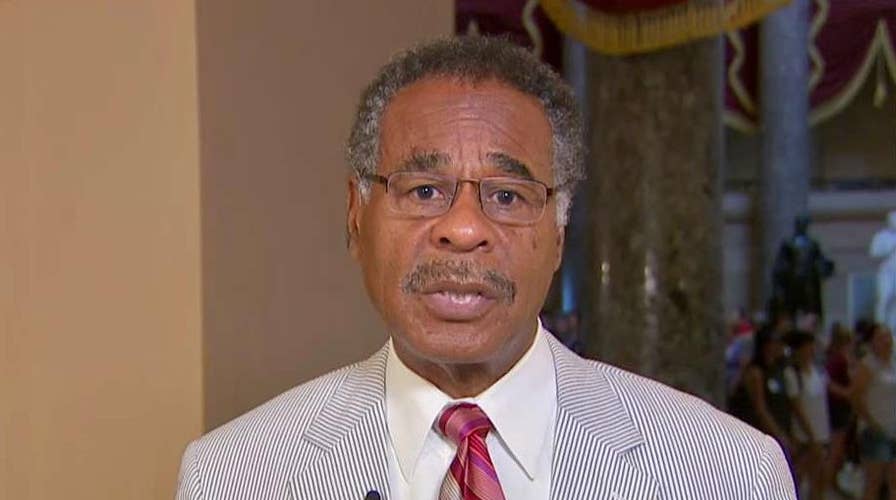
Rep. Emanuel Cleaver abandons chair in protest over partisan House debate
Missouri Democrat Rep. Emanuel Cleaver says the goal was to get through the resolution to condemn President Trump's tweets without more hostilities.
This is a rush transcript from "Your World," July 17, 2019. This copy may not be in its final form and may be updated.
NEIL CAVUTO, ANCHOR: Yes, the heat wave is on, and on the East Coast, it is not letting up, temperatures expected to drop 100 degrees this week.
You know, if I'm not careful, I could lose weight in this.
Anyway, big worries the Big Apple could see another blackout by the end of this week, and, by the way, not just the Big Apple. That heat wave is already gripping a third of the country and, by this weekend, try two- thirds of the country.
Still if you think a little thing like he is going to prevent a lot of the president's fans from lining up to greet him in Greenville, North Carolina, to see him in person for a big rally, think again.
Hardly hot, hardly bothered, hardly letting temps into the 90 stop them from rallying the president tonight.
Welcome, everybody. I'm Neil Cavuto.
And FOX on top of a heat wave that is not letting up with meteorologist Rick Reichmuth in a steamy New York City on how folks are handling this, Phil Flynn on Chicago on if utilities are ready for this, and David Spunt in Greenville, where, as I said these, Trump fans are staying cool through this.
We begin with Rick in the Big Apple.
Rick, how's it looking?
RICK REICHMUTH, CHIEF METEOROLOGIST: Hey, Neil, it's not looking good for so many people.
This is -- while we are going to complain about the heat, it's also serious. Make sure you check in on your neighbors, check in on the elderly, check in on people who live on a fixed income and won't be able to maybe afford to put on the A.C.
And if you're in the Northeast, plan tomorrow to get in A.C. if you need it, because the heat is on. The central part of the country, really from the Rockies all the way eastward, is going to be who's dealing with this.
If you look at the maps, I will show you what we're dealing with right now that. It has been feeling like last hour 111 in Memphis. We have got temps that are feeling an excess of 100 degrees everywhere you see that purple, up and down the Eastern Seaboard as well.
And now across -- right across the immediate Eastern Seaboard, feels like 101 in Charlotte, feels like 101 in Philly. It was 103 last hour in New York, dropped a little bit because you have some showers moving on through. Those showers are going to be a big improvement for us, at least in the Northeast tomorrow.
This line of storms goes through, it drops temperatures down. And it drops the humidity down for us tomorrow. It's going to be very short-lived behind this. The heat builds in and it builds in much deeper than it has so far this season.
Right there, you see that dark purple. Everybody is in the heat warnings right now. And that heat doesn't really budge anywhere across the central part of the country. Here's your high temperatures today, high temperatures tomorrow.
These are actual air temperatures, not including the humidity. And then the same goes for Friday, but that heat spreads towards the east. So we're going to be talking about the heat indices across the Eastern Seaboard by this weekend feeling much closer to 110.
Actual air temperature in D.C. on Saturday, Neil, 100 degrees. Factor in the humidity, it's going to feel like 110. It's uncomfortable, it's hot, and it's also dangerous. So certainly people need to be taking all precautions -- Neil.
CAVUTO: You are right, my friend.
Rick Reichmuth, thank you for that.
Now, it's obviously safe to say, the hotter things get, the more folks rev up their air conditioners, and fast. Just one question: Can utilities keep up with that?
To Phil Flynn in Chicago, where it's a balmy 91 degrees right now, but they're looking at 100 degrees by Friday.
How are things looking there?
PHIL FLYNN, PRICE FUTURES GROUP: Neil, it's looking hot and getting hotter. I hope you don't mind me losing my tie. It's getting hot standing here.
And the bottom line is, is we're going to test the infrastructure for the electrical power grid -- the electric power grid across this country, more than it's been tested in quite a long time.
In fact, major cities across this country are warning that this heat wave could be enough to push us over the edge. They're warning about blackouts in Chicago, New York, Washington, D.C., and other cities.
Here in Chicago, local officials are warning people to look out for buckling pavement. They're telling the Metro trains to run slower because they're afraid that the tracks could actually expand and cause problems, even some slowdowns, or at the very least some derailments.
So this heat is serious stuff, Neil. Now, when it comes to your heating bills, obviously, you're going to end up running your air conditioner more. You're going to pay more. The good news is, is that on a whole, because June was relatively mild, you're really just getting caught up to where we would have been if we had a hot summer the entire summer.
But at the end of the day, this is going to be serious stuff. And it's one of the reasons why President Trump is talking about improving the electronic -- the electric power grid across the country. He's looking for billions of dollars of improvement.
This may prove his case, this weather heat wave.
CAVUTO: All right, thank you my friend, very, very much.
In the meantime, who are average folks dealing with it?
We thought we'd check out a few today.
(BEGIN VIDEO CLIP)
UNIDENTIFIED FEMALE: It's the humidity. I kind of like feel like my face is melting off, but it's all good.
UNIDENTIFIED MALE: Drink water. Spray some water in the head, just trying to stay cool.
UNIDENTIFIED MALE: All we need is an ocean, and we would be set. So where's the pool? I'm jumping in. Give me a fountain anywhere.
UNIDENTIFIED FEMALE: Just trying to get lots of drinks. It's super hot out here in the concrete.
UNIDENTIFIED MALE: We're trying to go in an air conditioned place and hide out for a little while. We're at lunch at work right now, so we're going to sit in McDonald's.
(LAUGHTER)
UNIDENTIFIED FEMALE: I like the heat, so it doesn't bother me.
(END VIDEO CLIP)
CAVUTO: Don't you hate people who say, I love the heat? They're a hardy bunch.
Anyway, how do you keep safe in heat like this?
Dr. Jennifer Caudle joins me right now with some tips.
Doctor, we always forget there are a lot of folks vulnerable to this. But even if you're normally not, you have got to take precautions. What do you tell them?
DR. JENNIFER CAUDLE, FAMILY PHYSICIAN: You absolutely do have to take precautions. You're absolutely right.
So this is what we should all be doing. First of all, first and foremost, air conditioning is our friends during temperatures like this. For everybody out there, look, if you don't have to be outside, don't be. Stay inside. Stay in the air conditioning.
And, in fact, electric fans, when the temperatures really -- into the 90s in the 100s, they don't really work as well to prevent heat-related illness. So air conditioning is what you need.
The other thing are fluids, making sure that we stay hydrated, and skip the alcohol, skip the sugary drinks, because those can actually make things worse. And I would say for people who have certain medical problems, you have kidney problems or heart problems, and you know that you're on fluid restriction, check with your doctor first to find out how much you should be drinking.
But fluids is going to be a mainstay. And, Neil, the other thing I would say is wearing that sunscreen, if you have to go outside, wearing lightweight, loose -- loose clothing, but really staying inside in the air conditioning is our best bet.
CAVUTO: You know, a lot of people found out in New York last week when we had the blackout that affected much of Manhattan that it didn't really help. Now, of course, it was only in the 80s last week when this happened.
This is going to be significantly hotter. And there's only so much strain a system can take.
Let's say the air conditioning goes out. What do you do?
CAUDLE: Right.
So there's a few things we want you to do. First of all, for those people who don't have access to air conditioning -- and that's going to be a number of folks, right? It's important to -- I noticed one man on the street said that he was going to go to a local McDonald's. That's actually not a bad idea.
Find a local library, go to a restaurant, go to a museum, a building with air conditioning. And if you're not sure, why don't you call your local health department to find out places where you can go that does have air conditioning? That's going to be a really important thing to do.
The other thing, Neil, I want to bring up is that a lot of people are at higher risk than others. Remember, babies and young children, older people, people with certain medical conditions, those folks are at higher risk. So we really shouldn't play around with this.
CAVUTO: All right.
For kids, it's another factor. They can be very energetic, no matter the conditions. What do you advise for them?
CAUDLE: Yes.
No, I mean, of course, we love our kids. And you're right, they can -- they are very energetic all the time. But this is the thing. And not to lump kids in with pets, but let me talk about both of them for a second.
CAVUTO: Well, I do. Actually, I do lump them in with pets, but go ahead.
(LAUGHTER)
CAUDLE: OK.
Well, I don't, but let's separate them, but lump them. This is the first thing we always talk about around this time of year, is not leaving children or pets in the car. I hate that we have to keep talking about it. But we do. Please do not leave pets or kids in the car, not even for a short period of time.
In terms of pets, we got to make sure they have clean water and that they're in the shade. But children, keep them inside.
CAVUTO: Absolutely.
CAUDLE: Make sure that they're covered, they're in air conditioning, they're wearing sunscreen.
CAVUTO: All good advice.
Doctor, thank you very, very much, Dr. Jen Caudle, on all of that and what you have to look forward to, just as long as you're prepared.
Now back to that Trump rally in Greenville, North Carolina, where the heat index could hit triple digits by the time the president speaks tonight.
David Spunt is there.
David, already big crowds, right?
DAVID SPUNT, CORRESPONDENT: Yes, Neil, already big crowds.
I think that heat index might be a little bit over 100 right now, although a few degrees doesn't matter. People know it's hot as all could be. Many of these people have been here since early this morning.
Spoke to someone they said they got here at 5:30 this morning as I was just walking in just a few minutes ago. President Trump set to take the stage tonight at 7:00 behind me on the stage. I have already noticed that the banners are saying "Keep America great," instead of "Make America great again."
Vice President Mike Pence will be on stage about 15 minutes before to warm up the crowd, then introduce the president. President Trump tweeting about this campaign appearance.
I want to go to it. He wrote this morning on Twitter: "Big campaign rally in Greenville, North Carolina. Lots of great things to tell you about, including the fact that our economy is the best it has ever been, best employment and stock market numbers ever. I will also talk about people who love and hate our country, mostly love, 7:00 p.m."
Of course, President Trump talking about the Squad, those four congresswomen, Ayanna Pressley, Alexandria Ocasio-Cortez, Rashida Tlaib, and Ilhan Omar, who held a news conference a few days ago admonishing President Trump's comments, calling him racist after he sent out a tweet calling them out on Sunday.
We do expect him to address that tonight here on stage. Neil, I was just told by a Trump aide this is campaign rally number 551 for the president.
We will be here all night -- back to you.
CAVUTO: Wow. I didn't realize it had gotten that high.
All right, thank you, my friend. Try to stay cool.
And forget the heat. I want you to meet the pastor congressman who has had it with the heated rhetoric. Let's just say Emanuel Cleaver brought down the house when he up and left the House.
(BEGIN VIDEO CLIP)
REP. EMANUEL CLEAVER, D-MO: We don't ever, ever want to pass up, it seems, an opportunity to escalate. But unfairness is not enough, because we want to just fight. I abandon the chair.
(END VIDEO CLIP)
(COMMERCIAL BREAK)
(BEGIN VIDEO CLIP)
REP. NANCY PELOSI, D-CALIF.: Every single member of this institution, Democratic and Republican, to join us in condemning the president's racist tweets.
UNIDENTIFIED MALE: I request the gentlewoman's words are unparliamentary and request that it be taken down.
CLEAVER: We don't ever, ever want to pass up, it seems, an opportunity to escalate. And that's what this is.
Are there anybody to look at any of the footage and see if there was any unfairness? But unfairness is not enough, because we want to just fight. I abandon the chair.
(END VIDEO CLIP)
CAVUTO: That was powerful, Cleaver out.
Missouri Democratic Congressman Emanuel Cleaver, a pastor by training, by the way, essentially saying, the hell with it, and all the tweet finger- pointing on both sides. He was criticizing Democrats and Republicans.
Congressman Cleaver joins us now.
Sir, very good to have you.
CLEAVER: Good to be with you.
CAVUTO: What made you do that?
CLEAVER: Well, Neil, I was frustrated.
If you look at the footage, I was -- had admonished both sides during this process. My goal was to get through this without adding any more tumult, without adding any more hostilities.
And we were about five minutes through the whole process of the resolution condemning the president, when a guy who's generally a very good guy, Congressman Collins, then moved to strike the last -- I'm sorry -- moved to take down the words of the speaker.
Now, the reason that that became troubling to me is that because there was a point earlier where, if I were to be an unfair person, I would have given a congresswoman, Congresswoman Jayapal, the same opportunity to take down the words of a Republican who had also violated the rules.
Almost everybody who came up to speak violated the rules. I then allowed it to go along, because I thought, OK, we're not going to start a fight in here.
And, lo and behold, fight. So I didn't want to be involved in it, and decided, for my own mental health, I needed to get out of the chair.
CAVUTO: Well, they continued fighting after you left, Congressman.
CLEAVER: That is true. That is true.
CAVUTO: So what did that -- I don't mean to be dismissive. What did that prove?
(CROSSTALK)
CLEAVER: No, you're absolutely right. It didn't stop.
It continued on through the night. But at least I wasn't involved in it. And I think Republicans and Democrats have been coming to me since this happened, on both sides of the aisle, many on both sides of the aisle, saying, you did the right thing, we appreciate what you did, and things had gotten out of control.
So, in some ways, what I did reminded a lot of the people, the good and decent people on both sides of the aisle, who said, this is what -- I didn't come here to fight
Now, to the fair and to be sure, there are people who want to fight. And that's -- and I have had some of them to say, my constituents want me to come up here and fight.
And I don't think those people are going to change, no matter what. But there are some other people, I think, who, given the opportunity, would like to back away from all this hostility.
CAVUTO: Did you have a chance, Congressman, to speak to Nancy Pelosi, what she thought of what you had to say?
CLEAVER: I did. I went to both sides.
I went over, talked to the Republicans right after I stepped down. And then I spoke to Nancy Pelosi when she returned. She wasn't in the chamber when that happened.
CAVUTO: Right.
CLEAVER: But when she returned, I came back. She -- look, let's be clear. Nancy Pelosi violated the House rules. There's no question about it, as did almost everybody else who spoke.
But I was able to keep that from becoming riotous. So she and I had a conversation. She said, yes, I violated the rules, but I wanted you to go ahead and go through the process. And I said I couldn't do it.
(CROSSTALK)
CAVUTO: You know, she said later on and today, sir, that she was not calling the president and this resolution was not calling the president racist, but his words were racist.
So, let me ask you, do you think the president is a racist?
CLEAVER: Well, as I have said on your show before, I don't call people racist, even if I believe in my heart that they are, because, once you do that, the dialogue is over. And so I'm not going to do that.
What I will tell you is that the president does have a long and deep history of making racially insensitive comments. And there are a lot of people who would measure those things and say, well, he's doing that -- as much as we have him on record doing, then there obviously is some racism there.
I choose not to do it. And I didn't do it yesterday, and I'm not going to do it today. I think the president is doing enormous damage, however, to this whole country. We're being torn apart.
And the question is, for what?
CAVUTO: So when you see those on your side of the aisle who have used the F-word to describe the president or whatever, do you think that's fair? Do you think that the whole tone has gotten so debased that both parties are not serving the American people?
CLEAVER: Well, yes, I do think that we -- both sides can get some manners and better display things for the public.
But I do need to say that -- think about at the center of this is one man who continues to make these exotically nasty comments about people and groups.
And, look, when I was 13 years old person, Percy Cleveland and I was, who 12 at the time, experienced a guy down in Texas, my hometown, jumping out of a pickup as we're walking to Jalonik (ph) Park to play baseball, "You blanks need to get back to Africa."
We ended up running through a little wooded area, because he had a gun rack. And, as we recall it, he went and got to the -- he went to the gun rack.
I haven't told that story in years. And Percy probably hasn't told that story in years.
But when I hear somebody say, "Go back to Africa," my mind inevitably and unavoidably goes back to that day Percy and I walking to Jalonik (ph) Park from the public housing unit where we lived.
So the guy didn't do it because I was a good baseball player or because I was on -- I think my team was the Warhawks. He did it because we were black.
And so I don't -- to say that this man didn't think about race would be a lie.
(CROSSTALK)
CAVUTO: So -- but when you hear that kind that kind of thing -- I see where you're coming from.
The president's people are saying, well, you might not like his words or tweets, but look at his actions. Look at what he's done to the African- American community, the record low unemployment going on right now, improvement across the board for all Americans of all colors and stripes, and that -- that does not really indicate the kind of things you say.
You say?
CLEAVER: I say that the economy is moving in that direction, and I'm glad the president didn't try to reverse anything that would hurt, with great intentionality, African-Americans.
(CROSSTALK)
CAVUTO: Well, he has improved it, though, right? I mean, you can argue about who gets credit. And it started under Barack Obama. I understand what you're saying.
We have talked about this before. But he has dramatically improved that, and that, if he were a racist, he would not have allowed that to happen, right?
CLEAVER: I don't know. We could argue about that.
But I think it's like this. I was listening to my Jewish friends two or three weeks ago. And we were talking about issues of race.
And so somebody said, well, maybe he's not racist, that he is just -- really just a crude man. And this is one -- from his supporters.
And I said, I wonder what would have happened, how you would have felt if you had looked on television and heard the president of the United States say: "Hey, look over there. There's my Jew."
(CROSSTALK)
CAVUTO: But some of your Democratic colleagues have taken a very tough stance against Israel and Jews, so fair is fair, right?
CLEAVER: Yes, a few of them, a few of them, a few of them,
CAVUTO: Do they go too far? Do they go too far?
CLEAVER: Yes. Yes. Yes.
CAVUTO: OK.
CLEAVER: They go -- as long as it's -- I mean, criticizing Israeli policy shouldn't be a problem.
CAVUTO: Got it.
CLEAVER: But, yes, if you're going to criticize Jewish people, you got a problem with me.
CAVUTO: You know, you're a good man. Both sides respect you. They can agree or disagree, but you're an honorable man.
Congressman, Pastor, thank you very much.
CLEAVER: Good to be with you.
CAVUTO: Same here.
We will have more after this.
(COMMERCIAL BREAK)
(BEGIN VIDEO CLIP)
REP. RASHIDA TLAIB, D-MICH.: Acknowledge the fact that we are women of color. So, when you do single us out, be aware of that and what you're doing, especially because some of us are getting death threats, because some of us are being singled out, in many ways because of our backgrounds, because of our experiences and so forth.
But I think...
(CROSSTALK)
QUESTION: Alexandria, are you interested in having a conversation face-to- face with speaker -- House Speaker Nancy Pelosi.
(CROSSTALK)
REP. ALEXANDRIA OCASIO-CORTEZ, D-N.Y.: Absolutely. Absolutely.
TLAIB: Why wouldn't she sit down with her?
OCASIO-CORTEZ: Yes. No, absolutely. And we have reached out to that end.
(END VIDEO CLIP)
CAVUTO: All right, well, the Squad and not just going after President Trump in their first joint interview, tensions clearly still high between those four freshman progressive Democrats and the House speaker, Nancy Pelosi.
So could this ultimately be a problem for the party?
The Wall Street Journal's Jillian Melchior is with us, also Independent Women's Forum's Inez Stepman, and, last, but not least, Democratic strategist Max Burns.
Max, end it with you, begin with you.
What are we to make of that?
MAX BURNS, DEMOCRATIC STRATEGIST: I think this is actually a great sign.
I think you can see substantive concerns about policy differences, like the Green New Deal, like immigration reform and impeachment. But you don't see personal attacks.
And these are the kind of discussions that...
CAVUTO: Well, we did, though, a couple of days ago.
BURNS: Yes, from the president.
CAVUTO: Before the president and the tweets, I mean, the R-word, the racist thing, that was being lobbied back and forth between Democrats.
BURNS: I think, but what you see when you see this is like the Tea Party and the Freedom Caucus that have tried to push the Republican Party a bit, and it's created a dialogue.
And through that dialogue, Republicans continued to win elections. No one would argue that that...
(CROSSTALK)
CAVUTO: I don't know. I saw that full interview. It's not as if all of the animosities have stopped.
BURNS: Well, no.
I mean, they have -- still have substantive differences. Nothing has been fully addressed from this. The only thing what's happened is President Trump got in the way and managed to circle the wagons of the Democrats against him for a while.
So, if anything, he's actually bought them a bit of breathing room that otherwise they may not have had.
CAVUTO: What do you think, Jillian?
JILLIAN MELCHIOR, THE WALL STREET JOURNAL: Well, I think the this was the Democratic Party's mistakes to begin with, embracing identity politics.
You have now got a situation where things aren't going to be about the substantive ideas, they're not going to be about the discussion. Any time it gets uncomfortable, you can throw out racial allegations, claim bigotry, and it's the same stuff that we're seeing on college campuses.
The goal isn't to have a dialogue here. It's to shut down conversation, and to use this as an intimidation factor. And I think that's going to be really destructive for Democrats' ability to navigate some of these real policy differences they have.
CAVUTO: Do you guys ever notice, though, whatever your views on this subject, that we resort to calling people either Nazis or racists? It's such a common epithet. We just throw it out there with just reckless abandon.
It cannot be helping, as the Democratic congressman just pointed out, the nation's debate.
INEZ STEPMAN, INDEPENDENT WOMEN'S FORUM: Absolutely.
And swing voters don't like this stuff either, right? We have those poll numbers that were released by the Democratic side, leaked by the Democratic side, showing that a lot of the constituencies that Democrats are going to have to win back really don't like the Squad and what they stand for, which I think, you're right, it's the marriage of far left economics, sort of socialist Bernie-style economics, with a really hard-edge sort of identity politics that shuts down a lot of policy conversations, a lot of civil discussion between Americans who disagree.
CAVUTO: Do you think that the Squad speaks for Democrats, though, because you're always seeing, when Nancy Pelosi has described them, or Steny Hoyer, other Democratic leaders, that they don't speak for the party, that they're extreme, that the 36 others who came to the House, the Democrats to take over the House, are much more moderate in stance and these women are anomalies?
BURNS: I think the response tells you all you need to know, that when the president wants to pick a fight with the Democratic forces of power on the Hill, he's not attacking Chuck Schumer or Nancy Pelosi. He's going after four freshman congresswomen.
CAVUTO: Because he wants them to be the face of a party he thinks that the public is not going to register, right?
BURNS: No, I think it's because they already are substantively where the Democratic base is. And that's a good thing.
CAVUTO: Why do you think it's a good thing? Because the fear among the leadership, even among general Democrats who were not keen on some of the things they have espoused, like no criminal charges against those who try to cross the border, health care for illegals, that they're not even in sync with their own party?
BURNS: 2016 showed us the importance of having an energized base.
I don't think anybody would argue that Donald Trump was in line with the Republican Party, but he substantively changed the party in his image. And the same thing is happening here, not because they're working from outside, but because Cortez and Omar and Rashida Tlaib and others are accurately reflecting a frustration in the base that the Democrats have been a bit too moderate.
CAVUTO: So that passionate crowd will come out and vote? That's his thinking.
MELCHIOR: It's a base play, for sure. It's a base play, for sure.
(CROSSTALK)
CAVUTO: And hardly the first party to do that.
MELCHIOR: No, but I think the risk is the same that Donald Trump ran in 2016.
The risk that they're playing with is that you're going to veer so far to your base, to the most extreme voices in the party, that you're going to scare off absolutely everybody else. That's how you win a primary. It's not necessarily how you win a general election.
Yet, I think with these very -- they're not even running for president and they're setting the terms of the debate.
CAVUTO: Well, they are, because they are setting the issues that are dominating that debate. Right?
STEPMAN: I think they are. And I agree. I think they are the sort of the heart and soul of the Democratic base right now.
If you look at poll numbers, for example, you always get something like 70 percent of the Democratic voters, when you poll just Democratic voters, think that more socialism would be a good thing for this country.
CAVUTO: When you have someone like Thomas Friedman writing in today's New York Times that you're letting it slip away, Democrats, if you go this route, what did you think of that?
STEPMAN: I think that both things can be true, right? We can have the Democratic base super energized by these really radical positions.
And I actually want to reemphasize the fact that these are blending together, the far left economics and the far left identity politics. These are no longer separate entities. These are wrapped up together in a single ideology that's, I think, most represented by the Squad.
But in states like -- that Donald Trump won in 2016, states that Democrats are going to have to win back to take the White House, these are deeply unpopular positions.
So it's more like this group of voters that voted for Obama and then voted for Trump and are maybe up for play for the Democrats. They need to win those voters back. And this message won't win those voters back.
But it does energize their base. So they're kind of caught in a quandary, which I think is why you -- where you see Nancy Pelosi right now, really uncomfortable.
CAVUTO: Right, where they are, in the middle of that.
Guys, thank you very, very much.
MELCHIOR: Thank you.
CAVUTO: We got a lot of breaking news here, including that president's going to turn up the heat on Democrats when he braves the heat in Greenville tonight. But could he risk going too far?
I want you to meet the guy who is a big fan of the president's, and he fears that he already has gone too far.
(COMMERCIAL BREAK)
CAVUTO: You're looking at after-hours trading in Netflix, adding 2.7 million subscribers in the second quarter. Wall Street was expecting more like five million. The stock down more than 10 percent. Anyone's guess what happens tomorrow.
We're back after this.
(COMMERCIAL BREAK)
CAVUTO: All right, these are the crowds building right now in Greenville, North Carolina. They're waiting to see the president of the United States, who won't be there for another two-and-a-half-hours.
They're already braving the heat. We're told from people on site that the heat index there is well over 100 degrees. They don't seem to care, though.
The president is expected, we're told, to double down on some of those controversial tweets.
My next guest says that could be a problem, that already -- and keep in mind that Michael Goodwin is a fan of the president -- he could have gone a tweet too far. Wrote about it very eloquently, as he always does -- that's what guys who win Pulitzer Prizes do -- in today's New York Post.
Michael Goodwin with us now.
Michael, good to see you.
MICHAEL GOODWIN, CONTRIBUTOR: Thank you.
Oh, I wouldn't describe myself as a fan, but as a columnist who thinks the president has the right policies for...
(CROSSTALK)
CAVUTO: And doing a lot of good things on that.
GOODWIN: Yes.
CAVUTO: But let me ask you.
You had a chance to bounce this off the president.
GOODWIN: I did.
CAVUTO: Your concern was what?
GOODWIN: Well, it's the phrase "Go back."
I think that, to me, is the most troublesome thing. I actually disagree -- I actually agree with him on the substance of what he's saying about these four congresspeople. I think he is correct about their anti-Semitism. I think he's correct about their anti-Americanism.
But when he says go back -- and earlier, he had mentioned countries -- to where you came from, he's just wrong about that.
CAVUTO: He just conjures up old images, right?
GOODWIN: Well, that -- that those words I think, as Congressman Cleaver said earlier, I mean, the historic meaning of those words, they're never said nicely. They're only said to African-Americans.
They're said to immigrants. They were said to Jews throughout history. So it is a phrase that I think the president didn't intend it, which is why I when I spoke to him about that, I said, I don't believe you had the racial intent.
But he -- I think, for him, the strength of his passion about what they're saying -- and clearly he sees this as a political opportunity. I don't think he's playing to a racial card or anything like that. I think it was just a clumsy use of those two words, that, otherwise, I don't have a real problem with what he's saying.
CAVUTO: What did he say when you told him that?
GOODWIN: He said, look, that -- he said, you might be right, in other words, about the public reaction.
I do think this will hurt him, not dramatically.
CAVUTO: Hurt him with whom?
GOODWIN: Well, I think it's a swing voter issue.
Look, as president, you have to speak not only to your supporters, but to the whole country. I mean, I think that is the unique obligation of a president. And I think a lot of people in this country will see the media piling on as this is racist. They will see that it's clearly -- I say it's cringe-worthy. Others call it offensive.
Whatever you want to call it, I think it's the sort of thing that scares the central voters, the swing voters, the independent voters who are not aligned with either party, but who say they want this to stop, they want this fighting to stop.
Again, as Representative Cleaver said, I have had enough of all this fighting. And so I think, when the president speaks that way, he's not speaking to those people in a way that will enhance their support for him.
CAVUTO: Do you think, though, that the president -- he is reportedly set to double down on this in North Carolina in his speech tonight and to make these clarifications he's not a racist.
Even Nancy Pelosi was saying earlier today, we attacked his racist words. We didn't call him a racist.
I don't know where that distinction is found, but it is what it is.
GOODWIN: Yes.
(LAUGHTER)
CAVUTO: And that label once again was raised.
Do you think that it's going to hurt the president with African voters, minority voters?
GOODWIN: Right.
Well, look, I would first just say that, a week-and-a-half ago, Alexandria Ocasio-Cortez was accusing Nancy Pelosi...
CAVUTO: Absolutely.
GOODWIN: ... of targeting the women of color. So the Democrats are playing this card way too often.
CAVUTO: We use the racist thing, the Nazi thing. We go crazy.
(CROSSTALK)
GOODWIN: Yes, it's nuts.
It just -- it doesn't persuade.
CAVUTO: But he is the president. He's got to watch -- the tone sets...
(CROSSTALK)
GOODWIN: That's right.
And I said to him, I said, look, I don't believe you had intent, but sometimes it's people hear things that you didn't intend. And I think this is one of those occasions.
CAVUTO: All right.
All right, Michael, thank you very, very much.
As Michael and I were speaking, we're getting word right now that prosecutors have dropped a case accusing Kevin Spacey of groping a young man in Massachusetts, in Nantucket, back in 2016.
The Cape and Islands district attorney said that they dropped the indecent assault and battery case brought against the actor. Spacey, you might recall, was accused by this 18-year-old man at the time being drunk, groping him at Nantucket restaurant and a bar where the team worked as a busboy.
Spacey had denied the allegations. The problem seemed to be for the accuser that he wouldn't provide a phone. There was some sort of inconsistencies in his stories, and right now the case entirely dropped on Kevin Spacey.
We will have more after this.
(COMMERCIAL BREAK)
CAVUTO: All right, you're looking live at Bernie Sanders. He's speaking at George Washington University in Washington, D.C.
He has a message for Joe Biden, by the way, that his health plan is better, well, than Joe Biden's. And it is more expensive. And apparently that is the senator's point, that he's more serious about this.
FOX Business Network's Hillary Vaughn at George Washington University, where, of course, he's making that pitch.
Hey, Hillary.
HILLARY VAUGHN, CORRESPONDENT: Hey, Neil.
Well, Bernie and Biden are dueling over health care plans. Bernie right now is really making his case for Medicare for all, after former Vice President Joe Biden in Iowa today says he wants to build on Obamacare, instead of ditching it.
(BEGIN VIDEO CLIP)
JOSEPH BIDEN, D-PRESIDENTIAL CANDIDATE: That means building on Obamacare with a public option.
Look, but now there are a lot of people running in the party who want to get rid of Obamacare and start over with something new. Well, folks, I'm not for that.
And they're well-intended. They're all good people.
(END VIDEO CLIP)
VAUGHN: Today, Sanders is calling out Biden and his fellow 2020 contenders, telling them not to -- or challenging them not to take donations from big pharma and the health care industry.
Sanders moments ago making a pledge that he will not accept any donations from drugmakers or health insurance companies.
(BEGIN VIDEO CLIP)
SEN. BERNIE SANDERS, I-VT, D-PRESIDENTIAL CANDIDATE: The debate that we are currently having in this campaign and all over this country has nothing to do with health care, but it has everything to do with the greed and profits of the health care industry.
(END VIDEO CLIP)
VAUGHN: Campaign finance records show that former V.P. Joe Biden has received thousands of dollars in donations from executives at companies like Merck & Co. and Independence Blue Cross.
But, also, Senator Kamala Harris and Mayor Pete Buttigieg also received donations from the health care industry. Now that they're in the hot seat by Bernie Sanders, it'll be interesting to see if they're ready to give that money back -- Neil.
CAVUTO: Hillary, thank you very, very much.
The Sanders folks say that their candidate isn't desperate, but he is annoyed, because he's still polling very well, they say, but the senator himself doesn't understand why some in the media are already writing him off.
The Washington Examiner's Kristen Soltis Anderson on that.
He does have a good point there. I mean, he's still polling well. And I see these state-by-state samplings. Yet the media seems to have moved on, not everybody, but onto other candidates. What do you make of it?
KRISTEN SOLTIS ANDERSON, REPUBLICAN STRATEGIST: Well, there's always going to be more attention candidates who are moving in the polls, either up or down, someone who's surging or someone who's falling apart.
So, you're seeing lots of talk about, say, Elizabeth Warren, Kamala Harris, who have really moved up in recent months, or someone like Beto O'Rourke, who has had a really rough go of it.
But Bernie Sanders' numbers haven't really moved. Most Democratic voters know who he is. They know what he's about. And they're not really changing his mind one way or another, which makes him, frankly, just a less interesting story for the horse race when it comes to covering that issue.
CAVUTO: All right, crowds are fickle, aren't they?
But you know what's interesting, Kristen? If you think about it, whether you agree or disagree with his policies and left-of-center views, he was the original article, right? He was the original guy pushing health care for all. He was the original guy talking about college for all, for tuition, some of the things that, to a man or woman, they were all raising their hands supporting and advocating today.
But it started with him.
SOLTIS ANDERSON: Absolutely.
I think Democrats still remember being very surprised by the extent to which Bernie Sanders went from the low single digits up to really giving Hillary Clinton a scare in her run for the 2016 Democratic nomination.
And in the process, a lot of Democrats have been woken up to the energy in their base and that desire for some of these policies that are way out on the edge of what the Democratic Party, say, of the Obama era would have stood for.
That's what's creating this really dramatic contrast in policy between Joe Biden and between Bernie Sanders that's going to get resolved in this primary.
CAVUTO: Yes, and not just among them, one way or the other.
SOLTIS ANDERSON: Yes.
CAVUTO: All right. Thank you, Kristen, very, very much. Good seeing you again.
SOLTIS ANDERSON: Good seeing you.
CAVUTO: All right, on Capitol Hill, they have been good all day today, right, I mean, vs. yesterday. And they're calling each other names, and people are walking away with the gavel and all that. But they have been good all day.
But I'm telling you, I'm telling you, that is going to change tonight.
(COMMERCIAL BREAK)
CAVUTO: You know, compared to yesterday, it's so calm. No fights on Capitol Hill today so far, but we could be seeing some real fireworks later tonight.
Ellison Barber on Capitol Hill with more on that.
Hey, Ellison.
ELLISON BARBER, CORRESPONDENT: Hey, Neil.
We still expect the House to consider whether or not to move ahead with articles of impeachment, move ahead with impeachment proceedings sometime today.
We had been told earlier that a vote on that, that discussion, could start around 4:30 or 5:00 this evening. So far, it has not happened. But Democrat Representative Al Green of Texas says that yesterday's vote to pass the resolution condemning President Trump for racist comments makes it clear that now is the time to begin impeachment proceedings.
(BEGIN VIDEO CLIP)
REP. AL GREEN, D-TX: The president, we convicted him yesterday for his bigotry.
And after convicting him for his big country, we should have the spirit of 1868, when Andrew Johnson was impeached for his bigotry.
(END VIDEO CLIP)
BARBER: In the past, Speaker Pelosi had said that she doesn't support this resolution.
At her press conference today, she said they will deal with it on the floor, all of this as the House debates whether or not to hold the attorney general and secretary of commerce in contempt for failing to turn over documents related to the administration's push to add a citizenship question to the 2020 census.
It is rare for an attorney general to be held in contempt, in criminal contempt. But it has happened before under President Obama. Then Attorney General Eric Holder was held in contempt after failing to turn over documents related to Fast and Furious -- Neil.
CAVUTO: All right, thank you very much. We will watch that one closely, Ellison Barber.
Again, on Congressman Green and an attack line here, President Johnson at the time was fingered for ignoring the appointment process that was in place on both hiring and firing key workers. Had nothing to do with race.
I just want to lay that out there.
We will have more after this.
(COMMERCIAL BREAK)
CAVUTO: All right, you're looking live here.
We don't know what the president is going to talk about at his rally in Greenville, North Carolina, tonight.
My next guest has some ideas what the president should be saying. I'm talking about the Republican Senate majority whip, John Thune, who joins us now.
Senator, good to have you.
SEN. JOHN THUNE, R-SD: Hi, Neil. How are you?
CAVUTO: Good. I hope you're putting up with the heat down there. It's just as bad up here.
THUNE: Oh, my gosh.
CAVUTO: I guess get ready for more.
THUNE: Yes.
CAVUTO: Let me ask you, Senator. I know you were among those leaders who were on your way to the White House yesterday for a meeting with the president. It was abruptly canceled at the last second. You had to do a quick U-turn.
What happened?
THUNE: Well, I think what happened, Neil, is, they were in the middle of that debate on the House floor. And half of the contingent of the people that were supposed to be at the meeting at the White House were members of the House leadership.
And what was going on over there, they were kind of in meltdown over this resolution that they were voting on.
And I think the leaders, the House leaders, Republican leaders, felt like they needed to be there. So it got -- it got temporarily moved. But I'm sure we will pick it up. And it's a topic we will be addressing, I'm sure, again soon.
CAVUTO: You know, we're told, Senator, the president might revisit some of these tweet issues and talk a little bit about the issues that have been dominating the news cycle in the last few days.
What do you think of that, if he keeps pounding that?
THUNE: You talking about at his speech tonight?
CAVUTO: Yes.
THUNE: Yes, I think that the president is -- and remember what this is all about.
This is really about the issue of what we're going to do to solve the crisis that we have at the border. And I think the president is right to talk about that. It's an incredibly important issue.
We have literally already 600,000 people that have been apprehended in this year alone at the border. And we have seen the numbers of unaccompanied children and families coming across is triple what it was.
We have got a serious humanitarian crisis down there, which the Democrats have had no appetite to help fix, as evidenced by the fact that most of them -- or a lot of them, at least -- voted against the funding resolution that would provide the resources that are needed to help address that.
But, more importantly, the long-term solution -- and we all know what needs to be done to fix the problem at the border. And they have not expressed any willingness to help do that.
So I think the president is -- is addressing an issue that's important in the minds the American people. They see the images on a daily basis, and they want their elected leaders to act.
And the president is right, I think, to continue to talk about this issue.
CAVUTO: Well, Michael Goodwin, the Pulitzer Prize-winning columnist, who agrees the president's done a lot of good things on the economy and addressing the border issue, that he went a tweet too far with some of the comments, "Go back to your country" and all of that, that -- that it didn't serve him well, and didn't really help him with independents, Democrats, that sort of thing.
Do you agree?
THUNE: I think that the -- I -- as I have said before, I wish the president would spend less time on Twitter.
But I do think that there's plenty to talk about. And the issues that he raised are legitimate differences. The ideas that are being advocated by certain members of the House are -- some of them are crazy ideas and they're socialist ideas.
And I think the president is right to take issue with their ideology.
CAVUTO: Well, do you think he's a racist? Do you think he's a racist, Senator?
THUNE: Do I what?
CAVUTO: Do you think the president is a racist? That's what they're calling him.
THUNE: No, no, no, no, no. No, I don't think so. I don't think that's what he intended.
CAVUTO: All right.
THUNE: I think that, obviously, it was interpreted that way by some.
But I think what the president was trying to get at is, these are people who are expressing anti-American views, anti-Semitic views, getting up with these hate-America rants, and he was basically calling them on the carpet for that.
CAVUTO: OK.
Senator, always a pleasure. Thank you for bearing the heat and everything else, Senator John Thune of the much cooler state of South Dakota, by the way.
THUNE: All right.
Yes, sir. Right.
CAVUTO: By the way, at 12:00 noon Eastern time on Fox Business Network, don't forget, we're going to have the former House Speaker John Boehner. He's my special guest, along with the former Democratic Caucus chair, Joe Crowley.
Remember, he was unseated by Congresswoman Lopez on that. So, we're going to get both their reads on -- Cortez, I should say -- on what he wants to do now, what they both want to do to improve the nation's discourse.
Here comes "The Five."
Content and Programming Copyright 2019 Fox News Network, LLC. ALL RIGHTS RESERVED. Copyright 2019 ASC Services II Media, LLC. All materials herein are protected by United States copyright law and may not be reproduced, distributed, transmitted, displayed, published or broadcast without the prior written permission of ASC Services II Media, LLC. You may not alter or remove any trademark, copyright or other notice from copies of the content.
