










President Trump to address nation on border 'crisis' and nation is split over border wall
Reaction and analysis from the 'Special Report' all-star panel on the politics of Trump's border security agenda.
This is a rush transcript from "Special Report," January 8, 2019. This copy may not be in its final form and may be updated.
(BEGIN VIDEO CLIP)
KELLYANNE CONWAY, COUNSELOR TO PRESIDENT TRUMP: The president wants America to know that we have a humanitarian and security crisis at our southern border.
SEN. CHRISTOPHER COONS, D-DEL.: I'll tell what is a crisis is 800,000 federal employees including 40,000 law enforcement officers, corrections officers, who will be going without a paycheck.
SEN. KAMALA HARRIS, D-CALIF.: The president is holding it up because of his vanity project which is this wall. It's an emergency of his own creation.
UNIDENTIFIED MALE: Let's be as clear as we possibly can be. There is no national security crisis at the border.
(END VIDEO CLIP)
BAIER: The White House clearly disagrees with. The president will make that case from the Oval Office a short time from now. And they are going to point to, among other things, a "Washington Post" article over the weekend which said with parts of the federal government shutdown over what has morphed into the defining symbol of the Trump presidency, administration officials are clamoring louder than ever, only this time they face a bona fide emergency on the border and they're struggling to make the case there's truly a problem."
They will point to the stats, the statistics, the facts, and they will be fact checked real-time, the president will, sure, on different television networks. This as the latest polls on this issue show a big split in the country. Is building a wall necessary to improve border security? All voters there you see, 45-55. But look at the split here, Republicans 85- 14, Democrats 89-10, and then independents, about evenly split.
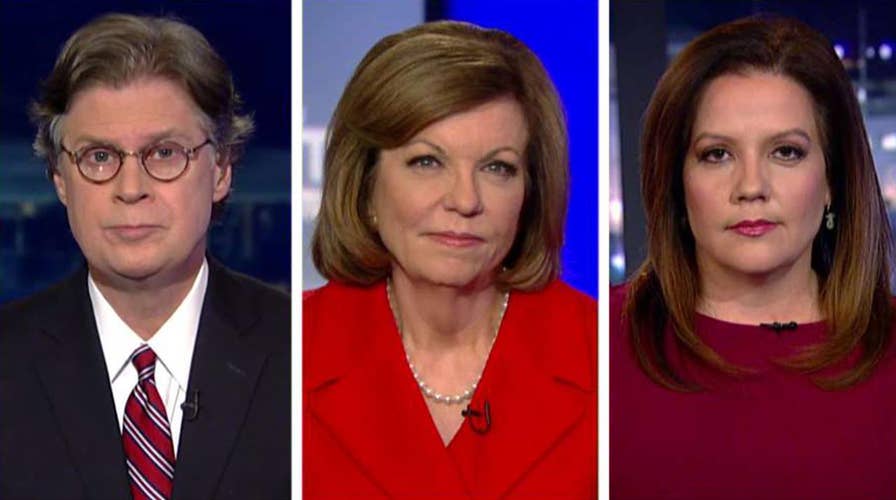
With that, that's the backdrop for these speeches tonight, let's bring in our panel, Byron York, chief political correspondent for the "Washington Examiner," Susan Page, Washington bureau chief at "USA Today," and Mollie Hemingway, senior editor at "The Federalist." The challenges, Byron, for this president tonight, what he needs to do, what he likely will do?
BRYON YORK, CHIEF POLITICAL CORRESPONDENT, "WASHINGTON EXAMINER": He has really only one real job, which is to try to convince Americans that there really is a crisis at the border. Democrats say no, there is not. The number of people who are crossing illegally into the United States is actually smaller than it was years ago. That is true. But the White House will argue that the nature of those crossing the border has changed. In the past it was single men mostly who could be quickly caught and returned to Mexico. Now, they say, two-thirds of that flow are women, children, and families, and they cannot be returned. In other words, once they cross into the United States, the chances of sending them back to Mexico or their home country are very, very low. That has changed everything, the White House is arguing.
So can the president actually convince Americans that that constitutes a crisis or not? That's his big job.
BAIER: We'll see, in eight minutes. That's the challenge. Meantime, on Capitol Hill, Susan, you have the Senate majority leader saying what changed? A lot of Democrats have voted for border security, a lot more for border security than $5.6 billion. Take a listen to Senator McConnell today.
(BEGIN VIDEO CLIP)
MITCH MCCONNELL, R-KY., SENATE MAJORITY LEADER: Maybe the Democratic Party was for secure borders before they were against them. Or maybe they are just making it up as they go along. Or maybe they are dead set on opposing this particular president on any issue for any reason.
SEN. CHRISTOPHER COONS, D-DEL.: This president has trouble hearing yes. Democrats are saying yes, we want to invest in border security and find a fix to our immigration system. But demanding a border wall and threatening to use his executive powers to do so is no way to accomplish his goals.
(END VIDEO CLIP)
BAIER: Not clear yet on whether he's going to declare a national emergency tonight or not, getting inclinations that he's not. But where does the pressure fall once we get to the paychecks not going out on Friday?
SUSAN PAGE, WASHINGTON BUREAU CHIEF, "USA TODAY": I think the pressure is greater and we know that the blame is just proportionately falling on President Trump. There was a Reuters/Ipsos poll out this afternoon that showed a 51 percent majority of Americans held President Trump largely responsible for the shutdown, about a third of Americans held Congressional Democrats responsible for that.
And this shutdown began when Republicans had unified control of the Congress. It continues after Democrats have taken over the House, and it seems to me that is one of the big differences here. This has become the first test, the first test of wills in this new divided government, and that is one reason it's going to be difficult for either side to give in enough to have some kind of settlement. It's not clear to me at all how this end.
BAIER: Mollie?
MOLLIE HEMINGWAY, SENIOR EDITOR, "THE FEDERALIST": I think you can think about blame. My own view is that this a broad bipartisan problem that reaches back decades where leaders of both parties have failed to address the issue. At some point you just kind of have to take care of the problem. Whether you are motivated to do it because there is a shutdown or you know that constituents are going to get angry, or you think there is a crisis, a humanitarian crisis because of all the drugs flowing over the border, the trafficking issues in play, the fact that children are dying at the border, all of those kinds of problems, or whether you care about national sovereignty and just having borders that are effective.
It doesn't really matter what you are thinking about it, but at some point the adults should all come to the table and decide what should be done. It doesn't have to all be a wall. It can be a wall, it can be increased border enforcement, changes to the laws that make some of these problems so intractable. But I think the American people care less about who precisely brought us to this moment, and there is a lot of blame to go around, and more about who is going to fix it.
BAIER: Meantime, Democrats are saying that television networks need to fact check the president real time in part because of some of the missteps made on different statistics rolled out over the recent days by the administration, basically a liar-liar montage. Take a listen.
(BEGIN VIDEO CLIP)
KELLYANNE CONWAY, COUNSELOR TO PRESIDENT TRUMP: I know you're covering it, but he also needs to cut out the middleman because there is a lot of misstatement and lies told about him routinely every day.
JOE LOCKHART, FORMER CLINTON WHITE HOUSE PRESS SECRETARY: We shouldn't be using our public airwaves for someone to spew more of these lies. Someone has got to fact check that.
MIKE PENCE, VICE PRESIDENT: The American people aren't as concerned about the political debate as they are concerned about what is really happening at the border.
UNIDENTIFIED MALE: Can you promise that the president will tell the truth tonight? Will he tell the truth?
CONWAY: Yes, Jim. And can you promise that you will?
(END VIDEO CLIP)
BAIER: So some of the sound today. Byron, what about this aspect of it?
YORK: There was a bit of a debate over whether to even televise this, which just makes no sense. To me it's seems self-evident that the networks should broadcast the president's address. It's not as if he's abused this privilege in the past. This is the first time he asked for a primetime Oval Office address. And if he does abuse it in some way, they don't have to do it again. As far as the fact checking is concerned, has anybody watched cable TV lately? That's done all the time on all of the networks, and of course it will be done on every sentence that he says tonight.
BAIER: Susan, the Democrats have a challenge. It's going to be Nancy Pelosi and Chuck Schumer responding to this speech tonight. And all the focus on the Republicans who may break away because of the partial government shutdown, there are also Democrats who say they could be for some element of border security if you don't call it a wall that is so nasty in Washington.
SUSAN PAGE, WASHINGTON BUREAU CHIEF, "USA TODAY": That's true. And Senator McConnell actually made a legitimate point a few minutes ago. In the clip that you show, which is that a lot of Democrats have in the past voted for funding for a wall over parts of the border, and I don't think they've had a really effective response to the criticism that Senator McConnell and others have made about that.
And you also have -- this is an unfamiliar setting format for President Trump who really prefers a big rally to have a setting, Nancy Pelosi and Chuck Schumer also have not been the most compelling public speakers, as skilled as they are at being behind the scenes legislators. So this is a test for them, too, to come across as reasonable and constructive and not as obstructionists.
BAIER: And Mollie, quickly, the Oval Office comes with its own trappings, it comes with its own import, it comes with its own urgency. So that's a challenge responding to that presentation anyway.
HEMINGWAY: It does. But the constitution also gives to Congress the power to handle a lot of these issues. And I do think Nancy Pelosi and the people in the Senate should work on presenting, if they don't like the plan that's being offered by the administration which has a lot of specifics in it, go ahead and offer something specific and let the American people see this debate. I think that's actually very healthy for people to see what the differing sides are and make a decision about who is handling it most seriously.
BAIER: Panel, stand by. Next up, increasing tension between Turkey and the U.S. over the Kurds and Syria.
(COMMERCIAL BREAK)
(BEGIN VIDEO CLIP)
JOHN BOLTON, NATIONAL SECURITY ADVISER: We're going to be discussing the president's decision to withdraw, but to do so from northeast Syria in a way that makes sure that ISIS is defeated and to take care of those who have fought with us against ISIS and other terrorist groups.
RECEP TAYYIP ERDOGAN, TURKISH PRESIDENT (through translator): Bolton has made a serious mistake. And whoever thinks like this has also made a mistake. It is not possible for us to make compromises on this point.
(END VIDEO CLIP)
BAIER: The Turkish president saying that he is trying to get mixed signals he thinks from the U.S. administration. The national security adviser over in Turkey, the Turkish president, Erdogan, not meeting with John Bolton.
Meantime, there are still plans for U.S. troops to come back from Syria, however, over some period of time. If you take a look at ISIS and where ISIS has been since 2015, all of the area controlled, and now what the U.S. military believes is the situation as of August. The question is, how long does it take to take that out, and how much time will U.S. troops be on the ground?
We're back with our panel. Mollie, we talked about it last night a little bit. It seems like more of this is coming out about where things stand between this administration.
HEMINGWAY: Well, and it does sound like maybe things got a little confused during Bolton's trip. President Trump has been clear. That map that you showed, all that green territory shrunk to the red territory, that was in August. By the time President Trump made his announcement in December it had shrunk even more to basically nothing.
So the stated mission of the United States being there was that we were going to be there until we eradicated ISIS as a military capability. That doesn't mean eradicating Islamist terrorism until the end of all time, but we accomplished our stated mission. President Trump has been clear about how it's time for us to come home. You've seen this resistance in a lot of people in the establishment just trying to claw back and get him to change his position. He came out yesterday, today on Twitter, and said he hasn't changed his position.
So it would be good for everyone in the Defense Department and in NSC to make sure that they are upholding what Donald Trump has said is our position and make sure we get out of there quickly, not in years or decades as has been the case with our situation in Afghanistan.
BAIER: Just to point out that there is someone with very good lungs right outside of the fence yelling as we continue our broadcast. Susan, the president essentially is saying there is no difference between what he said and what the policy is that's being talked about by Secretary Pompeo and John Bolton. The bottom line is that troops are going to be in Syria for some period of time, and the question is, how much?
PAGE: That is I think incorrect. The president made a very flat statement that the U.S. troops were coming out of Syria without consultation with our foreign allies or even a team to be in internal consultation. So now we see his top aides including John Bolton, who would be an advocate of pulling U.S. troops out of Syria, having to walk that back and set up conditions for their withdrawal and for the pace of their withdrawal that the president did not set.
You heard President Erdogan making it clear there were two messages by saying he was going to listen to Trump, he wasn't going to listen to Trump aides who were telling him something different. This is a mixed message, and it does not help the execution of U.S. foreign policy.
BAIER: However, Byron, the U.S. is clearly making the point to Erdogan that it is not acceptable for Turkish troops massed at the border to go after Kurds with or without U.S. troops on the ground in Syria.
YORK: That's right. I don't think John Bolton has gone rogue here on this. I think he reflects changing thinking with the president. I think the president has either changed his thinking or he has been talked into changing his thinking somewhat on how quickly this withdrawal will take place. And as far as Erdogan is concerned, didn't he tell the parliament that the preparations for a military offensive against the Kurds are all but done, but not going to do it as long as U.S. troops are there. I think he's being pretty clear about that. So I think the fact is the president did say, yes, we are coming out of Syria, we're coming out in 30 days, going to happen, and now he's clearly saying we're coming out, but it will take more time.
BAIER: In all of this what is not talked about is that map and the difference between the green from 2015 to the red in 2018 and the status and control that ISIS had then and has now. The administration likely, is the responsibility for seeing that color change.
When we come back, a very special wedding dance.
(COMMERCIAL BREAK)
BAIER: Finally tonight, a moment between a father and daughter. Mary Bourne Roberts has danced her whole life. She majored in dance at the University of Alabama, currently teaches at a dance academy. However, her most important dance took place on her wedding day late last month. Her father was diagnosed with glioblastoma, an incurable brain cancer in May of 2017. Despite being in hospice care he was able to attend the wedding and have the traditional wedding dance with his daughter from his wheelchair. Great news there.
You hear the sirens. That means there is action, movement. Thanks for inviting us into your home tonight. That's it for the “Special Report,” fair, balanced, and unafraid. Right behind those doors, down a couple of halls, there will be the Oval Office address in two hours from now.
Content and Programming Copyright 2019 Fox News Network, LLC. ALL RIGHTS RESERVED. Copyright 2019 ASC Services II Media, LLC. All materials herein are protected by United States copyright law and may not be reproduced, distributed, transmitted, displayed, published or broadcast without the prior written permission of ASC Services II Media, LLC. You may not alter or remove any trademark, copyright or other notice from copies of the content.
