






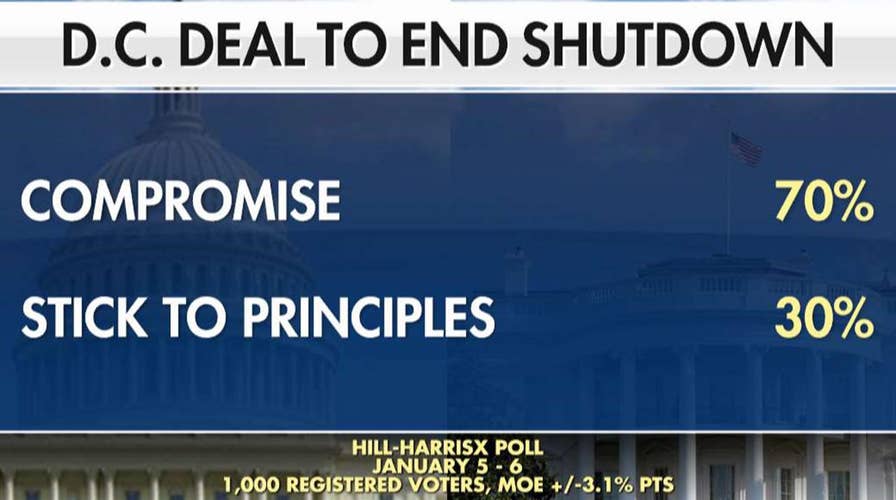
Poll: 70 percent of voters want both parties to compromise on deal to end government shutdown
GOP spokeswoman Ronna McDaniel weighs in on the border crisis and ongoing partial government shutdown.
This is a rush transcript from "Your World," January 8, 2019. This copy may not be in its final form and may be updated.
NEIL CAVUTO, HOST: Thank you, Shepard, very much.
You're looking live at the White House, everyone, where the president of the United States in just about five hours, from the Oval Office, a first for him, will deliver a national address on what he deems to be the crisis at the border.
The president is expected to make his case to the American people for a border wall and could declare a national emergency to build that wall. Democrats, without having seen it, are already slamming it.
Nancy Pelosi and Chuck Schumer will deliver their own response to the president's speech.
Still, if Wall Street is worried about any of this and the ongoing shutdown, it had a funny way of showing it, stocks racing ahead today, more on optimism about China trade talks that appear to be going somewhere, rather than progress on a government shutdown that does not.
Welcome, everybody. Glad to have you. I'm Neil Cavuto.
Let's begin with John Roberts at the White House with the very latest on this -- John.
JOHN ROBERTS, WHITE HOUSE CORRESPONDENT: Neil, good afternoon.
And, first of all, let's deal with this idea of the president declaring a national emergency tonight to build a wall. It's likely that that will not happen tonight. The chances, we're told, are very slim. The president wants to negotiate an end to the impasse, rather than pulling the trigger on something that radical.
But the White House is still holding out the possibility that the president could do that unilaterally and build his steel barrier, if Democrats do not come to the table and negotiate some money for the wall.
Listen to what Kellyanne Conway said earlier today.
(BEGIN VIDEO CLIP)
KELLYANNE CONWAY, TRUMP SENIOR ADVISER: Even some Democrats who would prefer the president not do that, would prefer the president not be the president, have grudgingly admitted that he does have the authority to do so.
The reluctance also, though, Kristin (ph), is that why let Congress off the hook yet again? Congress really has failed to do it job, including Democratic- and Republican-led Congresses. They have failed to do their jobs on immigration for a very long time.
(END VIDEO CLIP)
ROBERTS: Now, the president has dialed way back on his talk about a wall, now publicly saying that any barricade along the border is going to be a steel barrier, and there is already, as you can see there, plenty of steel barrier along the border.
The White House also pointing out that many Democrats who are in Congress now voted all the way back in 2006 to build 700 miles of secure fencing along the southern border. And now they want nothing to do about it.
But as much as the White House is blaming Democrats for the continuing government shutdown by not being willing to negotiate on national security, Democrats are blaming the White House for insisting an agreement to open government include funding for a wall. Listen to California Senator Kamala Harris.
(BEGIN VIDEO CLIP)
SEN. KAMALA HARRIS, D-CALIF.: There was a bipartisan effort out of the United States Senate and the United States Congress to pass funding of the government, and the president is holding it up because of his vanity project, which is this wall, at taxpayers' expense and at the expense of hundreds of thousands of workers who are working every day without being paid.
(END VIDEO CLIP)
ROBERTS: The vice president, Mike Pence, is currently up on Capitol Hill. He is going to be briefing House Republicans about what the president will see -- will say tonight. He will brief the Senate Republicans tomorrow.
If I said House Democrats, I meant House Republicans. I'm not sure I did. But he will be briefing the Senate tomorrow.
But what we're going to see tonight, Neil, is just basically a staking of positions on both the Republican side and the Democratic side. There's not going to be any break in the impasse. And I don't know if there will be this week, because, Neil, they still remain miles and miles apart.
But, as you pointed out a moment ago, the stock market doesn't seem to care.
CAVUTO: No, no, on to other things, like just making money. You know those guys.
ROBERTS: Exactly.
CAVUTO: All right, John Roberts, thank you very, very much.
ROBERTS: You got it. Thanks.
CAVUTO: All right, well, he has been at the epicenter this border fight, that with the vice president at the White House just yesterday.
With us now, former ICE Director Thomas Homan.
Director, very good to have you. Thank you.
THOMAS HOMAN, CONTRIBUTOR: Good to be here.
CAVUTO: If the president does not declare a national emergency, what kind of position can he stake out tonight?
HOMAN: I'm hoping he shares the data on what's going on, on the border to the American people to understand there is a crisis, both humanitarian and a national security crisis.
It's the same data that the secretary of homeland security tried to share with Pelosi and Schumer, but they refused to hear it, which you think about that, the House speaker refused to be briefed by the homeland security director on the state of affairs on the southern border.
So, after that happened last week, you know, on several shows here on FOX, I implored the president, forget about Nancy and Chuck. Go around. Talk to the American people and give them the data and educate them on what's going on, on the American border, on the southern border.
CAVUTO: All right, so if the president spells it out without declaring an emergency, Director, that we have got trouble down there, it's brewing, it's going to get worse, Democrats counter, say, all right, well, the number of apprehensions along the border is way down, it's down to five-, six-year lows, we seem to be making progress, is that going to be an uphill fight for him?
HOMAN: Well, look, it's certainly going to be a fight.
But this president has planted his flag. I have worked for six presidents. I have done this for 34 years. We finally have got a president who says enough. I'm done -- we're done kicking this can down the road. We're always promised more border security in exchange for amnesty, in exchange for DACA or some other thing.
I have been here a long time. They put a few more Border Patrol agents on the border and they call it border security. We have a president who is going to secure that border. And I'm proud he's our president. But one thing I shared with the White House yesterday, you got to give them real data that the American people can look at and make their own judgment.
And, for instance, I said you have got to talk about the wall. The Democrats say the wall is medieval, it's ineffective, when, in fact, that's a stone cold lie. Every place they built a border barrier, illegal immigration has decreased.
So, I asked the White House, you have got to provide that data to the American people. Show them that this talking point by the Democrats is just false. Walls work. They have worked every time we build a barrier, and that's why he wants a wall. Walls work.
CAVUTO: Director, the president was very close to scoring sort of a comprehensive deal, if you think about it, a little more than a year, 14 months ago, where they would address not only some security barrier or wall, whatever you call it, along the border, maybe, maybe deal with DACA, the kids of illegals who came in through no fault of their own, are kind of stuck in this legal limbo.
And it all fell apart. Now, Republicans blame Democrats. Democrats blame Republicans. I'm not here to refight that battle, but that we were very, very close. And that is the underpinning of getting a deal, even now. Do you agree with that?
HOMAN: Well, Neil, I'm glad it fell apart, because you know what, I understand the DACA situation.
But you can't give hundreds of thousands of people amnesty and reward illegal behavior, unless you address the reasons DACA even happened. Unless you close the loopholes that cause families to come to this country illegally, you are going to never solve DACA.
Yes, you can give 800,000 people some sort of status, but how about the 200,000 family units that came across the border in the last two years much? That's your next DACA population in five years. So, you just can't keeping putting a Band-Aid on this.
So, I have no problem with fixing DACA, as long as you fix the underlying reason, close the loopholes why families are coming, close the loopholes why UACs, unaccompanied children, come, close the loopholes in the asylum process to finally fix this once and for all.
Stop putting a Band-Aid on it. And I think this president understands that.
CAVUTO: All right, Director, thank you for taking the time. We appreciate it.
HOMAN: Thanks for having me.
CAVUTO: All right, to let you know -- John Roberts said this -- The Wall Street Journal has just come out with a bulletin saying that what John just mentioned is indeed the case, that the president is not, again, is not expected to declare a national emergency at the southern border.
We shall see. Things can change, and, oftentimes, we're told that a lot of addresses, not only from this president, but other presidents, are ripped up moments before they make them and they start from scratch. This president could be the same way.
(LAUGHTER)
CAVUTO: That laugh, a familiar and wonderful laugh that is, from very, you know, warming and enlightening to all of you is that of the judge, Andrew Napolitano.
ANDREW NAPOLITANO, JUDICIAL ANALYST: I remember Ronald Reagan once -- Ronald Reagan once joking around, not knowing the mic was loud, saying, we begin bombing in five months.
CAVUTO: We begin bombing in five months.
NAPOLITANO: And he was in the Oval Office.
CAVUTO: And he was pilloried for that.
NAPOLITANO: Yes.
CAVUTO: Let me get your take. If you don't declare an emergency, which you said would be a difficult battle regardless, we still don't know.
NAPOLITANO: Right.
CAVUTO: Then how do you make your pitch?
NAPOLITANO: I wouldn't be surprised if he declares the emergency tonight.
First, the declaration is a formal legal document which requires that he cite facts and site statutory authority. That would bore the American public to death if he were to read that. He might want to, in a showy way, sign it tonight, but I don't think so.
I think he knows whether or not he's going to declare the emergency. I don't think tonight is a legal event.
CAVUTO: What is the litmus test for that?
NAPOLITANO: It's a political test.
In the president's mind, it's, will the people accept it? But in my mind, it's, will the courts accept it? Because the courts will only accept it if the emergency complies with the definition of an emergency in a 1976 law.
The '76 law was written to clean up all the emergencies Richard Nixon declared and LBJ had declared which were technically still on the books.
That definition says an emergency is a profound threat, an immediate and palpable threat.
CAVUTO: And it's got to be fairly obvious, right?
NAPOLITANO: Correct.
CAVUTO: Pearl Harbor, fairly obvious, 9/11, fairly obvious, the Ebola virus, fairly obvious.
NAPOLITANO: Correct, a threat so profound to life, property and safety that it cannot be addressed by using the ordinary assets and the ordinary powers of the government, that it requires something extraordinary.
I don't know that the president will be able to make that case. But his task is to make that case tonight, A, for the American people, but down the road for a federal judge, whatever federal judge it is to whom the first challenge is filed once he signs that emergency declaration.
CAVUTO: Can you declare an emergency declaration and then all of a sudden get troops involved, get building involved, get hopping on a wall, when you know it's going to be legally challenged back and forth, back and forth potentially for years.
(CROSSTALK)
CAVUTO: Does the first judge -- I'm sorry -- does the first judge who challenged that mean you have to stop?
NAPOLITANO: Well, if a judge issues an injunction, and the president doesn't comply with the injunction, we then have Nixon and the tapes issue, where the president would be held in contempt. That would be unseemly, but there's the -- there's the authority -- there's authority to do that.
If your question is, can he go to another judge, the answer is no, because the injunction would stop him from doing what he wanted to do.
Will he do this even if his advisers tell him he will lose? He may want to do it for political reasons, because then he goes, it's not me. It's that unelected black-robed person who was appointed by so-and-so that stopped me. You know the way he likes to attack judges when they were appointed by a so-and-so, which basically means any president but him.
CAVUTO: Let me flip it around, Judge.
He doesn't declarative it an emergency, he opts not to take that route, but he still wants to take funds that have already been marked, let's say, within the defense budget for other purposes and realign them to this.
NAPOLITANO: Can't do it, because the Constitution is very clear. No money can be spent from the federal treasury but that which has been expressly authorized by the -- by the Congress.
Can he take money from column A which has been approved by Congress and put it into column B, an issue that just arose that Congress didn't think of when it approved column A? The answer, no. Would a court adjoin that? Probably yes.
So he's got a tough road tonight. He's got to make a very difficult case. He's got to justify why he's willing to keep half the government shut down over the issue of the wall, because, remember, both houses passed continuing resolutions to keep the government running until the wall issue was injected.
And then he's got to make the wall case so compelling that the American public decides he's correct and a judge decides, yes, there's enough evidence here to justify this.
CAVUTO: Incredible.
NAPOLITANO: And he's got do that in eight minutes. He's limited himself to eight minutes.
CAVUTO: Holy cow.
(LAUGHTER)
CAVUTO: Boy, that would be riveting TV, which is probably a good idea why we are live on this tonight on FOX Business, because a lot of your money could be at stake on this.
This is the rare opportunity, 8:55 p.m., when we pick up coverage of this on FOX Business Network, not only to hear the president's address, but the Democratic response from Nancy Pelosi and Chuck Schumer, already challenging his authority to move in any of these directions, declare an emergency or not.
This will also be the first time you will get a vantage point of how our stock futures trade on this and how foreign markets respond to this. I say foreign markets, because I was reading a lot of the English versions, Le Monde and elsewhere, the French press, the German press, Der Spiegel and some of these others, where they are terming this to be a constitutional crisis in our country.
So while we might be largely ignoring this, they are largely riveted by this and what this portends for Donald Trump and the next at least two years for this president and this Congress.
We will have more after this.
(COMMERCIAL BREAK)
CAVUTO: All right, the president will make his address to the country tonight.
And soon after that, you're going to see an unusual event, where two Democrat responses together. Of course, that will be Chuck Schumer and Nancy Pelosi. It is unusual for, although not unprecedented, for a non- State of the Union speech to get an opposing party response. It is again not something that hasn't happened before, however.
Back in September 2007, a Rhode Island senator responded to President George W. Bush's Iraq Afghanistan speech. In 2009 of September, former Representative Charles Boustany of have Louisiana responding to the Obama health care speech.
So there have been examples, but they are few and far between. This is that unusual and maybe that controversial.
Manhattan Republican Party CEO Andrea Catsimatidis. We have got Democratic strategist Kristen Hawn and political commentator Ashley Pratte. The very fact that we are going to have this sort of double response to what the president outlines, and both Chuck Schumer Nancy Pelosi taking the position ahead of time that they're going to try to correct what they consider to be the president's falsehoods, what do you make of that?
KRISTEN HAWN, DEMOCRATIC STRATEGIST: Well, I think it was the right decision for the networks to carry President Trump's speech. But it's also the right thing for them to carry the Democratic response.
You're right. It's unusual. But given the number of misstatements and mistruths that the president has perpetrated over the course of the past year -- I think The Washington Post counted it at around 1,000 -- the Democrats have a responsibility to take a look at this speech and talk to the American people about what might or not be the mistruths that he's -- that he's portraying to the American people.
CAVUTO: Well, surprisingly enough, Ashley, Republicans have said they have made plenty of misstatements and 180s of their own. So the back and forth on who's zooming whom is going to leave, I would suspect, viewers at home very confused. What do you think?
ASHLEY PRATTE, POLITICAL COMMENTATOR: I don't think I these addresses will correct anything that is going on.
And what the problem is really at the heart of all of this is that we are all Americans. This isn't a Republican or a Democrat shutdown. But the language we keep hearing on both sides is, it's the other party, it's this party.
And the problem is people want to get back to work. We want the government to be working. And we want things to move along. We elect people to Congress to get a job done. And sometimes that means compromise. Sometimes that means bipartisanship. And, at this point, we all need to come together and our lawmakers need to come together to do what is best for the American people.
And I'm not seeing that happen right now. I am seeing a president who's being extremely stubborn over something. And I'm seeing lawmakers be extremely stubborn in the other direction. But I'm hearing some talks of compromise. And that's around the idea of immigration reform, putting something forward to try to fix that issue, as well as border security.
So if two parties can, again, come together to find some alignment there, then maybe we can do something to fix the crisis, as well as the forthcoming crisis, which is those that are already here and how do we address that problem, which I have not really heard much about yet.
CAVUTO: Well, yes, good luck on that front.
Andrea, one of the things I found interesting, I like to peruse a lot of the papers and press and sites from around the world every time I get in. And one of the things I found interesting is, we are looking at this as the drama is unfolding. Most of the market shrug it off, thinking that it's just business as usual, no business as usual.
And -- but the foreign markets are interpreting this as almost a constitutional crisis here, that this could drag on a while, it could jeopardize the president's authority, nothing gets done in America, et cetera, et cetera, hence their anxiety that's building, more so than here.
Is that justified? What do you think?
ANDREA CATSIMATIDIS, MANHATTAN REPUBLICAN PARTY CEO: I don't think that's justified at all.
America is still the safest place to put your money. If you look at approval ratings for leaders around the world, President Trump's approval rating is actually much higher. Like, for President Macron, his approval rating is only 22 percent, whereas the president's approval rating is in the 40s.
So, really, we have a lot more stability here in America than they have in other parts of the world.
CAVUTO: Well, they don't know how to interpret us, I guess.
And, Kristen, the one that I'm left with is, I think, in the end, that sometimes that people forget that, the longer something like this drags on, doesn't matter which party is in power or which party people are fingered to blame.
People sort of have a hell with both of you attitude when all is said and done. Is there a chance that Democrats overplay their arrogance on this, that they have the upper hand, they're so convinced they have the upper hand, and before they know it, they're getting clobbered in the polls?
HAWN: Yes, I mean, I think that there's always that chance.
And I would just agree 100 percent that everybody has a responsibility to come together and compromise on this issue, not just...
CAVUTO: But they're not. They're not remotely doing that.
HAWN: But they're not.
(CROSSTALK)
CAVUTO: They're not showing any sign of that.
HAWN: Right. But I think that you're exactly right.
At the end of the day, and it's the more time that the government's been shut down and the hundreds of thousands of workers that aren't receiving paychecks are struggling to get by, this could ultimately come down on both parties. So I think we all need to figure out a way to move forward together.
CAVUTO: The one thing, Ashley, I will just leave with is, no one seems worried that this is going to really hurt the economy, so they just say, yes, federal workers are getting socked, a lot of the contractors are getting socked, but it's a nonevent to many looking at it.
Is that justified?
PRATTE: I don't think so, because we have to then look at those who are receiving subsidies of some sort, who are using that for housing to pay their rent, and then people who can no longer pay their rent or car insurance premiums, whatever it may be.
I mean, this could potentially put us down in a spiral here, as things start to spin out of control. And with the president not budging and saying this could be months, years, there's a lot of people in flux right now not knowing where their next paycheck is coming from. But then there's also those who are receiving federal government assistance who aren't workers with the government.
CAVUTO: And they get sucked into it.
All right, ladies, thank you all very, very much.
So, we don't know how this is going to be resolved, if it's going to be resolved. We do know there are some promising signs that talks with China have been extended an extra day. So maybe that one could be resolved -- after this.
(COMMERCIAL BREAK)
(BEGIN VIDEO CLIP)
JAMIE DIMON, CHAIRMAN, J.P. MORGAN CHASE: If you look at retail spend, home improvement spend, a whole bunch -- it's pretty good.
And so me -- my view is that the consumer is in good shape and has continued to grow. And they have back-wind with jobs and wages going up.
(END VIDEO CLIP)
CAVUTO: All right, that was Jamie Dimon, a Wall Street titan widely respected in the financial community, sitting down with our Maria Bartiromo, talking about what he says are pretty good fundamentals.
Wall Street must agree, the Dow up about 256 points. With this gain today, it's the first three-day winning streak the Dow has put together since back in November.
So what to make of that?
Let's go to the chief investment officer of the firm bearing his fine new, Hugh Johnson, and Empyrion Wealth Management president Kimberly Foss.
Kimberly, your thoughts on what the markets are saying? Not worried about a shutdown. OK with everything else. What do you think?
KIMBERLY FOSS, EMPYRION WEALTH MANAGEMENT: Yes, I mean, I think that the shutdown potentially really is -- obviously is a political one, it's not a financial one.
And, remember, we went through this again in 2013, Neil. And it really kind of shaved off about a half-percent from GDP. So while that's not terrible, it wasn't catastrophic at all either. So I think this is discounting the shutdown, although there is some slowdown there, or there could be, with mortgage applications slowly, and publicly funded companies aren't getting their capital that they need.
So at day 17, it could be an issue down the road, if we don't get some things resolved. But I think, overall, the consumer is very, very strong and the investor is strong. They don't like this. But at the same time, they're putting capital to work.
CAVUTO: Yes.
Hugh Johnson, I talked to some investment pro earlier on FOX Business Network, which you, if you don't get, you should demand. And one of the things he told me, Neil, this whole shutdown thing, been there, done that a lot, got used to it a lot. And indifferent though it might have seemed to the plight of 800,000 federal workers and other contractors not getting paychecks, in the scheme of things, it's happened so often, it's a nonevent.
What did you make of that?
HUGH JOHNSON, CHIEF INVESTMENT OFFICER, JOHNSON ILLINGTON ADVISORS: Yes, you have been talking earlier in your program about the fact that there seems to be some alarm from other parts of the world about the shutdown.
And there isn't that much of a shutdown. There isn't much alarm here at all. And I think that's exactly -- your guest got right at the point, is that the expectation is, given the history of the shutdowns that we have been looking at, Neil, is that it's not going to last for a very long time. And I think everybody kind of expects or thinks that this is not going to last a very long time either.
(CROSSTALK)
CAVUTO: But what if it does, Hugh? What if it drags on quite a while, months?
JOHNSON: Yes, you got a good point. It's a good question, because it's really not that trivial.
And the reason I say it's not that trivial, if you take a look at federal government spending, just broadly speaking, federal government spending as a percentage of our economy, well, it's 7 percent. Now, 7 percent doesn't sound like a big number. But it is a big number.
And, of course, that this drags on, we're talking about taking out or shaving off some of the growth, which is going to slow in 2019 -- we all expect that -- it's going to take some of that away. So instead of talking about, oh, say, 2.5, 2.4 percent growth, we're going to, over time, start to be talking about 2.2 percent growth in the economy.
And that means that the growth rate of earnings, which is so dear to all of us as investors, is also going to be lower than it already -- it already has been marked down to. So, if this lasts a long time, Neil, you're absolutely right. Your instincts are right. It then becomes an issue for the stock market.
CAVUTO: All right.
In the meantime, it's much ado about what's happening on the China talks front, Kimberly, and that we might have a deal or the makings of a deal. So, we get that, then what?
FOSS: Hey, if we get something like that, even if it's rumored right now, that's why the market is up today too, hey, that's awesome.
The investors really want that. That means that, yes, again, like your guest said, if we continue with this shutdown, that's an issue. But we have got these headwinds that keep coming into the play for uncertainty with the clients.
But the bottom line is our earnings are so near and dear to us, then we can actually have great earnings that actually will propel the markets further. And I think -- I think we have still got room to grow in this market.
We're cautiously optimistic here, but anything that's going to be a positive with China is going to be -- they're going to buy on the rumor and sell on the fact.
CAVUTO: All right, guys, I want to thank you. With some breaking news, we had to truncate things a little bit.
Again, just letting you know we're hearing that the president, if you are to believe The Wall Street Journal and our own John Roberts and some others reporting on the president's planned remarks tonight, he is not going to declare a national emergency to justify the building of a wall.
We don't know exactly what could be in the making here, or whether those reports are wrong. And what we're hearing, though, is the president will address the country. He will have a Democratic response from Chuck Schumer, Nancy Pelosi, but declaring a national emergency is not on the table for now.
More after this.
(COMMERCIAL BREAK)
CAVUTO: You're looking live on Capitol Hill right now, where former Congresswoman Gabby Giffords is about to join Nancy Pelosi on pushing gun legislation, better background checks to deal with violence.
We will have more after this.
(COMMERCIAL BREAK)
CAVUTO: All right, what do you think about tonight and the president's big address on border security, the wall, what to do about it, whether this is an emergency or not?
FOX Business Network's Deirdre Bolton has been talking to folks.
Hey, Deirdre.
DEIRDRE BOLTON, CORRESPONDENT: Hey, Neil.
We have been asking some people out here on the Plaza what they think. But a quick review of the facts, of course. So, first, we are in the 18th day of the shutdown, tying actually the third largest shutdown in the modern era.
And both Republicans and Democrats, they are digging in their heels on this border wall stance. So President Trump, as we know, wants more than $5 billion to put towards his long-promised wall along the U.S.-Mexico border.
Democrats insist no money will be allocated towards a wall. So right now, it is not really clear where any point of compromise is possible. But when we asked people here what they think, here's what they told us.
(BEGIN VIDEO CLIP)
UNIDENTIFIED FEMALE: I expect to that he's hopefully going to put down his guns a little bit and come to find a solution with the Democrats. But I also think that the Democrats need to put the guns down and hear him out.
UNIDENTIFIED MALE: I'm hoping that he's going to have some clear answers on how long he is going to keep the government shut down for. And hopefully he will have a solution that's not affecting government workers and everyday citizens.
UNIDENTIFIED MALE: The federal government employee shouldn't be put through this because of his wall.
UNIDENTIFIED FEMALE: I'm just hoping that he comes up with a bipartisan solution for both sides, so that we can get everyone back to work, because I think that's what everyone wants.
(END VIDEO CLIP)
BOLTON: Speaking of what everybody wants, Neil, as you know, there are about 800,000 federal workers who do not know when their next paycheck is going to come.
And so they and us, of course, will be listening tonight with President Trump's first Oval Office address this evening at 9:00 p.m. Eastern -- Neil, back to you.
CAVUTO: That's right, first from the Oval Office.
All right, Deirdre, thank you very, very much.
Well, Americans might be of differing views when it comes to the wall and all that stuff, but seven out of 10 of us, apparently, want to see both parties come together and address this.
Republican National Committee Chairwoman Ronna McDaniel with us right now.
Ronna, thank you for taking the time.
What's the president going to say tonight?
RONNA MCDANIEL, CHAIR, REPUBLICAN NATIONAL COMMITTEE: Well, I think the president's going to address the nation and talk about the crisis that is happening at our border.
We have had asylum claims increase 1700 percent in the past eight years. In the past month alone, 22,000 children have tried to cross our border. You have families coming across at an unprecedented level, 160,000 families last year.
We cannot continue to support this deluge of people coming across our border illegally. And we have to solve this once and for all. But the president is not for...
CAVUTO: Well, is that an emergency, Ronna, to you or the president? Or has he expressed that it warrants an emergency now?
MCDANIEL: Well, Neil, when 2,000 people are crossing our border illegally every day, when you have a backlog of 800,000 asylum cases that are backlogged in our courts right now, we are being deluged.
And we do not have the capacity to deal with this inundation of people coming across our border illegally. It has to be addressed. It's getting worse and worse and worse. For decades, we have seen politicians talk about this, Bill Clinton, Barack Obama, Hillary Clinton, Chuck Schumer.
We just released a Web site, BorderFacts.com, that goes through all the things that other politicians have said. The president is saying it's time to put away politics as usual and solve problems that every American and every Democrat and Republican knows need to be solved.
CAVUTO: Do you think, though -- critics of the president, Ronna, have contended that he's exaggerating the problem, that the caravan issues and the family separation issues notwithstanding at the border, the number of crossings is actually back to five- or six-year lows.
And many commend the president and the tough stance he's taken on the border for that. So he's creating an appearance of a problem that isn't as severe as it was.
MCDANIEL: Well, we have all seen the caravans. We all were watching that before the holidays. We all know that two children have recently passed as they have made this treacherous journey to come to our country.
We know that 12,000 children right now are being held by HHS because they came here unaccompanied.
(CROSSTALK)
CAVUTO: So, is it the children the families issue, Ronna...
MCDANIEL: It is.
(CROSSTALK)
CAVUTO: ... just to be clear, that changed the dynamics here, that had it not been for that and all the caravan stuff and all, the president wouldn't be making this speech?
MCDANIEL: Well, it's beyond that. It's the drugs coming across our border illegally. It's the 17,000 criminals who have come across our border illegally or been apprehended.
We know that there's a problem here. And why aren't we addressing it? And it should be done in a bipartisan way. The other thing, Neil, is, where we do have borders, where we do have fences, crossings are down, in Yuma, El Paso, Tucson, and San Diego, down 90 percent.
So walls do work. Fences do work. Come to -- come to a compromise. Democrats need to come to the table. Right now, Nancy Pelosi is just no if President Trump says anything. And we need to do better. And the president's willing to work with the Democrats.
CAVUTO: Have you had a chance to talk to your uncle Mitt Romney over that op-ed?
(LAUGHTER)
MCDANIEL: We have texted.
We're like any family. We don't always agree on certain things. But this was about me being party chair and him being a senator. But we're going to love each other. We're family no matter what.
CAVUTO: But you criticized it. Other Republicans criticized it, said it made him look bad. Do you think it made him look bad?
MCDANIEL: Well, I -- I think any Republican attacking our president right now isn't what our voters want to see, especially with this government shutdown, with the president staying here in Washington and Nancy Pelosi being in Hawaii, Democrats not willing to work on an issue that they know is a crisis right now.
I think that's an opportunity to come together and point out the differences between our parties. So that would be my suggestion to any Republican in our party.
CAVUTO: All right, so when he commended the president in the same editorial about tax cuts and all, regulation, and some of the things he has done on that front, of which he was complimentary, but his personal style that was left wanting, you disagree with that?
MCDANIEL: Yes, I think there's -- listen, Neil, we are a big party. We are a big tent party. There's room for disagreement.
But I think there's an opportunity right now to contrast what the Republicans are putting forward vs. the Democrats. The president's asking for $5 billion for border security to stop this immigration problem that we have that has persisted for decades.
Nancy Pelosi has been there three decades. She hasn't solved it. And the Democrats are saying, no, we're not going to address this issue, we like sanctuary cities, we want to abolish ICE. And, by the way, let's give $54 billion in foreign aid, instead of dealing with our crisis at the border.
It's a very clear contrast.
CAVUTO: All right, and your uncle, I assume, agrees on the border wall stuff?
MCDANIEL: He has said that he agrees on the border wall and will support the president and this issue.
CAVUTO: And the president and he are OK? They're OK now? They're getting along, or what?
MCDANIEL: Yes, they're -- they're grown men. They know how to deal with differences.
(LAUGHTER)
CAVUTO: All right.
MCDANIEL: They have both been successful businessman. I think they're going to be OK.
CAVUTO: Indeed, they have.
Ronna, thank you very, very much.
By the way, we did call Ronna's Democratic counterpart, Tom Perez. They could not do something for the time being, but hope springs eternal that they will.
Stay with us. We will have more after this.
(COMMERCIAL BREAK)
CAVUTO: Obviously, President Trump has given lots of addresses to the country. And there have been lots of exchanges with the press, planned and unplanned.
But for an Oval Office address, that is significant, the first of his presidency.
And that is something that gets this next fellow's attention, historian Doug Wead.
Doug, as far as Oval Office addresses, I was startled, yesterday, I remember, when we first heard about this, that it would be the president's first from the Oval Office. Ronald Reagan had 33 from the Oval Office, Barack Obama three. It depends on the president, but a lot of them in double digits when it comes to number of addresses from that august room.
Why is that a big deal?
DOUG WEAD, FORMER ADVISER TO PRESIDENT GEORGE H.W. BUSH: Yes.
Well, it was a big deal because originally television was controlled by government in France and Britain and other places. And the dawn of television in America., Eisenhower cut a deal. He said, OK, OK, you guys, Sarnoff, Paley, you can -- we will let corporations own television. And they're accountable to no one but their stockholders.
We will allow that. But when the government wants TV, you give it to us. And Paley and Sarnoff said, oh, absolutely, Mr. President.
So that was the deal. And when the president gave a speech, Eisenhower, than later, young, sexy Kennedy, when they gave a speech, America was united. That was our president. You couldn't turn to football or cartoons. You had to watch. The whole country had to watch the president, and there was no choice.
CAVUTO: And you think about it, an Oval Office address is meant to unify a nation, right, whether it's President Bush after 9/11, President Kennedy in the middle of the Cuban Missile Crisis. There's great gravitas to that, right?
WEAD: Absolutely.
And it did unify the nation. Now, by the time Reagan came along, there was more diversity and the media was much more aggressive. And so Reagan's speeches were bracketed on either side by this -- these tearing apart of the speech.
Now, the president is going to say this, and he's going to use this and that's a wrong statistic. And then after it was over, they would tear it to pieces again. So Reagan had to thread a needle. He had to somehow communicate in between those brackets to the public. There was no fair and balanced. There was no FOX that would show different opinions.
And he had to somehow speak to the Americans in that brief period before it got taken away. So it was a suburb high-wire act.
CAVUTO: You know, it's interesting too. We usually associate opposing party responses to a presidential address to something like a State of the Union address, although at times presidential speeches have a prompted a Democratic response, whether it would be on the Iran-Afghan war back in 2007, or the responding to President Obama's health care speech back in 2009.
So there is some precedent to this, but not much. What do you make of the fact that you're going to have two people responding to the president, Chuck Schumer, Nancy Pelosi, a little later?
WEAD: Yes, that's interesting to me.
Over the years, as you know, we have had laws passed. We had the fairness doctrine, we had equal access, and it just got out of hand. Somebody could make a comment on radio, you had to let somebody else come on and make a comment if it's pro-abortion or pro-life or whatever it may be. Back and forth, it went.
So they changed a lot of that. They still try to control and influence TV through the FCC, the number of stations that a company can own, but crony capitalism allows the big corporations to cheat in that regard as much as they can.
The biggest development has been FOX News, has been the free market and the audience that you have been able to pull here. And now I notice FOX is moving into new territory. It is truly fair and balanced. So in the evening, you have got one conservative show, one libertarian show, but during the day, you have got people with diverse opinions.
That's very healthy, I think. But that's going to take a big share of the market.
CAVUTO: The bottom line is, we have plenty of time, news networks, to cover it all, the good, the bad, the ugly, the conservative, whatever you want to say.
Thank you very, very much, my friend. It's always good seeing you.
WEAD: Thank you. Good to see you too.
CAVUTO: Historian extraordinaire Douglas Wead.
All right, you're hearing the story that better than 800,000 federal workers, many of them, just like a lot of Americans, go paycheck to paycheck, will have to wait for that paycheck, maybe a while.
A guy who can help you through that after this.
(COMMERCIAL BREAK)
CAVUTO: All right, come Friday, it could be the first time that some government employees will be missing their pay.
It's a reminder, in a country where a good many of us go paycheck to paycheck, that that's a dangerous position to be in anyway.
Chris Hogan is the author of "Everyday Millionaires," just that, "How Ordinary People Built Extraordinary Wealth and How You Can Too."
A lot of is just good practical guidance. And he has such a powerful voice. As I like to remind people that if you don't listen to what he says, he will beat you up.
(LAUGHTER)
CAVUTO: All right, so, Chris, very good to see you.
Congratulations.
CHRIS HOGAN, AUTHOR, "EVERYDAY MILLIONAIRES": Well, thank you. Thank you. It's an honor to be back with you.
CAVUTO: You know what's so neat about it? When we talk about everyday millionaires, there are a good many of them. And sometimes they're not so obvious, are they?
HOGAN: No, they really aren't.
Neil, we wanted to know the truth, right? Is it is it possible for regular men and women to be able to build wealth nowadays? I mean, you have some media tell you that you can't. And you have got a 14-year-old congressman out West that says you can't, right?
And so what's the reality? So we did the biggest study that's ever been done. We used a research firm to help us walk through this to find out the truth. We talked to over 10,000 millionaires all across this country to really dig in and find out, are they trust fund babies? Are these people that got lucky, that hit the lottery?
Or are these hardworking men and women that believed the American dream was still alive?
CAVUTO: And what you discovered is that they just are good with not going crazy and spending too much.
HOGAN: They really are. They're regular men and women.
These are people, a third of them never had a six-figure household income, OK? Sixty-two percent of them went to public state schools. Only 21 percent of these millionaires inherited anything; 83 percent didn't inherit a dime, right?
So you look at this and you start to realize these are people that are living next door to you, people that you work with that you don't know it, because they're not flaunting it. They're staying focused in what they do, because they're committed to a process.
CAVUTO: But so many of us do this paycheck-to-paycheck thing. And there are a lot of themes in your book here. But I do want to go to the core of what your ideas -- what I like to think are your ideas.
One is do a monthly budget. In other words, get an idea of the money going in and the money going out.
HOGAN: Yes, it's so important.
Ninety-four percent of these millionaires are budgeting. They're living on less than they make. That means they're intentional with their money. They're making decisions.
CAVUTO: That's a very important point. Live on less than what you make, because we have discovered that even multimillionaires, if they're living like multi-hundred-millionaires, they're going to lose it.
HOGAN: You really are. And that's the reality.
And a lot of people, Neil, want to wait until their income grows before they get intentional. The problem is, is that your lifestyle will increase. And so what you have to do is draw a line in the sand that says, I'm going to be in charge of my money.
You work hard for your money. I want you to make your money work hard for you.
CAVUTO: All right. Debt is another big problem for you, because you argue, people see out hot investments, but forget that 18 percent, 24 percent credit card, right?
HOGAN: No, I mean, debt is a thief.
And, according to our research, 73 percent of these millionaires never carried a dime of credit card debt; 68 percent of them never took out student loans. So the reality is, is that they understood that, if I have debt, I'm paying interest.
CAVUTO: But a lot of people can't avoid that, right?
HOGAN: Well, and, again, there are options out there, right?
And I'm not saying, if you have student loan debt, that you can't get there. What I'm saying is, is if we as parents can start to educate young people, to let them know that there are scholarships and grants available, that they can go to community college -- 62 percent of these millionaires went to a public state school; 9 percent of them didn't go to college at all; 8 percent went to community college.
So there are options available. We just have to know them and make the right choice.
CAVUTO: I always tell my kids, you're not getting squat. Your mother and I are spending every last penny.
Do you think that's a good strategy?
HOGAN: I don't think there's anything wrong with that, especially if you're teaching them. I don't believe that, but I understand what you're saying behind that.
CAVUTO: Well, you can believe what you want.
I'm looking at these dynamics. And we as a country, Americans, we love to show off. We love to show our wealth and all of that. And you argue all that's fine, whatever you want to do. Just don't overdo it, right, and keep an idea of the money coming in and the money going out.
It's central to your theme, isn't it?
HOGAN: Well, it is. It is.
There's nothing wrong with you having some nice stuff and doing some fun stuff. But the reality is, you're right. Do it with cash and do it with a plan.
Now, these millionaires...
CAVUTO: You mean that, right?
(CROSSTALK)
HOGAN: I really mean that.
(CROSSTALK)
CAVUTO: ... Dave Ramsey. He goes to these malls with a bag of cash. He looks weird doing that, right? But you're saying there's a lesson there.
HOGAN: Yet, it is.
It helps you to become more responsible. I mean, listen, when we use a debit card, we have no idea what's going on, if we're not balancing the bank statement, right?
(CROSSTALK)
HOGAN: So, going in with cash, I think it helps people give -- have a visual reminder that, when this hundred dollars is gone, I'm done.
And so having cash teaches us that discipline.
CAVUTO: So, when you go Christmas shopping, you're spending with money out of a bag?
HOGAN: Cash. Not out of a bad, Neil. I have -- I have cash in my wallet.
CAVUTO: Really?
HOGAN: Yes.
CAVUTO: Is it a bunch of $100 bills?
HOGAN: There are some Benjamins in there.
CAVUTO: Is it really?
HOGAN: Yes.
CAVUTO: You're not cheap with your family, are you?
HOGAN: Not at all.
CAVUTO: OK.
HOGAN: No.
CAVUTO: Very good.
The book is "Everyday Millionaires." It is -- it's very practical. It's obvious advice to avoid the conundrum so many Americans, so many on this planet face of just running out of money, because they're big on, well, spending all of that money.
We will have more after this.
(COMMERCIAL BREAK)
CAVUTO: They always call these things a make-or-break speech. But it is an important speech, and the first one from the Oval Office for the president.
We will be watching this on FOX Business tonight beginning at 8:55 p.m., gauging not only reaction from all parties involved, but market reaction here and abroad, because there's a lot at stake here about our country, the future, whether the two sides can get along and get anything done.
So, you watch it. It's a one-stop business and news environment for you tonight.
"The Five" now.
Content and Programming Copyright 2019 Fox News Network, LLC. ALL RIGHTS RESERVED. Copyright 2019 ASC Services II Media, LLC. All materials herein are protected by United States copyright law and may not be reproduced, distributed, transmitted, displayed, published or broadcast without the prior written permission of ASC Services II Media, LLC. You may not alter or remove any trademark, copyright or other notice from copies of the content.
