





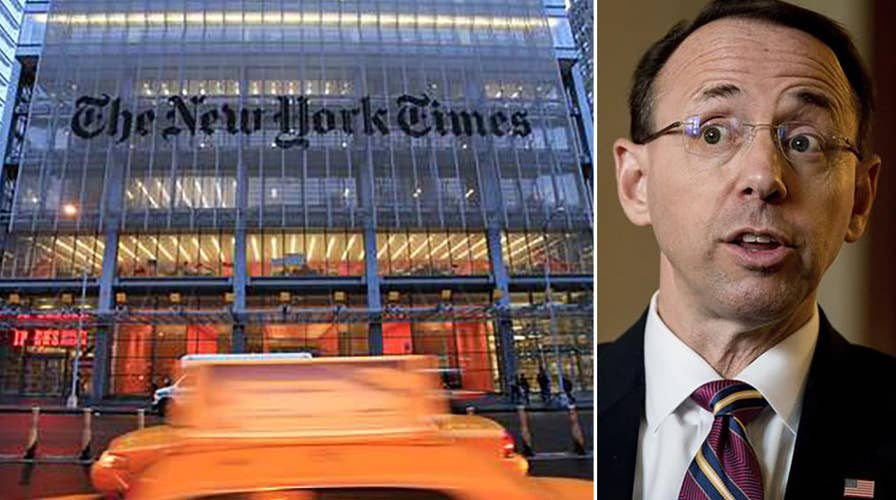
Politics of The New York Times' Rod Rosenstein report
Deputy Attorney General Rod Rosenstein says the New York Times report that he suggested secretly recording President Trump is 'factual inaccurate'; reaction and analysis from the 'Special Report' All-Stars.
This is a rush transcript from "Special Report with Bret Baier," September 21, 2018. This copy may not be in its final form and may be updated.
(BEGIN VIDEO CLIP)
JONATHAN TURLEY, GEORGE WASHINGTON UNIVERSITY: There is no relationship here. President Trump is highly antagonistic towards Rosenstein and Attorney General Jeff Sessions. This does not help that relationship. The most important question is whether this is going to be the straw that breaks that camel's back.
I think we have to keep in mind that the deputy attorney general denies all this and says that it's not true. He denies that there is a legitimate 25th Amendment case to be made.
(END VIDEO CLIP)
BRET BAIER, ANCHOR: Jonathan Turley on the story that broke late this afternoon. The New York Times moving this piece: "Rod Rosenstein suggested secretly recording Trump and discussed 25th amendment." The deputy attorney general putting out a statement, "The New York Times story is inaccurate and factually incorrect. I will not further comment on a story based on anonymous stories who are obviously biased against the department and are advancing their own personal agenda. But let me be clear on this. Based on my personal dealings with the president, there is no basis to invoke the 25th Amendment."
This deals with a meeting on May 16th between Rosenstein, Andrew McCabe, the former deputy FBI director, and Lisa Page, as well as four other career folks from DOJ. One senior official telling us that it was heated and that McCabe was charging that Rosenstein was blocking, getting in the way of aggressively investigating the president and his administration.
Rosenstein yelled back to McCabe's that he was going overboard and in the heat of the moment said, what do you want me to do, Andy, where a wire? And this person describes it going very heated. Do you want me to wear a blanking wire? And the people in the room suggest that that's how it went down.
Now, there's more to the story. This is a big deal. Let's bring in our Panel: Washington Post columnist Marc Thiessen Susan Page; Washington bureau chief at USA Today, and Katie Pavlich, news editor at Townhall.com. OK, Marc, thoughts?
MARC THIESSEN, WALL STREET JOURNAL: Rosenstein says that it's not true, the allegations are not true, and I think it's entirely possible that somebody is trying to goad President Trump into firing Rod Rosenstein because they know this would be a huge P.R. disaster for the president, giving him a pretext to be firing him over wiretapping him when in fact he'd be really firing him over Mueller and everything else that he's upset about. And so they want him to do this. Somebody's trying to get the president to, amazingly, be impulsive and do something not in his own interest.
One of the reasons is there is a CNN poll that 56 percent of Americans believe that Donald Trump has been obstructing the Mueller probe. And if you read Bob Woodward's book, it's the opposite. Bob Woodward lays out the unprecedented cooperation that President Trump has provided, something like 36 officials hundreds of hours of interviews. He didn't invoke executive privilege. Over 1.4 million documents. And so this will create an impression, again, that's already in the minds of the American people going into the midterm election that Donald Trump is obstructing the Russian investigation.
BAIER: Susan, we should point out that this denial is not point by point. It is a pretty broad and vague. These officials at the DOJ suggest that The New York Times had these memos from McCabe and Lisa Page, and they were responding to a number of things. And they suggest it's taken out of context. But your thoughts?
SUSAN PAGE, USA TODAY: So Rod Rosenstein's denial, as you say, is a non-denial denial. He denies the general, he doesn't deny the specific. And he says he does not seen any case, he used the present case for the 25th Amendment. He doesn't deny that he ever thought that it might be something that would apply.
I think this is, as you said, a very big deal. I think it confirms the worst suspicions of both sides. On one side, people who don't like President Trump, that it's so chaotic that top officials are talking about the 25th Amendment. But on the other side of people who support President Trump, that there is a conspiracy against him amongst top officials to deny the legitimacy or to threaten his presidency. So I think this is one of the most serious stories with repercussions to come that we've seen, even by the standards of these extraordinary times.
BAIER: Think about all the things we've seen, the anonymous op-ed, the Bob Woodward book, everything else. But this seems to have more to it. There is pushback from DOJ.
Quickly on this, I want to go to the breaking news right now.
KATIE PAVLICH, TOWNHALL.COM: Just quickly, I think it's difficult when you look at the players in the situation to take a lot of the allegations seriously. Jeff Sessions is cited in this piece as being one of the cabinet officials who was maybe going to be invoked to go with the 25th Amendment. The idea that Jeff Sessions would go to the primary, be the first senator to endorse the president all the way through the campaign, and then to the attorney general's office, and then somehow get roped into invoking the 25th Amendment just doesn't really hold a lot of water.
BAIER: Also, by the way, Rosenstein said today that he was not the anonymous op-ed writer. He was not a part of the list that had put out statements.
PAVLICH: The 25th Amendment narrative was first seen in that anonymous op- ed, so today with the language in this story that came out, we have a little bit of a tell of maybe where they came from.
BAIER: We'll see.
Here is the breaking news. Senator Grassley putting out a statement moments ago, Senate Judiciary Committee, "I am providing a notice of a vote to occur Monday in the event that Dr. Ford's attorneys don't respond or Dr. Ford decides not to testify. In the event that we can come to a reasonable resolution, as I've been seeking all week, then I will postpone the committee vote to accommodate her testimony. We cannot continue to delay."
So the offer is out there, the counteroffer was I think Wednesday for Dr. Christine Blasey Ford to testify, the accuser of Brett Kavanaugh. Now if they don't answer, it's out there. I think they have until tonight, then it's a vote on Monday.
THIESSEN: So I think Senator Grassley is 100 percent correct to do this. I think he has handled this fantastically. He has treated her with respect. He's given her an opportunity to present her case to the Senate, to the committee, and lay out the facts as she knows them.
But the truth is up until now there are no facts that have been laid out. There are accusations, but there's no evidence. There are allegations but no corroboration. And so at some point we have to ask ourselves what is the standard of evidence by which we need to have in order to destroy a man's life and his career and his reputation? She can't remember where it happened, where the house was, who was there except for a couple of people who deny it. There's literally no evidence.
And at some point if she's not willing to come before the Senate and make her case, then you can't destroy Brett Kavanaugh's life on the basis of somebody who makes an uncorroborated accusation and isn't willing to come to the Senate and present her case.
BAIER: Susan, the question is, does that, if they don't answer by tonight, does that satisfy Susan Collins, Lisa Murkowski, and Jeff Flake?
PAGE: That is the question. I think there have been some indications that Susan Collins in particular wanted to see her come and testify. And I think that's a perfectly fair point of view. I think it weakens her case if she does not come and testify in a public way and subject herself to questions, as difficult as that may be.
I do think that Republicans who give themselves a win on this vote and pay a high political price down the road because we already see the kind of energy coming around with the Me Too movement. This is almost the one year anniversary of the Me Too movement around the feeling that women who alleged sexual assault are not taken seriously and not treated appropriately. And that is -- has fueled already such energy among women since President Trump's inauguration. You could see more of that in just six weeks in the midterms.
PAVLICH: Just to that point, I would also say, though, if we are looking at white suburban voters as voters who are going to tell the midterm story, and while they are concerned about sexual harassment being taken seriously and sexual assault, they are also concerned about due process because they have brothers and fathers and husbands. And they look at the case and see an allegation has been made. This woman, as Chuck Grassley has been working all week -- he has dedicated his entire career to protecting voters, getting people to come forward, and making sure they have adequate resources to do so. Giving her a platform in whatever sense that she wants, private, public, in order to tell her story and be taken seriously. These are very credible, or very serious allegations. Grassley has tried to take them very seriously and has said that they are credible. And he's tired of playing games, and that's exactly what her attorney has turned this into and that's what the Democrats have been doing since day one while they held this for seven weeks.
BAIER: We shall see. We'll follow it all here.
Content and Programming Copyright 2018 Fox News Network, LLC. ALL RIGHTS RESERVED. Copyright 2018 CQ-Roll Call, Inc. All materials herein are protected by United States copyright law and may not be reproduced, distributed, transmitted, displayed, published or broadcast without the prior written permission of CQ-Roll Call. You may not alter or remove any trademark, copyright or other notice from copies of the content.
