


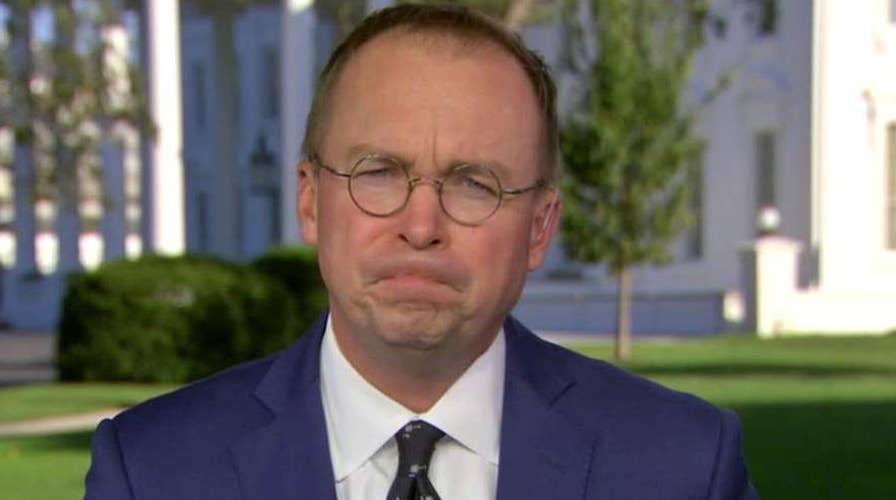
OMB Director Mulvaney on time frame for cutting spending
OMB director goes on 'The Story' to address dealing with the deficit and budget cuts.
This is a rush transcript from "The Story," October 17, 2018. This copy may not be in its final form and may be updated.
MARTHA MACCALLUM, HOST: So, we've got 19 days now and counting, until the big midterm elections folks. And tonight, we're getting our first look at some brand-new Fox News polls. A few surprises that we've gone through these numbers. A few surprises buried in there. So, what are the deciding factors and whose voters are actually going to show up at the polls in 19 days?
Good evening, everybody. I'm Martha MacCallum and this is "The Story" that everyone is trying to predict right now. So far, most of the experts that seem to agree that Republicans are likely to hold the Senate and lose the house. There is one huge question mark that hangs over all of this, and that's the memory of 2016 when conventional wisdom turned out to be so wrong.
One of the country's most prominent pollsters Nate Silver, who predicted that Hillary Clinton would win by 71 percent right before the elections is now doing a little bit of damage control ahead of these midterms. Writing this week that, "Polls and forecasts are pretty good instruments. But they are not all that precise. And we should all be prepared for the possibility of another election night like this."
(BEGIN VIDEOTAPE)
LAWRENCE O'DONNELL, HOST, MSNBC: America is crying tonight. I'm not sure how much of America, but a very, very significant portion and I mean literally crying.
RACHEL MADDOW, HOST, MSNBC: Am I right to ask about a doomsday plan? Do you see this as a doomsday scenario?
JONATHAN ALTER. CONTRIBUTOR, MSNBC: From slavery to -- you know, Nazism, we have faced challenges before.
JOY BEHAR, CO-HOST, THE VIEW, ABC: It was a rough night for everybody, I think. I'm -- you know, we're worried, the people are worried.
MADDOW: This is your life now. This is our election now. This is us, this is our country.
(END VIDEOTAPE)
MACCALLUM: Joining me now, Steve Hilton, host of the Next Revolution, who watched the Brexit vote that he worked on, surprised the world. And Brad Todd, who wrote "The Great Revolt" with Salina Zito which was a chronicle of what was really happening out there in America during the course of the 2016 election. Brad and Steve, great to have both of you with us.
BRADD TODD, CO-AUTHOR, "THE GREAT REVOLT": Thanks for having me.
MACCALLUM: So, Steve, let me start with you. Does anybody really know what's going to happen 19 days from tonight?
STEVE HILTON, FOX NEWS CHANNEL HOST: I think the short answer is no. By the way, what fun it is for me to see those clips again from election night. Can't get enough of that. I don't know whether we'll get more of that in a couple of weeks' time.
I think the story here is that there's a theory in polling and in communication that goes back to the early 1970s, it's called the spiral of silence. And what it says is that when there's a situation where there's a kind of approved point of view that everyone thinks is the right one. But it conflicts with what people really think.
They don't want to say their opinion because they think they're going to be criticized for it. That was so true with Brexit where all the establishment said, you got to be against Brexit. And yet, people didn't feel that way same with Donald Trump.
Right up until recently, I felt that, that wasn't the case this time around because everyone is so open about their how they feel about President Trump and so on. But that changed slightly with the Kavanaugh battle where it seemed to me that again, you've got this approved view from the establishment about what you're supposed to think.
You're supposed to be someone who believes in Dr. Ford and if you believe Kavanaugh, then, there's something not quite right about you. I think that's changed the dynamic.
And I think that once again, you're seeing people feeling something that isn't quite OK to say out loud, that might turn into real votes.
MACCALLUM: It might.
HILTON: In the election and surprise us all over again.
MACCALLUM: Well, yes. It's a very interesting the way you point that out. And you know, when you look at these numbers, Democrats hold the lead by about seven percent. That's the same as about a month ago, Bradd.
So, that number has not changed. President Trump's approval number went up to 47 percent. It was at 44 percent in the last poll that we looked at. So, what's your read on this as you take it all in, Bradd?
TODD: Well, the Kavanaugh confirmation has been a pretty big deal for the Republican coalition. You know, we've -- if you read the book, we believe that there's a realignment that's taken place, and the Republican electoral coalition is slightly different than what it had been in previous years.
And up into this point of the Trump administration, you've had the old traditional Republican part of the GOP coalition. Not quite know the value long term of Trumpism and you had some voters who like Trump better than they liked Republicans. And they didn't see the value in electing a Republican majority.
In the Kavanaugh confirmation, Republicans saw that it took someone as tough as Donald Trump to stand by Kavanaugh and get him through that fire. And Trumper saw that it took a Republican majority to achieve the president's objectives. That's pretty important going into the election.
MACCALLUM: Very interesting. Let's take a look at the one that shows what's really important to people, which elements are most important to them. Healthcare, 58 percent. The economy right near that at 48 percent - - I'm sorry, 54 percent.
Interesting to note too that you go all the way down to the bottom, you've got the Mueller investigation, 30 percent say that, that is what matters to them. Steve, what's your take on that poll?
HILTON: Generally speaking, my view based on a lot of Elections I've worked on is that it's much easier to change the agenda -- the political agenda what is people -- what are people talking about? What's at the front of their mind when they go and vote? Then, it is to change their opinion.
So, that's not good news for Republicans if health care really is at the front of people's minds. And so, they need to work really hard to raise the relevance of the issue where they're strong, and that's obviously the economy.
But there's one other I'd point to which is immigration. It's actually quite far down the list, but it's one where the base of the Republican Party strongly agrees with what President Trump stands for on that issue. And as that news agenda changes perhaps with this caravan coming up through Central America, that could raise the relevance of an issue that could be good to get out the Republican base.
MACCALLUM: Very interesting. And what's interesting about that, we are seeing -- you know, a lot of enthusiasm among women and democratic women saying that they are driven by the candidates who are out there. So, I think that's probably a positive sign for some of these Democratic candidates.
But if some of these House races, Bradd, are happening in places where you have a lot of moderates -- you know, outside of the cities, in the suburbs. And a lot of women who actually do care about things like immigration and border security, and those kinds of issues, and that will be an interesting factor here now.
TODD: It is. And the House and Senate are two really different stories. You know, Donald Trump ran behind Mitt Romney's number in 86 of the 100 largest counties in the country. A lot of House races are in those large counties in metropolitan areas.
Donald Trump ran ahead of Mitt Romney in 1,450 of the 1,500 smallest counties. And so, those counties dominate a lot of the Senate states, Missouri, Montana, Indiana, North Dakota.
And so, you really are kind of seeing a tale of sort of two different kinds of Americas in this -- in this election. And for Democrats, have pinned their hopes on those dense suburbs, that were a lot of suburban women -- independent women have negative views of the president.
Republicans meanwhile, have a great chance in states where there are rural industrial voters. And you know, I think immigration rising is an issue favorite Republicans if it becomes a bigger issue toward the November elections. You know, Independents tend to side with Republicans on immigration and other security type issues. And they side with Democrats on things like healthcare and education.
MACCALLUM: And maybe on Brett Kavanaugh. So, we will see. Thank you guys, Bradd and Steve, great to see you tonight.
TODD: Thanks a lot. Appreciate it.
HILTON: Thank you, Martha.
MACCALLUM: So, did Elizabeth Warren damage her chances for 2020 with this whole DNA test? And is she wishing that she never did the whole thing and open this can of worms? Bill Bennett, coming up next on that.
(BEGIN VIDEO CLIP)
SEN. ELIZABETH WARRE, D-MASS., SENATE ARMED SERVICES COMMITTEE: Now, the president likes to call my mom a liar. What are the facts say?
CARLOS BUSTAMANTE, PROFESSOR, STANFORD UNIVERSITY: The facts suggest that you absolutely have a Native American ancestry in your pedigree.
(COMMERCIAL BREAK)
(BEGIN VIDEOTAPE)
UNIDENTIFIED FEMALE: I'm already seeing though a number of names online, Elizabeth Warren, one 120th or something for president.
CHRIS CILLIZZA, CNN POLITICS EDITOR-AT-LARGE: I just think this will be used against her by her Democratic opponents. Maybe not publicly, but whisper of her campaign of, "She's -- do we want to risk someone with this known problem that he has attacked and he has fixated on, to on a risk a nomination, something like that.
WOLF BLITZER, HOST, CNN: Rebecca.
(END VIDEOTAPE)
MACCALLUM: So, some on the media, and some on both sides of the aisle kind of underwhelmed by the reality of Elizabeth Warren's argument that she's part Cherokee. Now, that the results of the test are out there showing her to be as little as one 1/1000 24th Native American.
But Warren doubling down, telling the Boston Globe, "I have an election. I got this analysis back, and I made it public." But if she may be wishing that she had left the DNA test in the box at this point?
Bill Bennett, host of the Bill Bennett podcast, and a Fox News contributor, joins us now. Bill, always good to have you with us. What do you think the answer to that question?
BILL BENNETT, FOX NEWS CONTRIBUTOR: Thank you. Yes, I think she's dealt herself a grievous blow. I think she's done. You know, there are smart people who teach at Harvard Law School even if some of them got in on identity politics which apparently she did. But I've never thought she wasn't a very smart person. Skillful, agile, intelligent, quick on her feet. But this was a very dumb move.
Look, when she got the results, there had to be a critical moment there, Martha, in her office. When she said, well, there it is 1/512, I think is the average, maybe 1/1,000th as you said. There must have been people sitting there saying, "Well, I guess that's it. We're done. Let's keep that quite.
MACCALLUM: Yes, and may not want to go with that. Exactly.
BENNETT: But she's -- but she -- but she ran with it, and it's preposterous as we have heard that in the days since hours after. And then, they since the average American has more Native American blood in him or her than does Elizabeth Warren.
So, she has not only done great damage to herself. And obviously, many Democrats are very upset about it. A few Democrats running for president probably pleased with it. But she's done great damage to the cause of racial and ethnic identity politics.
MACCALLUM: But let's play this from one of the descendants of Pocahontas, because -- you know, she's actually being called out by Native Americans to apologize at this point.
BENNETT: Yes.
MACCALLUM: Watch this.
BENNETT: Yes.
(BEGIN VIDEO CLIP)
TUCKER CARLSON, FOX NEWS CHANNEL HOST: Do you think that other Native Americans feel as you do?
DEBBIE PORRECO, DESCENDANT OF POCAHONTAS: I do, I do. I think they feel betrayed. They feel disappointed. You know, and --
CARLSON: Yes.
PORRECO: I think at this point, she needs to come back and, and just -- and apologize to everybody for what she's done.
(END VIDEO CLIP)
MACCALLUM: You know, I mean, we live in a period, Bill, where cultural appropriation is -- you know, cafeterias at colleges get criticized if they make tacos and sushi that their -- you know, cultural appropriation is -- you know, a problem.
BENNETT: Right.
MACCALLUM: So, I mean how this could not be seen as that? I don't think it can.
BENNETT: That's right. You know it's ironic here, is that one of the most liberal states in the country, Massachusetts, is now the center of what may be the most important blow against racial identity politics.
You have Elizabeth Warren, Senator from Massachusetts, you have this lawsuit against Harvard. All about the same thing. Consider what Elizabeth Warren has done in the larger context of colleges and universities. Everybody knows about the application form, Martha. You check a box. White, Caucasian, African-American, Pacific Islander, Native American. Well, can you imagine the number of people saying, well, if Elizabeth Warren can check Native American, so can I.
And so what happens when you have you know, thousands of people checking the right boxes because everyone knows that some groups are favored rather than others, this is going to create chaos. Next step, just give me a second, then you say well you must prove here what 20 percent, 30 percent. We're now then into mongrelization. You remember the Nuremberg Laws in Germany. If you had one grandparent who was Jewish, you were Jewish. This is an ugly business, always has been and she has perhaps contributed unwittingly to the beginning of its demise, I hope so.
MACCALLUM: Yes, that's fascinating.
BENNETT: It shows the absurdity of racial politics. I'm sorry, what?
MACCALLUM: Well, I think that's fascinating because it does -- it raises the question well maybe we don't need these boxes on any of these applications. Maybe everyone should just apply and that's the argument that's being made by some in the Harvard case right?
BENNETT: Right. If some people are winners, some people are losers is which is what the Asian kids bringing this suit are saying. But this is the ugliness of this -- of this business and if everybody is Native American, then nobody is Native American except those people who can claim as you mentioned the people from the Cherokee Nation and so on. But then what becomes the test? Isn't it better to just do what Lincoln said which is regard all of us as citizens, all of us who came here legally or who were born here and just start on that equal basis?
This could lead to a lot. There could be a lot of repercussions on this more broader culturally. Another evolution starting in Boston, maybe not the one the Liberals want.
MACCALLUM: Fascinating. Bill, great point. Good to see you as always. Thank you, Bill.
BENNETT: Thanks, Martha. You bet you.
MACCALLUM: So the White House is eagerly awaiting the return of Mike Pompeo from the Middle East. He is expected to be at the White House tonight. They want answers surrounding the conversations that happened when he was there with regard to the death of journalist Jamal Khashoggi. A live report from the White House next.
UNIDENTIFIED MALE: But we're not going to walk away from Saudi Arabia.
PRESIDENT DONALD TRUMP: No, I don't want to do that. I don't want to do that. I do not want to do that. I hope that the King and the Crown Prince didn't know about it. That's a big factor in my eyes.
(END VIDEO CLIP)
(COMMERCIAL BREAK)
MACCALLUM: President Trump at this hour is still waiting to see the evidence despite reports surrounding the death of journalist Jamaal Khashoggi growing more gruesome by the hour. There are indications that four of the men who were involved have close ties to the Crown Prince. You can see one of them pictured in his detail here. And reports of audio that are said to exist that reveal the horrific seven-minute torture and then killing of Jamaal Khashoggi involving first severing his fingers then beheading and dismembering him, as the killers blocked out his screams by listening to music on their headphones.
The president says that Mike Pompeo could be at the White House tonight back from his trip to the Middle East and ready to discuss the next move as the world watches very closely. Chief National Correspondent Ed Henry live at the White House right now with the very latest tonight. Hi, Ed!
ED HENRY, FOX NEWS CHANNEL CHIEF NATIONAL CORRESPONDENT: Martha, great to see you. The President again reminding the media and the rest of the world today about that important American concept of innocent until proven guilty. In fact, he linked this case in an interview with the A.P. to Brett Kavanaugh, the justice and the allegations against him. But what might be the big difference of course, is there was no corroborating evidence against Kavanaugh but in this case this story is turning against Saudi Arabia hard.
The President stressing that all this is coming in a broader context. He did an interview with Fox Business today. He said the U.S. needs Saudi Arabia in the fight against Iran, various terrorists around the world, but that has left him open to critics saying that he's giving Saudi Arabia the benefit of the doubt, letting them off the hook when the details that you just mentioned keep pouring in about the death of Washington Post Columnist Jamal Khashoggi and they're simply horrifying.
Reports tonight that he was butchered alive during that gruesome execution inside the Saudi consulate in Istanbul. Audiotapes allegedly revealing Khashoggi was beheaded and then dismembered. One tape has a Saudi official declaring "do this outside, you're going to get me in trouble." Another voice response "shut up if you want to live when you return to Saudi Arabia."
Well, the President said today he has asked for any tapes that do exist. His Secretary of State Mike Pompeo as you mentioned headed home here to Washington after visits with leaders in Turkey and Saudi Arabia both men saying they've been promised a full investigation as they also stress they do not want long-term damage to the Saudi relationship. Listen.
(BEGIN VIDEO CLIP)
TRUMP: Frankly, they have a tremendous order $110 billion. I've had some senators come up and some congressmen, they said, well, you know sir, I think what we should do is we should not take that order. I said, who are we hurting. It's 500,000 jobs. MIKE POMPEO, UNITED STATES SECRETARY OF STATE: We have lots of important relationships, financial relationships between U.S. and Saudi companies, governmental relationship.
(END VIDEO CLIP)
HENRY: Well, the tapes you mentioned are explosive because they suggest culpability by the Saudi Crown Prince Mohammed bin Salman. The Washington Post reporting 11 of the 15 killers in this so-called hit squad have ties to Saudi security services. One official (INAUDIBLE) even traveling with the Crown Prince during his tour of the U.S. earlier this year. And just breaking a short time ago, the Washington Post revealing that tomorrow they will publish a special opinion page devoted to Khashoggi and his situation, his legacy if you will, including a never before published column that he had finished before what is believed to be his death. They have still not found his body. Interesting, that column allegedly talks about the importance of a free press in the Mideast. Martha?
MACCALLUM: That may be the last we hear of his voice. Thank you very much, Ed. Joining me now, Judith Miller Pulitzer Prize Winning Investigative Reporter, Fox News Contributor. Judith, welcome back. Tonight, you've been covering the story with us throughout the course of it. What can you add to what we heard here?
JUDITH MILLER, FOX NEWS CONTRIBUTOR: Well, I think what we can add is that President Trump is desperately trying to buy some time until he can figure out whether or not there's a way to avoid the obvious assumption that MBS ordered this execution. And if they can't get around that, what do we do as a nation to preserve our special relationship with Saudi Arabia and the interests that we all have in a stable Saudi Arabia. Because I don't think they know what to do now.
A very disturbing addendum to the excellent report that you've just heard from Ed Henry was that Mohammed al Otaiba who was the Saudi counsel who was told to leave the room apparently during this procedure was recalled to Riyadh and he has been fired which might be laying the groundwork for blaming him in this episode which is impossible to believe if you see the number of people connected to the Crown Prince's office, his bodyguards, advisers, his people who were there, it's hard to imagine that a general counsel -- Consul General ordered such a barbaric act. I mean, I think this is a huge problem for Donald Trump at this point and for America and for the Saudis.
MACCALLUM: The President is asked about whether or not the FBI was involved. Here's what he said.
(BEGIN VIDEO CLIP)
UNIDENTIFIED MALE: We're talking about a man who lived across the river in Virginia. Why not send the FBI in to figure all this out?
TRUMP: Well, he wasn't a citizen of this country for one thing and we're going to determine that. and you don't know whether or not we have, do you? No, but you know whether or not we've sent the FBI?
UNIDENTIFIED MALE: Have you sent the FBI?
TRUMP: I'm not going to tell you.
(END VIDEO CLIP)
MILLER: We don't know yet, at least I don't know. Secretary of State Pompeo is on his way back. He's going to meet with the President and he will at that point tell him exactly what he thinks needs to be done. Remember, this is where Secretary Pompeo's previous job, as head of the CIA, is going to be very useful because he will know what the CIA assessment is, how stable the Kingdom is of whether or not there's any talk within the family that this is the time to move the brash young Crown Prince out of the line of succession.
None of these things are known now. The Saudis are very quiet and this is a very, very difficult Kingdom to penetrate. So I think this meeting between President Trump and Pompeo will be crucial to the decision the president makes on how to handle this. Look, the Senate is going to do something no matter.
MACCALLUM: What can they do? What can they do?
MILLER: Well, they can do a lot. They can -- they can sanction Saudi Arabia, they can ban arms deals which they almost did last year. They can stop cooperation on a lot of levels which would be my destructive --
MACCALLUM: -- Magnitsky Act against Saudi Arabia --
MILLER: Yes, against individual --
MACCALLUM: Which would restrict travel of all of these high-level individuals in the government.
MILLER: Right, but I'm not sure that that's going to be sufficient given what we've already heard about what went on inside the consulate. I think you have to assume that this was ordered at a very high level and therefore punishing the individuals who actually carried out the action will not satisfy the Congress. But I hope that nothing is done that people do take step back.
This is very difficult for me because I did know Jamal, I have known him for many, many years but there are many, many interests to be balanced here if this is a horrific crime. But if we overreact, we could jeopardize the stability of a long-standing ally. So this is a very difficult balance for President Trump to strike.
MACCALLUM: Three level chessboard action. Judith, thank you very much.
MILLER: Exactly.
MACCALLUM: I'm sorry about your friend. I know you knew him well. It's horrible story. All right, Judith, thank you.
MILLER: Thank you.
MACCALLUM: So it is the political move that is sparking some fierce backlash.
(BEGIN VIDEO CLIP)
SEN. SUSAN COLLINS, R-MAINE: Mr. President, I will vote to confirm Judge Kavanaugh.
(END VIDEO CLIP)
MACCALLUM: Republican Senator Susan Collins facing the fury of nearly 2,000 alumni from her alma mater who say that her decision to support Justice Kavanaugh calls for her honorary degree to be revoked.
(COMMERCIAL BREAK)
MACCALLUM: So, this is Susan Collins on the Senate floor in her now-famous speech before casting her vote for Brett Kavanaugh. This line is one that many have said made it one of the most memorable Senate speeches ever.
(BEGIN VIDEO CLIP)
COLLINS: We must always remember that it is when passions are most inflamed that fairness is most in jeopardy.
(END VIDEO CLIP)
MACCALLUM: The passions are still very inflamed. And now some members of the faculty and some alumni of her alma mater are calling for her honorary degree to be revoked because they think her vote was wrong. And that among other things, it signaled that she was not concerned enough about ending campus rape culture.
Jonathan Turley wrote about this story today and said this. "These professors and graduates are seeking to retroactively punish Susan Collins for a reaching a conclusion different from their own. These professors and students vividly demonstrate how power without principle is little more than a mob dressed up as a movement," he writes.
Joining me now, Jonathan Turley, George Washington law professor and Fox News contributor. Jonathan, welcome. Good to have you with us.
JONATHAN TURLEY, PROFESSOR, GEORGE WASHINGTON UNIVERSITY: Thank you.
MACCALLUM: So, I should say were off the bat that I, too, am a graduate of St. Lawrence University. I know that you said that Susan Collins was the most famous graduate, and I would say that's true. But also, Viggo Mortenson, Kirk Douglas, Eleanor Mondale, all of these people went to St. Lawrence.
And I would also say that I've heard from many individuals, and there are many people who support her and who do not agree with the sentiment in this alumni letter or in this faculty letter. But that being said, this is a very strong letter. And it basically says that they want to remove one of the two honorary degrees that she got because, essentially, they don't like the conclusions she reached, Jonathan.
TURLEY: That's right. And what's most disconcerting is that you have almost 100 professors from virtually every department in the university, signing this letter. The most fundamental obligation of professors is to preserve intellectual honesty and institutional integrity, to convey to students that a college or a university is a place for diversity of ideas. There's no one path, like the one described in this letter.
There's multiple paths in a world full of different ideas. And that's what is so disconcerting. You know, this is a school with about 217 full-time and part-time professors. Almost 100 of them signed this letter.
MACCALLUM: Yes, that's true. And they say that rescinding the honorary is not rooted in partisan loyalties. And they go on to say, though, that she received the award, originally, because she was, quote, "willing to break party ranks." But then it turns out that when she did vote with her party, they want her to lose the degree.
So, they are saying that they recognized how great it was for her to break party ranks but when she didn't, and she, you know, spoke her mind in another direction, that somehow that means that she doesn't uphold the values of the university?
TURLEY: That's right, they celebrated her independence of thought and action, until that took her in a direction that they didn't agree with. That's a truly sad aspect of this. This is a wonderful school.
MACCALLUM: It is.
TURLEY: It has a really rich history.
MACCALLUM: Absolutely.
TURLEY: And these professors, in my view, are leveraging that history and doing great harm to their institution.
MACCALLUM: You know, they also say that she cherry-picked the evidence. And they say that she was preserving the crucial role of evidence-based decision-making when she got the award. But they're saying she abandoned that because she didn't pay attention to the scientific evidence that said that this Professor Ford, you know, understood memory better than they did, that scientists backed that up.
There's no mention in the letter whatsoever of recognizing the other side of the equation, the non-corroboration. In fact, it says that her story was corroborated in the letter. But we know that that is not true, the story was not corroborated, Jonathan.
TURLEY: Yes. Look, people, reasonable people can disagree about the conclusions reached in the confirmation.
MACCALLUM: Absolutely.
TURLEY: This is, there was a paucity of evidence, there was not direct corroboration, it came down to a credibility test for many. But what is so concerning is the argument of these professors that there is no other option. They say we don't -- we're not doing this because we disagree with her position. We just believe that there's no ground upon which she could reach a different conclusion. now that's the type of imbecilic logic that leads to serious problems on universities.
MACCALLUM: You know, it -- they also say that she showed unwarranted skepticism towards Dr. Ford's claim. And as you say, you know, everyone has a right to free speech, and they have every right to write this letter, to sign the letter, to start a petition. I don't think anyone argues with that.
But to sort of not recognize that the other side of the argument also has validity, and that as a senator she -- you know when she got up there, she talked about the hours that she went through, of the evidence, and how difficult a decision it was for her to reach. So, I just think to not recognize that she spent time and energy looking at everything, is somewhat, you know, an unfair academic criticism.
TURLEY: Well, it's bizarre. Half of this country believed that he should be confirmed. Half the Senate believed he should be confirmed. But these professors are saying that's not a good-faith option. All of those people are somehow rape apologists and that there's this rape culture at St. Lawrence.
MACCALLUM: But by all accounts that I have read, and you know, I went there a long time ago, so I talked to some people who are currently there, they said that is an absolutely unfair characterization. And you know, they say that there's a rape culture there and then they say that they have a process for dealing with it and that occasionally that process leads to punishment.
I'm thinking if there's a rape culture there, it needs to lead to punishment more often than occasionally and you better be calling the local police to get over there and deal with it. But you know, I think that that is not a fair assessment from everything I can tell--
(CROSSTALK)
TURLEY: Of course, it is.
MACCALLUM: -- of the reality on the campus. And they're not the only, I mean, that this charge is, you know, all over the country.
TURLEY: Well, it's also very odd, you've got about half the faculty saying there's a rape culture on campus, that leaves the other half, I suppose, supporting the culture? I don't understand where this goes if half of the faculty is saying we need to deal with something about our rape culture.
MACCALLUM: Well, we should say that the university said that they've never revoked an honorary degree and there's no indication that they intend to do that. I did think as a kicker at the end of the letter which says this, at the end of this whole letter, "We continue to be grateful for her willingness to be a regular speaker who inspires our students at our D.C. connect events.
TURLEY: You're right.
MACCALLUM: I mean, I don't know if she's going to show up for the next D.C. connect event. But I thought that was an interesting--
(CROSSTALK)
TURLEY: Right. She might be a rape apologist--
MACCALLUM: Yes.
TURLEY: -- but we still prefer her to come and speak to us.
MACCALLUM: Yes. It's a wonderful school. I got a great education there and I know there are a lot of people who feel on all sides of this.
(CROSSTALK)
TURLEY: It's a great school.
MACCALLUM: So, Jonathan, thank you for writing about and thanks for coming on tonight.
TURLEY: Thank you, Martha.
MACCALLUM: So, remember this?
(BEGIN VIDEO CLIP)
THEN-PRESIDENT BARACK OBAMA: What we've done is we have taken a scalpel to the discretionary budget rather than a machete.
(END VIDEO CLIP)
MACCALLUM: So, cutting spending is something that nearly every president says they will do. But today President Trump said he means it. And that it's about to begin. Mick Mulvaney, Trump's director of the Office of Management and Budget explains the president's plan, next.
(BEGIN VIDEO CLIP)
PRESIDENT DONALD TRUMP: Get rid of the fat. Get rid of the waste.
(END VIDEO CLIP)
(COMMERCIAL BREAK)
(BEGIN VIDEO CLIP)
TRUMP: We're here today for one single reason, to cut the red tape of regulation. I am challenging my cabinet to find and remove every single outdated, unlawful, and excessive regulation currently on the books.
(END VIDEO CLIP)
MACCALLUM: That was President Trump almost a year ago pledging to remove regulations that have gridlocked Washington. And today he is going further, employing his cabinet members to get onboard with his, quote, "nickel plan."
(BEGIN VIDEO CLIP)
TRUMP: I'm going to ask each of you to come back with a 5 percent budget cut, from your various departments, whether it's a secretary, an administrator, whatever. I've heard about the penny plan for 15 years. One penny, every year, per dollar. One penny every year. After four or five years the country is in good shape. I'm saying let's not do the penny plan, let's do the five-penny plan, we'll call it the nickel plan. At least there will be one-year nickel plan.
(END VIDEO CLIP)
MACCALLUM: So here now exclusively the director of the Office of Management and Budget, Mick Mulvaney. Sir, good to have you with us today.
I think that, you know, conservatives will applaud that. I guess the question is accountability, how is the president going to follow through on this. When does he expect this 5 percent cut to all of these agencies to come to fruition?
MICK MULVANEY, DIRECTOR, OFFICE OF MANAGEMENT AND BUDGET: Well, he asked all of the cabinet secretaries today to take three or four weeks to work with the Office of Management and Budget to do exactly that. I think it's noteworthy what you saw was the public part of the meeting. When the press left and we had the private part of the meeting, the last two times that we've talked about budgets in the cabinet meeting he's turned to me and asked me to talk about the budgets.
Today it was all the president. The president led the entire discussion. Like I didn't even say a word. It was the president's idea. He's leading this. And I think the cabinet secretary is going to take it very, very seriously.
MACCALLUM: All right. So, here's what he said today about the last budget that you had to do. Watch this.
(BEGIN VIDEO CLIP)
TRUMP: The last budget we had to go because of the military, we had to fix our military. I made deals with the devil in order to get that done because we had to improve our military. Our military was depleted, it was in bad shape.
(END VIDEO CLIP)
MACCALLUM: So, you know, I think that that was understood that that was kind of an exchange to get what you all wanted in defense spending and you had to kind of swallow some other spending increases that maybe you would rather not have done.
But I guess one of the big questions is, you know, Republicans have had control of the House, the Senate, and the White House now since the president came into office. But there's a good potential that they're about to lose the House. So, how, why now? I mean doesn't it feel a little late to the table?
MULVANEY: No. First of all, keep in mind one of the reasons we've struggled had to make that deal with the devil that the president mentioned, is that appropriations bills like most bills, not all but most bills, take 60 votes in the Senate. And since the Republicans don't have 60 votes in the Senate that automatically implies Democrats have to participate, it has to be bipartisan.
And the one thing that's really bipartisan in Washington, D.C. is spending more money. It's what you essentially buy Democrat votes. So that's why we did what we did.
You and I can talk maybe another time about the control of the House. I'm not as convinced as you are that that's getting ready to happen. But regardless, these are the president's priorities. He takes the deficit seriously, he's taking spending seriously, we're doing a great job of growing the economy and getting new revenues into the government. In fact, the revenues are all-time highs but the deficit is still increasing. So we have to look at the spending side of the ledger and that's what you saw today.
MACCALLUM: So, I guess what's the time frame for that, when would you be able to get this done, and you know, who knows what the outcome is going to be in the House? I think if anybody's guess at this point. There are a lot of tossup states as you look at it. But what's the time frame for cutting spending, you know, it does feel like it's sort of the wire may be running out.
MULVANEY: No, no. Keep in mind, we just ended the fiscal year. Our fiscal year ended the end of September.
MACCALLUM: Right.
MULVANEY: So, we're actually just starting this fiscal year. So now the money is all spent for 2019, we're just starting. We're actually starting, believe it or not, right now on the 2020 budget. So, what we roll out in March or February of next year is actually already started, and started to get into the details right now.
So, this is the exact appropriate time to have it. And the normal time to have these types of discussions. So, the president is doing the right thing at the right time.
MACCALLUM: All right. Let's talk about the deficit which you mentioned. The treasury says it's $797 billion, that's a 17 percent increase over the previous year, it's the highest deficit that we've seen in six years.
And you pointed out there's so many amazing positive strengths that we're seeing in the economy when you look at jobs, when you look at the cuts that have happened in regulation and what that has unleashed in the U.S. economy, I think by anyone's measure that's an extraordinary story. But the deficit is a tough picture.
MULVANEY: Sure. the deficit actually is not that tough, it's easy in the sense and that it only has two pieces. Money in and money out. And money is now coming in because of the economic policies that the president has put into place. Money is coming in at a record rate.
It's just going out even faster in large part because of the Senate Democrats that I just mentioned. So, it's actually a fairly simple mathematical calculation. We just need to figure out a way to do better on spending. and the president gets that.
We will grow the government. We have proven that, we're going to continue to grow the government, we continue to think that this expansion is still on strong fundamentals. But if we're going to see meaningful changes to the deficit we have to focus on the money out, the spending at the same time.
MACCALLUM: Yes. Many would say that you also have to focus on entitlements. Mitch McConnell has spoken about this recently. I mean, you really can't make a significant dent in the spending in this country without touching that so-called third rail. Are you prepared to do that?
MULVANEY: A couple of different things, because that's actually not true. The social security only accounts for about 85 billion of deficit this year. Medicare, I think is about $300 billion of deficit. So, everything else is everything else.
So, when you say entitlements and Mitch McConnell talks about entitlements, social security and Medicare are a challenge to the deficit several years out. Right now, they're actually not what's driving the deficit this year.
We had things like hurricane spending, and a bunch of different things, we had a CAPs deal that increased spending last year. So, it's actually the discretionary spending that's having a big impact right now. Keep in mind that the president's budget that we introduced last year, was the largest mandatory of spending reduction proposal in history. But it did not touch social just or Medicare.
There is a lot of other entitlement programs that we could fix, that we can reform, without touching core social security and core Medicare. We've already offered that, and we would welcome that discussion. But again, everything on this topic needs 60 votes in the Senate, and that's where we hit a roadblock.
MACCALLUM: All right. Mick Mulvaney, thank you very much. Good to see you tonight, sir.
MULVANEY: Thanks, Martha.
MACCALLUM: You bet. So, by now you probably heard that Steve Doocy has a new cookbook, in fact, it's the bestselling cookbook. And what you did not know and Steve is not publicly revealed, is that I taught him everything he knows. He's up next.
(COMMERCIAL BREAK)
MACCALLUM: We did not talk about food a whole lot on The Story but it is always at the center of every celebration from birthday dinners, one of which I'm going to tonight for my husband, to weddings and graduation parties and football Sundays.
So, when you've took all those memories and you put them in one cookbook, do you know what it would be? It would be Steve Doocy and his wife, Mrs. Doocy, Mr. and Mrs. Happy's cookbook, "The Happy Cookbook." It is the best cookbook that I have ever seen. I love it so much and Steve is here, as co- host of Fox and Friends, good friend of mine.
STEVE DOOCY, FOX NEWS CO-HOST: Thank you.
MACCALLUM: -- and he joins me know. Hi, Steve.
DOOCY: Hello, Martha. You know, the book, we heard tonight it's an international bestseller. As it turns out it struck a chord because it seems like we have learned that foods are able to -- whether you smell them or you see them or you think about them are able to activate something in the nostalgia department of your brain and they remind of happy times.
(CROSSTALK)
MACCALLUM: So true.
DOOCY: Coming up in two days, we were talking about how tonight you're celebrating Dan's birthday.
MACCALLUM: Yes.
DOOCY: In two days, my wife Kathy will make the same four-pound chuck roast that my mom when I was growing up would make for me on my birthday where she puts (Inaudible) on your soup, the cream of mushroom soup, she puts into a Dutch up and she cooks it all day. I walk in the house, even today, you smell it.
(CROSSTALK)
MACCALLUM: There it is.
DOOCY: That's my mom's pot roast.
MACCALLUM: And you get that every year on your birthday?
DOOCY: Absolutely. And she also makes the German chocolate cake, which she made my dad and then made me and it's just one of those things. And as we were doing the book tour over the last couple of weeks, so many people have come up to us and said, you know what, I wish I would've kept more of my mom's recipes.
MACCALLUM: Yes.
DOOCY: Or I wish it would have had my mom write down some recipes and you, Martha MacCallum, actually helped us with the cookbook. There are two fantastic recipes. Betty's bourbon pumpkin cheesecake. That is right out there.
(CROSSTALK)
MACCALLUM: Delicious.
DOOCY: That is the best dessert I have ever had in my life.
MACCALLUM: It is so good.
DOOCY: And last week, Martha and I were preparing a segment for an upcoming episode of Fox Nation.
MACCALLUM: Yes.
DOOCY: You click out Foxnation.com.
MACCALLUM: There we are.
DOOCY: And there we are in her kitchen out in New Jersey and you are a good cook.
MACCALLUM: Now I said I make two things and they are both in Steve's cookbook. The Pumpkin cheesecake and the all-day beef stew and we made both of them at my house and it smells delicious in the house.
DOOCY: There's the stew.
MACCALLUM: And Steve made me drink red wine at like 10.30 in the morning.
DOOCY: Wait, wait, wait, no. I didn't make you -- she poured the red wine, she said you're probably tired. But here's the thing about that, Betty's bourbon pumpkin cheesecake.
MACCALLUM: Yes.
DOOCY: It turns out Martha MacCallum loves her bourbon.
MACCALLUM: I do.
DOOCY: And we had a food stylist who brought the stuff and she look at the bourbon that food style has brought and goes I'm not drinking this. Then went back to the pantry.
MACCALLUM: And there was a bottle of bourbon that had like this much left and there were fingerprints all over it. It's not a good look.
DOOCY: It stood open. She loves her Bullet.
MACCALLUM: Now you know what, but there's only a little bit, a little bit of Bullet in the bourbon pumpkin cheesecake but it was delicious and the book is just great. It's like all those comfort foods that you grew up with and you have all these different people's favorite recipes in there and thank you so much for including my mom's all-day beef stew and the pumpkin bourbon cheesecake, which is delicious.
And I like how comfortable I look in the kitchen in this video. I mean, Martha Stewart--
(CROSSTALK)
DOOCY: Eat your house.
MACCALLUM: Eat your heart out, right? Martha MacCallum, I'm going to start my own cooking show.
DOOCY: Martha Stewart MacCallum.
MACCALLUM: Yes, well.
DOOCY: Why not? Look at that. That is so good. Folks, if you're thinking about something for Thanksgiving, make your most.
MACCALLUM: Yes, that's what I make -- I make it every Thanksgiving, the bourbon pumpkin cheesecake.
DOOCY: Right.
MACCALLUM: My sister Liza is an excellent cheesecake baker, this is the only one that I really specialize in.
DOOCY: And you got children a couple of children floating around in college. When they come home you make the all-day stew and it's like my mom's pot roast.
(CROSSTALK)
MACCALLUM: Everyone loves the smell of it.
DOOCY: If you walk in the house and it smells great. And it's fantastic. And thanks to everybody for buying the cookbook. It sold out on the first day. They printed up a whole bunch of--
(CROSSTALK)
MACCALLUM: Lucky that I got my copy early.
DOOCY: Absolutely. They're now available. And Martha, thanks for taking part. I'm helping so many people relive their happy memories.
MACCALLUM: Thanks, Steve. Great to see you. You are up late. All right. So that's our story for tonight. We'll see you back here tomorrow night. Tucker Carlson is coming up next.
Content and Programming Copyright 2018 Fox News Network, LLC. ALL RIGHTS RESERVED. Copyright 2018 CQ-Roll Call, Inc. All materials herein are protected by United States copyright law and may not be reproduced, distributed, transmitted, displayed, published or broadcast without the prior written permission of CQ-Roll Call. You may not alter or remove any trademark, copyright or other notice from copies of the content.
