


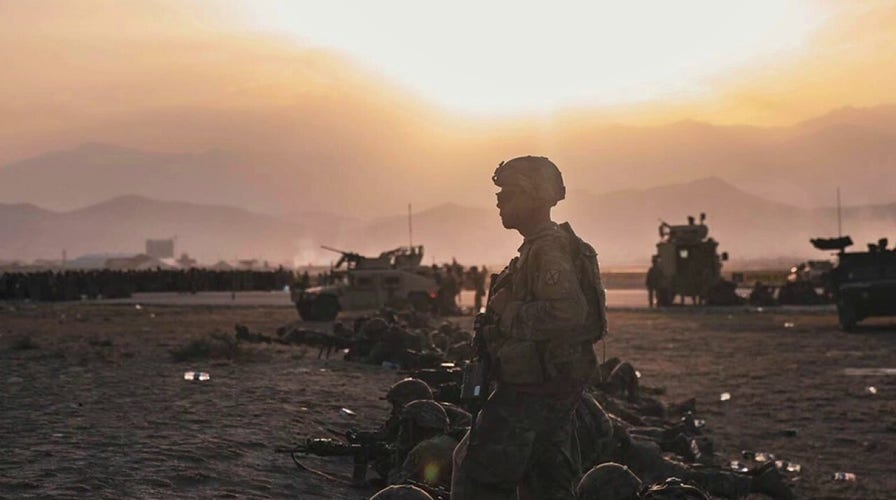
A 'somber' briefing on Afghanistan with very few answers
Fox News national security correspondent Jennifer Griffin summarizes the Joint Chief of Staff's update: 'The picture they painted was bleak.'
This is a rush transcript from "Your World," August 18, 2021. This copy may not be in its final form and may be updated.
NEIL CAVUTO, FOX NEWS ANCHOR: Shock of shocks. Could it be that the Taliban is not keeping its word?
The understanding was that the Taliban was OK with allowing those who want to leave Afghanistan to leave Afghanistan, but growing indications it is not that easy.
Welcome, everybody. I'm Neil Cavuto. And this is "Your World."
We're a half-hour away from hearing from the president of the United States, ostensibly on something that has nothing to do with what's going down in Afghanistan, and everything to do with a new booster shot to deal with COVID.
But you can bet the issue of what's happening at Kabul and the airport and the bedlam in and around there that is going on and on and disrupting thousands from even getting out of the country will come up.
Ahead of that, to Jennifer Griffin at the Pentagon where this stands right now -- Jennifer.
JENNIFER GRIFFIN, FOX NEWS NATIONAL SECURITY CORRESPONDENT: Neil, a somber briefing with very few answers and a defensive posture from the defense secretary and chairman of the Joint Chiefs, who said now is not the time for after-action reports or discussion of regrets.
The picture they painted was bleak and totally dependent on the Taliban. The bottom line is, Afghans and Americans cannot get to the airport due to Taliban checkpoints. U.S. military planes are leaving half-full due to bureaucratic bottlenecks at the airport.
People are told their papers are not in order and turned away from the airport. The defense secretary also spoke about the limits to U.S. forces on the ground and offered this frank admission:
(BEGIN VIDEO CLIP)
LLOYD AUSTIN, U.S. SECRETARY OF DEFENSE: We don't have the capability to go out and collect up large numbers of people.
GEN. MARK MILLEY, CHAIRMAN, JOINT CHIEFS OF STAFF: The time frame of rapid collapse, that was widely estimated and ranged from weeks to months and even years following our departure.
There was nothing that I or anyone else saw that indicated a collapse of this army and this government in 11 days.
(END VIDEO CLIP)
GRIFFIN: We just received these photos from the Defense Department showing Marines arriving in Kabul and beginning evacuations. The 10th Mountain Division is seen here standing watch and helping with evacuations.
But U.S. officials privately tell us it will be -- quote -- "very challenging" to meet President Biden's deadline of August 31 to fully evacuate U.S. citizens and their allies. There are still thousands of U.S. troops flying into Kabul. There are images of the Taliban leader and future emir, Mullah Baradar, who the U.S. pressed Pakistan to release from prison in 2018, returning to Kandahar, apparently flown in on a Qatari C-17 military transport plane.
He will now make his way to Kabul. But images of Taliban beating those trying to get to the airport captured by photographers in Kabul suggest otherwise, sadistic scenes of Taliban striking drivers with rubber hoses and firing weapons indiscriminately, targeting women who are not fully covered.
The Taliban are carrying out a massive P.R. push right now to suggest that they are a kinder, gentler version of the Islamic terrorist group. There are 4, 500 U.S. troops at the airport in Kabul right now. And now the very same specialized Air Force unit, the 621st Contingency Response Wing, the same unit that just closed down Bagram Air Base a month ago, is back securing the Kabul Airport.
The problem is, the Taliban control all the checkpoints outside the airport -- Neil.
CAVUTO: Yes, they control all the levers of government and escape, I guess.
Jennifer Griffin, thank you very, very much.
We should put this in perspective that the administration's goal was to get an evacuation plane going at a rate of one an hour on what they hoped would be upwards of 5,000 to 9,000 evacuees leaving per day. It doesn't sound that they're even close to that.
Let's go to Rich Edson at the State Department, where things stand now.
Hey, Rich.
RICH EDSON, FOX NEWS CORRESPONDENT: Good afternoon, Neil.
And it is in that environment that Jennifer just described that Americans and Afghans and others are trying to get to the airport and get their flights out. But they're finding, many of them, an impossible time trying to navigate these Taliban checkpoints.
And, as Jennifer said, and as we have been hearing from people on the ground, there are Taliban who are beating people, trying to get to the airport. It's in this environment that the State Department this afternoon sent out this alert to Americans who are in Kabul.
It says -- and this is from the U.S. Embassy there, which is now based in the airport -- quote -- "U.S. government-provided flights are departing. U.S. citizens, legal permanent residents and their spouses and unmarried children under the age of 21 should consider traveling to Hamid Karzai International Airport." And in all caps: "The United States government cannot ensure safe passage to the Hamid Karzai International Airport."
We're also hearing reports that some of these planes that are leaving the airport are doing so without a full contingent of people on them. There are a number of issues that they have to go through in order to get on these planes, first, as we talked about, the journey to the actual airport.
And then, once you're there, there are consular or diplomatic events that have to take place before people can get on these airports to whether they're coming to the U.S. or whether they're going to other countries.
To that, we asked the State Department spokesperson, what's the bottleneck? Describe the bottlenecks. And how exactly does the State Department plan to address them? The first part, Ned Price's spokesperson says: "We're opening the aperture to make sure there are people there present with increasing lift capacity to make sure there isn't a single empty seat on the aircraft," but a scene that some on the ground have described as utterly chaotic unfolding in Kabul, Neil.
CAVUTO: Rich Edson, thank you very, very much.
Again, to echo what the defense establishment is saying about all of this, the defense secretary said, we do not have the capability, again, we do not have the capability to go out and collect large numbers of people in Kabul.
Colonel Bob Maginnis with us.
That's a little distressing, to put it mildly, Colonel. What did you make of that?
LT. COL. BOB MAGINNIS (RET.), U.S. ARMY: Yes, I was very disturbed by that and what General Milley said.
To trust the Taliban, it's unfortunate that we're coming to this place. This is like a Dunkirk situation. And we have no ocean from which to go back home. We don't even have good places to vet people that we get out.
You know, I'm most concerned, Neil, it's not just Kabul. It's the 15,000, 20,000 people that are scattered across that Texas-sized country. How are we going to get them out? Are they going to have to flee to Pakistan, Iran, the Stans and even China? These are issues of major concern.
And a very catastrophic situation could continue to evolve here. And I'm especially concerned, having -- very familiar with the type of operations that we're talking about here, as an infantry officer, a Ranger, having seen how we have done this in the past. This is dire.
We never should have given up Bagram Air Force Base. After all, Karzai International, where all this is taking place in Kabul, only has one runway. And all you have to do is put a crater in the center of that, and you shut off all air travel.
So this is a bad situation. I don't have any confidence in what I'm hearing from the secretary of defense.
CAVUTO: You know, what is a little alarming -- and you can help me with this, Colonel, because you understand logistics far better than I.
Now, it seems that the people that they are letting board planes are those already in this and not outside that perimeter that the Taliban has set up all around the airport. No one is penetrating that perimeter. To take the defense secretary, his remarks earlier, we're not about to try.
What does that tell you?
MAGINNIS: Well, it tells me that the Americans that are trapped outside that airport are not going to -- are never going to get home, that the Taliban, as it builds up its forces inside Kabul, will solidify that control.
Those checkpoints will become more vicious. And like I say, this is a Dunkirk in the making. And it's just incredibly, incredibly poor judgment on the exit strategy.
I heard President Trump last night. He never would have followed this line of thinking. He would have at least allowed the military to tell the president how best to do this. And, unfortunately, I have no reason to believe the president listened to what General Milley and the Joint Staff said as to the best course of action to save as many American lives as we could.
CAVUTO: You mentioned Dunkirk, Colonel. And, there, we could see, relied on not so much governments, but just average folks who would come to the rescue of trapped soldiers.
Here, there's no such thing. There's no sort of Hail Mary pass to go to, anyone who could take pity upon the situation and help out. That's what's troublesome and even scary.
MAGINNIS: Well, there are clearly alternatives, Neil, that the Joint Staff is working on.
And I'm not going to give insights to the Taliban as to what those may be. We do have some options, but none of the options are good. And they're all going to be, unfortunately, bloody.
CAVUTO: Do you think, Colonel, that there's any possibility that some of the charges against the Taliban, that they are not keeping their word, that they are now given the furor over this and the confusion and bedlam over this, they might go to some sort of a procedure, get some sort of order?
Or do they relish the way these images look, the bedlam, the confusion, the panic, because it feeds this narrative that not only they have won, but they got the U.S. looking foolish.
MAGINNIS: Indeed.
As I told you Saturday, before all this chaotic situation developed, Neil, that we need to understand the Taliban are clearly a revolutionary and Islamist organization. They're not a transnational terrorist organization. They are relishing what's going on.
They have the American government, the American military on its knees. And what I'm more concerned about is what they're thinking in Beijing and Moscow. Now, they're going to take advantage of this. We have lost great credibility within the allied community and around the world.
The ramifications of this could be something far worse than what happened in Vietnam in 1975.
CAVUTO: Wow.
Colonel, I got to tell you, I mean, you talked about when we were talking last Saturday, but a number of times I talked to you prior, you were telegraphing just this sort of scenario. I thought it was a little blunt at the time, but you have proven prescient, sadly so.
Bob Maginnis, thank you very--
MAGINNIS: Yes. Neil--
CAVUTO: Go ahead, please.
MAGINNIS: Neil, could I say one last thing?
The special inspector general for Afghan reconstruction, for many years, over a decade, has been reporting these very things. The taxpayer paid for those reports. The lessons learned are very clear. They had all the warning signs that this is going to happen.
And yet our military and our political leaders have lied to us about the reality on the ground in Afghanistan. And I just -- my heart goes out to these people and to the military that is going to suffer as a direct result.
CAVUTO: So, when you say they lied, you just heard the defense secretary and others say the magnitude, the speed with which this all went down, they were not prepared for it. Do you believe that?
MAGINNIS: No.
CAVUTO: OK.
Colonel, thank you very, very much.
All right, the White House now, Jacqui Heinrich there.
The president is going to be addressing the nation in about 15, 16 minutes, but, ostensibly, it was supposed to date about this new push for booster shots for more Americans beginning next month to deal with COVID targeting the elderly, those with compromised immune systems and the like.
But I have a feeling, Jackie, this issue will come up if the president does indeed take questions. What are you hearing?
JACQUI HEINRICH, FOX NEWS CORRESPONDENT: Oh, certainly, Neil, it would come up.
The press has not been able to ask the president any questions about this. Since the Taliban took Afghanistan. He took no questions when he gave his remarks.
Yesterday, National Security Adviser Jake Sullivan said that the president still has full confidence in his intelligence teams, as now the U.S. is in a position where we have to negotiate with the Taliban to ensure safe passage from Americans who are stuck behind enemy lines against the Taliban, which is now armed, by the way, with significant U.S. military weapons that fell into their hands.
They had been belonging to the Afghan government. But we know the president met this morning with his whole national security team about getting Americans and allies out, also possible terror threats in the region and diplomacy efforts.
Numerous reports have emerged suggesting that the fallout we have been seeing is an intelligence failure. But now leaks from the spy community have been pushing back, pointing blame at President Biden in various articles, including in The New York Times and Wall Street Journal, alleging that the president was warned by spy agencies, diplomats and generals, that the Taliban would rapidly take over.
But now the military's top brass is pushing back.
(BEGIN VIDEO CLIP)
MILLEY: Let me make one comment on the intelligence, because I'm seeing all over the news that there were warnings of a rapid collapse. I have previously said from this podium and in sworn testimony before Congress that the intelligence clearly indicated multiple scenarios were possible.
One of those was an outright Taliban takeover following a rapid collapse of the Afghan security forces.
(END VIDEO CLIP)
HEINRICH: National Security Adviser Jake Sullivan said yesterday there will be a review for lessons learned and the results will eventually be made public.
But criticism has poured in for days. This morning, former President Trump saying what he had planned for when he negotiated the U.S. withdrawal with the Taliban.
(BEGIN VIDEO CLIP)
DONALD TRUMP, FORMER PRESIDENT OF THE UNITED STATES: You got to get your people out and you got to get them out first. Then you take your equipment out. And after you take your equipment out, you bomb the hell out of the forts, so nobody else can use them, because I was going to do that.
I said, I want every one of these forts. It will take a plane two hours, and you bomb the hell out of them. Now they're being used by the Taliban. It's just not even believable.
(END VIDEO CLIP)
HEINRICH: President Biden will speak in about a half-hour -- or less than that now, about 15 minutes -- about COVID booster shots. We don't know, Neil, again, if he will take questions. Certainly hope that he does -- Neil.
CAVUTO: Absolutely.
Jacqui Heinrich, thank you, Jacqui at the White House.
Again, 15 minutes away from hearing from the president. So, imagine, being a veteran here, you were there to save the country and saved America from any future attacks. That was what now turned out to be turned out to be a 20-year mission. And, in that regard, there were no follow-up attacks on us soil.
So, when you want to talk about sacrifice and what it meant to the 2, 400- plus families who remember loved ones who lost their lives, and thousands more maim and injured, what was it all about? Two veterans want to speak up. And they will next.
(COMMERCIAL BREAK)
CAVUTO: It was not for nothing.
Our two next guest, veterans who served in Afghanistan as well, have a message for Americans who wonder the 20-year battle, the better-than-2, 400 Americans lost their lives, thousands more injured, some maimed for the rest of their lives, that it was not a waste.
Curtis Grace, U.S. Army Afghanistan veteran, Luke Coffey, also Afghan veteran, kind enough to join us now.
Gentlemen, thank you both for joining us, but more importantly for your incredible service.
I know you each have a message you want to relay to so many of your friends and colleagues and buddies and the families of those we have seen lost.
Maybe, Curtis, you could tell me what that is.
CURTIS GRACE, U.S. ARMY VETERAN: Sure, Neil. And thanks for having us on. We really appreciate the opportunity to talk about it.
CAVUTO: No, thank you.
GRACE: The main thing with the post is, I don't want anybody to feel like their efforts were wasted. Your individual service mattered. You were asked to do a job, and you went and you did it. And I don't think that anything that's happening route right now takes away from that.
CAVUTO: Luke what about you?
LUKE COFFEY, U.S. ARMY VETERAN: Yes, just to reflect what Curtis was saying, that's been a sentiment that we wanted to express to the veteran community, and also to our friends and just the American people, and that it wasn't a waste, and that these were formative experiences that most of us got to experience.
And there are things that -- at the back end, there's a lot of positive to be taken from it. And that's what needs to be focused on for the veteran community right now.
CAVUTO: You know, you were both in hot spots, come to think of it, over your long career in the Army, and I think, Curtis, in your case, in Kandahar province.
Were you surprised how quickly -- forget about the whole country of Afghanistan, but how quickly Kandahar to the Taliban?
GRACE: You know, the timeline of things is something that definitely caught us by surprise. The outcome probably wasn't as surprising.
In Kandahar in particular, and in Panjwai, which is where we served, we kind of had information for a while that things were trending that way, that the shadow government had taken over. So we weren't surprised how quickly Kandahar feel, because it was largely a symbolic victory when they took the district centers and they took the city.
CAVUTO: You know, Luke, I was just wondering, as you guys look at what's going on, happening now, we're trying to get Americans out. We're trying to get those who helped Americans out and those who are fearing for their lives.
Are you worried that the Taliban might not let them all out?
COFFEY: I feel like the main priority right now, if everybody's focused, should be not only the Americans that are still there, which there are a few, but the Afghan people as well.
The Afghan people are obviously desperately crying for help, and they need our help. And these are people who are so desperate to not be under the Taliban's regime that they're willing to risk life and limb. And this is something that we should honor as a society and as a peoples.
And we should prioritize that right now, because the people are the ones who will suffer, no matter what. And so, for us, that's been a priority. It's been encouraging to see how the veteran community has actually really stepped up and stepped up to the plate in terms of getting people here, helping navigate with NGOs or with different organizations to help people come to here, to other places, and just begin that transition of these refugees, the people that are fleeing.
CAVUTO: Curtis, what do you think of the Taliban? I mean, the administration has been talking to the Taliban. They're taking them at their word that they're going to let this free flow of people who want to leave the country leave the country, that they're almost signalling it's a new and different Taliban today than the one that had its roots back some 20 years ago.
Do you believe that?
GRACE: Well, Neil, I mean, to begin with, I was just an infantryman and a pilot. I really didn't make policy. So I won't pretend to understand what the Taliban's motivations are right now.
CAVUTO: Understood.
GRACE: What I will say is, I do think it's a priority that we can to move forward, get as many people out of the country while we still can.
So if there's some sort of agreement that's allowing us to do that, we need to take full advantage of it for as long as we can, and just focus on getting American citizens, interpreters, and anybody that we can get out of that country out as soon as possible.
CAVUTO: Luke, I mean, you guys have touched on it.
I mean, because of guys like you and men and women who over the years sacrificed so much, we had not been attacked on U.S. soil since 9/11. People forget that and the significance of that, because it looked like, when the war started, that was a distinct possibility.
Does it anger you that people are looking at this as a waste, when that alone tells you it wasn't?
COFFEY: No, I don't think -- it doesn't anger me, because, intellectually and even emotionally, we have all come to an understanding of this for a long time, especially in the veteran community, because people who were there on the ground, they saw the realities of it, vs. what was maybe conveyed.
And so to see that reality and have a means of understanding the eventual outcome, it wasn't anger. Sadness, yes, but there's still action that we can take. And that's the important thing right now.
CAVUTO: You know, both of your attitude, guys, is just way beyond most people's comprehension, the class and the dignity you show.
I guess it's very representative of you and your colleagues, and, sadly, one of those who lost their lives fighting the good fight.
Curtis and Luke, thank you for your service. But thank you more for your attitude to persist.
GRACE: Thanks, Neil.
COFFEY: Thank you.
CAVUTO: We have a lot more after this, including the read on all of this from the commander in chief, if, if he talks about this -- after this.
(COMMERCIAL BREAK)
CAVUTO: Minutes away from hearing from President Biden, ostensibly to talk about a third shot, if you will, a booster shot, for Americans that's being recommended as soon as next month.
But you can bet Afghanistan should come up -- after this.
(COMMERCIAL BREAK)
CAVUTO: All right, it's one thing to get blasted by Republicans, but when Massachusetts Democratic Congressman Moulton is taking the president on, on his comment that the Afghan government really was not expected to do what it did it, he said that: "It's utter B.S. Don't tell me they don't want to leave when they're literally cleaning to airplanes to try to get out of this country."
Francesca Chambers right now, McClatchy White House correspondent.
Francesca, this is sort of like a building bipartisan rant against the administration and its handling of this and throwing some under the bus, including those who it says might not want to leave or didn't want to leave.
What do you make it?
FRANCESCA CHAMBERS, MCCLATCHY D.C.: Well, and we have heard Democratic senators who are in charge of key committees, Neil, indicate that they plan to have hearings on the leaving of Afghanistan, how the Biden administration handled this.
So this is certainly an issue that is not going to go away soon. Because Congress is currently on recess, that is something it sounds like they could begin doing the hearings when they get back. That would be in September. So this is -- it's got a little bit of a trajectory here before that would even start.
CAVUTO: We're about a minute away from the president, Francesca.
And a lot of people going, will he mention Afghanistan? This is all about booster shots. I cannot imagine he wouldn't or even wouldn't try.
CHAMBERS: It's also unclear, Neil, whether he will take questions or not after that. They often don't say whether he will. And so potentially he could be asked that in a set of questions after his remarks today, even if he does not personally touch on the subject.
CAVUTO: He seemed stunned by the reaction to this, the criticism, the unyielding criticism of his handling of this. Is that the case, that he's just stunned and surprised?
CHAMBERS: Well, the White House certainly understood, Neil, that it needed to respond to this scrutiny.
It sent out his national security adviser yesterday to talk to press in the room, where I was in the room as well, for about 45 minutes yesterday, which, in context, the White House press briefing sometimes doesn't go 45 minutes.
So that was just the front end of the White House press briefing yesterday responding to those criticisms.
CAVUTO: Right.
CHAMBERS: So whether we hear the president do that again today, we will have to see.
CAVUTO: All right, well. We're going to see it right now.
Francesca, thank you very much.
The president of the United States.
(JOINED IN PROGRESS)
JOE BIDEN, PRESIDENT OF THE UNITED STATES: -- to get every American vaccinated and protect them from the Delta virus, the Delta variant of COVID-19.
I just got a lengthy briefing from my COVID team. And here's the latest data that confirms that we're still in a pandemic of the unvaccinated.
While we're starting to see initial signs that cases may be declining in a few places, cases are still rising, especially among the unvaccinated. There are still 85 million Americans who are eligible to get vaccinated who remain unvaccinated and at real risk.
Across the country, virtually all of the COVID-19 hospitalizations and deaths continue to be among the unvaccinated. In Alabama, more than 90 percent of the current hospitalizations are among the unvaccinated. In Texas, 95 percent of those in hospitals are unvaccinated.
Right now, it's worse in states where overall vaccination rates are low. But let me be clear. Even in states where the vaccination rate is high, the unvaccinated in those states are also at risk. And we're seeing cases rise as a result.
Quite frankly, it's a tragedy. There are people who are dying and who will die who didn't have to. So, please, if you haven't gotten vaccinated, do it now. Do it now. It can save your life and it can save the lives of those you love.
You know, and the good news is that more people are getting vaccinated. Overall, weekly new vaccinations are up more than 80 percent from where they were a month ago. While it can take up to six weeks to get fully protected after your first shot, this increased level of vaccinations are going to provide results in the weeks ahead.
Just remember, we have two key -- and two key ways of protecting ourselves against COVID-19, one, safe, free, and effective vaccines, and, two, masks. Vaccines are the best defense. But masks are extremely helpful as well.
And for those who aren't eligible for the vaccine yet, children under the age of 12, masks are the best available protection for them and the adults around them. That's why we need to make sure children are wearing masks in school.
Before I talk about the news related to vaccines, let me say a few words about masks and our children. Unfortunately, as we have seen throughout this pandemic, some politicians are trying to turn public safety measures, that is, children wearing masks in school, into political disputes for their own political gain.
Some are even trying to take power away from local educators by banning masks in school. They're setting a dangerous tone. For example, last week, at a school board meeting in Tennessee, protesters threatened doctors and nurses who were testifying making the case for masking children in schools.
The intimidation and the threats we are seeing across the country are wrong. They're unacceptable. Now, I have said before this isn't about politics. It's about keeping our children safe. It's about taking on the virus together, united.
I have made it clear that I will stand with those who are trying to do the right thing. Last week, I called school superintendents in Florida and Arizona to thank them for doing the right thing and requiring masks in their schools.
One of them said, we teach science, so we follow the science. The other said they have a guiding principle: students first.
I couldn't agree with more than -- I just couldn't agree more with what they both said. And that's why, today, I'm directing the secretary of education, an educator himself, to take additional steps to protect our children.
This includes using all of his oversight authorities and legal action, if appropriate, against governors who are trying to block and intimidate local school officials and educators.
And as I have said before, if you aren't going to fight COVID-19, at least get out of the way of everyone else who's trying. You know, we're not going to sit by as governors try to block and intimidate educators protecting our children.
For example, if a governor wants to cut the pay of a hardworking education leader who requires mask in a classroom, the money from the American Rescue Plan can be used to pay that person's salary 100 percent. I'm going to say a lot more about children in schools next week.
But, as we head into the school year, remember this. The Centers for Disease Control and Prevention, the CDC, says masks are critical, especially for those who are not yet vaccinated, like our children under the age of 12.
So let's put politics aside. Let's follow the educators and the scientists, who know a lot more about how to teach our children and keep them safe than any politician. This administration is always going to take the side of our children.
Next, I want to talk to those of you who can get vaccinated, but you haven't. The Delta variant is twice as transmissible as the Alpha variant. It's dangerous, and it continues to spread.
Vaccines are the key to stopping it. We're making progress. Today, more than 90 percent of seniors have at least had one shot, and 70 percent of people over the age of 12 have gotten their first shot as well. That's good news. But we need to go faster.
That's why I'm taking steps on vaccination requirements where I can. Already, I have outlined vaccine requirements that are going to reach millions of Americans, federal workers and contractors, medical staff caring for our veterans at VA hospitals, and our active-duty military, reservists, and National Guard.
Today, I'm announcing a new step. If you work in a nursing home and serve people on Medicare or Medicaid, you will also be required to get vaccinated. More than 130,000 residents in nursing homes have, sadly, over the period of this virus, passed away.
At the same time, vaccination rates among nursing home staff significantly trail the rest of the country. The studies show that highly vaccinated nursing home staff is associated with at least 30 percent less COVID-19 cases among long-term care residents.
With this announcement, I'm using the power of the federal government, as a payer of health care costs, to ensure we reduce those risks to our most vulnerable seniors. These steps are all about keeping people safe and out of harm's way.
If you walk into a government office building, you should know that federal workers are doing everything possible to keep you safe. If you're a veteran seeking care at a VA hospital, you should not be at a greater risk walking into the hospital than you were outside the hospital.
And now, if you visit, live, or work in a nursing home, you should not be at a high risk for contracting COVID from unvaccinated employees. While I'm mindful that my authority at the federal level is limited, I'm going to continue to look for ways to keep people safe and increase vaccination rates.
And I'm pleased to see the private sector stepping up as well. In the last week, AT&T, Amtrak, McDonald's, they all announced vaccine requirements.
I recently met with a group of business and education leaders from United Airlines to Kaiser Permanente to Howard University who are also doing the same thing. Over 200 health systems, more than 50 in the past two weeks, have announced vaccine requirements.
Colleges and universities are requiring more than five million students to be vaccinated as they return to classes this fall. All of this makes a difference.
"The Wall Street Journal" reported the share of job postings stating that new hires must be vaccinated has nearly doubled in the past month. Governors and mayors in California, Maryland, Massachusetts, New York, Oregon, and Washington have all announced vaccination requirements.
So, let's be clear. Vaccination requirements have been around for decades. Students, health care professionals, our troops are typically required to receive vaccines to prevent anything from polio to smallpox to measles to mumps to rubella.
In fact, the reason most people in America don't worry about polio, smallpox, measles, mumps or rubella today is because of vaccines. It only makes sense to require a vaccine that stops the spread of COVID-19. And it's time for others to step up.
Employers have more power today to end this pandemic than they have ever had before. My message is simple. Do the right thing for your employees, consumers, and your businesses. Let's remember, the key tool to keeping our economy going strong is to get people vaccinated and at work.
I know that I will have your back -- they should know I will have their back, as I have the back of the states trying to do the right thing as well. For example, yesterday, I instructed the Federal Emergency Management Agency, FEMA, to extend full reimbursement through the end of the year to stake developments -- to state deployments of National Guard in support of COVID-19 response.
Nearly 18,000 National Guard members are supporting our response nationwide, from caring for patients, to administering vaccines, to running testing sites, to distributing supplies.
As the states continue to recover from the economic toll left by COVID-19, the full reimbursement of National Guard services during this pandemic will be another tool that will help them shore up their budgets, meet the needs of their communities and continue our economic recovery.
These are the latest steps we're taking to get more people vaccinated.
Next, I want to speak to you all, all of you who are vaccinated. How should you be thinking about the moment we're in? First, know that you're highly protected against severe illness and death from COVID-19. Only a small fraction of people going to the hospital today are those who have been vaccinated.
But we have a responsibility to give the maximum amount of protection, all of you the maximum amount. Earlier today, our medical experts announced a plan for booster shots to every fully vaccinated American, adult American.
You know, this will boost your immune response. It will increase your protection from COVID-19. And it's the best way to protect ourselves from new variants that could arise. The plan is for every adult to get a booster shot eight months after you got your second shot.
Pending approval from the Food and Drug Administration, the CDC's committee of outside experts will be ready to start these booster -- this booster program during the week of September 20, in which time anyone vaccinated on or before January 20 will be eligible to get a booster shot.
So that means that, if you got your second shot on February 15 you're eligible to get your booster shot on October 15. If you got your second shot on March 15, go for your booster starting November 15, and so on.
Just remember, as a simple rule, eight months after your second shot, get a booster shot. These booster shots are free. You will be able to get the booster shots at any one of approximately 80,000 vaccination locations nationwide. It will be easy.
Just show your vaccination card and you will get a booster, no other I.D., no insurance, no state registry requirement.
My administration has been planning for this possibility and this scenario for months. We purchased enough vaccine and vaccine supplies so that, when your eight-month mark comes up, you will be ready to get your vaccination free and booster shot free. We have it available. It will make you safer and for longer. And it will help us end the pandemic faster.
Now, I know there are some world leaders who say America shouldn't get a third shot until other countries got their first shot. I disagree. We can take care of America and help the world at the same time.
In June and July, America administered 50 million shots here in the United States, and we donated 100 million shots to other countries. That means that America's donated more vaccine to other countries than every other country in the world combined.
During the coming months of fall and early winter, we expect to give out another about 100,000 boosters, and the United States will donate more than 200 million additional doses to other countries.
This will keep us on our way to meeting our pledge of more than 600 million vaccine donations, over half-a-billion. And, as I have said before, we are going to be the arsenal of vaccines to beat this vaccine, as we were the arsenal of democracy to win World War II.
So, let me conclude with this. The threat of the Delta virus remains real. But we are prepared. We have the tools. We can do this.
To all those of you who are unvaccinated, please get vaccinated, for yourself and for your loved ones, your neighborhood, and for your community.
And to the rest of America, this is no time to let our guard down. We just need to finish the job with science, with facts, and with confidence.
And, together, as the United States of America, we will get this done.
God bless you all, and may God protect our troops. Thank you.
(CROSSTALK)
CAVUTO: Wow, that is a bit of a stunner.
Afghanistan imploding, panic at the Kabul Airport, and the president doesn't even touch on it or take any questions or having anything to do about it.
Whether you're on the left or right, that is, Democrat or Republican, on this, that's sort of like the quite large elephant in the room the president chose to ignore, instead focusing on the push for a third booster shot to deal with the COVID-19. You're up to it as about eight months after your second shot.
So, for a lot of Americans, that could come as soon as the fall. These shots would be available on September 20. Again, that was well-telegraphed and anticipated. The CDC had been outlining the possibility of booster shots and their availability for Americans, particularly the elderly, and those with compromised immune systems.
But I can't help but thinking -- and we have certainly followed the whole COVID phenomenon, but it's not only a spike in cases we have to concern ourselves with here in this country, but a spike in violence and just bedlam in Afghanistan, a country that has imploded in little more than 10 days, and now is calling the shots as to who does and does not get on those planes to get the heck out of Afghanistan.
All sorts of reports back and forth that we're hearing the Taliban is at that perimeter around Kabul, making it very difficult for those to pierce it, and indications as well from the defense secretary of the United States that we are not about to broach it ourselves.
John Hannah on all of this, former Vice President Dick Cheney's national security adviser.
John, I think the big shocker here in the president's remarks was no remark, nothing on what has been happening and going on in Afghanistan. What do you make of that?
JOHN HANNAH, FORMER VICE PRESIDENTIAL NATIONAL SECURITY ADVISER: Yes.
No, I agree, Neil. This is clearly a dereliction of duty for a president who has put competence and his foreign policy expertise at the top of his list of credentials. We are watching a world historical development that is going to affect American national interests around the world for years to come.
And, as you say, the -- all of the pictures right now are of humiliation, panic, chaos, and really one step removed from a massive tragedy and loss of life if things really get out of control at that airport. The American people, the world needs some reassuring at this moment in time.
And for the president of the United States to think that in this context, he could get off with a one-off speech a day or two ago, and not keep relaying to the American people that he had or has this situation under control, is going -- or is going to act immediately to get it under control and defend the interests of the United States and its citizens on the ground in Afghanistan, I think, is just a terrible image to be projecting to the American people and to the world.
CAVUTO: Yes, John Hannah, he doesn't have it another control.
The fact of the matter is, no matter where you are on this politically, it's pretty clear to see that thousands more are waiting outside that perimeter that the Taliban has set up, those inside that perimeter hoping they will find a plane out.
And we're relying on the Taliban's word that they are OK with -- quote -- "a safe passage" for those who want to leave the country, but they're not for a safe passage. They have been blocking that safe passage, and they have been picking and choosing who, if anyone, can find that safe passage, and if anyone can even pierce that perimeter.
The only ones who seem to have the shot or those who are already inside it. So this is a mess.
HANNAH: It's an absolute shambles, Neil.
And, as I said, we're very close to a potential disaster here if American troops need to need to take action to defend themselves and secure themselves from that chaos at the airport.
I have got to say that, of course, we will do the after-action report. But the thought that the president of the United States overruled his military commander several months ago and decided to close an American-military controlled air base at Bagram well outside of Kabul, and instead decided to base an evacuation plan of thousands of Americans and other foreign nationals, not to mention Afghan citizens, on a civilian airport, not under U.S. control, inside the perimeter of a city of 4.5 million people, just is a massive, massive failure and black eye for the United States.
CAVUTO: John, I can understand, warped as it is, the Taliban preventing people from getting through that perimeter.
I'm a little dumbstruck hearing from the defense secretary of the United States that he might not even venture there to force the issue. This is from the defense secretary about 45 minutes ago.
(BEGIN VIDEO CLIP)
QUESTION: You're still saying you're focused on the airfield. These people can't get into the airfield.
AUSTIN: Well, we're going to do everything we can to continue to try to deconflict and create passageways for them to get to the airfield.
I don't have the capability to go out and extend operations currently into Kabul. And where do you take that? I mean, how far can you extend into Kabul and how long does it take to flow those forces in?
(END VIDEO CLIP)
CAVUTO: All right, if I hear him correctly then, John, those waiting at the perimeter to get in, he's not even going to meet them there to help them get in.
I understand what he's saying about, how deep do you go into Kabul, but the Taliban has set up this perimeter, blocking people from getting in. If he and troops were to go to that perimeter and force the issue, there's every reason to believe that maybe he's concerned that it would lead to still more violence, or that the Taliban wants to look good, that might be a stretch, and allow us to get them.
But he's not so far of the mind-set to even try.
HANNAH: Yes. No, it's quite a stunning admission of weakness and fecklessness and lack of planning, Neil, especially from our most senior official in command of our military forces besides the president.
One thing that, of course, has been missing both in President Biden's speech from a day or two ago, as well as everything else U.S. officials have been saying, there's no direct threat and warning to the Taliban, who, of course, are responsible for breaking every commitment they made under that February 2020 so-called peace deal negotiated by President Trump.
They need to get a very clear message that we are going to get to safety American citizens, other foreign allied nationals, and Afghan citizens who have assisted our military and wish to leave, that we're going to take whatever action is necessary to do that, and the Taliban would be well- advised not to stand in our way.
We certainly have the capabilities to do that, to secure the entrance and the road to the military -- to the airport, and to get our people to safety.
CAVUTO: I don't know if we are showing that, though. And I guess that's part of my biggest concern, as -- is the president having said and others in the administration have said that Afghans were given the chance to go earlier, they opted not to.
Representative Moulton, a Democrat of Massachusetts, had said of that -- quote -- "That's utter B.S. Don't tell me they don't want to leave, when they're literally clinging to airplanes to try to get out of this country."
I'm sure the president's people had seen those same images, these same crowds trying to get the hell out, putting themselves at great risk in wheel wells and falling to their deaths, to make sure they can get out, thousands more outside that perimeter who just wait and tempt fate trying to get through.
So this notion that, all of a sudden, this is something they didn't want to do because they didn't appreciate the gravity of the situation, that misses point it's the administration that didn't appreciate the gravity or the speed of this situation. And he kind of threw them under the bus, the Afghan people.
HANNAH: There's no question about this.
I mean, again, and Neil, as you said, this is now a subject of bipartisan criticism. There's no disagreement that this has been a massive failing of planning by the administration.
And the question was, is this simply a massive failure of planning and intelligence? Or did this at the end of the day come down to politics, and the president's decision to completely override the best advice of his military commanders to retain a safe and secure airfield in Bagram that they could conduct this kind of evacuation from, taking into account all of the contingencies, rather than having to essentially have to fight our way into a civilian airport, not under our control in a city of 4.5 million people that every square inch outside of that airport is now controlled by the enemy?
CAVUTO: It just seems -- John, and you're the military national security expert -- tone-deaf to me.
It would be like on 9/11, which actually goes full circle here, people were reporting on the New York City election that was delayed in that day's news, when, in fact, the terror war had started on the United States. It is not only the elephant in the room. It's the mammoth, and the president chooses to ignore it.
I'm just wondering what the strategy is here, because, in a vacuum, cynicism and fears fester. And they're festering now and just looking at certain social media, where it's just gone out of control, that people are just wanting to know, do you know what the hell's going on? Can you see what the hell's going on? Can you see the bedlam and just how panicked it is getting and now dicey it is getting for Americans and their interests and their friends in Afghanistan?
Nothing, not a word, zip, zilcho.
HANNAH: Yes, not to mention, Neil, the absolute fear and concern that's no doubt spreading amongst American allies outside of Afghanistan and around the world who are watching this stunning display of weakness and collapse in an American project that is now two decades' old that we devoted enormous national treasure, not to mention blood in.
And to simply take a political decision to allow that all to unravel and collapse overnight, and now not to be out there with this as priority one, American national security, the security of our friends and allies, who, for better or worse, have hitched their national security and survival to American power and credibility, to not be out there speaking to them, to the American people, providing some assurance that the president of the United States at a minimum is going to do whatever it takes to ensure that we get our people to safety and complete a successful operation at that airport of evacuation, I just think is a terrible dereliction of duty.
CAVUTO: Well, it stands out.
John Hannah, thank you very much.
The president is choosing instead to talk about shots, and not a foreign policy that looks shot.
Content and Programming Copyright 2021 Fox News Network, LLC. ALL RIGHTS RESERVED. Copyright 2021 VIQ Media Transcription, Inc. All materials herein are protected by United States copyright law and may not be reproduced, distributed, transmitted, displayed, published or broadcast without the prior written permission of VIQ Media Transcription, Inc. You may not alter or remove any trademark, copyright or other notice from copies of the content.
