


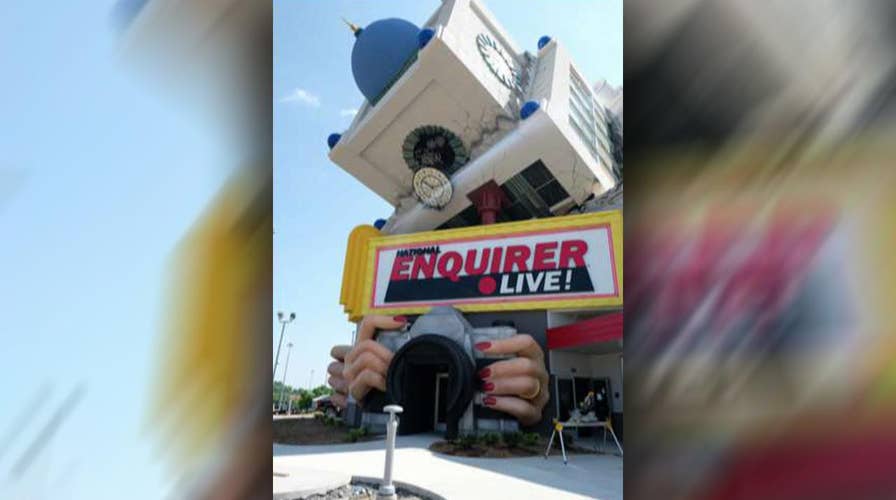
National Enquirer Live theme park opens in Tennessee
New attraction opens in Pigeon Forge, Tenn.; Raymond Arroyo breaks down his 'Friday Follies' for 'The Ingraham Angle.'
This is a rush transcript from "The Ingraham Angle," May 24, 2019. This copy may not be in its final form and may be updated.
LAURA INGRAHAM, HOST: I'm Laura Ingraham. This is a special edition of “The Ingraham Angle,” America at a Crossroads. Now, tonight's special is going to address issues in our politics and our culture that are dividing America right into, and what we can do to remedy this.
Now, we begin tonight with President Trump's decision to give Attorney General Bill Barr the authority to declassify documents that were related to the 2016 campaign surveillance. Now, first and foremost, Americans need to understand that their government has their best interest at heart always.
And when it became clear that some within the upper echelons of the DOJ, FBI and CIA and other intel organizations may have had their thumb on the political scale, a lot of Americans were rightly outraged. They want to believe in their government. That's why it is so stunning to see Democratic politicians sworn to uphold the constitution fight so hard to conceal present threats to it.
Now, take House Intelligence Chairman Adam Schiff. He called Trump's decision to give the public more information un-American. Now, if we can't even agree upon basic set of standards under which these powerful organizations can act, especially in relation to the American people, then we are indeed at a crossroads.
Now, Trump addressed this issue from the outside - from just outside of the White House this afternoon. Let's watch.
(BEGIN VIDEO CLIP)
DONALD TRUMP, PRESIDENT: I declassified everything - everything they want. I put it under the auspices of the Attorney General. He's going to be in charge of it. I don't want them to be for me or for anybody else. I just want him to be fair. And that's what he is. And we're going to find out what this yields. We're exposing everything. We're being - a word that you like - transparent. We are being -- ultimately we're being transparent. And that's what it's about.
(END VIDEO CLIP)
INGRAHAM: Transparency used to be a good word. Right? We used to like it. I mean, it's sunshine. It's a great disinfectant. But apparently not when President Trump is advocating for it.
Joining me now with reaction, Harmeet Dhillon, attorney and member of the Trump 2020 Advisory Council; Matt Schlapp, Chair of the American Conservative Union; and Joel Rubin, Former Deputy Assistant Secretary of State under President Obama. Great to see you all now on a Friday night.
Joel, I want to start with you. Now, the left is accusing Trump of some grand cover-up. Now, why would he urge the Attorney General to declassify all this information if there were all these nuggets and bits and pieces that were going to incriminate him or anyone in his campaign?
JOEL RUBIN, FORMER DEPUTY ASSISTANT SECRETARY OF STATE: Yes, Laura. You're right to ask that question, and transparency is good. And I think where we're concerned and where Democrats are coming out on this is that there needs to be, for example, an unredaction of the Mueller report, that if we want transparency, let's really get it all out there. But to have it in one direction and potentially to unmask American spies or those helping the United States and our national security, that's very risky and dangerous.
INGRAHAM: Well, you're saying competing things. And Matt, you have it. We're going to unredact the very few - not very much of the Mueller report is not--
MATT SCHLAPP, AMERICAN CONSERVATIVE UNION CHAIR: One percent.
INGRAHAM: --is not available to especially members of Congress who can go read it and read it almost in its entirety with a few redactions. Some of that are probably very sensitive sourcing information and methodology. But this is kind of wild.
I find this to be weird because I remember the Democrats when they're all like "you got to get the man and the man is going to keep info for us and the FBI is going to hurt the regular people," and now it's the shoe is on the other foot here. Now they're the big defenders of the spying agencies regardless of how much power they have.
SCHLAPP: Yes. Really I think you started off talking about how we try to heal the rift. You heal the rift by exposing what happened under the Obama- Biden at the end of their term, what was done against their political opponents, why did they let loose the FBI and other agencies to go after their political opponents. Let's put it all out there.
By the way, Laura, if they have good answers, then let's move beyond this. And I think that that is the key in all of this, which is somehow we skipped over the Obama-wrongdoing, moved right to the foe-Trump crimes, and we've been stuck on this Russia collusion thing. It's time to get to the real story.
INGRAHAM: Well, John Kerry is one of the people who's mentioned in some of the stories about the circle. It was a very tight circle they kept. Harmeet, I want you to chime in here. We learn more about how they met and how they discussed the origins of this probe and their concerns about Russia and the election. So initially it was Brennan, Clapper, Comey - and I'm missing one - Brennan, Clapper, Comey and Lynch - Loretta Lynch. So it's very tight. Then it expanded and included Vice President Biden, Kerry, and Ash Carter. And I guess the President of the United States was eventually brought into the loop. This is fascinating.
We're learning how Brennan would brief the President and keep the info out of the daily intel briefing. That came out in The New York Times today. I think we're going to learn a lot more just about that very interesting double cone of silence, if you will.
HARMEET DHILLON, TRUMP 2020 ADVISORY COUNCIL MEMBER: Absolutely, Laura. And some of the other things that we're getting reminded about right now is the fact that British intelligence tipped the Obama administration in 2015 about alleged hacking by the Russians against the DNC. But they didn't do anything about it until very late in the game and until it was clear that they had lost that election. And then everything fell into place very quickly.
And so what Nancy Pelosi and her colleagues, Schiff and others, are doing today is gas-lighting the American people by calling the exposure of a cover-up and of a plot, a cover-up itself. I mean, language has no meaning with these people. This is kind of a Orwellian doublespeak that's going on right now.
I think the President is exactly right to delegate this authority to somebody who has a long history of knowing how to parse out confidential and highly privileged and sensitive information.
INGRAHAM: Oh, no, no. They're trashing Barr, though, Harmeet.
DHILLON: Of course, they are.
INGRAHAM: I mean--
DHILLON: Of course, they are.
INGRAHAM: --Barr is now like what Halliburton was in the Bush years. So it's like Barr - it's like they have to have the bete noire. They've got to have the evildoer.
DHILLON: Well, he is a punching bag for them.
INGRAHAM: Yes.
DHILLON: Of course.
INGRAHAM: I mean, but it's--
DHILLON: And the President is - and it's becoming illogical. I mean, we heard that from Joel just now that--
RUBIN: Yes. Well--
DHILLON: Well, we should unmask - excuse me. We should unmask and we should reveal all the sensitive intelligence that Barr and others and Mueller thought should be redacted in the Mueller report. But then we should not ask any questions about how we got there. It's very clear to most Americans now that the entire process was illegitimate because the results are nothing, a big goose egg. And yet-
INGRAHAM: All right. The media--
DHILLON: There's asymmetry--
INGRAHAM: We got to talk about media role.
DHILLON: --in what should be exposed.
INGRAHAM: Hold on. Hold on, guys. We've got to talk about the media's role in this because I think that's part of why we're in this place we're in right now where people can't even agree on basic terminology. And right now, they are freaking out. The American media is freaking out over more transparency. I've never seen anything like it.
(BEGIN VIDEO CLIP)
UNIDENTIFIED MALE: Donald is obviously melting down. There's no doubt that he's every bit as unhinged as he was during the heat of the Mueller investigation.
UNIDENTIFIED MALE: Barr has proven himself, in my humble opinion, sort of the trained seal of the administration--
UNIDENTIFIED FEMALE: The idea of giving William Barr the power to declassify all of the material within the intelligence community is really unprecedented.
(END VIDEO CLIP)
INGRAHAM: Unprecedented. The Attorney General - how is that unprecedented?
SCHLAPP: First of all, obviously, with the directive that was put out last night, this is all following a very clear legal path. And the great thing about Bill Barr is he's been there before, Laura, as you know.
And the only reason he's being - he hasn't even made the decision yet. The only reason why he's being vilified is because he's good and they know he's good. And then he's always going to make sound decisions and they know that when they haul him up in front of the Senate and the House to ask him questions. He just plays games with them. He multi-tasks. He, like, plays with paperclips while he answers their questions.
INGRAHAM: Yes. It's like, is this all you have, really?
SCHLAPP: He's ready for this.
INGRAHAM: I mean, God bless them, but I mean, there's just no match for Bill Barr. I mean--
SCHLAPP: I'm sorry.
(CROSSTALK)
INGRAHAM: --table against like that could champ versus--
(CROSSTALK)
SCHLAPP: They are not good enough to get on the ride.
INGRAHAM: All right.
RUBIN: But even Mueller said himself that Bill Barr, in his letter, and the way that he explained, described the report, was inaccurate. And so--
INGRAHAM: No, he didn't say that. On the call that was transcribed in the notes, it said--
RUBIN: That was this letter.
INGRAHAM: They - no, no, no. He didn't say he got it wrong in the conclusion. He thought some of the nuance and the tonality was - wasn't - didn't capture the moment. But he didn't say he got it wrong on his conclusion because Barr asked him that in the call.
SCHLAPP: But where is - where is Mueller? Let Mueller--
RUBIN: Yes.
SCHLAPP: --come tell us--
(CROSSTALK)
RUBIN: Yes, we should--
INGRAHAM: --private.
SCHLAPP: Where is he?
RUBIN: Exactly.
(CROSSTALK)
INGRAHAM: You watched it on--
(CROSSTALK)
RUBIN: We should have Mueller come out. Yes.
INGRAHAM: No, no, no.
RUBIN: Yes, he should.
INGRAHAM: Mueller says, guys, he wants to go in private. I've got to Joel about this impeachment.
RUBIN: Yes, please.
INGRAHAM: On-again off-again impeachment. OK? Because the Democrats cannot make a decision about what they want to do on impeachment. Let's watch.
(BEGIN VIDEO CLIP)
REP. JERRY NADLER, D-N.Y.: The recalcitrance of the President and his lawless behavior is making it more and more difficult to ignore all alternatives, including impeachment.
REP. ADAM SCHIFF, D-CALIF.: We are seeing more members that recognize that the administration is acting in a lawless fashion, essentially having obstructed justice is now obstructing Congress.
REP. NANCY PELOSI, D-CALIF.: Ignoring subpoenas, obstruction of justice. Yes, these could be impeachable offenses.
(END VIDEO CLIP)
INGRAHAM: Could, would, might be, kind of, might there. But the President wants to be impeached. That's the other line they're using, Joel.
RUBIN: Yes. And I think the impeachment question is one where we're watching it unfold in front of us that--
INGRAHAM: What are they waiting for? They have the Mueller report. Why are they waiting? She's obstructing her own investigations.
RUBIN: Well, what they would like, I think, clearly Democrats, we want to have Mueller up and testifying. We want to have the report fully publicly vetted. Transparency is key. And if it shows something that should be impeachable, then that's what Democrats will do. Nancy Pelosi is--
(CROSSTALK)
SCHLAPP: You just said (inaudible) impeachable and--
RUBIN: If - no, no, I'm not going to put words in Pelosi's mouth.
INGRAHAM: You don't want impeachment, Joel. You just want this (ph). You don't want impeachment.
RUBIN: But Pelosi is definitely balancing on that (ph).
INGRAHAM: All right. Harmeet, real quick. Impeach or not to impeach? That is the question. Are the Democrats going to go anywhere near impeachment despite all the talk about it?
DHILLON: Well, they shouldn't. There's been a lot of mockery made of Nancy Pelosi and some of her hesitation over this issue. But she is quite smart and she doesn't want to do it. She's being pushed to do it, however, by her unruly left-wing caucus. And ultimately they may end up there, but it would probably be over her objections.
INGRAHAM: Yes.
DHILLON: It's going to be a political disaster for the Democrats. They shouldn't go there--
INGRAHAM: Yes.
DHILLON: --but as a supporter of the President, if they do, I think it's actually going to strengthen his hand.
INGRAHAM: All right, panel. Thank you so much.
And up next, on this special America at a Crossroads, the City of Seattle is dying in a den of homelessness, drug addiction and crime. It's only getting worse. What can be done? Democrat 2020 candidate Andrew Yang says he has the answer, next.
(COMMERCIAL BREAK)
INGRAHAM: As we've highlighted on the show many times, once thriving American cities are now declining at a troubling pace. Now, Seattle is just the latest example of this with homelessness and crime running rampant. So why are those in charge actually doing less to control it?
Fox News Correspondent Dan Springer has the disturbing details for us from Seattle. Dan?
DAN SPRINGER, CORRESPONDENT: Yes. Hi, Laura. In an effort to make Seattle more just for certain minorities and poor people, leaders have stopped enforcing several laws and frankly routine policies. It's against the law to camp in public, but you would never know it because thousands of people are living in tents.
Drug possession is still a crime technically, but the city prosecutor won't charge people if they have a gram or less. So cops won't bother making arrest for using drugs in the open. After a library audit found people of color and the poor were getting locked out of their accounts more frequently than whites for not paying late fines, the city decided to eliminate the fines. But since that will drop revenue, voters are being asked to pass a $213 million library levy. Officials say the fines are not about personal responsibility.
(BEGIN VIDEO CLIP)
ANDREW HARBISON, SEATTLE PUBLIC LIBRARY: Fines don't teach responsibility. They just distinguish people with money from those without.
(END VIDEO CLIP)
SPRINGER: Seattle public schools found racial disparity in kids getting suspended. So this year, it did away with suspensions at elementary schools, and that could be extended to older students next year.
And after learning that the poor and homeless were being disproportionately impacted by bus fare enforcement, King County Metro just changed the policy. Getting caught dodging a fare and then not paying your fine is no longer a misdemeanor. Officials say they rarely collect from the indigent. Anyway, critics say it puts taxpayers on the hook for bad behavior and divides people along racial lines.
(END VIDEO CLIP)
ARI HOFFMAN, SEATTLE CITY COUNCIL CANDIDATE: It seems to be, the more checkboxes you have in terms of which category you fit into, that makes you more important. And that's not equity for anybody.
(END VIDEO CLIP)
SPRINGER: Voters will decide in the fall if they like the city's direction or want to return to a more accountability system. Almost every city council seat is up for grabs in November. Laura?
INGRAHAM: Dan, that is totally shocking. And thank you so much for doing that report for us today.
SPRINGER: Sure.
INGRAHAM: Now, Seattle, like a lot of West Coast cities, is overwhelmingly liberal, from the people themselves to the leadership. Now, even The New York Times is taking note, writing an op-ed this week titled "America's Cities are Unlivable, Blame Wealthy Liberals." Though I'm not sure the solution of this particular columnist is really the answer. It's kind of more left-wing policies. But what are the solutions?
Now, given their track record, why should anyone trust the Democratic Party on this? Democratic Presidential hopeful, I'm delighted he's with us, Andrew Yang, thinks he has the answer and joins me now.
Andrew, first of all, thank you very much for being on with us tonight. We really appreciate it. Seattle is one of the most beautiful cities in the country. It just is. I mean, San Francisco, Seattle, San Diego, they're spectacular places. What can be done that's not being done now in this beautiful city given the leadership that's in place and given the enormity of the problems?
ANDREW YANG, D-PRESIDENTIAL CANDIDATE: Well, the cost-of-living in Seattle and San Francisco, both of them have skyrocketed over the last number of months. And so my plan would put a thousand dollars a month in the hands of every American adult, and that would create an economic incentive for cities to be able to invest in people who are struggling with substance abuse or homelessness and hopefully get the economic resource in place to provide them a path forward and in some cases even access to have shelter and housing.
INGRAHAM: So you think a thousand bucks a month is going to make much of a difference here? Because it seems like we're way beyond that. I mean, I remember Gavin Newsom, when he was Mayor of San Francisco or on the City - in City Council, he actually came in. It was a day I started my radio show. It was back in - gosh, it was back in 2001, in April.
He came in and he said, giving cash to the homeless was a disaster. So Gavin Newsom - we did cards. So we gave them cards for extra food, I think, and shelter maybe. But they found the cash payments didn't work at all. In fact, they just incentivized people to be more or less industrious, I would say. And that's about it.
And Andrew, just on the money, according to Cato, I guess it was since the War on Poverty was declared, what was that, in 1964, we've spent about $23 trillion. So it didn't seem to help us, at least in the cities.
YANG: Well, the question is, where did that money go, Laura? And my plan would put economic resources directly into our hands. And it would create, again, an economic path forward for many people who right now are struggling and don't have access to, let's say, treatment for substance abuse problems or mental health issues because right now we have to face facts where these problems are growing in many of our cities and our current programs are not well designed to handle this particular problem, because in large part, if there's someone who's lying on the street, there's not right now an economic incentive to help that person get back on their feet.
INGRAHAM: Right. The problem is, though, if we give a thousand bucks to a guy on the street, not everybody, some people are just down on their luck, but there is a significant percentage of people, and we know from just two blocks from where we are now there's a homeless shelter, a lot of people have a lot of problems. There are drug problems, there is mental health issues.
So giving a thousand bucks to a person who already has a mental health problem is probably not going to do the job. I mean, that's - probably that money is probably going to go - be quickly be spent on things that are going to get that individual into more problems. That's, I think, the concern of just giving cash to people because they're obviously not making good decisions, many of them, to get into the position they're in already in a very expensive city.
But I want to read you a statement - hold on, Andrew - that you made just a few weeks ago to Newsweek. You said, "When I've talked to Trump voters around the country, they've said that they're disappointed in what they've gotten from the administration. They feel like a lot of it was bluster and hot air."
But a recent Goldman Sachs study found that wage growth has picked up sharply. Bottom 50 percent of wage earners are making more. Consumer confidence is up. Got other metrics up at 71 percent since the beginning of polling on confidence in the economy. Things - people think things are going to get better. So, this idea that nothing is working with Trump, I just think that's an overstatement at best.
YANG: Well, I've been around the country now, and a lot of people don't feel like they are connected to a lot of the statistics that are coming out. And if you remember Donald Trump, the candidate in 2015, he said that a lot of these headline unemployment numbers were misleading and they don't report what's happening on the ground. And then now that he's in the White House, he's singing a very different tune. The experience I'm having when I talk to voters around the country is that 78 percent of them are living paycheck-to-paycheck, 57 percent--
INGRAHAM: Oh, yes.
YANG: --can't afford an unexpected $500 bill.
INGRAHAM: I think you're right about that.
YANG: Yes.
INGRAHAM: There's a lot of people who still are vulnerable, they're still feeling insecure. But this has - this has been going on for, what, 20 years? We've got flat-lining income for 18 years preceding Trump. Finally it's going up. But back to leadership though, Andrew, because I think you're someone - I don't maybe agree with you, but you're someone who seems like you want to solve things, you want to solve problems, and I respect that.
Forbes says the top five cities in the United States with the largest homeless populations are the following. It's not surprising. So New York, LA, Seattle, San Diego, San Jose. Now, four of five of these cities are run by Democrats. So, how is liberal governance working out for these cities?
I mean, my hometown of Hartford - outside of Hartford, Connecticut - but Hartford, Connecticut, it's having real problems, had problems for a long time. Always liberal leadership in Hartford. Detroit - Chicago has big challenges. It's not like these are raging conservative districts of the country, Andrew.
YANG: Now, that's one reason why we need to build a trickle-up economy that works for everyone by putting economic resources directly into people's hands because we're in the midst of this winner-take-all economy. You can certainly see it in our urban areas where there are rich and poor living next to each other in very different circumstances.
And unfortunately, the dynamics of our economy are just going to become even more extremely polarized, as technology starts transforming industries like retail, transportation, food service, and on and on. So we need to wake up to the fact that we're in the midst of the greatest economic transformation in our country's history and start moving in a direction of just putting economic resources directly into our hands because we're the owners--
(CROSSTALK)
INGRAHAM: But those are handouts.
YANG: --of this country.
INGRAHAM: That's the problem. I mean, did anyone give you a handout to start work at Manhattan Prep? You started that, right? Was that your baby?
YANG: That was my baby. And we've all had hand in--
(CROSSTALK)
INGRAHAM: Yes, you did really well. You were really - I mean, you are a really successful entrepreneur.
YANG: Well--
INGRAHAM: And you work really hard. And--
YANG: We know that--
INGRAHAM: --everyone gets help. But did anyone hand you a thousand bucks to get you to - I mean--
YANG: Well, a lot of people, including entrepreneurs, have something in the way of forming support.
INGRAHAM: You're a capitalist, in other words. You are a successful capitalist. And there's nothing wrong with that. I mean, you've become a huge success because of the market and because of your hard work and because of your work ethic, all of that together and your family, I imagine. Not everybody has a family that supports them. But that all - that combined to really work for you.
YANG: Well - and that's the great thing about putting these economic resources into our hands, as it will give more people an opportunity to start businesses. It would create--
INGRAHAM: Yes.
YANG: --two million new jobs in the economy. It would reward hard work, because right now, many Americans might have a great idea, but they're stuck with their heads down and they're not able to build around them and build a new business.
INGRAHAM: (Inaudible) I've maintained this is the best time in my lifetime to be an American. If you want to work and you want a job, it's only - it's - the sky is the limit right now, I think.
But Andrew, we really appreciate you joining us tonight. It's really interesting conversation.
And when our special America at a Crossroads continues, we examine some cultural trends that should concern us all, including a troubling theme park. Yes. Arroyo reveals it all. This week's Friday Follies, next.
(COMMERCIAL BREAK)
AISHAH HASNIE, CORRESPONDENT: Live from America's news headquarters, I'm Aishah Hasnie. President Trump on his way to Japan for a four-day state visit where he'll meet with Japanese Prime Minister Shinzo Abe. The President and the first lady left Washington earlier today. During a stop to refuel Air Force One in Alaska, the President also met with troops ahead of Memorial Day. Trade talks are expected between the two leaders. This, as the Trump administration puts on hold a move to increase tariffs on cars coming from Japan.
The man convicted of kidnapping a 13-year-old Wisconsin girl and killing her parents has been sentenced to life in prison. Jake Patterson broke into the home of Jayme Closs last October. The teenager was able to escape in January after being held for 88 days. A statement was written by Closs was read by the family's attorney, saying she wanted Patterson to be locked up forever.
I'm Aishah Hasnie. Now back to “The Ingraham Angle.”
INGRAHAM: It's Friday, and that means it's time for, it's Friday Follies. A macabre theme park, deceased singers return, and messy political protests. Joining us now with all of the very troubling Follies details, Raymond Arroyo, Fox News contributor and "New York Times" bestselling author of the "Will Wilder" series and "The Amulet of Power." Raymond, tell us about a truly disturbing theme park that opened this week.
RAYMOND ARROYO, CONTRIBUTOR: Laura, in Pigeon Forge, Tennessee, the National Enquirer Live theme park has opened. Now, you talk about America at the crossroads. This is a museum dedicated to all that is wrong with the country. It purports to celebrate the stories behind the stories, but it's really like a tour of the seven rings of tabloid hell. It's sort of "Ripley's Believe It or Not" for the really twisted. You can take a selfie like Kim Kardashian. You can see Michael Jackson in a hyperbaric chamber, or the King of Pop dangling Blanket out the window of the Berlin hotel.
And nothing says family entertainment like the recreation of the O.J. murder scene.
INGRAHAM: What?
ARROYO: Yes, I wish I was making this up. And most controversially, there is a 3-D journey through Princess Diana's final car ride. The creators says it's done in a positive fashion and not in poor taste. Now, Laura, this is the commoditization --
INGRAHAM: Commodification. It's Friday.
ARROYO: Commodification of tragedy. Why are we celebrating or using murder scenes as entertainment? Come on, kids, let's see how the princess died.
INGRAHAM: Do we think this is going to be popular?
ARROYO: I don't know if it's going to be popular. Enquiring minds might want to know, but I don't. I don't what to know anything about this.
INGRAHAM: OK, I have a spin on this. Maybe we could do a different spin. If you could kind of recreate the interesting news moments, like when President Trump had all his aides lined up yesterday. Tell them that I'm calm.
ARROYO: That would be lighthearted. That's not what this is, Laura.
INGRAHAM: Or like the Jussie Smollett supposed hate crime that it's going to be OK because it really wasn't a hate crime. It was just him and his two friends pretending. Then maybe you would learn something. But I'm not sure what you are learning from this.
ARROYO: I'm learning nothing from it because I won't to go. I find it just gross.
And speaking of gross displays, this week the Whitney Houston estate announced that it is planning to send the dead singer on tour via hologram. Now other diseased acts like Roy Orbison and Tupac and even Maria Callas are on tour thanks to this technology. Now Whitney's cousin, Dionne Warwick, reacted to the idea of a Houston hologram tour yesterday.
(BEGIN VIDEO CLIP)
DIONNE WARWICK, SINGER: I have no idea as to what that is. It surprising to me, too. I don't know what it is. I think it's stupid whatever it is, that's what it is.
(END VIDEO CLIP)
ARROYO: I don't like this idea at all. I saw Sinatra 30 times in concert. I wouldn't pay a dollar to see a hologram.
INGRAHAM: It's not a Friday Follies unless Raymond mentions Sinatra. Or New Orleans or Drew Brees.
ARROYO: I'm getting paid by the Sinatra estate.
INGRAHAM: Three things, Brees, New Orleans, or Sinatra. And we've gotten Sinatra.
ARROYO: At least Brees I can see live. Why would you want to see as a performer --
INGRAHAM: I find it depressing. You know why it was depressing? Because the really big acts, the real talent that's going to last for the ages, they there are not as many. It seems like 50 years ago, and I don't care if I sound like an old fogie, but 50 years ago there were people whose music you're still listening to, whether it's The Beatles, or The Who, or Led Zeppelin, or Frank Sinatra, or Dionne Warwick or Gladys Knight. You're still hearing their music today.
ARROYO: The magic of those performers is the interaction --
INGRAHAM: Right, with the audience.
ARROYO: -- between they and the audience, and that live moment.
INGRAHAM: That's sad. It's sad.
ARROYO: The diversity of performance, you're deprived that. This is really like watching a recorded concert because it is a recorded concert.
INGRAHAM: Wait a second, did Dionne Warwick say something about Beyonce this week?
ARROYO: She did. She said that she doesn't quite think that Beyonce is at iconic status yet, that it takes decades to establish.
INGRAHAM: She said she likes dear Beyonce and she finds her very talented. She's been watching her journey, but don't claim the diva icon status until you've walked in my shoes. That was kind of fun.
ARROYO: My final take on this, they've got nothing, nothing, nothing.
So back to the hologram tape. There's a disturbing trend, Laura, that we've been seeing over the last few weeks that really should be resisted -- aggressive political protest that cross the line. Arnold Schwarzenegger was in South Africa when some moron dropkicked the actor. Of course, he's in such great shape at 71 he barely moved. Then in the U.K., several conservative politicians have been subjected to milkshaking. There is where protesters target pols and at times citizens by dousing them with milkshakes. Here is Nigel Farage being milkshaked in Newcastle where he was campaigning for his Brexit party.
INGRAHAM: Now we're using "milkshake" as a verb now. Is that milkshook?
ARROYO: No, they call it milkshaking. And the other day, Farage had to shelter in his campaign bus because they had a bunch of people waiting with the milkshakes.
INGRAHAM: You know what I would do if I were Farage. I wouldn't shelter. I would just bring a straw. It's a waste a perfectly good milkshake. I love milkshakes.
ARROYO: Laura, we're laughing at this, but it's not funny.
INGRAHAM: No, it's not funny. It isn't funny.
ARROYO: Because the fact that they can violate your space -- Schwarzenegger did not press charges. He should have.
INGRAHAM: It's also an assault. It's an assault.
ARROYO: It is an assault.
INGRAHAM: And let's just say what we always say in these circumstances -- if the milkshake were on the other lapel, people would be reacting differently. They wouldn't think it was cute, they wouldn't want to put a cherry on top, they wouldn't ask if it was malted.
ARROYO: Right, caramel malted.
INGRAHAM: But Farage should bring a and say is this all you've got.
ARROYO: Farage charged the guy, though, with assault, and that's what --
INGRAHAM: You have to do that. You can't make a joke out of it.
ARROYO: I brought a milkshake out now, Laura, and I'm wondering what I should do with it.
INGRAHAM: This is about the best thing I can wear.
ARROYO: This would be redundant, so I won't do that.
INGRAHAM: Yes, don't.
ARROYO: But Monday, a Laura and Raymond extravaganza on Memorial Day.
INGRAHAM: This is almost going to be too much.
(LAUGHTER)
INGRAHAM: If there's such a thing as too much of Laura and Raymond. But you're going to watch because you're going to see what we do on FOX Nation, and it is a bit wild.
ARROYO: We go slightly different directions.
INGRAHAM: Raymond.
ARROYO: I'll just drink this.
INGRAHAM: Please drink that. It's always malted with Raymond.
Coming up, a transgender athlete stripped of titles after breaking records in women's powerlifting competitions. The president of the federation explains why he did it and the backlash that he is now facing. Plus, one author asks, are the issues facing young men in our society being totally ignored? He is here to explain, next.
(COMMERCIAL BREAK)
INGRAHAM: A small corner of the athletic world may just have found the fairest solution to the challenge of transgender rights. We told you last night about transgender powerlifter Mary Gregory who was born a man, but competed in women's events. Gregory broke multiple records last month at the 100 Percent Raw Weightlifting Federation competition. And that sent shockwaves through the athletic world. Now upon finding out the federation's president, Paul Bossi, stripped Gregory of all titles, insisting that the bylaws of his competition we're based purely on biology at birth. So why has that seemingly reasonable explanation become so controversial?
He is here exclusively to explain. All right, Paul, what has the reaction been so far?
PAUL BOSSI, 100 PERCENT RAW POWERLIFTING FEDERATION: Well, at the beginning it was terrible. I got a lot of hate mail for the first couple days. It took place, the competition was on a Saturday, and on Sunday when this all became public knowledge on her Instagram, I started to get a lot of hate mail. And by the time I realized what was going on and was able to put a statement together, it was about a day or two after that.
And while I put a statement together saying we're going to investigate, we're going to look into it, the hate mail was coming in by the dozens. It was terrible. But once I made my statement, it was about three or four days later I finally made a statement, and since then things have gotten much better. I'm getting e-mails, hundreds of e-mails from across the world. I just had a woman today calling me from South Africa thanking me.
INGRAHAM: Well, Paul, this is gotten out of hand. We had a situation in Connecticut where my high school, where I played sports in my high school, I played a couple sports, three sports, but track and field which I did not run, two biologically born meals defeated the top runners in the state and won one, two in this particular competition. I'm sure they're really nice people, I'm sure they want to win and I get it, but you had these parents of these girls who have worked since they were little girls to be the best girl competitors, and they lost. And they lost pretty big to these two individuals who identify now as transgendered females, but they were born men. And that sent shockwaves through Connecticut, and now this.
And people have to understand, and you can comment on this, just the biological differences regardless of hormone treatment and all of that. Females are on average nine percent shorter than men. Male bones are bigger in both size and density, affects your sport. Females have shorter arms, legs, relative to the body size, and females are around 30 to 35 percent muscle by weight, while males are 40 to 50 percent muscle by weight. Female ligaments are thinner and softer. Paul, does all of this pure biology affect the results in your sport?
BOSSI: Absolutely, 100 percent. That is why we have our policy in place where biological males compete against males and females against females. The transgender situation that's going on is relatively new in all sports. We had seen it happen in a different organization about two or three months ago. We have been preparing for it. We've been trying to put together a policy. It just takes a lot of time to get all the facts straight and the rules straight for the new policy that we're putting in place. But we saw this coming, and we tried to be proactive in getting this --
INGRAHAM: Paul, I'm sorry to interrupt, but the Equality Act, which passed only the House of Representatives, it's not law yet, but that would I think affect your sport. It would require you to allow transgender females to compete against biological females. What would that do to your records? What would that do to the sport of powerlifting?
BOSSI: That would destroy the sport of powerlifting for the females. It is a terrible decision. I can't even believe we're even talking about this. It doesn't make any sense at all. Women have worked so hard over the years for equal rights and to get their opportunity to be on the sports field, Title IX has helped them a lot. And now also women have good programs going, they have good records going, good sports organizations, lots of female divisions in all sports.
INGRAHAM: It's going to change it all. It's going to upend the entire female sports framework, period. I don't care what anyone says. Paul, you've got a lot of guts. You stood by your bylines. You didn't crumble to political correctness, and I think you're going to get a lot more supports. You respect all people, but these are the rules of your federation. We really appreciate your perspective tonight.
And by the way, with all the attention being paid to protecting transgender individuals, are we losing sight of the problems dogging young men and boys? My next guest says the future of America herself is at risk, and boys are facing a crisis of economic health, physical health, and mental health. Joining me now is Warren Farrell, co-author of the book "The Boy Crisis." Warren, what is the cause of these series of problems that boys are facing?
DR. WARREN FARRELL, AUTHOR, "THE BOY CRISIS": In all 56 countries where they're facing this, the common denominator is these countries are developed. Their survival is not such a big problem, so there's plenty of permission for divorce and there's plenty of permission for women and boys to be raised without dads. And it's in the areas where there is a lack of father involvement that the problems exist. I'd say the boy crisis resides where fathers do not reside. So that's one part of it.
And the other is, where we have single moms, we are not helping single moms know what dads typically bring to the parenting process so that the single moms can do things like roughhouse with the kids or teach the kids --
INGRAHAM: I want to get into what we're looking at here so people get it. We're talking around the issue. Just on the issue of suicide, OK, when I saw these numbers, I have two sons, it just, it shocks me. Ages 15 to 19 years of age, boys have three times the suicide rate of girls. They have four-and-a-half times the suicide rate of girls between the ages of 20 and 24. So three times the rate and four-and-a-half times the rate for those two age groups. That is just one of the issues we have. We have dropout rate higher. We have opioid use. Jerome Powell, I think we have a sound bite, he spoke about this. Let's watch.
(BEGIN VIDEO CLIP)
JEROME POWELL, CHAIR OF THE FEDERAL RESERVE: The opioid crisis is millions of people, they tend to be young males. It's a very significant problem, and it's part of a larger picture.
(END VIDEO CLIP)
INGRAHAM: Opioid crisis, mostly centered, not all, but predominantly men, boys.
FARRELL: Exactly. Your suicide rate, your depression rate, we used to always associate depression with females. But when we look at how the depression leads to suicide and what are the other characteristics, ways boys express depression, the withdrawal into video games, the withdrawal into port. And there are so many dimensions of male depression that lead to the suicide that we have been completely overlooking.
INGRAHAM: Dr. Farrell wants the president, hopes that the president would appoint a White House Council on Boys and Men to make the boy crisis a national priority. I'm not usually one for promoting new commissions or studies, but in this case I think it's long overdue. Dr. Farrell, thank you so much.
FARRELL: Thank you.
INGRAHAM: And a veterans group is putting the brakes on an annual Memorial Day tradition because they're tired of being harassed during the D.C. event. “The Ingraham Angle” investigates next.
(COMMERCIAL BREAK)
(BEGIN VIDEO CLIP)
UNIDENTIFIED MALE: They are why we have the liberty and freedoms that we do.
UNIDENTIFIED MALE: It is all about what America stands for.
UNIDENTIFIED FEMALE: It's incredibly special and emotional, and, again, a great reminder for us every year.
(END VIDEO CLIP)
INGRAHAM: But this Memorial Day weekend will be the last year for the annual Rolling Thunder Ride in the nation's capital after 31 years. Tens of thousands of motorcycles roar through the streets as a reminder of the nearly 100,000 prisoners of war and those missing in action. Organizers say they are tired of being harassed. David Spunt is standing by in Washington with the story. David?
DAVID SPUNT, CORRESPONDENT: Laura, organizers with Rolling Thunder say that harassment stems from logistical issues. This is a Memorial Day staple that began earlier this evening with a blessing of the bikes. Rolling Thunder officials tell Fox News a larger reason this is the last year, they are having problems with Pentagon officials when it comes to parking and access issues. Officials say there are logistical and financial issues they just don't want to deal with anymore.
For example, those officials say vendors who have paid top dollar are being denied access to staging areas under Pentagon control. Laura, we reached out to and heard from the Pentagon about this issue, and we are told people were not denied access. I want to read a statement in part from the Pentagon, quote, "During a review after last year's event, we were unable to identify any instances when groups we're denied access to the Pentagon Reservation. There was always the potential to experience a delay or detour transiting the Pentagon Reservation, especially during large event such as Rolling Thunder either to exist with the general traffic flow or for other reasons," end quote.
In a statement from Sergeant Artie Muller, who runs the Rolling Thunder event, he said in part, quote, "We are not going away. We have a lot to still do. Our military and our veterans need our support, and we are moving on. We want a full accounting of our prisoners of war and missing in action from all past wars. That's our goal," end quote.
Now, organizers say Rolling Thunder will continue, but not in a central location like Washington D.C., but in the future there will be smaller rights in individual states. The last ride, Rolling Thunder in Washington, takes place on Sunday. Laura?
INGRAHAM: David, thank you. Final thoughts, next.
(COMMERCIAL BREAK)
INGRAHAM: That is all the time we have tonight. I hope you might think about taking a moment this weekend to think about what Memorial Day really is and what it means. We all like to be with our family and our friends and celebrating, but it's really commemorating the soldiers, the sailors, the airman, the marines, all the reservists, and their families, who sacrifice every day, and those who paid the ultimate price.
We can never forget them. We always must honor them. And talk to your children about it and instill that in them as well. When you go by a cemetery, you'll see in that cemetery there will be members of the armed forces buried. Maybe take your kids in there, say a prayer, think about how blessed we are to live in this country where great men and women make that sacrifice willingly every day of every year.
And God bless you all. Fly a flag, spend some time with your family, have a meaningful Memorial Day weekend. And don't forget to check out my podcast on PodcastOne.com.
Content and Programming Copyright 2019 Fox News Network, LLC. ALL RIGHTS RESERVED. Copyright 2019 ASC Services II Media, LLC. All materials herein are protected by United States copyright law and may not be reproduced, distributed, transmitted, displayed, published or broadcast without the prior written permission of ASC Services II Media, LLC. You may not alter or remove any trademark, copyright or other notice from copies of the content.
