


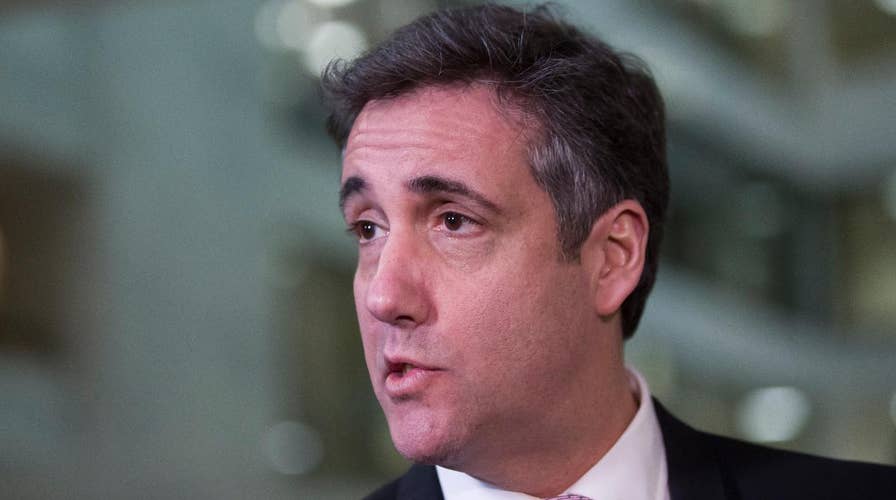
This is a rush transcript from "Media Buzz," March 3, 2019. This copy may not be in its final form and may be updated.
HOWARD KURTZ, HOST: On the Buzz Meter this Sunday, the televised spectacle of Michael Cohen attacking his former boss on Capitol Hill overshadows the president's nuclear summit with North Korea with the pundits divided whether Cohen is a reformed sinner or a pathetic liar.
(BEGIN VIDEO CLIPS)
CHRIS HAYES, MSNBC: It was the most damning testimony against a sitting president since -- well, probably John Dean incriminated Richard Nixon and this despite Cohen's very real credibility issues.
LAWRENCE O'DONNELL, MSNBC: Michael Cohen wrote the first article of impeachment against President Trump in his testimony in the House of Representatives.
DON LEMON, CNN: If you believe that Michael Cohen lied, then you got to believe that the president lied, too.
BRIT HUME, FOX NEWS: You look at Michael Cohen and he is a broken man. He's broken because he committed crimes and he got nailed for it. And now he's doing everything he can to try to make things easier for himself.
TUCKER CARLSON, FOX NEWS: If Michael Cohen had the dime, he would drop it, but he doesn't. There is nothing there. It was all a lie.
(END VIDEO CLIPS)
KURTZ: Does the media debate mirror the hyper-partisan questioning at the hearing and beyond the sniping? What exactly did Cohen prove about Trump?
The president walks away from his second sit-down with Kim Jong-un, cutting the talk short and leading the press to declare the negotiations a failure.
(BEGIN VIDEO CLIPS)
PRESIDENT DONALD TRUMP: I think, you know, eventually we will get there. But for this particular visit, we decided that we had to walk.
ANDREA MITCHELL, NBC NEWS: I think that this summit failed. It wasn't well prepared. It probably should not have happened.
SUSAN GLASSER, CNN: This was an embarrassing defeat for the president of the United States on the world stage and a blow to his prestige.
FAREED ZAKARIA, CNN: I actually think frankly he did the right thing in walking away with no deal. Why did we get there? My guess is Donald Trump invested way too much in the idea of his personal relationship with Kim.
GEN. JACK KEANE, FOX NEWS: I absolutely think it's a positive step forward. It's not a setback of any kind whatsoever.
(END VIDEO CLIPS)
KURTZ: Was the president unrealistic about the talks as many pundits say or does he deserve credit for rejecting a bad deal?
And why did the White House bar several reporters from the two leaders' dinner?
Nancy Pelosi and Alexandria Ocasio-Cortez warn moderate Democrats after a gun control vote, they could face consequences. Why a story on Democratic (INAUDIBLE) isn't getting much traction.
Plus, an expose on Facebook censors. The staffers who removed violent or offensive content say they are so traumatized that they are smoking dope, having sex in stairwells or embracing conspiracy theories.
I'm Howard Kurtz and this is "Media Buzz."
CBS, NBC, and ABC in a rare move joined the cable news networks in airing the House testimony of the man who was Donald Trump's fixer for a decade. Michael Cohen is also a convicted felon who soon will be serving a three- year prison term for charges that include lying. This time, he says, he's telling the truth. (BEGIN VIDEO CLIP)
MICHAEL COHEN, FORMER ATTORNEY FOR PRESIDENT DONALD TRUMP: I'm ashamed that I chose to take part in concealing Mr. Trump's illicit acts rather than listening to my own conscience. I am ashamed because I know what Mr. Trump is. He is a racist, he is a con man, and he is a cheat.
(END VIDEO CLIP)
KURTZ: The president was in Vietnam when he tweeted that Cohen was just disbarred by the State Supreme Court for lying and fraud. He did bad things unrelated to Trump. He said in a news conference after the nuclear summit that he watched some of the testimony.
(BEGIN VIDEO CLIP)
JONATHAN KARL, ABC NEWS: He called you a liar, a con man, a racist. What's your response to Michael Cohen?
TRUMP: Well, it's incorrect. But I think having a fake hearing like that and having it in the middle of this very important summit is really a terrible thing. He lied a lot. But it was very interesting because he didn't lie about one thing. He said no collusion with the Russian hoax.
(END VIDEO CLIP)
KURTZ: Joining us now to analyze the coverage: Guy Benson, political editor at Townhall, a Fox News contributor, and co-host of the radio show "Benson and Harf"; Sara Fischer, media reporter for Axios; and Clarence Page, columnist for the Chicago Tribune.
Guy, the nonstop coverage of Cohen is still going on, focused on all the negative things that Michael Cohen said about his former client. The fact that he is a convicted liar is sort of a subsidiary point.
GUY BENSON, FOX NEWS CONTRIBUTOR: Right. So, I think generally the media, I would have liked to see a bit more skepticism about this road to Damascus moment and thinking about the motives that he has to do the what was me, I'm so sorry, I was bamboozled by this guy.
He now has to ponder to the resistance because he has torched his bridge to Trump world, he will have a life after prison, and he's spoon feeding the left exactly what they want to hear.
Now, some of it is very likely true and in fact he has proven that some of it is true with documentation. I think on the flip side of the media argument from my side of the aisle, the conservative press, I think that too many of us were too willing to go along with the White House and the Republicans with this all hands on deck, this man is a liar, you cannot believe a word he says, because he actually testified a few things that are helpful to the president, and I think it's disingenuous to say he's a complete liar except for these three things which we like.
KURTZ: Almost all of the Republican questioning at the hearing was attacking his character. It is fair game but that was almost all (ph). Clarence, are many in the media too quick to champion Michael Cohen as this now whistle blower after being so critical of him during the years when he was Donald Trump's fixer and sometimes yelled at threatened journalists?
CLARENCE PAGE, COLUMNIST, CHICAGO TRIBUNE: Championing him, Howard, but I'm delighted they gave him platform that the House -- Democratic House gave him this platform as well. It reminded me of "The Valachi Papers" which nobody is old enough to remember but me -- this is a hell of a comparison here. Joe Valachi was a member of Cosa Nostra who went public in his testimony to Congress. In fact, Cosa Nostra is not just a mafia --
KURTZ: Yeah.
PAGE: -- in our language. It came from that hearing. It gives an insight into the inside world of organized crime.
KURTZ: Already --
PAGE: An inside look at Donald Trump's organization.
KURTZ: Right now, people are tweeting at you saying you are comparing this to mobsters?
PAGE: I get tweeted for making comparisons to a lot of different people.
(LAUGHTER)
PAGE: Yeah, some people do call them the Trump crime family. Some of the journalists have written about them. It's not that unusual to have that kind of reaction when you see people possibly colluding and possibly conspiring.
KURTZ: We'll see about that, but I think the mob rhetoric goes too far. Sara --
PAGE: This is not a trial member (ph). This is how CNO (ph) is a political process.
KURTZ: This is a television show.
(LAUGHTER)
KURTZ: This seemed like a perfect snapshot of a very polarized media and political culture where you trash Cohen if you are Trump supporter and believer, and you praise Cohen if you're Trump detractor.
SARA FISCHER, MEDIA REPORTER, AXIOS: That's exactly right. But there is one thing that I think everyone can see across the board which was that there was some sort of national importance. I mean, look at all the news networks taking this. They clearly saw this could be a moment that could be leading to the downfall of the president potentially. We don't know.
KURTZ: And that's the broadcast networks decided to use their precious air time because --
FISCHER: Exactly. You know, they are going to be losing some commercial money to be doing this because this could be historic. But you're right, Democrats go in there and they are sort of leaning on a key witness to be bringing out some details that could be juicy. Republicans go in there and they say, look, don't believe this guy, he doesn't want to have a bad sentence, this is good for him to be here, and he can't be trusted. It's so polarized.
KURTZ: As was mocked on "Saturday Night Live" last night. Guy, weren't journalists expecting more bombshells? Much of what Cohen said, whether it was about the hush money payments he participated in, he said it was at the president's direction to Stormy Daniels, or continuing to work on the Trump Tower Moscow project throughout the campaign important but we kind of already knew most of that because of previous reporting.
BENSON: Right.
KURTZ: When it came to the question of Russian collusion, Michael Cohen said I don't have any evidence of that.
BENSON: There was tons of damaging stuff from his testimony. I think you can't spin it some sort of unvarnished positive for the president. He came across as a man of very low character, from a fellow man of very low character. It was sort of a mess to watch.
As I alluded to in my first answer though, how there were some interesting developments when he was asked, Cohen, do you have evidence of collusion, did you witness collusion? He said, no, I may have suspicions but I have no evidence. He also said in a crucial piece of testimony that he did not visit Prague in the Czech Republic which was a key piece of that infamous Steele dossier which discredits that document which is the basis of so much of this investigation.
So, again, if the Republicans on the panel had been a little bit less obsessed with just trashing this guy and calling him a liar and a sleaze which he admitted being both of those things --
KURTZ: Yeah.
BENSON: -- and actually focus more on these other points, it might have been less damaging for the president.
KURTZ: The one exception was Michael Cohen testifying that Roger Stone had called Donald Trump in December 2016, given him advance where the WikiLeaks dump of Democrat e-mails, but Stone denies that. Meanwhile, Sara, the president gave a two-hour speech at CPAC yesterday calling Cohen's allegations "BS," kept to use the whole word, and then dumping on the press saying journalists are sick and they take his jokes and make them serious stories. They play dirtier than anyone who has ever played the game.
FISCHER: But to Guy's point, the president is going to leverage the one point he does like and say, look, all this is not true except the point that sort of says I didn't direct Cohen to like, that part, the no collusion part. That is totally fair game. I think this is just an example of everyone takes out of the hearing what they need to get out of it.
KURTZ: On that point, Clarence, I want to focus on one moment that has gotten an enormous amount of days of media coverage. It had to do with Republican Congressman Mark Meadows bringing an African-American woman who works for HUD, her name is Lynne Patton, to stand behind him as to sort of counter Michael Cohen's charges of racism, and then it brought -- we will just play a little bit of reaction from Democratic Congresswoman Rashida Tlaib.
(BEGIN VIDEO CLIP)
REP. RASHIDA TLAIB (D), MICHIGAN: The fact that someone would actually use a prop, a black woman, in this chamber, in this committee, is alone racist in itself.
(END VIDEO CLIP)
KURTZ: So, Lynne Patton says she was not a prop. She was just there speaking for him in person. Tlaib later apologized to Meadows. Are you troubled by this incident or pundits just made way too much of this one moment?
PAGE: I know across the black community as much as I know it. There was a bit of awe struck by the moment of seeing Mark Meadows calling over this black woman to stand there looking like the liberal stereotype of a token. I'm not saying she is but this is what it looked like. It was just a weird scene in the first place. We have found out that Miss Patton was trying to -- has been campaigning to get a reality TV show of her own. It's no sin. Almost everybody watching is doing that these days. But it just sort of adds to the media circus.
KURTZ: Yeah, and she's giving a lot of interviews. You know, ordinarily, Sara, Cohen's account of various racist comments by Donald Trump would be explosive, but in this presidency, we're sort of used to those allegations as the whole country and so forth.
FISCHER: It's become totally awash. And this is a breakthrough moment. You have a hearing that is supposed to have so much power around something completely different with the president is being sidetracked by this conversation around race. But at the end of the day, we've had so many of these conversations involving the president that quite frankly it's going to be something that we're probably not even going to be talking about next week.
KURTZ: Let me turn to the BuzzFeed story because you recall that a few weeks ago, BuzzFeed reported President Trump directed his long-term attorney Michael Cohen to lie to Congress, personally instructed him to lie. Robert Mueller's office disputed that. BuzzFeed stuck by the story. So, in the testimony, Michael Cohen was asked about this, having to do with his account about the Trump Tower Moscow project. Here is what he said.
(BEGIN VIDEO CLIP)
COHEN: And so I lied about it, too. Because Mr. Trump had made clear to me through his personal statements to me that we both knew to be false and through his lies to the country, that he wanted me to lie.
(END VIDEO CLIP)
KURTZ: So, Cohen is saying, well, he didn't directly tell me to do this. I just interpreted that was his intent. What does that do to the BuzzFeed story?
BENSON: Well, the BuzzFeed story is still usually problematic for BuzzFeed because what they reported was that Trump directed Cohen to lie under oath and he denied that. Cohen did on the stand saying, I felt like I knew what he wanted me to do which was to lie, which was a very different thing than being ordered or directed to do something.
It is plausible, but that is not what BuzzFeed reported. There is still this outstanding problem that they have, which is the true reporters on that piece, one of them when it first broke said that they had seen documentation that proved that this directive had occurred. One of them said they had seen it, the other one said they had not seen it. And to this day, they still can't get on the same page.
KURTZ: Just briefly, Clarence, Cohen said it is not his job to be a fact checker for BuzzFeed, and why didn't he speak out on this earlier. But even if he is telling truth as he sees it, that's not what BuzzFeed reported.
PAGE: Mueller become a fact checker for BuzzFeed --
KURTZ: Yeah.
PAGE: I mean, this is -- that argument has already started and continues like all the other arguments. I called this issue awash right now. It is true BuzzFeed is on the defensive for good reason. They have to back up that story, if you will.
But this whole affair is really, like I said, a political process or media process to try (ph) Donald Trump over the media, through the media and make an issue out of everything and interpret it from the advantage point they are speaking from.
KURTZ: That is why it has been such an enormous media story this week. Let me get a break. Ahead, the Democratic House passes a gun control bill. Is that a big story if it's not going anywhere? When we come back, some journalists are up in arms over how the White House treated them during the Vietnam summit. John Roberts is next.
(COMMERCIAL BREAK)
KURTZ: While we were on the air, the president just tweeted again about Michael Cohen, calling him a liar trying to reduce his prison time. He has just written book manuscript, says the president, showing what he said was a total lie but fake media won't show it. I am an innocent man being persecuted by some very bad, conflicted and corrupt people in a witch hunt.
The president actually is referring to -- shouldn't be referring to a manuscript, a book pitch to publishers for Cohen when he was still on the Trump train to do positive book about Donald Trump.
All right, when President Trump and North Korean dictator Kim Jong-un first shook hands in Hanoi, the reporters from Reuters and the AP each yelled questions like they would at home.
(BEGIN VIDEO CLIP)
JONATHAN LEMIRE, JOURNALIST, ASSOCIATED PRESS: Mr. President, do you have any reaction to Michael Cohen and his testimony?
(END VIDEO CLIP)
KURTZ: The result, the White House banned those two reporters along with journalists from the L.A. Times and Bloomberg from covering that night's dinner between the two leaders. The reason, said Sarah Huckabee Sanders, was sensitivities over shouted questions. I spoke earlier with Fox News chief White House correspondent John Roberts from Vietnam.
(BEGIN VIDEOTAPE)
KURTZ: John Roberts, welcome.
JOHN ROBERTS, FOX NEWS CHIEF WHITE HOUSE CORRESPONDENT: Good to be with you, Howie. Good to be with you from Vietnam.
KURTZ: What was your reaction when the White House barred four reporters from that first Trump-Kim dinner because a couple of them had shouted questions in an earlier event?
ROBERTS: Yeah, I mean, it seemed to be yet another victory for Kim Jong- un. They were at a photo-op. there was a one-on-one photo-op on Tuesday night between the president and Kim Jong-un. Jeff Mason and Jonathan Lemire from Reuters and AP, respectively, had the temerity to try to ask a question and they were ushered out of the room. We do not know for sure if Kim Jong-un complained to President Trump about it. Sarah Sanders was asked about that and she said, I wouldn't say that.
But when they went to go in for what is called the pool spray for the dinner where President Trump was having dinner with Kim Jong-un, Mick Mulvaney, the secretary of state, and a couple of other folks on the North Korean side, there were four reporters, Mason and Lemire and reporter from Bloomberg and one from Los Angeles Times, who were not allowed into that pool spray.
The reporter for the Wall Street Journal was assigned to be the pool reporter for all of the print. Now, we can't make the direct connection that they were being punished for having the audacity to ask a question --
KURTZ: The official explanation was sensitivities about shouted questions. Does the White House have a point about that taking place with a foreign leader?
ROBERTS: The questions were asked to President Trump. In every leader, event that we do around the world, every time we are in on a one-on-one bilateral situation, we always ask the president questions. Sometimes, he responds to them and sometimes he doesn't. Sometimes, we will even ask the leader from the other country a question. So, it is just sensitivities dealing with a person who is not used to being asked questions, certainly not by a free press, anyway.
KURTZ: What happened when Kim Jong-un arrived at a hotel in Hanoi where the media filing center had been set up and you're probably there?
ROBERTS: He hadn't even arrived at the hotel. He had just arrived at the train station. It is China-Vietnam border. Rumors started flying around. We were all at the Melia Hotel, the North Korean delegation as well as the White House Press Corps.
Now, some of us like me were staying at the Melia Hotel, but every time we go to a city around the world with the president, we set up what is called the White House Filing Center. We usually set this up a couple weeks in advance. It costs tens of thousands of dollars.
When Kim Jong-un got to that train station at China-Vietnam border, rumors started flying around at the Melia Hotal that he was upset that we were in his hotel. And just before that filing center officially opened on Tuesday morning at 11, we got an e-mail from the White House saying we were moving our filing center over here to the International Press Center.
I mean, logistically it was a huge hurdle to get over. But I think principle more than anything, in the 10 years that I have covered the White House off and on through Clinton and through Bush and now President Trump, we have never had to shut down and move a file center in a hotel because there was a complaint by a foreign leader.
KURTZ: Last question, did you (INAUDIBLE) traveling half way around the world for this nuclear summit when the dominant story was the Michael and Cohen hearings back in D.C.?
ROBERTS: Not at all because whether it was President Clinton or President Bush or many cases President Obama and now President Trump, it seems almost like every time we go overseas, there is another story that knocks whatever the president is doing, whatever city around the world off of the headlines.
KURTZ: All right, John Roberts, thank you very much for joining us from Vietnam.
ROBERTS: Thanks, Howie.
(END VIDEOTAPE)
KURTZ: In a few moments, we will look at the coverage of the North Korea summit that ended with no deal. But up next, our media microscope on how much at primetime each cable news network devoted to the Korean summit versus the Michael Cohen hearing. This is eye popping.
(COMMERCIAL BREAK)
KURTZ: The Michael Cohen hearings were a massive media story this week.
(BEGIN VIDEO CLIP) JAKE TAPPER, CNN CHIEF WASHINGTON CORRESPONDENT: Big news on Michael Cohen today. ANDERSON COOPER, CNN ANCHOR: Cohen also hinted at other investigations.
RACHEL MADDOW, MSNBC HOST: Let me ask you about Mr. Cohen's testimony yesterday.
(END VIDEO CLIP)
KURTZ: And I fully understand why the president's former lawyer denouncing him at congressional hearings withdrew so much media attention. But obviously, there was another very big story this week, the second summit meeting between President Trump and Kim Jong-un involving perhaps the world's foremost nuclear threat and a surprising outcome, no deal being made.
But on the other two cable news networks, one story dominated. It was practically all Cohen all the time. On Wednesday night, U.S. time, as the summit was about to get underway, MSNBC in primetime devoted just two minutes to the nuclear talks, 132 minutes to the Michael Cohen saga.
On CNN which has the most reporters around the world, in primetime, it was under two minutes to the Vietnam summit, 141 minutes for Michael Cohen. On Fox in primetime, 85 minutes for the U.S. and North Korea, 66 minutes for the Cohen saga.
Now, let's move to Thursday night. President Trump had broken off the talks so it was the new story. It would have been easy to portray this as his failure. And yet, MSNBC primetime: five minutes for North Korea, 88 minutes for Cohen. CNN primetime: eight minutes for North Korea, 32 minutes for Cohen. Fox primetime: 37 minutes for North Korea, 38 for Michael Cohen, an even split.
Now, look, I get that Cohen is the sexier story and of course ratings may be a factor, but the other networks made an editorial decision that pounding away at the Cohen hearings even a day later and listening and replaying the best sound bites was far, far more important than an effort, even unsuccessful effort, to get rid of Kim Jong-un's nuclear arsenal.
By the way, CNN's Jim Acosta, Donald Trump's least favorite White House correspondent, had this to say after the presidential news conference in Hanoi.
(BEGIN VIDEO CLIP)
JIM ACOSTA, CNN WHITE HOUSE CORRESPONDENT: We have to point out the obvious which is the president steered clear largely during the news conference of the White House Press Corps and was instead selecting journalists at random from the other side of the room where there were foreign journalists seated.
(END VIDEO CLIP)
KURTZ: Except that wasn't quite true. While Trump did take questions from foreign journalists and from Sean Hannity, he also called on David Sanger of The New York Times and the following members of the White House Press Corps: CBS's Major Garrett, ABC's Jonathan Karl, Bloomberg's Margaret Talev, Fox's John Roberts, The Washington Post's David Nakamura, and Ayesha Rascoe of NPR, just not Jim Acosta.
Ahead on "Media Buzz," a report on a bitter split between Nancy Pelosi's liberals and Democratic moderates. Should that get more attention? But first, much of the press blaming the president for failing to reach an agreement with Kim Jong-un, but didn't he also walk away from a bad deal?
(COMMERCIAL BREAK)
HOWARD KURTZ, MEDIA BUZZ, HOST: President Trump's second nuclear summit with Kim Jong-un ended with no deal. With the president cutting off the talks early, he put the best face on the decision to leave Vietnam.
(BEGIN VIDEO CLIP)
DONALD TRUMP, PRESIDENT OF THE UNITED STATES: This wasn't a walk-away like you get up and walk out. No, this is very friendly. We shook hands.
(END VIDEO CLIP)
KURTZ: The Washington Post says Trump was humbled by the setback. The New York Times said the talks ended in shambles, underscoring the risk of relying his self-described skills as the master negotiator. Politico called it the latest demoralizing episode in a months' long losing streak. And we are back with the panel.
Guy Benson, some say it was a bust, Trump cut it short. At the same time, for a few days, there have been stories from anonymous aide who were afraid he would give away the store, that he was so anxious for positive headlines. Mike Pompeo didn't want him spending too time alone with Kim. That narrative was quickly dropped when the president decided to walk.
GUY BENSON, TOWNHALL.COM POLICAL EDITOR: Right. And then, that was the new line of attack. So we're so terrified he's going to give away the store. And then, he didn't. He stands up and says I got to get out of here. Sorry, this deal isn't good enough, goodbye. Everyone says look at this here.
So, there is an element of lose-lose among some -- some in the press. Others were much more fair. I think there are things that are reasonable to criticize, Trump for on North Korea, but I feel like it's incumbent on journalists to look at the last few decades of history. Everything we have tried through the normal channels with North Korea has -- all of it has failed.
KURTZ: Right.
BENSON: And so, Trump said I'm going to do something totally different. I'm going to rely on personal diplomacy and see if it works. I think it's unfair to knock him too hard for that.
KURTZ: I'll come back to that. But, Sara, the White House didn't try to spin this so some kind of success. The president said sometimes you have to walk, we had handshakes. So you didn't have any sort of overstatement on what had happened.
SARA FISCHER, AXIOS: No, they were pretty realistic about it. We went, we tried, we failed, we got out. I mean, I think the lesson learned here is that you can't rely too much on your personal diplomacy when you're negotiating with a regime like that in North Korea.
But at the end of the day, the media was pretty hard on the president for this one. He decided to take a walk. I think anyone that's' going to label this as a huge massive failure -- I mean, the whole diplomacy with North Korea has not been successful to date. With this particular thing, the massive failure that they painted it to be, not so much, we haven't given up all the sanctions.
KURTZ: I do think Clarence Page and many of the media were right that Trump relies highly on highly personal diplomacy. He's talking about this great love between me and Kim rather than say, letting experts and diplomats negotiate. In the old days, 98 percent of it, the two leaders come in and they stay in front of the cameras.
CLARENCE PAGE, CHICAGO TRIBUNE COLUMNIST: Right.
KURTZ: And that is a risky strategy, as we just found out.
PAGE: That's very risky. I hope he has learned a lesson though. Prepare yourself. You know, this should have -- it's personal or group or delegation, you need to prepare yourself before the big event occurs and know pretty well what's going to happen before it happens. I think both Trump and Kim misjudged what was going to happen.
KURTZ: Now, there's a fair analysis.
PAGE: Yeah. And I think Trump did the right thing to walk away from a bad deal. But is he going to walk into another bad situation to come. That's what I'm worried about.
FISCHER: I will push back the line. Kim misjudging the situation, one thing he got out of it was a press moment with the United States. And he knew that even if the deal didn't come through, there would be cameras with the two of them together. There are people that say that alone is a loss to the United States and a win for Kim.
KURTZ: What was striking about North Korea, Sara, the world's most closed regime, is that after this fell apart, North Korean officials had a press conference saying we didn't demand an end to all U.S. sanctions, as the Americans are claiming. We only wanted some of those for shutting down our nuclear program.
It actually turned out it was almost all of the important sanctions. But Western journalists aren't used to having a competing narrative from North Korea.
FISCHER: But we need to expect it moving forward. They're going to spin anything to be a win to their people because they don't want to be embarrassed. So, we need know going into these types of summits that they're going to use this as an opportunity to spin these talks in a way that they need to for internal PR. And we have to be ready for that.
KURTZ: Guy, the media have really pounced on Trump up until today, including today, for saying that he takes Kim and his word, that he didn't know about the horrible death of the American student, Otto Warmbier, who died in captivity. He doesn't believe Kim knew about it or Warmbier's family certainly blamed Kim. And so, that has been a very big secondary story coming up.
BENSON: Yeah, unfair, right? I think -- I defended the president on some of the North Korea stuff. I think the concessions on military action with South Korea, the military exercises is, to me, a big mistake. And another big mistake coming out of this was exactly what you just described, Howie.
This -- this comment on the death of Otto and sort of holding Kim blameless and blaming the regime more broadly, Kim is the regime. Nothing happens, especially to an American hostage, without the knowledge of that dictator in that country. And I get flattery is part of this whole thing. But sometimes, you go too far. And clearly, in the eyes of the family and the parents, the president went too far.
KURTZ: Right. I should have said he didn't die in captivity, but obviously, he was mistreated and even tortured in captivity.
BENSON: Right
KURTZ: When he came home, John Bolton, the national security advisor, said on Fox News Sunday, that Bolton wasn't -- that the president didn't mean he accepts Kim's version of reality when he said I take him at his word. But that sounds like that to the average person.
Clarence, the story about what the president had to say about Kim have more resonance for journalists because Trump accepted Putin's word against U.S. intelligence on Russian hacking of elections.
PAGE: Right.
KURTZ: He has accepted the Saudi Prince's word when it came to the brutal murder of Jamal Khashoggi.
PAGE: That's right. That's disturbing when you see the president kick two reporters out of his press briefing. And I was watching Kim smile when the reporters were asking questions to President Trump. And I was thinking, if this happened in North Korea, Kim would have those reporters march out and shot.
And I was wondering perhaps another one of our reporters -- American journalists have problems overseas, can we depend on President Trump to have our back, if Otto Warmbier's -- if he didn't have their backs. And that's a negative message.
KURTZ: I think it's fair he didn't have their backs. OK.
(CROSSTALK)
KURTZ: He got him home.
FISCHER: To that point, we had Jorge Ramos being held up by Nicolas Maduro in Venezuela. And the State Department did tweet in his defense, you need to bring him home. Now, did the president address it? No.
KURTZ: But the State Department did.
FISCHER: The State Department did.
KURTZ: Really good point. And on that point, Clarence Page, Sara Fischer, Guy Benson, great to see you all this Sunday.
Coming up, Nancy Pelosi making her move on gun control, and Rolling Stone gives her cover billing along with Alexandria Ocasio-Cortez.
And later, a really troubling report on what should be removed from Facebook.
(COMMERCIAL BREAK)
KURTZ: House Democrats made two major moves on gun control this week, passing measures for stricter balk ground checks and gun purchases, and allowing the FBI more time to conduct background checks. But these have drawn relatively little media coverage.
Joining us Emily Jashinsky, culture editor at the Federalist, and Mara Liasson, NPR's national political reporter and a Fox News contributor join us. Emily, the press really cares about gun control. Every time there is a mass shooting, we have complaints about gun control that go on for weeks. I think this vote was barely covered. I mean, here's the New York Times, it's on page A21, why is that?
EMILY JASHINSKY, THE FEDERALIST: Well, I think, of course, when it's happening against the backdrop of Cohen-mania, that's exactly what's going to happen. And of course, it's also competing with the very important North Korea cycle.
KURTZ: Yes, fair enough.
JASHINSKY: And these are legitimate news cycles.
KURTZ: Oh, yeah.
JASHINSKY: This is a good example what is lost in Cohen-mania, in Russia- mania, in 2016-mania. We're never going to leave the year 2016, we're still living in it.
KURTZ: Yeah.
JASHINSKY: Because this was very legitimate. This is major legislation. It's something both sides should be interested and concerned about. And for it to be on A21, I think it's a telling statement.
KURTZ: It's also true, Mara, that this would probably never pass the Senate.
MARA LIASSON, NPR'S NATIONAL POLITICAL REPORTER: That's right.
KURTZ: It wasn't a bipartisan bill.
LIASSON: Right.
KURTZ: As some stories note, it's the first action by 25 -- by Congress in 25 years on guns because many Democrats have been beaten.
LIASSON: That's right. And that's the most of significant thing. Look, I think in this case, the band bandwidth is narrow. We're talking about newspapers. We're talking about -- there's only 24 hours in a day. And you have two mammoth news stories. But it did get covered everywhere, even if not on A1. And it isn't going anywhere in the Senate.
But it does show you the logjam, at least among Democrats, on gun control, has broken. It's no longer death sentence to vote for a gun control bill for a Democrat.
JASHINSKY: I think there is an added importance to it happening against the backdrop of a presidential election, because it means that they are willing to take action on this particular issue. So I think that also heightens the importance of it in this context.
KURTZ: There was a Washington Post story related to this that said that House Democrats exploded in recriminations, behind closed doors, in a meeting led by Nancy Pelosi, over 26 moderates, who defected and joined the GOP on an amendment to notify ICE if illegal immigrants try to buy a gun. Apparently, the message was you got a totally liberal line with this. Would this be a bigger story if Republicans were exploding in recriminations because there wasn't that much follow-up to this piece?
LIASSON: When Democrats used this same exact procedural rule to do the same thing to Republicans, it was big news.
JASHINSKY: Yeah.
LIASSON: I mean, that's what -- that's what the minority in the House does because they have no other tools than this motion to recommit. That's what it is called. So it is big stories -- it's always a big story.
KURTZ: I'm not talking about procedural part of it. I'm talking about the fact that there is...
LIASSON: Yes. And what I'm saying is the Freedom Caucus versus John Boehner was always a big story.
KURTZ: Right.
LIASSON: Just like the Herbal Tea Party, Alexandria Ocasio-Cortez versus the moderates is a big story.
JASHINSKY: Yeah.
KURTZ: You should trademark that, the Herbal Tea Party.
LIASSON: I don't know.
KURTZ: Alexandria Ocasio-Cortez, in this meeting...
LIASSON: Yeah.
KURTZ: There are reports that she told moderates that they are putting themselves on a list, primary next year, which is the thing to say. Her spokesman confirmed it. She is now walking it back saying well, they are making themselves vulnerable. Will this sort of hardball bring more skeptical press?
JASHINSKY: Oh, yeah. You know, I mean, this is going to be a huge issue, especially in the next couple of year. Again, it's happening over the course of a presidential election. And to some extent, that's a good thing for the Democratic Party because it means that they are actually having a conversation. They are having this process that plays out.
But it will be interesting. It already has been interesting to see the difference between the John Boehner split and the Tea Party split.
KURTZ: Oh, yeah.
JASHINSKY: Because there was so much glee in the press watching that play out, whereas in this, it's a very...
KURTZ: Some of these moderates are in red-leaning districts or states and, you know, can't sign on to the liberal agenda. I want to move you to the Rolling Stone cover. Let's put it out there. Because Nancy Pelosi and Alexandria Ocasio-Cortez is there. We also have another freshman, Ilhan Omar, who apologized for anti-Semitic remarks.
The headline is women shaping the future. Emily, Republican women shaping the future on the Rolling Stone cover?
JASHINSKY: No, this is like old school media. This is a perfect example, right. This is like a case study. And it's funny. It's amusing. But it's a great example of what we were talking about. This is Alexandria Ocasio- Cortez literally touching Nancy Pelosi's arm on the cover of Rolling Stone. It's not an accurate narrative. That's not...
KURTZ: It's a great...
JASHINSKY: Right. It's not conveying the truth.
LIASSON: Well, there are two things. The truth that it doesn't convey is the House majority was made up of moderate women, not of people like AOC. She represents an 85-percent Democratic district. The majority of female -- new female Democrats are not like her. That's a failing of the media to not point that out.
KURTZ: Well, no, I would go further. I would say the media are probably helping the Republicans paint the Democrats as a socialist party.
LIASSON: Yes, yes, yes, yes.
KURTZ: Because this is not a competition. She is brilliant in getting media attention. But she and a few others are kind of representing the face of the party...
LIASSON: Yes.
KURTZ: When they don't have it.
LIASSON: I totally agree, except there is one thing that I disagree with. The reason there is not a cover somewhere else of Republican women shaping the future because in 1989, there were 13 Republican female members of the House. In 2019, there are still only 13 Republican members -- female members of the House.
JASHINSKY: Yes.
LIASSON: That's why you're not going to see that corresponding cover.
JASHINSKY: There were some great women running in 2018 that got basically zero attention.
KURTZ: That's right.
JASHINSKY: You mean, Republican women.
LIASSON: Yeah, Republican women.
KURTZ: We got to go. Mara and Emily, thanks so much. Great to see you.
LIASSON: Thanks.
KURTZ: After the break, Facebook staffers who police offensive content working in a pretty miserable condition. And that affects their job. Here's a disturbing expose coming up next.
(COMMERCIAL BREAK)
KURTZ: In a troubling piece on some of Facebook's content reviewers whose job is to remove violent or offensive postings, the Verge reports it's an environment where workers -- dark jokes by committing suicide and then smoke weed during breaks to numb their emotions. Their employees desperate for a dopamine rush amid the misery, but found having sex in stairwells where people develop severe anxiety while still in training and continue to struggle with trauma symptoms long after they leave.
Joining us now, Shana Glenzer, a technology analyst and executive here in Washington. So, the Verge says that these sensors, I call them, work for a Facebook contractor, they sign nondisclosure agreements. So, apparently, Mark Zuckerberg's company doesn't want people to know that some of these workers are so traumatized because they have to watch repeatedly things like people being killed.
SHANA GLENZER, UPRIGHT CONSULTING: I mean, their job is stressful, it's an understatement of the year, when you're out there smoking pot on their break just to cope. And what Facebook has done here is they committed to double their workforce and they do it quickly, so they spent a lot oft these centers. But, really, in the United States, this is a huge cost- cutting opportunity for Facebook.
KURTZ: Why?
GLENZER: Paying these employees, these outsource centers are making something like 100K less a year than a lot of the average Facebook employees.
KURTZ: The average job in this facility is said to be $28,000 a year, not exactly what you get in memo part. And so, these are the people who are responsible in protecting us or protecting Facebook's users from the really violent or disturbing or offensive, more racist stuff. And yet, these reports, as some of them in conspiracy theory, what do you make of that?
GLENZER: Well, these folks are reviewing thousands. I mean, hundreds a day, thousands a week of these posts that are coming up, whether it's conspiracy theories or violence. And yes, they are normal people when they go in. But it seems reports show some of them are -- starting with conspiracy theories.
And while Facebook has multiple checks in place to try to make sure that these individual views don't influence work. You got to imagine that if they start thinking the way that these conspiracy theories, you know, are being posted, it's influencing how they're applying the rules.
KURTZ: Right. Well, for example, one of them is promoting the idea that the earth is flat. A former employee said he began to question certain aspects of the holocaust. And we're talking really disturbing stuff here.
Facebook says look, they are showing examples of when they are in the process of being hired. Then they try to screen people who have coping skills. But you get to this question of community standards, because that's what this is supposed to be upholding. And some of these seem to be ambiguous, even arcane, which troubled me. What do you make about the standards Facebook is using?
GLENZER: First of all, there are a lot of them and they're complicated. And some of them seem to make no sense. One of them, one post, I want to make sure I get it right. It's hard to even say. But a post saying that autistic people, for example, should be sterilized doesn't come down from the site, because that characteristic isn't a protected characteristic. Autism isn't.
KURTZ: Even if they say they should be sterilized, you can't say, if you're talking about race or gender.
GLENZER: Correct.
KURTZ: If you have autism then it's OK.
GLENZER: That is according to their standards, an OK post to continue to keep up online. It wouldn't come down.
KURTZ: Also, my favorite N word can stay up because you're making a positive reference, but you're still using the N word.
GLENZER: If you're calling your friends that, it stays up online.
KURTZ: So what does this tell you about Facebook standards? And by the way, I wasn't super duper -- technology is supposed to solve all of these problems. We have about half a minute.
GLENZER: Artificial intelligence is supposed to be the way of the future when it comes to content moderation. But clearly, we're a long way from there. Facebook needs to take a close look at some of these practices as they move forward.
KURTZ: Yeah. And I guess the standards, in some degree, subjective. But it just makes you wonder why people always complain about this and in political terms, too. Why is it taken off and this was allowed to remain?
Shana Glenzer, great to see you.
GLENZER: Thank you.
KURTZ: Thanks so much for coming in.
Still to come, the corporate shake-up that could affect CNN. And the co- host of fourth hour of the Today Show is a pretty prominent Republican. Stay tuned.
(COMMERCIAL BREAK)
KURTZ: CNN President Jeff Zucker maybe expanding his portfolio as part of a shake-up at AT&T whose takeover in Warner Media was just upheld on appeals. Zucker will also assume oversight of Turner Sports, which carries a lot of pro-basketball, that according to the Wall Street Journal. And he's not a tall rookie, having overseen NBC Sports when he ran that network. CNN declined to comment as part of the corporate shake-up. Turner President David Levy abruptly resigned along with HBO Chairman Richard Plepler who built that movie network into a powerhouse.
The new co-host of the fourth hour of the Today Show is Jenna Bush Hager.
(BEGIN VIDEO CLIP)
JENNA BUSH HAGER, TODAY SHOW CO-HOST: I can't believe.
UNIDENTIFIED FEMALE: You've been keeping it as a secret for a little while.
HAGER: Yes, we have. And it feels good.
UNIDENTIFIED FEMALE: It was the worst kept secret in show business, though.
UNIDENTIFIED FEMALE: If anyone were to ask, we were like we don't know.
HAGER: No, it feels humbling and I can't believe it. My dad just wrote me three words, which made me weep. He said very proud dad.
(END VIDEO CLIP)
KURTZ: Worst kept secret, I didn't know about it. Obviously, a former president's daughter has some advantages. But there are drawbacks in terms of expectations, just ask Chelsea Clinton, who kind of bombed in her short time as a special correspondent for NBC. With so many liberals and television Hollywood, It's refreshing to see a prominent member of a Republican family make the grade in morning TV.
That's it for this edition of Media Buzz. I'm Howard Kurtz. You know, we have been on the air for an hour. President Trump gave his address to the CPAC conference yesterday, he spoke for two hours with no commercial breaks. People who love the president love the speech. People who don't like the president didn't like the speech. But the man can certainly talk. He doesn't use a lot of notes. He said he was going off-script and he did.
Hey, check out my new Podcast, Media Buzzmeter. We rife on the day's five hottest stories. We don't talk for two hours, maybe 20 minutes or so. But you can subscribe at Apple iTunes, Google Play, or FoxNewsPodcast.com. I also hope you like our Facebook page. We post my daily columns there, original videos.
Let's continue the conversation on Twitter @HowardKurtz. I would love to interact with you and see what you think of the show and the media issues we discussed.
We are back here next Sunday.
Content and Programming Copyright 2019 Fox News Network, LLC. ALL RIGHTS RESERVED. Copyright 2019 CQ-Roll Call, Inc. All materials herein are protected by United States copyright law and may not be reproduced, distributed, transmitted, displayed, published or broadcast without the prior written permission of CQ-Roll Call. You may not alter or remove any trademark, copyright or other notice from copies of the content.
