





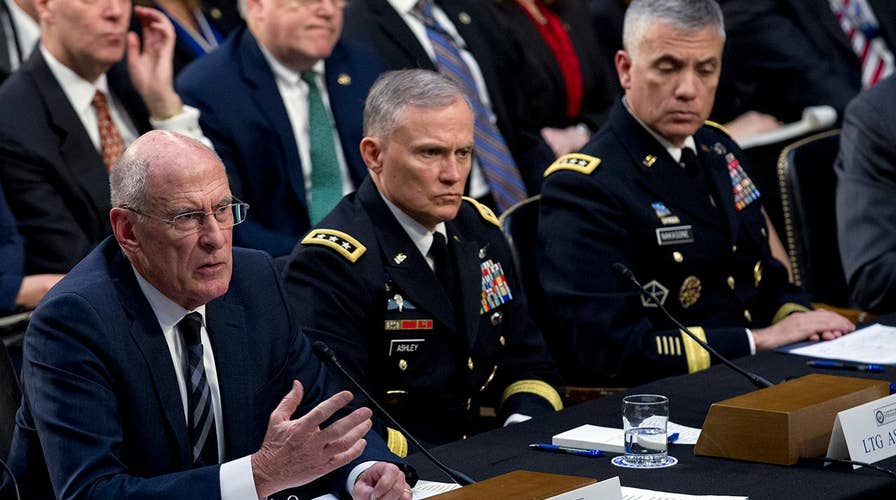
Media melts down after top intelligence officials contradict President Trump
Trump's media critics go wild after intel chiefs contradict the president's statements on Iran, ISIS and North Korea during Senate testimony; reaction and analysis on 'The Five.'
This is a rush transcript from "The Five," January 30, 2019. This copy may not be in its final form and may be updated.
GREG GUTFELD, HOST: Hold it forever and then boom. Hey, I'm G.G. with Katie Pavlich, Juan Williams, Jesse Watters, and she borrows her Barbie dolls' shoes, Dana Perino. “The Five.”
It's the battle of the billionaires, and now it's Mike Bloomberg's turn. He used to be Republican, but he became so rich he had to join the Democrats. He's rich, he's white, he's male, or in CNN's terms, he's Satan.
Now, he bloviates (ph) in the faces of other Dems, offering wisdom based on his decades of success as well as being really boring and earnest. While speaking in New Hampshire, he reminds the Dems that the election takes place in America, not Berkeley. But their lame platitudes the Democratic campaign resembles a high school beer party before mom and dad unexpectedly show up.
(BEGIN VIDEO CLIP)
MIKE BLOOMBERG, CEO, BLOOMBERG: I'm a little bit tired of listening to things that are pie-in-the-sky, that we're never going to pass, never going to afford.
People aren't going, overnight, give up their jobs if those jobs happens to not be on the right side of the green new deal. I think you can have Medicare for all for people that are uncovered to replace the entire private system where companies provide health care for their employees would bankrupt us for a very long time.
(END VIDEO CLIP)
GUTFELD: Talk about charisma or opposite of charisma. Don't have him stand in front of machines because he just blends in. So, Bloomberg is calling B.S. on his own side, offering a reality check to a party riddled with dopey history, reverse chuckle buckets.
Now, that makes two billionaires, him and Schultz, throwing cold water on these bozos. They almost make one Trump. But this is a party tied in knots with the loudest voices embracing bad ideas that left behind a centuries worth of skulls. As progressives, aren't they supposed to look forward instead of dressing up as Vlad's Lenin?
Rejecting the common American dream, they look at this country and say I'm tired of all this prosperity. Let's destroy the greatest system ever created and replace it with a thing that always fails, which is why Bloomy reminds people that socialism isn't some cool new thing a hip teacher told you about to get you to share his bong in a van behind the football field.
(BEGIN VIDEO CLIP)
BLOOMBERG: We need a healthy economy, and we shouldn't be embarrassed about our system. If you want to look at a system that's non-capitalistic just take a look at what was perhaps the wealthiest country in the world, and today people are starving to death. It's called Venezuela.
(END VIDEO CLIP)
GUTFELD: Sounds like he's handing some common sense to the Dems, which is like feeding steak to a cactus.
You know, when we were -- when I was writing this up, I didn't actually look at -- listen to the tape, Katie. I just read his quotes. I thought, wow, these are really good quotes. He's a smart dude. And then I listen to him and I go, nope.
KATIE PAVLICH, HOST: A little dry.
GUTFELD: He's not gonna making this. He's not making it.
DANA PERINO, HOST: It would be nice if you could put yourself on 1.5 speed.
GUTFELD: Yes.
PAVLICH: He's not going with the bombastic nicknames, like President Trump. He's not going with the Cory Booker style hands and Spartacus moves. I'm not sure he's going to make it. But, I do like what he is saying about Democrats. He had some good words to say about Venezuela and the socialism that we're seeing there. Today, Alexandria Ocasio-Cortez actually attacked Howard Schultz for being a billionaire --
GUTFELD: Right.
PAVLICH: -- and saying that he needs to get in line. So, it's funny how the left likes billionaires when it's convenient, like donations to their campaign, George Soros, you know, funding all of these advocacy groups.
When it comes to their success in the American dream and building themselves up from the bottom as Howard Schultz did as someone who grew up in Brooklyn housing complex, and then made his way with Starbucks, they're telling him to get in line and saying their American dream doesn't count despite them --
PERINO: But get in line is what Democrat said about Alexandria Ocasio- Cortez when she was trying to beat -- and she did handily beat --
PAVLICH: Through hard work.
PERINO: -- the incumbent congressman who didn't even show up to his own debate.
GUTFELD: Do you think, you know, Bloomberg was a pretty good mayor, right?
PERINO: Well, compared to now, yeah.
GUTFELD: Yeah. You know, just a rock that you found at the bottom of a toilet.
PERINO: Honestly, what -- did you see today? People are hiring private security --
GUTFELD: Yeah.
PERINO: -- to protect themselves on the upper west side? Come on.
GUTFELD: Well.
PERINO: Anyway.
JESSE WATTERS, HOST: Is that what your Pilates teacher told you today?
(LAUGHTER)
PERINO: No, but he told me something else.
GUTFELD: So, Dana, since you're already talking, what do you -- do you think that somebody like him is going to make any headway?
PERINO: I think that the headway he makes is by -- is within the party.
GUTFELD: Yeah.
PERINO: I don't think he goes to the front of the pack as their ultimate nominee, but can somebody like a Howard Schultz or Mike Bloomberg get the Democratic Party -- like, keep them from going so far left that --
GUTFELD: Yeah.
PERINO: -- it's just unrecognizable.
GUTFELD: What do you think, Juan? Do you think -- you think he has a chance or will anybody listen to him? Or it's just like whoever is kind of Trumpian, charismatic, memorable is going to be -- who is going to be the nominee?
JUAN WILLIAMS, FOX NEWS HOST: Well, I think people like the fact that Mike Bloomberg is a thoughtful guy and he has a lot of money, obviously, so he can fund his own campaign. And he's going to get lots of platforms. Right there you saw him at St. Anne's that's already up in New Hampshire.
So, no question he's going to be, you know, out there. And media attention in New York, he's known, the New York media likes him. So, but that's not the issue. The issue is whether or not a billionaire in an era of tremendous income inequality is in touch with the real issues that face the American people.
I was looking up today, I've said -- something like, you know, was it, you know, huge number, 57 percent of Americans can't afford a $500 bill in 2019. And so, there's populism, the Trump side of it --
GUTFELD: Who buys a $500 bill?
WILLIAMS: I don't know. Anyway, populism on the far right and populism on the far left, Bernie Sanders, Donald Trump. We've talked about this before. And I think he's out of touch with that. I mean, like for example, the criticism of Medicare for all which is coming from Kamala Harris. Well, guess what, most American support this.
GUTFELD: Until they figure out how it works.
WILLIAMS: And then they say what about, you know, can I keep this, whatever. But the principle, the bold idea that's starting a discussion is supported by most Americans, including most Republicans.
GUTFELD: But that is a half opinion, and the other half opinion which is never brought up is how do you pay for it. And once you get to that, the other opinion goes. Jesse, would you like to talk about Bloomberg or would you like to talk about Howie Schultz?
WATTERS: I'll do both, Greg.
GUTFELD: Can I show you something?
WATTERS: Sure.
GUTFELD: Anyway. It's this tape from Morning Joe.
WATTERS: OK.
GUTFELD: Watch what they did to Howie Schultz because they're trying to protect Kamala --
WATTERS: OK.
GUTFELD: -- or Kamala.
(BEGIN VIDEO CLIP)
UNIDENTIFIED FEMALE: How much does an 18-ounce box of Cheerios cost?
UNIDENTIFIED MALE: An 18-ounce box of Cheerios? I don't know.
(CROSSTALK)
UNIDENTIFIED MALE: Here's the deal. You ask us, you know, like the budget is for the V.A. We didn't ask you questions.
UNIDENTIFIED MALE: I don't eat Cheerios, I'm sorry.
UNIDENTIFIED FEMALE: OK. It's four bucks.
UNIDENTIFIED MALE: Is it four bucks.
(END VIDEO CLIP)
GUTFELD: Yeah, because she just looked it up on Google. She does not drink -- eat Cheerios for breakfast.
WATTERS: Well, as the reigning supermarket showdown champion, I was very disappointed in Schultz. And I bought some cereal today that cost $7.99. It was very expensive organic cereal.
GUTFELD: You bought it --
WATTERS: I treat my body like it should be treated, right? Only the best for Watters. Here's what I think. What's happening right now in the Democratic Party is an intervention. And trust me, I know about interventions. It's happened a few times. I know when I see it. And the centrists are making the same arguments that conservatives have been making about socialism for decades. And this is why it stings so much, and the Democrat response is shut up, billionaire. That's all they have.
PAVLICH: Right.
WATTERS: And Schultz and Bloomberg are coming at the Democrats with genuine political fellowship. These are Trump haters. They want what's best for the country. And you think someone that ran the biggest city in the country, or ran one of the biggest companies in America knows a little something about supply and demands and basic economics.
But instead, the Democrats don't argue the substance of their policies. They don't say this is how it's going to work, and this is why it's going to work, and this is how much it's going to cost. They just say you're mean for opposing me. So, it's bad politics and bad policy because you're ceding the entire middle of the country to Republicans, and Republicans don't even have to do anything.
And if you look at the policy of it, to say I want to destroy a trillion dollar industry, put everybody out of work, 50 percent of the country gets their health insurance through their company, they like it. You take their plans away, it's going to be Armageddon.
GUTFELD: But you know what's interesting, they're -- Schultz is already having an effect because Kamala is already adjusting.
WATTERS: She's on defense.
GUTFELD: She's on defense but she's changing her mind. She's going, you know, I'm not going to ditch the --
PAVLICH: Kind of.
GUTFELD: -- industry.
WILLIAMS: But he never said that.
GUTFELD: Yeah, she did.
WILLIAMS: All she said was --she never said that.
PAVLICH: She said eliminated.
(CROSSTALK)
PAVLICH: She said eliminated.
WILLIAMS: But I think the big issue here, I'm surprised that you say this, Jesse, is the deficit has ballooned under Donald Trump. Where did Republicans come and say, oh, this is how we're going to pay for this huge tax cut and increase --
(CROSSTALK)
GUTFELD: The mainstream media completely loses it again, the reason for the latest meltdown, that's next.
(COMMERCIAL BREAK)
WATTERS: Liberal media melting down after top intelligence officials testified on ISIS, North Korea, and Iran.
(BEGIN VIDEO CLIP)
UNIDENTIFIED MALE: President Trump and his intelligence chiefs are worlds apart on ISIS, Russia, and the border.
UNIDENTIFIED MALE: This was essentially a public repudiation by his own people of Donald Trump's worldview.
UNIDENTIFIED MALE: It was like these intelligence leaders we're describing a different planet than the one Donald Trump inhabits.
UNIDENTIFIED MALE: His growing disparity between the ground truth that they presented and the planet that this president lives on.
UNIDENTIFIED FEMALE: Where does the president get intelligence and foreign policy advice from?
UNIDENTIFIED FEMALE: Not agreeing with these conclusions is willful disregard of the facts.
UNIDENTIFIED MALE: This is dangerous, is it?
UNIDENTIFIED MALE: It's incredibly dangerous.
UNIDENTIFIED MALE: This is a dangerous thing.
(END VIDEO CLIP)
WATTERS: After that media freak out, the president calling his intel chiefs extremely passive and naive when it comes to Iran. All right, Dana. Well, I guess the president has made the media take the side of the intel agencies. They've never done that before. It's very doubtful.
PERINO: No. I'm sorry, aren't you forgetting 2003?
WATTERS: Oh, that's right. They're very critical back then. But what do you think is going on here with the president and his men at the top.
PERINO: Well, here's the thing. Like, I understand that the media -- like the story -- and we cover it all the time too. It's the story between -- about the president and the media, right? I'm actually melting down about the threats because these are -- it's like super serious. We're behind on the cyber war, especially from China and Russia. I look forward to this hearing every year because I want to know, like, what are the problems --
WATTERS: You look forward to the intel hearing every year. Dana Perino, everybody. I do, too. But I just don't remember until the day before.
PERINO: Look, and he also -- he said in his tweet that they should go back to school, and he's just throwing -- but, look, they work very hard for him every day.
GUTFELD: Did you say throwing shade?
PERINO: Yes, is that -- is that woke?
WATTERS: Oh, my gosh. You know, your Shultz and Christie interview all went to your head. Greg, what do you think is happening here? I mean, the president has always been very suspicious of the intel people after the WMD thing, and they've spied on his campaign, he didn't like that either.
GUTFELD: It's weird. The media is demanding that everybody agree. They can't be happy. They call it disparity but it's not lockstep. It's -- they want lockstep and if they don't see it then it's called disparity. They keep parsing over his tweets. They're like old guys on the beach with metal detectors hoping to find a bottle cap.
Meanwhile, they overlook bigger stories that perhaps this is working. I mean, the fact that the good cop-bad cop thing that was going on with Syria, I think might be working. North Korea had a good cop-bad cop thing where people were disagreeing. That seems to be working. If you still do not believe there's any progress there. When you say that, oh, it's disparity that they're saying nothing is happening.
It's actually better than it was last year and you have to admit it. And you can hold two ideas in your head. We are destroying ISIS. We will continue to destroy ISIS. It doesn't have to be, you know, the prison of two ideas. You said we destroyed ISIS, but they're still here. You can actually have both. We are destroying and continuing to destroy. The media wants you to be in their prison of two ideas. Let them stay in there. You have a free mind. You're smarter than they are. And you make more money than they are, Jesse.
(LAUGHTER)
PAVLICH: Much smarter.
(CROSSTALK)
WATTERS: Go ahead. Take it away.
(LAUGHTER)
PAVLICH: I think that there's plenty of room for skepticism when it comes to what the intelligence community is saying, and the sourcing that these media outlets are using to push a certain agenda when it comes to foreign policy.
However, when it comes to the threats that we do face, I was at a cybersecurity panel last week at foundation for defense of democracies, and they were saying, basically, with cyber, the good news is that were both -- both adversaries, United States, Russia, China, are both bad at responding and they're not -- and they're better at attacking, so that's their analysis.
We have to get better at cyber. It's a very serious thing that's coming down the pike. There was talk of ways to respond to that. So while we're all, you know, fighting over who said what and who agrees with what, there are real things that are happening behind the scenes that we need good people to be doing.
And so, when it comes to the ISIS thing, yeah, we've seen a number of ISIS attacks after the president has said directly they've been defeated. Is he talking about the territory? Yes. Does it mean ISIS is defeated all around the world? No. I got a press release today. Someone got arrested in the United States again for giving material support to ISIS. But that comes down to the ideology of Islamic radicalism and what our approaches to that.
WATTERS: Maybe the congresswoman from Minnesota can write a letter of support.
PAVLICH: Maybe she can.
WATTERS: Juan, to Dana's point about the threats, there are a lot of really serious threats out there, but the president has been pretty strong on ISIS, on North Korea, on China --
GUTFELD: On Russia.
WATTERS: -- he's been effective on those areas.
WILLIAMS: I'm listening to this defense coming from, at least, three of you, and I just think it's tissue thin. It's just -- but I guess you're desperate. I guess that's what --
GUTFELD: Explain how it's tissue thin rather --
WILLIAMS: Because you have Trump's people -- these are Trump's people saying we are doing a realistic assessment and we all agree. It's not a matter of disagree. No, no. This is FBI, CIA, director of National Intelligence putting themselves on the line before you, the American people, and saying here's the reality. It's not what this guy is saying, not what Trump is saying. They don't mention the southern border, for example, as an immediate threat. No, no, no, they're talking about China and Russia increasingly working together against us.
(CROSSTALK)
WILLIAMS: Hang on. Hang on. You think about for a second, North Korea. He's going to go meet again. You say, wait a second, for what? And he says, well, things are better than ever. No, according to intelligence they're still intent on creating nuclear weapons. And how about Iran? Iran -- Trump is like, oh, yeah, Iran is terrible. Nope, intelligence -- they're not violating the terms of the Obama agreement, but you never hear this from Trump. It's like he's on a different planet and you guys are -- I don't want to hear it. I don't want to hear it.
GUTFELD: Venezuela is now responding, saving that they are willing to cooperate. Must have been -- notepad.
(CROSSTALK)
WATTERS: Remember when Obama had the intel people cook the books on ISIS and say that, you know what, not that big of a threat anymore. And then, the rise of ISIS, he blamed the intel agencies for missing it. Remember when he weaponized the intel agencies to go after Donald Trump's campaign.
WILLIAMS: I tell you what, let's do a current affairs news show on Fox News Channel. Right now, today, you know what we learn? We learn that Trump is talking with Putin privately. He doesn't have a translator. Putin has a translator. Putin has aides. We don't even --
(CROSSTALK)
WATTERS: I'm going to translate it for you, Juan. Sour grapes.
WILLIAMS: Oh, yeah. That's it.
WATTERS: All right. Up next -- you're so safe. You can't stand being so safe.
(CROSSTALK)
WATTERS: All right. You've never been right yet. Up next, insane video from the deep freeze in the Midwest, and the governor claiming the cold is making us too soft.
(COMMERCIAL BREAK)
WILLIAMS: Ice, ice, baby. It's a deep-freeze in the Midwest. A polar vortex creating bone-chilling negative degree temperatures. It's so cold, rail cruise in Chicago had to light fires to keep the shrinking tracks connected.
And check out this crazy video of our own Mike Tobin in Chicago earlier today. Yeah, that's boiling water thrown by Mike instantly turning to ice. Hundreds of schools are closed across a number of states, and in some places, the post office has stopped delivering the mail. But the governor of Kentucky, he's not having it. He says we're all getting too soft.
(BEGIN VIDEO CLIP)
GOV. MATT BEVIN, R-KY.: Again, you know, now we cancel school for cold. I mean, --
UNIDENTIFIED MALE: Well, it's the deep-freeze. This is serious business.
BEVIN: Come on, now. I mean, there's no ice going with it or any snow. I mean, what happens to America? We're getting soft, Terry. We're getting soft. I've being only slightly facetious, but it does concern me a little bit that in America on this and any number of other fronts, we're sending messages to our young people that if life is hard, you can curl up in the fetal position somewhere in a warm place and just wait until it stops being hard. And that just isn't reality. It just isn't.
(END VIDEO CLIP)
WILLIAMS: Wow, he's a hard man. Katie, what do you think? I saw Al Roker said that guy is a nitwit or something. The teacher of the year in Kentucky said, yeah, you go stand outside in this temperature --
PAVLICH: Back in my day, Juan, we walked to school uphill and back both ways.
PERINO: You're in Arizona.
PAVLICH: I grew up Flagstaff --
(LAUGHTER)
PAVLICH: We have school off for an entire week one time.
PERINO: I did, too. Pretty amazing.
WILLIAMS: Well, is that a sand storm.
PAVLICH: No, it's freezing. It's a snow storm.
WILLIAMS: In Arizona?
PAVLICH: Snowy part of Arizona. People that knows this, but there is a part of Arizona that looks a lot like Colorado. We have a ski resort called Snow Ball. And it tends to get very cold there, but not negative 40 like in Chicago. And I've read a story today about how the penguins at the Cleveland Zoo had to be taken inside because it was so cold outside.
(CROSSTALK)
PAVLICH: I think the kids cannot go to school.
WILLIAMS: Wow. Jesse, incredible temperatures of 54 below, and International Falls, Minnesota, 52 below, in Minneapolis, in Chicago with the wind chill, 52 below. Are you going outside?
WATTERS: No. There's only one way to beat the cold, Juan.
WILLIAMS: Tell me.
WATTERS: Move.
(LAUGHTER)
WATTERS: I'd have everybody move. I wouldn't live there. If I lived there, I wouldn't stay there long. I'd go right to Florida where I belong. But if you do have to weather it out in a storm like this, I have some tips for staying warm. You guys want to hear them?
WILLIAMS: Sure.
WATTERS: Grow a beard. Does not apply to the ladies, just the men. Grow a beard.
PAVLICH: Very sexist.
GUTFELD: Yes. What if I couldn't grow a beard? Men who identify as women can grow beards.
WATTERS: OK. Anybody that can grow a beard, you grow a beard. Get heat - - instead of oil to heat your home, do gas. It's cheaper. Always use jumper cables when you leave the house. And drive an SUV.
PERINO: Did you get these off the internet?
WATTERS: No, this is from my brain.
(CROSSTALK)
WATTERS: Get in your car and you drive, preferably, your SUV, because you need to drive an SUV because that's what's making the environment warmer because we need more warmth, obviously, to do that. Also, I'm taking back my sweater roll. Remember how I'm anti-sweater. I'm lifting the sweater ban. And if you want to layer up, you layer up.
WILLIAMS: So, Dana, I can imagine that you as a little kid hanging out, anxious to hear school is close.
PERINO: Well, so, we -- to Matt Bevin's point, the governor of Kentucky, I think these decisions need to be made at a state and local basis, right? So our superintendent of school in Douglas County, Colorado, he would only close school if he could not get down his driveway in his tractor. It was like a quarter-mile. If he could get down in the tractor, then we all had to go to school. But the time -- I remember also we didn't have school for a week and it was because of temperatures like this.
WILLIAMS: Well, take a look. I mean --
WATTERS: You studied up hard at home, right?
PERINO: We've watched the Prize is Right and Family Feud all night.
WILLIAMS: Yes. So take a look at this tape here. Oh, it's a full -- OK, look at the full screen.
PERINO: Yes.
PAVLICH: We used to wear our pajamas inside out --
WILLIAMS: Here we go. As you can see from the full screen it says, we feel bad for kids nowadays. They get to see if school is closed on the internet, mobile devices, when people used to have to wait to see --
PERINO: Yeah. You'd wake up in the morning and then you come in, like, do we have -- is there any word yet? You have to wait for your local news. You watch the local news and, you know, there's suspense. The one thing I do worry about that we haven't paid enough attention to, I think, are the farmers and ranchers in these places that are trying to take care of their livestock. This is their livelihood. And they might end up having to do a disaster declaration.
WATTERS: Animals are great.
WILLIAMS: Yeah. So, Greg, I imagine you would just say I'm not going to school.
GUTFELD: Exactly. I grew up in the West Coast, but isn't it appropriate that the Kentucky governor is saying snowstorms are creating snowflakes.
WATTERS: Oh.
PERINO: Ha, ha.
GUTFELD: You can use that, Tomi Lahren. I didn't see snow until, maybe, I was 15. I went to Lake Tahoe skiing. I never -- I grew up on the West Coast. I got second degree burns.
PERINO: I didn't see the beach until I was 16.
GUTFELD: Wow.
WATTERS: That's a great story.
GUTFELD: Anyway, it's kind of tough to talk about whether - or a great show. We can talk about anything.
PAVLICH: I only complain one time a year and that's in the winter time.
WILLIAMS: Are you pulling your punches with your weather jokes?
GUTFELD: Well, you know because you never - because like I don't want to seem like somebody who like - weather is - like there are people that are probably suffering, so I try to--
WILLIAMS: People dying.
GUTFELD: Yes, so I try to be careful about making jokes about this.
WATTERS: You don't have any Al Gore material.
WILLIAMS: No, I have nothing. I have nothing.
WATTERS: I'm disappointed.
GUTFELD: Actually, I'm worried about my pipes.
WILLIAMS: Your pipes.
GUTFELD: I don't want my pipes to burst. That happened last year.
WILLIAMS: Your voice.
GUTFELD: No.
WILLIAMS: No, no.
GUTFELD: I have pipes in my building just exploded. OK, we'll go. And finally, I'm talking about the weather. Shut up. But just snowflakes.
WILLIAMS: You know Katie (ph), you know what. Jesse gave me for Christmas.
PAVLICH: What? Snowflakes.
WILLIAMS: A snowflake suit. Yes.
PAVLICH: Why didn't you wear it? Perfect for weather report.
WILLIAMS: No, it was a political statement. It wasn't a weather statement.
PERINO: But you should wear it now for the weather reporting you're doing.
WILLIAMS: Thank you, ma'am.
PERINO: So, well.
WILLIAMS: The border wall debate, that's heating up again. As the President sends more troops to the border. Stay with us.
(COMMERCIAL BREAK)
PERINO: The President sending several thousand more troops to the southern border as three more migrant caravans are heading towards the United States with one carrying roughly 12,000 people. And in Washington, a bipartisan group of lawmakers meeting today to try and nail down a plan for border security to avoid another potential government shutdown. President Trump warning if a wall is not part of the talks, "they're wasting their time". All right, Jesse, are we getting a wall in two weeks or not?
WATTERS: We might get a fence.
PERINO: Or a barrier.
WATTERS: I think it depends what you call it. I'm going to say something that might shock you. I believe I am more open minded than these Democrats.
PERINO: Oh! Really.
WATTERS: And I'll tell you why. Because if you hit me with facts and testimonials and logic, I will change my position on things. I'm changing my position--
PERINO: Are you changing it?
WATTERS: No. Not on the border wall, because I haven't been convinced, but on things like sweaters. I've changed my opinion.
GUTFELD: Yes. That was an amazing change.
WATTERS: Guns or gay marriage or military commands. I'm very open minded, but the Democrats, no matter how many facts you explain to them, they don't move. So, this leads me to believe that they don't want the wall, because they want to hurt the President or they don't really want to secure the border, because you cannot say, you are for border security and be against barriers in certain designated areas.
So, Juan, I just wanted to read you two things from the failing New York Times. All right, this is not fake news when I cited. When barriers were built in Yuma, Arizona in the mid-2000s. arrests for illegal crossings plummeted 94 percent. Also, when they were built in San Diego in the 90s arrests fell 80 percent over seven years. So, when The Times makes a logical case for it, it has to make sense.
PERINO: I have a question about that specifically and the President is sending more troops, the numbers brought down from 6,000 to 2,400. He's going to be sending more. There are three caravans coming, tens of thousands of people. What is the solution to stopping that from just invading the country? What is the Democratic solution?
WILLIAMS: The first two caravans for caravan man never invaded anything.
WATTERS: Caravan man.
PERINO: Because I've got to stop by a wall.
WILLIAMS: These things are coming. They've got terrorist and they've got disease. Nothing, nothing.
WATTERS: To die.
PERINO: Juan, you are not answering my question.
WILLIAMS: Here is the reality. No, I want to answer your question, because I think the Democrats are open minded and saying we need border security--
PERINO: Because I mean.
WILLIAMS: Jesse sometimes says to me, hey, they voted for border security before. Now there--
PERINO: What are they willing to do now.
WILLIAMS: They voted for border security.
WATTERS: What other ways to secure the border besides fencing?
WILLIAMS: Well, you can have--
WATTERS: Don't say drone, Juan.
WILLIAMS: Why? You can't have technology?
WATTERS: Because drones watch them cross the border.
WILLIAMS: No.
WATTERS: You don't stop them from crossing the border.
WILLIAMS: Jesse, you live back, it's like you're in 1800s.
WATTERS: All right.
PERINO: OK.
WILLIAMS: I want to bring you through 21st century.
WATTERS: What's a smart wall, Juan?
WILLIAMS: You can have a smart wall with technology.
WATTERS: What's a smart wall? What technology?
WILLIAMS: Technology, censors.
WATTERS: Censors.
WILLIAMS: Yes.
WATTERS: So, someone in a little lab, 40 miles away goes, we sense people crossing.
GUTFELD: Sensor.
WATTERS: That doesn't secure the border.
PERINO: It sounds like we're going to get a deal.
WILLIAMS: That's very funny, but if you add security, you add border--
WATTERS: And security.
WILLIAMS: And you deal with the reality. The crisis at the border.
WATTERS: I'm telling you the reality.
WILLIAMS: Humanitarian crisis of desperate people.
WATTERS: You said, there was no crisis.
GUTFELD: You said, there was no crisis.
WATTERS: And there was no crisis.
GUTFELD: OK. It's not an emergency. It's a crisis.
WILLIAMS: Oh! My God.
PERINO: But it's not a crisis.
WILLIAMS: It's not a national emergency of an invasion.
PERINO: OK. So, based on that conversation we just had between Juan and Jesse--
WATTERS: Which was a crisis.
PERINO: Which was a crisis, an ongoing humanitarian crisis between the two of them. Do you think that this commission of 17 lawmakers on Capitol Hill is actually going to be able to come up with some kind of compromise with the White House is willing to sign?
PAVLICH: I think that - I think no one wants to shut down again. I don't think they are actually going to come to something that the President looks at. He'll never be satisfied. And they're always going to try to deny him something. So, he's sending the troops to the border now, because he's like I'm the President, I'm the Commander-in-Chief, I have to do something. But also, that sets him up to have the national emergency that I think he'll declare on February 15th.
WILLIAMS: But you noticed that Republicans like Mitch McConnell--
PAVLICH: I know they don't like it.
WILLIAMS: They don't like it. The Republicans don't like it.
PAVLICH: But you know like he's mad because the priorities for the first two years were not the wall and they went with health care, and that's not just on the Republicans and Congress, so White House can dictate what they want to have happen. So, they're in a bit of a fix. Yes, Greg.
GUTFELD: Well, I have a suggestion that no one will take. Wouldn't it be great, if the media agreed to stop covering this?
PAVLICH: Yes.
GUTFELD: Let's just say for two weeks, OK we call--
PAVLICH: Yes.
GUTFELD: We call CNN and MSNBC--
PAVLICH: Make a deal.
GUTFELD: We say, look, we're going to stop covering this whole thing because we realize that this polarization is generated by us.
PAVLICH: Us. Absolutely.
GUTFELD: The media is convincing both sides. So, the Democrats don't want to make a deal because they're following the media's idea that if you compromise, you cave, because we saw that when Trump compromised, he caved. He said, he reopens the government after calling him an autocrat. Then when he compromises, they call him weak and they mock him.
PERINO: Yes.
GUTFELD: So, you realize that most of this, if not all of this is dictated by the media. Wherever the media goes, it just poisons all discussion.
WATTERS: Except The Five.
GUTFELD: Except The Five, The Five is because we talk about stuff, we can even talk about the weather. But the thing is, it's not about policy to your point, it really is about showing the media, showing Morning Joe that you can give it to Mr. Orange Meanie. You really showed him that you could stand up to Trump. And that's what's happening because if you actually subtracted the media, if we all shut up on this for two weeks, there would be progress.
PAVLICH: It's true. Well, like even in the White House briefing room, if you took cameras out of there.
GUTFELD: Yes.
PAVLICH: You would not have a problem, you could do a briefing every day.
GUTFELD: Yes. Why don't you take me up on that offer, media?
PAVLICH: I'm in.
GUTFELD: Give me a shot.
WILLIAMS: Yes, I think we should shut - all this phony caravan coverage. Stop it.
PERINO: I don't think it's phony.
GUTFELD: I'm fine. We should do it right and say, The Five won't do anything. Won't do the segment at all.
WILLIAMS: No. Look at Jesse, he's in pain.
WATTERS: What else are we going to cover?
WILLIAMS: We need to scare people with something.
PERINO: Negative 40 degrees, all right. We'll stay right there. Wild Card Wednesday is up next.
(COMMERCIAL BREAK)
PERINO: All right. That was Tamille (ph).
GUTFELD: Tony?
PERINO: Tamille (ph). All right. It's Wild Card Wednesdays.
GUTFELD: Terrible music.
PERINO: So, we each chose a topic, we put them in this hat, none of us know the stories each other picked and I didn't even cheat. OK. Wild Card Wednesday bad handwriting causing a big problem in the U.S. This is mine. So, this new study finds that one in two people have been told by others that their handwriting is hard to read of course. The average person has had at least two instances of that. The study also found that 45 percent of people struggle to read their own handwriting. So, we're like losing the art of handwriting.
GUTFELD: Have you ever tried to write a check. It's impossible.
PERINO: This is my handwriting on my edits today. Can you pull that back up, so my assistant Honda today had a terrible time? I was like here are all my - and I said, well come in and I'll read them to you, so that you can do them later.
WILLIAMS: Who has good handwriting.
PERINO: Who?
WILLIAMS: John Bolton.
GUTFELD: That's true. That was on purpose.
PERINO: 5,000 troops to Libya.
WILLIAMS: Oh! My God.
WATTERS: I wrote to check the other day and the handwriting was so bad that people called me up and said you're going to have to write another one. The bank denied it.
GUTFELD: That bank denied mine as well. Yes. Because of my handwriting.
WATTERS: Yes, they couldn't read it.
GUTFELD: Is that incredible? Banks, you know what, you shouldn't even exist.
PERINO: OK, Elizabeth.
WILLIAMS: You know what I get a lot of compliments for?
WATTERS: What?
WILLIAMS: Signing books. People think I have good handwriting.
PERINO: It can be good.
GUTFELD: Did you signed in my books.
PERINO: Slow down.
PAVLICH: Yes, I can slow down and plus I like to make little notes.
PERINO: Yes. I think the more we type--
PAVLICH: The more you type, you get out of practice, OK.
GUTFELD: We're losing.
PAVLICH: Next story. A three-year-old boy who was lost in the woods says a bear kept him company. Is this true? Three-year-old, Casey Hathaway has been found unharmed after going missing in the North Carolina woods and claims that a bear kept him company in the woods. How could a three-year- old know that.
GUTFELD: This is my story.
PAVLICH: OK. GUTFELD: Either it was Brett bear or it's a lie.
PAVLICH: He's only three.
GUTFELD: So, three-year olds don't lie?
PAVLICH: Maybe he was hallucinating?
GUTFELD: No, I don't know. Maybe--
PAVLICH: It was negative 20.
GUTFELD: Maybe it was a hairy hobo.
PAVLICH: It was heavy rain, negative 20. Police say that they don't have direct evidence that the boy was kept company by bears. But you know, it's kind of sweet that he thinks that.
GUTFELD: Yes, it's a great story. You know what, he'll live with this story that he may have dreamt. I've done that. Do you ever - when you were a kid, did you ever have a dream that you thought was real.
PAVLICH: Yes. That the hospital burned down when I had my tonsils taken.
GUTFELD: I dreamt that a garbage truck turned over in front of my house and it never happened.
PERINO: I had a dream that T Rex was in my window. It was really scary.
GUTFELD: What about Jesse, what dreams have you--
PAVLICH: I think the bear--
WATTERS: I don't share my dreams to other people, because I think it's soft. I don't. I think it shows weakness and makes me feel too vulnerable. I'll never tell anybody my dreams. It's too private.
WILLIAMS: What about me? You can share it with me. It's just between us, Jesse. Oh! God.
PERINO: All right, you're ready for the next one. Americans spend 240 hours a year thinking about food. It's that all? So, a new study finds that Americans think about food at an average of four times a day and spend 40 minutes per day purely thinking about food adding up to more than 240 hours. The study also went under some of the most crave foods to chocolate, 62 percent cheese, 49 strawberries, 39 bacon. There is no bacon on this table. 38 percent in barbecue. Now. Greg whose story is this?
PAVLICH: It's mine.
PERINO: Every day. He's like I need to figure out what I'm going to eat for dinner.
GUTFELD: Life, OK.
PAVLICH: I'll have some of those.
GUTFELD: Almost all of your life is about food. Like you wake up in the morning and you want to eat--
PERINO: They're human beings.
GUTFELD: Then what you are going to have. You think like you probably think about food more than you think about anything except for one thing.
PERINO: Maybe.
GUTFELD: But--
WILLIAMS: I'm glad you said because I was pretty happy.
GUTFELD: Yes. But as you get older, you start thinking more about food. PERINO: You don't think about what's in your food.
GUTFELD: Yes.
PAVLICH: What you are going to eat tonight.
GUTFELD: I'm thinking about ordering big piece of meat and then--
PERINO: OK.
WATTERS: And getting dinner.
PAVLICH: Oh! My God.
WATTERS: I'm so glad, I didn't say that.
PERINO: Yes. All right. Next story, program pays workers $10,000 moved to Vermont and work remotely recently started in 2019, the remote worker grant program. So, get this, you could get paid $5,000 a year, for two years if you moved to Vermont and work remotely for an out-of-state employer. The state's budget has set aside funds to cover 100 grants for the first three years in 20 - I mean would you do this?
GUTFELD: Jesse remotely works.
WATTERS: I know this is my story because I didn't even get that job. This is my story, because I think working remotely is a total scam. Everybody knows it's a scam.
PERINO: My sister is being doing it for a year.
WATTERS: And it's a scam. You can't tell if your employee is actually working or if they're at home watching TV.
PERINO: Look, they have--
WATTERS: Working remotely is a total rip off to the employer.
GUTFELD: Wear a bracelet that shows whether you're working or not.
WILLIAMS: But you have to produce - you've got to product.
PERINO: Yes, you have to produce.
WATTERS: Yes, but you don't know what they're doing.
GUTFELD: You know what, people do need offices. I shouldn't be eating right now.
PAVLICH: I feel like they need--
GUTFELD: Getting up in the morning, going to an office, it feels good.
PAVLICH: Having a purpose.
GUTFELD: It's in a steam builder. You sit down, have a different place then you're home. Getting up in the morning, showering, shaving. That's a process that every person--
PERINO: Making your bed.
GUTFELD: Who makes their bed?
PERINO: I make my bed.
PAVLICH: Working would only save companies now like tens of thousands of dollars.
PERINO: Yes, Jesse what are you talking about?
WATTERS: OK. I also think it's desperate for Vermont to do this. It makes them look desperate. Paying people to move there.
WILLIAMS: They're not the only ones. There are lots of states that want to encourage people to come to their communities.
PERINO: All right.
GUTFELD: Media blogs. Media bloggers all work at home.
WATTERS: Yes.
PERINO: And this is not the only state to do this. I think--
WILLIAMS: That's what I was just saying.
PERINO: There was a city in Oklahoma. OK. My last one, intense plank fight between angry neighbors caught on camera. This is in UK.
WILLIAMS: Yes, look at this. This is mine.
PERINO: This is your - Oh! My God.
WILLIAMS: So, I was thinking like if Greg and I moved in next door to each other.
WATTERS: It's funny.
WILLIAMS: So, this is what happens. Watch the wife, watch the wife get involved here. Initially she's a peacekeeper, now she goes back in the house, watch what happens.
WATTERS: Oh!
WILLIAMS: OK. Here comes the wife. She's in it. She's throwing stuff, she threw the broom.
GUTFELD: Nice shot.
WILLIAMS: So, this is in England.
GUTFELD: Of course, it is. You know--
WATTERS: They don't have guns.
PERINO: Exactly.
WILLIAMS: That's a good thing, Jesse.
PAVLICH: Do you think someone had a few pints, Greg?
GUTFELD: Yes, I think so. That's what happens when you live right on top of each other and you have wood line around.
PAVLICH: You know I thought that fences made better neighbors.
WATTERS: Yes.
GUTFELD: They need a wall.
PAVLICH: One more thing is up next.
WATTERS: That's good.
(COMMERCIAL BREAK)
GUTFELD: Stops. Juan, one more thing.
WILLIAMS: Well, you guys know I love, love songs, so it felt to me like part of the soundtrack of my life was lost today when I heard that James Ingram had died. Various Things is one of his many, Baby Come to Me with Patti Austin.
Ingram is not as well-known as some other R&B crooners like Luther Vandross or Lionel Richie, but he was nominated 14 times for the Grammy, won it twice. He also co-wrote Pretty Young Thing, one of Michael Jackson's biggest hits and he was a starring voice in We Are the World. Quincy Jones who discovered Ingram said, Ingram's voice was "soulful, whiskey sounding, simply magical".
PERINO: Wow.
WILLIAMS: To Mr. Great Music James Ingram, rest in peace brother.
PERINO: Indeed.
GUTFELD: All right, Dana.
PERINO: So, you may have heard that I did an interview this morning and then it ran up 2 o'clock with Howard Schultz. He's the former CEO of Starbucks. And there is an extended version on foxnews.com and I asked him - I thought it was an interesting question.
GUTFELD: We'll be the judge.
PERINO: So, he had a tough relationship with his father. He said, he didn't forgive him for many decades because of this one incident where his dad beat him up. And he said that, it was decades later that he was able to forgive him and here is one of the reasons why.
(BEGIN VIDEO CLIP)
HOWARD SCHULTZ, FORMER CEO, STARBUCKS: He was a broken man. He never found purpose or dignity of work. He was devalued in the workplace. And I think he thought he was kind of a victim. And at times, he was in rage about that and everything I've tried to do at Starbucks was to try and build the kind of company, he never got to work for by providing dignity and respect for people.
(END VIDEO CLIP)
PERINO: So, they ended up working a lot with veterans. And he realizes that his dad who served in World War II probably suffered from PTSD.
GUTFELD: Interesting.
PERINO: That's why he was able to forgive him.
GUTFELD: Nice back story there.
PERINO: Thank you.
GUTFELD: All right, Jesse.
WATTERS: Speaking of dads.
PERINO: Dad.
WATTERS: No, there was a dad in a trampoline with his son. This crazy video. I've watched this about 50 times.
PERINO: I don't think that's a good.
WATTERS: Oh! The kid is fine.
GUTFELD: Jesse hasn't even checked yet.
WATTERS: The kid is fine. I have notes here, the kid is fine.
WILLIAMS: Jesse, he missed the kid.
WATTERS: The kid went over his head.
WILLIAMS: That's what I'm saying.
PERINO: They're supposed to grab him.
WATTERS: I know.
WILLIAMS: You told Dana, the kid is fine.
PERINO: It says it on--
WATTERS: The kid is fine. Don't worry, the kid is OK.
WILLIAMS: His brains, but he's OK.
PERINO: It's just tough for now.
GUTFELD: My podcast is up. Go to foxnewspodcast.com. I've got Anthony Cumae (ph), I am talking about his new book. It's a fun interview. It's on the top of Twitter, on my Twitter. Fox Nation, if you belong to that, I've got great Mike Baker. We talk about Venezuela. Roger Stone, you name it, it's fun and animals are great. Animals are great because they can do two things at once like scratch themselves and ski. Take a look at this guy. He's got an itchy stomach, right. He's got to scratch that stomach, doesn't he? It's going to happen. There he goes scratch his stomach and then he just decides to go downhill.
WATTERS: That is awesome.
GUTFELD: Yes, isn't that awesome.
PERINO: Dog.
GUTFELD: That's like me walking home from the bar. All right, Katie. All right.
PAVLICH: I'm going to teach you guys. All right. Well, the New England Patriots as we all know especially Jesse are such as face off against the Rams this Sunday in the Super Bowl. And we may have just found the biggest Patriots fans around the O'Connell family is taking home that honor after naming their son Brady, after Patriots quarterback Tom Brady. They have a new baby on the way, and they plan on naming him Tom. She is due two days before the Super Bowl. They're planning to watch it from the hospital.
WATTERS: Let's hope he doesn't - I'm going to cry.
PERINO: Tom Brady should go visit them when they have the baby,
PAVLICH: They should.
GUTFELD: All right.
PERINO: Great PR.
GUTFELD: Set your DVRs. Never miss an episode of “The Five.” "Special Report" is up next.
Content and Programming Copyright 2019 Fox News Network, LLC. ALL RIGHTS RESERVED. Copyright 2019 ASC Services II Media, LLC. All materials herein are protected by United States copyright law and may not be reproduced, distributed, transmitted, displayed, published or broadcast without the prior written permission of ASC Services II Media, LLC. You may not alter or remove any trademark, copyright or other notice from copies of the content.
