






Markets surge on word of new trade talks with China
U.S. and China agree to resume talks amid tariff dispute; reaction and analysis from the 'Special Report' All-Stars.
This is a rush transcript from "Special Report with Bret Baier," September 5, 2019. This copy may not be in its final form and may be updated.
(BEGIN VIDEO CLIPS)
PRESIDENT DONALD TRUMP: If I were China I'd want to make a deal. I can't tell you, but I'd want to make a deal. And I can tell you, they do want to make a deal. We'll see if we can do a real deal, not a fake deal.
GAO FENG, CHINESE COMMERCE MINISTRY (through translator): The trade teams of the two sides have been communicating effectively. This morning the chief negotiators of both sides did a phone conversation to confirm the time arrangement for the next round of talks. The two sides agreed that joint efforts should be made and practical measures taken for creating a favorable condition for the talks.
(END VIDEO CLIPS)
BRET BAIER, ANCHOR: That came from the Chinese side, and then from the U.S. trade representative. The statement Ambassador Lighthizer and Secretary Mnuchin spoke with the Vice Premier Liu He of China. And on Wednesday night regarding U.S.-China trade talks, they agreed to hold meetings at the ministerial level in Washington in the coming weeks. The Dow loved that news, as we have been on a rollercoaster ride in the Dow. Every day there is a development or a tweet or a reaction, and today they did like it.
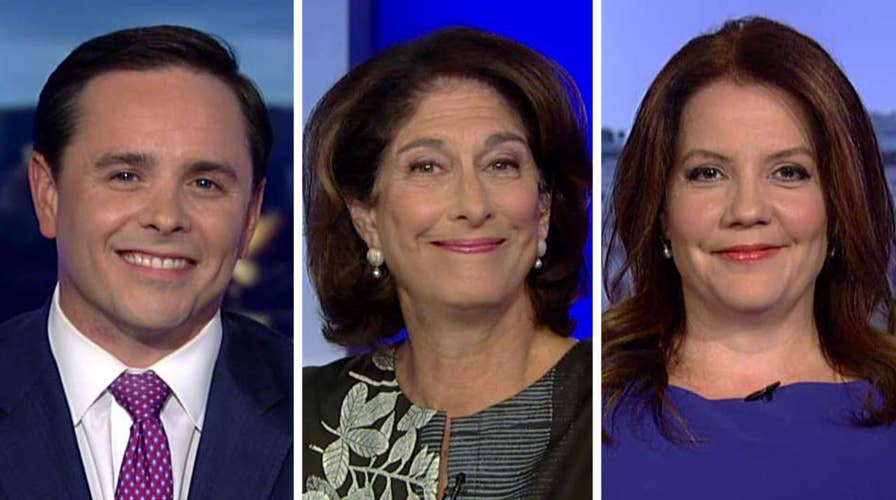
Let's bring in our panel, we'll start there: Josh Holmes, former top adviser to Mitch McConnell, now the president of Cavalry Consultants, Mara Liasson, national political correspondent for National Public Radio, and Mollie Hemingway, senior editor at The Federalist.
It is up and down, Mara, but these talks seem like they are now real.
MARA LIASSON, NATIONAL PUBLIC RADIO: The talks are real. Will they come up with a real solution other than China buying some more soy beans and semiconductors, something that really achieves the president's goals of changing China's business model? It's a pretty big ask. Or is he willing to settle for something that he can declare victory?
BAIER: So what's your guess? Is the president willing to be short of all of the goals that they've listed already?
LIASSON: I think the president needs something that he can say is a victory. And he knows that all of this turmoil in the tariffs are having an effect on the economy that could affect his real election. So he does want a deal. The question is, how much does he want a deal, and how much is he willing to give up?
BAIER: Josh?
JOSH HOLMES, CAVALRY CONSULTANTS: I think we have to also be totally eyes wide open about the nature of our economic relationship with China. We've had these problems for an awfully long time. Donald Trump is just the first one that's actually dealt with it in a meaningful way. But I think what that means is it's going to take an awful long time to try to unwind each and every one of these issues. The I.P. issue, for example, is something you can't just snap your fingers and fix overnight. It's something that's going to take maybe decades to try to fix. And so I tend to agree that we have to try to figure out a way to make progress incrementally on these things. I think the president is willing to do that because the off-ramp on this, as you can see from the markets, is really enjoyed by the American economy.
BAIER: I just don't think we have a sense of where China is and how much they're hurting, or how willing they are to do on their side short of everything they've talked about.
MOLLIE HEMINGWAY, THE FEDERALIST: Right. And Josh is absolutely right that this is a problem that was decades in the making, and there is this fundamental question about whether the U.S. can continue to essentially subsidize China's growth and aggression by having uneven trade practices. I think China, to your point, is thinking, can we just wait this president out? We think that there are people who are willing to exploit the situation politically so that once they're in power they'll let us continue to behave the way that we are, which is why I think it was interesting that you saw senators get involved this week and carry that message that the administration has, which is important if China realizes that this is something that is going to happen regardless of who is in power, there's going to be a reorientation of our relationship, they'll be more likely to deal.
BAIER: All right, Afghanistan, take a listen.
(BEGIN VIDEO CLIPS)
TRUMP: We're like policemen in Afghanistan. But we're talking to the Taliban, we're talking to the government. We'll see if we can do something.
ROYA RAHMANI, AFGHAN AMBASSADOR TO U.S.: The mothers, their cries for their children that they keep losing in the bombings. And I wonder how you could ask for peace and continue with this violence.
(END VIDEO CLIPS)
BAIER: So a deal is in the making, in the works with the Taliban, these peace talks. Josh, a big Taliban attack, the third in a couple of weeks. For people sitting at home, some of them don't get it. Here we are dealing, we're getting a peace talk. Everybody wants U.S. troops home, but the people we're doing the talks with are taking responsible to for these attacks.
HOLMES: This is the vexing problem 18 years in the making. It's hard to find allies in this discussion, and certainly it's hard to see an off-ramp in Afghanistan that gets you to a place where you can secure American security better off without our troops in the region. Obviously everybody shares the goal to try to get our troops out as soon as possible. But I think the question that has now faced three presidents is, can you do that effectively? Leaving that region to a place like the Taliban with also having any sort of assurance that American security or our allies' security in the region is protected.
BAIER: I've been over there a bunce, 8,600 is basically a security force for Kabul. It's not anything beyond that.
LIASSON: No, it's not anything beyond that. You're just protecting a pretty small chunk of the country. You have got these bombings going on while the talks are happening. And when the U.S. pulls out, if it pulls out entirely, you're going to have probably more violence. I can't even imagine the stories about what is going to happen to women and children trying to go to school under Taliban rule. But we have a responsibility.
BAIER: I can already see Mollie's response. That's not our deal.
HEMINGWAY: And 8,600 is actually a pretty significant number, particularly when you think about people putting their lives on the line, like our soldier that we lost today, and have been losing for 18 years.
The real issue is I think people are happy to have forces wherever we want to have them, as long as we have a clear understanding of why we are there, how it serves our interest. And it is true that Afghanistan is a horrible place for -- has serious problems for women and other communities, but that is not necessarily our problem to solve. There are many countries with many problems. We need to understand that when we are putting our lives on the line and spending so much money and so much time that we are laser focused on what we hope to accomplish.
Its' been an overarching problem with Afghanistan that we haven't had a clear vision for what we want to accomplish, and people keep thinking that we just need to stay there until we figure it out. I think we actually did a really good job many years ago, and it's fine to take people home and get them where they are more needed.
BAIER: A big topic for Democrats last night, over recent weeks, climate change. Here is a proposal about red meat reduction.
(BEGIN VIDEO CLIP)
ERIN BURNETT, CNN: Would you support changing the dietary guidelines?
SEN. KAMALA HARRIS, DEMOCRATIC PRESIDENTIAL CANDIDATE: Yes.
BURNETT: The food pyramid, to reduce red meat specifically.
HARRIS: Yes. Yes, I would. There has to be also what we do in terms of creating incentives that we will eat in a healthy way.
ANDREW YANG, DEMOCRATIC PRESIDENTIAL CANDIDATE: You can't force people's eating choices on them. All you can do is try and shape our system so that over time we evolve in a productive way.
(END VIDEO CLIPS)
BAIER: How do you think reducing cheeseburgers would poll in Wisconsin?
(LAUGHTER)
HOLMES: We were joking in the break about what tonight's football crowd between the Packers and the Bears would think about such a proposal. But I think a large swath in the middle of this country would find that and almost everything that was said last night during that climate conference absolutely incredibly out of touch. I was shocked that you could actually accrue that many political liabilities in one several-hour sitting.
BAIER: It was seven hours.
HOLMES: I didn't watch the whole thing, Bret. I'll be honest with you, I didn't make it through the whole thing. But what I did see from the highlights looked to me like an awful lot of people are going to have trouble getting elected in places like Ohio, Pennsylvania, Michigan, Wisconsin, Iowa, the entire Midwest, really.
BAIER: But Mara, that issue is big for especially younger Democratic voters.
LIASSON: Climate change is huge. Young people want to vote for a party that acknowledges that, yes, it is happening and has some kind of solutions for it. The thing that's interesting to me is usually candidates who plan on being the nominee allow themselves a pretty good path to get back to the center after the primary is over. And it seems like in a lot of those issues Democrats are closing those doors. But there is clearly a space for Andrew Yang, I don't know about Joe Biden, but some other people who are going to say, no, we're not going to tell people that they can't have hamburgers.
BAIER: And Andrew Yang said nuclear should be on the table, too. I want to play one more soundbite, Bernie Sanders responding to a question.
(BEGIN VIDEO CLIP)
SEN. BERNIE SANDERS, DEMOCRATIC PRESIDENTIAL CANDIDATE: I think especially in poor countries around the world where women do not necessarily want to have large numbers of babies, and where they can have the opportunity through birth control to control the number of kids they have, something I very, very strongly support.
(END VIDEO CLIP)
BAIER: It was a question about population control and abortion.
HEMINGWAY: And he further said that he thought that U.S. taxpayers should fund abortions in third world countries. This was actually a really interesting and horrible thing to hear someone say that part of the global warming fighting agenda is to go after black and brown kids in third world countries, particularly from someone like Bernie Sanders who has three houses. But there is something to be appreciated about the candor with which he displayed his eugenics and his support for eugenics.
BAIER: We will see how this all plays as we continue to do it.
Content and Programming Copyright 2019 Fox News Network, LLC. ALL RIGHTS RESERVED. Copyright 2019 CQ-Roll Call, Inc. All materials herein are protected by United States copyright law and may not be reproduced, distributed, transmitted, displayed, published or broadcast without the prior written permission of CQ-Roll Call. You may not alter or remove any trademark, copyright or other notice from copies of the content.
