


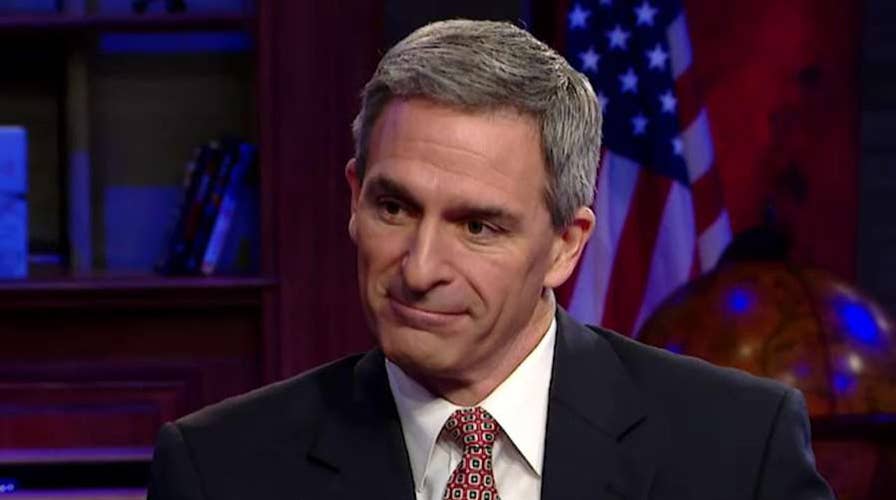
Ken Cuccinelli says Mueller's team knew they didn't have a prosecutable case on obstruction
Former Virginia Attorney General Ken Cuccinelli joins Mark Levin to discuss the fallout from special counsel Robert Mueller's report.
This is a rush transcript from "Life, Liberty & Levin," April 28, 2019. This copy may not be in its final form and may be updated.
MARK LEVIN, HOST: Hello, America. I'm Mark Levin. This is "Life, Liberty & Levin." Great guest again, Attorney General Ken Cuccinelli.
KEN CUCCINELLI, FORMER ATTORNEY GENERAL OF VIRGINIA: Good to be with you.
LEVIN: Good to be with you. You were Attorney General of Virginia. You had a big landmark case. You won your Obamacare challenge, then it got all screwed up in the Supreme Court.
CUCCINELLI: That's right.
LEVIN: You are -- you're well known not just in conservative circles and legal circles, you have a great legal mind. I've known you a very, very long time and I thought it was very important to have you here. So I want to thank you to go through this.
CUCCINELLI: It's good to be with you.
LEVIN: Well there's a lot going on and so we need to work our way through this. All right, let's go back to the report. This report that came out - - the Mueller report -- two sections. One section was legal, no collusion.
CUCCINELLI: Right.
LEVIN: It's kind of long. No collusions -- two words last time I checked.
CUCCINELLI: Right.
LEVIN: So it goes on and on and on, then there's another section, which is highly political. Verbose and reads completely differently, doesn't it?
CUCCINELLI: Yes, it doesn't read like a prosecutor wrote it.
LEVIN: And that's the so called obstruction section.
CUCCINELLI: Right.
LEVIN: Now a couple questions on this obstruction issue. One of the individuals who was involved in writing this report was the number two guy, Andrew Weissmann. He was involved in the prosecution of Arthur Andersen related to Enron. Arthur Andersen, as a result, went out of business; 80,000 people lost their jobs and that was focused on obstruction of justice, an expanded definition of obstruction of justice.
The statute as the Supreme Court would later tell us has really two important elements. You need mens rea, you need to know what you're doing. It's a specific intent crime, so you need to have knowledge.
CUCCINELLI: Right, tied to the specific intent.
LEVIN: To have the specific --
CUCCINELLI: That's right.
LEVIN: So you need to have knowledge that you have a criminal motive, right, a corrupt purpose?
CUCCINELLI: Right.
LEVIN: And so they were reversed. Mr. Weissmann and the government, but Arthur Andersen already went out of business, 80,000 people lost their jobs. It was a nine to zero decision. It was 12 pages long. If you take the cover page out and the two census on the last page and the summary of the facts out, it was a five or six-page opinion. It was like that.
CUCCINELLI: Right.
LEVIN: When you read this Volume 2 on obstruction, it reads like Weissmann wrote it. He is expanding or trying to --
CUCCINELLI: It's definitely got a very expansive view of obstruction.
LEVIN: Right. Let me ask you this question, if you're a prosecutor and Mueller believed even though the Department of Justice's position was you can't indict a sitting President, he told the Attorney General Barr that's not the reason they didn't bring charges under obstruction. They didn't have an obstruction case.
CUCCINELLI: Right. That's right.
LEVIN: Because that didn't hold them back, did it?
CUCCINELLI: No, it didn't and it's interesting when you listen to some people in mainstream media, they focus on language in there that talks about the Department of Justice -- bipartisan Department of Justice who have concluded you can't indict a sitting President, so they focus on that.
But Mueller also said in that Volume 2 that that didn't hold them back, that what they were saying was without regard to that policy of the Department of Justice, they didn't have a case to make and that's what a prosecutor does. They decide to prosecute or not.
Here, they went beyond that as we've already discussed, but clearly on that question, they knew they didn't have a prosecution to go forward with.
LEVIN: So when we hear Hillary Clinton or we hear others who probably haven't read this, they certainly didn't read the Supreme Court decision in 2005 that Weissmann was involved in. We hear "legal analysts" quote- unquote, these titles that they get. They don't know the law, do they?
CUCCINELLI: No, frequently, that's very true.
LEVIN: And if Mueller wanted to bring a case, he said he would have brought a case. That would have been challenged on a number of fronts, he would have brought a case. But if he had brought the case, he would have lost and he would have lost badly because of the two elements.
CUCCINELLI: And he knows that.
LEVIN: Yes, and that's why they didn't bring the case, so why did he write the Volume 2 of the report?
CUCCINELLI: Well, Volume 2 goes like you said, it goes beyond a legal analysis. That is not what I read there. I read a lot more political results into what they're writing. I think you could he is writing for Congress, baiting Congress into maybe impeachment proceedings, but with so many facts laid out, because it is long, the whole thing being of almost 450 pages. We know a lot now and there just isn't anything there that meets any -- or comes anywhere close to a criminal standard.
So if Congress wants to proceed, they're going to have to do it on the political basis that Mueller put in the second part of the report and it is political, just like you said.
LEVIN: And you know it's interesting, the Attorney General and the Deputy Attorney General and the Office of Legal Counsel which is filled with civil servants and other legal offices that the Department of Justice looked at Volume 2.
CUCCINELLI: Right.
LEVIN: They looked at the information the prosecutor presented and they said, there's no case here.
CUCCINELLI: Right.
LEVIN: There's no case here based on what the Supreme Court has said, based on law and they were said to have been basically sellouts. So we move into the political. Volume 2 was written for the political. Let's see if you agree with me.
What did the prosecutor's office know when they were writing Volume 2? They knew that the Democrats took the House of Representatives. What else did they know? They knew that nominee Barr had told the Senate Judiciary Committee during his confirmation hearings, he said "I'm going to try and release as much of this as I can."
CUCCINELLI: Right.
LEVIN: "The 6(e) grand jury, I'll hold back. Classified," and so forth, "I'll hold back." He wasn't required to turn over anything, but he says, "Look, I'm going to try and turn over as much as I can." So the prosecutor's office knew one, the Democrats control the House; two, the report is going to be released.
CUCCINELLI: Right.
LEVIN: Volume 2 has very little redacted information in there.
CUCCINELLI: Almost none.
LEVIN: Almost none.
CUCCINELLI: Right.
LEVIN: So who are they writing it for? They weren't writing it for the Department of Justice because they weren't going to do anything.
CUCCINELLI: Right.
LEVIN: They're writing it for the media, the Democratic chairmen of these committees and they're running wild with it politically and that's what I want to get to with you.
You have all these subpoenas being thrown out there. Nadler pushed out how many?
CUCCINELLI: Eighty one.
LEVIN: Eighty one like --
CUCCINELLI: That's already done. That's pre-Mueller report.
LEVIN: Pre-Mueller, he puts out 81.
CUCCINELLI: With no explanation for what they are for.
LEVIN: No explanation, family members, business associates, homeless people -- I don't know, there is just 81 out there. He puts all kinds of documents he wants.
CUCCINELLI: Right.
LEVIN: Then we have Elijah Cummings on this House Oversight and Reform Committee. He is going after the President's taxes, going after the President's accountant and not just that, they want all notes and all communications and everything between the President when he was a private citizen, his family members and then we have another committee headed by Maxine Waters, the Financial Services -- or whatever they call it -- Committee. They want all the President's bank account information. So they're sitting there coordinating.
CUCCINELLI: Of course, of course.
LEVIN: To do what?
CUCCINELLI: Well, personal destruction.
LEVIN: Personal destruction.
CUCCINELLI: Yes, that's what that's about.
LEVIN: Under our Constitution Article I, is that a legitimate role for the United States Congress?
CUCCINELLI: Of course not. They can issue subpoenas for legislative purposes and oversight purposes and Nadler started this whole ball rolling with his 81 subpoenas. None of the folks who got those subpoenas were given either of those reasons. They were very generic and people have already started saying, "I'm not turning anything over to you. I'm not coming." They are refusing.
And on the record so far -- the public record so far -- they would win those contests.
LEVIN: You mean, legal people challenging it.
CUCCINELLI: Yes, yes. There's no basis for Congress to issue these yet and Nadler isn't willing to say, "We're pursuing impeachment or considering impeachment." He is not saying that. That's quite a red line to step over that both even Pelosi and Hoyer, their Majority Leader, have been trying to talk their people down from.
They are unwilling to absorb the political cost of crossing that line, the chairmen are, and so they don't have a basis to issue these subpoenas and if you're on the President's team, one of the things that's gotten very little coverage about the Mueller report is you know, you mentioned the redactions, they didn't -- they didn't claim executive privilege one single time.
LEVIN: The President.
CUCCINELLI: That's right. You remember the Clinton impeachment process, setting the politics aside, they used executive privilege all over the place.
LEVIN: They created privileges. We never heard of it.
CUCCINELLI: Yes, that's exactly right. That's exactly right. They were creating brand-new fresh ones and they didn't refuse providing any witnesses. The President didn't sit down to be interviewed. He did answer written questions, which are in the report un-redacted and read very straightforwardly and very honestly and therefore, they've gotten no coverage because they don't give anybody anything to stoke fires with.
And so they've been incredibly open with Mueller during the investigation and of course, we know how the President feels about this investigation. Now, we know even more, not just that it was a witch hunt from his perspective, but that it undermined the legitimacy of his presidency in some people's eyes and he has a great concern about that.
And yet they turn over a million documents. They made everybody in the White House available, though the President was only available in writing as opposed to sitting down and so now, you've got Congress coming in and the President is saying, "No, no, no. We cooperated a hundred percent." More than anybody else in our lifetimes. Nixon didn't cooperate like this. Clinton didn't cooperate like this in similar circumstances, but Trump did.
LEVIN: Our man, Reagan, didn't either.
CUCCINELLI: No, he didn't.
LEVIN: In Iran-Contra. He asserted privileges, and by the way, maybe they should have.
CUCCINELLI: Right.
LEVIN: But here's the thing. Here we have the President dealing with his own administration, the Special Counsel after all is an inferior.
CUCCINELLI: That's right.
LEVIN: That's the theory anyway. A theory employee of the Executive Branch. Now, you have a separation of powers issue.
CUCCINELLI: Right.
LEVIN: Now is the time where you can assert privilege, so Nadler says, "Too late. You didn't assert it during the other investigation." Is Nadler a constitutional illiterate? I mean, now we're talking about separation of powers.
CUCCINELLI: Right.
LEVIN: Doesn't the President have an obligation to do this to protect the office of the presidency so that future Congresses aren't demanding personal financial information, tax returns, bank information? The President doesn't report to the House of Representatives. That's not who he represents, he represents the American people.
CUCCINELLI: That's right and that's an excellent point, so we everybody personalizes -- and it's human nature -- they personalize the presidency. The presidency is Donald Trump right now. Before, it was Barack Obama. But the presidency is its own office. It has its own article in the Constitution, Article II and in addition to protecting himself, the President also has an obligation to protect the presidency and establishing precedence of ceding ground to the Article I branch is something that all of his successors would have to live with.
LEVIN: If Congress gets away with this, what's to stop them from subpoenaing the Chief Justice's bank records? Or subpoenaing the Chief Justice's tax returns?
CUCCINELLI: Then nothing.
LEVIN: Or anybody they don't like? Or for that matter, any citizen that they are focused on and trying to harass. Their bank accounts, their tax returns -- whatever. I have to believe if this ever gets to the Supreme Court, those gentlemen and ladies better be thinking about it.
CUCCINELLI: Right.
LEVIN: Because there may be some Congresses that are hostile to them. I want to pursue this with you in a moment further. Before we do, ladies and gentlemen, don't forget, you can join me on Levin TV, Levin TV almost every weeknight. Just go to blazetv.com/mark to sign up, blazetv.com/mark or give us a call, 844-LEVIN-TV, 844-LEVIN-TV. We'll be right back.
(COMMERCIAL BREAK)
LEVIN: Ken Cuccinelli, it's pretty obvious Mueller knew relatively early on in his investigation that there was no collusion, so collaboration, no conspiracy. So why didn't he tell the American people?
CUCCINELLI: Well one of the -- perhaps the most political aspect of this report is the fact that it didn't come seven months earlier. If it comes seven months earlier, a different party might still be in control of the House of Representatives and let's be clear about that and they were more or less done with their information gathering that early. It was a question of wrapping it up and like you said, there was no evidence of collusion really at any point.
And we saw information come out slowly in indictments and witnesses would talk and so forth and there was never anything as someone who managed a team of prosecutors in the Attorney General's Office, there was never anything that pointed to actual intentional cooperation, knowing cooperation between any American.
We've all focused on the Trump campaign, but this report noted that no American that they identified cooperated with the Russians knowing that they were cooperating with the Russians.
LEVIN: Yes, but you were an Attorney General. You're sitting there and you're watching this hysterical media, 24/7, people connecting dots that don't even exist.
CUCCINELLI: That don't exist, right.
LEVIN: About collusion, collusion, collusion, tearing down a presidency, burdening a President and they wanted to interview him knowing full well there was no collusion and the conclusion that I come up with as a former Chief of Staff to an Attorney General, maybe you as a former Attorney General is they're out to get him because there was no reason to talk to him.
CUCCINELLI: Yes, it is a game of "gotcha." Yes, a game of "gotcha."
LEVIN: So you agree?
CUCCINELLI: I do agree and I thought that it was entirely appropriate and smart for the President not to sit down with this investigation and look, you know, a couple of minutes earlier I pointed out how they cooperated in every way. They gave them documents. Everybody in the White House was available, but the President didn't sit down and wasn't directly interviewed nor should he have been under these circumstances.
LEVIN: And the reason they didn't issue a subpoena, you need some kind of predicate when you're going to demand a President come in front --
CUCCINELLI: They do. That's right.
LEVIN: They didn't have one because there was no collusion, wasn't there?
CUCCINELLI: No, and when they -- of course, they included the written answers the President gave to their questions, which has gotten zero coverage because they were so straightforward and frankly logical to anybody who goes through and reads them all, there is nothing to punch holes in and they said in the introduction, you know, we wanted to sit down with him. We tried for a year to get an interview, but really when we gathered all of our other information, we didn't feel like we needed to do that anymore that it wasn't worth the hassle.
And so they more or less conceded that they could come to all of their conclusion -- they had more than enough information to draw what conclusions they did draw and if you're the President, there's nowhere to go but down with that interview. Why do it?
LEVIN: And if you're the prosecutor, you would lose if you press the case.
CUCCINELLI: Correct.
LEVIN: Because you would be tested in front of a very skeptical court.
CUCCINELLI: That's right, and if you don't have -- you don't have a basis to argue to the judge.
LEVIN: Right. Let's circle back to Don McGahn, the President's counsel. Extraordinary. The President allows him to testify to the prosecutors, not in front of the grand jury by the way, the prosecutors, which means the White House knew that none of this would be redacted. I mean, it's not 6 (e) grand jury information.
CUCCINELLI: No, it's not.
LEVIN: Thirty hours. That's a lot of time.
CUCCINELLI: That is a lot of time.
LEVIN: How much in the report of that testimony is there?
CUCCINELLI: Less than a page.
LEVIN: Less than a page. Well, what happened?
CUCCINELLI: Maybe two paragraphs.
LEVIN: What happened to all of those 30 hours?
CUCCINELLI: Apparently nothing very interesting.
LEVIN: Well isn't that interesting?
CUCCINELLI: Well, it's easy to throw these numbers out. For people who aren't lawyers, who don't do depositions, an eight-hour deposition is a marathon.
LEVIN: Yes.
CUCCINELLI: It is a marathon and when you have a point at the heart of why you're interviewing this deponent, you come at it 20 different ways in eight hours and they were with him for 30 hours and all we see is the exchange about the President wanted to fire the Special Counsel, Don McGahn didn't want the Special Counsel fired and that's pretty much it, and of course, the President didn't fire him. So we know how that argument turned out. That's all that's in there.
LEVIN: Let's break this up.
CUCCINELLI: That's it.
LEVIN: This is very important. Thirty hours, we get a couple of sentences.
CUCCINELLI: Right.
LEVIN: In a report, which is really not legal, Volume 2 where they are writing, you know --
CUCCINELLI: None of those restrictions and it's 450 pages long.
LEVIN: No restriction, no grand jury and there, they only give us a couple of sentences.
CUCCINELLI: Right.
LEVIN: You and I know and you kind of pointed this. You're aggressive prosecutors, you have the President's counsel. That's a gift that you can't even dream about.
CUCCINELLI: Right.
LEVIN: You know damn well they asked him about obstruction a hundred different ways.
CUCCINELLI: Right.
LEVIN: You know they came at him hard about it.
CUCCINELLI: Right.
LEVIN: And that's the best they have is that he asked McGahn to fire Mueller. He says that. The President says I never said that and my point too is multiple. Number one, I bet they videotaped this.
CUCCINELLI: I would have.
LEVIN: I would have.
CUCCINELLI: I would have, for sure.
LEVIN: I bet there's a videotape of this. I would love to see the rest of this interview because I think it can only help the President of the United States because these prosecutors took what they thought was the best they could cherry pick.
CUCCINELLI: Right.
LEVIN: And put it in Volume 2. Okay, what about the other twenty nine hours and 59 minutes?
CUCCINELLI: That's right.
LEVIN: What else took place there? That's number one. Number two is this, the President could have fired Mueller anytime he wanted to.
CUCCINELLI: That's right.
LEVIN: There's nothing that says he has to ask his counsel to fire Mueller.
CUCCINELLI: No, the White House counsel is not in the chain of command. The White House counsel is an adviser to the presidency. That's it. And the President never made any attempt to actually fire the Special Counsel. They obviously argued about it or assuming there's some accuracy in there, they argued about it, but good lawyers don't tell clients what they want to hear. Good lawyers evaluate a question and tell their client, "Here are your options, and here's what I suggest you do." And they can argue about it. I've argued with my clients.
LEVIN: Right.
CUCCINELLI: And some of those arguments, they've taken my advice; others, they haven't. Those they regretted not taking my advice, but the President lawyer's advice, clients decide. The President, clearly by not doing it decided not to fire Mueller because there was as you said, Mark, there was never any impediment to him doing that. Ever.
LEVIN: So this idea that McGahn saved the President, that's just another phony pseudo argument. We'll be right back.
(COMMERCIAL BREAK)
AISHAH HASNIE, FOX NEWS CORRESPONDENT: Live from "America's News Headquarters," I'm Aishah Hasnie. A shooting at a cookout in Baltimore leaves one person dead and seven others injured. Police say a gunman fired into the crowd and appeared to be, quote, "extremely targeted." Cops also say there may have been a second gunman or somebody firing back at the first shooter who fled on foot. It happened near a church, but the city's acting mayor says the church was not the target.
A college student is among the dead following a crane collapse, Saturday, in Seattle. Seattle Pacific University official say freshman, Sarah Wong was one of four people killed. Three others were also injured. She was in a car that was crushed by the crane as it fell from a building under construction at Google's new Seattle campus.
I'm Aishah Hasnie, now back to LIFE, LIBERTY & LEVIN.
LEVIN: Ken Cuccinelli, so we have committees in the House that are obviously coordinating the issuance of their subpoenas, their press releases, their public propaganda. They have a media that basically writes down every word they say and then regurgitates it, and then, pushes them to -- here's how I'm looking at this.
The Democrats in the House of Representatives are blackmailing this President. Now what do I mean by that? They are telling him, "Either you give us your bank records, either you give us your tax returns, either you give us whatever we demand, or we're going to impeach you. And if you don't, we're going to impeach you."
What they're basically saying to him is, "We want you to give us the weapons by which we can destroy you."
CUCCINELLI: Right.
LEVIN: "And if you don't allow us to destroy you, we're going to destroy you any way."
CUCCINELLI: For that.
LEVIN: For that.
CUCCINELLI: Right.
LEVIN: Have you ever seen anything like this?
CUCCINELLI: No, no. We've never seen anything like this and even in the Clinton impeachment which politically was a mistake for the Republicans.
LEVIN: But he committed crimes.
CUCCINELLI: Right, right. Oh, yes, lying under oath on video et cetera and while President.
LEVIN: And in front of a Federal judge, I might add.
CUCCINELLI: That's true. All of those things are correct, and yet, you didn't have this kind of orchestrated, broad scale, the whole -- you know, they're turning over three committees to this effort basically and I just have never seen anything like it.
Also of course, it's in the first term of a President and that's actually an important distinction that even Steny Hoyer made in the case of Bill Clinton. They were in the second term. There was no accountability. This couldn't be tried in public, if you will, with the American people. Well, this President is running for re-election next year and I think he is perfectly happy to do battle on these issues in the public arena.
What he's not going to concede to do as he has already said and demonstrated is he is not going to play their game their way in the House of Representatives and they don't have the authority because of the separation of powers to compel him to do it. So why should he?
We will see this played out I think over next year and a half, but I can -- my view of the media perspective on this is that you've got the so called Acela Corridor, the New York-Washington Corridor of people who get all worked up into a lather about a lot of this stuff that ordinary Americans don't care a lick about.
There is no collusion. There is no obstruction. Let's move on to make this country even better than it is. And why are you people wasting your time with all of this? I think that's the average American's view. It's by and large my view, particularly, when you had as much cooperation by the President in the White House with the Mueller investigation, which they thought very ill of anyway in the first place.
LEVIN: Let me try this on you. The Chairman of this House Oversight and Reform Committee, Elijah Cummings is from Baltimore.
CUCCINELLI: Right.
LEVIN: Heavy blue, heavy Democrat.
CUCCINELLI: Very safe seat for him.
LEVIN: Safe seat. No Republican could ever win that.
CUCCINELLI: Right. Same with Nadler and Waters.
LEVIN: I'm going to get to that. Nadler, another, New York City -- safe seat, heavy blue, no Republican is going to take him out.
CUCCINELLI: Right.
LEVIN: Waters, LA.
CUCCINELLI: Right.
LEVIN: Same thing. Pelosi, San Francisco, same thing.
CUCCINELLI: Yes.
LEVIN: We have a handful of Democrats that run the House of Representatives. They have the Caucus. They have about a handful that have the iron fist.
CUCCINELLI: Right.
LEVIN: They come out of these very specific areas of the country that basically represent 90 miles on one end of the country, maybe 120 miles on the other end of the country. Then we have the big country in between. All those red places and purple places.
CUCCINELLI: Right.
LEVIN: We have a handful of members of the House of Representatives who are trying to take down the President of the United States because he is of a different party, he is of a different philosophy and let me suggest this to you, if they succeed -- I don't think they will -- if they succeed, it's the greatest act of voter suppression in American history. Over 63 million people voted for this President and what these handful of radical Democrats are saying is, "Too bad."
CUCCINELLI: Right.
LEVIN: It's also the greatest disenfranchisement.
CUCCINELLI: Yes, that's what I would describe it.
LEVIN: In the history of the country, over 63 million people are being told, "Oh that vote you took in 2016, that doesn't matter." What do you think of that?
CUCCINELLI: Yes, I think that a lot of those 63 million people are frankly pretty ticked off about this attempt because that is what they're trying to do. It's interesting that this past week, Hillary Clinton resurfaces with an op-ed in "The Washington Post." I will say I agreed with one thing she said in there. She started out by saying, "I may not be the best messenger to talk about this subject." You think?
And in it is sour grapes. Look, I lost her an election for Governor.
LEVIN: Tiny. Two and a half percent.
CUCCINELLI: Two and a half percent here in Virginia and while I engaged on issues whether on Fourth Amendment issues, on a number of issues in Virginia, I never directly engaged with Terry McAuliffe who is the guy who won that race, because I think, as frankly Presidents who have gone out of office have behaved similarly that that kind of personal engagement, the doing battle like she did this week, reduces -- it lowers your credibility. You sound like a sore loser because frankly, you are a sore loser, and she is among the sorest of sore losers.
And it and it demonstrates the desperation of even what she is arguing for and she's just -- all she did was try to lay out a slow walk to impeachment. That's all. And what I thought was most interesting when I got to the end of it is, there was no statement like, "And we need to show nobody is above the law," because no Clinton is ever going to write that.
LEVIN: That's hilarious. We'll be right back.
(COMMERCIAL BREAK)
LEVIN: Ken Cuccinelli, the truth is there was interference from the election, really by two entities -- the Russians and the Obama administration.
CUCCINELLI: That's right.
LEVIN: And what's interesting in this 400-page, $35 million report, there's nothing about the interference in the election by the Obama administration. The entire senior level of the FBI wiped out itself. There are either in a criminal investigation or an Inspector General investigation. They were leakers. They were colluders. It took this dossier paid for by the Hillary Clinton campaign and the DNC and they used it with the FISA --
CUCCINELLI: Paid a foreigner to go interview Russians.
LEVIN: Exactly.
CUCCINELLI: To get dirt on their opponent, but apparently, it's a problem when the other side tries to get dirt on their opponent from the same people. "Yes, but we didn't pay people to do it."
LEVIN: But here's the thing, Mueller asked to expand his investigation multiple times. He went into tax fraud, mail fraud, wire fraud. He was looking at prostitutes up in Manhattan. He is doing all kinds of things, but he never --
CUCCINELLI: That's Paul Manafort, right?
LEVIN: It's Paul Manafort, but he never asked to look into the Russians, the Hillary campaign, the DNC, the corrupt activities with the FISA Court, why is that?
CUCCINELLI: Yes, that's a very good question. If we give him the benefit of the doubt, I think the best answer and we won't know for a few months probably is that the Inspector General is already looking at some of that.
LEVIN: The Inspector General could only look at the Department of Justice.
CUCCINELLI: That's right.
LEVIN: It does not have subpoena power.
CUCCINELLI: That's right and so can't look at the connections out in the campaign world. You're absolutely right.
LEVIN: And then we have Susan Rice who is the adviser to the President -- National Security adviser --
CUCCINELLI: President Obama.
LEVIN: Of Obama and the head of IT comes to her and says, "Hey, the Russians are trying to tap into our system." This is near the end of their administration and she -- I paraphrase -- tells him to stand down, don't write anything. We don't want any paper on this. We have unprecedented unmasking of American citizens going on by Samantha Powers and says, "It wasn't me." So somebody is unmasking American citizens using her name, among them, Lieutenant General Michael Flynn.
CUCCINELLI: Right.
LEVIN: Michael Flynn is encouraged to do an interview without lawyers present. First time, the FBI says, no problem. Second time, Strzok sets him up and he is fighting for his life.
CUCCINELLI: Right.
LEVIN: We have the Deputy Attorney General at the time, an Obama holdover, Sally Yates, who undertakes an investigation of him under the Logan Act, which nobody has used. That's like the jaywalking act that nobody enforces, and they use that. With all of this going on, is Mr. Nadler interested in any of this?
CUCCINELLI: Yes, of course not.
LEVIN: Is Mr. Cummings interested in all of this?
CUCCINELLI: Of course not.
LEVIN: Is Maxine Waters interested in any of this?
CUCCINELLI: Of course not.
LEVIN: Is Nancy Pelosi interested in any of this?
CUCCINELLI: Absolutely not.
LEVIN: How about 98 percent of the media, are they interested in any of this?
CUCCINELLI: Not in the least.
LEVIN: Now why would that be?
CUCCINELLI: Because it doesn't fit the narrative.
LEVIN: It doesn't fit the narrative and it doesn't hurt whom?
CUCCINELLI: The President who won.
LEVIN: The President of the United States who won. All these activities that are going on, do you think apart from the base on either side, politically, the American people watching this, those who are paying attention, which is not most of them. What do you think they make of this?
CUCCINELLI: They see Washington behaving in a way that's irrelevant to their life and spinning their wheels in the mud and I pick mud, intentionally, just practicing the politics of personal destruction. They voted and I think the average American's view is, "Get on with it." "It" being the business of government.
You know, we look at what's going on, on the border. There's a desperate need for congressional action. They all acknowledge it and yet do nothing. Instead, they send out subpoenas without a basis to fight wars with the President that have already been investigated by Mueller and nothing gets done. No progress is made.
LEVIN: Here is what I'm worried about. You're right. They refuse to secure the border.
CUCCINELLI: Right.
LEVIN: And now the so-called manufactured crisis, everybody knows it wasn't manufactured and it's a five-alarm fire.
CUCCINELLI: Right.
LEVIN: Action begins in the House of Representatives. They're doing absolutely nothing. Red China is on the move. They're massively increasing their military, their naval power is incredible right now. Their missile technology is incredible right now.
CUCCINELLI: Right.
LEVIN: They've sent into space kill satellites to kill our satellites, which would kill our ability -- our military's ability to target sites and so forth. They're getting bases and strongholds in North Africa and part of our hemisphere. Russia is on the move, same thing. We've got a problem with Iran. That's an understatement.
CUCCINELLI: Yes, that is an understatement.
LEVIN: We've got all of these problems going on and the Democrats in the House of Representatives act like there's nothing going on. As a matter of fact, we just got a report that Social Security is going under in 18 years and Medicare in eight years. Is there a single proposal coming out of the House for any of those?
CUCCINELLI: Their single proposal is to blow it up faster with Medicare- for-All, right, so mathematics is not a prerequisite to being Congress.
LEVIN: But what about the media? I mean, should there be --
CUCCINELLI: Well, as I said earlier, they're the communications arm for the Democrats in the House, really on Capitol Hill. The House Democrats are louder. We hear more from them now, but before the election, we heard as much from Chuck Schumer in his crowd, but they're not in a majority. So it's really turned to the Democrats in the House.
And we're going to hear more and more from the Democratic candidates as we approach 2020 and it'll be interesting to see just how crazy extreme they're willing to go to try to pick up votes.
LEVIN: That sounds like they're already there.
CUCCINELLI: Yes, we think they are, but they're going to come out and they're going to surprise even you and me in the months to come.
LEVIN: What's left?
CUCCINELLI: Exactly what's left? I don't even want to speculate because it might come true and they're going to -- you heard it here on Levin's show first, they're going to have a contested Presidential convention.
LEVIN: Oh really?
CUCCINELLI: They're going to have a contested convention. They don't have winner-take-all states and they have too many candidates. No one is going to go to their convention with a majority and it's going to be a dogfight for delegates. Now, that's about 2,500 people roughly. Where do you think they fall in the Democrat spectrum of activists? And that's who's going to decide their nominee.
So we're going to be hearing a lot more about all the craziest stuff including the not well based conclusions coming out of the Mueller report from their Presidential candidates.
LEVIN: All right, don't forget ladies and gentlemen, you can watch Levin TV on blazetv.com, blazetv.com. That's our wonderful conservative network over there or give us a call at 844-LEVIN-TV, 844-LEVIN-TV. We'll be right back.
(COMMERCIAL BREAK)
LEVIN: The President has a lot of opponents, really. I mean he is facing Republicans like Mitt Romney, who for some reason seek to undermine him. The Democrats in the House of Representatives, the media and the courts. You have Federal District judges, about 900 of them give or take, a lot of them appointed by Obama.
CUCCINELLI: Right.
LEVIN: The Chief Justice is wrong. There are Obama judges. You and I are regionalists and we don't believe that should matter, but apparently it does and they're cherry picked and there is court picking going on from the litigants.
CUCCINELLI: Sure.
LEVIN: Trying to undermine every step of the way his immigration agenda, aren't they?
CUCCINELLI: Absolutely and they're being very aggressive about it and frankly, it doesn't make us happy, but they're being successful at it. They're slowing down this President and really virtually all of these challenges, when they get to the Supreme Court, the President is winning these things.
So what the lower courts are doing is just slowing things down, hoping this President loses in 2020. So that he ends up between a slow approval of his nominees and the slow down by the judiciary of the implementation of his agenda, essentially denying him years of governance. Time of actual governing that the American people elected him to do.
Now, if he gets reelected in 2020, it's going to be -- the courts are going to be in a very difficult place because as you and I know, those cases many of them are working their way up through the courts are going to start getting decided much more quickly simply because they've gone through the process at the Supreme Court and the President is going to be left actually able to implement the agenda he has campaigned on with or without Congress participating.
LEVIN: It's really quite amazing, isn't it? Donald Trump comes in office. He is not a traditional conservative. He is not a philosophical conservative. He is definitely an outsider. He gets elected despite all these forces that are right against him.
CUCCINELLI: Right.
LEVIN: The media, the money people, the Democrats, his own party and they're furious and they're trying to reverse the course of -- like they're trying to stop his agenda and what I've noticed, I'd be curious what you think. He is getting more and more conservative and he understands these forces better than almost anybody since Reagan because he is having to fight with them every single day just to do what he campaigned on.
CUCCINELLI: Right.
LEVIN: You get that sense?
CUCCINELLI: Yes, I definitely think -- look, he never sold himself as a traditional conservative. He sold himself as a practical person, a practicalist. He told us what his trade policy was. He told us what his immigration policy was. He told us he wasn't going to come here and get along with people who were already here. He succeeded mightily in that.
And look, look at his deregulatory agenda. He has done not only what he said he was going to do, the two-to-one ratio, I can tell you in my role fighting regulations, they've blown the doors off the deregulatory goals they set for themselves and that is a huge part of why economic opportunity and freedom is growing in this country, is because you reduce government power, you increase citizen liberty and you create opportunity.
The judges that he is nominating and when they do get through the Senate have been spectacular and highly qualified and he ran very specifically on those and he is keeping those promises and he is fighting hard on immigration despite having his hands tied as best they can by the courts and an inactive Congress whether it was Democratic or Republican.
LEVIN: All right, we'll be right back.
(COMMERCIAL BREAK)
LEVIN: Ken, where do you see this country in five, ten or fifteen years?
CUCCINELLI: I think that depends heavily on 2020. I think you've -- as we've talked about, you've got courts and a Congress that are trying to impede the agenda of a President who ran very clearly on certain goals and is trying to achieve them and they're trying to wear him down in the hopes he doesn't get reelected.
If he does get reelected, then a lot of his agenda is going to break through the dam especially on immigration, which has been where the other side has been most successful in stymieing this President.
LEVIN: But let me ask you this based on what you're saying.
CUCCINELLI: Those judge picks.
LEVIN: We don't have a lot of time. Is our republic slipping away apart from these elections? Listen to what we've been talking about. Courts out-of-control, bureaucracy out-of-control. Congress in some ways quite diabolical or even inert, just depending on what's going on. The American people are almost, you know, observers rather than participants in so many things. Is the republic slipping away? Are we more and more any post constitutional period?
CUCCINELLI: Well we are definitely for some people in a post- constitutional period and you and I both know there are plenty of people in this country on the left who think the Constitution is a tremendous inconvenience. Justice Ruth Bader Ginsburg famously doing interviews about how mediocre our Constitution is relative to others in the world.
I think that if this President hadn't won in 2016 and we ended up with a genuinely liberal anti-constitutional majority on the Supreme Court, then I think we would be slipping away. We do not have a conservative court.
LEVIN: No, we don't.
CUCCINELLI: We do not have a conservative court. We have four liberals, three conservatives and two Roberts -- Roberts and Kavanaugh.
LEVIN: You're right.
CUCCINELLI: And nonetheless, that doesn't -- that's a firewall on sliding down that slope.
LEVIN: But even look at the way we're talking. Supreme Court, Supreme Court, Supreme Court.
CUCCINELLI: Yes, like it is saving us and it's supposed to be the weakest branch and what's supposed to be the strongest branch just sits on their hands, does nothing on areas of national security, first responsibility of government.
LEVIN: Congress. Yes, except trying to take out another branch of government while it is creating a fourth branch of government, the administrative state. Listen, it's been a great pleasure having you. I think we're in for some very, very tough times actually and it's good to have people like you out there explaining to the American people what the law actually is.
CUCCINELLI: You do a great job of that yourself.
LEVIN: Thank you.
CUCCINELLI: Always a pleasure, Mark.
Content and Programming Copyright 2019 Fox News Network, LLC. ALL RIGHTS RESERVED. Copyright 2019 CQ-Roll Call, Inc. All materials herein are protected by United States copyright law and may not be reproduced, distributed, transmitted, displayed, published or broadcast without the prior written permission of CQ-Roll Call. You may not alter or remove any trademark, copyright or other notice from copies of the content.
