


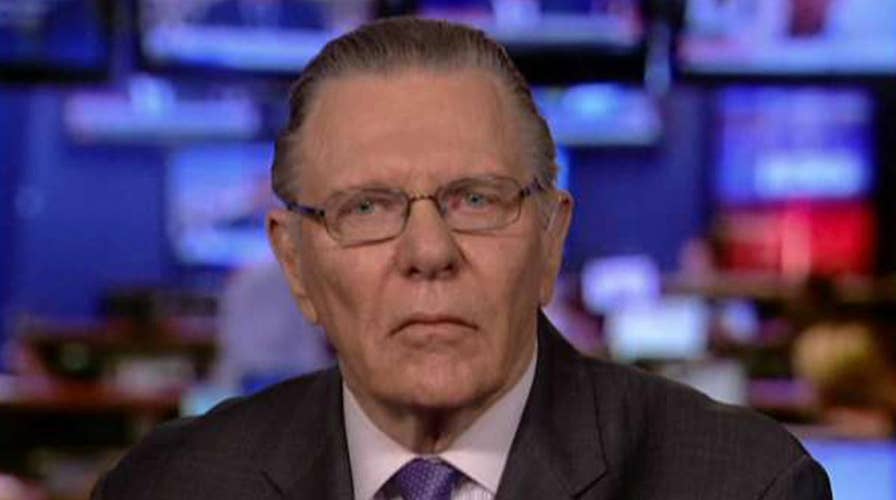
Keane: We must retaliate against Iran
Fox News senior strategic analyst Gen. Jack Keane on the potential for military action against Iran.
This is a rush transcript from "The Story," September 18, 2019. This copy may not be in its final form and may be updated.
MARTHA MACCALLUM, ANCHOR: That is so cute. That might be the best thing I've seen all day. Thank you, Bret. Good to see you tonight.
All right. Now, to something very different and very horrific. This story out of Indiana and Illinois at the home of Dr. Ulrich Klopfer, where he died two weeks ago, and a gruesome discovery was made in his house, and in his garage. They found the remains of more than 2,200 unborn children.
Klopfer described as Indiana's most prolific abortion doctor. Got his license pulled from him in 2016. Tonight, the White House is calling for a full criminal investigation. Saying that they are horrified by the news which echoes back to the atrocities of Doctor Kermit Gosnell.
You probably remember his story. He was the Philadelphia abortion doctor, whose so-called house of horrors stored fetal remains in his home in glass jars. I mean, it's just beyond, beyond the ability to understand.
In 2013, he was found guilty of murdering infants who were born alive after botched procedures. He now serves three consecutive life sentences.
In a moment, I'm joined by South Carolina Senator Tim Scott, who is among those leading the charge in Washington to protect life. But first, the breaking news on this story tonight from our correspondent Trace Gallagher. Good evening, Trace.
TRACE GALLAGHER, CHIEF BREAKING NEWS CORRESPONDENT: Good evening, Martha. Over the course of several decades, Dr. Ulrich Klopfer performed tens of thousands of procedures in multiple counties. He lost his medical license in 2016 for numerous violations including the use of unqualified staff, not filing reports of abortions for girls 13 or younger, and not providing pre-abortion counseling.
Klopfer was not licensed in any other state, including Illinois. And authorities say there is no evidence that abortions were conducted on his Illinois property, where the medically preserved remains were found.
So, there is a reason to believe, the remains are from Indiana which means they would have been illegally transported across state lines. Now, the attorney general's in both Illinois and Indiana are launching a joint investigation to find out if Klopfer was involved in the illegal storing, hiding or selling of fetal remains.
Here is the Indiana A.G. on "Fox News @ Night". Watch.
(BEGIN VIDEO CLIP)
CURTIS HILL, ATTORNEY GENERAL OF INDIANA: The first step is to determine, are there more fetal remains still out there unaccounted for, and left in this degrading situation? So, that's one of the first steps that we're working on right now.
(END VIDEO CLIP)
GALLAGHER: Yes, there's a concern there may be other remains in the Indiana clinics where he performed abortions. And one Indiana state representative, says the investigation needs to go beyond just this gruesome find. Look.
(BEGIN VIDEO CLIP)
REP. CHRISTY STUTZMAN, R-IND.: There are laws in place regarding this that were not followed, and it's very clear that this opens a lot more questions about how this practice was conducted and the legality of everything that they did.
(END VIDEO CLIP)
GALLAGHER: This also puts a new focus on South Bend mayor and 2020 democratic presidential candidate Pete Buttigieg, because when Dr. Klopfer's clinic was shut down, another abortion clinic tried to open, but was denied a state permit.
Pro-choice advocates, then, circumvented the state, filed suit in federal court and won. Allowing the abortion clinic to open in South Bend. Buttigieg applauded the ruling, but when a woman's support center which counsels pregnant women and teens tried to open next door to the abortion clinic, Buttigieg denied the zoning permit, saying it would lead to violence and harassment. Critics called the decision purely political.
And breaking right now moments ago, Mayor Buttigieg gave his first comments on the findings of the 2,000 plus fetal remains, calling it disturbing. But adding, "I also hope it doesn't get caught up in politics at a time when women need access to health care.
Mayor also welcomes an investigation. Martha.
MACCALLUM: OK. Trace, thank you very much.
So, joining me now, Republican Senator Tim Scott of South Carolina who serves on the Senate Finance and Armed Services Committee. Senator Scott, good to see you tonight.
SEN. TIM SCOTT, R-S.C.: Thank you, Martha.
MACCALLUM: This is just an absolutely horrific story. And I just want to remind people of your passion on this issue and show them a bit of a floor speech that you gave a while back. Watch this.
SCOTT: Yes ma'am.
(BEGIN VIDEO CLIP)
SCOTT: We are a nation that must continue to value life. This is common sense, this is human decency. This is not an issue of being pro-life or pro-choice. This is being pro-child which we all should be.
(END VIDEO CLIP)
MACCALLUM: Senator, what prompted that speech that day that what was going on, on the Hill?
SCOTT: I was just so frustrated that we were actually having to debate any issue about infanticide. The fact to the matter is that the United States of America, the country built on compassion, should not be ever in a debate about whether or not a child born and separated from his or her mother should be killed by the doctor.
And to have a doctor who happens to be the governor of Virginia suggest that perhaps, infanticide, somehow some ways to be legal, just -- it hurt my heart and it frustrated me. And as a legislator, I felt my responsibility was to speak out loud and clear that we are not talking about pro-choice or pro-life, we're talking about being pro-child.
And to think about the discovery just the last 72 hours or so, it's devastating. It's indefensible. And in many corridors of this country, especially on the left, the silence is deafening, it's sickening.
MACCALLUM: There was -- you know, update everybody on the status of what you were also advocating for which was the Born-Alive Survivors Protection Act. What happened with that?
SCOTT: Well, it's got stuck. We can't have -- we can't get 60 votes in the United States Senate to move that bill forward. Ben Sasse, the leading sponsor of that bill along with myself, other co-sponsors, we've been pushing this envelope. And we're going to continue to push it because here again, Martha, is this just common sense, this is common decency. It's not a -- it's not an issue in the gray. This is a black and white issue and we should all be on the side of life.
This is a chance for every single person in this legislative body to be pro-child without talking about politics. We're talking about a child born, separated from his or her mother.
MACCALLUM: Yes.
SCOTT: And whether we should let that child live.
MACCALLUM: In related, but other news, because I know, as you just said, you want to separate this from the pro-life, pro-choice question. This is -- it is, is after a child is, is feasible and born. However, there's a new study out. And this is a headline from The New York Times that says, that, "America's abortion rate has dropped to its lowest rate ever." And, "New research suggests that contraception and fewer pregnancies may be more responsible for the decline than state laws that are restricting abortion."
And they go in this piece, you know, to back that up with a number of facts related to states that have and adopted stricter laws. And the fact that actually in those days, they've actually seen the abortion numbers rise a little bit. What do you think about that?
SCOTT: Well, I think, people who are providing information will take the facts, and perhaps, hide the truth behind the facts. Here is what we know, in 2011, we had over a million abortions. The fact that we've had 938,000 is still 938,000 kids who will never walk on this earth.
So, I don't want to dive into whether we should celebrate or not celebrate a small reduction. Certainly, we should be thankful that we have fewer abortions today than we had in 2011.
But here is the question. The question is simply this. Because of science, our friends on the left want to talk about science in the environment. Here is what we know from a scientific perspective on life. At 20 weeks, we know the child fear -- feels pain. Why not get your country together on the left and the right and say, we'll take science, and we'll say, at 20 weeks, we cannot have any abortions beyond that point.
Why not have confidence that every year, we will see that number of weeks move back and back? I'm a believer that we should defend and protect life at conception. I am willing to have a fight on that issue. But there are things that we can't fight about. We can't fight about infanticide. It's just not possible to have a logical reasonable conversation on that topic.
But we should not be talking about allowing late-term abortions as we're having that discussion on the left today.
MACCALLUM: Understood.
SCOTT: There are like seven countries on earth that allow for abortions in the late-term.
(CROSSTALK)
MACCALLUM: Yes, we are in a rare company on that one.
SCOTT: (INAUDIBLE) company, actually.
MACCALLUM: Senator, thank you very much. Senator Tim Scott of South Carolina.
SCOTT: Thank you, Martha.
MACCALLUM: Always good to see you, sir.
SCOTT: Yes ma'am.
MACCALLUM: Coming up, General Jack Keane, says that the United States must conduct a retaliatory strike against Iran. His reasoning, next.
ANNOUNCER: “The Story” is sponsored by the all-new 2020 Lincoln Aviator.
(COMMERCIAL BREAK)
(BEGIN VIDEO CLIP)
MIKE POMPEO, SECRETARY OF STATE: We were blessed that there were no Americans killed in this attack. But anytime you have an act of war of this nature, there's always a risk that, that could happen.
(END VIDEO CLIP)
MACCALLUM: An act of war, says Secretary Pompeo on Saudi Arabian soil today. Calling it an attack on the world's energy supply that puts the global economy at risk. That by definition is a national security threat to the United States.
So, where is the president on this right now when asked about a military response to the attack? Here is what President Trump said.
(BEGIN VIDEO CLIP)
DONALD TRUMP, PRESIDENT: We have many options and there's the ultimate option. And their options are a lot less than that and we'll see. We're in a very powerful position.
There's plenty of time to do some dastardly things. It's very easy to start and we'll see what happens. If we have to do something, we'll do it without hesitation.
(END VIDEO CLIP)
MACCALLUM: So, yesterday, the chairman of the Joint Chiefs of Staff, said that he was, "thinking about options to help the Saudis defend themselves. And about restoring deterrence. And quote, "If this was an attack on Saudi Arabia and they requested help in defending themselves. We would be supporting Saudi Arabia. That's the framework within which we would provide the President options. Very important words there from the Chairman of the Joint Chiefs.
The general said that Trump had not issued orders for any action, so those are the voices that are around the president as all of this is being discussed. Fox News Senior Strategic Analyst General Jack Keane says that we have a major crisis on our hands and that we must retaliate against Iran with a limited strike.
General, good to see you tonight. Why is that what you believe and what in that introduction does that tell you about the different strategic options that are being perhaps even argued over at this point?
GEN. JACK KEANE, RET., SENIOR STRATEGIC ANALYST: Yes, certainly. Well, I think Secretary Pompeo laid the framework out quite accurately. This is not just an attack on the largest oil fields in the Middle East or on one of our allies, Saudi Arabia, it is clearly an egregious act of war attacking the world's economy.
And since post-World War II, Martha, a core national interest of the United States has been to safeguard and maintain the oil flow in the Middle East in support of a stable world economy that depends on it. Iran is attacking that world economy to destabilize it and also to demonstrate that they're in control of the Middle East oil flow, not the Arab nations who own that oil and those who are distributing it.
So essentially, given that reality, we need to respond. I think the first thing is we got to fix the air defenses out there that were so vulnerable and did not protect Saudi Arabia. Maybe we can help not there but also in the other Arab Gulf states.
Second thing is declassify all the evidence. I believe the administration is working on that with our Intelligence Community. Go to the U.N. with that evidence and the American people. Lay it out so they can see it.
And the U.N. General Assembly's meeting next week, all the presidents are coming in, at least most of them, that's a golden opportunity to further isolate Iran politically, diplomatically, and economically. Get maybe someone to sign up for sanctions which are working by the way. But then also, build a coalition here.
It's not just about Saudi Arabia in the United States to conduct a limited military attack likely on military and economic targets. But here's the key. The key is the focus must be robust enough to impose cost that deters Iran from continuing this behavior.
And if we don't act or if we don't act strong enough, it's guaranteed that Iran will continue. And if we do -- if we -- go ahead.
MACCALLUM: Let me ask you. You know, what -- are you suggesting that over the summer, when they attacked our drone that the response wasn't strong enough and that now they're pushing the envelope even further? And second, you know, a lot of people are going to listen to what you are saying tonight, General Keane, and say no way.
We have our own energy resources now. That's one of the reasons that we needed that kind of security. This is their problem. It is not ours. Also, there are reports tonight that the Saudi Arabians are saying we don't -- we don't want a war. We don't want to escalate the situation.
KEANE: Well, let's just think about what you just said, if that's the case.
MACCALLUM: OK.
KEANE: Yes, we are independent finally of our own energy. But it's in our national interest to have a stable world economy. Iran is trying to destabilize that, force recessions on people, and possibly even worse. We know what that means in the United States in terms of the suffering it caused.
That is why for 70 years this has been a core national interest of the United States even though we are independent of our own energy. And that is why we have to stop this behavior. Diplomatically it hasn't worked. So obviously we have to apply some level of force to do that.
Not a comprehensive attack on all of Iran's military which would lead to war. We're smart enough to avoid that. But we must act responsibly if we intend to stop the disruption of the world economy.
MACCALLUM: Do you think the Pentagon does not agree with you? Quickly.
KEANE: I don't know where the Pentagon is but I've heard some things that concern me. They may be steering and emphasizing the risk involved too much which normally steers a decision-maker to a weaker response and we wound up not occurring.
Like the first attack in the Trump administration by Assad's chemical attack, we conducted a military strike. It did not deter Assad. He did another chemical attack after that. We don't need to go down that road again.
MACCALLUM: General Jack Keane, thank you very much, sir. Good to see you tonight.
KEANE: Yes, good talking to you, Martha.
MACCALLUM: You too. So my next guest spoke with the vice president about this yesterday and he has seen the classified report on the dimensions of this attack and how it was executed. Republican Senator Jim Risch is the Chairman of the Senate Foreign Relations Committee. Senator, good evening to you. Thank you for being here tonight. You heard my conversation with General Jack Keane.
SEN. JIM RISCH, R-ID: I did.
MACCALLUM: He says that a strike is necessary, that a strong response is the only thing that will change the dynamic here. What do you say?
RISCH: Well, first of all, he made a lot of very legitimate points. But we have a commander in chief and he has said he does not want war with Iran and the Saudi Arabians have said the same thing. The unfortunate part of all this is Iran continues to push the envelope. I don't think we're there yet but it's very, very close.
And the difficulty is the Iranians are just notorious for making bad judgments, bad calculations, miscalculating, and they're doing that now. They all -- they need to listen carefully what the president said. He doesn't want war with Iran. Having said that, sometimes you get pulled into something and have to do something that you don't necessarily want to do.
The Iranians are very, very close to that. Look, this was such a deliberate and overwhelming use of military force that it is very hard to look the other way. The President has added some additional sanctions. There's going to be more done in the future. There's no doubt about that. But the Iranians think to be very, very careful here.
They should not weigh what we've done or not done so far as weakness. Any reasonable forbearance needs to be put in that category. But this president should not be mistaken for someone who's weak and unable to respond. I haven't helped them. If they -- if they get on the wrong side of him and do something further, that gives us no choice.
MACCALLUM: Understood. You know, but back to what General Keane said moments ago, that this attack in his mind meets that standard. You heard Secretary of State Pompeo said this is an act of war. So it sounds like there's a little bit of daylight here perhaps among different people in the administration, perhaps the Commander-in-Chief and perhaps the Secretary of State, I don't know. I'm just asking if that's what you're seeing based on what you're hearing on the Hill.
RISCH: Well, what I'm hearing is everyone is thoughtfully going to this. Look, I was in the room when the President made the decision last time on the drone. I was with a handful of other people from the Hill, plus the Secretary of State, and the Joint Chiefs of Staff, CIA, and all those people, and these things are not -- just jumped into.
People are talking about this. This is going to be very thoughtful. I saw a president that was incredibly thoughtful as we all discussed and gave our point of views to how -- what the response should be to the drone. We're in that same stage right now. Obviously, this is broader and that we've got to engage allies in this like Saudi Arabia. That's what's going on right now.
I wouldn't put it in terms of there's daylight. I think what I would put it in terms of, there are a suite of options and those are all being considered right now.
MACCALLUM: OK. Senator Risch, I hope you'll come back because this -- the decisions that are made on this are going to have long-lasting ramifications either way and we'll really appreciate you me and her.
RISCH: No question about that.
MACCALLUM: Thank you, Senator.
RISCH: Thank you.
MACCALLUM: So first, New York Times reporters behind the now revised Kavanaugh stories say that it was the editor's fault for leaving out key details. Now, at least one of them is calling out Fox News for our reporting on this story and Brit Hume is here to respond to that tonight.
(COMMERCIAL BREAK)
MACCALLUM: Here's the latest on this. The New York Times reporters behind that evolving Kavanaugh story now doing some clean-up simply insisting that it was an oversight that the original report should not include the key detail that the alleged victim does not recall the incident and made that very clear and has said this -- and has said that all along.
(BEGIN VIDEO CLIP)
KATE RILEY, REPORTER, NEW YORK TIMES: During the editing process, there was an oversight, and this key detail about the fact that the woman herself has told friends she doesn't remember it and has not wanted to talk about it got cut. And it was an oversight and the Times adjusted it and we're very sorry that it happened.
(END VIDEO CLIP)
MACCALLUM: So the former Executive Editor of The New York Times was here today defending their story as well.
(BEGIN VIDEO CLIP)
HARRIS FAULKNER, ANCHOR: Why does this even end up in the New York Times?
Why does this end up in the New York Times?
FAULKNER: Yes. I mean, if they're -- if they're --
JILL ABRAMSON, FORMER EXECUTIVE EDITOR, NEW YORK TIMES: Because it's important. This is a third example of you know, sexual impropriety by Brett Kavanaugh.
FAULKNER: Allegations.
ABRAMSON: And --
FAULKNER: Do you think there was --
ABRAMSON: It confirms the story of Deborah Ramirez. It's important.
(END VIDEO CLIP)
MACCALLUM: And now, one of the authors is going even further by pointing the finger at Fox News tweeting out a Vox article that accuses this network of twisting THE STORY to attack "The New York Times.
Here now is Brit Hume, Fox News Senior Political Analyst with his take on this. Good evening, Brit, good to have you here.
BRIT HUME, SENIOR POLITICAL ANALYST: Hi, Martha. You know, we got to review a little history here. It was I guess last Sunday when both Mollie Hemingway, a contributor here and a senior editor the Federalists and our own Howard Kurtz pointed out on the air that -- and on Twitter is that this crucial detail that the alleged victim doesn't remember the alleged incidents had been left out of the New York Times story on the -- on that book excerpt, based on that book excerpt.
So that was our -- that was you know, our initial role in this and we commented about it ever since. It was pursuant to that or at least after that, that the times then appended to the story and editor's note. And what is this claim that weed that we twisted events based on? It's based on the fact that the -- that the editor's note was in the form of just that and not formally a correction? There is a distinction without a difference if I ever saw one.
So the idea that that news -- that journalist from The New York Times who participated in this would now be whining about Fox News after the colossal screw-up that she and her partner made seems to me to be kind of amazing at this stage.
MACCALLUM: It is also worth pointing out, I think, that -- and I know Mollie Hemingway pointed this out, that in a longer form interview with NPR prior to the publication of The New York Times piece, they had an opportunity to bring this deal up and they didn't bring it up then either.
HUME: They didn't mention it then either, so, you know --
MACCALLUM: Which makes --
HUME: -- significant enough.
MACCALLUM: -- which makes the omission of it obvious. Now, one of the other elements here that I think is very important is the Leland Kaiser part of the story, which, you know, I think to most people covering this story fairly across the board, this becomes a very, very important detail, does it not, Brit?
HUME: Well, let us remember who Leland Kaiser was. He was a dear friend of Christine Blasey Ford, and I think basically almost a lifelong friend.
And when Christine Blasey Ford was asked, you know, who could verify her account of this event that happened that night -- you remember and you recall, of course, her story was very hard to prove or disprove because she couldn't remember exactly what happened, exactly what the date was, and many other of the kind of details you could use to pin something like that -- she cited Leland Kaiser as someone who could verify for her.
Well, Leland Kaiser said at the time that while she believed Christine based on Christine's word, she didn't have any recollection of the event and didn't witness it, didn't even know she'd ever met Brett Kavanaugh.
Well, subsequently, we now know, she told the FBI when she was interviewed that she didn't have any recollection of ever witnessing such an event. She has since told the FBI, we now know, that she now doesn't believe Christine Blasery Ford's story, which blows up the one witness, really, that was supposed to be the one who could verify that original allegation. So that is another very important detail.
MACCALLUM: It's a big deal.
HUME: You think that that might have been something they choose to accept (ph) --
MACCALLUM: Yeah, they have it.
HUME: -- but they didn't.
MACCALLUM: It's in the book.
HUME: It's in their book.
MACCALLUM: It's just a question of which pieces they wanted to highlight, but I think a lot of people see this as a big news story. She said it would be impossible for me to be the only girl at a get-together. This is Leland Kaiser. We can put her quote up.
"With three guys, have her leave," she is referring to Christine Blasey Ford, "And then not figure out how she's getting home. I just really don't have confidence in the story," said Leland Kaiser, which now makes her part of a group of four people, Brett Kavanaugh, Mark Judge, P.J. Smith, and Leland Kaiser, who all were four of the people that Blasey Ford pointed to that were there, who now have all claimed under the investigation that they have no recollection of the evening, Brit.
HUME: Yeah. I think that's telling because, you know, we keep hearing people on the left who were still into this attack on Kavanaugh, saying, you know, there were multiple witnesses. And so there were not and the claim witnesses don't back up the story.
You know, there was a time, Martha, it wasn't that long ago, when The New York Times would never have considered publishing this story in the form it was in. They certainly would never have left out -- left that giant hole in the story as it concerned the alleged victim and it's just unthinkable.
I can remember back in my days as an investigative reporter, I did a story for Jack Anderson's column where I worked back in the '70s, about the syndicated cartoonist All Capp who had emerged as a -- he's the guy who created Li'l Abner --
MACCALLUM: Yeah.
HUME: A lot of people don't remember that now but many people will remember. He became a prominent political spokesman. He was making college speeches on colleges all around the country. We got reports that he was molesting women when he was doing that, college students.
And we did a story about it but we had -- not only did we have the word of victims, we had affidavits from them. I mean, that was the lengths you would go to verify a story so explosive and so damaging.
MACCALLUM: In order to print something like that about somebody. Their reputation on the line is a very serious thing.
HUME: So here's a story based upon the say-so of this alleged eyewitness whom the reporters never interviewed and who isn't talking about this, right? This is on the say-so of friends who say he says this. That's flimsy enough to start with.
And then with the fact that the victim has told people that she doesn't remember it, you wouldn't touch a story like that with a barge pole if you had any sense.
MACCALLUM: Brit, thank you. Brit Hume, thank you, sir. Good to see you tonight.
HUME: Thank you.
MACCALLUM: We'll stay on it. Coming up next, "The Squad" is insisting on impeachment proceedings for President Trump and for Justice Kavanaugh.
Donna Brazile says that the culture in her party leaves no room for bringing people together, saying "I get in trouble when I refuse to say that Trump is a racist." That is getting a lot of attention today, and she will be here to expand on that in a moment.
(COMMERCIAL BREAK)
(BEGIN VIDEO CLIP)
REP. AYANNA PRESSLEY, D-MASS.: If you are not prepared to come to that table and to represent that voice, don't come. Because we don't need any more brown faces that don't want to be a brown voice. We don't need black faces that don't want to be a black voice. We don't need Muslims that don't want to be a Muslim voice. We don't need queers that don't want to be a queer voice.
(END VIDEO CLIP)
MACCALLUM: That was Rep. Ayanna Pressley this summer. Pressley now wants a full court press to impeach the president and Justice Kavanaugh. And AOC says the case for Trump's impeachment has "increased" after Corey Lewandowski testified on the Hill yesterday. Here's Congresswoman Rashida Tlaib today.
(BEGIN VIDEO CLIP)
REP. RASHIDA TLAIB, D-MICH.: This is why among other violations of the Constitution by this president, I along with many here are calling for impeachment of the president of the United States.
(END VIDEO CLIP)
MACCALLUM: Nancy Pelosi thinks that impeachment is the wrong political path. She told a private meeting of Democrats that they can "feel free to leak" her frustration on that to the press.
Former DNC chair and Fox News contributor Donna Brazile joins me now. Donna, thank you for being here tonight.
DONNA BRAZILE, CONTRIBUTOR: Thank you.
MACCALLUM: You know, it's pretty clear from that initial sound bite -- that kind of goes to the other subject that I want to talk to you about as well -- the one that we just played from Ayanna Pressley that it is sort of like, you know, it's their way or the highway in terms of who is a true member of the party.
First of all, on the impeachment issue, what did you think of the hearing yesterday and do you agree with Nancy Pelosi or with the members of the "The Squad" on this?
BRAZILE: Well, I got a chance to see a little bit of the hearing. Of course, I was busy yesterday, but let me just say this. I thought Corey was very competitive but the House Democrats got what they wanted out of that. That is he admitted that the president ordered him to direct Attorney General Sessions to, you know, basically stop the investigation.
But as you well know, the calls for impeachment, 137 Democrats are in favor of it, 92 Democrats believe that Congress should do its job in terms of oversight and accountability. Six are unclear. One former Republican member, as you know, Justin Amash, agrees with those 137 Democrats. So --
MACCALLUM: They are not the votes. That's what Nancy Pelosi is saying, they simply are not the votes.
BRAZILE: She is absolutely correct that they don't have the votes at this time. What she is concerned about -- I don't want to speak for those members and I don't speak for the speaker, but I think what she's concerned about is that majority of Americans, including independents who will determine the outcome of the next election --
MACCALLUM: That's right.
BRAZILE: -- they are not in favor of it. And because they are not in favor of it, the speaker believes strategically that we should continue to do the oversight, continue to hold the executive branch accountable, but perhaps do not go full --
MACCALLUM: Yeah.
BRAZILE: -- speed ahead until all of the evidence, all of the material, and all of the subpoenas have been issued.
MACCALLUM: In terms of the sort of our way or the highway mentality that is often professed by those members of the House, representatives of the House –
BRAZILE: Just a few members, Martha. I don't like --
MACCALLUM: Well, we just mentioned them specifically.
BRAZILE: Yeah. I don't like to paint the entire House democratic caucus with one brush.
MACCALLUM: I understand.
BRAZILE: As a former hill staffer, during the time Bill Clinton was being impeached, I was a Hill staffer, tough Hill staffer. So we don't like to paint everybody with one brush. This is a very diverse caucus with conservative, moderates and a lot of progressives.
MACCALLUM: All right. So here is what you said about how you sometimes feel when you are not willing to toe the line on the President Trump is a racist line of thinking. Here you are talking about that.
(BEGIN VIDEOTAPE)
BRAZILE (on camera): I'm sick and tired of people asking me, is he a racist? Is he -- I got to speak for myself. I can't speak for him or what's in his heart.
(END VIDEOTAPE)
MACCALLUM: What do you think about that? It got a lot of attention, what you said.
BRAZILE: I get attention because I'm on Fox and perhaps because I'm here on this network, people often think that I either lost my mind or maybe ready to retire. No, the truth of the matter is that I don't like to do this name-calling, finger-pointing. I've been in this world now almost 60 years, and I appreciate the contributions of all Americans.
I want to try to bring people together. I believe in racial reconciliation. Have I called the president out on the birtherism (ph)? Yes. Have I called him out on Mexicans and rapists? Yes. Have I called him out? Absolutely.
The president understands the frustration that many of us have when he sometimes go on Twitter and do his thing, and we will call him out, but I believe that this president, like every American citizen and every soul in this universe, should be given an opportunity to come forward and try to bring all of us together as Americans.
The second thing is I don't want to energize his base. I don't want to tell people out there that, you know, I have some profound personal disagreement with this president. No, it is about the policies that I dislike, but there are policies when I like what the president is doing. Martha, you know I will say that as well. I am a free, liberated woman about to turn 60 at the end of the year.
MACCALLUM: Good for you.
BRAZILE: I still got my groove. I'm going to make my move and some people would like me, some people will not. But here's what I will do. I will respect the office of the president as long as I'm alive.
MACCALLUM: Good for you, Donna. We appreciate all of your points of view when you join us here.
BRAZILE: Thank you, Martha.
MACCALLUM: Thank you very much for being here.
BRAZILE: Always.
MACCALLUM: Everybody included, thank you. All right, coming up next is a powerful new PSA. I don't know if you've seen this, but it paints a chilling picture of the reality of the threat of school shootings in America, and it implores everyone to be on the alert for the warning signs.
Andrew Pollack says it is time for parents to wake up, take a hard look at your school, and who is attending that school. He is next.
(COMMERCIAL BREAK)
MACCALLUM: This is a pretty gut wrenching glimpse into the stark reality of school shootings in America in a new back to school PSA released by the advocacy group Sandy Hook Promise. Watch this.
(BEGIN VIDEO CLIP)
UNIDENTIFIED MALE: These headphones are just what I need for studying.
UNIDENTIFIED MALE: These new sneakers are just what I need for the new year.
UNIDENTIFIED FEMALE: This scissors really come in handy in our class.
(GUNSHOTS)
UNIDENTIFIED MALE: These colored pencils, too.
UNIDENTIFIED FEMALE: These new socks? They can be a real lifesaver.
UNIDENTIFIED FEMALE: Phone to stay in touch with my mom.
(END VIDEO CLIP)
MACCALLUM: Wow! Joining me now is Andrew Pollack, father of Parkland shooting victim Meadow Pollack and the author of "Why Meadow Died." I think it is a powerful message, Andrew. I mean, you know, they have their own agenda in terms of how they would approach this problem that's different from yours, but I think it's pretty interesting.
ANDREW POLLACK, FATHER OF PARKLAND SHOOTING VICTIM: I think it's disturbing and shocking, but I think parents need to see this.
MACCALLUM: Yeah.
POLLACK: If you spoke to any parent who had a kid murdered out of school, they would say -- they would think it couldn't happen to them, and that's what every parent thinks in this country. This video should be an eye- opener for all these parents to get involved at a local level and see -- look into the policies at their child's school and get involve. Don't put your kid in an unsafe environment, and talk to your kid. They're the first ones that see disturbed kids at school.
MACCALLUM: Yeah. I think it is so important that you ask the question. Is there anybody that scares you at school? And as you say, Andrew, talk to the officers who are in town or who are involved in the school because there are people who are on their radar and they don't share that with the rest of the community.
POLLACK: No. The kids -- you know, talk to your children, talk to the school resource officer, talk to the teachers, and really get involved. That's what parents need to do. Don't leave it up to politicians to make your school safe. Just know that you do have options.
Look into the policies that are in my book, "Why Meadow Died" and see if they are at your school. Listen to your kids because they really know and there's nothing that we wouldn't do for our kids. This video, parents, this is a real eye-opener.
MACCALLUM: Yeah.
POLLACK: And it was to me, looking at it. It hit home. They needed it. You needed that gut wrenching video to get parents involved. That's what they did and they were successful.
MACCALLUM: Yeah. And at the end, they say, know the signs, understand, know your school, as you've been saying. I encourage everybody to read "Why Meadow Died" and look into the policies that have left a lot of kids who don't belong in the schools and should be incarcerated, not there, and that's really I think such a significant point that you've made.
Before I let you go, these sweatshirts that are being pushed by the fashion company, they have one that has a guy -- let's put it up on the screen. He is wearing the Stoneman Douglas high School sweatshirt and it's got bullet holes in it. And this is supposed to be some sort of fashion statement.
POLLACK: Yeah. It's just done in such bad taste. Family members, I know what bothers them. I'm born in New York, so I'm pretty much thick-skinned so it doesn't bother me. But what bothers me more is after every mass shooting, when Democrats pushed that gun control agenda before even looking into the facts, that's more bothering to me and with no real solutions.
MACCALLUM: I know that you feel the whole structure of leadership in the school, the superintendent, everybody was at fault. And as you outlined in your book, I encourage people to read that. Andrew, thank you very much. We will see you soon.
POLLACK: Thanks, Martha.
MACCALLUM: I sat down with Andrew for the latest episode of the "Untold Story" podcast and he goes into detail on this. I really encourage all parents, grandparents to listen to this and to watch it.
And then still to come tonight, an old photo scandal that is just breaking for a major world leader, "Wednesdays with Watters," up next.
(COMMERCIAL BREAK)
MACCALLUM: So there is a story breaking tonight that is a bit of a scandal perhaps for Canada's Prime Minister Justin Trudeau. This photo was obtained by Time and it shows him in brown face at a 2001 event. They say that he was attending an "Arabian Nights"-themed gala at the private school where he was teaching in 2001.
Here now, "Wednesdays with Watters," Jesse Watters, host of "Watters World" and co-host of "The Five." He is in an election on October the 21st. The timing on this may be related.
JESSE WATTERS, HOST: Yeah, I'm sure the opposition research leaked it out. Maybe when he loses, he can move to Virginia and run for governor because this is really bad. And it is even worse, I think, than the Virginia governor, Northam, because this was in 2001 and he was a teacher at the school. Northam was 84 and he was a student.
Now, it's such incredibly bad judgment to do this. I don't know what he was thinking. Apparently he was the only one who did anything to his face at this party. I know there is a distinction between blackface in America which has all the historical pain that is wrapped into that.
The French-Canadian, they have him in brown face because he's trying to imitate someone from Aladdin at the party. I guess that's maybe a little bit different, but not different enough to not hurt him. This is going to hurt him big time. A part of me thinks he's going to survive.
MACCALLUM: I mean, look at Ralph Northam.
WATTERS: He survived.
MACCALLUM: I mean, you know, he survived. He is still the governor of Virginia. He doesn't, you know, he's not out there that publicly.
WATTERS: No.
MACCALLUM: He had a number of issues back then. Justin Trudeau, as I said, the election is on October the 21st. It is an extremely tight race. He's running against a conservative, Andrew Scheer. He's at 37 percent in the polls right now. But my guess, given what we saw here in Virginia, is that he's going to try to ride this out. His own people came out and confirmed that it is indeed him.
WATTERS: It is indeed him. He's going to address the Canadian nation tonight about this. We will see if he can think quickly on his feet because he's probably had to scramble. Remember, every single national Democrat in America told Northam to drop out of the race.
MACCALLUM: That's right.
WATTERS: And he didn't. I would like to see if some Democrats here are going to be asked that question by the media about our closest ally, Canada, whether they think Trudeau should drop out. It would be an interesting comparison.
MACCALLUM: There is the picture. Jesse, thank you very much. We'll see where it goes. Thanks for being here.
WATTERS: Thank you, Martha.
MACCALLUM: A different "Watters' World" but we have some breaking news out of Canada tonight. Thanks for helping us handle that. Coming up next, this is “The Story” -- we are done. What am I saying? Really 25 seconds left in the show. This is “The Story” on Wednesday, September 18, 2019. But as you know, the story goes on, so we will see you back here tomorrow night at 7:00.
Coming up next from Washington D.C. is Tucker Carlson. Stay tuned for that. Good night, everybody. Have a good night. We will see you tomorrow.
Content and Programming Copyright 2019 Fox News Network, LLC. ALL RIGHTS RESERVED. Copyright 2019 ASC Services II Media, LLC. All materials herein are protected by United States copyright law and may not be reproduced, distributed, transmitted, displayed, published or broadcast without the prior written permission of ASC Services II Media, LLC. You may not alter or remove any trademark, copyright or other notice from copies of the content.
