





Judicial independence becomes flashpoint for Trump, Roberts
President Trump and Supreme Court Chief Justice John Roberts get into a very public disagreement; reaction and analysis from the 'Special Report' All-Stars.
This is a rush transcript from "Special Report with Bret Baier," November 21, 2018. This copy may not be in its final form and may be updated.
(BEGIN VIDEO CLIP)
PRESIDENT DONALD TRUMP: I'm going to put in a major complaint, because you cannot win if you or us a case in the Ninth Circuit. This was an Obama judge, and I will tell you why. It's not going to happen like this anymore. The Ninth Circuit is really something we have to take a look at because it's not fair. Every case that gets filed in the Ninth Circuit, we get beaten, and then we end up having to go to the Supreme Court.
(END VIDEO CLIP)
BRET BAIER, ANCHOR: In a rare rebuke, the chief justice of the U.S. Supreme Court put out a statement dealing with what the president was talking about there, saying, quote, "We do not have Obama judges or Trump judges, Bush judges or Clinton judges. What we have is an extraordinary group of dedicated judges doing their level best to do equal right to those appearing before them. That independent judiciary is something we should all be thankful for."
That set the president to the Twitter-verse, and he tweeted, "Sorry, Chief Justice John Roberts, but you do indeed have Obama judges, and they have a much different point of view than the people who are charged with the safety of our country. It would be great if the Ninth Circuit was indeed an independent judiciary, but if it is, why are so many opposing views on border and safety cases filed there, and why are a vast number of those cases overturned? Please study the numbers, they are shocking. We need protection and security. These rulings are making our country very unsafe. Very dangerous and unwise."
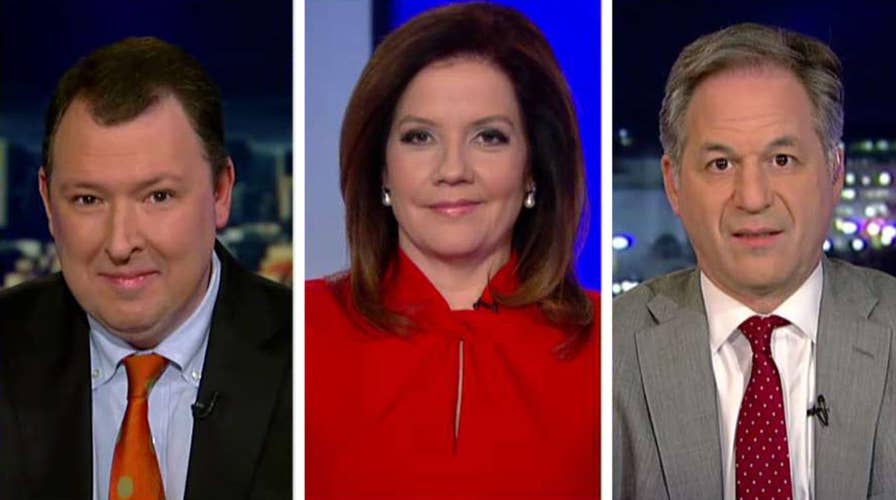
With that, let's start with our panel: Marc Thiessen, fellow at the American Enterprise Institute; Mollie Hemingway, senior editor at The Federalist, and Charles Lane, opinion writer for The Washington Post. Marc, thoughts?
MARC THIESSEN, AMERICAN ENTERPRISE INSTITUTE: If Chief Justice Roberts wanted to demonstrate that the Supreme Court is above politics, then getting into a political tussle with the president is sure a funny way of showing it.
The reality is of course there is a big difference between Obama judges and Trump judges. If there was no difference, then why did they Democrats filibuster Merrick Garland -- I mean, why did they filibuster Gorsuch? He's just the same of Merrick Garland. Why did Anthony Kennedy wait until there was a Republican president to resign? Why did they try to destroy Brett Kavanaugh to keep him from taking the court? And why doesn't Ruth Bader Ginsburg resign and let Trump replace her?
So it's a preposterous idea that there is no difference between Obama judges and Trump judges. In fact most voters, a lot of voters voted in this election specifically because they wanted to make sure that there were Trump judges and not Obama judges. So the chief justice should stick to running the Supreme Court and not get into fights with the president.
BAIER: Chuck, what about that? Is Marc right? Is this a fight he should not have gotten into?
CHARLES LANE, THE WASHINGTON POST: I think it was a fight he felt he had to get into and that he has been trying to stay out of for several years, ever since President Trump, going back to the time he was a candidate, has been vilifying Chief Justice Roberts, first for Obamacare and then for other things.
Look, of course it's true that there are ideological and partisan differences among the judges. That's been true since Thomas Jefferson and John Marshall. But it is important for political leaders to respect the good faith of judges and not reduce what they say to partisanship or the president who appointed them. And I think that is what the chief justice was trying to say, is that regardless of who appointed you, you have to trust in the good faith of the independent judiciary.
And by the way, it was good advice to the president himself, because the next time he needs a ruling from the Supreme Court, he is going to want to be able to say that was an independent ruling by people made in good faith and not by a bunch of Trump judges like Neil Gorsuch and Brett Kavanaugh. So quite apart from making a mistake, I think the chief in his own way was desperately trying to prevent the president from making any further mistakes. But obviously, it didn't work.
BAIER: Mollie?
MOLLIE HEMINGWAY, THE FEDERALIST: I think the problem with what he is saying is not that we should of course want to have the ideal of an independent judiciary, but anyone who is paying attention knows that we don't have that situation. We have something of even a crisis with all these universal injunctions that partisan judges are putting in place. That is a threat to the judiciary.
And when you have the chief justice of the Supreme Court say, there's no problem here, nothing at all, don't think about what your eyes are telling it or what you are reading, just trust me, there's no problem, it actually kind of increases the anxiety that a lot of Americans have about the failure to address this problem where one rogue judge can actually subvert the constitutional processes for how we do things. So I think it was such a bizarre statement for him to make, I can only assume that he intended something differently than how it came off.
BAIER: There are a lot of people weighing in. Ramesh Ponnuru from "National Review" saying the chief justice's defense of the federal judiciary, "There's a problem with Robert's strategy. What he is saying is pretty obviously untrue. The decisions of judges appointed by Clinton and Obama generally differ in predicable ways from the decisions of judges appointed by Bush and Trump. In an ideal world, the difference would be smaller than it is and perhaps would not even I exist, but I do not think we will move towards that ideal by rebuking those who notice we are not already there." In other words, in the ideal world, Marc, what the chief justice is saying would be true. But it's not saying that.
THIESSEN: It is an ideal world. And it's actually probably more true for the Justice Roberts and the Republican justices than it is for the liberal judges, because the Republicans follow the philosophy of judicial restraint, that their job is not to create law but it is to interpret the law, as Justice Roberts said, to be an impartial empire.
Democrats, on the other hand, follow this principle of a living constitution and judicial activism, for the most part, where they come up with the outcome and then they find the judicial rationale to get there. And the evidence of that, quite frankly, is the fact that if you look at the Supreme Court over the last 30 years, the Republican justices, almost half of the Republican justices appointed since Reagan have come over and either joined the liberal block or become swing votes that vote with the liberal block in a regular time. I defy someone to name me one liberal justice in the last 30 years who has come over to the conservative block or become a swing vote that votes regularly with the other side.
So I think what you are seeing is Chief Justice Roberts is expressing an ideal that Republicans try to live up to, and it's the Democratic appointed judges that vote in a block and in a particularly partisan way. And it's even worse, as President Trump points out, when you get to the appellate court than it is on the Supreme Court.
BAIER: Last thing, there is still a lot of reaction to the president's stance, announcement of standing with Saudi Arabia, even after the details of the Jamal Khashoggi killing. Chuck, will this fallout continue? And how long will it last?
LANE: I think it is going to continue because the president can't, notwithstanding this extraordinary statement he made with all the exclamation points, he can't tell people this is over because it's not over. Among other things, Turkey is continuing to agitate the question. They are calling for a U.N. investigation, and so on. Congress, the Senate is talking about getting involved. There is some movement by Senators Corker and Menendez to activate the Magnitsky Act and apply that more aggressively to Saudi Arabia.
The CIA itself seems to have reached the conclusion that what the president is intimating in this last statement isn't really true. And so I expect leaks out of the intelligence community in greater detail. It's one thing to be a realist and foreign policy and say that we have to swallow our principles sometimes to have alliances. We have always done that throughout our history. It's very important how you do it. And the president did it in an extraordinarily un-nuanced, and I would almost say overly blunt way by essentially saying, look, we get a lot of money from Saudi Arabia, that is all that matters. And that, I think, really tarnished the American brand in international affairs, and we are going to be hearing more about it indefinitely I think.
BAIER: It is a little ironic that Turkey is taking this as far as they are, being that they are the country that jails the most journalists around the world. Mollie, last word.
HEMINGWAY: I think if you find yourself siding with Turkey, you may want to rethink where you are. I actually agree with Chuck, this was an extraordinary statement, and it was extraordinary because for decades we have had a foreign policy built on an idea that our foreign policy should be about spreading American values or spreading democracy. Donald Trump is saying we tried that, it didn't work, and we should have a foreign policy based on national interests.
He did condemn what happened to Khashoggi. We do know that Saudi Arabia is responsible for that. The question is do you reorient your entire foreign policy to deal with the fact that Saudi Arabia brutally murdered their dissident of theirs, or do you think about your strategic interests and what happens in a region when you break an alliance with Saudi Arabia? Who does that strengthen? Are we comfortable with strengthening Iran? Are we comfortable with what the means to the oil flows? Are we comfortable with what that means to the region?
And I think that you have people who really want to have this debate, and people in Washington, D.C., are pretty certain that Donald Trump is on the wrong side of this debate. I think the American people actually are much more aligned with Donald Trump. Foreign policy, we have tried the spreading of American values. Not only did it not work, not only did we not spread democracy, it came at a huge financial cost. It came at a huge cost of lives, and it's time for us to think very seriously about our national interests here and abroad.
Content and Programming Copyright 2018 Fox News Network, LLC. ALL RIGHTS RESERVED. Copyright 2018 CQ-Roll Call, Inc. All materials herein are protected by United States copyright law and may not be reproduced, distributed, transmitted, displayed, published or broadcast without the prior written permission of CQ-Roll Call. You may not alter or remove any trademark, copyright or other notice from copies of the content.
