


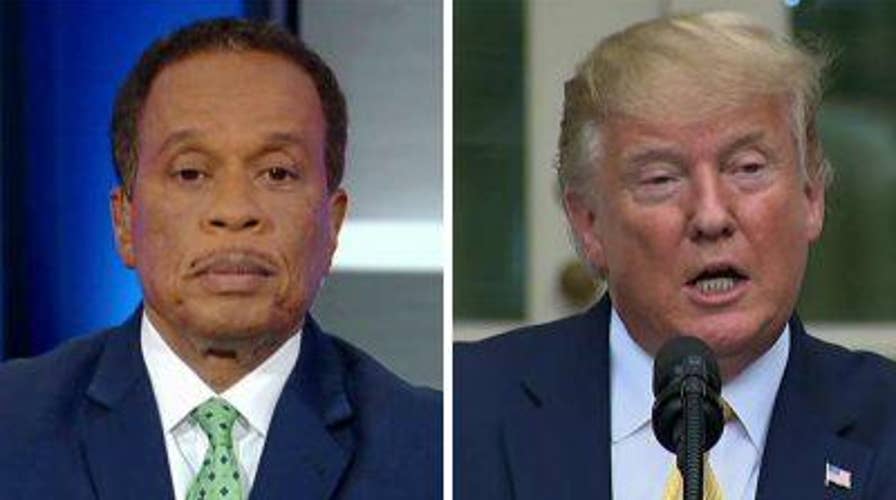
This is a rush transcript from "The Five," July 11, 2019. This copy may not be in its final form and may be updated.
DANA PERINO, HOST: Welcome to “The Five.” President Trump is wrapping up a social media summit moments ago. He's also set to make a major announcement about the citizenship question live. We're going to bring that to you when it happens. But let's listen in on what he saying at this social media event, Greg.
TRUMP: And she won by 12. That's right. She was down by 10, and she won by 12, and she wouldn't stop. They just -- every day -- where is she? She's here. She's there. Fantastic job you did. We're proud of you. Well, thank you, honey. That's great. It was just -- honestly, working with people that know what they're doing, it's fun. That was fun. And you know what you're doing.
Representative Dan Crenshaw who is very good at this, by the way, Dan. Very good at this. Really good. Thank you. It's great to have you in the party. And you have more courage than I do, Dan, OK? That courage of yours is incredible. Thank you very much. Great job. A friend of mine and a wonderful person, and somebody that has -- I don't know, pretty unlimited future, I'd say. I hear a lot of very positive things. Liz Cheney. Liz, thank you.
(APPLAUSE)
TRUMP: And you know, I pardoned somebody named Scooter Libby. A lot of you don't know who Scooter Libby is. Scooter Libby is a man that got treated very unfairly, and Liz was right in the forefront of that one. And I said what do you think, Liz? And you said absolutely he deserved it. And it's been a very popular pardon. He was treated very, very brutally and unfairly, so thank you for that -- for that help. Matt Gates. Where's Matt --
GREG GUTFELD, HOST: All right.
PERINO: All right. That's President Trump, and as we've said he's at the White House. He's doing the social media summit and he's wrapping that up, and he's got other things to come and we will bring that to you. That's not all that is happening in Washington.
GUTFELD: Wait. Introduce us.
PERINO: You want to be introduced?
GUTFELD: Yes.
PERINO: I don't know if they can do it with the camera. There's Greg, and Jesse, and Juan, and Emily. It's our eighth anniversary. We're already off the rails as everybody very happy with us. OK. Here we go.
Democrats apparently running out of Republicans to attack so they're turning on each other. Alexandria Ocasio-Cortez has been battling back and forth with Nancy Pelosi. And now, AOC is suggesting that Pelosi's criticism of her and other freshman Dems is racist. AOC is saying the persistent singling out -- it got to a point where it was just outright disrespectful, the explicit singling out of newly elected women of color. Despite that smear, Pelosi isn't backing down but neither is AOC.
(BEGIN VIDEO CLIP)
UNIDENTIFIED FEMALE: Singling out four individuals. And knowing the medium we're operating in, knowing the amount of death threats that we get, knowing the amount of concentration of attention, I think it's just -- it's just worth asking why.
UNIDENTIFIED MALE: Do you think she has racial animus? Is she racist?
UNIDENTIFIED FEMALE: No, no. Absolutely not.
(END VIDEO CLIP)
PERINO: Of course not, Greg. She just said that they didn't really mean it.
GUTFELD: I really wish -- I know that Juan might disagree with me. But I want the best for the Democrats, I really do because I think that every party -- I do -- every party benefits from a strong competitor, right? And they always get better. I know you don't believe me. I don't want this to happen. I don't want them to eat themselves alive.
But in woke culture, it's not about cooperating or uniting. It's about delineating. I'm not a person like you. I am X,Y, and Z. Color, orientation, gender, disability, all of this becomes -- you know, this intersectionality game of who's better. Who's more oppressed? And to win, you have to label everyone else intolerant, so what you're left with is the tiniest party.
And it's a movement -- this whole thing is based on narcissism, right? Who can be the most woke and get the most attention? And it's at the expense of your allies. So, AOC insults -- it's no question, when you said that she was -- she was targeting women of color, she was saying she was being a racist. So --
PERINO: But then she said that she's not. So what about -- what about that, Juan, in terms of -- you know, she pushes on Nancy Pelosi and then she pulls back. Well, Nancy Pelosi is trying to deal with her member management problem.
JUAN WILLIAMS, HOST: Well, I think this is bigger than Nancy Pelosi. But let me just say, I think she's very clear this is actually not a claim that Nancy Pelosi was racist. And, boy, was there blowback from Nancy Pelosi's caucus in terms of blacks and Latinos saying this is crazy. Look at how diverse this caucus is, and that's because of Nancy Pelosi.
And there was blowback in terms of some of the comments made about moderates, especially southern Democratic moderates, Dana. And some of those Southern Democratic moderates, guess what? They're black. And they said, wait a minute, what are you talking about, right?
So I think she's getting blowback within the caucus. But I think that part of this is that, you know, people are reluctant -- we're reluctant to talk about generational divides in our country. We like to talk about race, you know. We can talk about --
GUTFELD: I think that's the opposite.
WILLIAMS: No, I think --
GUTFELD: We love talking about generations. We hate race.
(CROSSTALK)
GUTFELD: By the way, they went after Mayor Pete, too. They went after Mayor Pete.
WILLIAMS: No, hang on, hang on. Let me finish this point. They don't -- I think we as a country do not say, hey, you know what, there's a huge generational divide in the country, and a huge generational divide among Democrats, with the younger part of the country right now. It's mostly Democratic, heavily diverse in terms of race, immigrants, and the like. And the older part of the Democratic Party is more -- I think it's diverse but --
GUTFELD: But they love Bernie. The young ones love Bernie.
WILLIAMS: Correct. What is that point?
GUTFELD: My point is, generational -- I mean, you've got the younger progressives are flocking to Bernie, not to Mayor Pete. So it's not generational is what I'm saying. Let me explain it again.
WILLIAMS: OK.
(LAUGHTER)
WILLIAMS: I think the younger people might, in fact, like a Bernie, or like the more progressive politics and the like. But they are really angry that the older folks, as they see it, don't respond to the bullying, to the punching that comes from President Trump. They say, hey, how come you guys don't fight like President Trump. And why don't you punch back? The older crowd is saying, hey, I know how to count votes on the House floor.
PERINO: Right.
PERINO: I know how to win elections. All you guys do is talk about clicks on twitter.
PERINO: Yeah, she talks about -- Nancy Pelosi called them the squad.
JESSE WATTERS, HOST: The squad. That elevates them by giving them a nickname. So I don't know if that was the best technique. Juan, the older Democrats tried to stage a coup against the president. I think they've been fighting the president pretty damn hard the last two years. But I also strongly disagree with Greg. I want to see the Democratic Party destroy itself. I want to see eat itself alive.
They've uncorked this bottle -- this virus, this identity politics virus, and now it's eating them. And now they're upset about it. Oh, really? You guys are upset because the last five years, anytime you criticize Barack Obama, racist. You criticize Omar, oh, Islamophobic. You criticize the captain of the U.S. soccer team, sexist and homophobic. So, you know what? The chickens have come home to roost, to quote the pastor of Barack Obama.
And it's sad because the only time you play the race card and the gender card is because you don't have any cards left to play. And that's what you said right here when you cited this Democratic lawmaker. She sounds like a Republican. She -- William Lacy Clay, excuse me, male Democrat from Missouri. What a weak argument talking about AOC because you can't get your way. And because you're getting pushed back you resort to using the race card? That's unbelievable to me.
So that's what Republicans have been saying for so long that it's a weak response when you can't persuade to make an argument. And I will say lastly, they haven't been singled out. They singled themselves out. They were the only four people to vote, while 240 others voted the other way. And they've all been lightning rods since they got in. They're always getting all the attention. Nancy hasn't singled themselves, they've done it to themselves.
PERINO: Can I make a point? I'm going to make a point. So, the squad only has four votes right now, but they don't need that many more votes in order to cause Nancy Pelosi real headaches. It would take about 18 votes for them to not be able to pass things. So, if people get increasingly frustrated with the establishment. That could happen.
EMILY COMPAGNO, HOST: And that's why I think it's important for somehow there to be a balance of energy. And to me this entire thing is like -- you know when you go out to dinner with another couple and they get into an argument in front of you. They're bickering. It's just -- it's too achy. It makes everyone uncomfortable. And to me --
GUTFELD: I enjoy that.
WATTERS: I enjoy it, too.
(LAUGHTER)
(CROSSTALK)
COMPAGNO: Like, do it at home. Because, to me, it's like a sorority squabble. And more than generational, it's a maturity difference, too. I agree the squad singled themselves out. It's like they showed up on the first day wearing the same t-shirt and now are aghast at the thought --
PERINO: What was it? On Wednesdays we wear pink?
COMPAGNO: Totally. And so -- but I think, importantly, moving forward, that Pelosi has to prove to her centrist district that AOC and the squad are not setting the agenda. And then also, however, she needs to harness that energy like I said in the beginning because otherwise she can lose the speakership if the Democrats do hold the House or maintain the House moving forward.
So somehow they have to figure it out. But to me it's better done behind closed doors, strategically, rather than playing out like a reality show.
PERINO: All right. Has anyone --
GUTFELD: Yes, I would like to point out that the naked cowboy was outside while --
PERINO: Is that what I missed?
(CROSSTALK)
WILLIAMS: We were supposed to be outside.
GUTFELD: Yes, and he came.
WILLIAMS: He likes to say hello to me everywhere.
GUTFELD: Yeah, yeah, yeah.
WILLIAMS: Somebody has a sign --
GUTFELD: See, everybody thought were supposed to be outside but it rained.
PERINO: I know it rained. Our fans --
GUTFELD: By the way, the naked cowboy, that's false advertising.
WILLIAMS: Why? The guy's built.
(CROSSTALK)
PERINO: He's not really naked.
GUTFELD: He's wearing underwear.
(CROSSTALK)
WILLIAMS: Oh, Dana, you're such a nice lady.
PERINO: He's not.
WILLIAMS: you want the whole thing, huh?
PERINO: No, I don't.
(CROSSTALK)
GUTFELD: Where is this going?
PERINO: OK. It's a big day for us here on “The Five.” As we've said, it's our eighth anniversary. We have a lot of fun lined up coming up later. But first, we're also waiting for major news from President Trump. The latest on the citizenship question just ahead.
(COMMERCIAL BREAK)
WILLIAMS: You're looking live at the White House. We're waiting for a major announcement from President Trump about the citizenship question on the census. We're gonna bringing that to you live when it happens. In the meanwhile, Los Angeles residence and business owners now appearing to take matters into their own hands as they battle the city's homeless crisis. They're reportedly putting up fences and planting thorny bushes, even cactuses to keep the homeless from sleeping in front of their private property. The mayor is calling the move short sighted, while the city's homeless population has risen by 16 percent since last year.
So, Greg, let me just begin with you and say, you know, I think what individuals can do is pretty limited. I don't know that we can -- an individual can solve this problem. We can shove it down the street for somebody else -- but don't you think government solution is required here?
GUTFELD: Yes, but they're not doing it. They abdicated their responsibility. And unfortunately, you know, these poor citizens who are law-abiding citizens are probably going to be painted as oppressors. Oh, My God. That fence is bigoted. The cactus is racist. You were -- I ran out of stuff.
PERINO: Poison ivy.
GUTFELD: Poison ivy is sexist. So politicians have basically said we cannot decide on how to improve your safety or security. Essentially, it's up to you. And the politicians in California are incredibly lucky because they can live -- the state is so huge you can live far enough from the misery that you never, never see it.
Gavin, Pelosi, Garcetti, they use land in a way as a moat. And this is a concrete example of inequality. Real estate is a moat where the richest people can just sit and live their lives, while you have the road warrior, you know, meets the road going on 2 miles away.
WILLIAMS: Well, Jesse, why doesn't President Trump, if he cares about this, have a summit? Instead, it looks like it's just that Republicans like to call attention to this issue to beat up on big cities, beat up on Democrats --
GUTFELD: We have solutions.
PERINO: Republicans are supposed to solve it?
WATTERS: Well, I mean, he's having a social media summit right now. Maybe next week you can do the homeless summit. I wonder what would happen if the president went to Southern California --
GUTFELD: It had solutions. What would they say?
WATTERS: -- and tried to hold a summit. He would get destroyed by you, by everybody in the media, and all -- Gavin Newsom, all the local -- you're politicizing it.
GUTFELD: You're building camps. You're building camps.
WILLIAMS: Wait a minute.
WATTERS: Stay out of California. You don't think he'd get criticized? He'd absolutely -- and actually, it might not be a bad idea for him to go down there and draw attention to it.
WILLIAMS: I think the president has been to California.
WATTERS: Well, I'm saying it actually focus its attention on the homeless crisis.
WILLIAMS: I mean, he pulled the budget for the one agency that was, in fact, in charge of this --
WATTERS: Well, you know what those budget things, Juan. Those things never work. I think the Democrats controlled the budget now. Anyway, let me just finish.
WILLIAMS: Go ahead.
WATTERS: If you're going to detour the situation, the cactus thing won't work. I have some other ideas.
WILLIAMS: Oh, please.
WATTERS: Would you like to hear them? OK. Canines, they bark very loudly. The homeless will never be able to sleep, OK? Also, fences -- I thought fences didn't work --
GUTFELD: Yes.
WATTERS: -- that's confusing. I would install video cameras to monitor illegal activities, so that when you call the cops you have proof. The best thing, sprinkler systems. You install a sprinkler system manually, effective, boom. They can't sleep. They're all wet. They have to move somewhere else. You pay the homeless to shuffle on down to some neighbor's property. That's not a really good idea, but it is also effective.
GUTFELD: The worst examples I've ever heard.
WATTERS: Imagine if this is your business.
GUTFELD: Yeah.
WATTERS: And they're sleeping outside of your business, and you're losing --
GUTFELD: Well, the money thing is a reality --
WATTERS: How do you legally get them out of there?
GUTFELD: Restaurants do that in New York. I sat at restaurant where a guy pays somebody.
WATTERS: You don't slap your tents, Greg. That's not a good idea that you told me in the green room.
WILLIAMS: Jesse, do you think you lack a little sensitivity, compassion?
WATTERS: Juan -- OK, if I'm running a business and I'm trying to make money to feed my family and the homeless people camping right outside the business --
WILLIAMS: No, no, no, I understand.
WATTERS: -- and the government has failed to address it, sometimes you have to take matters into your own hands. This is like someone who gets a weapon because the police can respond to the shooting.
PERINO: But here's the other thing, is that if you're a private property owner and you are a compassionate person, but then you find out that the government is doing nothing to help you protect your private property. You have to take matters into your own hands. And some of these cities including Denver, Colorado, they're talking about allowing people to set up camps just about anywhere.
GUTFELD: Yeah.
PERINO: Outside of somebody's home. Well, why is that -- why should that be allowed? I mean, somebody like my mom wants to be compassionate, of course, and she can't solve the homeless problem by herself, but the government is saying just move on in, homeless people, rather than dealing with the fact that they need shelter and they need -- maybe need mental health.
GUTFELD: The liberal leaders have let everybody down. That's the bottom line.
WILLIAMS: No, I think this is --
GUTFELD: Republicans aren't running those cities, and you effectively block Republicans for contributing to ideas. You don't -- you demonize them in every liberal city. There's no Republicans in Oakland. There's no Republicans in L.A. There's no Republican --
(CROSSTALK)
WILLIAMS: It's not an absence of saying you can't have Republican ideas. They would be welcome if anybody had a real solution --
WATTERS: Juan, you could pass an ordinance right now in Southern California says you can't have a tent on a public sidewalk.
(CROSSTALK)
COMPAGNO: OK. So you're asking about federal funding. It's not the federal problem. It's not the nation's problem that these super Democratic cities are totally inept. And this highlighting the fact the city officials are just that. They're inept. And now the citizens are taking in their own hands -- they're basically being vigilantes.
And by the way, the county -- the city officials in county are now investigating and then citing them for it. So they're taking their efforts like the wrong way. To respond to your specific question, however, in L.A. the homelessness has increased 75 percent in the last six years, since Eric Garcetti assumed the mayor role in 2013, and since there was a super Democratic majority on the county board.
So it's 100 percent data backed that it is a Democratic problem. Newsom is throwing $2.5 billion added in the state budget towards homelessness, and yet his care not cash didn't work when he was San Francisco's mayor. Garcetti is throwing almost 450 million added, most of it long term debt in L.A. He calls these spikes and stuff -- he called that the short term solution.
It's the worst band aid approach ever. And, by the way, to your idea about music -- guys, do you remember the -- guy -- he would blast classical music, to like deter the drug dealers? But it totally worked. Side note. But it was good that it was classical music. It calm everyone down.
WILLIAMS: Let me just say, I think in San Diego which has a Republican --
WATTERS: They should play Greg's music --
WILLIAMS: Yeah, there you go.
WATTERS: I'll get them out of there.
WILLIAMS: Emily, San Diego has a Republican mayor. They've been dealing with this, too, with the homeless problem. And they have had to put more money, but the money comes away from other public housing, public facilities, so people have complaints about that. But I'm going to make the case that this is a national problem. I don't care what city you are in America. It's not that the homeless population has exploded, but we have rising income inequality --
GUTFELD: In your liberal cities.
WILLIAMS: And we have a shortage of affordable housing in this country --
GUTFELD: In your liberal cities.
WILLIAMS: Lack of care for people with mental health problems --
GUTFELD: In your liberal cities.
WILLIAMS: No, this is not just liberal cities, but I think that's the kind of shortsighted rhetoric --
GUTFELD: No, you have no solutions, Juan.
(CROSSTALK)
WILLIAMS: You know what? This is an American problem. Why can't we solve -- no, but you guys --
GUTFELD: We tried, but there's an obstacle called left-wing losers.
COMPAGNO: And it's been intensified at the local level --
(CROSSTALK)
(LAUGHTER)
WILLIAMS: All right. We're waiting for a major announcement from President Trump --
GUTFELD: It will never come.
WILLIAMS: -- about the citizenship question. We're gonna bring that to you live, hopefully next here on THE FIVE.
GUTFELD: I doubt it.
(COMMERCIAL BREAK)
GUTFELD: This is long. Still awaiting President Trump's announcement on the census. But meanwhile, according to the New York Times, which is like saying according to ugly fat pants, families are hiring screen time coaches to help pry smartphones away from their kids. These screen-free parenting coaches offer advice that boils down to go outside and kick a ball. That advice cost hundred of dollars, so it's no wonder it's a trend among rich parents who still read the Times, because only Times readers would actually pay for advice that a Fox host would give you for free.
Not to say this isn't a problem, but it's a joke for parents to discipline kids if they can't discipline themselves. You know mom has her own Facebook page and God knows what dad searches for when she's out of town. Bottomline, it's a new world, humans have grown a new permanent electronic appendage, the phone. The key five things that beat staring at a screen, a pet, a hobby, a day at the firing range. The problem is they'll just Instagram everything.
So I say accept it, but lay down some ground rules and screw the consultants. A, if you share a picture of any body part, the phone is gone for a year, and so is the body part. B, if you share any family information, you go back to the orphanage. C, if I catch you texting while driving, the phone stays in the car and the car goes in the lake. That's all.
So it's not that hard. And consider what we did before smartphones, doorbell ditching, crank calls, moaning traffic, lawn darts. A kids life was dangerous, full of stitches, scabs, and little league coaches and stank of rye. At least with smartphones, you'll live longer, even if it's hardly living at all.
All right, to the parents around here, I guess I'll start with you, Jesse, any advice for limiting screen time? Do you need a consultant?
WATTERS: No, I don't outsource my discipline.
(LAUGHTER)
WATTERS: You do that.
GUTFELD: I have to.
WATTERS: Yeah, we know --
GUTFELD: I know my safe word.
(LAUGHTER)
WATTERS: Wait, what was it again? You said it the other day.
GUTFELD: Watters' World.
(LAUGHTER)
WATTERS: That's disgusting. No, listen, you just take the phone away or you don't give them a phone to begin with. Right now, I'm hearing stories about 9-year-olds that have iPhones, which is absolutely bananas. I think, when you give them a phone at what age -- maybe, 14?
GUTFELD: Yeah.
WATTERS: And that's just so like if they're going out with their friends, you can say it's time to come home. Then you plant a little device and you know where they are. But they don't have to be on the screen the whole time. Jungle gyms?
GUTFELD: Yes.
WATTERS: Kayaking. Go to an arcade. Maybe a ropes course.
GUTFELD: Yeah.
WATTERS: These are all things that I've done recently. But trapeze --
GUTFELD: Yes.
WATTERS: -- dangerous things like that. Not lawn darts, though. Please don't try that at home.
GUTFELD: Yeah, lawn darts -- lawn darts have changed them, Juan. They're now like Nerf darts. What would you say? What would be your advised?
WILLIAMS: Well, I think the whole thing about this is it takes you away from relationships. That you pretend -- they think that they're there, but they're not present in the relationship with the parent or with each other. So I think what you got to do is put it down.
Now, one of the things the consultants say is they have this virgin pledge, no phone until you're in the eighth grade, I guess you're about 14-years- old. It fits what Jesse was just saying.
GUTFELD: Yeah.
WILLIAMS: But, of course, if you're a parent, you worry that the kid needs to be able to call you in case of an emergency and the like. So -- but to me, the phone is not the biggest problem. The problem is like even at dinner time when I'm with the grandkids, they have the --
GUTFELD: iPad?
WILLIAMS: iPad in front of them and they've got a movie or TV show.
GUTFELD: Yes.
WILLIAMS: So again, the relationship is attenuate. It just to me these little kids now are like, they're in Dr. Frankenstein laboratory, and we don't know the effects of all this social media on a young person, on their mind, on how they talk, or how they relate. We're going through a huge social experiment.
GUTFELD: He's absolutely right. This is the first time. But Dana, you're like me, we despise children.
PERINO: Yes, pretty much.
GUTFELD: So, having them--
PERINO: Jasper doesn't have a phone.
GUTFELD: Yes, having them preoccupied with an iPad means they're not bothering you.
PERINO: Yes, they're in silence just like we want.
GUTFELD: Yes.
PERINO: I think also the other thing is children are imitating their parents.
GUTFELD: Yes.
PERINO: You had this in your monologue. My parents - when you ever go to a restaurant or I see this at the airport a lot where the parents are on their phones--
GUTFELD: Yes.
PERINO: Like adults do on the phones and the kids are like looking around, like for something to do or looking longingly at their parent and that kind of breaks my heart.
I do remember last year, South Park season had one of the episodes was they sing a song and it was to President Trump and to other people because of driving while texting. And it was called Put It Down, it's a great song. We should have played it here on THE FIVE for you, but if anybody has that, send it around on Twitter and I'll retweet it.
GUTFELD: That was helpful, Dana.
PERINO: On my phone, because I'm always on my phone.
GUTFELD: Emily.
COMPAGNO: Yes, I agree with everyone here.
GUTFELD: Well, that's helpful.
WATTERS: What do you do with the most?
COMPAGNO: Myself. Kids are craving connection obviously. And I think what these kids are or what these parents are doing is so absurd, because all they're doing is managing rather than leading. Let me pay a bunch of money to do what I failed to do, which is led by example and put my smartphone down or actually pay attention to my children and having firm discipline rather than capitulating to them or oh! my God stop crying here, here's a movie. And there is a total lack of thought going into it.
And I do think though that we have seen data. We do know the effects certainly at the younger ages, it literally affects them physiologically and at the older ages, it's affecting them emotionally.
PERINO: Well, Silicon Valley, a lot of the CEOs and managers, they don't let their children.
GUTFELD: Yes.
PERINO: Have smartphone.
GUTFELD: They're like drug dealers. They don't use their stash.
WATTERS: Don't get high off your own supply.
WILLIAMS: Have you ever seen these kids on Fortnite.
GUTFELD: Yes. They're like--
WILLIAMS: It's like cigarette addiction. They can't pull away.
GUTFELD: Yes.
WILLIAMS: And then you think - hey put away that and the kids like no, I want - their hearts, their minds are like locked in.
GUTFELD: On the bright side, if you have kids, there is going to be no competition. Like you have smart kids, you'll just roll right over them.
COMPAGNO: Have you guys seen the video game like ports at the airport. Entire pods with like 10 screens, so people can come and play their video games there. I don't know if there is like a different subject than the thing--
PERINO: I saw that in Dallas.
COMPAGNO: But it was--
WATTERS: And kids if you're at home watching, follow me on Instagram.
GUTFELD: All right. We're waiting for President Trump's major announcement about the citizenship question. I can't hardly wait.
PERINO: This is a big wind up.
GUTFELD: We'll bring it to you next.
(COMMERCIAL BREAK)
WATTERS: Fox News Alert, we're waiting for President Trump's major announcement about the citizenship question. John Roberts is standing by with the latest.
JOHN ROBERTS, CORRESPONDENT: Jesse, good to talk to you. The President is about to come out here. He's going to make the announcement. This is not going to be an executive order to announce the addition of a citizenship question to the census. This is going to be something else down through the Commerce Department, probably the integration of administrative data like from IRS tax returns, Social Security, other state and local information to find out who is a citizen in this country. Let's listen to the President.
WATTERS: I was there with the Attorney General William Barr.
DONALD TRUMP, PRESIDENT: Are you a citizen of the United States of America. Oh! Gee, I'm sorry I just can't answer that question. And that's after spending billions and billions of dollars. There used to be a time when you could answer questions like that very easily. They used to be a time when you could proudly declare, I am a citizen of the United States. Now they're trying to erase the very existence of a very important word and a very important thing, citizenship.
They're even coming after the Pledge of Allegiance in Minnesota. I'm proud to be a citizen. You're proud to be a citizen. The only people who are not proud to be citizens are the ones who are fighting us all the way about the word, citizen.
Today, I'm here to say, we are not backing down on our effort to determine the citizenship status of the United States population. I stand before you to outline new steps, my administration has taken to ensure that citizenship is counted so that we know how many citizens we have in the United States. Makes sense?
We will defend the right of the American people to know the full facts about the population, size of citizens and non-citizens in America. It is essential that we have a clear breakdown of the number of citizens and non- citizens that make up the U.S. populations comparative.
Knowing this information is vital to formulating, sound public policy. Whether the issue is health care, education, civil rights or immigration, we must have a reliable count of how many citizens, non-citizens and illegal aliens are in our country.
The Department of Commerce sensibly decided to include a citizenship question in the 2020 census as has been done many, many times throughout the history of the United States. Unfortunately, this effort was delayed by meritless litigation. As shocking as it may be, Far Left Democrats in our country are determined to conceal the number of illegal aliens in our midst. They probably know the number is far greater, much higher than anyone would have ever believed before. Maybe that's why they fight so hard.
This is part of a broader Left-wing effort to erode the rights of the American citizen and is very unfair to our country. The Supreme Court ultimately affirmed our right to ask the citizenship question and very strongly it was affirmed. But the Supreme Court also ruled that we must provide further explanation that would have produced even more litigation and considerable time delays.
The case is already in three federal district courts that have been to be totally honest extremely unfriendly to us. These delays would have prevented us from completing the census on time. It's deeply regrettable, but it will not stop us from collecting the needed information and I think even in greater detail and more accurately. Therefore, we are pursuing a new option to ensure a complete and timely count of the non-citizen population.
Today, I will be issuing an executive order to put this very plan into effect immediately. I am hereby ordering every department and agency and the federal government to provide the Department of Commerce with all requested records regarding the number of citizens and non-citizens in our country. They must furnish all legally accessible records in their possession immediately. We will utilize these vast federal databases to gain a full, complete and accurate count of the non-citizen population, including databases maintained by the Department of Homeland Security and the Social Security Administration.
We have great knowledge in many of our agencies. We will leave no stone unturned. The Census Bureau projected that using previously available records, it could determine citizenship for 90 percent of our population or more. With today's executive order, which eliminates longstanding obstacles to data sharing, we're aiming to count everyone.
Ultimately, this will allow us to have an even more complete count of citizens than through asking the single question alone. It will be - we think far more accurate. The Census Bureau can use this information along with information collected through the questionnaire to create the official census.
In other words, as a result of today's executive order, we will be able to ensure the 2020 census generates an accurate count of how many citizens, non-citizens and illegal aliens are in the United States of America. Not too much to ask.
This will greatly inform a wide array of public policy decisions. This information is also relevant to administering our elections. Some states may want to draw state and local legislative districts based upon the voter eligible population. Indeed, the same day, the Supreme Court handed down the census decision. It also said, it would not review certain types of distracting decisions which could encourage states to make such decisions based on voter eligibility.
With today's order, we will collect all of the information we need to conduct an accurate census and to make responsible decisions about public policy, voting rights and representation in Congress. In everything we do, we will faithfully represent the people of the United States of America.
I would like now to introduce Attorney General Bill Barr to the podium. Thank you. Thank you, Bill.
WILLIAM BARR, ATTORNEY GENERAL: Good evening. Thank you, Mr. President and congratulations on today's executive order, which will ensure that we finally have an accurate understanding of how many citizens and non- citizens live in our country.
As the Supreme Court recognized, it would be perfectly lawful for the federal government to ask on the census whether individuals are citizens of the United States. And it's entirely reasonable to want to know how many citizens and non-citizens there are in the United States.
In fact, the federal government has routinely asked questions relating to citizenship ever since the 1820's. But while the Supreme Court correctly recognized that it would be entirely appropriate to include citizenship questions on the census, it nevertheless held that the Commerce Department did not adequately explain its decisions for doing so on the 2020 census.
Because as the Supreme Court recognized, the defect in the Commerce Department's decision was curable with a better record. The President asked me to work with Secretary Ross to determine whether there remained a viable path for including a citizenship question on the census. I did so.
In my view, the government has ample justification to inquire about citizenship status on the census and could plainly provide rationales for doing so that would satisfy the Supreme Court. And therefore, there is no question that a new decision to add the question would ultimately survive legal review.
The problem is that any new decision would be subject to immediate challenge as a new claim in the three ongoing district court cases. In addition, there are injunctions currently in place that forbid adding the question. There is simply no way to litigate these issues and obtain relief from the current injunctions in time to implement any new decision without jeopardizing our ability to carry out the census, which we're not going to do. We're not going to jeopardize our ability to carry out the census.
So, as a practical matter, the Supreme Court's decision closed all paths to adding the question to the 2020 census. Put simply, the impediment was not - was a logistical impediment, not a legal one. We simply cannot complete the litigation in time to carry out the census.
One other point on this. Some in the media have been suggesting in the hysterical mode of the day that the administration has been planning to add the citizenship question to the census by executive fiat without regard to contrary court orders or what the Supreme Court might say. This has been based on rank speculation and nothing more. As should be obvious there has never been under - this has never been under consideration.
We have always accepted that any new decision to add a citizenship question to the census would be subject to judicial review.
Turning to today, I applaud the President for recognizing in his executive order that including a question on the census is not the only way to obtain this vital information. The course the President has chosen today will bring unprecedented resources to bear on determining how many citizens and non-citizens are in our country and will yield the best data the government has had on citizenship in many decades. That information will be used for countless purposes as the President explained in his remarks today.
For example, there is a current dispute over whether illegal aliens can be included for apportionment purposes. Depending on the resolution of that dispute, this data may be relevant to those considerations. We will be studying this issue. Congratulations again, Mr. President on taking this effective action. Thank you.
TRUMP: Thank you very much everybody. Thank you very much.
WATTERS: All right. So that was President Donald Trump there at the White House with Attorney General William Barr and Commerce Secretary Wilbur Ross talking about an issuing of a new executive order, basically ordering all federal departments and agencies to hand over relevant data that they possess piece meal or not on who is in the country legally and illegally citizen or non-citizen. And this could come from anywhere, the Health and Human Services Department, USDA, Social Security Treasury, it all goes to the Commerce Department, Greg, which runs the census. And now they'll have a more accurate reading of who is in the country legally as a citizen and who is not.
GUTFELD: So, the Supreme said no and he found another way using previous available databases. That is about 90 percent accurate kind of what he said. It's almost exactly what Scott Adams said yesterday that he was going to do. I have to say that. So anyway, here's the thing, this goes to the bigger question, is - and I think the Democrats have to understand this. This is America's decision about our borders and our citizenship, not the rest of the world.
If you ignore that question, you're going to end up with Brexit, because Brexit happened when millions of British citizens saw Germany's decision impact their future immigration, right. And that caused the fracture caused them to leave the EU, because they said, Germany is going to let all these refugees in, they're going to end up in England.
So, if government ceases to enforce their borders, America will end up like the EU and states will have to create their own long-term solutions right to impact security. And are we going to get a divorce. Are we going to work together? And I would rather see the country work together than divorce over this.
WATTERS: All right. So, the President said that he needs this relevant information to make informed public policy with regards to immigration, health care, the Voting Rights Act and also to deal with congressional apportionment, which is going to be challenged anyway.
PERINO: And also, things like infrastructure. Also, I've mentioned USDA just because that's where if you are on food stamps for example or you're a farm worker, things like that. I think from a legal issue; the Commerce Department did not set this up well initially and that's what led to this legal jam that they were in. And what Bill Barr, the Attorney General just said is that the impediment to adding the question was a logistical one. It's not a legal one.
WATTERS: Right.
PERINO: He still maintains that it would be legal to put it on there, but they're not going to be able to do that in time in order to do the census. So, they had to take another route. But from a political standpoint, I think that President Trump would be in a position to say, well it's a win- win for me and for him, he would say for America, because he has raised the issue, this question of - isn't it common sense to want to know.
GUTFELD: Yes.
WATTERS: Right.
PERINO: How many citizens are in the country. And I'm trying to fight for it and I'm trying to find a way to do it. The Democrats want to block me, the courts want to block me, but I've found another way, I'm doing everything that I can so that he figures out a way to talk about it on the trail.
WATTERS: He actually said that the Democrats want or are trying to conceal the number of non-citizens in the country.
WILLIAMS: Right. He went after the courts. He went after the Left-wing. He said, they're trying to stop the Pledge of Allegiance in Minnesota, another total lie. But OK.
WATTERS: That is something that's happening in Minnesota.
WILLIAMS: No, it's not. This is ridiculous. Anyway--
WATTERS: OK well, it's been all over the news all day.
WILLIAMS: Yes. And apparently you misinterpret, because all it is, is a city council and one city that said, you don't have to do it at the start of a city council. Nobody is banning the Pledge of Allegiance.
WATTERS: OK, Juan. Semantics. But you get the idea.
WILLIAMS: I get the idea that people are scaremongering and that's what this President is doing. Hillary Clinton said today, this is weaponizing fear and bigotry and I couldn't agree more.
WATTERS: Why is it scary?
WILLIAMS: I'd tell you what he's doing.
GUTFELD: According to Hillary, it's not a good thing at this time.
WILLIAMS: Let me just - I think she's right.
WATTERS: Why do you think it's scary, Juan?
WILLIAMS: I'll tell you something. The Supreme Court of the United States said, no.
WATTERS: That's not what they said.
WILLIAMS: Yes, they did.
WATTERS: They said their legal rationale for including it was--
WILLIAMS: He couldn't do it if it was just a matter of an executive order, Jesse. He would done this before. No, he went to the Supreme Court. They made their argument to the Supreme Court. The Supreme Court said, no.
WATTERS: Juan.
PERINO: No, they said--
WATTERS: They did not say, no.
WILLIAMS: They did otherwise he would have done it.
WATTERS: And then they were going to readdress it. They don't have time.
WILLIAMS: Oh! They don't have time because they lost in the Supreme Court.
WATTERS: They didn't lose.
WILLIAMS: And now in fact, the census is a responsibility of the Congress. And he is going around the Supreme Court, around the Congress.
WATTERS: No, it's the responsibility of the Commerce Department, Juan.
WILLIAMS: No, it's not.
WATTERS: You never answered the question. Why is it scary to ask this question?
WILLIAMS: Because it intimidates people who should be participating in our census--
GUTFELD: You are mind reading.
WILLIAMS: How many people live in our country.
WATTERS: You know what other lessons they ask. They ask if you're in a same sex marriage. They ask you if you were born in Puerto Rico, your age, your race, how you commute to work, how much you use the Internet, if you're disabled. Are all those questions scary?
COMPAGNO: It's such a fabricated manufactured outrage and it's so transparent. And I just disagree with you respectfully, Juan. And to respond to your points too, Dana. I think it's telling that A, Justice Thomas's comment said, in his separate opinion. He basically said, look, this is the court that's doubting the sincerity of what is otherwise an adequate rationale. Since when do we invalidate agency decisions based on that.
Secondly, don't forget that Speaker Pelosi is calling for a vote to hold AG Barr and the Secretary of Commerce in criminal contempt for failing to answer questions about their internal discussions. So, when you say that they're going around it, I think that's a utilization of resources available to them that for some reason I don't agree that we should remain these inflexible boxes that the Left keeps trying to shove the administration into.
Final point.
WILLIAMS: Wait a second. Let me respond to that.
COMPAGNO: Final point. I think it's interesting that many countries have this question. The UN recommends it as practice actually. And yet for some reason when we bring it up in a wave of changes that we often do, it's considered draconian.
WILLIAMS: OK. So, I just want to respond to what you were saying.
COMPAGNO: Yes.
WILLIAMS: That in fact what we know is that Republicans in fact the deceased Republican donor came up with this idea as a way to depress non- whites in the country in terms of counting them for purposes of--
WATTERS: Juan, they've been doing this from the - since 1820's.
WILLIAMS: No, no.
WATTERS: Yes. They have.
WILLIAMS: I'm just telling you that this was part of the rationale being employed by the Trump administration. And let me just add--
GUTFELD: How do you know this--
PERINO: That is what happened.
WILLIAMS: That is what happened. I'm not making this up.
COMPAGNO: But it can be true--
WILLIAMS: OK. So, this weekend what the President now is proposing is, oh! we're going to have immigrant raids this weekend. Oh! so--
WATTERS: No, no. He's not. Illegal immigrants' raids, Juan.
WILLIAMS: That's right. So, let me ask you--
WATTERS: Illegal immigrants.
WILLIAMS: You know what you guys--
WATTERS: Not legal immigrant.
GUTFELD: You guys, now he's stereotyping. You guys everybody.
WILLIAMS: So, people who have lived here 10 years, 20 years, their families together. You think it's OK then to have people knocking down their door separating children.
WATTERS: I'm sure they're very targeted raids--
WILLIAMS: Targeted.
WATTERS: People that has committed crimes, Juan. Apparently, you're OK with not knowing anything about who is in the country, a lot of them--
WILLIAMS: That's not a secret, who is illegal.
PERINO: Can I add one thing.
WATTERS: Yes, go ahead. If it's not a secret, how many illegal immigrants are in the country?
WILLIAMS: About 12 million.
WATTERS: About 12 million, I've heard 10 to 30, Juan. You have no idea.
WILLIAMS: Fantasies.
PERINO: So, the census is done every 10 years but there is this other thing called the American Community Survey.
WATTERS: Right.
WILLIAMS: Correct.
PERINO: On an American Community Survey, it does ask citizen.
WILLIAMS: Right.
PERINO: So, I don't understand why we're having this fight.
WATTERS: It's because if you ask people, it could depress the number of people in congressional districts run by Democrats and that--
WILLIAMS: Run by Democrats.
WATTERS: Juan, a lot of Democrats represent districts that have a high illegal immigrant population, not all of them, but some. And they're worried about a decrease in power.
WILLIAMS: What does the constitution say?
WATTERS: In the Congress, it decreases--
WILLIAMS: What does the constitution say, Mr. Watters.
WATTERS: It says, individuals.
WILLIAMS: No, that's right. Count the number of people.
WATTERS: OK. Well, a non-citizen is also an individual.
GUTFELD: Yes, you are counting the people.
WATTERS: A non-citizen is also an individual.
GUTFELD: You are counting them.
(CROSSTALK)
WATTERS: How many there are ad what type they are.
WILLIAMS: From participating - just go out and count people and you can put this--
GUTFELD: So, no gender either, no gender either, just count the people. We are counting the people. But there are categories within the people.
WATTERS: There is thousands of categories.
GUTFELD: Two of these things exist. You can count the people and then ask them that they're citizens or not. They don't intersect.
WATTERS: Right. Juan, they ask if you're white--
WILLIAMS: This is theater.
WATTERS: If you're black, they ask if you're born in Puerto Rico.
WILLIAMS: You can do that. Sure.
WATTERS: They ask if you're a Russian.
WILLIAMS: Correct.
GUTFELD: But you can't ask if you're a citizen.
WATTERS: But you can't ask if they're a citizen?
WILLIAMS: Are you guys that daft. Here's the situation. People who are here illegally, fear that they would be not only would the door be busted down, but they would then be taken away either put in jail or thrown out. This is a threat to them, and these people are our neighbors. These actors if they come from outer space.
GUTFELD: That has nothing to do with counting people.
WATTERS: I don't think they're as scared as you think they are, Juan.
WILLIAMS: OK.
WATTERS: Because they're walking around in broad daylight. Number one. Number two, I thought they fled these violent countries in Central America. I don't think they're afraid of a questionnaire. OK.
WILLIAMS: Oh! I see.
WATTERS: They've been fleeing violence in their own countries.
GUTFELD: Don't you want them to get driver's licenses.
WILLIAMS: Yes.
WATTERS: Juan, also--
GUTFELD: They have to get a driver's license.
WATTERS: The government does not make decisions based on whether or not someone might be scared.
WILLIAMS: Of course not.
WATTERS: That's just not how the government operates.
WILLIAMS: How about the government should make the decision based on our constitution instead of having an executive.
WATTERS: It is.
WILLIAMS: I remember when people like--
WATTERS: So, you're saying this executive order--
(CROSSTALK)
WILLIAMS: Why is Obama doing things through executive action. Now, look at you Jesse, you have totally timed--
WATTERS: And you know what--
WILLIAMS: Now you say, we love executive action.
WATTERS: They can sue, and they can be held up in court.
WILLIAMS: If that's the case then you get your guy Bill Barr back, have him say, we're going to go--
WATTERS: You actually think this is illegal action.
WILLIAMS: I think it's - I know it's unconstitutional. You can't go around the Congress and the courts.
WATTERS: OK, Juan. So, if you're the President the United States, you operate the executive branch. So, all of these departments and these agencies are under the executive branch. You can't call DHS or any of these departments. Hey Secretary, can you send over the data that you have. You're saying that's unconstitutional. That's what he's doing.
WILLIAMS: I'm saying that's fine. I just said--
WATTERS: That's exactly what he's doing.
WILLIAMS: The constitution says that the census is under the authority of the Congress. What you see from the Commerce Department is the Commerce Department actually operates. But it's this Congress that has this authority.
WATTERS: I don't know what you're talking about.
WILLIAMS: The President is now going around the courts, around the Congress.
WATTERS: No, he's not.
WILLIAMS: To fire up his political base with this kind of bigotry.
GUTFELD: Actually--
WATTERS: He's actually just doing something in the executive branch which he runs.
GUTFELD: And it's something that he promised and that he's working on and he's kind of laid it out pretty clear. It's a simple question and it's a question that somehow. How is that any worse than asking your gender. Right.
WATTERS: That could be scary, right.
GUTFELD: Well, for me.
PERINO: Or your sexual orientation.
GUTFELD: Exactly.
WILLIAMS: Yes.
GUTFELD: Or your race for example. I guess that's racist.
WILLIAMS: By the way, that's in the constitution. You can ask the race. But this is about--
WATTERS: I love how Juan is a strict constructionist.
WILLIAMS: Yes. Because you guys are suddenly--
GUTFELD: What about One More Thing. Animals are great.
WATTERS: We have to go.
WILLIAMS: Go ahead.
WATTERS: That's it for us tonight. Happy anniversary.
GUTFELD: Where's my cake.
WATTERS: We'll see you tomorrow. Special report is up next.
GUTFELD: No cake.
Content and Programming Copyright 2019 Fox News Network, LLC. ALL RIGHTS RESERVED. Copyright 2019 ASC Services II Media, LLC. All materials herein are protected by United States copyright law and may not be reproduced, distributed, transmitted, displayed, published or broadcast without the prior written permission of ASC Services II Media, LLC. You may not alter or remove any trademark, copyright or other notice from copies of the content.
