


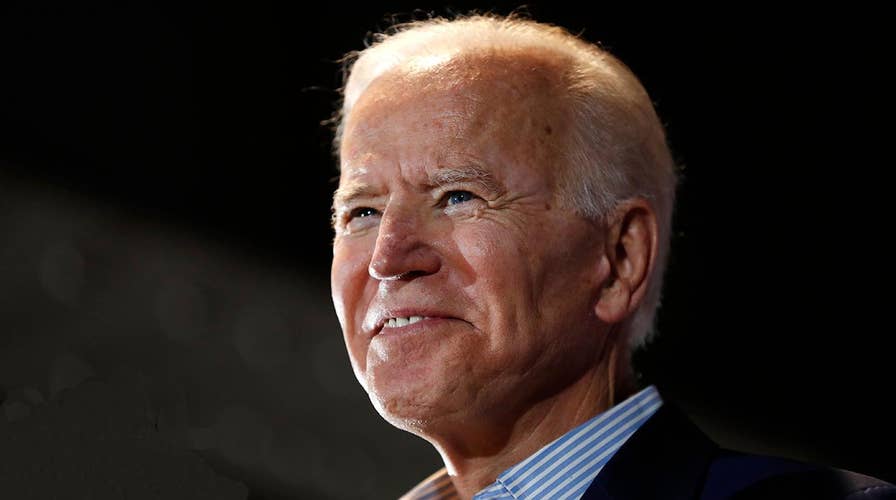
Joe Biden slams GOP tax cut during Iowa campaign rally
Reaction from RNC chairwoman Ronna McDaniel on 'Your World.'
This is a rush transcript from "Your World," April 30, 2019. This copy may not be in its final form and may be updated.
NEIL CAVUTO, HOST: It is coming to a head, my friends, violent clashes in Venezuela, as supporters of opposition leader Juan Guaido try to topple the Nicolas Maduro regime. Good luck with that. He's got the soldiers. They have got the fury.
Now U.S. National Security Adviser John Bolton says all options are on the table. What does that mean?
We will talk to Florida Republican Senator Rick Scott, who says maybe it's time for the U.S. military to get involved. We will talk to others who say, not so fast.
Welcome, everyone. I'm Neil Cavuto. Glad to be here.
Senator Scott in just a moment.
First to Rich Edson at the State Department with the very latest -- Rich.
RICH EDSON, CORRESPONDENT: Good afternoon, Neil.
And the State Department special representative for Venezuela, Elliott Abrams, says that the situation on the ground remains confused and that we have conflicting reports, this as, of course, the administration is hoping that this is the end of the Maduro regime and the beginning of it, where the military finally switches over -- or much of it does -- to push him from power, to support then Juan Guaido.
The national security adviser, John Bolton, just spoke at the White House and stressed the importance of this moment.
(BEGIN VIDEO CLIP)
JOHN BOLTON, NATIONAL SECURITY ADVISER: This has been building for a long time, that, if this effort fails, they will sink into a dictatorship from which there are very few possible alternatives. It's a very delicate moment.
(END VIDEO CLIP)
EDSON: Maduro's foreign minister has been responding to U.S. government officials throughout the day.
To Bolton's declaration that Maduro's time is up, he says, "Dream on, Ambassador Bolton, not today."
Abrams says there have been negotiations between Venezuelans both inside and outside of the Maduro regime. And the administration is hoping those inside the regime step up and move to support Juan Guaido.
Abrams also says the administration didn't expect these demonstrations today -- Neil.
CAVUTO: All right, Rich, thank you very much.
My next guest says that, you know, it could be time for U.S. military involvement in Venezuela, Florida Republican Senator Rick Scott.
Senator, good to have you.
Do you think that our presence there would make a difference?
SEN. RICK SCOTT, R-FLA..: Oh, absolutely.
I was down the Venezuelan border last Wednesday. This is just pure genocide. Maduro is killing his own citizen. You can see it today how many people are being killed. You can see the genocide going on through starvation.
I met moms lived on the street that had to walk hours to get food in Colombia, with schoolchildren coming, walking hours to go to school each day. So it's just pure genocide.
I think clearly we have got look at our military going and taking humanitarian aid in there to stop the death, stop the death just through starvation.
I'm hopeful that we will have a change in leadership today, Juan Guaido will be recognized inside Venezuela as the leader, like he is worldwide right now. I hope Russia and China understand they are supporting a murderer, a thug, somebody that's committing genocide against poor little children.
That's exactly what -- that's what -- when President Putin and President Xi, what they're doing right now is they're supporting somebody that is killing little children. It's disgusting, what they're doing. So we have got to step up.
We have got to do everything we can to stop this genocide.
CAVUTO: Is it worth, however strongly you feel, sir, losing American men and women to do just that?
SCOTT: Neil, here's what's going to happen.
We are in the process. If we don't win today, we are going to have Syria in this hemisphere. Russia's there. China's there. Hezbollah is there. Iran is there. Cuba's there. We will have -- we will have -- we will have Syria in this hemisphere.
So we can either make sure something happens now, or we can deal with this for decades to come. And Syria is not -- and look at how many people lost their lives in Syria, and look at how much unrest it created in that entire area. That's exactly what's going to happen in South and Central America.
CAVUTO: All right. There are, I think, about 100 retired generals, colonels from Venezuela who are in Colombia right now.
Do you think that those folks working with the Colombians might be a better strategy for us?
SCOTT: Well, I think we have got to -- I think everybody's got to work with us.
It shouldn't just be the United States. Every democracy worldwide that understands that we have got to stop genocide needs to step up and be part of this. Do not -- Americans shouldn't be going and doing things, have to do things by themselves. All of us should be working together.
If we care about families, if we care about the human race, if we care about our fellow worldwide citizens, then we have got to step up and stop this genocide.
CAVUTO: What if they don't step up? Would you be open, Senator, to have us step up alone?
SCOTT: I think, look, the president did a good job in getting Juan Guaido recognized as the interim leader, and countries around the world stepped up.
I think we need to use all of our resources to get all these countries to be -- be supportive.
CAVUTO: Now, Senator, one of the other ideas, short of American intervention, has been an amnesty, if you will, for generals who are part of this regime, are sympathetic to this regime, that benefited mightily from that relationship, because while most of the population is starving and has no access to medical supplies, they certainly do, unlike even some of their lower-ranking soldiers.
Would you be open, in order for them to turn on the regime that has taken very good care of them, to provide protections and assurances that they wouldn't be punished if -- if they turn on Maduro?
SCOTT: We have a government in waiting with Juan Guaido. That's a decision for the National Assembly to make. That's an internal decision they should be making.
They have got to figure out what's going to make sure that Maduro steps aside and we stop the genocide. That's a decision for Juan Guaido and his government.
CAVUTO: All right, have you talked to the president about this?
SCOTT: I have been talking to the president all along. I talked to Ambassador Bolton this morning. I talked to the ambassador last week when I was in Colombia at the border. I talked to the president this weekend.
I have been -- I have been doing everything I can to make sure everybody understands what has happened -- has happened here. We have got genocide now. In the future, we're going to have Syria if we don't get this done.
CAVUTO: And was he sympathetic, that is, the president, to your arguments? When we heard the ambassador talking about all options are on the table, was it your understanding that that included American troops?
SCOTT: I think the president all along has understood that all options have to be on the table. And he's going to -- I believe the president will do everything that is necessary to make sure Maduro steps aside.
CAVUTO: Senator, thank you very much for taking the time.
SCOTT: Thank you.
CAVUTO: All right, to retired General Jack Keane on all of this.
General, you know combat. You know, as a four-star general yourself what it's like? Is this a struggle that warrants American intervention?
JACK KEANE, SENIOR STRATEGIC ANALYST: I don't think it warrants American intervention yet.
And I -- the president's policies of peaceful transition, there's still leverage here to achieve that. I mean, watching John Bolton, the national security adviser, today, I know him well, as we all do here at FOX. I mean, he was frustrated and disappointed.
It was stunning in his revelation and the fact that he was talking publicly to high government Venezuelan officials, who after weeks and months of coordination, had determined that, on this day, they were going to step up and turn against the Maduro regime, none other than the defense minister, chief justice of the Supreme Court, and the guy in charge of the regime guard force.
All of them are going to step up today, and for some reason, they didn't do that. And you heard...
CAVUTO: Why do you think that is?
KEANE: Well, you heard Ambassador Bolton say it's likely out of fear that they didn't, or they are fundamentally prohibited from doing it.
Now, why would they be prohibited? Let me tell you a couple of facts. Fact one, in January of this year, Putin deployed 400 members of a private military firm called the Wagner Group, same organization that we killed 200 of in Syria, and they have been involved in Crimea and also in Eastern Ukraine.
For what purpose? To provide personal security to Maduro. Last month, 100 of his advisers -- now, these are officers and technicians -- came into Venezuela. For what purpose? To provide advice for the security of the regime.
That means Putin has a direct link into what is happening every single day in Venezuela, and likely pulling leverages himself. And, of course, we all know there are 20,000 to 25,000 Cuban goons here who are the paramilitary force that are opposing the people, not the military.
I think we have got to let this play out. I think the administration clearly doesn't know all the facts in a volatile situation like this. But, clearly, also, Neil, the strategic stakes are high here. We have made a decision to push back on the authoritarian and communist regimes of Venezuela, socialist regime, Nicaragua, communist, Cuba, communist, change their strategic framework.
Russia, China and Iran are supporting them. Russia has intervened to prop up the Maduro regime, similar to the way they did to prop up the Assad regime. If this regime doesn't fall, Russia comes out with leverage. And the fact is, the United States' influence in a region would likely be diminished, as it was in Syria when we didn't take the proper action to do something about the regime there.
But we have more time here before we rush in with military force. And those who want to use military force, you have to remember one thing. It never usually ends the way it starts. There are some rare exceptions to that. And these things have a tendency to seek its own level.
So we have to act in concert with our allies in the region, and where they are in all of this. And I'm confident the administration is talking to them.
One day...
CAVUTO: Do you ever get the feeling, though, General, that they have laid a trap, that is, the Maduro government laid a trap, let them think that there's going to be this sort of mass surrender on the part of generals to switch over to the Guaido camp, when in fact they were laying a trap to maybe seize the protesters, seize Guaido himself, and perform their own permanent takeover to this solution?
KEANE: You should be in government, Neil.
CAVUTO: I'm very cynical. That's a very cynical view, isn't it?
KEANE: Yes.
No, I mean, it's a possibility. I don't think so, because the people doing the coordination, this took weeks and months to get these three top officials to the position that they're at and provide them some assurances. I don't think that kind of conspiracy was operating. I'm just speculating.
CAVUTO: But we have given all these assurances, right, as well safe passage out of the country for Maduro. I think one of the countries mentioned was the Philippines, maybe another similar climate environment, to his generals, mass amnesty to all of them whatever monies they have stolen or taken advantage of the people.
None of that seemed to work. So we're past that stage, I would guess.
KEANE: Well, and the reason for that is, is that, one, they're all making a lot of money.
CAVUTO: Right.
KEANE: And they're financially probably independently wealthy. They want to be able to get out with all of that if they do.
They don't like the alternative. And they see in front of them still some daylight in terms of their ability to stay in power.
CAVUTO: Right.
KEANE: Much as we have seen others do the same thing in Iran, certainly, in Syria, obviously.
But the fact is, there's a lot of pressure here, and it's going to play itself out. One day of protest usually doesn't create a regime change, although I will admit, with those three officials, if they had turned against the regime, it probably would have been a catalyst to move on, to Maduro to move on.
CAVUTO: Yes, and that catalyst does not seem in evidence right now.
Thank you, my friend, very, very much, the general on these developments.
Real quickly, what's at heart here is the generals and the high-ranking military leaders are so far with Maduro. Lower-ranking soldiers, who don't have the same access to the food and then some of the other benefits that these generals enjoy, they have sworn that they wouldn't shoot protesters or shoot their own people.
The generals have not made such a commitment. Be that as it may, this is a test of wills here on the part of the military itself, divided among the top ranks still loyal, maybe out of fear, maybe out of a host of other monetary reasons, to stay with Maduro, and the lower-ranking soldiers who are saying, we are sick of this.
We shall see.
If this was rattling the markets, it had a funny way of showing it in Latin America and an even funnier way of showing it at the corner of Wall and Broad that capped another good month for the major markets, the Dow finishing higher today, the S&P 500 closing at an all-time high.
Just in case you're tracking, the Dow, the Nasdaq S&P 500 finishing with strong gains, the S&P 500 up about 4 percent on the month, the Nasdaq leading the way with a surge of about 5 percent.
Earnings, by the way, have been driving a lot of this. They have been coming in better than expected, 77 percent beating estimates, only 18 percent missing, about 5 percent matching. More than half have beaten the revenue estimates, the forward guidance that shows momentum, and that's something we follow very, very closely.
In other words, what these guys are saying is, the good times should continue. We shall see.
Meanwhile, forget Thursday's hearing, a fierce clash already erupting between the House Judiciary chairman, Jerry Nadler, and the attorney general of the United States over the format of a hearing, if it ever comes to happen -- after this.
(COMMERCIAL BREAK)
CAVUTO: All right, first Herman Cain, now Stephen Moore.
We're learning from our White House reporter on FOX Business Network, Blake Burman, that opposition has apparently been building to Steve Moore's nomination.
An aide to Senator Joni Ernst is confirming that Ernst told reporters she's unlikely -- unlikely -- to support Moore. He can only really afford to lose three Republicans. If four are opposed, and assuming all Democrats vote against him, he's toast. We will keep you posted.
Meanwhile, New York Democrat House Judiciary Chairman Jerry Nadler putting Attorney General William Barr on notice, show up for our hearing, or I'm going to subpoena you.
With us now, Georgia Republican ranking member of that House Judiciary Committee, Doug Collins.
What do you think of that? Do you think that the attorney general should appear before that committee? Should there be ground rules? What?
REP. DOUG COLLINS, R-GA: I think it's amazing to me that my chairman can take on a hearing in which the attorney general voluntarily says he will come and talk about the Mueller report or anything else that my -- that the Democrats or Republicans want to ask him.
And my chairman has found a way to sabotage that. He's found a way to make it into a political sideshow, in which he wants it to appear as an impeachment inquiry, an impeachment hearing, when they don't have the fortitude to actually bring an impeachment inquiry.
It's just a sad day, Neil, when we can't have a simple hearing of oversight.
CAVUTO: I just want to understand, though, first things, Congressman.
The attorney general had already agreed that he would come to testify, right?
COLLINS: Yes.
CAVUTO: So do we know what changed and what got this sort of thing at loggerheads?
COLLINS: We do.
Really, what happened, if you want to go back a little bit, about a week or so ago, the Mueller report came out, and it didn't have anything in there that they wanted. They didn't get collusion. They didn't get charged obstruction.
So now the Democrats are just upset. And their base is demanding that they impeach. So the way that you show impeachment without really doing impeachment is, you have staff ask questions.
Now, I'm not sure why the Democrats believe the staff can ask better questions than their members. The chairman doesn't seem to have a lot of confidence in his membership.
But I believe that their members are fully capable of answering (sic) questions. But what they want is the visual. They want the visual of a staff attorney asking the attorney general questions, like they did in the Clinton impeachment and the Nixon impeachment hearings.
And they say there's precedent for this. And there is in impeachment proceedings, but not when it's just simply an oversight hearing in which the attorney general voluntarily chose to come.
CAVUTO: All right, so, when the chairman is saying that he's not pursuing impeachment, he just wants to hear these guys out, you don't believe that?
COLLINS: No, I think it's a visual here.
I think the visual is, is they want their base to appear that they're going down this impeachment inquiry. And they're wanting it to make it seem like it is. It's just simply a game of mirrors.
They have no agenda that they have put on the floor. They have no agenda they have worked on in the committee. All they have an agenda is, is trying to defeat the president next year.
And this is just the sad game of this. Tomorrow, the Senate is going to have Bill Barr appear and answer any questions they ask. Unfortunately, our side in the House, the Democrats have decided to make a game show of it. And this is again sad, but we will have the popcorn ready for the theatrics.
CAVUTO: All right, but part of the theatrics might include the White House, right, so far rejecting subpoenas and saying he doesn't think that they should have to testify.
Now, I don't know if there been any updates on that. But does that risk making this a bigger crisis than it need be, if he just says, look, the report is out, leave it at that, done?
COLLINS: Well, this is not what the attorney general is saying.
The attorney general is saying, I will ask (sic) any question that the member of Congress have for me to ask (sic). And they will ask anything and he will sit even for whatever time that is required.
CAVUTO: No, but I'm talking about the president rejecting or saying the subpoenas are going to be ignored in that case.
COLLINS: Well, I think the president is very frustrated.
And also I think that some of the subpoenas that we need to look at is it, does it actually have to do with bona fide congressional oversight, or is it simply an overreach by committees who are desperate to get back at the president?
I think those are the questions that need to be asked. Real oversight always needs to happen. But when you're overreaching, and you're going past the things that you don't already have or already will know, then that's a problem that needs to be addressed.
And I think the president is simply fighting back. And we will see where it goes with that. But I think this president has made it very clear he wants to have an agenda for America, and not be simply pushed around by subpoenas and other things that are not -- are tangent to what we're doing.
CAVUTO: Congressman, thank you for taking the time. We appreciate it.
COLLINS: It's always good to see you, Neil. Take care.
CAVUTO: All right, here's one thing that Democrats and Republicans agree on, infrastructure spending, even the actual amount spent, $2 trillion.
Here's where they don't, how they come up with that.
(COMMERCIAL BREAK)
CAVUTO: This is coming into us live from Caracas, Venezuela, where protests have been continuing all day.
This was the day we were told that Nicolas Maduro was going to be forced out of the presidential palace, that Juan Guaido had enough support even from some of the top ranking generals who had heretofore been loyal to Maduro. They didn't break from Maduro, though, and that has complicated this protest that has oftentimes turned violent today, with soldiers turning tear gas and sometimes shooting at those protesters.
Now, the soldiers are apparently in a bit of a conundrum of their own, because they don't want to shoot on their fellow Venezuelans. And that divides the high-ranking generals and top colonels with the rest of the so- called rank and file in the military, who don't enjoy the same benefits and economic securities and access to food and medicines that their high- ranking officers do.
So that is the problem there. And that could complicate things for Juan Guaido, who has asked for international support. And even though he has overwhelming international sympathetic support, and even though he has Governor Rick Scott of Florida among those advocating a U.S. military role here to help him out and to help him seize that presidential palace to which he was, according to Senator Scott, duly elected, but right now it goes on and on and on.
I want to get a read from all of this from South Carolina Democrat House Majority Whip Jim Clyburn.
Congressman, thank you for joining us.
REP. JAMES CLYBURN, D-S.C.: Well, thank you.
CAVUTO: I do want to talk to you about other things, sir, but I would be remiss if I didn't mention what's going on in Venezuela.
CLYBURN: Yes.
CAVUTO: Are you in the camp that says we have to help them out, even if it involves military help?
CLYBURN: No, I'm not.
I think that we have them out. I would hope that we would try to do what we can to influence the government down there to do right by its people and hopefully find folks down there to align ourselves with.
But I am not interested in any kind of police action at this moment. That may change later, but not now.
CAVUTO: OK.
Let me switch, because we can back and forth on this. Senator Rick Scott, your colleague in the Senate, was talking about the fact that we don't want another Russia or Iran essentially setting up base in Latin America. You don't buy that that's a real possibility, right?
CLYBURN: Well, I don't know if that's a possibility or not. I don't think it is.
But irrespective of what it may be, I'm not for police action using armed military force at this juncture.
CAVUTO: I would like to switch to infrastructure, Congressman.
The president is open to it. Democratic leaders and yourself included, open to it, have been for some time. The $2 trillion price tag, that was eye-popping, but both sides seemed to wrap their arms about it.
The question is, how?
CLYBURN: Yes.
CAVUTO: Do you believe that a federal gas tax, a hike in the federal gas tax is warranted?
CLYBURN: Not at this point.
Look, I think that every time we start talking about infrastructure, people start talking about roads and bridges, and immediately go to gas tax. To me, infrastructure is a much broader issue than that.
We got to look at water and sewage. We got to look at deepening our harbors. Now there's -- the harbors maintenance fund is there. We ought to start spending that money to deepen these harbors and repair the ports around the country.
Then I think we got to look at broadband deployment. To me, we're not going to be able to adequately educate our children or to have effective health care delivery if we don't have broadband.
And, to me, that's the biggest infrastructure issue that is on my mind at this particular juncture.
(CROSSTALK)
CAVUTO: So, you're arguing -- now, the one idea that paid for it is -- and it is broader than -- as you stated, to the point that it was broadband, water and energy, schools, housing, a host of other things.
But that part of the way to pay for it would be for a hike in gas the tax. But some of your colleagues, sir, have been saying that would be damaging to poorer individuals.
So they want to see -- I think it was Chuck Schumer was saying, maybe the president has to give back some of the tax cut he gave to corporations to justify a hike in the gas tax to pay for this.
What do you think?
CLYBURN: Well, it would seem to me that we ought to look at the impact of this thing, anything that we do, will have on low-income communities. That's the pet peeve of mine.
Every time I look around, we're talking about we're going to have an infrastructure bill, we are going to have a transportation bill, we are going to raise the gasoline tax to do so. Then we put together this big public transit stuff and spend all the money on subways.
I don't know what my farming community down in Jasper County or Hampton County paying for people to ride subways. If they are going to pay for infrastructure that will bring broadband to their schools and their hospitals and their homes, then they may not mind paying a gasoline tax.
But we got to see whether or not these communities are going to benefit from the pay-for, or we ought not do it at all. I'm a big proponent of an infrastructure bank. I have been talking about that since I first ran for Congress in 1992.
We can put together an infrastructure bank that will allow us to pay for these big-ticket items, amortize them over a period of 10, 15, 20 years, and do it the same way we do it for our mortgages when we buy homes.
So I think this can be done. And I would hope that we won't just rush to crushing low-income people, rural communities, in order to make things comfortable for those of us who live elsewhere.
CAVUTO: Finally, Congressman, I would be remiss if I didn't mention what's happening with this House Judiciary Committee and other hearings looking into the Mueller report.
Many of your colleagues have been saying there's enough there to proceed with impeachment proceedings. The president is very angered by all the present and past staff members who've been subpoenaed to testify. He doesn't think they're justified. He is compelled to ignore them. Your thoughts?
CLYBURN: Well, what I think is, Mueller -- the Mueller report was a road map.
Now, he said in the report that there are some barriers erected in his way. There are some roadblocks that prevented him from going the route he wanted to travel.
He then implied and even expressed, in some instances, that Congress is the proper vehicle to travel the rest of the distance.
CAVUTO: All right.
CLYBURN: So, if Congress is that vehicle, we ought to do what is necessary to let our committees do the work that needs to be done to fulfill the Mueller report.
CAVUTO: Congressman, thank you. Good seeing you again.
CLYBURN: Thank you.
CAVUTO: All right, we have a lot more coming up after this, including Joe Biden leading a packed Democratic field, but not by a little bit. What if I told you a lot? Should the president be worried?
After this.
(COMMERCIAL BREAK)
CAVUTO: No bail, that's a ruling moments ago by a judge in California for the 19-year-old accused of opening fire at a synagogue on Saturday, killing one woman, the suspect pleading not guilty.
We're back in 60 seconds.
(COMMERCIAL BREAK)
(BEGIN VIDEO CLIP)
JOSEPH BIDEN, D-PRESIDENTIAL CANDIDATE: We have to deal with that god- awful tax cut the president...
(CHEERING AND APPLAUSE)
BIDEN: By the way, you all did really well on that, right? You all really saw things go.
Look, folks...
(END VIDEO CLIP)
CAVUTO: All right, I'm just going to take a leap here that the vice president, Joe Biden, the former vice president, wasn't a fan of the tax cuts.
He leads the presidential field right now. And he's making it and its apparent failure, in his eyes, a signature issue, among many. Recent polls showing that he leads the crowded 2020 field by quite a bit right now. That could change, but, for now, is he the one the administration should be worried about?
RNC Chairwoman Ronna McDaniel.
We did -- excuse me -- call her Democratic counterpart, Tom Perez. He was unavailable.
All right, Ronna, very good to have you.
It's interesting, because the fact is that -- and I just deal in facts here -- most Americans did, in fact, get a tax cut. What is interesting about it, though, is, most Americans don't feel they did. And that's what's kind of wacky, right?
I don't know whether it's a case of people who don't see their checks because they're automatically deposited or they just wrote it off as not as big as they wanted, even though they got a cut. Does it worry you that a signature issue could turn on Republicans?
RONNA MCDANIEL, CHAIR, REPUBLICAN NATIONAL COMMITTEE: Well, you also have other indicators where most Americans feel that the country's doing well economically. Consumer confidence is up.
So, people overall recognize that our economy is booming. We just had the 3.2 percent GDP. We know wages are up. We know jobs are coming back. So, all of those things together show the American people that President Trump's policies have worked. Deregulation, better trade deals and cutting taxes have created a much better economy.
And we get to contrast that with the Biden-Obama economy, where wages were stagnant, where our GDP was minuscule, and jobs were fleeing our country. So it's a pretty clear way to balance what the Trump administration has done vs. the Obama-Biden administration.
And, clearly, the Trump administration is working for the American people.
CAVUTO: Well, it's not as if the other guys weren't, right?
I mean, and I think you will have to accept the fact that Barack Obama inherited an economy in a freefall. I'm not taking sides here. But it's fair to say... MCDANIEL: Yes, but it was the slowest recovery -- slowest recovery from a recession in history. And wages were stagnant.
CAVUTO: But it was also the worst postwar recession we had.
So, I guess what I'm saying is, when the president keeps taking a bow for the depression and the mess he inherited, do you think the hyperbole is a bit much there, a bit nervy?
MCDANIEL: No, I think the president has every right to take credit for what's happened.
And it's come through policies, deregulating industry, so that people can get more income to start small businesses, cutting the corporate tax rate, so companies can invest more and create more jobs. I mean, these are things that are directly because of policies enacted by President Trump.
Obama did the opposite. They increased regulation. They increased taxes. That's why our economy didn't grow as quickly after that recession.
So, it's very clear.
CAVUTO: Well, you're quite right, Ronna, to talk about the fact that wage growth has been picking up. It's now in the latest period running at about a 3.3 percent clip, very, very good.
That's a volatile number. It was averaging about 2.8 percent, 2.9 percent under the eight years of Barack Obama, when all was said and done.
But do you think that it hurts his message when he talks about the Federal Reserve holding him back or blames someone else for holding him back, and blames other people for other things that aren't going right, that, for some reason, the number -- the numbers and the economy and the markets, you are quite right, speak for themselves.
Why can't he leave it at that, without pointing a finger that I did better than this guy, this guy was a disaster, or the Federal Reserve stopped me, and I could have done a lot better without them? It just gets kind of like a pile, doesn't it?
MCDANIEL: Listen, Donald Trump was a businessman who ran for office because he said Washington can't get it done -- get it done.
The bureaucracy and the slow nature of Washington is preventing our economy from growing. And he came in with very succinct goals, cut taxes, cut regulation and make better trade deals. And we have seen, as a result, our economy pick up steam.
I think he does deserve to take credit. And I think he's somebody who speaks his mind. That's why he was elected.
CAVUTO: But can't they both take credit? Can't they both take credit?
A 10-year-plus long bull market. I agree with you. A lot of his policies have done just the trick, as you said. But why can't this 10-year-plus bull market be both on the president's doorstep and his president's -- his prior president's doorstep?
MCDANIEL: Well, why can't anybody from the Obama administration or Joe Biden or any Democrat say, you know what, President Trump was correct?
He has kick-started this economy. You know what they're proposing? They're saying, let's take government -- take -- government take over our health care. Let's have government take over our schools. I mean, it's more of a government takeover and a lot of policies that will slow and stagnate this economy.
CAVUTO: Do Republicans have a health care plan yet?
MCDANIEL: Republicans are putting forward a health care plan. The president's talked about this.
(CROSSTALK)
CAVUTO: When is that going to happen? Because I don't see it.
MCDANIEL: I'm not a policy-maker, but I will say this.
We want to make sure that the doctor-patient relationship is restored. We do not want bureaucrats in Washington making medical decisions for families across this country.
CAVUTO: No, Ronna, I understand it. Those are meritorious goals.
But if you're going to criticize your predecessor and say that his plan sucked or whatever you're saying, and you don't have a plan, and you don't have a plan to...
(CROSSTALK)
CAVUTO: But you don't have a plan to substitute it, and you're always slapping him around.
(CROSSTALK)
MCDANIEL: No. Let me take -- let's go back.
We had Graham-Cassidy. Democrats didn't vote it, where you block-grant the money back to the states. You have the states craft plans specific to their uninsured. It restores the doctor-patient relationship.
And it's much better for the health care system and provides better care for the patient. Absolutely we put a plan forward. Democrats at every step have rejected Republicans' plan.
So, you can't put that on us.
CAVUTO: So, when the president was saying that we're going to have a health care plan put forward and Republicans are looking forward, and Republicans were surprised that he was talking that up at a time that's an issue that could be very vulnerable on, are you saying that we're going to have a health care plan out like really, really soon?
Because you don't right now.
MCDANIEL: I'm not -- I'm not crafting the plan.
But I will say, we're going to contrast with the Democrats what Medicare for all means, which sounds great, great, Medicare for all. What does it mean? A total government takeover. It means bureaucrats in Washington are going to be making your Medicare decisions. And the cost will be astronomical. And it will destroy the absolute -- the underlying health care in this country.
CAVUTO: All right.
MCDANIEL: So, yes, we're going to contrast that.
CAVUTO: Finally, last question then on deficits.
The president keeps mentioning them and that President Obama kept building up debt and all the like. He is running it up at a faster pace. I'm not saying he exclusively, obviously, but does he feel bad about that or that he's not been able, and that is, Republicans, when they had the run of the table, have not been able to deal with that?
Because Republicans are attacking Democrats for being spendthrifts, when, in fact, at the rate we're going, this president's going to top that.
MCDANIEL: Well, let's remember the Democrats control the House, and we never had a full majority in the Senate and 60 votes to pass budgets. So we had to work with Democrats.
And that's the way that this government has functioned. But, absolutely, the president is fiscally conscious. And he's recognized that we need to grow this economy if we're going to pay off our debt.
CAVUTO: He was furious at a budget that the House foisted on him that had -- was over a trillion dollars, that would later contribute to trillion- dollar deficits, but he signed off on it, right?
MCDANIEL: Because the president recognizes we have to pay for our defense, and we have other things we have to get done.
And the only way he can do that is with Democrat votes. So I think Democrats need to be more fiscally responsible as well.
CAVUTO: And what about Republicans?
MCDANIEL: I think we all need to recognize that we have a deficit and a debt problem. But as long as we're working with Democrats...
CAVUTO: I haven't seen a one who does. I haven't seen a one who gives a rat's you know what about it.
(LAUGHTER)
MCDANIEL: Yes, we have, because we have grown this economy, Neil, and that's taking care of it too. By growing up economy, by growing the GDP, we are dealing with deficit and debt problems.
CAVUTO: All right, because I just see trillion-dollar deficits for years to come, but maybe you're looking at different numbers, right?
OK, Ronna, thank you very, very much.
Apple is soaring after the bell, maybe to Ronna's point, with better-than- expected earnings and revenues.
We will have more after this.
(COMMERCIAL BREAK)
CAVUTO: All right, the debt is a problem.
I'm obsessed with it because I think, under Republicans and Democrats, it just gets bigger and bigger.
I'm not the only one. The former Microsoft CEO, the current L.A. Clippers owner and the founder of USAFacts, Steve Ballmer, with us.
Steve, it doesn't come close to getting solved, no matter who's in charge. And it worries me a lot.
What about you?
STEVE BALLMER, USAFACTS FOUNDER: It worries me a lot too.
When we set out to build this USAFacts product, we wanted to present the numbers, but I will cop to the fact that, as a former businessmen, a current businessmen, it just doesn't make sense to me how, long term, expenses can exceed revenue.
And this year, last reported year, last year, we were up to almost $750 billion of debt -- deficit, rather, per year. That's a big number, Neil. That's a big number, even by government standards. CAVUTO: And it's not sustainable, right? I mean, for companies, of course, you keep going that route, well, you're not around very long.
But I know you just try to put it in English and in terms people can understand of where the money's going and where it's not going. But all I do know is that the red gets deeper and deeper and deeper, and I don't see willingness on the part of either party to address that.
BALLMER: No, I agree with that.
No matter whatever your politics, if this is the issue for you, both the D's and the R's have found ways to increase deficit. And I think it -- to me, it's a very important issue. There are other also very important issues.
But the way this one will get solved will take real deep collaboration both on how to improve taxes and revenue and how to manage expenses. I don't see any other way there. But, again, our organization, USAFacts, we don't make forecasts.
CAVUTO: Right.
BALLMER: But if you look at the historical data, it is alarming.
And if you look at where we spend money as a country, 86 percent of government money goes into just eight areas, just eight areas. Education, most people don't want to cut. Crime in and disaster, most people don't want to cut. The military, we have cut the number of active war fighters by about 35 percent in the last 15 years, which some people may want to cut further.
We spend on Social Security. We spend on Medicare, where there's generally been resistance. We spend on Medicaid and aid to the disadvantaged, and we spend on government pensions and debt.
That's 86 percent. You throw in transportation, you're at 90 percent. And you say, where do people have the will to make cuts? And where do people have the will to increase taxes? We also run through in our report just how much of the tax burden is borne by the top 1 percent, by income, the top 20 and so on down to the bottom 20 percent.
You just have to look and say, where are we going to get any more money and where are we going to cut expenses? And it will take a set of hard decisions.
If you ground the discussion in the numbers, which we try to give you the basis for that with our USAFacts offerings -- today, we're releasing our annual report, trying to make it simple to understand spend in America. For people who are more business-oriented, we got this big old fat 10K, like businesses produce?
(LAUGHTER)
CAVUTO: Yes.
BALLMER: But whether you look at any of that or not, acquainting yourself with those numbers -- I heard about this $2 trillion infrastructure package today.
CAVUTO: Yes.
BALLMER: Well, as a country, we only spend just over $200 billion a year. Are we talking about doubling that spend for the next 10 years? Is that what the proposal is going to be.
CAVUTO: And then where is the money going to come from, and what's being said for this? Yes.
BALLMER: Where is the money -- and what it's going to buy us?
CAVUTO: It is what it is.
(CROSSTALK)
CAVUTO: Yes.
BALLMER: I mean, we show you the numbers. How good are our bridges? The truth is, they have been improving every year.
CAVUTO: All right.
BALLMER: Our highways are getting a little worse. Who knows.
CAVUTO: Who knows is right.
Steve Ballmer, I'm sorry for the truncated nature of this, all the breaking news out of Venezuela and elsewhere.
But, as he pointed out, this isn't a red or blue issue. It's green, it's your money, and you're losing it fast.
(COMMERCIAL BREAK)
CAVUTO: All right, the violence continuing, although I must say contained violence.
The worst suspicions have not materialized yet, but it is still a mess down there, two men competing for the honor of being recognized as the country's president. The guy holed up in the president's palace right now, Nicolas Maduro, he isn't going anywhere.
Juan Guaido, the guy that says he's the duly elected, and recognized by most of the world as the duly elected constitutional president, he's nowhere closer to seeing that dream fulfilled.
Former Assistant Secretary of State Robert Charles on all of this.
Secretary, We Had Senator Rick Scott here earlier saying American military needs to come to the rescue here. How do you feel about that?
ROBERT CHARLES, FORMER ASSISTANT SECRETARY OF STATE: I think the average American watching this should take a deep breath, but also understand that this is a very important moment for the hemisphere.
This is a people's movement. This is not a coup. This is not a putsch. This is the result of people being absolutely distressed by the fact that they can't make a living, they can't feed themselves or their children.
In terms of who's down there and what to do next, you have foreign actors down there. We have Russian advisers down there. That's very problematic. We have Chinese in there. And we also have Iranians in there, all of which says that others are trying to get a foothold here to create essentially Cuba version two.
And we're not going to let that happen. To the point of military, what we know is that our allies are well aware that we are prepared to support them and they are prepared to support us. We know, I think -- the foreign actors down there and Maduro need to know that our intelligence is very good.
We have -- I have no doubt that we know exactly where the senior generals are and where he is. And if this thing were to get out of control, and there would be a massacre of some kind, I think we would respond as a humanitarian act, even if that involved military personnel.
CAVUTO: What would we do? What should we do? Even then, some are afraid that it would become an out-of-control insurrection for us to handle and that we can't do it alone.
CHARLES: Yes.
So, this is not a surprise event, in the sense that Venezuela has been coming apart for several years, actually for probably a decade. We have contingency plans, I am sure, for the lowest-level engagement to the highest-level engagement. And my guess is, we have had very close conversations with our allies.
One thing that just to remember is, this is economy -- an economy in freefall, 1,300,000 percent inflation.
CAVUTO: That's right. That's right.
CHARLES: And so we're...
CAVUTO: All right.
CHARLES: These people have a right to a change.
CAVUTO: All right, you're absolutely right. Sorry to jump on you, sir. Thank you for your service to this country as well.
CHARLES: Sure.
CAVUTO: The secretary touched on something thing that we always forget.
This was once one of the richest countries on Earth on a per capita basis. It had natural resources, had plenty of oil.
They pissed it all away, all of it, making promises, cradle-to-grave promises for everyone in the country that it would be there forever, until it wasn't. And there we be now.
Content and Programming Copyright 2019 Fox News Network, LLC. ALL RIGHTS RESERVED. Copyright 2019 ASC Services II Media, LLC. All materials herein are protected by United States copyright law and may not be reproduced, distributed, transmitted, displayed, published or broadcast without the prior written permission of ASC Services II Media, LLC. You may not alter or remove any trademark, copyright or other notice from copies of the content.
