




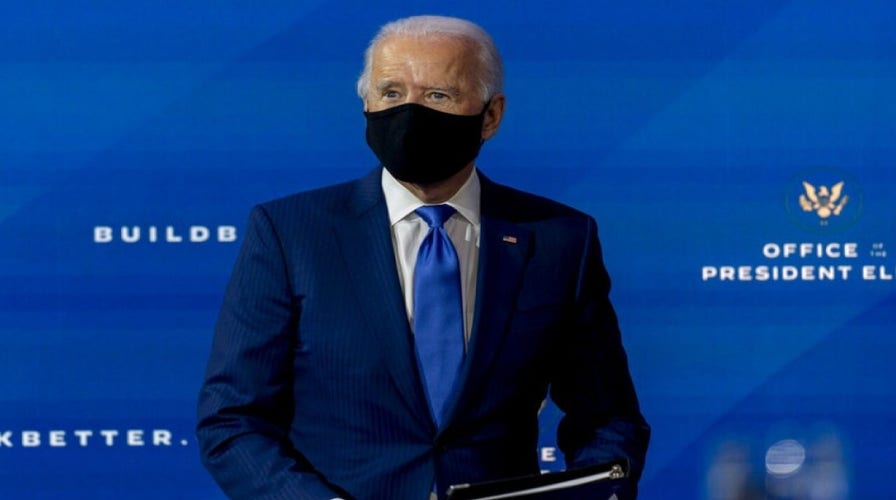
Joe Biden responds to Hunter Biden allegations: 'I'm proud of my son'
Fox News correspondent Peter Doocy has the latest from Wilmington, Del. on 'Your World'
This is a rush transcript from "Your World with Neil Cavuto" December 11, 2020. This copy may not be in its final form and may be updated.
NEIL CAVUTO, FOX NEWS ANCHOR: Sorry, we are closed. In New York and in
Baltimore, that, today or by Monday, will be the rule of thumb for indoor
dining, in the case of Baltimore, for both indoor and outdoor dining,
amidst a spike in cases. That affects things immediately in Baltimore.
In New York, it's going to be indoor dining in the New York metropolitan
area, effective Monday. How long all of this could go on, anyone's guess,
but it comes at a time, ironically, vaccines are on the way, but so are
spikes in cases.
What to make of all of this in a fast-moving news day, where we're looking
at the hope of a vaccine that could be out in Americans' hands and arms on
Monday morning, well, juxtaposed against a spike in cases that has a lot of
folks worrying whether we're going to be hanging around, these shutdowns,
lockdowns, restaurant delays, and much more in the weeks and months to
come.
Let's go to David Lee Miller in New York City on how far this goes -- David
Lee.
DAVID LEE MILLER, FOX NEWS CORRESPONDENT: Neil, New York Governor Andrew
Cuomo says his decision to halt all indoor dining in this city is because
of an increase in the number of infections, rate of transmission as well,
as a surge in the number of hospitalizations.
He says the density also of the city's populations makes eating indoors at
restaurants, in his words now -- quote -- "too risky."
Restaurants in the city, which was once the epicenter of the pandemic,
reopened two months ago. Capacity was limited to 25 percent. As of Monday,
they're going to be restricted to offering only outdoor dining or takeaway.
According to state statistics, based on tracing data, restaurants are the
fifth highest cause of COVID spread.
The governor called on Washington to provide financial help for the
struggling industry.
(BEGIN VIDEO CLIP)
GOV. ANDREW CUOMO (D-NY): I believe the federal government should include
subsidies for bars and restaurants in their relief package.
Today, we will extend the commercial eviction moratorium, so a landlord
can't evict a commercial enterprise because they haven't paid the rent.
(END VIDEO CLIP)
MILLER: An industry trade group, the New York City Hospital Hospitality
Alliance, called the governor's decision -- quote -- "the last straw" for
countless restaurants and drugs.
The group says restaurants in the city have taken precautions to keep
customers, as well as employees safe. One local restaurant owner said the
forced shutdown is bad for the overall economy.
(BEGIN VIDEO CLIP)
TINA MARIA OPPEDISANO, OWNER, IL BACCO: It's becoming to the point where
it's really hurting people. You take in the five boroughs -- there's 24,000
restaurants within the five boroughs. They employ close to 320,000 people.
And look what it's doing to all of them right now right before the
holidays, when they need the money the most.
(END VIDEO CLIP)
MILLER: Now, New York City is not alone in halting indoor dining. A similar
ban is going to take effect tomorrow in Pennsylvania.
And in a little less than one hour, Neil, Baltimore is going to put a halt
to all indoor, as well as outdoor dining, as the virus continues to surge -
- Neil.
CAVUTO: Just incredible.
All right, David Lee, thank you very, very much.
Two restaurant owners in New York who are worried about what's going to
happen to them and how long could this drag on, and we need this, yes, like
a hole in the head.
Amanda Cohen joins us right now, owns a great restaurant in downtown New
York. It's called Dirt Candy, a very, very well-regarded French concern,
French restaurant. Tommy Greco, K Rico Steakhouse on Ninth Avenue in New
York City.
Good to have both of you with us. And appreciate that.
Amanda, to you first.
What do you do?
AMANDA COHEN, OWNER, DIRT CANDY: I don't know what we do.
I don't know what we have doing for the last couple months. Having indoor
dining, we actually didn't do at Dirt Candy. But, from what I can tell, it
wasn't that great of a scene here anyways. It was a little bit of extra
money.
We need financial help from the federal government. That's the only thing
that is going to save us; 25 percent indoor dining, that's not going to
save the restaurant industry. We need government aid. We need them to pass
the RESTAURANTS Act.
CAVUTO: All right, don't hold your breath for that. They're having some
trouble on that.
But, Tommy, let me ask you.
I mean, your steakhouse, I mean, you can -- obviously, you will have
delivery and all of that and pickup. But I got imagine that's tough when it
comes to trying to do that with steak, right? I mean, so what do you do?
TOMMY GRECO, OWNER, THE RITZ BAR AND LOUNGE: Yes, steak -- in my genre of
the steakhouse, fine dining, that I am, you can't deliver porterhouses and
tomahawks.
CAVUTO: Right.
GRECO: And folks right now who are tight with money aren't ordering that.
They're ordering more fast, casual, inexpensive stuff. And it's difficult.
It's difficult for us. I mean, to allow us just to have outdoor dining,
with the weather coming up being in the 30s, with possible snow and all
that, who's going to sit outside?
CAVUTO: Yes.
GRECO: Why would you do that? I wouldn't even want my customers...
CAVUTO: I thought the same thing. It's freezing out. It's freezing out.
So, let me get your thinking on this, Amanda. You talked a little bit about
the hope for some help out of Washington. I'm sure, Tom, you're looking for
the same kind of thing. They're having a devil of a time coming up with
some sort of a package regarding COVID-19 relief, increasingly looking more
unlikely every day.
If you don't get that, and if this drags on weeks, Amanda, then what?
COHEN: Then I close. Then every restaurant starts to close,
I have been open for 12 years. Eight months ago, I was making $10,000,
$12,000 a night. It was enough to cover my costs. I have a successful
restaurant. Now I'm making $500 a night, maybe $2,000 on a really good one.
I can't cover any of my costs anymore. I have nothing left in my bank
account. So, just like every single other restaurant out there, I will
close. I will put my employees on unemployment. The jobs will disappear
permanently. And I also will be out of a job, and probably bankrupt.
CAVUTO: Oh, my goodness.
Tommy, the rationale behind these shutdowns from the governor of New York
and some of his counterparts, places like California and Maryland, some of
these other places, is that the spikes do happen at restaurants, even
though the data is a little inconsistent on it.
But you're doing everything from distancing and all the other provisions,
both you and Amanda. And you have -- have you had any reported cases that
have come from your restaurant?
GRECO: No, we have had no reported cases come from our restaurant, OK?
And just like Amanda said, we're not even making money. We're just going
through the motions here. And what he said today was 74 of these -- percent
of these cases come from in-home gatherings, with only 1.4 percent coming
from restaurants.
CAVUTO: Right. Right.
GRECO: So, if you close the restaurants, you're forcing people to do more
in-home gatherings. It makes no sense.
CAVUTO: You know what's weird about it, Amanda? All of this is happening as
we're preparing to see a vaccine maybe out as soon as Monday, another one
that could come out maybe as soon as next Thursday or Friday.
So, in the middle of all this hopeful news, you're shutting down. It's
weird.
COHEN: Yes, it's hopeful news with a side of really distressing news.
We still need help.
CAVUTO: Yes.
COHEN: The vaccine, by the time everybody gets vaccinated or we have enough
herd immunity, it's going to be a couple months down the road at least. We
need help now.
CAVUTO: Hang in there, guys. We will see what's happening. We will watch
it. We will get an update on that.
But I'm very familiar. This might strike you as odd that I am familiar with
both your restaurants. I know I don't look like a restaurant visitor,
because I'm so thin and fit.
(LAUGHTER)
CAVUTO: But I actually am. And in both of your cases, I'm a big fan.
But, listen, guys, hang in there. I'm sure better days are ahead. But, man,
it does seem like you have been unfairly targeted here. But we will watch
it closely. And we have got your back.
We have also got the latest, to both of these fine managers' interest here,
what's happening on the vaccine front, its ready availability come Monday,
then deciding who gets it and when, but not only who gets it and when, but
how it gets to you, period. It's a little tricky.
We will explain.
(COMMERCIAL BREAK)
CAVUTO: Teasing, but not quite done.
The official write-off from the Food and Drug Administration on that Pfizer
COVID-19 vaccine could come any moment.
Mark Meredith in Silver Spring, Maryland, with what happens after that.
Hey, Mark.
MARK MEREDITH, FOX NEWS CORRESPONDENT: Neil, good afternoon.
Will it be happening tonight or tomorrow? That is still the big question
when it comes to the FDA approving Pfizer's vaccine candidate.
Dr. Stephen Hahn is denying reports that his job was threatened over
whether or not it would get done today, but there are still a lot of
questions about what's been going on behind the scenes here at the FDA.
President Trump has been making it clear all day long he wants them to move
as fast as possible.
He had a very sharp tweet for the FDA this morning. He even called them a
big, old, slow turtle. And he also said that he wanted to get the damn
vaccines out now, stop playing games and start saving lives.
But, on Thursday, just 24 hours ago -- we were talking about this, Neil --
an FDA advisory committee approved Pfizer's vaccine. We're still waiting on
that final green light from the FDA for emergency authorization. Canada and
the U.K., they have already approved it for use.
And you may be wondering, what is the holdup? Well, we're getting an idea
from Dr. Hahn himself, who wrote: "The FDA is finalizing the necessary
documents to ensure that patients and providers have the information that
they need to make informed decisions and to safely administer the vaccine.
This is a critical part of what the agency does to promote and protect the
public health."
While they are still waiting to give that final green light, today, the FDA
told the CDC, as well as Operation Warp Speed, to essentially get ready, to
make sure that their vaccine distribution facilities and plans were ready
to go. All indications are that they are, and they are still waiting,
again, to get these injections started potentially as early as Monday is
what we're hearing from the Health and Human Services Department.
So, Monday looks like for the first vaccinations, but it's not going to be
going out to you and me, Neil, right away. Of course, it's going to be
going out to those first responders, those people on the front lines, and
then continue to roll out throughout early 2021 -- Neil.
CAVUTO: I hate to break it to you, Mark. You're so young. You're going to
be last in line for this. So, I hate -- I get yours. That's the point.
Mark Meredith, great seeing you again, my friend.
MEREDITH: Fair enough, boss.
(LAUGHTER)
CAVUTO: Great reporting on this as well.
MEREDITH: Good.
CAVUTO: All right, there you go.
Mike Tobin with us from Kalamazoo, Michigan, now.
Mike, so I understand they're all set up with the manufacturing to get this
out, but that's going to be a big project, isn't it?
MIKE TOBIN, FOX NEWS CORRESPONDENT: It'll be a huge project.
But if the approval of this emergency use authorization, if it goes through
on Friday, if it goes through on Saturday, they can start moving vaccines
out of this massive facility here in Kalamazoo, Michigan, as well as
another in Pleasant Prairie, Wisconsin, within 24 hours; 2.9 million doses
can move right away.
Half of the supply needs to stay here and stay here in cold storage,
because the Pfizer vaccine in particular requires a follow-up shot. A trial
showed one shot was 50 percent effective at fighting the virus. A second
shot proved 95 percent effective.
Now, Health and Human Services Secretary Alex Azar said if the EUA is
approved on the expected timeline, shots could start going into people's
arms as early as Monday or Tuesday. Other officials say the pandemic isn't
over, but at least there's a light at the end of the tunnel.
(BEGIN VIDEO CLIP)
ADM. BRETT GIROIR, U.S. ASSISTANT SECRETARY FOR HEALTH AND HUMAN SERVICES:
It means we can see the end of the pandemic. It's really in our sight, with
20 million people being able to be vaccinated in December, 30 million in
January, and another 50 million in February, just with the two vaccines we
know about now, Pfizer and Moderna, we know the end of the pandemic is in
sight.
But we still have a lot of work to do until most people can get vaccinated
and the pandemic goes away.
(END VIDEO CLIP)
TOBIN: Now, UPS and FedEx will be handling this very sophisticated super
cold supply -- or shipping chain that will get the vaccine out to its
points of use.
Once it's at the points of use, states will have control over who gets the
vaccine first. And, as you were talking a little bit with Mark Meredith,
the priority is going to go to -- be those health care workers and then at-
risk populations, like people in nursing homes, things along those lines --
Neil.
CAVUTO: Got it, Mike, thank you very much, Mike Tobin in Michigan on all of
that.
Want to go to Warner Thomas right now. Mr. Thomas is the Ochsner Health
CEO, one of the biggest in Louisiana, certainly largest nonprofit health
care company, on how they will go about getting this distributed to folks.
Mr. Thomas, thank you for taking the time here.
How do you go about getting this out to folks? Because it's one thing to
approve something. It's quite another to then get it out into people's,
well, I guess, in this case, arms. But how do you do it?
WARNER THOMAS, CEO, OCHSNER HEALTH: Well, Neil, thanks for letting me be
with you today.
We have been preparing for this for literally months, for this day that
hopefully is coming next week. We have five of the ultra-cold minus-80
freezers that are deployed across Louisiana. We have 26 of the minus-20
freezers deployed across Louisiana.
We anticipate, hopefully with the emergency authorization, to get 9,400
doses, approximately, on Monday. That's our anticipation. And we would
begin vaccinating our health care workers immediately upon receipt of the
vaccine.
So we have been working on this plan for some time. And we are ready even
today, should it come today. But we're certainly ready Monday, should the
approval be done, and we receive vaccine on Monday.
CAVUTO: Apparently, Mr. Thomas, there's enormous pressure on the FDA to get
this out, and, in fact, to do so and give the green light today.
The Washington Post was reporting that the White House chief of staff, Mark
Meadows, told the FDA commissioner, Stephen Hahn, to submit his resignation
if the agency does not clear the nation's first coronavirus vaccine by
day's end.
Do you know anything about that? Or is that undue pressure? And, if true,
does that worry you?
THOMAS: Yes, I don't know a lot about that.
I think the important thing here is that this is done right, and that the
appropriate process is followed. I think, as we have heard from patients
and heard from our health care workers, I think folks want to make sure
there are no corners cut.
And I think the FDA, working in conjunction with the White House and with
the administration, I know they're going to get this right and do it
appropriately. Once that's done, we're ready to take the vaccine and
vaccinate folks.
So, I think everybody wants to make sure this is done appropriately. We do
know that there's a certain percentage of the population that is worried
about getting the vaccine because they feel like maybe this has been done
too quickly.
CAVUTO: Right.
THOMAS: But, once again, I think the appropriate process is being followed,
and that's what we all want to see.
CAVUTO: You do raise a good point.
I guess the questions first started last week, right, when the United
Kingdom approved it for their -- for their citizens. I believe Bahrain came
after them and Canada a couple of days ago, and that we're still waiting
for FDA.
Do you trust, then, that the FDA is being very careful, that it's certainly
not rushing, and that this report about pressure coming on the White House
to get it out, like, pronto, by the end of the day, is -- is unnecessary?
THOMAS: Yes, it's hard for me. I can't really comment whether that's
necessary or unnecessary.
What I would say is, we are confident the FDA is going through the right
process. Our physicians have reviewed all of the documentation from the FDA
and feel very confident about what they're seeing.
I think the fact that we need to get the right guidance on storage and any
other concerns about how we administer the vaccine is important. We were
part of the Pfizer trial, so we are very familiar with the ultra-cold
storage and how to handle that and how to do those vaccines.
CAVUTO: Right.
THOMAS: But, once again, I think making sure we can ensure the American
public that this is done right and all the processes are done appropriately
is very important.
CAVUTO: And you would honor -- obviously, you're everywhere, but you would
honor the protocols of whatever the governor is calling for, right?
I mean, there are wide protocols about those health care workers, those who
are in nursing homes, older, more vulnerable patients and the rest. That
seems to be the guidelines folks are getting, no matter where they live,
right?
THOMAS: Correct.
We're going to follow the CDC guidelines.
CAVUTO: Got it.
THOMAS: We have been in contact with the governor's office here in
Louisiana. We have identified our first wave as approximately 10,000 health
care workers. That would be in phase 1-A. And we have got those folks
identified.
We think we can vaccinate them, actually, within 10 days, that we can get
that group done. And, as we get the second shipment of vaccine, hopefully
in the second week, we will continue to vaccinate folks into 1-B.
But, once again, we will follow the CDC guidelines. We have had close
connections with the governor of Louisiana. He has done a great job in the
plans and the distribution of the vaccine. So, we are ready to go as soon
as we get approval.
CAVUTO: And, real quickly, the 10-day time target is for both doses, right,
the first dose, and then, some days later, the second dose, correct?
THOMAS: No, actually, there's a 21-day delay between the first dose and the
second dose.
CAVUTO: Oh.
THOMAS: The 10 days I'm talking about is that would be the period of time
it would take us to vaccinate the first 10,000 people.
CAVUTO: I understand.
THOMAS: We want to do this in a wave progression, just because we're
concerned there could be some side effects. And we don't want to vaccinate
all of our people in one or two days.
We're doing this over a few-day period of time. We have deployed the right
nurses and the right technicians to help us in this process. And we will be
doing this across all of our facilities in Louisiana.
CAVUTO: Understood. sir. Thank you for clarifying that for me, Warner
Thomas, the Ochsner Health CEO.
They're going to have a big responsibility here just getting it out to the
fine folks there who have been waiting for a long, long time.
By the way, again, sometime tonight, we just might get the official FDA
clearance, whether this Washington Post story is true or not as to whether
it's put undue pressure on the FDA commissioner to go ahead and get this
done tonight, or just submit his resignation.
Be that as it may, tomorrow, we will officially know one way or the other
if it's going to be now or it's going to wait until Monday; 10:00 a.m.
tomorrow, we will be on it, all over it.
In the meantime, all over Hunter Biden. His father commented on all of this
just minutes ago with our own Peter Doocy -- after this.
(COMMERCIAL BREAK)
CAVUTO: In the Big Apple, they have a big worry. What if there is no help
coming from Washington, no COVID-19 relief, $900 billion or otherwise? Then
what?
Restaurants shutting down, people firing up.
(COMMERCIAL BREAK)
CAVUTO: All right, you have heard all the stories about Hunter Biden,
Hunter Biden himself acknowledging that he is being investigated by the
Delaware Justice Department.
But it really has been a mystery as to how his dad felt about all that
until today.
Peter Doocy joining us now out of Wilmington -- Peter.
PETER DOOCY, FOX NEWS CORRESPONDENT: And reaction to this investigation was
not part of the president-elect's prepared remarks.
But as he was exiting the stage of the theater where he was holding an
event this afternoon, I did manage to get the first direct response of any
kind from the president-elect about this federal investigation into his
son's tax affairs.
(BEGIN VIDEO CLIP)
DOOCY: Did Hunter Biden commit a crime? Have you spoken to your son, Mr.
President-Elect?
JOE BIDEN (D), PRESIDENT-ELECT: I'm proud of my son.
(END VIDEO CLIP)
DOOCY: "I'm proud of my son," he said at the end.
The only other comment we had before that was attributable to the
transition team two nights ago. the transition team also hosted a briefing
via Zoom earlier today. The transition calls on correspondents at these
things where -- who say that they have a question.
They called on a handful of people today, but, notably, nobody asked about
Hunter Biden or this investigation. Questions instead came about the
vaccine and about diversity in the Cabinet, nothing concerning tax affairs
or Hunter Biden.
And that is now fair game because the taxpayer-funded transition team sent
out Hunter's statement on Wednesday night, even though Hunter Biden does
not work for the transition. The press pool that is traveling in the Biden
motorcade today reports back that, just two or three minutes ago, he exited
that theater to head home. He did not answer any other questions.
So, that one we just played is what we got for today -- Neil.
CAVUTO: Very impressive, Peter, that you got it out there, Peter Doocy in
Wilmington, Delaware.
Jim Trusty with us right now, the former federal prosecutor.
Where do you think this entire Hunter Biden thing is going?
JAMES TRUSTY, FORMER FEDERAL PROSECUTOR: Well, it's a good question. I
think there's -- it's very interesting that this information finally
surfaces because of the Bidens.
And I think that can bode one of two things. Number one is, they're getting
in front of an issue. They know that perhaps an indictment is coming in the
near future. And they wanted to kind of get out a trial balloon that says
it's something to do with taxes, a very euphemistic way to look at the
investigation.
The other thing that I think is an actual possible here -- I'm not saying
it's a probability -- but it's possible that there's a deal in the works,
that there's a tax case that will be filed as a guilty plea with Hunter
Biden that will have the effect of truncating all the other issues about
foreign money and other possible federal statutes.
So, you could see a real Biden Christmas present towards the end of the
year have a Hunter Biden plea, and this was a trial balloon to get everyone
ready for it. So, something's moving for them to be acknowledging it
publicly at this point. And it could be one of those two things.
CAVUTO: I'm way ahead of myself here. But could a President Biden pardon
his son?
TRUSTY: Sure.
I mean, we have had inter-family pardons before. There's always a political
calculation to that, right? How terrible does that look for a president to,
first day in office to say, by the way, I'm pardoning my son?
But it's available to a President Biden, if he felt the need to do it.
CAVUTO: In the meantime, we're also hearing, Jim, that Attorney General
Bill Barr was at least aware of all of this sort of percolating before the
election.
I'm sure that's not sitting well with the president, if true. Your
thoughts?
TRUSTY: Well, it's probably not. It wasn't politically helpful to have the
Hunter Biden's story completely quiet.
And the issue is more whether the press walked away from congressional
investigations than it is the Department of Justice. I mean, think about
it. Prosecutors are supposed to be ethical, and only announce their actions
through indictments, through court. They do their talking in court.
What the attorney general did, for all the criticism he gets from the left,
is, he knew there was an investigation, he knew there was one that could
have powerful political repercussions. But he did the right thing, as the
attorney general of the United States, which is to not dignify it, to not
talk about it until you get to a point where it's public, where -- by
natural course of events.
So, he's doing the right thing. Somehow, his critics have lost track of
that. But I understand, politically, it's a frustrating moment to know that
this is out there, and to not be able to use it. But that's why we have a -
- hopefully, an independent attorney general who knows his ethics.
CAVUTO: Independent or not, there's only another five or six weeks left of
this administration.
But we do know the president is still pretty angry at Mr. Barr over his
dismissing up some of the fraudulent and other claims about the election,
but that they wouldn't, even though they're real, some of them are real,
that wouldn't have tipped or -- tipped the election outcome.
What is the likelihood, and what would be the fallout if the president did
dismiss him?
TRUSTY: Well, if he dismissed the attorney general at this point, it might
be a very momentary thing, right?
I mean, if Trump doesn't pull out with this litigation, or if the state
legislatures don't find a way to inject different electors, then you're
only talking about a six-week period of an interim or an acting attorney
general, which normally would be the deputy attorney general.
So, again, I think that's a possibility here, but I don't think Barr has
actually earned it. I think he's done his job the right way, even though,
sometimes, it doesn't always benefit the president politically.
CAVUTO: I will flip it around then.
Talks are that Barr himself is a little just chagrined by all of this,
wants to quit. What if he resigned?
TRUSTY: Well, same thing. He has that option. He could certainly resign.
I don't know that it's anything more than a footnote in terms of his career
overall, but I would hope that he sticks it out and sticks around until
he's ready to leave of his own accord.
CAVUTO: Jim Trusty very good catching up with you, the former federal
prosecutor following these and other developments.
By the way, we were mentioning under Biden and whether that issue is going
to be an issue even in the run-off race going on in Georgia. The president-
elect will be heading -- heading down there. So what would the impact be if
this comes up? Will it come up? I guess it depends on the media.
(COMMERCIAL BREAK)
CAVUTO: All right, well, it is getting crowded down in Georgia, as a host
of who's-who players in both parties appear on behalf of the candidates
running there in that January 5 election, twin elections, really, that
could decide the future of the United States Senate right now.
Keep in mind the Democrats would have to take both seats from the incumbent
Republicans to gain control of the Senate.
President-elect Biden himself will be there next week.
Let's get the read from Susan Ferrechio -- Ferrechio, I should say -- of
The Washington Examiner. We have Francesca Chambers as well with McClatchy,
the White House correspondent there.
Susan, there are so many things swirling around as these visits are
planned. You have got the release of these vaccines or the imminent
release, seems like pretty soon, for what Pfizer has come up with, and then
the Moderna vaccine that could come out next week, reports just out that
it's a go. The administration has already agreed not to purchase 100
million doses of that Pfizer -- I'm sorry -- of the Moderna vaccine for
next week.
So it will be out there, and fast. How is that affecting, or will it affect
these Georgia races?
SUSAN FERRECHIO, THE WASHINGTON EXAMINER: If the Trump administration can
talk about the upcoming vaccines in terms of the success of his
administration, the success of the Republican Party, and if Republicans can
try to translate that into why (AUDIO GAP) hold on to those two Senate
seats.
It's really important to try to get that message out, because President
Trump has taken a lot of blame for the state of coronavirus right now in,
America fairly or not, unfairly or not. And the vaccine development was
under Operation Warp Speed, all or in part, for some of these vaccines that
were developed.
And the president, his credit has not been really awarded to him. It's all
been drowned out by this fight over the election and the belief that the
president was not given a fair shot on November 3. That's kind of drowned
out so much of this.
But for Republicans, if they can just try to drill home that message that
it was their party that pushed for the development of this vaccine and can
continue to help the country survive this pandemic and bounce back from it
in a healthy way, economically and physically, that's a plus for them right
now.
A lot of it's getting drowned out, though, by this dissatisfaction with the
election results by the president. I know Vice President Mike Pence has
campaigned there. I know Biden's going there next week. It's really kind of
an extension of the campaign season that just ended. They're still kind of
duking it out because of this unfinished situation.
(CROSSTALK)
CAVUTO: Yes. No, you're right. It could cut both -- it could cut both ways.
And, Francesca, to that point, and with the president visiting the state
himself last week, I'm just wondering whether he hurt himself, in that, if
you're going to quest to the legitimacy of the vote in Georgia, a lot of
people who are very loyal to him would say, well, I'm not going to vote in
this Senate election, because, obviously, it's a rigged game.
So could it boomerang on him?
FRANCESCA CHAMBERS, MCCLATCHY D.C.: Well, Neil is the issue that
Republicans are really struggling with in the state of Georgia right now.
The president himself in that rally said that, essentially, if you want to
get revenge -- that was his word -- revenge on Democrats in the state, then
you should come out and vote in the Senate elections.
And both sides believe that their presidential candidates from the 2020
presidential election are the ones who are really going to juice the vote
and the turnout in that state. You did see President Trump go down there.
Joe Biden will go down there next week.
And I'm told that Joe Biden will largely push the same message that he did
when he was running for president, which is that he will talk about unity
and his vision for the nation, and why he would need the help of those two
Democrats to complete that that are running for this election.
CAVUTO: Susan, the Hunter Biden issue might come up maybe during his stay
there. And I'm just wondering how that plays.
Given the scant coverage it's been getting, I'm wondering if it -- if he
even mentions it or even if he's asked about it. But what kind of impact do
you think it could have on that race?
FERRECHIO: Well, as you say, it doesn't get a lot of media coverage.
And Biden's not really getting asked about it directly because his handlers
don't allow it. And I don't think he's going to bring it up. I think that
the Biden -- incoming Biden administration wants this to just be -- to go
away, that it's coming out now before he sworn in office, and they're
hoping it just fades away. People are tired of hearing about it. People
don't make a big deal about it.
I don't think that Democrats are going to bring it up at a campaign rally,
certainly. And I don't know if anyone's ever going to really question the
administration about it either. And I blame the media for that. I know FOX
has been covering it, but it deserves as much attention as it would have
gotten had it been one of Trump's children or Trump's brother who was
wrapped up in this.
CAVUTO: Francesca, finally, in the closeness of the race, I mean, the issue
has come up, what other big guns come? I mean, you have had the president.
You will have the guy who is going to be the next president. You have had
Sarah Palin. You have had all these past and present party luminaries.
In the end, the polls still seem very, very tight. What will decide it?
What do you think is going to decide it?
CHAMBERS: Well, the fear from both sides is that the turnout that you saw
in the presidential election won't be repeated, Neil, in these run-off
elections.
While all of us nationally might be really focused on this, that, locally,
they are concerned that they just won't come out, because, in run-off
elections, that's typically been the case, so both sides really, really
really trying to get as many of their voters as they can out.
Democrats had told me that they were not as focused on bringing out some of
those big guns, like you just mentioned, but, certainly, they're not
turning down help from former President Obama, when he wants to give it to
them, whereas Republicans have been more focused on getting out some of
those people that you just named.
And Kelly Loeffler has been rallying senators to come out and support her,
as well as David Perdue.
CAVUTO: All right, we will watch very closely.
Ladies, be well and be safe this weekend and through the holidays. I
appreciate it, Susan and Francesca.
In the meantime, when it absolutely positively has to be there overnight --
I'm talking about a vaccine -- well, you can call FedEx, you can call UPS,
you can call all the major airlines and DHL, because that's what this comes
down to, once approved, getting it out, and fast.
You will not believe the Marshall-like plan to do just that with this
vaccine and the others to come -- after this.
(COMMERCIAL BREAK)
CAVUTO: All right, we are just getting worried right now that Oracle, the
big database software concern, is moving out of Silicon Valley for the
friendlier tax regulation confines of Texas.
We don't have much more than that, but it follows on the heels of Hewlett-
Packard Enterprises indicating that it is leaving San Jose, California, at
least as far as expanding operations, and to Houston, Texas. So this
continues a theme of companies that are opting out of a pricey Golden State
to see if they can find better confines. And Texas seems to be a popular
locale.
We will keep you posted, if we learn any more and the details of how many
will be going there and how it's going to be phased out and all that=.
In the meantime, getting ready right now for a vaccine and vaccines to
come. It's one thing when they release it. It's one thing when they go to
governors and say, all right, here's your allotment, but how do you get
that shipped out, and nationwide, worldwide?
Well, you call a lot of people who have planes and distribution systems
that can do just that.
Casey Stegall with more right now at Dallas/Fort Worth Airport -- Casey.
CASEY STEGALL, FOX NEWS CORRESPONDENT: Neil, you're right about that,
calling a whole lot of people, and this really is a partnership between the
federal government and private industry, because getting the vaccine from
point A to point B, frankly, is a very carefully choreographed and
rehearsed set of steps that have to go into motion.
And Pfizer says that, really, companies like UPS, DHL and FedEx will fly
the initial doses primarily to their designated airport hubs across the
country, and then, just like your holiday packages, only, a lot of people
could argue these are much more important, the precious cargo then loaded
on vehicles and taken to the awaiting point-of-care locations or the dosing
centers, then right into the first Americans' arms.
(BEGIN VIDEO CLIP)
JIM MAYER, UPS: We have informed all of our drivers across the country
what's in those boxes and how important it is. And so our goal is to have
100 percent accuracy in delivering those.
(END VIDEO CLIP)
STEGALL: Now, as if it couldn't be challenging enough, we have also talked
about some restrictions.
Pfizer's formula, it has to be kept, stored and transported at 96 degrees
Fahrenheit below zero. Large freezer units are farms like this one at the
FedEx headquarters in Tennessee will be used for that purpose. Specifically
engineered packaging has even had to be implemented. They're manufacturing
dry ice like crazy. They can't keep up.
Now, commercial airlines will eventually have a role in distributing some
of these vaccines. A couple of the carriers will help with Pfizer. However,
because of all of the dry ice and certain restrictions, because passengers
are also flying on those airplanes, they are under more scrutiny and
restrictions with the FAA.
So they won't be able to distribute as much of a vaccine as carriers like
UPS and FedEx and the others will play. However, commercial carriers will,
in fact, be hauling vaccines, especially down the line, when Moderna and
others released theirs, and if they get approved, because they have less
stringent requirements for storage and transportation.
An awful lot goes into this, Neil.
CAVUTO: You're not kidding.
The more people are talking about this, man, this is like a huge operation.
STEGALL: It's huge.
CAVUTO: It's like a D-Day for a big drug. All right, thank you very much,
my friend, Casey Stegall.
Meanwhile, taking a look at what's going on in Washington right now and the
plight of stimulus and COVID-19 relief, despite the vaccine emergency, or -
- what if it doesn't happen, though? Not the vaccine. That's happening. I'm
talking about the stimulus. I'm talking about the relief.
Then what?
(COMMERCIAL BREAK)
CAVUTO: All right, don't hold your breath for that COVID-19 relief package.
Right now, it's looking dicey, or, at the very least, delayed, very
delayed.
Chad Pergram, where do we stand with this?
CHAD PERGRAM, FOX NEWS CONGRESSIONAL CORRESPONDENT: (AUDIO GAP) government
shutdown in the middle of a pandemic, and that won't happen, as the Senate
approved a one-week spending plan today.
But, because there's no deal and COVID assistance, Vermont Senator Bernie
Sanders threatened to blow up the bill. He wanted to add $1,200 direct
payment checks to the spending plan. Listen.
(BEGIN VIDEO CLIP)
SEN. BERNIE SANDERS (I-VT): But, this, I want to say right now. I am
prepared to withdraw my objection at this moment. But I will not be
prepared to withdraw an objection next week.
(END VIDEO CLIP)
PERGRAM: Sanders said, if there wasn't a deal for direct payments, senators
should be prepared to spend Christmas in Washington. COVID aid talks are in
shambles.
(BEGIN VIDEO CLIP)
SEN. MITCH MCCONNELL (R-KY): If my friends actually oppose PPP funding,
vaccine distribution money or extending some expiring unemployment aid,
let's hear why.
(END VIDEO CLIP)
PERGRAM: So, the government is funded for now. But there will be increasing
pressure next week to fund the government again at this time and get a
COVID deal just before Christmas -- Neil.
CAVUTO: Chad, thank you very, very much.
Want to go to my buddy Charles Payne, a star on FOX Business Network.
Charles, I just opened the show today with two restaurant owners who are
under a world of hurt right now. They have to shut down on Monday because
of these spikes in cases, even though they didn't contribute to that.
We're seeing the same thing going on in California, Michigan and elsewhere.
They need help, and they're not getting it from Washington anytime soon.
But what do you -- what do you make of this?
CHARLES PAYNE, FOX NEWS ANCHOR: It's devastating, Neil.
It's hard to understand. And it's one of these things where it's coming
from everywhere, right? These folks out there saying, does anyone see our
plight while they play these games?
On the local level, I also had a restauranteur on my show today. And she
was saying that the COVID cases, from what they have seen, from the
science, which we're all being told the U.S. as our guiding -- our guiding
star in all of this, less than 2 percent.
And a lot of that's from fast-food chains. And that's from the employees
who work there, not the diners themselves. So, the science behind it, the
panicky feel to it all, they're dropping. They're dropping.
On Monday, the National Restaurant Association came out and said, you have
got 500,000 restaurants of every kind that are right now in an economic
freefall. And this just makes it happen a lot quicker.
Of course, if they have got a bridge to get through these sort of, in many
cases, arbitrary lockdowns or restrictions, then that's one thing. But that
money was poorly distributed. It was -- it was -- by the way, it worked,
OK? I'm not saying it didn't work.
But we have got a chance to use it again. And I don't understand why
Congress -- pox on both houses -- just won't get this together and get it
out there.
CAVUTO: Yes, I mean, the owner of this French restaurant in New York City
was telling me, if this goes on for three weeks, that's it. I'm out. My
business is done. It's not just a matter of limping along. I'm finished.
And there are a lot of people like that.
PAYNE: Yes, 110,000 restaurants so far, 17 percent of the industry in this
country, already have already met that fate.
And the thing is, once they're gone, they're gone. They don't come back.
Maybe after a year or two, someone will fill that void, but they're gone,
their employees are gone. And that's why this need for another round of
fiscal stimulus is so important, because we have seen a magnificent,
amazing, even inspirational rebound.
It shows you the American spirit.
CAVUTO: Absolutely.
PAYNE: We saw the administration come in, do this quickly. Hats off to
everyone who was involved.
But the same sense of urgency is still there.
CAVUTO: You're absolutely right.
Charles Payne, thank you very much, my friend.
In the meantime, we are going to be following a lot more of this tomorrow
about how far and big this impact gets to be.
We will also follow up on that report I was telling you about that Oracle
is moving from Silicon Valley to Austin, Texas, tomorrow at 10:00 a.m., the
phenomenon that's real. All over it for two hours.
Content and Programming Copyright 2020 Fox News Network, LLC. ALL
RIGHTS RESERVED. Copyright 2020 ASC Services II Media, LLC. All materials
herein are protected by United States copyright law and may not be
reproduced, distributed, transmitted, displayed, published or broadcast
without the prior written permission of ASC Services II Media, LLC. You may
not alter or remove any trademark, copyright or other notice from copies of
the content.
