


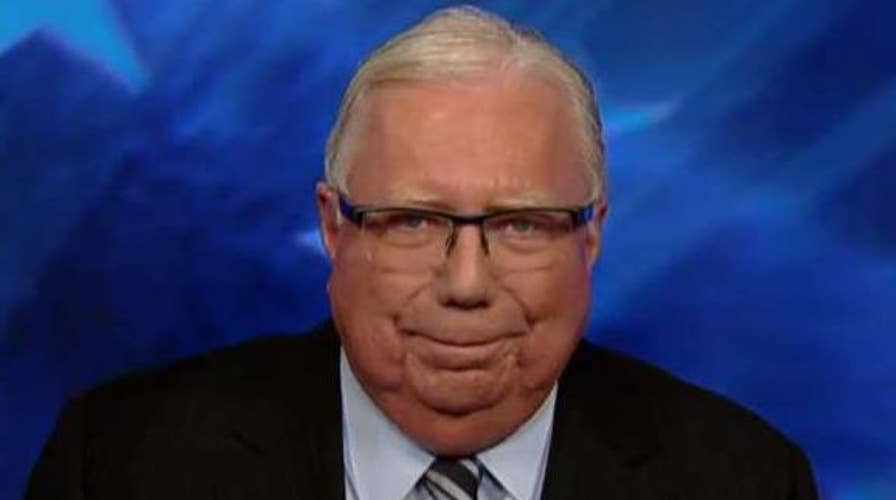
Corsi: I've had no contact with Assange
Jerome Corsi addresses charges against him in Mueller probe.
This is a rush transcript from "Tucker Carlson Tonight," November 27, 2018. This copy may not be in its final form and may be updated.
TUCKER CARLSON, HOST: Well good evening and welcome to "Tucker Carlson Tonight." As has become the rule lately, there are a couple of big stories unfolding simultaneously tonight. Big news in Mississippi, the polls have just closed in a key runoff election there. You'll get the results right here, maybe during this hour.
We'll also bring you the latest on the migrant Caravan and investigate the news coverage of that. Was it accurate now that the facts are in? We can assess that, and we will.
But first tonight, Robert Mueller's investigation. It was created, as you'll remember, to uncover collusion between American citizens and the government of Russia. Two years in, its main achievement, so far, are the financial destruction of several enemies of the political Left and the prosecuting of crimes that did not exist before the investigation was created.
Now in the latest, in the crosshairs of the Mueller investigation at the center of all this, he's refusing to go down meekly, Jerome Corsi. In just 60 seconds, he will join us to tell you about what he has gone through himself.
But first tonight, Trace Gallagher joins us with new information we just learned a short time ago. Trace?
TRACE GALLAGHER, FOX NEWS: Tucker, court documents now show that Jerome Corsi, a conservative author and associate of Trump confidant, Roger Stone, began speaking with Special Counsel prosecutors on September 6th this year where, of course, he was first questioned about, then shown an email in which Roger Stone asked him in July of 2016 to, "Get to Julian Assange at Ecuadorian Embassy in London and get the pending WikiLeaks emails."
Corsi claims he declined the request by Roger Stone, saying that any attempt to contact WikiLeaks could put them in investigators' crosshairs. But Robert Mueller's team believes Corsi lied. And instead of turning down Roger Stone's request, he personally passed it along to someone in London.
And eight days later on August 2nd, 2016, Corsi sent an email to Roger Stone saying WikiLeaks possessed information damaging to Hillary Clinton's campaign and plan to release it in October quoting again, "Time to let more than John Podesta to be exposed as in bed with enemy if they are not ready to drop Hillary Rodham Clinton. That appears to be the game hackers are now about."
WikiLeaks released John Podesta's hacked emails on October 7th, 2016 just hours after the Access Hollywood tape went public where Donald Trump bragged about groping women.
Special Counsel wants to know if there was coordination between Roger Stone and Julian Assange about when to release Podesta's damaging emails. Jerome Corsi says he did not have insider information. Instead, he did his homework, connected the dots and theorized that Assange had Podesta's emails.
And Roger Stone just told "Tucker Carlson Tonight," "None of the emails cited prove I had advance notice of the sources or content of either allegedly hacked or allegedly stolen emails published by WikiLeaks. When did political gossip become a criminal activity?"
Stone also says his friend Jerry Corsi is being harassed by Special Counsel not for lying but for refusing to lie.
Tucker.
CARLSON: Thanks a lot, Trace. Appreciate that.
GALLAGHER: Mm-hmm.
CARLSON: So, let's boil this down to its essence.
Jerome Corsi is 72 years old. He has a Ph.D. in political science from Harvard. He's written two New York Times bestsellers about politics. Jerome Corsi is the kind of person who could and probably should be happily retired by now.
Instead, as you just heard, he is facing potential felony charges from Robert Mueller. How did this happen?
Well, earlier this year, the Independent Counsel subpoenaed Corsi and seized his laptop and personal phone. They have all of his communications. They know exactly what he said and didn't say.
In September, Corsi was summoned to an interview with prosecutors. They asked him if he'd ever tried to broker a meeting with Julian Assange in London. Corsi responded no, "I didn't want anyone to see Assange."
So, the prosecutors left the room to confer after Corsi said that. They returned and informed Jerome Corsi that he had just committed a felony. On Corsi's laptop was an email chain from more than two years before in which he had been asked to contact Assange.
As you just heard, Corsi forwarded that email to somebody else. Nothing ever came of any of this. And again, the Independent Counsel would know because they have Corsi's laptop and phone.
They know that Corsi never left the United States and never spoke to Julian Assange. Corsi said he forgot all about forwarding the email. For the crime of forgetting that he forwarded that email, he is facing bankruptcy and imprisonment.
So, ask yourself this question. How would any of us fare under this standard? How would Robert Mueller fare under the same standard he set up for Jerome Corsi? Robert Mueller is 74 years old. What if the next Special Prosecutor seized his personal computer and interrogated him about every email he'd ever sent or forwarded going back years?
He probably would be able to remember some of it. But all of it, to the letter? Keep in mind, the slightest mistake would mean prison time. Would that be justice or would it be its opposite? Jerome Corsi would know firsthand and he joins us tonight.
Mr. Corsi, thank you very much for coming on.
JEROME CORSI, AMERICAN AUTHOR, POLITICAL COMMENTATOR, CONSPIRACY THEORIST: My pleasure, Tucker. Thank you.
CARLSON: So before - and you're not under oath, and so our viewers will have to assess the accuracy of what you say. But before we get to your interaction with the Mueller investigation, just the basics, have you ever had contact with Julian Assange?
CORSI: No. I - I've never met Julian Assange. I've never spoken with him. I've never emailed him. I've had no contact with Julian Assange whatsoever.
CARLSON: Have you ever had contact with Russian intelligence or subverted - knowingly subverted the interests of your own country?
CORSI: Absolutely not. I've been a loyal American. I have no contacts with Russian intelligence. I have no business interest in Russia. I have nothing to do with Russia. I've never been to Russia.
CARLSON: So, tell me if I summarized what happened to you accurately. The Special Counsel's office--
CORSI: Yes.
CARLSON: --gets ahold of your personal computer and your phone. They've got all the records, all the data, and they start asking you about things they already know, and they ask you have you ever tried to broker a meeting with Assange, you don't remember forwarding this email, they come back and say, "Bingo, you just committed a felony." Is that--
CORSI: Well it's--
CARLSON: --what happened?
CORSI: --even worse. First of all, I offered, I gave my computer to the Special Counsel. I gave them my cell phone. I gave them all my email accounts. I gave them everything they wanted, my Twitter accounts, my - I signed permission and handed all this over.
Now, on the first day, when I was interviewed, I didn't remember that email. Now, the Special Counsel came in and blew up and they actually sent me home and gave me an opportunity to review the emails. When I came back, I amended the testimony to say that I now remember the email.
CARLSON: Right.
CORSI: And Special Counsel was happy with that until I couldn't give them what they wanted, which was a connection that I had with Assange that they assumed I had, which I didn't have.
Now suddenly, they forgot they allowed me to amend my testimony, and they're going back to the mistake I made, day one, when I forgot the email. So, it's really, I think, completely fraudulent the charge that they were trying to get me to plead to and I refused to plead to a lie.
CARLSON: Well so I - but I'm a little confused here. So they have - is there anything that you withheld for them? You say you gave them access--
CORSI: Nothing.
CARLSON: --to all--
CORSI: Everything.
CARLSON: --of your communications, so if you'd had direct contact with Julian Assange or with someone else who would had contact with Assange, they would already know that, wouldn't they?
CORSI: I would think so. I mean I gave them everything voluntarily. I had a time machine on that computer, which recorded everything precisely and kept it in the time machine back through 2015.
I - the computer broke in 2018. But I gave them. I kept it. They have - I voluntarily gave them the 17-inch Apple laptop and the time machine. I gave them my cellphone. I signed over permission for all of my emails, gave them the usernames and passwords.
I allowed them to see my Twitter. I even helped Quantico download my Twitter and my Google accounts. I signed over Verizon accounts, everything they wanted. I had nothing to hide. I gave them to him immediately.
And for having forgotten on day one because I hadn't reviewed the emails, this particular email about Ted Malloch, I'm now being charged with willfully and knowingly giving false information, which is - which is nonsense.
I never willingly and falsely gave false information. I intended always to tell the truth. My memory was not perfect.
CARLSON: Right. And, let me just say that if you deleted emails presumably, the Special Counsel would have the ability to retrieve those emails. So, they would know, I think, what your communications were.
I've read accounts in the press, I read one in the Washington Monthly, a Liberal magazine, saying that you deserve to go to prison because you've expressed views that they don't like. Do you think that your political views are playing a role in the decision of the Special Counsel to charge you with a felony?
CORSI: Yes, I think, and also, by the way, they accused me of deleting emails. And I told them to restore. They restored the emails, I supposedly- -
CARLSON: Yes.
CORSI: --deleted through the time machine. This is a political witch-hunt. Because I did not have a contact with Assange but yet had figured out that Assange had Podesta's emails and I figured that out and told Roger Stone and told many people in August and it just happened that I was right.
Well the Prosecutor said, "Dr. Corsi, we're not going to believe that on your 25th Wedding Anniversary day (ph) to Italy with your wife and family, you had divine inspiration and God told you Podesta had Assange's emails."
Well, I said, I don't know if you want to (ph) put it that crassly but I did figure it out and I connect the dots. And this time, I happened to. You're right. You just won't believe that I figured it out.
CARLSON: So - so quickly, because I can't resist asking because I think the human cost is worth knowing about. What does this cost you?
CORSI: Oh, it's a - it's going to be just to get started, a couple hundred thousand dollars. I mean it - it bankrupts you very quickly.
And - and the special prosecutors blow you up. They do this, what I call, perjury trap. It's really, you know, they ask you a question. They have material they won't show you. You've forgotten about it. They say, you just lied because this email you forgot about in 2016--
CARLSON: Yes.
CORSI: --proves your current memory is wrong. I mean it's a memory test. And--
CARLSON: It's disgusting.
CORSI: --and then they accuse you of lying. It's completely rigged and it's politically driven by Clinton operatives--
CARLSON: Yes.
CORSI: --who have an agenda. And if you can't give them, Roger's right, if you can't give them what they're looking for to fill their narrative, they blow you up and charge you with a crime.
CARLSON: I think the public should see what's happening. And so, I'm grateful that you came on to explain. Thank you, Jerome Corsi.
CORSI: Thank you.
CARLSON: Well you've learned a lot of things on television recently about the migrant Caravan in the past month. How much of it wound up being true? We're going to compare what we know now that the facts are in against what we've been told for weeks and weeks?
Plus, the polls have just closed in Mississippi. There's a special Senate election there. We're monitoring it, and we'll have the results right here just ahead.
(COMMERCIAL BREAK)
CARLSON: Big news this weekend. The migrant Caravan actually exists. It's right across the U.S. border in Tijuana, Mexico, causing huge problems for that city.
That may be a surprise to you because you've been hearing for weeks and weeks that the Caravan wasn't real. And you'd have to be a Right-wing bigot to think it was. Then they told you it's so far away that it's irrelevant.
Well, then on Sunday, that irrelevant imaginary migrant Caravan attacked American Border guards. And that may surprise you more still because you were told the Caravan was entirely harmless. And again, if you believe otherwise, you're a bad person.
Well, soon, a news story, we don't know what it is, but we can be sure there is one, will come to dominate the headlines, and the migrant Caravan will be mostly forgotten. Even if the border crisis remains unresolved, the press, the public, likely, the President too will have moved on.
But we want to pause just for a moment before that happens that inevitably happens, and look back and consider how this story was handled by the press because we think it matters.
Now, the story evolved rapidly and the media's official story evolved just as rapidly. But were their descriptions about what was happening factually on the ground true? Tonight, we want to investigate that.
This is not a partisan question, by the way. It's about the future of the country. For a free society to function, the press doesn't have to be perfect, but it does have to be better than a propaganda outlet. Are they?
Let's break it down with Buck Sexton. He's a former CIA Analyst and host of the Buck Sexton Show, and he joins us tonight. Buck, thanks a lot for coming on. You've been following this really closely. You had really, I thought, incisive breakdown of the coverage. And so, I want to put these questions to you.
This is claim number one. The migrant Caravan, we were told, is mostly women and children who pose no threat to anybody, here's one example of that claim.
(BEGIN VIDEO CLIP)
STEPHANIE LEIGH RUHLE, NBC NEWS CORRESPONDENT, ANCHOR, MSNBC LIVE: All of this for a group of people, a lot of whom are mothers and children, who pose no imminent threat to the United States.
UNIDENTIFIED MALE: Many of these individuals are women and children.
(END VIDEO CLIP)
CARLSON: Oh, the talking point. You remember it. Was it true?
BUCK SEXTON, THE BUCK SEXTON SHOW HOST, FORMER CIA ANALYST: No. In fact, a vast majority of them are clearly, what (ph) we would have called in the agency, military-age males. These are guys mostly in their 20s and - and 30s.
And that was apparent, Tucker. I mean there are the - there are the misreporting that you could expect from people making an honest mistake. And then there's a lot of journalists gathered together because I've been talking to journalists all throughout this Caravan's progression, and there's just been this March of Lies.
There've been some people telling the truth. But only if you be (ph) there and you see, it's guys. This is mostly guys. There are some women and children there. But the focus on it is clearly dishonest.
CARLSON: Of course.
Claim number two, the Caravan, we were told again and again, is mostly comprised of genuine asylum seekers seeking refuge in the U.S.
(BEGIN VIDEO CLIP)
MARIA CARDONA, LATINOVATIONS FOUNDER, DEMOCRATIC STRATEGIST, CNN/CNN EN ESPANOL POLITICAL COMMENTATOR: These people are coming and asking for asylum. Guess what, Ben? It's in our laws that people are allowed to come to our borders and ask for asylum.
(END VIDEO CLIP)
CARLSON: Yes. It's our fault for not welcoming them because they're sincere asylum seekers. Is that true?
SEXTON: No. It's a scam. And people know it's a scam based on the percentage of individuals in the past who have come and tried to claim asylum in this way, and the fact that they're being coached to lie. This is actually a form of fraud.
When you say that I'm in imminent fear of my life because people along the way have said this is what you have to say to get into the asylum process, you can later be adjudicated, you're lying to people in a vast majority of these cases.
And, by the way, if just being from Honduras, for example, means you're in such sort of (ph) violence that you could get asylum then the whole country would qualify for asylum. So, this is a scam, and people realize that now. But the media was pretending all along that it is not.
CARLSON: That is such a good point. Why doesn't the whole country qualify for asylum? I'm sure we'll hear soon that it does.
Claim number three. There are no criminals in this Caravan.
(BEGIN VIDEO CLIP)
JORGE RAMOS, CHIEF NEWS ANCHOR, UNIVISION: I spent two days with the Caravan and I didn't see criminals or rapists or terrorists.
CHRISTOPHER CHARLES CUOMO, AMERICAN TELEVISION JOURNALIST, NEWS ANCHOR, CNN: Stop saying they're monsters. They're more mothers than monsters.
(END VIDEO CLIP)
CARLSON: How did the dumb people get on TV but they do. It - was that true? There are no criminals. There are more mothers than monsters.
SEXTON: An official statement yesterday from Immigration and Customs Enforcement says about 600 known criminals, by the way, so these are people that we are - we are sure have a criminal record, apart from trying to cross the border and perhaps throw some rocks at some federal agents.
And oh, by the way, I was (ph) speaking to a journalist early on in this, Tucker, said, pretty sure there are some criminals because there are a whole bunch of guys covered in MS-13 tattoos, which are very prominent, who are marching along with the Caravan too. So, this was known from the beginning but people chose to focus on other things.
CARLSON: Were they MS-13 mothers, not monsters or were they men?
SEXTON: I suppose that's possible. But certainly, the media was trying to find a way to avoid the fact that there were some bad folks among this whole crew.
CARLSON: They were lying.
Claim number four, and this comes from a former Commander-in-Chief. The Caravan doesn't matter, and you're a bad person for worrying about it, because it's very far away.
(BEGIN VIDEO CLIP)
BARACK OBAMA, FORMER PRESIDENT OF THE UNITED STATES: They're telling you, the - the existential threat to America is a bunch of poor refugees a 1,000 miles away.
This group of folks, we don't even know where they are and they're way down there.
(END VIDEO CLIP)
CARLSON: They're way down there. We don't even know where they are, Buck.
SEXTON: Buses and trains exist in Mexico, which I think journalists know, especially journalists who are in Mexico, reporting on this, but there was always this "Well, it's going to take them forever to march."
No. What they did is they, by the way, with some help, got on buses, trains, other modes of transportation, got through at (ph) the border. By the way, if they were actually refugees, as Obama says, they should claim refugee status in the first country they arrive in, where they are no longer under mortal threat.
Mexico has offered them asylum. They've said no, because they're not refugees. They are just people that want to get to the front of the line for immigration.
CARLSON: Such a great point. Jorge Ramos of Univision came on this program to present claim number five that the Caravan received no external support.
(BEGIN VIDEO CLIP)
RAMOS: I know that there are fake stories in - in the United States saying that these people were funded by George Soros and by Democrats or by Nicolas Maduro from Venezuela.
If they really finance these people, it was a scam. I've been talking to people here in - in Chiapas who don't have a single dollar, Tucker, to buy a bottle of water. So there - there's no financing here.
(END VIDEO CLIP)
CARLSON: No financing at all. And, by the way, you're immoral if you claim otherwise.
SEXTON: That's a lie. I've talked to journalists who are seeing people handing out food, gathering donations together, so they can buy food and equipment. When you got 6,000, 7,000 people together that's going to be a difficult logistical challenge, unless there are people who are there to provide support, and there clearly are people support - providing support.
So, again, if journalists wanted to know this stuff, Tucker, some of them do, but they just don't get as much air time in places like CNN and MSNBC, they could find out, but they don't want to know.
They just want to present people getting tear-gassed, mothers and children. If you don't like this, you're a monster. When the reality is, this is a massive scam. There's a lot of outside help. And there are laws that are being broken here.
CARLSON: And finally, we have the sixth claim that deploying troops to the border was wrong, but it was also completely unnecessary as The New York Times cartoonist put it, troops sign up to fight in an obscure country in the Middle East, not to guard their own country's border. Kamala Harris agreed with that.
(BEGIN VIDEO CLIP)
KAMALA DEVI HARRIS, JUNIOR UNITED STATES SENATOR, CALIFORNIA, DEMOCRATIC PARTY MEMBER, FORMER ATTORNEY GENERAL OF CALIFORNIA: It is inappropriate to require the limited resources of the United States military to be used in such a way.
All because there needed to be some demonstration for the TV cameras based on a political agenda instead of what is a national security threat.
(END VIDEO CLIP)
CARLSON: So, why aren't they in Syria where they belong?
SEXTON: Also, why can't Senator Harris call down to Border Patrol and say, or - or Immigration and Customs Enforcement for that matter, or - do you think it's helpful, because the answer is yes, because I've spoken to Border Patrol and they say that the logistical support that military was giving them was in fact very much needed, because this Caravan was arriving.
And there were real concerns that they will try to overrun the border which, Tucker, is exactly what they did do. So, we've just had this progression of lies all along the way. And, at every phase, it seems the media always gets it wrong in one direction and that is somehow we're exaggerating this threat, when in fact--
CARLSON: Right.
SEXTON: --we're under-estimating the reality of how big this problem is going to get.
CARLSON: A precise, fact-based summation, and we're grateful for it. Buck Sexton, thank you very much.
SEXTON: Good to see you, Tucker.
CARLSON: Even MSNBC has had to admit the Caravan isn't what the Left spent weeks portraying it as. Watch this admission.
(BEGIN VIDEO CLIP)
GADI SCHWARTZ, NBC NEWS CORRESPONDENT, STAY TUNED CO-HOST: The - the truth is the majority of the people that are part of this Caravan, especially outside, if we can make our way all the way over there, we'll show you, the majority of them are men.
From what we've seen, the majority are actually men, and some of these men have not articulated that need for asylum. Instead, they have talked about, you know, going to the United States for a better life and to find work.
(END VIDEO CLIP)
CARLSON: Enrique Acevedo is an Anchor at Univision, and a frequent and welcome guest on this show, and he joins us tonight. Enrique, thanks very much for coming on.
So, can - now that that it's here and the facts on the ground are undeniable, can we stop lying and admit what is obviously true? This Caravan is not primarily mothers with children. It's primarily men.
ENRIQUE ACEVEDO, UNIVISION ANCHOR, SPECIAL CORRESPONDENT, THE FUSION MEDIA GROUP: I find it interesting, Tucker, that you're criticizing journalists for presenting a partial view of the Caravan, while you're doing the exact same thing just from the--
CARLSON: No, no, no, no, I'm criticizing--
ACEVEDO: --opposite side of the ideological spectrum.
CARLSON: --them for lying--
ACEVEDO: The reality--
CARLSON: --for lying in concert--
ACEVEDO: --is that--
CARLSON: --for (ph) lying together as a group reading the same talking points from the Democratic National Committee office script in order to influence an election, which is what they were doing. That's what I'm accusing them of doing.
ACEVEDO: The - the Caravan is not a monolithic group, Tucker. It's 8,000 different stories, 8,000 different realities. And according to the government's own numbers, less than 10 percent, without any evidence, but according to those numbers, less than 10 percents have any criminal background.
So, you're talking about a group of 600, among more than 8,000 people, so 90 percent of them, the majority of them have a - a legitimate claim to request asylum. That's according to the--
CARLSON: No. But hold on, hold on, no wait, wait, wait, hold on--
ACEVEDO: --numbers your Secretary of Defense (ph)--
CARLSON: --for - for one - for one thing (ph)--
ACEVEDO: --presented (ph).
CARLSON: --I would say if 600 out of 8,000 are "Known criminals," that is a higher percentage than a cross-section of the American population. So, we're getting way more criminals per - per capita than we--
ACEVEDO: Yes. But they're not going to get in because--
CARLSON: --have already in this country.
ACEVEDO: --if they have a criminal background then--
CARLSON: So, so, but hold on, hold on--
ACEVEDO: --they won't be allowed in and their--
CARLSON: --just because - hold on that's not - that--
ACEVEDO: --asylum request will be denied. So--
CARLSON: --just as a factual matter, this is what - no but hold on--
ACEVEDO: --you don't have to worry about that. Let's talk now about the other 90 percent--
CARLSON: --this is what I'm talking about.
ACEVEDO: --and, you know, we can - we--
CARLSON: Hold on--
ACEVEDO: --right.
CARLSON: --this - just because you don't have a criminal record does not mean you're eligible for asylum. So, please address Buck Sexton's, I thought, very incisive point that if you are seeking asylum, you are, by definition, required to ask for it in the first safe country you reach, where you don't face a mortal threat--
ACEVEDO: Right.
CARLSON: --and that was Mexico where they were offered asylum--
ACEVEDO: Keyword - keyword being safe--
CARLSON: --but they didn't take it.
ACEVEDO: --not in country where thousands of people are being killed every year. Actually, more than, you know, 500,000 people have been killed in Mexico in the last decade or - or so. So, it's not a--
CARLSON: So--
ACEVEDO: --safe country.
CARLSON: --oh, so, so, so what - so - so that released (ph)--
ACEVEDO: I wouldn't let you (ph) characterize Mexico as that and (ph)--
CARLSON: --my second question - I knew you were going to say that. So, let me just ask you the follow-up--
ACEVEDO: --well--
CARLSON: --the logical follow-up--
ACEVEDO: Sure.
CARLSON: --which is if Mexico is so dangerous that you cannot seek asylum there because you're imperiled just by being in Mexico, then why isn't the entire population of Mexico eligible for asylum in the United States?
ACEVEDO: Well, this is the thing, Tucker. You see these immigrants, these Central American immigrants going across Mexico, they are victims of extortion, rape, they are victims of murder, and sometimes they're recruited by these criminal gangs. That's why, in part, they're now moving across Mexico in a large group because they know--
CARLSON: I'm sorry. I - I can't let you dodge the question.
ACEVEDO: --the strength and security lies in (ph)--
CARLSON: I understand. They - they want to come here.
ACEVEDO: --the numbers. So - so that - that--
CARLSON: It's a great country. I get it. I don't blame them. What I blame is the media, which has been lying relentlessly in an effort to convince Americans of things that aren't true. So, let me just ask you, let me pin you down here--
ACEVEDO: No, and that's - I think it's--
CARLSON: --you've said they can't accept--
ACEVEDO: --it's a fair criticism.
CARLSON: --they can't accept the offer of shelter. Mexico said, "We will shelter you. We'll give you asylum."
ACEVEDO: Sure. I think it's a--
CARLSON: They offered that. Good for Mexico.
ACEVEDO: --it's a fair criticism. We - we--
CARLSON: So, why--
ACEVEDO: --insist on, you know, putting this label on the Caravan and doing just, you know, again, training this debate (ph)--
CARLSON: --I just want you to answer (ph) one question.
ACEVEDO: --on absolutes. It's good--
CARLSON: If Mexico--
ACEVEDO: --it's bad. It's--
CARLSON: --hold on, why is the entire population of Mexico, since you said it's too dangerous to live in, why are they not all--
ACEVEDO: Right.
CARLSON: --eligible for asylum in the United States. Sincere question.
ACEVEDO: Well it - it's a complicated question but I'm happy to--
CARLSON: It's not complicated.
ACEVEDO: --answer it. It's there are around - there are around a more than a 130 million people in Mexico.
CARLSON: Right, I know.
ACEVEDO: And the violence is focused in mainly bordering - bordering states with the U.S. and in other parts of the country--
CARLSON: It's not true, actually.
ACEVEDO: --so not that a 130 million are in peril, but it is a dangerous country. And it is, you know, a country where violence--
CARLSON: How many Mexicans would you say are eligible for--
ACEVEDO: --have become increasingly huge (ph).
CARLSON: --but hold on, since it's so dangerous, how many Mexicans, just spitball it for me, are eligible under our Asylum laws to come to the United States--
ACEVEDO: Well, you should ask--
CARLSON: --and seek shelter?
ACEVEDO: --an Immigration Judge that question. And everyone should have the chance to present the case--
CARLSON: A lot. Everyone--
ACEVEDO: --in front of an Immigration Judge.
CARLSON: --everyone has a right to come here and get free stuff from us--
ACEVEDO: We can debate all we want. But they're the ones--
CARLSON: --everyone can do it (ph).
ACEVEDO: --who're going to judge the merits of an - of an - of a--
CARLSON: Yes.
ACEVEDO: --asylum claim. And - and just--
CARLSON: You know, when you abuse our generosity--
ACEVEDO: --to be clear, Tucker, I think--
CARLSON: --we become less generous, just so you know.
ACEVEDO: --it's important, again, to stop framing this debate in - in absolutes and to understand that there are nuances and there's context.
CARLSON: You're right. I'm not the one who's framing in absolutes.
ACEVEDO: There's not just one thing. It's not a monolithic group.
CARLSON: You're the one who told me it was all women with kids and strollers.
ACEVEDO: You know, according to--
CARLSON: You told me that. And that turned out--
ACEVEDO: --according to the, again--
CARLSON: --to be totally false.
ACEVEDO: --let's - let's - let's - let's go back to the numbers, the official numbers.
CARLSON: All right.
ACEVEDO: According to CBP--
CARLSON: All right.
ACEVEDO: --the majority of arrests today at the border are family units, so that's--
CARLSON: OK.
ACEVEDO: --women and children. That's not an interpretation.
CARLSON: But that doesn't mean the majority of--
ACEVEDO: That's a fact.
CARLSON: --that doesn't mean the majority in the Caravan were. Enrique, I hope you will come back. It is always a pleasure to talk to you. Thank you.
ACEVEDO: Thanks for having me.
CARLSON: Well polls have just closed in Mississippi. There was a special Senate election in the state today. It was supposed to be an easy win for the Republican. We'll find out if that actually happened.
Also, we just had a fascinating interview with the man currently at the center of the Mueller probe, the man facing felony charges. We'll have a reaction to that interview just ahead.
(COMMERCIAL BREAK)
CARLSON: We've got a Fox News Alert for you, as we often do. The runoff in the special Senate election in Mississippi is ongoing. The polls have just closed. What can we expect when the ballots are counted?
Lisa Boothe is a Senior Fellow at Independent Women's Voice. She's been with us throughout the 2018 election season, and she joins us again tonight for--
LISA BOOTHE, FOX NEWS CO-HOST, OUTNUMBERED, INDEPENDENT WOMEN'S VOICE SENIOR FELLOW: Hi, Tucker.
CARLSON: --an assessment of the Mississippi race. Lisa, thank you for coming on. So, it's a little weird even to be thinking about a race in Mississippi, a statewide because the results should be foregone, but they're not, apparently.
BOOTHE: They aren't. But I actually don't think it's going to end up being that competitive of a race, and I'll tell you why. The only reason why Cindy Hyde-Smith did not get over 50 percent on November 6 was because there was another Republican on the ballot, Chris McDaniel.
He got 16.5 percent of that Republican support. Chris McDaniel is not going to be on the ballot tonight. It is only going to be Cindy Hyde-Smith versus the Democrat Mike Espy. So, you can easily see how Cindy Smith - or Cindy Hyde-Smith, you know, is going to win the election.
And if you look at the collective share of the Republican vote on November 6th, it was around 58 percent compared to the collective share of the Democrat vote for around 42 percent. So, I - I think Cindy Hyde-Smith wins this tonight in pretty healthy margin.
CARLSON: To - to what extent do you think all the talk of this being a close election was hyped, really, from the beginning?
BOOTHE: I - I think it was hyped, to be honest. I - I think it was journalists projecting and hoping that it was going to be a tight election.
CARLSON: Yes.
BOOTHE: I don't think it's going to be, you know, maybe I'm wrong, but I - I really honestly think Cindy Hyde-Smith wins by a pretty sizable margin tonight.
CARLSON: Yes. We haven't covered it much because I kind of agree with that.
BOOTHE: Yes.
CARLSON: And but we'll find out soon.
BOOTHE: We'll - we'll see if we're right, Tucker, you know.
CARLSON: Lisa, thank you.
BOOTHE: Thanks.
CARLSON: We - we'll find out. Save the tape.
BOOTHE: Thank you.
CARLSON: Well, a Somali-American is being investigated for a possible hate crime after he allegedly tried to run over two men who were leaving a synagogue in Los Angeles.
Now, guns take the blame for mass violence most of the time. But as this latest attack shows, guns don't cause people to act violently. They can make it easier, but they're not the reason for violence. What is the reason, exactly?
Nicholas Giordano is a professor at Suffolk Community College and he joins us tonight. Professor, thank you very much for coming on. So--
NICHOLAS GIORDANO, PROFESSOR, SUFFOLK COUNTY COMMUNITY COLLEGE: Hi, Tucker.
CARLSON: --lost in the debate over gun control, which I think is interesting, we engage in it a lot on this show. It is worth having. But it doesn't address what's actually happening. Why are people doing this?
GIORDANO: Because--
CARLSON: Why are they doing it?
GIORDANO: --because they're either intellectually lazy or they're just flat-out lying because the numbers don't lie. If you look back about 50 years ago, there was virtually no gun control laws. There were more households that had guns. And there were hardly any mass shootings.
So, you have to look at what has changed in our society and you have to look at our culture, and what's with the dehumanization and the loss of value of human life.
And if you look at it, in 1990s, the late 90s, the internet goes mainstream, and we start to see the modern-day mass shooter. Go into the 2000s, you see social media emerge.
Not only do you see social media merge, it becomes mainstream, you see an increase in mass shootings. You also see a 30 percent increase, that's a CDC number, of people committing suicide between the ages of 10 to 34.
That's CDC numbers. And so, we have to look at social media and the internet as a whole that's affecting our culture, it's changing our culture. And one of the problems is we don't communicate human to human anymore.
Instead--
CARLSON: Yes.
GIORDANO: --it's human to machine to human. And we lose our empathy. We lose our compassion and our humanity. The internet was supposed to make us a community. What it's done is make us strangers living amongst each other, and that's one of the big problems that we're seeing.
We're more isolated than ever before. We see the rhetoric get extremely nasty. Just go to any news article and look at the third comment, and people are already calling each other names. They're not debating issues. And part of the reason is because we only seek out information that agrees with us. It agrees our point of view.
CARLSON: Yes.
GIORDANO: And so, when someone disagrees with us, we don't really know how to handle it anymore.
CARLSON: So why - I mean, what you're saying is so clearly true. I don't know to what extent it's causing the spike in violence but certainly it's partly responsible, but we never debate it. No one ever mentions what you just said. Why?
GIORDANO: Because we try and avoid - because we always think that government may have an answer for us that we could always point to the government and government could solve a problem.
But what happens if the government can't solve the problem? What happens if our culture is changing and it's changing for the worse? And that becomes a much more difficult situation.
CARLSON: Yes.
GIORDANO: And that's what social media is creating. It's creating this environment where we're so isolated, you're seeing anxiety, depression skyrocket and that's been proven. Studies have been done that social media is causing the anxiety and the depression increase.
CARLSON: Yes.
GIORDANO: We're having more problems today than ever before. And - and look at it. The technology was supposed to make our lives better. It was supposed to make our lives--
CARLSON: I know.
GIORDANO: --easier. And it's made it more complex. And it's because we don't use it responsibly. We're human beings. We're flawed. Therefore, everything we touch is also flawed. And that's the problem with social media that--
CARLSON: Of course.
GIORDANO: --we're seeing tonight.
CARLSON: Thank you for adding to that conversation, which I think should increase. Professor, thanks a lot.
GIORDANO: I appreciate it.
CARLSON: Three more Americans have been killed in Afghanistan. Does anyone in Washington even know that happened? How long will America's longest war continue? Another subject that is rarely talked about but ought to be and we will talk about it, after the break.
(COMMERCIAL BREAK)
CARLSON: After 17 years, American troops are still in Afghanistan. It costs billions and billions of dollars. American lives are still in danger. Some reports say the U.S. has given up on the prospect of victory in that war. And yet, it continues, and Americans are still dying.
A reminder, just yesterday, three more American soldiers killed in an attack that brings the death toll for the year to 12. Now, American lives, sometimes, must be sacrificed for the sake of the nation. That's the sad truth. But it's a high bar. And does Afghanistan meet that bar in 2018?
Douglas Macgregor is a former Army Colonel, Author of the book, Margin of Victory, and he joins us tonight. Colonel, thanks for coming on. Simple question.
DOUGLAS MACGREGOR, RETIRED U.S. ARMY COLONEL, AUTHOR, CONSULTANT: Thank you.
CARLSON: Does Afghanistan meet that test?
MACGREGOR: Oh, absolutely not. It didn't meet the test within the first six months of staying in Afghanistan. There was no reason for us to remain in that country. Our principal interest was in a few hundred people, subordinate to our friend, Osama bin Laden.
Unfortunately, we went in. We changed the mission. We turned it into a nation-building proposition. And we've been there now for 17 years, lost $2 trillion, thousands of lives.
But this is what the globalist elite on the Hill wants. They're behind this. They and their Lobby. And now, the globalist elite actually includes the senior ranks in the Pentagon as well as most of the people in the State Department. So, there's enormous pressure on the President to stay.
CARLSON: Right below the senior ranks, among combat-tested Colonels, for example--
MACGREGOR: Sure.
CARLSON: --a group you know well--
MACGREGOR: Yes.
CARLSON: --what percentage believe, do you think, that we should stay in Afghanistan?
MACGREGOR: Well, first of all, I don't think any of them do. But the ones who want to be generals or think that they have a shot at being Generals will naturally provide you with all sorts of rationales. "Oh, well ISIS is now here."
It's interesting how ISIS springs up like McDonald's just about everywhere we go. And then there are other reasons, special minerals, rare earths. If we leave, the Chinese will harvest them. Therefore, we have to stay. So--
CARLSON: Aren't the Chinese already harvesting them?
MACGREGOR: Well not quite. But I'm sure they probably will. How long that will last is anybody's guess. But we can go elsewhere. There's no particular reason why we should be in Afghanistan for the purpose of that. That has nothing to do with the original intent.
All of this is part of keeping us engaged overseas. And remember, it's the overseas commitments that are the basis for the enormous defense spending. Take those commitments away, and the defense budget starts to decline precipitously (ph).
CARLSON: I noticed in Bob Woodward's book, the - the really the focus of a lot of the rage at Trump stemmed from him questioning the wisdom of staying in Afghanistan.
MACGREGOR: Sure. Well, especially from people like Mattis, Dunford, the senior officers who had served over there and how could we possibly leave? We're there. Once there, we can never go.
In other words, wherever the flag has been raised, we must remain in perpetuity. If we leave, chaos will break out. Actually, if we leave, Iran, Russia, India, Pakistan will all have to become involved, and that's fine. Let them become involved.
CARLSON: Colonel Douglas Macgregor, always a voice of clarity. Thank you.
MACGREGOR: Sure.
CARLSON: We just spoke to a man who is currently at the very center of the Mueller investigation facing imminent felony charges. He's 72 years old. He says he cannot remember the email he forwarded that may send him to prison.
Will America be any safer if he's behind bars? We'll get a response from progressive viewer after this.
We're also closely monitoring the election results in Mississippi Senate race there tonight. Stay with Fox for a call in that race just ahead.
(COMMERCIAL BREAK)
(BEGIN VIDEO CLIP)
CARLSON: So quickly, because I can't resist asking because I think the human cost is worth knowing about. What does this cost you?
CORSI: Oh, it's a - it's going to be just to get started, a couple hundred thousand dollars. I mean it - it bankrupts you very quickly.
And - and the special prosecutors blow you up. They do this, what I call, perjury trap. It's really, you know, they ask you a question. They have material they won't show you. You've forgotten about it. They say, you just lied because this email you forgot about in 2016--
CARLSON: Yes.
CORSI: --proves your current memory is wrong. I mean it's a memory test.
(END VIDEO CLIP)
CARLSON: Well that was Author Jerome Corsi. He's 72 years old. Earlier this year, the Mueller investigation asked him for his laptop and his phone and he complied. He voluntarily gave both to the prosecutors.
They asked him about a series of questions about emails he had sent. And in one case, he says he forgot that he had forward an - forwarded an email two years ago. The Mueller people whipped around and accused him of perjury and threatened to charge him with a felony.
Jerome Corsi is looking at years behind bars for that. The question is, is America any safer for it?
Chris Hahn is a progressive radio show host and former aide to Senator Chuck Schumer, and he joins us tonight. Chris, thanks a lot for coming on. I think--
CHRISTOPHER HAHN, AMERICAN POLITICAL COMMENTATOR, DEMOCRATIC PARTY ACTIVIST, RADIO SHOW HOST, FOX NEWS CONTRIBUTOR: Thanks for having me, Tucker.
CARLSON: --both of us agreed at the outset a couple of years ago that the allegation is a serious one that the Russian government tried to subvert our democracy and subvert our election. And I was--
HAHN: Yes.
CARLSON: --all for finding out if that's true. So, here we are at the other end of the process with Jerome Corsi, whose politics I'm sure you disagree with, but it's irrelevant.
72 years old, he's facing prison time because he didn't remember forwarding an email two years ago. So, you tell me with a straight face how that protects me or anybody else in this country?
HAHN: Well, we don't really know what he's being accused of lying for. We only know his side of the story. We'll soon hear from the Special Counsel and we'll know exactly what he's really being accused of, and what's really gone on here.
If it was a simple mis-direction or mis - mis-memory upon (ph) his point, it wouldn't be perjury. Perjury has to be intentional. And it has to be relevant to the case at hand. A lot of people out there saying there's a perjury trap, there's no perjury trap. You intentionally lied about something that's relevant, a material matter--
CARLSON: Oh, is that - is that true? So - so - so, let me say, if I took - if I got ahold of your phone and your laptop, and I say--
HAHN: Right.
CARLSON: --Chris, I have every communication that you sent and received two years ago, and I'm going to ask you questions about an email that you forwarded two years ago. You're 72 years old, and you don't remember--
HAHN: The President's 74, right?
CARLSON: --forwarding it. No, no there are lot of--
HAHN: So, we - we shouldn't be worried about the memories of 72-year olds--
CARLSON: --look, I'm not--
HAHN: --when our President's--
CARLSON: --OK, look - look, I'm not--
HAHN: --74.
CARLSON: --attacking older people. I'm just saying--
HAHN: Right.
CARLSON: --as a 49-year old, I can't remember what emails I forwarded two years ago.
HAHN: Right.
CARLSON: But it's not a felony if I can't remember. If you suddenly charge him in with a felony because he can't remember forwarding an email, I don't know if it's a perjury trap or not. It's--
HAHN: Look--
CARLSON: --totally immoral.
HAHN: --I'm an attorney.
CARLSON: The point of this is to protect America--
HAHN: I - I'm an--
CARLSON: --from a foreign power.
HAHN: --I'm an--
CARLSON: How does that protect us?
HAHN: --I'm an attorney, OK? If you forget about an email, that is not perjury. If you intentionally lie about a material email, that is perjury. Forgetting about something--
CARLSON: OK.
HAHN: --that might have happened two years ago, that sounds all "Oh, I'm just an old man. I can't remember." No, it's got to be a material lie about--
CARLSON: OK, but - but Chris, let's - let's--
HAHN: --something that is relevant--
CARLSON: --OK, but that's--
HAHN: --intentionally.
CARLSON: --a subjective description. You can't know whether--
HAHN: That is the description.
CARLSON: --no. It - you can't know whether it was intentional or not. But take three steps back. The point of this investigation is to determine whether or not the Russian government--
HAHN: Right.
CARLSON: --attacked our election.
HAHN: Right.
CARLSON: There is no allegation that Jerome Corsi had contact with the Russian government or with Julian Assange. They have his communications. He voluntarily gave them over.
HAHN: Sure.
CARLSON: So, why aren't they charging him with a real crime like helping a foreign power hurt the United States or leave him alone like what is this?
HAHN: From what I--
CARLSON: No, I'm serious.
HAHN: --look, from what I've read about his case today and - and - and for the last couple days that he's been in the media, it appears to me that he was somehow being used by Roger Stone to somehow provide an alibi for Roger Stone's actions. I think this all leads back--
CARLSON: Look (ph)--
HAHN: --to Stone if you really--
CARLSON: OK. No, but - but whatever, look I don't--
HAHN: --read between the lines here.
CARLSON: --I don't - I'm just saying in the case of Jerome Corsi, who's a real human being--
HAHN: Right.
CARLSON: --who's lived in this country for 72 years--
HAHN: Yes.
CARLSON: --his life has been destroyed by this investigation. And my question is, for what? What did he do that hurt this country that would justify destroying his life, bankrupting him--
HAHN: If - if--
CARLSON: --making him unemployable--
HAHN: --look--
CARLSON: --wrecking him at the age of 72. It's a real question.
HAHN: --if he participated in this crime, which is the Russians interfering with our elections, he should be prosecuted for whatever--
CARLSON: And if he didn't, he shouldn't be threatened by some creepy--
HAHN: --they will do (ph). If he committed perjury--
CARLSON: --partisan prosecutor.
HAHN: --well I don't I - I mean it's hard to--
CARLSON: I mean, let's be real.
HAHN: --call Mueller a partisan prosecutor unless you're really looking through--
CARLSON: Really? Is it really--
HAHN: --a very partisan lens because the man served multiple presidents--
CARLSON: I'm the least partisan person--
HAHN: --of all parties.
CARLSON: --you've ever met. I don't even like the Republicans. I just don't want to see an American be destroyed for nothing.
HAHN: I don't either.
CARLSON: I'm an American.
HAHN: I don't want to see--
CARLSON: OK.
HAHN: --Americans destroyed--
CARLSON: Well then I hope you'll stand up for him.
HAHN: --for nothing, either. But I - I think that look, if - if it was relevant, and material, and he intended to lie, then he should be prosecuted.
CARLSON: Shh (ph). Man, I hope I never have to face that standard. Chris, thank you very much.
HAHN: Thank you, Tucker.
CARLSON: Actor Kevin Hart has become the latest celebrity who has been uncovered by the ever-vigilant watchdogs on Twitter as a White supremacist. We've got details, after the break.
(COMMERCIAL BREAK)
TEXT: TECH TYRANNY.
CARLSON: An update now on the story we brought you last night.
Twitter banned Radio host Jesse Kelly. Kelly appeared on this show last night. He explained he never received an explanation for why that happened. After coming on this show, he had his account restored by Twitter.
The company still won't say why it banned him in the first place. It now claims it simply temporarily suspended him, though that contradicts their original explanation. They still haven't explained why. We'll try to find out and tell you when we do.
And now, Kevin Hart, good news and bad news. The good news is his son turned one last week. That's great. The bad news is Hart made the mistake of having a Cowboys and Indians themed birthday party to celebrate.
And you know what that means? He's a secret racist. You wouldn't have guessed it. But Twitter was on the case. One social media user said that by throwing a Western themed party, Hart was "Celebrating genocide, White supremacy and slavery."
Doesn't look like a White supremacist. But then, neither does Kanye West, and Twitter calls him one, too. Amazing.
We'll be back tomorrow, 8 p.m, the show that's the sworn enemy of lying, pomposity, smugness, and groupthink.
Content and Programming Copyright 2018 Fox News Network, LLC. ALL RIGHTS RESERVED. Copyright 2018 CQ-Roll Call, Inc. All materials herein are protected by United States copyright law and may not be reproduced, distributed, transmitted, displayed, published or broadcast without the prior written permission of CQ-Roll Call. You may not alter or remove any trademark, copyright or other notice from copies of the content.
