







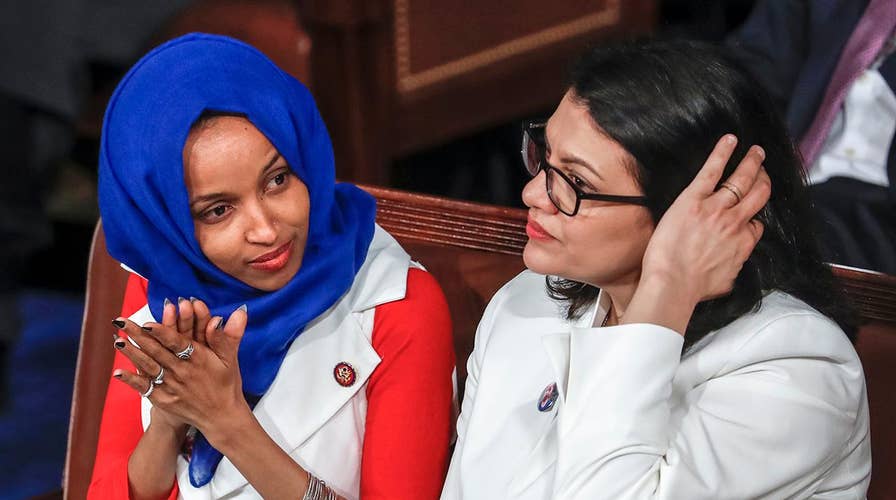
Israel denies Reps. Omar and Tlaib entry amid Trump pressure
Freshman congresswomen blocked from entering Israel; reaction and analysis from the 'Special Report' all-star panel.
This is a rush transcript from "Special Report," August 15, 2019. This copy may not be in its final form and may be updated.
(BEGIN VIDEO CLIP)
DONALD TRUMP, PRESIDENT: I think we are having very good discussions with China, they very want to make a deal. We'll see what happens. China is doing very, very poorly. The tariffs have really bitten into China. They haven't bitten into us at all.
The longer the trade war goes on, the weaker China gets and the stronger we get. Just so you understand, I have been very mild about it, very, very mild. There is a long way I can go. Not China, I'm not there yet.
(END VIDEO CLIP)
JON SCOTT: Let's bring in our panel, Tom Rogan is commentary writer for the "Washington Examiner," Mollie Hemingway, senior editor at "The Federalist," and Josh Kraushaar, politics editor for "National Journal." Tim, you in particular have said the president is playing some of a dangerous game here. What do you mean by that?
TOM ROGAN, COMMENTARY WRITER, "WASHINGTON EXAMINER": I think because of the timing with the essential collapse, although fortunately his remedy today of the markets and the president then throwing a new amenability to cutting a deal and framing that under the broader environment of the Hong Kong protest, or at least the perception will be that in Beijing, the risk is that he shows Xi Jinping, who does have very real economic concerns, and the president knows from his intelligence briefing that China is in pain, but he shows Xi Jinping, actually the American president is getting ready to buckling a little bit here. So we can play for more time rather than coming to the table. I think that is what the perception will be at the standing committee in Beijing, and that's the risk.
SCOTT: But Xi Jinping does have huge problems. Those clashes in Hong Kong right now are a real problem for him, are they not?
MOLLIE HEMINGWAY, SENIOR EDITOR, "THE FEDERALIST": They are a problem, particularly because he's somewhat constrained in what he can do in response. The situation in Hong Kong is very unfortunate, and it's what people probably had every reason to expect might happen when great Britain gave Hong Kong back to China. This is really dangerous. This is an important place that is a center of financial markets and also a beacon of freedom in this region, in a country that is otherwise quite oppressive and brutal.
But for China to crack down too much on Hong Kong would be extremely dangerous for them. They would face economic sanctions from more than just the U.S. They would increase tensions, it would be probably humiliating for the party. They control the media, but they can't control the global reception to what would happen if they behave in too brutal of a fashion.
SCOTT: So is there going to be a deal? The president says that China is going to come around.
JOSH KRAUSHAAR, POLITICAL EDITOR, "NATIONAL JOURNAL": It's in President Trump's political interest to cut some sort of deal, because there's some real headwinds in the economy, and it's not just China. It's not just our allies overseas. There's some signs that we could be heading into a recession in a worst-case scenario. So President Trump's biggest asset politically is the economy. There are a lot of trade hawks in the White House that have cautioned Trump to be more aggressive with China, but I think the political operatives are now looking at the economic numbers and worrying about Trump's reelection. So I think it's in Trump's interest to play ball, come to some sort of compromise, at least for the short term, and punt it to later on in the term.
SCOTT: You're getting a nod of agreement from Tom, but Mollie seems to disagree.
HEMINGWAY: Just that what happened yesterday in the stock market was not related to China trade but an inversion of the yield curve when long term interest rates are lower than short. There are ways to handle that domestically, cut interest rates here, which is something that President Trump has advocated. But even so, even if it is a sign of a looming recession, it's still far off. Usually these types, if this is a correlation you expect to see, still a year, maybe two years off. So it won't be an immediate situation.
SCOTT: The president is pooh-poohing the threat of any economic downturn. Here's a tweet from him today. He says "The United States is now by far the biggest, strongest, and most powerful economy in the world. It is not even close. As others falter, we will only get stronger. Consumers are in the best shape ever, plenty of cash, business optimism is at an all-time high." Using the bully pulpit to rally some good feelings, I guess.
BEVAN: And yes, it is true. You compare the U.S. economy to France, Germany, which I think actually the president, it will be interesting to see if he uses it as a campaign narrative because a lot of the policies that Democrats, the 2020 Democrats are proposing, are the ones that are perhaps not achieving great dividends in Europe.
But on the point of confidence, investor confidence, with the uncertainty as to where the president is willing to deal with China, how quickly, I think that's why you have seen with the president giving these inklings of more amenability to a deal, the markets haven't recovered as much as you might've expected because they don't know what's going to happen the day after tomorrow. And so I think more certainty from the president would be definitely in his political favor, but also in his trade favor to cut a deal with Xi on good terms.
HEMINGWAY: I also think it's interesting that you see so many people almost rooting for a recession or rooting for problems in the U.S. economy. It is alarming to see that from U.S. media figures or some U.S. politicians. It's important that to win a trade war that everybody be on the same page and work toward -- China really is a global threat, and they need to be taken on seriously.
SCOTT: Let's take a look, though, at some of the economic indicators, we have them on screen here. Real GDP growth right now is at 2.1 percent. When the president took office, it was 2.3. But everything else is down in a good way. The unemployment rate is down, consumer confidence is significantly up from where it was in January 2017 and average hourly earnings are up almost $2 from where they were two years ago. Doesn't that bode well for the president?
KRAUSHAAR: And there is another encouraging data point, consumer spending went up, a new report came out today suggesting there's encouraging signs on the consumer market. But there is a big challenge for Democrats politically. You have a candidate like Elizabeth Warren who is actively predicting a recession. Maybe if she's right, that will go to her benefit, but I've never seen politicians rooting against the American economy like Mollie was saying. And it's a lot of risk for Democrats to sound too pessimistic when the macroeconomic indicators are still fairly good.
SCOTT: Up next, Israel refuses to allow two Democratic members of Congress to enter the country.
(COMMERCIAL BREAK)
(BEGIN VIDEO CLIP)
BENJAMIN NETANYAHU, ISRAELI PRIME MINISTER (through translator): We will not allow into Israel people that call for the boycott of Israel and work to delegitimize the Jewish state.
HANAN ASHRAWI, PALESTINE LIBERATION ORGANIZATION: The Israel government and in particular Netanyahu is behaving like a typical dictatorship in the sense that they cannot tolerate dissent, they cannot tolerate criticism.
TRUMP: They are so anti-Israel, so anti-Jewish. But I did speak to people over there. I don't encourage or discourage.
REP. RO KHANNA, D-CALIF.: It really sets a horrible precedent for Israel in making this decision. Why would any country make a decision to deny a United States congressman access to their country? Do they not believe the United States has done a tremendous amount for Israel?
(END VIDEO CLIP)
SCOTT: And we are back with our panel. Ro Khanna, the congressman there, a Democrat, is joined by virtually every other Democrat in blasting President Trump and Benjamin Netanyahu for this decision not to let the two members of the so-called squad into Israel. How says the panel?
BEVAN: I think the first thing, obviously from an Israeli security standpoint point of view, there is an opportunity for them to say, actually, if you are supporting something that is manifestly against the Israeli national security interests in terms of economic boycott, divestment, which aims to -- and the economy, that's one thing.
The problem for Democrats is that with the young progressive element coming in who are noticeably more anti-Israel, and now with the Democratic caucus having to surround these two members of Congress, there is a challenge in the sense that it forces the Democratic Party to coalesce in a way that perhaps makes them more anti-Israel.
SCOTT: It was interesting to hear Hanan Ashrawi, who is a member of the Palestinian Authority, blasting Israel for not letting her, or not letting these members of Congress into the country, she's been blocked from coming into the United States.
HEMINGWAY: Right. There is this widespread rejection of borders and national sovereignty that we are seeing in some groups on the left. The first question that needs to be answered is whether Israel has the right to determine who comes into their country. And they actually have a law forbidding entry to noncitizens who support boycott movement against Israel and its people. So you can have an exemption to that, and they actually were willing to provide that exception to these two members of Congress because of their close relationship to the United States. But then they found out the itinerary of these members of Congress, which the ambassador to the U.S. described as a BDS circus. BDS is the term for the boycott movement.
So finding out that they were coming not as an outreach mission or to find facts about Israel, but to do something that was so political, it would be in direct violation of an Israeli law. They have the right to do this. It's unfortunate because it's good for people to visit Israel to learn more about this country and to understand the complexity of the situation there, not just about Israel but the Palestinian territories as well. So one hopes that they will be able to visit under different circumstances.
SCOTT: Some Republicans have suggested this was a bad move on the part of the Israelis. Senator Martha McSally is not among them. Listen to her take on all of this.
(BEGIN VIDEO CLIP)
UNIDENTIFIED MALE: An unjust, racist decision. Rashida is a Palestinian who is coming to visit her country, to visit her family, to visit her village. Her father and her mother, their roots are Palestinian. Rashida's roots are Palestinian. Her grandfather, her grandmother, her father, her mother, are from Palestine, and they talk all the time about the fact that she is Palestinian. Why are they preventing her from entering Palestine?
SEN. MARTHA MCSALLY, R-ARIZ.: I think Israel has a right to decide who can come under their country just like we do. For my part, I love Israel. I've been deployed to the Middle East five times, and I think that both Omar and Tlaib, their actions and their words have been dangerous.
(END VIDEO CLIP)
SCOTT: That was Rashida Tlaib's uncle who began that particular sound segment. So interesting politics on both sides, really.
KRAUSHAAR: It's important to separate the policy from the politics. What Israel is doing is saying we're going to boycott the boycotters. And this BDS movement has anti-Semitic roots, it's pretty radical. And these are the first two members of Congress ever to hold those anti-Israel views. So Israel has done this with other members of parliament, other allies of other countries.
The politics of it are much more tricky for Israel, because they rely on bipartisan support in Congress, especially Democratic support. All the big Israel votes rely on a majority of Democrats. So when you have folks like Steny Hoyer, when you have Nita Lowey, head of the Foreign Relations Committee speaking out about this decision, you are losing that bipartisanship.
SCOTT: So you think Israel should not have banned these two?
KRAUSHAAR: They P.R. side of it, they are losing the P.R. battle, and that's a lot of the game for this issue.
HEMINGWAY: It's also true that people need to understand the seriousness of efforts to go after Israel and its people. And there has been a lot of tolerance of BDS movements, boycott movements against Israel on the American left. I think it's important for people to speak out against those movements and the harm that they cause instead of just tolerating men.
KRAUSHAAR: And this was not going to be an official Congressional delegation, right?
BEVAN: It wasn't, but the broader point here of the Democratic Party being a necessary ally for longstanding Israel security strategy is something that I think means that this on the balance of mistake, even if the BDS thing is a big problem, as Mollie suggests.
HEMINGWAY: But we have also banned Israeli parliamentary members, a member of the Knesset was not allowed to come into the country under the Obama administration because of the views he held. So this isn't something that is not without precedent from multiple countries, including our own.
KRAUSHAAR: It's important to know that Trump was a big proponent of not letting these two members go to Israel. And I think Trump views this as beneficial for his political standing. He wants the Democratic Party to be representative of Tlaib and Omar's values.
SCOTT: What about Benjamin Netanyahu? He has an election coming up?
KRAUSHAAR: And I think it helps Netanyahu. There's certainly not a lot of support in Israel for these two backbenchers on the Democratic side. So I think it helps him politically. But Netanyahu originally, the Netanyahu government originally said it was OK for them to come. Trump tweeted out today that he would view that as unacceptable, and you quickly saw a backtracking from the government.
HEMINGWAY: Except they said it didn't have anything to do with Trump's views on the matter, but the realization of their itinerary being different than what they thought.
SCOTT: Panel, thank you.
When we come back, a couple of thieves discover crime does not pay.
(COMMERCIAL BREAK)
SCOTT: Finally tonight, on the police blotter, a couple burglaries to tell you about. first, a successful apprehension at Pine Ridge High School in Volusia County, Florida. A thief breaks into the vending machine there, but even though he was wearing a mask, officers caught him red-handed, or maybe he caught himself. With help from animal control, deputies wheeled the machine out in the open, unlocked the door, and their suspect made a clean getaway.
Then the bobcat burglar is still on the loose in Columbus, Ohio. In this surveillance video, he is wearing a hard to miss hoodie of the Ohio University Bobcats. You see him smash open the door of a Dollar General. He finally gets in, but things go downhill from there. He does get away with alcohol, cigarettes, and some electronics, but you have to wonder whether he thinks the gain was worth the pain. Columbus police says crime is not funny, but this guy handed them these bloopers on silver platter.
Thanks for watching “Special Report.” I'm Jon Scott in Washington. "The Story" hosted by Martha MacCallum starts right now.
Content and Programming Copyright 2019 Fox News Network, LLC. ALL RIGHTS RESERVED. Copyright 2019 ASC Services II Media, LLC. All materials herein are protected by United States copyright law and may not be reproduced, distributed, transmitted, displayed, published or broadcast without the prior written permission of ASC Services II Media, LLC. You may not alter or remove any trademark, copyright or other notice from copies of the content.
