


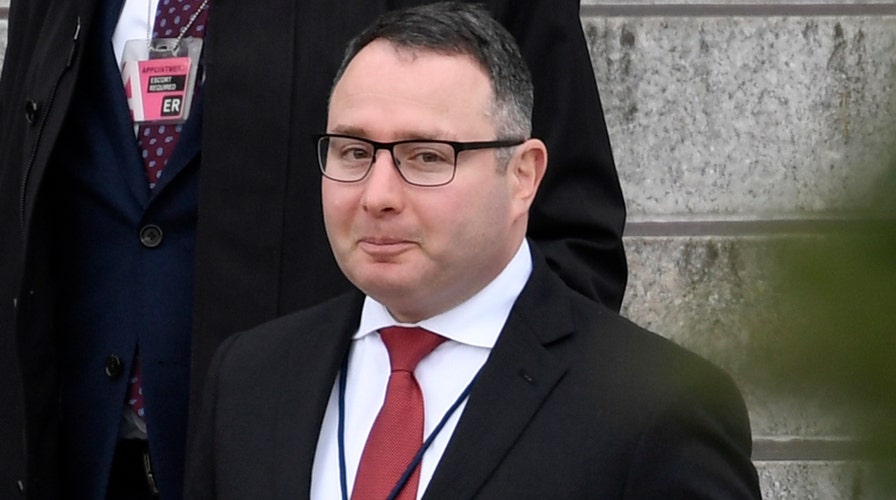
Impeachment witness Lt. Col. Alexander Vindman to leave National Security Council post
Lt. Col. Alexander Vindman, who made waves as a witness during the Trump impeachment proceedings, was fired by the National Security Council and escorted off of the White House grounds, Fox News chief White House correspondent John Roberts reports.
This is a rush transcript from "Your World," February 7, 2020. This copy may not be in its final form and may be updated.
NEIL CAVUTO, FOX NEWS ANCHOR: You are looking live at a Royal Caribbean that is kind of stuck in New Jersey, at least until tomorrow. Our passengers on this ship tested for the coronavirus. It's not to say they have it. They were tested for it and exhibiting symptoms of it. All the other passengers, close to 5,000, on this ship -- it's a biggie -- have been released.
But would you want to get on that ship when it has a repositioned journey starting tomorrow? Today, we ask, and you decide.
Welcome, everybody. Glad to have you. I'm Neil Cavuto
And it's not just ships. 300 Americans evacuated from Wuhan, China, arriving back in the U.S. today on charter flights landing in California and Texas. Those passengers will now be quarantined for 14 days.
And on Wall Street, what should have been and otherwise good day for stocks on a very strong jobs report, well, a sell-off on worries that this outbreak is going to break the global economy, investors not wanting to take any chances going into a weekend.
The latest now on that Royal Caribbean ship. It is called the Anthem of the Seas. Only issue now is whether folks slated to hop on board tomorrow want to take it to the seas.
To Bryan Llenas in Bayonne, New Jersey, with more.
Hey, Brian.
BRYAN LLENAS, FOX NEWS CORRESPONDENT: Neil, hey.
Yes, that is a great question, but the Royal Caribbean Anthem of the Seas, all of the thousands of passengers have disembarked off of this ship for today, all except for four passengers who did disembark, but were sent to a nearby hospital.
All those other passengers went home just fine. But those four passengers sent to a local hospital are being evaluated for possible coronavirus.
From what we understand, the governor of New Jersey, Phil Murphy, says that 27 passengers on board this ship were met by CDC personnel here in Bayonne, New Jersey; 23 of those passengers were cleared immediately. But those four passengers were not.
Royal Caribbean says one of those four passengers tested positive for the flu. And in a statement Royal Caribbean, said this -- quote -- "None of the four guests showed any clinical signs of -- or symptoms of coronavirus while they were on board our ship. All other guests have been permitted to disembark as usual."
We spoke to passengers as they disembarked, and many of them said that they weren't worried. Royal Caribbean didn't say anything on the ship as to what was going on. But we did speak to one Chinese national, who says he was isolated. He was one of those 27 passengers isolated in a restaurant on board.
And he says he's a Chinese national, but he hasn't been to China in three years. And now he's a little concerned.
(BEGIN VIDEO CLIP);
QUESTION: You were isolated?
JIN YAN, PASSENGER: Yes, with all the Chinese together. But it's actually putting me at risk, because I hadn't been to China for the last month, and then some of the passengers have been to China, and they may infect me as well, but I just feel -- putting me at risk.
(END VIDEO CLIP) LLENAS: There are some 7,000 passengers on two other cruise ships in Asia who are now being quarantined right now, one in Japan, the Diamond Princess cruise ship.
Some 11 Americans so far have been diagnosed with coronavirus on board that ship; 61 passengers on total have been diagnosed so far. They are quarantine on board that ship off the coast of Japan until February 19.
Another cruise ship is being quarantined off of Hong Kong as a precaution right now as well, all of this as two U.S. State Department evacuation planes carrying over 300 Americans from the virus epicenter of China, well, they land -- they are landed here in San Diego, as well as in San Antonio, and a third plane is also set to have arrived today in Nebraska.
And all of this, Neil, as Royal Caribbean just moments ago released brand- new travel restrictions. Anyone with a passport from China, Hong Kong or Macau will no longer be able to board any of their ships, at least through the month of February.
And as for this ship, all -- it's a go for right now for their cruise that's set to be an eight-day cruise to the Bahamas tomorrow -- Neil.
CAVUTO: Wow.
All right, Bryan, thank you very much my friend, Bryan Llenas.
So, should those passengers on that Royal Caribbean ship have gotten off that ship and released right back into the public before knowing if any of the four passengers exhibiting symptoms tests positive or not?
With us is Dr. Amesh Adalja. He is a member of the Infectious Diseases Society of America.
Doctor, thank you for joining us again.
DR. AMESH ADALJA, INFECTIOUS DISEASES SOCIETY OF AMERICA: Thanks for having me.
CAVUTO: What would you have done? Would you have said, all right, go ahead, you can get off the ship?
ADALJA: Yes, I would have. That is not the right thing to do, to quarantine these people on the ship, like what is being done in Asia with the other two ships. I think they handled that perfectly.
They found people that were maybe suspicious of having an infection, screened them, found the ones that actually might have a higher likelihood of being positive, and let everybody else go home.
You can quarantine people. You can do self-isolation. You can test people, and you really don't need to panic them. This can be done. We're doing this with people coming off of airplanes. We don't need to do anything different for cruise ships.
CAVUTO: All right, so I know there's an incubation period of up to 14 days, Doctor.
Is there any risk anyone is taking, even though they're looking for symptoms and signs that might not materialize right away?
ADALJA: No, because we don't have any evidence that this is contagious during its incubation periods.
CAVUTO: I see.
ADALJA: If you don't have symptoms, you can't transmit it.
So those people really don't pose much of a risk to the public, and maybe even zero risk. And they're monitored or they're checking in with public health officials. And we have been doing this for some time. And we do this with other infectious diseases as well.
We don't need to quarantine people forcibly, if we can do this with self- isolation.
CAVUTO: So, Doctor, I'm not making you a cruise expert here, but you have been very patient.
What about these people who are going board this same Anthem of the Seas ship tomorrow for a cruise that was supposed to take off today? They have pushed it back. Would you advise they go ahead?
ADALJA: Yes, I would advise them to go ahead.
We know that viruses can remain viable outside the body. But cruise ships are something -- a place where we often see viral outbreaks, usually norovirus, with those gastrointestinal outbreaks, and they have protocols in order to clean those ships, in order to make them less likely to transmit any kind of infection.
So I don't think that there is a major risk. We do this in hospital rooms too. We clean hospital rooms after one person who has fluids in it, another person goes in. There are procedures you can follow that limit the risk.
CAVUTO: All right, Doctor, thank you very much.
We have calmed a few people here.
All right, let's get the read on people who are not calm at the corner of Wall and Broad, not so much concerned about the economy here. That's fine. And we had a strong jobs report. That was very fine. More to that in just a second.
It's this concern about the coronavirus and how it could slow economic activity.
One big firm predicted that it is going to bring China's growth down to a near recession, growing at about a 1 percent clip, which is as low as you can get in China, if you buy the fact that they have been growing at a 6 percent clip.
Market watcher Heather Zumarraga here with us right now.
Well, that's the concern, right, Heather, that this is going to spill over, dampen economic demand across the region, certainly the Asian region, and that's going to spill over across the globe.
What do you say?
HEATHER ZUMARRAGA, FINANCIAL ANALYST: Absolutely.
I mean, we live in a very interconnected, global world now. If you think about U.S. companies like Apple, for example, Adidas, Nike, Starbucks all closing stores in China, some other U.S. companies may have to adjust their supply chain, depending on how bad it gets.
And China is the second largest economy in the world right now. So it does matter.
CAVUTO: So we're just learning, by the way, Heather, that Apple is working very hard to reopen a lot of its China offices, as are other U.S. entities.
Obviously, they seem to be waiting who's the bravest first to stick their toes in the water. The longer they wait to do that, the longer the impact, right?
ZUMARRAGA: Sure, absolutely.
I think that the bigger impact on U.S. consumers, the longest -- the longer this virus goes on. But, remember, we don't really know how widespread this could be yet. You just had a doctor on previously that noted it takes about 15 days to show symptoms.
So if the first cases were recently reported -- we're up to outbreak of over 20,000 now in China -- that could reach hundreds of thousands of people, if not already in China, because you're walking around showing a lot of symptoms, and you don't know you have it.
CAVUTO: You know, we had otherwise good news in this country, a startlingly strong jobs report, 225,000 more added to the economy in January. It's a good way to kick off the new decade, the unemployment rate still historically low at 3.6 percent.
This was across-the-board strength that I think probably, Heather, on any other day would have been greeted by a huge run-up in stocks. So are we overreacting and playing off too many fears with the coronavirus, or is it justified?
ZUMARRAGA: No, I think it's very justified.
But, at the same time, the U.S. economy is on solid footing, Neil, but because we're so interconnected to China and say Europe growth is slowing down as well, then that's why there's an impact in the U.S.
But before today, the markets have done -- held up very well, despite the coronavirus this week. The jobs number, 225,000 on the headline number, I think that's not the most important story. The most important story is that people feel confident to go back into the labor force and get a job; 180,000 new jobs were added.
That's 183,000 new paychecks, and the unemployment rate holds steady near 50-year lows. They're historic lows, Neil. So that's the positive spin on the markets and the economy here in the U.S.
CAVUTO: All right, I will go with that half-full glass for now.
(LAUGHTER)
ZUMARRAGA: Yes, sir.
CAVUTO: Heather, thank you very, very much.
ZUMARRAGA: You got it.
CAVUTO: In the meantime, FOX News can now confirm that Lieutenant Colonel Alexander Vindman has indeed been fired by the National Security Council today and escorted off of White House grounds.
And we have this for you. A record number of Americans are satisfied with the way things are going in their lives right now. Now, it was a personal type of a question, but does it have implications for 2020?
We have got the read on that from New Hampshire, where we will be later on tonight, tomorrow, and Sunday and Monday -- after this.
(COMMERCIAL BREAK)
CAVUTO: All right, you didn't hear it for me. There's a big primary coming up in a few days in New Hampshire, where we will be in the next few days.
2020 Democrats are already there. They have been busy making the case to be the next president of the United States. And the economy is busy making more jobs. Now, that could be problematic for a lot of these Democratic candidates.
Peter Doocy is in Manchester, New Hampshire, following them.
Hey, Peter.
PETER DOOCY, FOX NEWS CORRESPONDENT: Neil, for months, Democratic candidates have been out on the campaign trail trying to convince early state Democrats that, despite what they might hear, the economy really is not doing that well, except for billionaires.
For example, Bernie Sanders was here at Saint Anselm early today in Manchester, one of the only candidates hosting an event today, and he said companies like Amazon, owned by the wealthiest guy in America last year, paid zero in federal income taxes, less than you paid. How does that happen?
DOOCY: But as the progressives are battling each other, talking about the economy, running against the economy in the primary, President Trump is out there flying around on Air Force One, standing behind the presidential seal hosting official events, talking about official labor statistics numbers, like earlier today.
(BEGIN VIDEO CLIP)
DONALD TRUMP, PRESIDENT OF THE UNITED STATES: This morning, the brand-new jobs numbers came in. We smashed expectations and created 225,000 new jobs last month, 225, pretty good, right, 225,000 for last month.
(CHEERING AND APPLAUSE)
TRUMP: That's only last month.
(END VIDEO CLIP)
DOOCY: The economy is the centerpiece of the Trump reelection pitch.
And Trump is the centerpiece of every Democrats' primary pitch. So voters have a pretty distinct choice here -- Neil.
CAVUTO: Indeed, they do, my friend. Thank you very much, Peter Doocy.
Well, none of this really guarantees any votes for the president. But think of this. When 90 percent of Americans answer a survey that they're satisfied with their lives, that they're essentially happy with the way things are going for them, is that a good boon for the president United States?
Let's ask The New York Post's Sohrab Ahmari, who joins us.
Sohrab, good to have you.
SOHRAB AHMARI, THE NEW YORK POST: Thanks for having me.
CAVUTO: I guess you would prefer Americans feeling that way than 90 percent not feeling that way. But how -- does that translate politically?
AHMARI: Well, it should.
CAVUTO: Right.
AHMARI: I mean, it's hard to predict these things.
CAVUTO: Right.
AHMARI: But if you compare president who's delivered jobs growth, wage growth, wage growth at the bottom of the economy, not necessarily Even faster at the bottom than at the top, and then you compare that with a party that's spent the past three years chasing bizarre conspiracy theories and the Mueller report and impeachment and Ukraine and this and that, I think it's hard for Americans to say, what's working for me and what's not working for me politically and draw the political conclusions.
CAVUTO: A lot of the candidates running for president on the Democratic side, as you know, have been saying, yes, more jobs, absolutely, not great jobs, not great pay.
So they try to talk about, as Republicans did when they were in this position, on defense, with Barack Obama, where we saw a nominal pickup in jobs, and then things were getting better and better, that, look, this could be a lot better.
It's hard to make a case like that in this environment. But what do you think?
AHMARI: Well, I mean, you mentioned the quality -- from the Gallup poll, the sense of people's confidence in the American economy and their quality of life, their own sense of satisfaction are up.
We're beginning to see some of those kind of national malaise lift up.
And these things...
CAVUTO: I haven't heard that in a long time.
AHMARI: These things can't be quantified, and yet they can in things like that Gallup poll.
So...
CAVUTO: And I always feel, in a lot of these polls -- and you have been following for years -- that they might not adequately represent how people feel, because the polls are very tight for the president.
We have -- given this economy, given that sentiment, you think he'd be up by double digits, and he's got a battle on his hands. So does it reflect a silent vote, a quiet Trump support vote, or is it simply too early to tell?
AHMARI: I mean, look, some of it could be -- some of it could be silent.
Some of it is, frankly, we have a deeply polarized culture.
CAVUTO: Yes.
AHMARI: And so no matter what happens, people will say, well, Trump didn't deliver that. This is finally the Obama economy paying off, against all...
(CROSSTALK)
CAVUTO: They already are. They already are saying that.
AHMARI: Yes, exactly.
CAVUTO: Lifting that up.
A lot of them too decide on other issues. When the economy's going well, even in 2018, Democrats seized on health care, where Republicans were weak with an alternative plan, and captured the House.
Is it your thought, depending on the survey, obviously, that that's where Democrats will try to score inroads with, I wouldn't call health care a wedge issue, but a non-strictly economy issue?
AHMARI: I think health care is one of them.
I think if -- they will definitely try with the student loan burden, which Republicans need to have an answer for.
CAVUTO: Right.
AHMARI: That's for my generation, the fact that so many are laboring under six-digit debt loads, and not being able to start families and...
CAVUTO: So, they'd have to go at least Democrat-lite, offer something. right?
AHMARI: Yes, yes, I think so. I think so.
CAVUTO: Interesting.
AHMARI: And health care too.
The fact that there's a -- the basic level of health security in this country could be dangerous. And I think this is something that -- where President Trump, by bucking Republican orthodoxies in some cases, is better poised to win with some folks like that than a doctrinaire Republican than Romney was.
CAVUTO: That's very interesting.
All right, Sohrab, thank you very, very much.
In the meantime, we are getting word right now that the Iowa Democratic Party chairman is going to address the media soon; 100 percent of the vote is now in, close as a tick between Mayor Pete Buttigieg and, of course, Bernie Sanders.
But even a lot of news organizations are saying, you know what? We still can't call this thing, because it's so darn close. We're looking at that.
We're also looking at the president looking to move in on the wake of his acquittal. But will tensions flaring right now in the nation's capital freeze anything getting done? And is that such a bad thing if nothing gets done?
After this.
(COMMERCIAL BREAK)
(BEGIN VIDEO CLIP)
TRUMP: I do work with Democrats. I work with everybody.
But that group is -- they say Trump derangement syndrome. They have got it. They have got a bad case of it. You saw that. That was on display the other night when she ripped up the speech. That was terrible.
It was a terrible -- so disrespectful to our country.
(END VIDEO CLIP)
CAVUTO: Well, the president not mincing any words, still talking about Democrats today. Will they be able to work together to get things done, especially when -- you think about it -- they have not talked to each other, the president, the speaker, since last October?
I was telling James Freeman earlier of The Wall Street Journal, who I'm happy to have with me again, that I have Italian relatives who went decades not talking to each other, but they had different reasons.
JAMES FREEMAN, FOX NEWS CONTRIBUTOR: Wow. Yes, OK.
CAVUTO: And they never knew what the reason was.
But I was surprised by that, when I heard, that this has been obviously, we know, festering a while, but to the point of not even talking. That's a little weird.
FREEMAN: Yes, but I like how you have set the bar low. So decades is the Cavuto standard.
CAVUTO: Yes, absolutely, absolutely.
FREEMAN: So, by that standard...
(CROSSTALK)
CAVUTO: They always came for funerals. They always -- they stumbled in for funerals, yes.
(LAUGHTER)
FREEMAN: The good news is that nothing is going to get done this year anyway. It pretty much never does in an election year, especially in a presidential year.
The only thing that might get done would be a big infrastructure plan that a lot of taxpayers would be upset about, because a lot of the money wouldn't go to bridges and highways, but other things.
So, this is kind of a good year to maybe start repairing relationships a little, because you're probably not going to get anything done anyway. Obviously, the rhetoric is pretty harsh.
But the president has said at times that they get along, he and Nancy Pelosi get along better on the phone than at public events.
CAVUTO: When they do speak on the phone.
FREEMAN: When they do speak, yes.
CAVUTO: But let me ask you this. It's hypothetical. And you're very patient with such questions.
FREEMAN: Yes.
CAVUTO: But let's say the president's reelected, the House stays Democratic, they have to deal with each other.
What is the deal?
FREEMAN: Yes.
CAVUTO: What's going to happen?
FREEMAN: Yes.
I would think, at that point, you would start to see a necessity of working together, maybe a return to what you might call normal politics.
CAVUTO: What is that again?
FREEMAN: Well, again, and it's not always good.
I mean, gridlock, if you don't want Washington doing lots of new stuff and imposing lots of new things on you, it can be very good.
CAVUTO: Right.
FREEMAN: But I think it's interesting. You hear it all the time from candidates, from Democratic staffers working in the field, is, they don't hear as much about impeachment and didn't hear as much about it over the last year from voters than you hear about it in the media and in Washington.
So I think there's a there's a possibility there that the message could get through that partisan warfare is not really the number one agenda item for most voters.
And I think, for all of us, if you're a voter out there, of whichever party, and you're meeting candidates this year, I think it might be nice to say, I'd like you to work on X, Y and Z, and not work on shouting at the other party.
CAVUTO: All right, in the meantime, with the focus on New Hampshire and a lot of people looking at Bernie Sanders, he and Buttigieg really came out with a tie in Iowa, I guess.
But is it your sense that, obviously, the president and his people seem to want Bernie Sanders. They seem to think they have the best chance against him. I always say, don't count your chickens here. Democrats hoped it would be Donald Trump emerging as the Republican nominee, that they could crush him like a bug.
FREEMAN: Yes.
CAVUTO: But what kind of sense are you getting about how they're looking at New Hampshire and beyond?
FREEMAN: I guess that I think that's fair to say that they see vulnerabilities in Bernie that aren't there with the other candidates.
I think -- as someone who likes the market economy, I find it kind of scary to have that on the ballot this fall, that we're sort of having a referendum on whether free markets work if Bernie ends up being the guy.
But...
CAVUTO: Well, they all will raise taxes in one way, shape or form.
FREEMAN: True.
CAVUTO: The only degree is how much, right?
FREEMAN: Yes.
No, we're talking about the relative moderate Pete Buttigieg with a $5 trillion tax hike plan, and, obviously, Joe Biden, another competitor for that "moderate lane" -- quote, unquote -- much bigger tax increase than Hillary Clinton proposed in 2016.
So the party has shifted, but I think a reasonable analysis would be that the further extreme the candidate, the more the president has an argument for people in the middle.
CAVUTO: Wall Street generally likes things the way they're going.
FREEMAN: Yes.
CAVUTO: You and I have talked about this so much, that they're not Democrat or Republican. They just like money.
FREEMAN: Right.
CAVUTO: And they have been making a lot of it out of this president, just as they didn't want Bill Clinton to go. They were making a lot under him.
If it looked like a Bernie Sanders or one of these other candidates emerges, and then in polls seems competitive, all bets are off, right?
FREEMAN: Yes, I think -- I guess it depends.
You could maybe not get too worried if you were persuaded that the Congress was going to be moderate enough to check some of his more extreme positions.
But, generally speaking, yes, we can expect a big sell-off if markets start expecting something they don't expect now, which is a Bernie Sanders presidency.
And just to emphasize your point, there have been a lot of surveys, including over the last few years, saying that, regardless of their beliefs, people tend to invest the same way. In other words, the portfolios of Republicans vs. Democrats don't look very different.
So the...
CAVUTO: It changes the algorithm, right? Yes.
FREEMAN: Yes.
But they would all be change their allocations if a Sanders presidency is - - it looks certain.
CAVUTO: All right, well said, James Freeman.
And, again, this isn't a right or left view. It's just looking at these guys who just love to make money, and they will go for whoever can make them the most money.
Republican senators, meanwhile, are ramping up their inquiry into Hunter Biden's past business dealings, and what the Treasury Department just handed over to the Senate has Democrats already crying foul.
Republican Senator Thom Tillis, who had some praising words from the president of the United States, is here, and he's next -- after this.
(COMMERCIAL BREAK)
CAVUTO: All right, you thought the caucuses were over in Iowa, we had all the results, waiting for a press conference at a time, when the Democratic committee there is still under fire for botching it.
So what happens now?
After this.
(COMMERCIAL BREAK)
CAVUTO: All right, want to take you to San Antonio, Texas, right now.
Remember I told you about that jet with some passengers who had to be quarantined. They have to be quarantined in San Antonio for at least the next 14 days, and they will be. We will keep you posted on this. A separate plane landed in California. Might be the same drill there, as the government tries to make sure what's going on in China doesn't spread here.
We will keep you posted, as I said and promised.
Meanwhile, our John Roberts over at the White House on some fast-moving developments there, particularly with the administration taking full offense on the economy and indeed on this virus -- John.
JOHN ROBERTS, FOX NEWS CHIEF WHITE HOUSE CORRESPONDENT: Yes.
And it would seem that the first shoe to drop post-impeachment acquittal is the fact that Lieutenant Colonel Alexander Vindman, who you remember had concerns about the phone call that the president had with the Ukrainian president, Volodymyr Zelensky, and brought those to the attention of the NSC's lead counsel, has been fired from his job and escorted from the White House.
In a statement that was given to FOX News by his attorney, David Pressman, Pressman says -- quote -- "There is no question in the mind of any American why this man's job is over, why this country now has one less soldier serving it at the White House. Lieutenant Colonel Vindman was asked to leave for telling the truth. His honor, his commitment to right frightened the powerful."
FOX had confirmed this morning that Vindman wasn't long for the job. And the president was asked about it as he was on the way out of the White House earlier today on his way to North Carolina. Here's what the president said.
(BEGIN VIDEO CLIP)
TRUMP: Well, I'm not happy with him. Do you think I'm supposed to be happy with him? I'm not.
They will make that decision. You will be hearing. They will make a decision.
(END VIDEO CLIP)
ROBERTS: The press secretary had said earlier this week that some people may pay for what the president went through.
Vindman had been detailed to the White House from the Department of Defense. It's assumed that he will go back there, though we're double- checking on that.
Also today, a big victory for the president. The D.C. Circuit Court of Appeals, a three-judge panel, unanimously throwing out the emoluments lawsuit against him. Dozens of Democratic senators and House members had joined that lawsuit, charging that the president was making money from foreign governments at a number of places, including the Trump International Hotel here in Washington.
Now, the D.C. Circuit didn't decide the case on the merits. They simply ruled that the individual members of Congress didn't have standing to file the suit because they didn't represent a majority of either House.
The president this morning, though, still taking it as a win. Listen here.
(BEGIN VIDEO CLIP)
TRUMP: It was a total win. This was brought by 230 Democrats in Congress on emoluments. It was another phony case.
And we won it 3-0. We won it unanimously.
(END VIDEO CLIP)
ROBERTS: Senate Judiciary Committee member, though, Richard Blumenthal, the senator from Connecticut, indicating that the fight might not be over.
In a series of tweets earlier today tweeting -- quote -- "Today's decision wasn't based on the merits of our allegations that Trump has been defying the Foreign Emoluments Clause. And nothing changes the fundamental facts. Trump has flagrantly and frequently violated the Constitution's preeminent protection against corruption."
The president also weighing in this morning for the first time on Nancy Pelosi on Tuesday night ripping up her copy of his State of the Union address.
Listen to what the president said.
(BEGIN VIDEO CLIP)
TRUMP: Well, I thought it was a terrible thing when she ripped up the speech.
First of all, it's an official document. You're not allowed. It's illegal, what she did. She broke the law.
(END VIDEO CLIP)
ROBERTS: So the president claims there that she broke the law, but many legal scholars say, because that was a courtesy copy of the speech, and not an official presidential document, while the appropriateness of what she did can be debated, no laws were broken.
But a lot of people have different ideas about that -- Neil.
CAVUTO: Yes, I guess they do.
All right, thank you, my friend, John Roberts at the White House.
North Carolina Republican Senator Thom Tillis with us right now.
Senator, the back-and-forth on this, and the ripping up the speech first, the president said that that's technically illegal. Is it?
SEN. THOM TILLIS (R-NC): Well, I don't know if it was illegal, but it was certainly, let's say, bad -- bad behavior.
The fact of the matter is, the Democrats have had a really bad week, with the debacle in Iowa, with their host committee under investigation for a toxic environment for the convention, the jobs numbers that are coming out, the acquittal.
It just looks like maybe the speaker snapped.
CAVUTO: Separately, sir, as you have heard, Lieutenant Colonel Alexander Vindman, who proved to be a thorn in the president's side, has been fired now, and led away over at -- by the NSC.
What do you think of that?
TILLIS: Well, Neil, you have to keep in mind the testimony.
Colonel Vindman said that he thought that the conversation with the president of Ukraine brought up serious policy concerns. You're talking about the president of the United States, who gets to set foreign policy.
But it's also important to remember that Colonel Vindman's boss and his boss' boss was on the line, and they testified that they didn't see any issue with the conversation.
So this is a lower-level person who suddenly decides that he's going to express a concern about policies. When the president of the United States determines policy, he expects his staff to execute it.
CAVUTO: Sir, I'm hop-skipping around, but you're very patient.
In Iowa right now, the Democratic state party chairman is speaking to reporters about that debacle of a vote earlier in the week. They have 100 percent of the results in, but many are arguing that Iowa should lose its first-in-the-nation status.
The president wants to keep it as is. Do you?
TILLIS: Well, you know, I think that the Iowa caucuses, it's hard for a lot of people to understand who are in primary states, like my own in North Carolina.
CAVUTO: Right.
TILLIS: But the Iowa caucuses present an interesting opportunity for just about anybody to go up there and win the hearts and minds of Iowans.
And they have generally been correct in terms of setting the direction for the presidential campaign. It's interesting that the -- that the Democrats want to throw it out. They -- but -- and they give a lot of different reasons. It's not a diverse enough state, or it's not a big enough state.
I think what they're trying to do is shift focus away for -- they had four years to prepare for these caucuses. And they could not even do something as simple as check out the capability of an app before they execute.
These are the same people, by the way, who want to run our health care system.
CAVUTO: Let me ask you.
You were at this event with the president today in Charlotte, where he's talking up empowerment zones, that kind of thing.
And he made a reference that you have had your differences and fights. I'm paraphrasing here.
But do you guys get along now? Are you all on the same page? How would you describe it?
TILLIS: We have all -- we have always gotten along.
Look, I'm a U.S. senator. And we're -- we have a job to do to raise questions about things that maybe on the margins were OK, but we have a few disagreements.
But I think the fact that the -- the president and I have a great relationship. I was honored to have him point to policy I'm working on in sanctuary cities in the State of the Union address. The president knows that I campaigned for him and supported his campaign in 2016.
We have got a great relationship. You know, again...
CAVUTO: Will you use him again as a -- to campaign on your behalf and in North Carolina?
TILLIS: Oh, yes.
CAVUTO: Yes.
TILLIS: We're ground zero at the convention here in Charlotte just about a mile away from where I am right now, and the attention.
We're the battleground state. And my race -- I'm up in 2020 -- is the number one targeted state in the battleground states.
CAVUTO: Absolutely.
TILLIS: We will be campaigning together on results.
(CROSSTALK)
CAVUTO: Democrats think you're gettable. What do you tell them?
TILLIS: Well, I tell them, anybody that wants to go to North Carolina and say, we want to raise your taxes, we want to take your health care away that you're satisfied with on the job, we want to basically reverse what has been an extraordinary three years for job creation, record low unemployment.
Take all comers.
CAVUTO: All right, Senator, they dismissed you when you first ran for your office. So, there is that backdrop.
We will watch it very carefully. Thank you very much.
TILLIS: Thank you, Neil. Have a great weekend.
CAVUTO: You, too.
CAVUTO: Meanwhile, the president signaling he is ready to go after wasteful spending. But is he?
(COMMERCIAL BREAK)
CAVUTO: All right, even Republicans said this White House, you know, when it comes to spending, you're not making us stand out.
Of course, the president goes back at them and says, well, you're not helping me stand out either.
But, apparently, both sides are getting increasingly serious about eventually addressing this runaway spending, including the White House, which could release next week the first blueprint that it hopes, within 15 years, will balance the budget; 15 years is a long time, but it's a start.
Independent Women's Forums Patrice Onwuka.
Patrice, there's so little we don't know. This much, we do, that the president wants to get serious about this. But, again, a 15-year time frame does allow a lot of wiggle room.
What do you think?
(LAUGHTER)
PATRICE ONWUKA, INDEPENDENT WOMEN'S FORUM: Well, I think his heart is in the right place. Certainly, he wants to ensure that every tax dollar is being spent the right way.
And so this idea of tackling a war on waste, I think, is a good idea. But the question is, are there the political -- is their political will to get it done on both sides of the aisle?
And I will say though, Neil, if there's a president to get it done, it's probably President Trump. I mean, he has a good track record when we look at deregulation in the administration, where his executive order of two regulations out for every new one, they have actually done seven regulations out for every new one.
So, maybe this is the president to actually get it done.
CAVUTO: Well, I hope you're right.
I'm not speaking on the left or the right. It's just that others have talked about doing something on this.
But it's just too tempting. If you're a Republican, you like building up defense, which is fine. You might zero in on entitlement programs or the rest, just the opposite of Democrats.
The bottom line is, even though deficits themselves move up and down, the debt, which is an accumulation of all those annual deficits, just rises and rises, to the point we're at north of $23 trillion. And it's unstoppable, you know?
ONWUKA: Well, and particularly if we are not touching entitlements.
I mean, yes, I understand the GAO has identified at least maybe $140 billion, $150 billion worth of spending that can be cut from improper payments. But let's talk about Social Security, Medicare and Medicaid spending, which is astronomical and continuing to rise at, what, 20 to 30 percent over the next decade or so.
So...
CAVUTO: But you know what happens there, Patrice. As soon as somebody even mentions trying to rein that in, you're a monster, you're a villain, you're taking Social Security checks away, Medicare coverage away.
ONWUKA: Yes.
CAVUTO: So even slowing its growth, just slowing its growth becomes a Herculean task.
ONWUKA: That's right.
CAVUTO: And I can't blame politicians of both sides who say, oh, the hell with it. It's not worth it.
ONWUKA: Well, that's why it's called the third rail.
CAVUTO: You're right. You're right.
ONWUKA: Nobody wants to get electrified and have their political careers ended because of it.
I would love to see President Trump stand up and say, OK, we need to at least have a discussion about entitlements, and how do we slow the growth?
We have heard, unfortunately, Democrats putting out bills that would continue to expand Social Security and the amount of benefits that are given out.
CAVUTO: Well, the president has not expressed any willingness in addressing these entitlements in the past.
ONWUKA: Yes.
CAVUTO: Is it your sense, maybe, if he's reelected, that that's when he tries it, or that's when he tries to do something about it, or what?
ONWUKA: Maybe.
But I think that's why he's leading with the waste, fraud and abuse angle of trying to tackle the smaller bite that might be more bipartisan.
CAVUTO: Right. But that can only get you so far. That's like looking at change underneath couch cushions, rights?
ONWUKA: Yes, it's quarters in the bucket right, Neil?
CAVUTO: Right.
ONWUKA: But maybe he will start to breach or at least brace that topic to the American public, because I do think Americans recognize, when they look at their kids and their grandkids, we can't continue to push this down the -- down to the future and think, oh, well don't touch my entitlements.
CAVUTO: You're right.
ONWUKA: There has to be some sort of give and take. And somebody has to be brave enough to make that make -- that case.
Maybe, in his second year towards his last -- second term, towards his last year, maybe that's the time to start bringing it up.
CAVUTO: Yes, because the math doesn't lie.
ONWUKA: Yes.
CAVUTO: Whether you're on the red or blue side of this, it's a lot of green that's piling up here, which is forming the red.
All right, thank you very, very much, Patrice.
We will see what happens.
ONWUKA: Thank you.
CAVUTO: All right, it's probably no surprise that Bernie Sanders constantly slams the president. After all, he wants his job.
But now he's going after his strongest Democratic rival, because, well, that guy wants Bernie -- after this.
(COMMERCIAL BREAK) (BEGIN VIDEO CLIP)
SEN. BERNIE SANDERS (I-VT), PRESIDENTIAL CANDIDATE: How do we feel when we are candidates in the Democratic Party right now?
I'm reading some headlines from newspapers about Pete Buttigieg.
Pete Buttigieg has most exclusive billionaire donors of any Democrat,
I like Pete Buttigieg. he's a nice guy. But we are in a moment with billionaires control not only our economy, but our political life.
(END VIDEO CLIP)
CAVUTO: All right.
Well, Bernie Sanders might like his Democratic rival Pete Buttigieg. He's not liking some new poll numbers, which might explain his now going more on offense against the mayor.
They're in a virtual time in New Hampshire.
Pollster John Zogby on all of that.
John, good to have you.
JOHN ZOGBY, FOUNDER, ZOGBY STRATEGIES: Hey, nice to see you again.
CAVUTO: How real is the Buttigieg threat to Bernie Sanders?
I mean, these polls are essentially even now. He was given no chance -- that is, Mayor Pete -- to win Iowa. It looks like he has. I mean, they're separated by a tick, I get -- I grant that. But he suddenly has emerged as a real force.
ZOGBY: He certainly has.
He's gotten a bounce out of Iowa. And now just in the two or three sets of polls that we have seen, daily tracking, in New Hampshire, he's gone up in clumps, to the point where he's in a dead heat in New Hampshire with Bernie.
And so the thing about New Hampshire, it's an independent state, and it's a moderate state in terms of even the Democratic primary. And with moderates and independents not being able so much to vote in a Republican primary, they could give Pete Buttigieg enough of a boost to not only tie Bernie Sanders, possibly even beat him.
Buttigieg's biggest concern right now are the three moderates that are left in the race. How many votes will they take away from what could have been his own column if he'd faced Sanders just one-on-one?
CAVUTO: How does this polling on your supporters and whether they're billionaires or millionaires help or hurt a candidate?
I mean, you could clearly make the argument Buttigieg is the only not millionaire among the prominent candidates. So it's not as if he's a silver spoon in his mouth here. What do you make of that?
ZOGBY: Well, that's what's worked for Bernie his entire career.
CAVUTO: Right. Right.
ZOGBY: And, frankly, none of this is new.
It certainly worked for him really beyond all expectations in 2016.
But add to that the fact, this is essentially the modern-day version of the heart -- the battle for the heart and soul of the Democratic Party since 1968, the progressive wing vs. the moderate wing.
And at least in -- where we stand today, Bernie is the king of the progressive wing.
CAVUTO: So, is it your sense, given this 15 percent allocation of delegates -- in other words, it's always proportional, going from Iowa, going to New Hampshire, South Carolina, Super Tuesday, et al, that we arrive at the convention with no one having enough delegates to win on the first pass?
ZOGBY: Well, it's within the realm of possibility.
Look, we have had battles before in the Democratic Party, Teddy Kennedy in 1980 against Jimmy Carter...
CAVUTO: Sure.
ZOGBY: ... and Gary Hart in 1984.
So, this -- we had the same kind of talk before in the party. Those wings are kind of co-equal. And the elephant in the room, the big winner in Iowa actually was Mike Bloomberg, who has the resources to go on.
CAVUTO: Good point. Very good point.
ZOGBY: Mike see Pete Buttigieg as a stalking horse for him.
CAVUTO: All right, we will see what happens.
John, I always learn a lot. Thank you, my friend, John Zogby, follows this better than anyone I know.
All right, the 2020 Democrats already campaigning in New Hampshire, but it's a battle that's now turned personal -- after this.
(COMMERCIAL BREAK)
CAVUTO: All right, not exactly Ali-Frazier, but Bernie Sanders and Pete Buttigieg are facing off for the first time since Iowa.
Let's get the read right now from Jacqui Heinrich in New Hampshire with the latest.
Hey, Jacqui.
JACQUI HEINRICH, FOX NEWS CORRESPONDENT: Hey, Neil.
Former Vice President Joe Biden will be front and center on the debate stage tonight, because polling averages put out between mid-December and yesterday still had him at the front of the pack.
But since the Iowa caucuses, the spotlight has been on Senator Bernie Sanders and on former Mayor Pete Buttigieg, who are locked in a virtual tie.
And leading up to tonight's debate. Biden took some time off the trail to meet with advisers and fine-tune what's sure to be a critical performance ahead of Tuesday's primary.
If Biden does poorly in New Hampshire, and after his fourth-place finish in Iowa, it could shake the support he's really relying on in the next early primary state in South Carolina.
Meantime, Sanders and Buttigieg have been exchanging barbs, Sanders reading several newspaper headlines depicting Buttigieg campaign as being funded by billionaires.
Sanders has long touted his own grassroots support. His campaign has more individual donors than any of his rivals.
Buttigieg in a fund-raising e-mail to supporters leaned into that conversation, touting the 22,000 new individual donors, the e-mail also accusing Sanders' campaign of being -- supported by nine outside dark money groups.
So, tonight critical for all of them, and also Elizabeth Warren, who's going to be clinging to a chance to stay in the top of the pack -- Neil.
CAVUTO: Great job, Jacqui. Thank you very, very much.
We will be bringing you the latest from New Hampshire tomorrow morning, a special live "Cavuto" show from New Hampshire.
Tulsi Gabbard will be joining me, Republican New Hampshire Governor Chris Sununu as well, ahead of the big primaries. It's going to be a busy day, busy weekend.
Here's "The Five."
Content and Programming Copyright 2020 Fox News Network, LLC. ALL RIGHTS RESERVED. Copyright 2020 ASC Services II Media, LLC. All materials herein are protected by United States copyright law and may not be reproduced, distributed, transmitted, displayed, published or broadcast without the prior written permission of ASC Services II Media, LLC. You may not alter or remove any trademark, copyright or other notice from copies of the content.
