


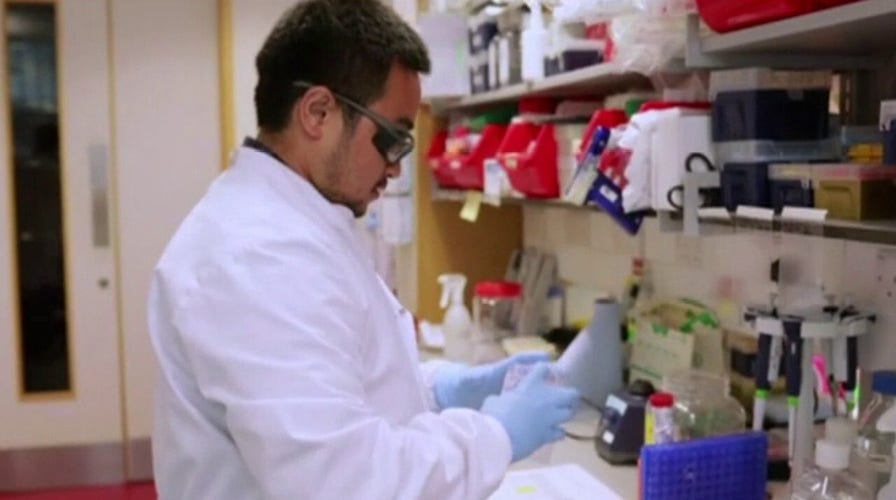
How will individual states distribute the coronavirus vaccine?
Connecticut Democratic Gov. Ned Lamont joins 'Your World' to discuss the plan for his state
This is a rush transcript from “Your World with Neil Cavuto” December 2, 2020. This copy may not be in its final form and may be updated.
NEIL CAVUTO, FOX NEWS ANCHOR: The first shots in a matter of days.
The word out of the United Kingdom now that it is officially sanctioned and
said it can go ahead and see Pfizer and BioNTech come up and out with a
vaccine, oddly before U.S. authorities here do the same.
But it doesn't matter. People are going to be getting it. And more are
coming on the way.
Welcome, everybody. I'm Neil Cavuto.
And we are looking at a stunning development, when people thought it was
unthinkable, impossible that, in the middle of a pandemic that was gripping
the world, that a vaccine, two, maybe three, could be available by year
end. One is out there now. A couple are waiting at planes at La Guardia.
So it does seem that they're coming soon and they're coming fast. And
they're going to be in millions of doses by the end of the year, possibly
more than a billion doses in the new year.
What to make of this with Laura Ingle and the fallout in this country, and
then, of course, Greg Palkot with the fallout from London that, well, got a
jump on this country.
We begin with Laura in Malverne, New York -- Laura.
LAURA INGLE, FOX NEWS CORRESPONDENT: Hey, Neil.
Well, the CDC's advisory committee made that vote last night that basically
green-lights a plan of action of getting a couple of groups ready to go,
front of the line when this vaccine, maybe one or the two that are on the
table right now, in front of the FDA get approved.
Those are the front-line health care workers and those living in long-term
care facilities. Now, the panel of outside scientific experts who make up
the CDC's advisory committee voted 13-1 last night to recommend those two
critical groups.
The news comes just as Britain, as you mentioned, gave emergency
authorization today to Pfizer, something Health and Human Services
Secretary Alex Azar says should be reassuring for Americans, as the FDA
works through its own process to ensure the vaccine is safe and effective
for use here.
(BEGIN VIDEOTAPE)
ALEX AZAR, U.S. HEALTH AND HUMAN SERVICES SECRETARY: They have a very
detailed approach. They look under the hood. They're going to look at all
the data to make sure that it proves to be as good as it appears.
And we will have that meeting of our advisory committee on December 10.
(END VIDEO CLIP)
INGLE: And, Neil, just hours ago, the CDC also released revised guidance
on quarantine time for those who may have been exposed to the coronavirus
and have tested negative.
They're moving the goalposts from 14 days to seven days, and then 10 days
for those who have not been tested at all. And the director of the CDC
says, while all of this is very encouraging news, we still have the next
several months, which they predict to be some of the toughest months of the
pandemic, ahead of us.
And they're also asking people today not to travel for the holidays. We saw
how that went for Thanksgiving, but that's the recommendation from the CDC
today -- Neil.
CAVUTO: All right, thank you very much for that, Laura Ingle.
Now let's skip across the pond here, the Atlantic Ocean, more to the point,
Greg Palkot in London with the fallout there, that it got regulatory first
approval in London than in the United States. It's not meant to disparage
anything here in this country, just different time standards, different
allowances for different things.
Greg, what are you hearing?
GREG PALKOT, FOX NEWS CORRESPONDENT: Neil, it's big stuff here and
possibly big relief, as the U.K. becoming the very first country to give
approval to a rigorously tested COVID-19 vaccine, getting that emergency
authorization, a vaccine from the German firm BioNTech and, yes, the
American pharmaceutical giant Pfizer.
In studies, it was proven to be 95 percent effective in dealing with the
coronavirus. Some 800,000 doses will be distributed here starting next
week. It takes two doses within a month for treatment, millions more
expected.
First to get, very similar to the United States, nursing home residents and
staff, front-line doctors, medical, social workers, then the elderly, the
vulnerable, and working your way down.
Here is how U.K. Health Secretary Matt Hancock described it:
(BEGIN VIDEO CLIP)
MATT HANCOCK, BRITISH HEALTH SECRETARY: In our battle against the virus,
help is on its way. Today is a triumph for all those who believe in
science, a triumph for ingenuity, a triumph for humanity.
(END VIDEO CLIP)
PALKOT: There are hitches, though, Neil.
Maybe the biggest, these vaccines have to be stored and transported at
super cold temperatures, about 100 degrees below zero Fahrenheit. But the
company say they have special dry ice shipping containers which have GPS
monitors in them, and they should be able to handle it, just in time, Neil.
The U.K. authorities have announced just in the past 24 hours here in the
U.K. there were 650 more deaths due to COVID-19. Of course, the U.S. will
be watching very closely as the U.K. starts this, rolls it out, to see how
it will go -- back to you.
CAVUTO: All right, and that could all be within 48 hours.
Greg Palkot, thank you very, very much.
So, the implications of all of this not only for this Pfizer offering, but
the others that are out there.
Dr. Mike Varshavski joins us right now, the board-certified family medicine
physician,
Doctor, very good to have you.
How will this process go then, Doctor? What do you think?
rMD-UL_DR. MIKE VARSHAVSKI, FAMILY MEDICINE PHYSICIAN: Hey, Neil. Thank
you so much for having me.
It's an exciting day for us in the health care community. We have been
battling this virus on the front lines for going on nine, 10 months now,
these trials have been going on for that same period of time. And so far,
the results have been so reassuring.
We have tens of thousands of candidates in randomized controlled studies
proving the effectiveness and safety of this vaccine. To us, effectiveness
is equally, if not more important, than safety. So, to have both of those
boxes checked at this time is amazing.
And, Neil, we did this in a span of 10 months in a process that usually
should take 10 years.
CAVUTO: Incredible.
VARSHAVSKI: And it's really been an incredible undertaking, coming
together, technology working with us.
But, Neil, I do have a concern. Because, right now, the CDC has been
working with their advisory committee, the ACIP, the Advisory Committee for
Immunization Practices, and they have recommended that health care
professionals on the front lines and long-term care residents get this
vaccine first, that doesn't mean it's guaranteed to happen, because this is
ultimately still going to be under state control in how they want to
administer vaccines.
I hope that it happens in this manner, because these are the highest-risk
groups, especially the long-term care residents, Neil. Forty percent of all
deaths related to COVID-19 came in this vulnerable, frail population, and
we need to get them vaccinated.
CAVUTO: So how does this work, then, Doctor?
I understand, I think I heard it correctly, 20 million doses would be
available this year. But, really, it would be for 10 million individuals,
because they get two doses, right, over time. How does it work?
VARSHAVSKI: Well, Neil, the way that it works is, it's going to be unclear
from the outset of how many people are going to get it how quickly.
We're just making a lot of predictions right now based on how many people
are going to get it, how many are going to be shipped appropriately. And we
do have Operation Warp Speed in effect, but our dates are not yet perfectly
set. And I know, like, the whole purpose of us discussing this right now is
the differences between the U.S. and Europe and who is going to get the
vaccine first.
Ultimately, it's not even clear right now, Neil. In Germany, for example,
they're hoping to get the vaccine ready to go in mid-December, yet the E.U.
is aiming for regulatory approval in late December. So, right now, the
dates are not clear, the numbers are unclear. That should not be what we're
focusing on right now.
What we should be focusing on is that there is, in fact, a vaccine that's
efficacious, that is safe. We have multiple options. Each come with their
own challenges, because, as your colleague said, they need to be stored
differently, they need to be administered differently.
But if we take this seriously, and we continue doing all the safety
guidelines laid out by the CDC, we can have a positive return back to
normal in 2021.
CAVUTO: Doctor, how do you advise your patients, knowing that, besides
this Pfizer/BioNTech drug and Moderna one to come -- and I know AstraZeneca
is getting a lot of attention, maybe the next to launch, Johnson & Johnson,
a host of other players.
I assume they will do different things. So you have to sort of play it by
ear then, right, yourself, don't you?
VARSHAVSKI: Well, Neil, that's not unusual for us.
For example, when I want to give a patient the influenza vaccine, which we
do year in, year out, there are always multiple options, different brands,
different formulations. For example, if you're over the age of 65, and you
need a flu vaccination, we give you one that is of higher potency, because,
generally, your immune system needs that higher potency in order to kick
in.
So we are used to having multiple vaccine options available for patients.
This is going to be nothing new for us. We just need to make sure that we
do this carefully, safely, and do not rush this process.
CAVUTO: Yes, you said that from the very beginning, Doctor. Wise words,
then, wiser words now.
Thank you. Very good seeing you. Continued good health yourself.
VARSHAVSKI: Thank you.
CAVUTO: All right, Dr. Mike.
Let's go to Ned Lamont. You know him, of course, the governor, beautiful
state of Connecticut, what he makes of all of this.
You know, Governor, I understand that governors themselves, yourself
obviously included, will decide what works best in their respective states.
Any early thoughts, sir, then, how you handle it in Connecticut, once you
get enough available doses available?
GOV. NED LAMONT (D-CT): Yes, we get our first doses from Pfizer -- Neil,
nice to see on -- the 14th.
We're ready to roll that out of through our hospitals. Our hospitals
already have the refrigeration units, so -- and those are the front-line
folks we need to take care of.
But more complicated, we had to put together a vaccine advisory board made
up of ministers, made up the labor leaders, politicians, do everything we
could to give the community confidence that, when the vaccine is available,
take it. It only works if you get the shot.
CAVUTO: Is it good enough for you, Governor, if the FDA says, ready to go,
this is good stuff? Technically, it has not done so yet. Britain has done
that.
And I'm told that there's no significance to that, just that the FDA is
dotting the I's, crossing the T's, making sure it's effective and all that.
But, until you get that, do you hold off, or what do you do?
LAMONT: People ask me that, and I say, look, I'm going to take the vaccine
as soon as I can. I would like Dr. Fauci to take it first, if you want to
know what my seal of approval would be.
(LAUGHTER)
LAMONT: But I have talked to Pfizer. I have talked to the pharma
companies.
I think maybe it got off to sort of a rushed or political start. But I
think, here we are in December. I think they're ready to go, ready to do it
safely.
CAVUTO: You know, a lot of people have said, if not for Operation Warp
Speed, this effort to get this done, organized, searched out, remove the
hurdles as quickly as possible, we might not be here today.
Do you agree with that?
LAMONT: I'd say it's coming in the nick of time.
I didn't want to wait another year. I can tell you that people are
exhausted here in the state and throughout the region. We're -- still have
a low rate at 5 percent. But, man, it's a lot more than it was a month ago.
And people are tired. And they don't necessarily have the same discipline
they did in the spring.
So, thankfully, we can say there's an end zone in sight. And that's called
the vaccine. So, be careful for a little bit longer.
CAVUTO: What are you advising for your residents, Governor, as far as
gatherings?
I know you put a limit on crowds at Thanksgiving. Dr. Fauci, you mentioned
earlier, had been saying, we need one more holiday to get this right, limit
your Christmas, Hanukkah, New Year's gatherings as much as possible, one
last attempt to get this from getting out of control.
So, what are you planning for the holidays?
LAMONT: Well, Thanksgiving was a little small. And the kids are tired of
my same old stories. I can tell you that.
But I think the most important thing we can do is those informal social
gatherings. You can look at hockey rinks, you can look at restaurants, you
can even look at bars, because those are informal social gatherings.
And that's where we got to be careful. So, you're right. We have said no
more than 10 people. Stick to your family as much as you can. That's how
we're going to power through this. That's the most important discipline you
can exact.
CAVUTO: So, I just want to be clear. You're telling me I should not see my
in-laws? Just want to bounce this off my wife. Is that right?
(LAUGHTER)
LAMONT: Well, if they're the 11th and 12th people, say, you would love to
have them, but the governor says no more than 10.
CAVUTO: Gotcha. All right, I will just say, the governor just said that.
Governor Lamont, very good seeing you. Continued good health, sir. We
appreciate you taking the time.
LAMONT: Be good, Neil.
Thanks, everybody.
CAVUTO: You know, we're focused on -- thank you, Governor.
We're focused on Georgia right now, not only the continued count on the
election that was more than a month ago, but the upcoming Senate run-off
elections right now, and the secretary of state looking into allegations
that a number of progressive groups are trying to entice folks to move to
Georgia to vote in Georgia, and then they can go leave Georgia.
There's only one teeny problem with that, if true. It's illegal -- after
this.
(COMMERCIAL BREAK)
(BEGIN VIDEO CLIP)
GABRIEL STERLING, GEORGIA VOTING SYSTEM IMPLEMENTATION MANAGER: We do
everything we can within the bounds of law to assure that Georgians and
only Georgians are the ones who vote here who are legally registered and
available to vote.
(END VIDEO CLIP)
CAVUTO: All right, the problem is, they can't be too sure of that.
The Georgia secretary of state is now looking into allegations that a
number of progressive groups are trying to entice those who live outside
the state to temporarily move in, vote in Georgia, presumably for the
Democratic senatorial candidates.
And then they can do what they want. There's just one little problem with
that. It is illegal. You can't do that.
But Jonathan Serrie following some of these fast-moving developments and
what the charges actually are -- Jonathan.
JONATHAN SERRIE, FOX NEWS CORRESPONDENT: Hi there, Neil.
Well, George's Republican secretary of state is really fighting forces on
the left and the right. He's trying to ward off legal challenges by
Republican electors who want to gain access to the state's voting machines,
conducting forensic investigations, which state officials say would
actually cause potential security breaches.
At the same time, the secretary of state has launched an investigation into
liberal groups allegedly trying to register out-of-state or deceased
residents to vote in the January 5 Senate run-offs.
(BEGIN VIDEO CLIP)
STERLING: We have New Georgia Project that you might know associated with
Stacey Abrams and Raphael Warnock that sent voter registration forms to New
York City.
So, we're continuing to dig in this investigation. We're finding more and
more information every day.
(END VIDEO CLIP)
SERRIE: Meanwhile, a progressive political action committee has purchased
ad space on nine billboards across Georgia, not to rally Democrats so much,
but to exploit divisions among Republican voters who are torn between
loyalty to their party and President Trump.
While this unusual tactic, it's not illegal, it is raising some eyebrows.
Now, Neil, tonight at midnight is the deadline for all 159 Georgia counties
to finish their machine recounts of ballots in the presidential race
requested by the Trump campaign. Already, 132 counties have wrapped up
their tallies, and state elections officials expect that the remaining 27
will finish well in advance of the midnight deadline -- Neil.
CAVUTO: All right, thank you very, very much, Jonathan Serrie.
Again, that count that Jonathan was referring to, the hand count of the
election, does seem to closely mirror what these Dominion systems' votes
were, almost to an individual vote.
The read on all of this and what's going on now in the Senate run-off
election with the lieutenant governor of Georgia, Geoff Duncan.
Governor, thank you for joining us again. Very good to see you, sir.
LT. GOV. GEOFF DUNCAN (R-GA): Yes, absolutely. Thanks, Neil.
CAVUTO: Let me ask you first about the hand count right now. This is the
third vote going through all of the votes right now.
And up to now, it seems that the counts have pretty closely matched these
machine-processed Dominion system votes, uncannily so. So, what can we
conclude from that?
DUNCAN: Yes, not a lot has changed the last few weeks, Neil.
We continue to watch now our final count, recount, which was asked for by
the president. And I think all signs point to the results continuing to
match the other counts that we have had, so not a lot of news with --
pertains to the outcome.
But I will tell you, the mountains of misinformation continue to flow in at
an alarming pace. And it is very -- it's very alarming to me.
CAVUTO: All right, that misinformation is -- are you saying that
misinformation is coming from the president?
I know he's disparaged some things you have said, what the governor has
said, what the secretary of state has said. You want to clarify?
DUNCAN: Yes, that information -- misinformation is coming from every
single angle, Neil.
And I got to tell you, it's disheartening. It's definitely not our finest
moment. We continue to get hundreds, if not thousands of pieces of
misinformation flowing in almost by the hour from folks seeing something on
Facebook or Twitter. And it takes 10 seconds to debunk.
And, really, I think the troubling part to me, Neil, is that so much of
this is flying in just under the premise of not rooting out fraud, but to
simply try to flip an election. And, certainly, my job is too important to
take that bait.
I'm going to continue to work with the secretary of state and attorney
general to make sure we have a fair, legal election.
CAVUTO: All right, I assume what you're referring to is the president's
charge that thousands of votes that went to him are not coming up in these
counts and recounts.
Can you unequivocally state that is not the case?
DUNCAN: Yes, so we're four weeks into this, Neil, four weeks into this.
And we have not seen -- the attorney general, the secretary of state, the
investigators have not seen any signs of systemic or organized fraud.
And, Neil, I got to be honest with you. As a Georgian, as the lieutenant
governor of this state, I'm proud of that. Even though the guy I voted for
isn't going to win Georgia, I'm still proud that we were able to put on a
fair, legal election.
CAVUTO: Now, he is going to be in your state on this weekend, in which
he's going to try to help out those Republican senatorial candidates.
Do you think his actions have hurt them?
DUNCAN: Well, look, my encouragement -- and I have said this a couple of
times to our senators that we're fighting hard for, to the president and to
Republicans as a whole -- we need to redirect our post-election focus here.
Short term, we need to make sure that we send two Republican senators back
to the Senate, not just for us here in Georgia, but for Republicans all
over the state -- all over the country.
But also, long term, we got to protect this Republican brand. We are bigger
than one person. We need to -- we need to continue to champion and see the
wins that President Trump had for us. I mean, his policy positions were
phenomenal. The grounds gained by an outsider were awesome and should be
championed.
But there's more work to be done. I think this Republican Party can get
better. I think we can take on some big issues, like immigration reform,
like health care. These are big issues that we can gain ground on in the
coming years.
CAVUTO: Will you support him, the president, if he runs again in 2024?
He's hinting at that.
DUNCAN: Well, look, I'm not going to -- I'm not going to project out four
years from now. I think we have got a lot of time to keep working hard.
And I think, look, this is an important reminder, Neil. On January 20, when
Vice President Biden is sworn in as president, this will still be America,
and we will still have the Constitution to protect our conservative point
of view.
And I'm going to fight hard to protect small business owners that can't
afford tax increases. I'm going to support folks like myself that want the
Second Amendment to be strong. Those are things that the Constitution
affords us the rights to have. And I'm going to fight hard for.
CAVUTO: Are you going to meet the president when he comes to your state
this weekend?
DUNCAN: I got good news. I'm actually hanging out with my three kids all
weekend, and so excited about it. My wife and I have got plans with the
kids, but certainly wish him the best of luck.
I hope Senator Loeffler and Senator Perdue are able to rally up a lot of
support and get folks to show up for them on January 5, because I'm
counting on it. I know Republicans all across this country are counting on
them winning. And we need them.
CAVUTO: All right.
So, to be clear, you will be with your kids. Great. You're a great dad.
There's no denying that. But you will not be meeting with the president?
DUNCAN: No, sir. I'm going to be hanging out with my three boys.
CAVUTO: OK.
Governor, thank you very much, Geoff Duncan, the Georgia lieutenant
governor.
We will have more after this.
(COMMERCIAL BREAK)
CAVUTO: All right, you are looking at the 737 MAX, American Airlines
showing off the brand-new Boeing plane and inviting media and a lot of the
corporate types to go for a spin from Tulsa to Dallas.
Everything went OK.
Back after this.
(COMMERCIAL BREAK)
CAVUTO: All right, another big company from Silicon Valley is saying
goodbye to Silicon Valley, not entirely, but Hewlett-Packard Enterprises
indicating it's going to move a lot of its operations to Houston, Texas.
Sam Liccardo joins us right now, the mayor of San Jose. He has been doing
his best to stop this sort of thing, but it has happened yet again.
Mayor, very good to have you. What do you make of this?
Now, it looks like, reading from Hewlett-Packard Enterprises' comments on
this, that it's not abandoning your area, but it certainly is cutting down
its presence in your area. Does it alarm you?
SAM LICCARDO, MAYOR OF SAN JOSE, CALIFORNIA: Well, certainly, it's a
wakeup call for all of us, Neil.
And the good news is, here in the city of San Jose, they're actually adding
hundreds of employees, because they're consolidating their operations here
in Silicon Valley, in my city.
But we are seeing the headquarters move. And we know that this is a story
we have seen before, that, certainly, for the kind of talent that you
really need to find in Silicon Valley, that highly specialized, if it's
around artificial intelligence, or engineering, or software, you will find
it in Silicon Valley, and folks will want to locate here.
But if you're looking to expand operations for accountants, or lawyers, or
administrative assistants, you can do that in a lot of other places for a
lot less. And we have got to do more to make this region and the state more
affordable.
CAVUTO: You have been trying to address that.
You were reelected in 2018 with more than 75 percent of the vote at the
time, and largely by taking on unions and entrenched pension-funded
organizations, where you just wanted to ease back on those obligations,
because they're a good reason why San Jose and other areas across the
country that have similar issues are so pricey, and, well, actually being
priced out, and having companies move.
But that apparently wasn't, isn't enough. So what does the state have to
do, do you think?
LICCARDO: Well, the biggest challenge I think we all have is with housing
costs. It makes it so expensive to live here. Obviously, companies need to
pay a lot just to keep people here.
And there's a lot more we need to do to ramp up production. We can
certainly get some of the red tape out of the way. And I appreciate some
recent efforts of the governor, for example, to be able to, for example,
waive CEQA on the construction of affordable housing we need for homeless
residents, for example.
And that enabled us to build three separate developments in four months,
rather than four years. Those are the kinds of things we need to do. It
mostly is just getting out of the way.
But, also, we need to be more innovative in how we're building housing.
We're using a lot of different technologies, for example, prefab and
modular housing. And that takes local bureaucracies to be able to be
nimble, to enable the permit those kinds of things, make sure they're safe,
but obviously still allow the innovation.
So, housing is really a core of it. But we know there's a lot else going
on. It's taxes. It's regulation. It's a lot of issues where I think we just
need to be very cognizant in California. We have been taking it for granted
for too long that tech employers want to be here.
That won't happen forever.
CAVUTO: Did you offer an alternative deal to Hewlett-Packard Enterprises
from making this move? Or did they say, our mind is made up, we're building
this big facility in Houston, we're going there?
LICCARDO: No, I have been very clear that we don't want to offer companies
deals of any kind. When Amazon was announcing its beauty contest for the
move of its headquarters, I wrote an op-ed in The Wall Street Journal
saying, thanks, but we're not giving you any money.
I don't believe in giving taxpayer money to companies. And H.P. never asked
for it. To their credit, they have been completely aboveboard with us. I
understood clearly why they'd be going to Houston. They have a lot of
operations already there and a lot of employees.
But for those headquarters operations, you don't necessarily need the top
technical talent. They can keep all of that here in Silicon Valley. And
they can hire elsewhere.
CAVUTO: You know, do you think it's about more than taxes, though, and the
cost of living, Mayor?
I know you have apologized for this incident where you joined your family
for Thanksgiving. It was quite a large gathering, larger maybe than even
you suspected. But it came at a time when number of other top politicians,
mostly Democrats, I hate to say that to you, did one thing and practiced
another.
Do you think that people look at that, Mayor, and say, the guy's a
hypocrite?
LICCARDO: Sure. I recognize folks will come to those kinds of conclusions.
And I made a mistake, and I own it. And I certainly should have been more
astute about the specifics of the regulations.
I knew that there were advisories, and I simply should have been more
astute to it. And I -- as I learned, when the media reported that I was at
home, we immediately disclosed, no, actually, I was at my parents' house.
And that's how all this came out.
So, I have (AUDIO GAP) going forward and, certainly, I'm going to do
better.
CAVUTO: When you entered your relatives' house, did you notice, oh, wow,
there's a big crowd here, and I'm the mayor of San Jose, and I have just
been telling my constituents, keep it small, keep it limited?
LICCARDO: No. No, I can't claim to have been...
(CROSSTALK)
CAVUTO: Did you think, I'm looking a little hypocritical?
LICCARDO: The reality is, I have got a big family. I'm one of five kids.
And so, typically, Thanksgiving for us is 25 people. We actually had eight
adults dining at the same time. And the problem was, under the state rules,
you can only have three households. And so we had too many households
there, even though all of us -- many of us had been dining together every
week.
Simply, the rules have changed, obviously, as we have gone into -- deeper
into the -- this challenging period of high infection spread. And I should
have known better. I should have done better.
CAVUTO: Well, unlike a lot of other politicians who did the exact same
thing, you got ahead of it. You apologized for it. You did so again. If
more did, maybe we would just -- it would be easier to move on.
Mayor, thank you very, very much. Good having you. Be well. Let's see how
the whole Hewlett-Packard thing goes.
LICCARDO: Thank you.
CAVUTO: All right, the mayor of San Jose, Sam Liccardo, on that.
In the meantime, this growing concern of keeping a prosecutor going to
explore Russian interference in the 2016 presidential election that has its
origins in something that Joe Biden once thought was a very good idea, this
very thing -- after this.
(COMMERCIAL BREAK)
CAVUTO: All right, here in a nutshell was Democrats' prominent reaction to
Bill Barr appointing John Durham as a special prosecutor to look into the
whole Russia and the investigation mess that followed on all of that.
But they might want to be a little careful criticizing it, because no less
than Joe Biden had been warning back in 1987 that such prosecutors aren't a
bad idea, quoting here: "History proves that those who would strike down
the independent counsel statute as unconstitutional base their claim on a
flawed factual premise. History teaches that prosecutions have not always
been controlled by the attorney general, and that they have not always been
public. In my view, the independent counsel statute can and should
withstand constitutional scrutiny."
To John Yoo, the former deputy assistant attorney general on, all of that.
What do you make of that, John? Because here we go with yet another one on
this, where I guess Joe Biden could contend, well, this is a good idea. I
don't think he's saying that. But what do you think?
JOHN YOO, FORMER DEPUTY ASSISTANT ATTORNEY GENERAL: Well, Neil, I think
that Joe Biden wished that there were no Internet where you could easily
find articles and speeches that he gave when the independent counsel law
went to the Supreme Court for the first time back in 1987.
And, in fact, Joe Biden loved special counsels so much then that he wanted
them to have even more independence and more protection than Durham has. He
wanted to make it almost impossible for presidents to order independent
counsels around or fire them.
The one that we have now, the independent counsel is really under the
control of the attorney general, still can be fired by the president. But,
more importantly, look at what he said in the quote that you just read.
Biden should welcome John Durham's appointment, because he said, even
though the president should generally control prosecution, when we have to
investigate the highest-ranking members of the government or the Justice
Department themselves, then we got to have independence.
And independence means a special prosecutor like Durham.
CAVUTO: So, what happens to Durham? What can he do? Obviously, Illinois
investigation will continue. He will have to bring him or whatever he's
coming to find to whoever Joe Biden's attorney general is going to be.
Explain that process.
YOO: He can basically do everything that Robert Mueller did. He's going to
be able to hire up a full staff. He's going to have a pretty large budget.
And, most importantly, he's going to be able to follow the evidence
wherever it leads him. And that's what I think ought to worry Biden, just
like independent counsels tormented Clinton, tormented Trump, tormented
Reagan, because it may start off on one subject. He's going to follow the
evidence. Other things may come to light.
You never know. And so that's why presidents end up burning up a lot of
time and energy and find these kinds of investigations quite crippling.
Durham is going to start by looking at, what were the origins of this probe
into Russia collusion? Some of these meetings are ones where Biden himself
was president -- was present as vice president. Who knows what else might
be there once Durham starts digging?
CAVUTO: But he's not exactly Johnny rocket ,though, right, John Durham, I
mean, in getting stuff out. Do you suspect that this could go on for years?
YOO: You know, if you are Biden, you wish he would hurry up now, wouldn't
you?
CAVUTO: Right.
YOO: Because the last thing you want is this to be the sword of Damocles
hanging over the Biden administration's head for two or three years.
But you're quite right, Neil. Durham doesn't feel like he has to hurry up
for anybody. I mean, I'm sure President Trump and Attorney General Barr
would have loved for him to wrap up his probe over the summer, but COVID
got in the way. I think maybe some witnesses gave him a hard time.
And so he's had to delay past the election. I could see him easily taking a
whole 'nother year to complete his probe, especially if he starts finding
evidence of new kinds of wrongdoing that we don't even know about yet.
CAVUTO: All right, we will watch it closely. John Yoo, thank you very
much, John Yoo following all these developments here.
In the meantime, following what is again another hopeful sign out of
watching them that we could see a lame-duck stimulus package, to the tune
of about $908 billion. It has bipartisan support. It has Nancy Pelosi and
Chuck Schumer saying it's a very, very good beginning, but it has just one
problem, the White House not keen on it -- after this.
(COMMERCIAL BREAK)
CAVUTO: It had bipartisan support, still does, a number of senators from
the left and the right, and from all sizes of states, supporting a $908
bipartisan plan to help those who are dealing right now with the fallout
from COVID-19.
There's just one problem. They're not exactly on the same page, and the
White House so far not a fan of what they have produced.
Let's get the latest from Susan Crabtree, RealClearPolitics.
Is this too soon to call dead on arrival, Susan, or how would you describe
it?
SUSAN CRABTREE, REALCLEARPOLITICS: Well, in Washington, Christmas and
December is not a very cheery month, because it involves deadlines.
And this is when Congress -- push comes to shove, and Congress finally gets
to work on things. I thought that this coronavirus stimulus bill was pretty
much on life support last week, but it's revived by the centrist group.
People like Susan Collins and Mark Warner are getting together, Joe Manchin
and Lisa Murkowski.
Usually, these moderates don't have a lot of heft, and they have been
criticized for not being able to produce results. But they seem to have at
least revived the talks right now. You have both sides exchanging paperwork
this week, Senate Majority Leader Mitch McConnell talking to House
Democratic leaders.
Steve Mnuchin seems to want a deal. The White House has said they would
accept the $500 billion that Mitch McConnell produced for his stimulus
bill, just today and yesterday announced those -- that $500 billion, but
that's pretty far away from this centrist $908 billion bill.
So we're still a ways to go. And we have a very limited amount of time
left. December 11 is the deadline for these talks to end and Congress
members to go home.
CAVUTO: You know, when you talk about the White House, I don't mean that
that includes -- I'm not trying to be flippant here -- the president,
because he was a fan of going big, and the bigger the better during the
campaign, and urging that, if it meant signing on to something -- I don't
remember the exact figures -- of $2 trillion or more, where Nancy Pelosi
was, and a little bit north of that, that was fine.
So, now is the issue that $908 billion is too pricey? So, where does that
leave it?
CRABTREE: It seems like there's some concern on behalf of Republicans,
mainly Senate Republicans, most -- probably, most likely, that's where the
concern is, because they're looking at this Georgia race, and they know
that they have been leading a lot of huge deficit spending during the last
four years during the Trump administration.
They don't want voters to take that out on them. But, meanwhile, you are
seeing the coronavirus numbers skyrocket, and businesses really been
suffering. In California, there's going to be new lockdowns in place.
Americans are really hurting.
So, I think that that's what's driving this. There's some concern, if they
do nothing, they're going to face criticism. Yet they still are worried
some people, certainly the Democrats, Senate Democrats and House Democrats,
think their hands will be strengthened next year, if they have Biden in the
White House, which looks almost like it's obviously going to happen.
CAVUTO: Yes.
CRABTREE: So, that's what...
CAVUTO: So there's no reason for them to accept something they don't like,
yes.
CRABTREE: Well, they're too far apart right now on the numbers.
We will see in the next few days.
CAVUTO: Got it.
CRABTREE: It's going to be really telling. It's going to be really telling
in the next few days if they can make some move -- there will be movement
there.
But, right now, McConnell said that Democrats needed to accept half-a-loaf.
And I don't think they're going to be accepting half-a-loaf right now, not
with Biden coming into the White House.
CAVUTO: I suspect you're right.
Susan Crabtree, thank you very much, RealClearPolitics.
Do you remember the requirements here on quarantines? It used to be 14 days
if you tested positive for the virus or you were around anyone else who
had. Now talk that they could limit that or the CDC is open to limiting it
to as few as seven days. What happened?
After this.
(COMMERCIAL BREAK)
CAVUTO: All right, have you had it with these states that say you should
quarantine for 14 days, even at the slight chance that you have been
exposed to COVID-19?
Now the CDC is saying, you know, seven days could work just fine or down to
that.
Tom Frieden is the former CDC director, Resolve to Save Lives president and
CEO.
Director, good to have you back.
What do you think of those guidelines? And what might have changed them
from two weeks to as little as one week?
DR. THOMAS FRIEDEN, FORMER DIRECTOR, CENTERS FOR DISEASE CONTROL AND
PREVENTION: Well, we're learning more about COVID every day. And it's
clear that people who get infected usually get sick within about a week.
So, if you can test at the end of a week, or quarantine for at least a
week, especially if there are no other cases that are spread from the
person you were exposed to, then it may be safer.
So, it's an evolution of the CDC guidance. But, really, the big picture
here is that, while we are all rooting for a vaccine and hoping for a
vaccine to come, for the time being, we're going to have to double down on
those protection protocols, because the pandemic is still very much with us
and, unfortunately, over the next few weeks is likely to get worse.
CAVUTO: So, if the pandemic is, to your point, Tom, still with us, what
has changed in dialing back the number of days you have to quarantine
yourself once exposed to it? It's the same COVID-19, right? It's the same
threat.
So what brought the cut in days?
FRIEDEN: I think what we're seeing is that people weren't really complying
with 14 days of quarantine.
So, let's get real, and let's do what we can to reduce spread. And that
means the three W's, wear a mask, watch your distance, wash your hands. It
also means, for people who are sick, immediately isolate and get tested,
because what we're finding is, people are waiting a day or two after they
feel bad.
In that day or two, they're spreading it to a lot of other people. And
then, if you have been exposed, quarantine, new guidance says, at least
seven days, so that you won't spread it to others.
Now, in the second seven days, it is still possible that you could become
infectious. But the risk of that goes way down, especially if you have had
a test at the end of that first seven days.
And I think the basic idea is, better people really quarantine for one week
than pretend to quarantine for two.
CAVUTO: Oh, that's -- you know, that's a very good way to describe it.
Director, what do you make of what a lot of people are saying, all right,
the United Kingdom wrote off on this Pfizer vaccine, but not our own FDA?
And a lot of people say, I don't touch it until the FDA rules on it.
What do you say?
FRIEDEN: Yes, I learned something here.
I thought, well, what's taking the FDA so long? All they have to do is
review the documents. Actually, that's not what they do. If you remember,
thalidomide, a medication that caused terrible birth defects, was used in
Europe for a long time before it was brought here.
So, we do have more rigorous safety protocols here than many of the
European agencies. And the FDA actually doesn't just look at and review
what the companies have done. They actually redo the work. They reanalyze
all the data. They look at the production facilities.
These are new vaccines. And one of the biggest fears we have is that we
will have a great vaccine, and people will too suspicious of it to take it.
So, I think it's better to be safe than sorry. We want the vaccines as soon
and as safely as possible. There's a lot of data that we still haven't
seen, the rate of different adverse events.
We're looking at company press releases now, not scientific articles. When
the U.S. FDA, if they give it an approval, they're going to have a lot of
data that has not been in the public domain before. And I think it's going
to give us -- I hope it will give us a lot more confidence in the safety of
the vaccine.
The key is not necessarily to be first, but to get this out widely as soon
as possible. And the recent recommendation to give it to nursing home
residents and staff and health care workers first is a great
prioritization.
The key is going to be to roll this out. A vaccination program is
enormously complicated. And it will only succeed if people trust it. And it
can only be trusted if there are no corners cut on safety.
CAVUTO: Got it. Yes, better to be late and exactly right than early and
possibly wrong.
Tom Frieden, very good seeing you, the former CDC director and much, much
more.
FRIEDEN: Thank you.
CAVUTO: To Tom's point here, people are doing better dealing with this
virus.
Keep in mind, 87-year-young Chuck Grassley, the senator, will be talking to
us, the first time since getting diagnosed. He's doing just fine. He's here
tomorrow to tell us how fine on FOX Business. We will see you then.
Here comes "THE FIVE."
Content and Programming Copyright 2020 Fox News Network, LLC. ALL
RIGHTS RESERVED. Copyright 2020 ASC Services II Media, LLC. All materials
herein are protected by United States copyright law and may not be
reproduced, distributed, transmitted, displayed, published or broadcast
without the prior written permission of ASC Services II Media, LLC. You may
not alter or remove any trademark, copyright or other notice from copies of
the content.
