






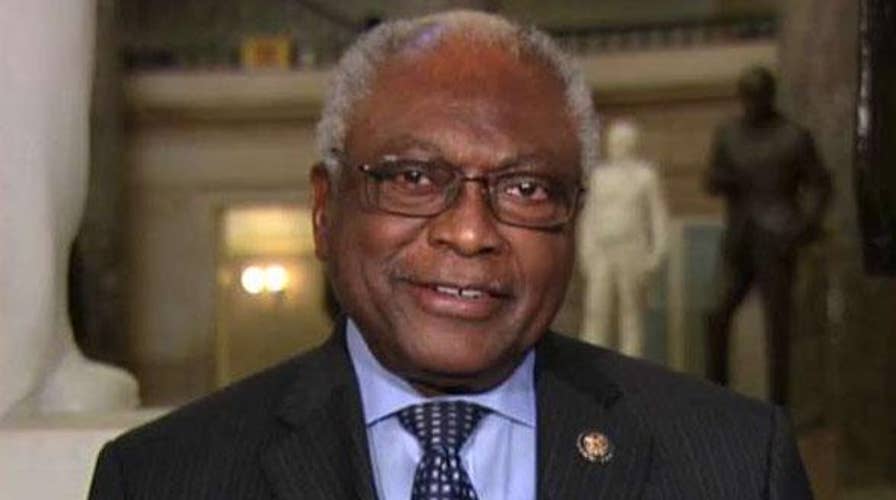
House Majority Whip Rep. Clyburn: Democrats don’t have anything against a 'smart wall'
South Carolina Democrat Rep. James Clyburn says he is against a 30-foot-high concrete wall, will support reinforced fencing and technology upgrades to secure the southern border.
This is a rush transcript from "Your World," February 6, 2019. This copy may not be in its final form and may be updated.
NEIL CAVUTO, HOST: All right, thank you, Shepard.
And after the delivery, could, could, could we have a deal?
Welcome, everybody. I'm Neil Cavuto.
And the day after the president's big speech, House Speaker Nancy Pelosi is signaling -- signaling, I add -- that we could be close to a bipartisan deal on border security maybe by Friday, and that she's prepared to support it.
But will the president be OK with it? Let's just say we're all over it with House Majority Whip James Clyburn on just how close both sides might be to a deal, that in a moment.
First, FOX team coverage with Fox Business Network's Blake Burman at the White House and Peter Doocy on Capitol Hill.
We begin with Peter on where those folks could stand.
Hey, Peter.
PETER DOOCY, CORRESPONDENT: Neil, there's apparently been a big change from when that bipartisan committee met on camera last week, and nothing happened, no progress was made, and today, when they met in person, in private.
(BEGIN VIDEO CLIP)
SEN. RICHARD SHELBY, R-ALA.: Strong words. I'm working toward that goal. We're hopeful. The tone is good between the various members of the conferees. We're dealing in substance now, something we haven't done before.
(END VIDEO CLIP)
DOOCY: Today's action away from the cameras included a classified briefing, where DHS officials and border experts gave security-based intel about what specifically is needed along the border to keep illegal people and products out. It wasn't a political briefing.
But part of the reason Democrat Henry Cuellar thinks the White House could be willing to sign a compromise measure happened with millions watching. President Trump never used the word shutdown last night.
And Speaker Pelosi says, whatever this bipartisan group comes up with is going to have her blessing.
(BEGIN VIDEO CLIP)
REP. NANCY PELOSI, D-CALIF., SPEAKER OF THE HOUSE: I told them, whatever you all come to agreement on, bipartisan agreement, I will support. I hope that the administration would have the same attitude and respect the appropriations process. Of course, I'm an appropriator, and I know they can find agreement.
(END VIDEO CLIP)
DOOCY: Many Democratic lawmakers brought guests last night to the State of the Union who were negatively affected by the last government shutdown.
And now the lawmakers they shared the House chamber with for the president's address think they are closer to avoiding another one -- Neil.
CAVUTO: All right, Peter, thank you very, very much.
And now to Blake Burman at the White House with what they're saying there.
Hey, Blake.
BLAKE BURMAN, CORRESPONDENT: Hi there, Neil.
It was the vice president, Mike Pence, earlier today in an interview this morning with CBS where he was out defending one of the more talked-about lines from the president's State of the Union address last night, in which the president denounced congressional investigations.
The vice president saying today in that CBS interview that the president was talking about investigations have -- quote -- "partisan tint."
Of course, the president said last night at one point -- quote -- "If there is going to be peace and legislation, there cannot be war and investigation."
But the vice president clarifying today exactly what the president had meant there.
Seemingly on cue, it was the top Democrat in the House Intelligence Committee, Adam Schiff, who announced that his committee would be launching an investigation into Russian interference during the 2016 election, including whether Russia holds any financial leverage over President Trump, his family or the Trump Organization.
Earlier this afternoon, the president was asked about it and dismissed that probe.
(BEGIN VIDEO CLIP)
PRESIDENT DONALD TRUMP: Under what basis would he do that? He has no basis to do that.
He's just a political hack who's trying to build a name for himself. And I think that's fine, because that's what they do. But there would be no reason to do that. No other politician has to go through that. It's called presidential harassment.
(END VIDEO CLIP)
BURMAN: The president saying today, Neil, that he felt that his speech went over well, as it was -- quote -- "loving words and words of compromise" -- Neil.
CAVUTO: All right, Blake, thank you very much, Blake Burman.
Was this the moment that is getting things moving today? Take a look.
(BEGIN VIDEO CLIP)
TRUMP: We must choose between greatness or gridlock, results or resistance, vision or vengeance, incredible progress or pointless destruction. Tonight, I ask you to choose greatness.
(CHEERING AND APPLAUSE)
(END VIDEO CLIP)
CAVUTO: Well, he said greatness of number of times. He did not utter the word shutdown. He did not utter the word emergency. He did not say my way or the highway throughout any of his remarks.
And Mark Weinberg noticed, Mark, of course, Ronald Reagan's former assistant secretary, selling author.
And you were helping me on our coverage on FOX Business, Mark. And one of the first things that came to mind is this reaching across the aisle, this idea that, much like the Gipper, Ronald Reagan, each side has a chance to help the other side. He exercised that last night.
What did you think?
MARK WEINBERG, FORMER REAGAN ASSISTANT PRESS SECRETARY: It was a good move. It's the right thing to do. He's got to go beyond his core base and bring in people.
After all, the House now is controlled by Democrats. And Donald Trump is president of all the people. He's not just president of his base. Reagan knew that. He reached across the aisle.
Remember, there were things called Reagan Democrats or Blue Dogs?
CAVUTO: And the Boll Weevils all that, right.
WEINBERG: Right. Right.
And remember the relationship that Reagan developed with Tip O'Neill, the speaker. That was perhaps the most important relationship that he had congressionally as president.
Now, it's interesting too, because Reagan was famous for whatever we get out of a deal, do not make the other side look bad. Each side has got to walk away from this feeling that they got something. So if we get something we really like, don't rub it in their faces. John Kennedy pretty much the same way when negotiating tax cuts that sadly came to fruition after his death.
I'm wondering whether the president was taking a page from history there.
WEINBERG: I hope so. I mean, it was on the eve of -- today would be Reagan's 108th birthday, by the way.
CAVUTO: Is that right? Wow.
WEINBERG: Yes. He would be 108 today, the Gipper.
So maybe President Trump was thinking about him a little bit last night. I sure hope so. But you're right. You can't spike the ball. You have to -- everybody has to go home and be able to declare victory. And that's the only way they come back the next day.
CAVUTO: Now, of course, he and Tip O'Neill, Ronald Reagan, developed a personal relation that often meant negotiating late into the night at the White House residence.
WEINBERG: Right.
CAVUTO: I believe some alcohol would be involved there.
WEINBERG: Well...
CAVUTO: But whatever works, right?
WEINBERG: Right.
CAVUTO: I'm just wondering whether this president and, for example, Nancy Pelosi could enjoy the same type of relationship. But it doesn't seem likely.
WEINBERG: It doesn't seem likely.
But that's OK. They're different people. And it's a different time. That doesn't mean they can't work together. I mean, after all, they're both politicians. They are both there to do the business of the people and make the country better. And if they work to find what they have in common, not what divides them, they will get it done.
CAVUTO: Do you think it's enticing? I don't know whether Ronald Reagan did this, but maybe you can help me with this Mark.
The idea that, look, we make progress on this. Look at the other areas where we have pretty broad and bipartisan agreement, lowering drug prices, infrastructure. What do you think? That was a teaser?
WEINBERG: Maybe so.
Progress begets progress. And if they get one success under their belt, and it feels good, they're more inclined to work toward another area of working together, like on sentencing reform. That was good for everybody. And they should use what they got -- how they got there to move forward on other issues.
CAVUTO: You were the first to seize on something that happened last night that a lot of people have been talking about ever since.
When the president gave his speech, obviously, to the vice president and gives it to Nancy Pelosi, the speaker, shortly thereafter, he immediately began speaking.
WEINBERG: Right.
CAVUTO: And there was not the normal introduction, where the speaker says, ladies and gentlemen, I give you the president of the United States. There's a lot of applause and all. That never happened. Why not?
What do you think?
WEINBERG: I don't know if he jumped the gun or if he just didn't want her to introduce him, because usually the speaker says, I have the distinct personal privilege and the high honor of presenting to you.
CAVUTO: Right. Right.
WEINBERG: But he -- maybe he was just anxious to get started.
CAVUTO: Mark, you were telling me too there's something special about this venue.
The president, when the speech was first delayed by Nancy Pelosi, he could have done it on the Senate side. It would have been problematic. Or you could have given it in the Oval Office or anywhere else.
But you had said, no, there's something about that locale that matters. It's historic. It's significant. It's a stage like no other.
WEINBERG: It's iconic.
The president of the United States, with the speaker and vice president behind him, and that giant flag and that chamber, there's no other forum quite like that. And it says something about our country and that at the end of the day, we're all Americans.
CAVUTO: I was forgetting that in 1983, when Ronald Reagan gave his State of the Union address, his popularity had plummeted. There were a lot of people saying, there's no way in heck this guy's going to be reelected.
The same kind of sentiment builds, at least among Democrats, who say Donald Trump has no chance at all. History is a funny thing. And, of course, in the 1983 State of the Union address, Reagan knocked it out of the park. And everything was going up from there. The economy picked up considerable steam. The rest is history, as you remind me.
What can this president and maybe people following him learn from that?
WEINBERG: That you never count a president of the United States out or down. Political fortunes can turn on a dime.
And if presidents keep their word and do what they say they're going to do, they're a lot more likely to generate popular support than if it's just empty rhetoric.
CAVUTO: Well said, Mark Weinberg, the former Reagan assistant press secretary, bestselling author.
We're also following some things close to Washington, D.C., like the scandals mounting, and they're running out of prospective governors in waiting.
The three top Democrats in the state of Virginia are all apparently tainted, or the very least controversial. And the fourth guy in line to be governor, so far, we don't know much about his personal life. What we do know is, he's a Republican. And some Virginians are so confused.
(COMMERCIAL BREAK)
CAVUTO: Just in case, can they find anyone potentially to run the state of Virginia? Because they're running out of options in what looks increasingly like it could be a constitutional crisis.
First, the governor, Ralph Northam, as you know, was hit by a racist photo on his yearbook page that dates back to 1984. He's trying to hang on to his job. And now the woman accusing Lieutenant Governor Justin Fairfax, who would be normally his backup, well, he's trying to fight all of these assault charges himself, and she is not letting up.
Then the state's attorney general, Mark Herring, admitting he too wore blackface at a college party that dates back to 1980.
Where do we stand in this mess?
Garrett Tenney has been following it all in Richmond, Virginia.
They're running out of options, Garrett.
GARRETT TENNEY, CORRESPONDENT: Yes, they quickly are, Neil.
And a lot of folks are wondering what happens if we have the fourth in line that isn't able to do this as well? That would be, interestingly enough, a Republican, the speaker of the House, who would become -- if the governor, the lieutenant governor and the attorney general, if they are not able to fulfill that role, it would fall to him.
So a Republican would then be leading the state because the three Democrats ahead of him had to step down from office. There are no indications yet that any of those three men are going to resign. But, today, Attorney General Mark Herring said he is certainly open to doing that if the circumstances call for it in the days to come.
It's interesting. Just a few days ago, he called on Governor Ralph Northam to resign after the governor had that racist yearbook picture and admitted that he wore blackface back in the '80s. Well, today, Herring admitted he too wore blackface.
He said he was a 19-year-old undergrad, that he and some friends dressed up like rappers and wore brown makeup to a party.
Now, in a statement, he said the memory of that experience has haunted him ever since. And he continues that: "I have contributed to the pain Virginians have felt this week is the greatest shame I have ever felt. In the days ahead, honest conversations and discussions will make it clear whether I can or should continue to serve as attorney general."
Well, today, we also heard from -- for the first time from the woman who is accusing Lieutenant Governor Justin Fairfax of sexual assault. Dr. Vanessa Tyson recounts in graphic detail her encounter with Fairfax from 15 years ago, saying: "What began as consensual kissing quickly turned into a sexual assault. Mr. Fairfax put his hand behind my neck and forcefully push my head towards his crotch. Only then did I realize that he had unbuckled his belt, unzipped his pants."
And she goes on to say that Fairfax forced her to perform oral sex even while she was gagging and crying.
Now, that account stands in stark contrast to that, that the lieutenant governor has given, saying that their encounter was completely consensual. And he walked back today as well, Neil. After attacking her credibility, he said today every survivor deserves to have their story told -- Neil.
CAVUTO: Now, Garrett, if none of the principals involved, the governor, or the lieutenant governor, or the attorney -- any of them do not want to step down, because this is all pre-office behavior, they can't go anywhere, right?
So everyone is locked in place.
TENNEY: Yes, it is not clear that, at least for the blackface controversies, that there is an impeachable offense there.
And there are a lot of questions if they try to take that route that it would even be able to amount to anything. So, if these controversies stand and these men stay in office, a lot of Democrats at the state and national level are worried that this will be a black eye the party, that it'll hurt their chances of retaking control of the Statehouse here in Richmond.
But also remember, Virginia is a key swing state. And in the 2020 elections, that is going to be very important. And they worry if you have the governor, lieutenant governor and the attorney general, all Democrats, the top three Democrats in the state they have this hanging over them, that that will make it a lot harder to convince African-American voters in Virginia and to really rally the base to come out and vote for the 2020 presidential candidate -- Neil.
CAVUTO: Incredible. Garrett, thank you very, very much.
As we were pointing out here, the fourth in line for that office would be the speaker the House of Delegates in Virginia. It's Kirk Cox. He is a Republican. So you can imagine Democrats not too keen on that fallback scenario.
The read from the House Majority Whip and Democrat James Clyburn on what happens next -- after this.
(COMMERCIAL BREAK)
(BEGIN VIDEO CLIP)
TRUMP: The United States military, our coalition partners and the Syrian Democratic Forces have liberated virtually all of the territory previously held by ISIS in Syria and Iraq.
It should be formally announced, sometime probably next week, that we will have 100 percent of the caliphate.
(END VIDEO CLIP)
CAVUTO: All right, the president saying a big announcement is expected next weekend, and that U.S. and coalition forces will have reclaimed all, he says, as 100 percent of ISIS caliphate in Syria and Iraq.
Rich Edson at the State Department with more on that.
Hey, Rich.
RICH EDSON, CORRESPONDENT: Hey, good afternoon, Neil.
And despite that potential announcement for next week, the president acknowledges that this anti-ISIS coalition that met here at the State Department today is likely going to have to continue meeting for years to come, because the justification that is that, as ISIS loses its territory, it's tactics are changing.
And those tactics, according to administration officials, are to launch insurgent attacks in Northeastern Syria and in Iraq in an effort to try to destabilize those areas.
Despite that, the president says he is still moving forward with plans to remove the 2,000 or so U.S. troops that are fighting and are in Syria. Secretary Pompeo is defending that decision. He says that as ISIS loses its territory, the U.S. will change its tactics, more law enforcement tactics, intelligence, rely on that less than the military, though there is some disagreement in Washington with that.
You do have some members of the military who have been testifying this week, saying that the U.S. will lose some ability, it will be difficult to keep the pressure on ISIS if the U.S. does move forward with the plans to remove all of its troops out of Syria.
Officials here are also preparing for another foreign policy challenge, that of North Korea, as the president announced yesterday that he's going to meet for a second summit with Kim Jong-un later this month in Vietnam. And the president says if it weren't for his diplomacy, there'd be a much different scenario when it came to North Korea.
(BEGIN VIDEO CLIP)
TRUMP: If I had not been elected president of the United States, we would right now, in my opinion, be in a major war with North Korea.
(END VIDEO CLIP)
EDSON: Though opponents of the president's diplomacy say that North Korea has yet to really dismantle much or any significant portion of its ballistic missile program or its nuclear weapons program.
And there's now reporting out that the United Nations is soon going to come out with a report that says that North Korea is hiding its ballistic missile weapons and its nuclear weapons to avoid any type of damage from a U.S. military strike -- Neil.
CAVUTO: Rich Edson, thank you very much, my friend.
To retired Brigadier General Anthony Tata.
General, very good to have you.
What do you think about the president was saying, had he not come into office, by now, we'd be at war with North Korea?
BRIG. GEN. ANTHONY TATA, RET., U.S. ARMY: Well, I think it's a fair point.
When you look at Kim Jong-un, up until about a year ago, a little more than a year ago, he had launched 80 ballistic missiles and tested seven nuclear weapons. And so since the Trump administration has been applying the maximum pressure campaign, there's been no ballistic missiles and no nuclear tests.
So I think, yes, it's Occam's razor, right? The simplest explanation is the truth. I think since this maximum pressure campaign with Kim Jong-un in North Korea, we have been successful in suppressing the North Korean drive to launch ballistic missiles and test and deploy nuclear weapons.
So, at the end of the day, we are making progress. Nobody is pretending that we're there yet. But before President Trump, it was the wild West, and they were launching missiles and testing nukes.
CAVUTO: Well, they were launching missiles, right, General?
I'm just wondering the behavior of launching missiles doesn't necessarily mean it's provocative. You're quite right. But whether it would amount or degrade into outright war between our countries, you don't think that's a bit of a stretch?
TATA: Think a short round, Neil, comes into Japan. They're an ally, and suddenly you have a confrontation on your hands.
CAVUTO: Right.
TATA: And so World War I started with sort of a mistake, right?
CAVUTO: Fair enough. Fair enough.
TATA: So, yes.
When you look at it, the chance for mistake is high, when you're launching that number of ballistic missiles and testing that number of nukes.
(CROSSTALK)
CAVUTO: Yes. Yes. Anything could happen. Anything could happen.
TATA: Right.
CAVUTO: But, General, I did want to get your take, first of all...
TATA: Sure.
CAVUTO: ... on this second meeting with Kim Jong-un.
And many are concerned that we're rewarding un with an audience with the president of the United States. It's a big deal, and he has -- and has done little to show for it.
There's a separate military intelligence report that was out last week that says authorities have a very hard time locating where missiles are, and that actually they might be hiding some.
Now, it wouldn't be the first time critics of the regime have said stuff like that. But you would think we would want to resolve that one way the other before rewarding him with a sit-down with the commander in chief. What do you think?
TATA: Yes.
Well, Neil, you got to imagine that there are forces here in the United States that don't want this to happen, the military industrial complex and so forth. So the reports are accurate and inaccurate as they may be.
But what's happening on the ground, my sources tell me, we have had over 20 guard posts dismantled, over 20 mine fields removed, that the -- Kim and that North Korea and South Korea are working toward unification of the peninsula.
And this is part of a larger campaign, as Secretary Pompeo said, as the president has said. This is a larger campaign to unify the Korean people and to get to denuclearization. And so whether or not they have destroyed their nukes and all of that, that is to come.
And if you're Kim, that's your hole card. And you're going to make sure that the United States is living up to its end of the bargain, which we will, I am sure.
So I think that we're jumping the gun a little bit in prejudging. I think the president is right to have this second meeting. I don't think it diminishes him. I don't think it aggrandizes Kim at all.
CAVUTO: OK. And you might be right.
I know Mike Pompeo, the secretary of state, was telling our Maria Bartiromo just that, that there's been enough progress to warrant these talks. So we will see what happens.
TATA: Right.
CAVUTO: General, thank you very, very much.
TATA: Thank you, Neil.
CAVUTO: You know what people forget on this argument over what happens to the wall and legal immigrants is this president's record on legal immigrants, those who legally become American citizens.
He says he wants the greatest numbers ever. What if I told you he already has them?
(COMMERCIAL BREAK)
CAVUTO: Who knew? Nancy Pelosi says we might be close to securing a deal that can avoid a government shutdown or declare an emergency.
The read from the House majority whip, James Clyburn, right after this.
(COMMERCIAL BREAK)
(BEGIN VIDEO CLIP)
TRUMP: I want people to come into our country in the largest numbers ever, but they have to come in legally.
(END VIDEO CLIP)
CAVUTO: And many are, in record numbers.
Forget about the president's goal to get the highest numbers ever. We are at or around that level right now. In the first half of the most recent fiscal year, 2018, better than half-a-million, 542,011. If you average it out over the last couple of years, including the 1,127,000-plus who came into this country in 2017, the pace does show record levels.
In other words, the process to become a legal U.S. citizen or to get your green card or both is at record levels, with a president who many have said is doing anything but to keep immigrants of all sorts out.
Legal vs. illegal, it is a point we discovered is lost on those who sort of morph the two subjects together. We thought we should point that out. Regardless of whether you're Republican or Democrat, conservative or liberal, legal immigration to this country is at or near record levels as things stand right now.
Arizona Republican Congressman Andy Biggs.
Congressman, a lot of people don't know that. What do you make of that?
REP. ANDY BIGGS (R), ARIZONA: Well, I think it doesn't fit the narrative that they try to create against this president, which is that he's some kind of xenophobe, that Republicans are xenophobic, they don't want these great diverse immigrants to come in.
And the reality is, as you said, we're having more immigrants come in legally per year, every year. And we -- and so they conflate those folks with the -- those who come in the country illegally.
And they just can't do it. But that fits their whole narrative on everything from law-abiding folks, to education, to participation in the United States of America's civil community. So it really doesn't fit their narrative to do this.
CAVUTO: Congressman, in the meantime, much of the controversy is at the border, and, as you have indicated, what we do about those who try to illegally cross the border.
There are hints of a deal between Democrats and Republicans that could get the blessing of the chiefs on both sides, Mitch McConnell in the Senate and Nancy Pelosi in the House. And that seemed to hint when Nancy Pelosi indicated a deal was close that it might involve funding for a wall.
What do you know?
BIGGS: Well, I'm hearing that she said something trying to walk back from her position that she had put herself in a corner.
The question is -- and this is where it's always been, Neil -- is if she decided that she could fund the wall, does she deliver enough votes on the Democrat side to offset whatever they're going to give up for that wall?
And we just simply don't know. And today they were having a meeting, and I just haven't -- I haven't heard anything of the outcome of that meeting yet.
CAVUTO: All right, now, part of the argument then would be, we will give you something for a structure. They might not call it a wall. The understanding would also be that the president might get the $5.7 billion he wants, but that in between these sharp areas is a gray for maybe $3.5 billion worth of funding and security of the border.
They just won't call it a wall, but it will be kind of like a wall.
BIGGS: Right.
They're calling it enhanced -- an enhanced barrier, Neil.
CAVUTO: Right.
BIGGS: So, this is the great way Washington works. They have got a little office. They must have a little office somewhere where they come up with these terms, enhanced barrier.
But enhanced indicates that it's going to apply to the barrier that's already there, which makes me wonder, how much is she willing to give for a new barrier?
CAVUTO: So, if you heard that you have got a package together that would call for an enhanced barrier protection or what have you, that would not pass muster with you?
BIGGS: Well, and probably most of my colleagues that I talk to. We want to know what's going to happen with that. What do you mean when you say enhanced barrier?
Are you talking about putting up new set of paint on the structure that we already have? Are you putting razor wire or concertina wire on this? What are you doing? Or are we going to get some new fencing in places that we need new barriers?
CAVUTO: So when it comes to DACA and doing something on that for the children of illegals who got in this country through no fault of their own, they're in this limbo, that doesn't sound like you could get something comprehensive on that done by Friday in order to get it voted on by next Friday.
BIGGS: Yes, I doubt that that's going to happen.
I mean, first of all, the DACA population hasn't been clearly defined, actually. I mean, are we talking the 690 that actually registered or the more million or several million, depending on who's estimating?
So it's really hard for them to clarify that. It's really hard for them to clarify enhanced barrier.
And let me put it this way. It's not really hard to clarify that. They're making it far harder than it needs to be, the people that are negotiating this thing out, because the people voted for a wall. That's what they want. That's what they thought they were getting.
CAVUTO: All right, even though polls say just the opposite here. But we will see what happens.
BIGGS: Yes. We will see.
CAVUTO: You should hear what they have been saying about Republicans.
In fact, fair and balanced, Congressman, we're going to talk to your counterpart, the House majority whip, James Clyburn, on this very issue right after This.
BIGGS: Yes.
CAVUTO: Thank you, sir.
BIGGS: Thanks, Neil.
CAVUTO: We will have more after this.
(COMMERCIAL BREAK)
CAVUTO: So, are they closer to a deal on border security? No less than Nancy Pelosi hinting at that.
Let's get a sense from James Clyburn of the beautiful state of South Carolina. He is number three in House leadership, the majority whip.
Sir, very good to have you. Thank you.
REP. JAMES CLYBURN, D-S.C.: Thank you so much for having me by.
CAVUTO: All right, let me get a sense from you. Where do you think we stand? What was Nancy Pelosi talking about when she was sending these signals? What is she looking at?
CLYBURN: Well, I don't know what signals Nancy may have sent, but I know what I have been saying from the beginning.
We don't have anything against a wall, so long as it's a smart wall. Define what a smart wall would be, one that would use drones to make it too high to get over, one that would use X-ray equipment to make it too wide to get around, and that would use scanners to be so deep, you can't burrow under it.
That, to me, would be a smart wall.
And, having said that, I do believe that we have to put in infrastructure, reinforce the fencing that may be already in place, especially at the ports of entry. We need to upgrade these ports of entry, make them welcoming, and equip them with the equipment they need, the technology that they need, because 90 percent of all the drugs coming into the country are coming through the ports of entry that are ill-staffed, and people are ill- prepared and unequipped to do anything about.
(CROSSTALK)
CAVUTO: I apologize.
You don't have a problem with a wall, per se?
CLYBURN: Well, I'm against a concrete, 30-foot-high monument.
CAVUTO: Well, so is the president. He has moved to steel and slats and the intelligent dividers and all that. So you're closer to the same page there, I guess.
CLYBURN: Well, we may be.
CAVUTO: Yes.
CLYBURN: I'm all for using the information that comes from the experts that hopefully we will employ to tell us, what's the most effective way to secure our border?
That's what we want to do. And that's what the president seems not to want to do.
CAVUTO: Well, I don't know. He has talked about that.
But let me ask you, sir.
CLYBURN: Well...
CAVUTO: Just to be clear, there was a point when Nancy Pelosi had called a wall immoral. Do you believe that a wall was immoral?
CLYBURN: She was talking about a 30-foot-high concrete wall. If you recall, at the time she said that, that is what was on the table.
The president has since taken that off of the table, as you just said.
CAVUTO: So when she was talking a wall being immoral, she was talking about a 30-foot concrete wall?
CLYBURN: That is the...
CAVUTO: Because I didn't get that at the time, but that's fine.
CLYBURN: Well, that's what I got at the time.
CAVUTO: Understood. Understood.
CLYBURN: I don't know. Sure. OK.
CAVUTO: Now, she has also said to the Democrats who sit on this conference committee, sir, that not to feel any pressure -- I'm paraphrasing here -- whatever they come up with is fine, and then they will vote accordingly.
Is that the sentiment? Are any of the Democrats on the committee under a certain notion that, if they dare vote for something akin to a wall or whatever you want to call it, she's going to slap them down, or maybe you might slap them down?
(LAUGHTER)
CLYBURN: Nobody is going to slap anybody down.
What we want these people to do is work in a bipartisan way to reach common ground. If they were to reach common ground in that committee, that conference committee, I don't see anybody on our side being against approving their work product.
CAVUTO: Interesting.
CLYBURN: But so long as there's common ground.
Why would we put a committee together, they work hard, come up with something they all can agree on, and then we sit here and slap them down? I don't think so.
CAVUTO: Well, it's happened in the past, right, not with just Democrats. It's happened with Republicans.
(CROSSTALK)
CLYBURN: Sure.
CAVUTO: That is the way things sometimes turn.
But, Congressman, how do you think the president might or might not have fostered this process? Last night, he didn't mention declaring an emergency. He didn't mention the word shutdown.
He did sort of put everything out there and not to come up with a hard and fast, black and white, his way or the highway, approach to this. What did you think of that?
CLYBURN: Well, I thought what he did regarding that last night was very comforting. And I hope that he will stay there.
But, you know, he was there before, and double-crossed everybody, including McConnell, and just walked away from what he had already agreed to. So let's just hope that he maintains that civility on the subject as we get to a conclusion on it.
CAVUTO: Congressman, much has been said about each party is kind of captive to the extremes within it, and whether it's the president and his base, or when it comes to Democrats, your party, on the far left, that they're kind of calling the shots here, and maybe holding Nancy Pelosi to this very tough stance.
Now, that seems not to be the case as much as, if some of these signals you're talking about are true. But what do you think of that, whether it's Congressman Cortez or some of these others, that they're kind of ruling the roost? Are they?
(LAUGHTER)
CLYBURN: Absolutely not.
We have a caucus that is a Democratic Caucus in more ways than one, big D and small D. And we are going to be democratic in our approach to this.
Nancy doesn't rule the caucus. The left wing of our party does not control the caucus. We have a caucus that will function democratically in more ways than one.
CAVUTO: Congressman, I would be remiss if I didn't mention what's going on in Virginia. You're probably well aware of more than I that the governor, Ralph Northam, he's still in office. He's not resigning over these pictures that popped up from a year -- back in '84.
The lieutenant governor, Justin Fairfax, has been accused of sexual misconduct, he too not going anywhere. And I can talk about the attorney general there in the state also acknowledging controversial pictures in his yearbook that date back to 1980.
The fourth person in order in that state, if those three individuals resigned, is a Republican. I'm assuming he doesn't have such controversies.
(LAUGHTER)
CAVUTO: Would you support the speaker the House of Delegates, Republican Kirk Cox, becoming the next governor of Virginia?
CLYBURN: Well, I don't think we should get out in front of this process.
I think that the process ought to be allowed to work. All these issues are serious issues, both regarding blackface, involving MeToo. These things are serious.
CAVUTO: But should any one of those three, given some of these controversies, really even be in the offices they're in right now, if you had you way?
CLYBURN: Look, the controversy is always going to be there.
CAVUTO: Right.
CLYBURN: I don't know how much you know about my background, but I spent almost 18 years supervising the investigation of these kinds of allegations at the state level in South Carolina.
I did it for four governors, two Democrats and two Republicans. So I know how these things work. We ought to let due process take its course and then we ought to then act once that's done.
Take all these allegations seriously, investigate them, and then make a decision afterwards. I would not get out in front of this and speculate on what should or should not be the case going forward.
CAVUTO: But if it ended up with a Republican taking over the Statehouse, how would you feel about it?
CLYBURN: Well, I would not feel good about that. My goodness, I would not feel good about the governor having to leave the office.
But I think it is something that he should consider doing for the party's sake. And I would not feel good if Justin Fairfax were not given due process as it relates to the charges regarding him.
So -- or the allegations, I should call, regarding him.
CAVUTO: Right.
CLYBURN: So I'm not going to feel good about any of this. But that's not what this is about, my getting to a good-feeling place. I am all for the process working itself out.
I have a massive amount of experience in this. Now, albeit, I have been here for 26 years. And so that was 18 years prior to my coming here. A lot of may have changed since then.
CAVUTO: OK.
CLYBURN: But I don't believe due process has changed at all.
CAVUTO: All right, yes, a lot of years. I didn't know you were so old. No. Kidding.
(LAUGHTER)
CLYBURN: Well, I do.
CAVUTO: All right, Mr. Majority Whip, very -- a honor having you.
Thank you, sir, very, very much, James Clyburn, the Democrat, beautiful state of South Carolina, the House majority whip, as I said.
The fallout from what he just said and what Republicans are saying too -- after this.
(COMMERCIAL BREAK)
CAVUTO: Well, something is up.
Republicans and Democrats hinting that a deal to avoid a crisis over this wall funding could be at hand.
Let's get the read from Charlie Gasparino, The Washington Examiner's Becket Adams, Democratic strategist Danielle McLaughlin.
Becket, what does it look like? How is it forming?
BECKET ADAMS, THE WASHINGTON EXAMINER: Right now, I wouldn't put any hope into this deal they're talking about.
CAVUTO: Really?
ADAMS: I think it's going to be stretched out and it's going to look like the fight we saw over the State of the Union, just going back and forth, a lot of power moves.
Like you mentioned earlier, the Democrats pinned themselves into a corner by making this a moral issue. You can't then go ahead and agree on some form of a wall after saying this is immoral. The base isn't going like it and the Democrats are...
(CROSSTALK)
CAVUTO: Now, apparently, I learned the distinction, it was immoral if it was a 30-foot cement wall right.
ADAMS: Right. But a beautiful fence is a totally different thing.
CAVUTO: All right, could it down to semantics in the end, like what do you think call it?
DANIELLE MCLAUGHLIN, POLITICAL COMMENTATOR: I think it's all about semantics.
I think that's all -- that's where we are right now. I think Democrats talks about the morality of a sea to sea shining sea 30-foot wall in context of comments that the president and the candidate had made about immigrants, about illegal immigrants.
But Democrats have always been for some form of border security. It's in DNC platforms. They have tried to go in a bipartisan route with fencing, the Secure Fences Act of 2006. This is purely semantics.
And I think to your point they get -- this becomes about which -- whose base gets disappointed in the deal.
CAVUTO: I'm wondering, could they each get a little something and each lose a little something? That's called dealmaking. But in this environment, dealmaking is tough.
CHARLIE GASPARINO, SENIOR CORRESPONDENT: Well, yes, particularly when the base of the party controls most of the stuff.
I think the problem that President Trump has is that Mexico was supposed to pay for this thing. OK? He said that he had all the cards.
CAVUTO: One step at a time.
GASPARINO: Yes. He said he had everything. He had them by the you know what, and they were going to pay for them. It was going to be a big, beautiful concrete thing that the Mexicans were going to pay for.
And that is never going to happen, no matter how much he says it. And that's going to haunt him for the next two years. It's just not going to happen.
CAVUTO: One thing James Clyburn was just saying here is that they were encouraged by the president's olive branch offer last night, or at least the appearance of that.
But he's skeptical and concerned, clearly, that the president will do a 180 on him. Now, the president, his thinking was, I think the Democrats would do the same.
But what's your sense?
ADAMS: No, but that's -- it's the same gamesmanship.
In fact, Clyburn was the same person who said it was a nonstarter when the president offered temporary protections for DACA recipients, and at the same time he said, I want...
(CROSSTALK)
CAVUTO: There's no way DACA is going to be part of this. That's a lot to chew.
(CROSSTALK)
ADAMS: No, it's going to go back and forth.
And to what you were saying, Democrats used to be more pro-immigration. It's that fervor of the anti-Trump mentality that they have honestly fed into and they have cultivated and nurtured has made it almost impossible to do a deal.
(CROSSTALK)
ADAMS: Look, when you spend two years portraying the president as literal Hitler, they're not going to be seen doing a deal.
(CROSSTALK)
GASPARINO: I think the problem that Trump has, particularly during the campaign -- and I remember talking to some of his campaign people, like Rudy.
They would say, listen, this wall stuff is all baloney. Rudy Giuliani, all his guys around, he's never going to go -- it's just a talking point.
Well, guess what? It's a talking point that is now etched in everybody's memory and that they were going to pay for. It's hard to put that genie back in a bottle. It's hard. And, listen, both sides can copyright, fence, slats, I don't know.
But the payment, the finance of it was supposed to come from Mexico. And it's not happening. Guess what's happening? We're shutting down the government
CAVUTO: I don't know if it will come to that. I can't see a shutdown at all.
GASPARINO: We had one already.
MCLAUGHLIN: We had one already.
(LAUGHTER)
MCLAUGHLIN: And we're no further along.
CAVUTO: To redo it.
MCLAUGHLIN: His numbers didn't really take a hit the first shutdown.
CAVUTO: Well, he could declare an emergency, right? If he declares an emergency, Mitch McConnell is more concerned about that, apparently, than anything else.
MCLAUGHLIN: He should be.
ADAMS: If he declares an emergency, then he's pulling from the Defense Department budget. And if he wants to try to convince his base that it's better to take money from the military, good luck with that.
GASPARINO: Well, Mitch McConnell is more worried about the precedent.
(CROSSTALK)
CAVUTO: But doesn't it take the monkey off his back to say, all right, well, I tried? And a court is going to shoot him down anyway along the way, until this goes maybe up to the Supreme Court.
ADAMS: Right, which goes to the point I was making earlier, that this is just going to be a series of oneupmanship and gamesmanship.
CAVUTO: You don't they're going to score a deal?
ADAMS: Not -- I don't think either side wants to be seen as...
(CROSSTALK)
CAVUTO: You're a very jaded young man.
ADAMS: I am, very cynical.
(CROSSTALK)
CAVUTO: What do you think?
GASPARINO: Mexico is never going to pay for the wall, and that's going to haunt Trump for the next two years.
CAVUTO: Actually, they're sending you the bill.
(LAUGHTER)
(CROSSTALK)
GASPARINO: You know what's going to happen when this is over? It's going to be "No trespassing" signs.
CAVUTO: You know, that's rich.
(LAUGHTER)
CAVUTO: All right, guys, I want to thank you very, very much.
Again, we don't know how these talks are going. We know enough that they appear to be making progress, but in time for this thing next Friday? Who knows.
More after this.
(COMMERCIAL BREAK)
CAVUTO: You know, a lot of critics say, you know, all you news guys do is report the bad news.
Here's some good news I want to leave you with. GM is sharing the better- than-expected financial news, rewarding its hourly workers with better than $10,000 bonuses. So, there.
Content and Programming Copyright 2019 Fox News Network, LLC. ALL RIGHTS RESERVED. Copyright 2019 ASC Services II Media, LLC. All materials herein are protected by United States copyright law and may not be reproduced, distributed, transmitted, displayed, published or broadcast without the prior written permission of ASC Services II Media, LLC. You may not alter or remove any trademark, copyright or other notice from copies of the content.
