


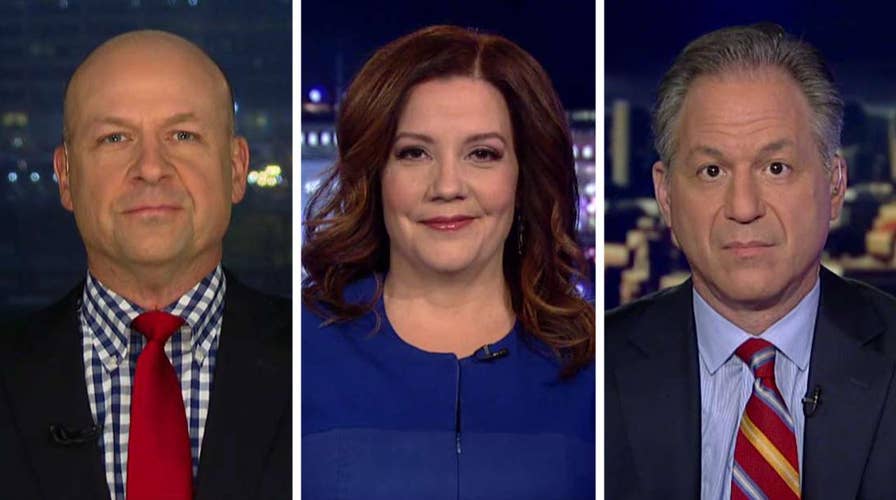
House Democrats prepare impeachment resolution amid GOP criticism of process
Trump defends Ukraine call as Democrats ramp up efforts; reaction and analysis from the 'Special Report' All-Stars.
This is a rush transcript from "Special Report," October 30, 2019. This copy may not be in its final form and may be updated.
(BEGIN VIDEO CLIP)
REP. TOM COLE, R-OK: The process laid out in the resolution before is different from the processes used for both President Nixon in 1974 and President Clinton in 1998.
UNIDENTIFIED MALE: I'm understanding the process is the same as what we've always used in this type of proceeding.
REP. DEVIN NUNES, R-CALIF.: We don't even get any witnesses at this point. And it doesn't look like we're going to get any ever.
REP. ADAM SMITH, D-WASH.: The minority has never had the right to unilaterally subpoena witnesses. All they have ever had is the right to ask for a subpoena.
SEN. LINDSEY GRAHAM, R-S.C.: The president's counsel can't participate, so I think it's very inadequate.
REP. AL GREEN, D-TX: When we first impeached Andrew Johnson in 1868, it really was not this complicated.
(END VIDEO CLIP)
BRET BAIER, HOST: Welcome back to the Richard Nixon Presidential Library and Museum in Yorba Linda, California, talking about the impeachment inquiry vote. It is scheduled for tomorrow. Meantime, we're continuing to get the lists of potential witnesses up on Capitol Hill. One big name announced today, and that is former National Security Advisor John Bolton. His testimony is seen as potentially explosive depending on what he says about what warnings happened in the White House, about the Ukraine situation and aid being tied to those investigations.
Let's bring in our panel, Charles Lane, opinion writer for "The Washington Post," Mollie Hemingway, senior editor at "The Federalist," and Tom Bevan, Real Clear Politics co-founder and president. Mollie, your take as we get ready for this impeachment inquiry vote tomorrow on Capitol Hill.
MOLLIE HEMINGWAY, SENIOR EDITOR, "THE FEDERALIST": First off, it's just interesting that there is going to be a vote. I think it speaks to how much those arguments that there needed to be a vote resonated. But there was this demand that things be fair, and this is where this -- what we know about this vote that will take place tomorrow, I don't think it's going to satisfy people who are looking for a real thorough impeachment process where the minority can subpoena witnesses and testimony and be able to ask questions without being shut down by the person running it.
It's also very interesting that Nancy Pelosi is having Adam Schiff run the impeachment inquiry instead of Jerry Nadler. I think this is because she recognizes that Jerry Nadler is very bad at running hearings. He's had disasters when he's had people, whether it was Robert Mueller, Corey Lewandowski, John Dean. Those hearings did not go well. So it's a really a testament to how little she trust Nadler, and hoping to be able to continue the semi-secret operations going on under Schiff.
BAIER: President Trump, Tom, says again and again, just read the transcript of the call. He calls it a perfect call, but read the transcript. Obviously, there was a lot of back and forth up on Capitol Hill about possible transcript omissions from some of the testimony. Take a listen.
(BEGIN VIDEO CLIP)
UNIDENTIFIED MALE: It certainly concerns me if the White House has released an incomplete transcript.
SEN. DICK DURBIN, D-ILL., SENATE MINORITY WHIP: The fact that it went to a secret server very quickly tells me there are political forces at work here that didn't want the world to see what was even in the amended transcript.
GRAHAM: I've read the transcript, and if you add his corrections in, it doesn't change anything to me. He's entitled to his opinion. I don't doubt his motives at all.
(END VIDEO CLIP)
BAIER: So this really comes down to making the case not only for the lawmakers but for the American people in public hearings.
TOM BEVAN, REAL CLEAR POLITICS CO-FOUNDER: Yes, exactly. And I think the day-to-day stuff, the list of names, it's too in the weeds, it's too confusing, I think, for the average voter who is out around the country. And a lot of them have already chosen sides anyway.
I do think, though, if Lieutenant Colonel Vindman is correct and there was some omissions from that transcript and they materially change the import of that conversation in a meaningful way, that is something, because, as you said, this is all Trump, and the Republicans have been saying, look, I released the transcript. Read it for yourself. It's all right there. There was no quid pro quo. There was nothing wrong. If something comes out that that transcript was altered in a meaningful way, then that might be something that is a problem for the White House and for the president.
BAIER: For the longest time, Chuck, it seemed like Speaker Pelosi didn't want to have this impeachment inquiry vote because she didn't want Democrats in moderate districts that Donald Trump won to have to do this vote. Now it's coming to pass. Politically, where are those Democrats as they look at this process?
CHARLES LANE, OPINION WRITER, "WASHINGTON POST": Well, I think as time has gone on, it's become a safer vote for many Democrats who were on the fence. My understanding is there's still about five or six who are hesitant and perhaps would even vote no on this resolution, which is not per se an impeach or don't impeach, proceed or don't proceed vote. It's sort of she has arranged things so they've moved beyond that point by the time they take a vote. And I think one of the purposes of proceeding the way they are proceeding was precisely to spare the largest number of people possible from taking that, what they consider to be a high-risk vote.
But I agree with Tom that on the broader politics of this, we have seen the usual crystallization of the usual sides in America. Most of the polls tend to show people who -- the number of people or percent of people who want to see him impeached and removed is pretty similar to the number who already disapproved of him for the job he's doing. So that sets up a decision about the timing for this for the Democrats, about how much longer they're going to go before they really do fish or cut bait on an impeachment vote in the House, and they have to determine when the extension of the hearings and so on will start to yield diminishing returns.
BAIER: Mollie, just to put a finer point on it, these four Democrats have not said whether they would support an impeachment inquiry or not, Representatives from New York, Oklahoma, Minnesota, New Jersey, all in districts that Donald Trump won in 2016.
HEMINGWAY: I think it's worth asking the question why this is even happening. It's not about whether the House will impeach President Trump or not, although that is something of a debate. They have clearly been wanting to do it since the day after the election. They have been looking to impeach him. The question is, knowing that he won't be convicted in the Senate, why so much time is being wasted on this.
It's getting complicated. I want to clarify something really quickly. It is true that the Schiff team did leak to "The New York Times" that the transcript had been materially missing some key information. That was refuted by other officials. The fact is that none of us actually know because it's all been done in secret. We don't know what the testimony was yesterday. We can only know what Adam Schiff and his team selectively decide to leak to shape a narrative.
And that speaks to this unfairness of the whole process. In order for impeachment to have legitimacy beyond that core group of people that Charles was just talking about who already don't like the president, you have to run a fair process. And doing it secretly, selectively leaking, it reminds so much of the Russia operation that we went through for several years where you had information that was selectively leaked out and ended up with nothing. And if you don't want do have something like that happen again that people are already tired about, you need to make it as legitimate as possible. They're not doing that now.
BAIER: Yes. We've pointed out that the opening statements have come out, but we haven't seen the cross examination of some of that questioning by Republicans. Likely those public hearings would do some of that. Panel, stand by.
Next up, the latest from the campaign trail, plus a warning from a former president over the cancel culture.
(COMMERCIAL BREAK)
(BEGIN VIDEO CLIP)
BARACK OBAMA, D-FORMER PRESIDENT: This idea of purity and you're never compromised and you're always politically woke and all that stuff, you should get over that quickly. The world is messy. There are ambiguities. People who do really good stuff have flaws.
That's not activism. That's not bringing about change. If all you're doing is casting stones, you're probably not going to get that far. That's easy to do.
(END VIDEO CLIP)
BAIER: Former President Barack Obama today talking about this culture and ideological purity in his own party, warning Democrats to not be so stuck on being woke, so called. Senator Elizabeth Warren was asked about those comments today.
(BEGIN VIDEO CLIP)
UNIDENTIFIED FEMALE: Do you agree that there's a purity test in the Democratic Party? And how helpful is that to you?
SEN. ELIZABETH WARREN, D-MASS., PRESIDENTIAL CANDIDATE: I don't know what he was referring to. I guess I didn't see the comment.
(END VIDEO CLIP)
BAIER: So there is this -- whether Barack Obama factors into this Democratic primary, where this all stands. We're back with the panel. Tom Bevan, you look at this. Elizabeth Warren has been making that case on debate stages. We didn't come this far to stop fighting for the ultimate goals that they want to go for, Medicare for all, Green New Deal, the big ticket items.
BEVAN: I didn't take Obama's comments so much as a rebuke of Democrats running for president as much as sort of the cancel culture, social media. He mentioned college campuses specifically. And I loved what he had to say. I thought it was nice that someone of his stature on the left was able to say with some clarity, look, this has gotten out of hand. It needs to stop. We need to get over it and we need to move on and be more civil towards each other. And I thought it was a great thing for him to say.
BAIER: The question is, Mollie, whether the political purity message that he talked about is really going to sink into the Democratic primary. We haven't seen that. The progressives are the most fired up of the Democratic voters.
HEMINGWAY: I agree it was brave of Barack Obama, President Obama, to say this given how that message does not play well in the Democratic primary. And when we look at the poll numbers for what's happening, Joe Biden is struggling in both of the early primary states, and that excitement is with Elizabeth Warren and Bernie Sanders.
Even among the moderate votes, it's not Amy Klobuchar who is gaining steam by Pete Buttigieg. And so the excitement is definitely with the wing that does not want to be open or tolerant to a wide swath of voters. That concerns people who actually know how to win elections in the Democratic field. But it looks like it's on a collision course of some kind.
BAIER: Chuck?
LANE: Well, I would just like to step back, and I agree with both of my colleagues broadly on this. But I would just like to remind people, this is consistent with what Barack Obama has been saying for a number of years, including when he was president. He made speeches like this, if I recall correctly, at Howard University where he admonished students about cancelling speakers or trying to boycott speaker who might be not necessarily 100 percent to their ideological liking. He urged people to consume media, including FOX News and "The New York Times," the whole gamut.
And so I think he is being consistent with a message that he has put out a number of years without getting a whole lot of credit, frankly, for doing so. And I think it's actually been one of his better contributions to public debate.
I do think, though, that there is an implication from what he's saying, which is, hey, everybody, let's think about some of the people running, and he didn't have to say the name Biden because it was implied who, yes, might have said, yes, I can work with southern segregationists to get things done. That's part of politics. That's what real world politics are all about. And so yes, I think it was a very significant message coming from that messenger.
BAIER: Notably absent in that message, Tom, was any endorsement of his vice president.
(LAUGHTER)
BEVAN: Indeed. And Biden gave this interview to "60 Minutes" the other day and repeated this fiction, I think everybody knows it's a fiction, that, oh, I didn't want Obama to endorse me. I want to do earn this on my own. I don't think anybody believes that to be true. He would take his endorsement if it was offered. And we've wondered why Obama has been so silent, had not come to Joe Biden's defense even if he wasn't going to endorse him, but just to help support him when the segregationist thing came out. Obama has been pretty quiet when it comes to Joe Biden.
BAIER: I appreciate Chuck's remarks, but there were some high profile swipes at FOX News by President Obama, and he wasn't exactly pushing FOX News viewership. Mollie, final word?
HEMINGWAY: Right. I would also note that cancel culture is such that it never stops. It never relents. And President Obama probably recognizes that even if he's on the safe side of things right now, if it continues, he will soon be on the unsafe side of things, and just witnessing that can be very threatening even for someone as high profile as President Obama.
BAIER: All right, panel, thank you.
When we come back, a big congressional gamble.
(COMMERCIAL BREAK)
BAIER: Welcome back to Yorba Linda, California, the Nixon Library and Museum. This is a replica of the East Room in the White House. They are getting ready for some author to speak.
First, as we close the show tonight, a thank you for interest in my new book, "Three Days at the Brink, FDR's Daring Gamble to Win World War II," debuted today at number three on the "New York Times" bestseller list for combined print and e-books. So thank you very much, I am speaking here at the Nixon Library tonight about the book as this 12-city tour wraps up this week.
And now a World series wager of congressional significance.
(BEGIN VIDEO CLIP)
UNIDENTIFIED MALE: I just want to acknowledge my colleague from Texas, should the Astros win tonight in game seven, I will be wearing Astros gear and serving his staff Chesapeake crab cakes and Catoctin whiskey. Should the Nationals win, he will wear Nationals gear and serve my staff Texas Barbeque and Shiner beer. I would rather win than lose, but either way a group of hardworking and ill-fed staffers will be having cuisine far above their station in life.
UNIDENTIFIED MALE: I've been a Marylander for almost 30 years --
UNIDENTIFIED MALE: If you want to get confirmed, I think I --
(LAUGHTER)
(END VIDEO CLIP)
BAIER: If you want to get confirmed, easy.
Two of the best words in sports, "game seven." May the best team win tonight. I'm going to be fair and balanced, even though I think you know where I stand. But what a series, World Series on big FOX tonight.
That's it for the “Special Report,” fair, balanced, and still unafraid. "The Story" hosted by Martha MacCallum in New York starts right now.
Martha, are you pulling for the Nats?
Content and Programming Copyright 2019 Fox News Network, LLC. ALL RIGHTS RESERVED. Copyright 2019 ASC Services II Media, LLC. All materials herein are protected by United States copyright law and may not be reproduced, distributed, transmitted, displayed, published or broadcast without the prior written permission of ASC Services II Media, LLC. You may not alter or remove any trademark, copyright or other notice from copies of the content.
