








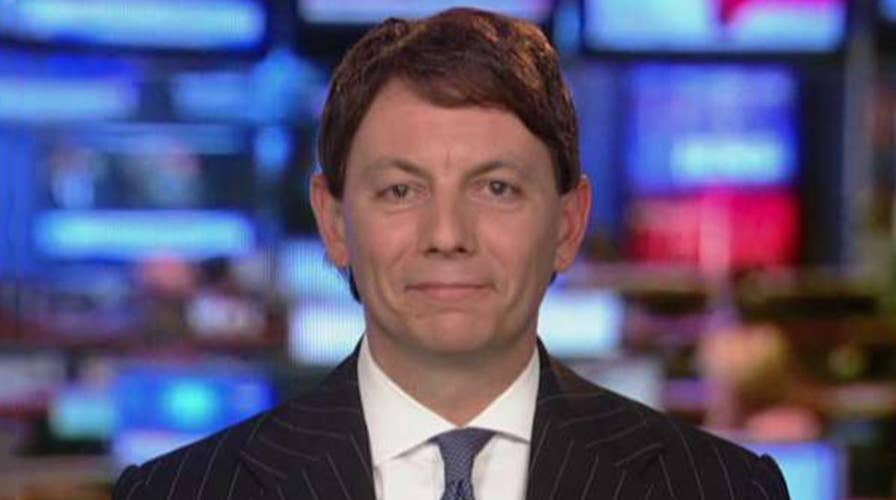
Hogan Gidley: Trump critics clueless and crazy over Mueller report denial
New York Times columnist Paul Krugman, Trump critics refuse to accept Mueller findings; White House deputy press secretary Hogan Gidley reacts.
This is a rush transcript from "The Story," April 24, 2019. This copy may not be in its final form and may be updated.
MARTHA MACCALLUM, HOST: Hey there, Bret. Good evening to you. And good evening to all of you, everybody. I'm Martha MacCallum and this is “The Story.”
You know, there's a saying that you're entitled to your own opinion but not your own facts. And perhaps that is more true now than ever in America. In the past, Americans agreed to disagree, but there were moments in our history that were largely indisputable regardless of your political leanings.
The attack on Pearl Harbor meant the United States must enter World War II. The 9/11 attack required a firm response and American solidarity in the face of terrorism. So, now we know that there was an attempt by Russia mostly to sow discord in the 2016 elections. That's a heads up for our future elections, of course.
And thankfully, we know, thanks to a two-year investigation that no American aided them in that effort. But we also now know that just as being afraid or changing your lifestyle after 9/11 was seen as letting the terrorists win is not accepting the Mueller reports findings in a way letting the Russians win if their goal was to sow chaos in American politics. They seem to still be winning on that front.
Economist Paul Krugman who predicted the day after the election that the markets would "never recover" from Trump's win. Here's what happened by the way. As you can see, this guy did not fall.
Now, says that the report confirmed that Republicans "no longer believe in American values. And it's very much up in the air," he writes. "Whether America as we know it will survive."
And he's not alone. Hillary Clinton writing tonight. "The Mueller report isn't just about a reckoning of our recent history, it is a warning about the future. This is an urgent threat, unless he's held accountable, the president may show even more disregard for the laws of the land and the obligations of his office."
Joining me tonight, Hogan Gidley, Dan Bongino, and Austan Goolsbee. We begin with Hogan Gidley, the deputy press secretary, live from Washington tonight. Hogan, good to have you with us tonight. So, you know, in that sense in terms of sowing discord in the country, we do feel as politically divided as ever even after this report.
HOGAN GIDLEY, WHITE HOUSE DEPUTY PRESS SECRETARY: Absolutely. But let's be honest, Krugman is clueless and he is crazy. He has no idea what makes this country great because everything he stands for sides with socialist countries. He is fawning over the Soviet Union and places like Venezuela. And he wants our economy to mimic that even though this president came in and bucked all of the predictions by people like Mr. Krugman himself.
Who said we would irrevocably be damaged by President Trump's economic policies. Instead, the exact opposite has happened, and as you know, we have record low unemployment with African Americans, Hispanic American, Asian Americans, women. We are going gangbusters in this -- in this economy, and that's something that he failed to predict.
In fact, he has been woefully inaccurate on so many predictions up to and including what would happen after this Muller report. Let's be honest. We've seen 2,800 subpoenas, 500 witnesses, 500 warrants, 40 FBI agents, 19 attorneys, and a partridge in a pear tree. There is no collusion, no corruption, no obstruction, a complete and total exoneration, and we are moving forward despite what Mr. Krugman claims.
(CROSSTALK)
MACCALLUM: Well, he -- all right, I hear you. And I'm sure he would -- he would disagree with some of your assertions there. But those are your opinions as you state them. He also said in his piece that the Trump administration was aware of this intervention and welcomed it. He also -- you know, we know that the report said that based on the available information, the investigation did not establish such coordination.
But what do you think -- you know, the White House should do in terms of communication to try to quell the discord? Because what we're seeing so far is a lot of pushback to these subpoenas, pushback to everything that the other side is wanting to do to continue this discord. What are you folks going to do to try to calm things down?
GIDLEY: Well, great. Well, what are we going to do? What is -- what is the media and the people like Paul Krugman going to do? 93 percent of the coverage against this president is negative. They pushed a lie on the American people. And said, the president was guilty of treason.
(CROSSTALK)
MACCALLUM: Understood, but that's not the question that I ask you.
GIDLEY: Right.
MACCALLUM: I asked you what the -- what the White House -- because as you look at this, you know, I think it's true that if the Russians wanted to sow discord, they must still be laughing all the way because it's still happening. It's still happened, right? Despite the findings of the Mueller report.
(CROSSTALK)
GIDLEY: With that -- that's because they have willing -- with that's because they have willing partners in the Democratic Party and most of the mainstream media. Listen, we've reached across the aisle, the president has had Democrat leadership, and the rank-and-file over to the White House to have conversations about how we move forward with things like infrastructure, things like immigration, health care.
In the State of the Union, he said, you guys have a choice, we can move forward on getting some policy, accomplishments for the American people, bettering our country, or you guys can focus on investigations. They have done nothing in the first 100 days except push lies on to the American people with no proof and no evidence. And they wanted it to be true so badly that now they have nothing to say.
And while I understand, the reason they cannot backtrack, they have to double-down is because then they would be admitting that the last two years of their life has been a complete and total a waste of time.
(CROSSTALK)
MACCALLUM: All right, let me ask you one more question before, before I'm out of time. You know, did the criticism against the White House is that not recognizing the attempts that were made in terms of the hacking, and in terms of the -- you know, the Facebook purchases.
And we heard Jared Kushner talking about that yesterday, you know, saying that really, in terms of the actual technical attempts, they were not really that significant. But are you concerned about future elections, and do you feel like the president looks at that as sort of some kind of acceptance that they were able to middle -- meddle in the elections as something that he doesn't want to talk about as Kirstjen Nielsen said?
GIDLEY: No. Yes. No, no, look, there are a couple of things. First of all, that story's just incorrect. But there are a couple of things here. Listen we now know --
(CROSSTALK)
MACCALLUM: How was that story incorrect?
GIDLEY: Well, we -- that conversation never happened. Mick Mulvaney said it never happened. And the fact remains that while the Democrats continue to push this lie, we know a couple of things. One is that the Russians did not affect the outcome of this election, the president was elected freely and fairly.
And we also understand that this happened under Barack Obama in 2014, he did nothing in that time. This administration has now done something that no other administration has done in history.
We now work with state, local, and federal officials to share intelligence. We've brought in the Department of Homeland Security, the Department of Justice, the FBI. We're already conducting at the local level breach tests. We're working on trying to hack into our own elections to see how we can better protect the American people and the vote.
The Barack Obama administration did none of that. We are stopping it, it's unacceptable. This president has called out Russia from the get-go when other cut -- when other presidents like Barack Obama sat in the Oval Office and told Dmitry Medvedev that he'd be happy to work with him after the election was over. He'd have more flexibility, we've done the office.
(CROSSTALK)
MACCALLUM: All right, all right. I got -- I got your point. Hogan, thank you very much. Good to see you tonight. Thanks for being here.
GIDLEY: Thank you.
MACCALLUM: Also here tonight, Dan Bongino, host of the "Dan Bongino Show", and a Fox News contributor. And Austan Goolsbee, former chief economist for President Obama. Good to have you both here tonight.
You know, I guess that that's what it goes back to. You know, when you look at this, Austan, and you think about what happened, and that some of it happened under President Obama's watch.
And you know, when you talk about Hillary Clinton writing these -- you know, sort of frightening editorial tonight about what she -- her concerns are with regard to the president, and what he might do in the future. That raises all kinds of questions too about the dossier and that who purchased that intelligence in the first place, since, perhaps, some would say started the whole thing.
AUSTAN GOOLSBEE, FORMER ECONOMIC ADVISER TO BARACK OBAMA: I guess I would say try to tone down your inner conspiratorial critic. I think the impact of a Hillary Clinton op-ed is something totally different than looking at the Mueller report. I think, if you look at the Mueller report, a, I'm happy I'm thrilled that there was not active collusion cooperation, whatever you want to call it between the administration and the Russians.
And I said before the report came out that I hope that's what it would find because that would be a really awful day for this country.
MACCALLUM: Yes.
GOOLSBEE: The thing that is more disturbing in the report -- so, that's the good side. The bad side is the president comes across as a person who's engaged in a lot of lying, and a lot of abuse of power. And I think a lot of people are nervous about that. Now, I hope that's not an accurate rendition. But it certainly seems like there are a lot of Republicans in the White House who are the ones describing his behavior that way. And I don't know what we're going to do if the president is increasingly acting in that kind of manner.
(CROSSTALK)
MACCALLUM: Dan -- OK. Dan, what do you think about that? What do you say about that?
DAN BONGINO, CONTRIBUTOR: Well, it's interesting. It kind of resets the bar. You know, Austan, saying, well, there's negative information there about Donald Trump. OK, Austan, if I subjected you to a $30 million investigation using some of the finest investigators in the world and a bunch of prosecutors, some who donated to the political opponent, by the way, for as nice as a guy you may be, Austan, and I've never had any reason to say otherwise. I assure you, I would come up with negative information on you too.
Austan, this is not a standard for criminal prosecution to put handcuffs on somebody. There's one more thing on this. You know it's fascinating, you know on July 5th, 2016 when James Comey laid out in his speech, a basically 20-minute diatribe against Hillary Clinton. That was all negative information too. And at the end, he says, "Well, let's not prosecutor her." And Democrats clapped.
And now, they get the Mueller report and some Democrats want to keep going. It's really a horrible double standard.
MACCALLUM: I guess one of the questions that -- you know, that I'm going into --
(CROSSTALK)
GOOLSBEE: That seems very misleading.
MACCALLUM: Well, I want to play this. Because, you know, when I read these -- you know, sort of dire assessments about the democracy and the American way, and people who don't have any values anymore.
I think that -- you know, you talk about the inner conspiratorial thread that runs through this. I think there is a -- perhaps, a conspiratorial thread to convince Americans that our democracy is truly in danger.
Here's another exchange. This one is Anderson Cooper and Paul Krugman. Let's play that.
(BEGIN VIDEO CLIP)
PAUL KRUGMAN, OPINION COLUMNIST, THE NEW YORK TIMES: If Trump is re- elected, if Republicans retake control of the House, what are the odds that we will really have a functioning democracy after that?
ANDERSON COOPER, ANCHOR, CNN: I mean that's a pretty terrifying idea.
KRUGMAN: If you're not terrified, you're not paying attention.
(END VIDEO CLIP)
MACCALLUM: Austan, what -- you know, what do you think about that? I mean, does that sound a little -- a little over the top to you?
GOOLSBEE: Yes, it sounds a little over the top to me. The place where I would say the thing that concerns me when I was in the Cabinet, I was called before Congress to answer at hearings. Because Congress has oversight over the administration. It constitutionally, in our check and balance system. And it wasn't pleasant to be an administration official when Republicans in Congress are running those investigations, but that is the business you've chosen. That's the way the government operates.
(CROSSTALK)
MACCALLUM: But I guess the question is, what American --
GOOLSBEE: When the administration is refusing to send its people, it's telling administration, "People, don't give Congress information because we don't want to cooperate." I do think that's dangerous.
MACCALLUM: Honestly, I feel like I've been watching this for the past several administrations, you know. Both sides ask people to appear, both sides ask for documents, you know, you can go back to fast and furious, they never get what they ask for.
But in terms of this idea, Dan, and I got to leave it up to this one. You know that the values of Americans are in jeopardy. And that we're losing our values. What do you -- what is that referring to, what values are we losing?
BONGINO: I have no -- it's insane. I don't know what basis, in fact, Krugman says it. By the way, Martha, Krugman's been wrong about just about everything. The effect of the Obama stimulus, the effect of the Trump tax cuts. You can read his stuff, it's online. You can read his predictions and how they're categorically wrong.
So, he has very little credibility on the prediction front. But secondly, what rights of you lost? Why is democracy under threat? You have more of your money back under Trump, you have more economic liberty, you're not now forced to buy health care by the government, because they wiped out the individual mandate, and he hired an advocate for school choice as his education secretary.
What rights big or God-given rights are under threat? The answer is none. Krugman is just making that up. That's absurd. It's totally out of the box, totally at the bottom.
(CROSSTALK)
MACCALLUM: Well, it's not, yes. I mean, clearly, what he's saying he's not alone, which we said at the top. Thank you very much, gentlemen. Dan Bongino, Austan Goolsbee, always great to have both of you with us.
BONGINO: Thank you.
MACCALLUM: Thank you, both. Coming up next. Should inmates who rehabilitate themselves regain their right to vote or should they? Some of them, be able to vote while they are still in prison. We are going to speak to this gentleman who was released from prison. Thanks to the criminal justice reform that was signed by this White House, and he joins me next.
(COMMERCIAL BREAK)
(BEGIN VIDEO CLIP)
MACCALLUM: Do believe that murderers and rapists or thieves or child molesters should have the right to vote from prison?
SEN. BERNIE SANDERS, I-VT, D-PRESIDENTIAL CANDIDATE: Good question. If somebody does something terrible, they're rapist, they're murder, we send them away. Sometimes we send them away from life. But I also think that integral to who we are as Americans no matter what kind of terrible things you did -- you're paying the price, maybe you're in jail for the rest of your life, but you have the right to vote.
(END VIDEO CLIP)
MACCALLUM: That was Bernie Sanders, the candidate at our town hall saying that he believes that convicted felons should be able to vote while they are still behind bars, still in prison, and he doubled down on that here.
(BEGIN VIDEO CLIP)
UNIDENTIFIED FEMALE: Does this mean that you would support enfranchising people like the Boston Marathon bomber, a convicted terrorist and murderer?
SANDERS: If somebody commits a serious crime, sexual assault, murder, they're going to be punished. But I think the right to vote is inherent to our democracy. Yes, even for terrible people.
(END VIDEO CLIP)
MACCALLUM: So obviously this is very controversial. And it got Cher's attention as well in a since-deleted tweet to her more than 3.5 million followers. She questioned, does Bernie Sanders really believe that people who are in prison who are murderers, rapists, child molesters, the Boston bomber, still deserved the right to vote, she questioned.
Here now joining me tonight is Mr. Matthew Charles who is a former prison inmate. He was the first prisoner released under President Trumps criminal justice system reform law called the First Step Act. Mr. Charles, we've had you on before and it's nice to have you back again. Thank you very much for being here this evening, sir.
You know, so I guess -- I want to get your reaction to this and your thoughts on this question of whether or not you know, rapists and the Boston bomber for example still in prison should be -- have the right to vote while they are still incarcerated.
MATTHEW CHARLES, FIRST BENEFICIARY OF THE FIRST STEP ACT: Well, I mean, it was something that was put forth and it's kind of hard for me to actually fathom due to the fact that I do know that while you're incarcerated, you do -- you lose some of your liberties. But my thing is once a person has been completely released and they paid their debt to society, and they're back in society, actually functioning paying taxes, then they should have their rights restored to vote.
But during the period that they're incarcerated, it's going to be like a complex issue because of the logistics. You got people that are incarcerated in states that they actually are not from. So, therefore, their vote will be technically consideration with their states count as well as the logistics.
You have the Election Commission as well as to prison whether it's an alignment Department of Corrections or state facility or the Federal Bureau of Prisons all working together to make sure that this person has been registered to vote because where the candidates and their positions.
So there's a lot of logistics that have to be worked out. But my thing is that restorative justice, means that once a person has paid their debt and has been released back into society, I fully believe that then they should also have the right to vote.
MACCALLUM: Yes. I mean, I think a lot of people agree with you that -- and that's the question though. That's the heart of this matter is whether or not someone should have to wait until they have paid their debt to society and they are released from prison or whether or not some of these hardened criminals that he was questioned about here should have the right while they are still in prison.
And it sounds to me, and I don't -- are you saying that you think that while these hardened criminals are still in prison that they -- that they have not earned that right yet?
CHARLES: Well, I don't necessarily want to say. I've not earned that right yet. I'm just speaking you know, from my perspective that I fully understand that once you go to prison, you do lose certain liberties while you are incarcerated. And I know at that time you know, even for people that are in jail, some states allow the people that are in jail to continue to vote because they haven't yet been convicted of a crime.
So once a person is convicted of a crime, then there's a punishment that is sent forth and that punishment is contingent on the crime that they committed. So I don't understand logistically how it worked like I said you have to have all those different organizations working in concert with one another which is kind of difficult because even after a person has been released from prison, they still run into barriers just to get the certification of registration to vote once they're released.
So while they're incarcerated, I really don't want to get in a perspective of separating certain individuals based on the crimes that they committed, but I truly understand why the public was you know, making the statement that they made.
MACCALLUM: Yes. All right, thank you very much, Mr. Charles. Good to see you tonight. Thank you for being here.
CHARLES: All right, thank you for having me.
MACCALLUM: Thank you. Joining me now, Charlie Hurt, Opinion Editor for The Washington Times and a Fox News Contributor and Rochelle Ritchie, Democratic Strategist and former Press Secretary for the House Democrats. Welcome to both of you. Good to have both of you here.
CHARLIE HURT, CONTRIBUTOR: Good evening.
MACCALLUM: I want to play something that Karen Finney, a Democratic Strategist said about this, about what Bernie Sanders said at the town halls and get your reaction to this. Let's take a look.
(BEGIN VIDEO CLIP)
KAREN FINNEY, DEMOCRATIC STRATEGIST: Remember that Bernie had trouble with African-American community in 2016. In my -- when I -- my read in his answer was this is part of his attempt to cater to African-Americans.
(END VIDEO CLIP)
MACCALLUM: Rochelle, what do you think about that?
ROCHELLE RITCHIE, DEMOCRATIC STRATEGIST: Well, first of all, African Americans are not the only ones that are incarcerated right now so that's the first fact. I hate when people continue to correlate African-Americans with prison reform all the time. Here's the deal. This is why I think that Bernie Sanders sort of sees this idea of allowing inmates to vote. This is normal in the state of Vermont.
In his state, incarcerated people are actually allowed to vote. Only in Vermont and Maine is that true. So I think this is very normal to him and the rest of us are like this is a crazy idea. The idea that we're actually going to let this Tsarnaev, one of the Tsarnaev brothers vote on American issues when he attempted to kill -- actually, he did kill and injured hundreds of Americans is really crazy.
And so I think that we have to open this discussion to a broader topic and I think that restoring the rights of those who have already served their time. As we've seen in Florida they have 1.4 million former felons that are now going to be allowed to vote. So I could see the argument for maybe allowing those people that are incarcerated for low-level offenses being able to vote but not murderers, rapists, and certainly not domestic terrorist.
MACCALLUM: Charlie, what do you think about that? And what did you think about what Karen Finney had to say because I had a similar reaction that Rochelle had?
HURT: Yes. I found it kind of gross. And of course -- but it's sort of the -- you know, what do you expect in a party that really does assign -- you know they color code everything. Everything you know, to the whole point of racial identity politics is to sort of divide voters into all these groups and then appeal to one group and you know, maybe not appeal to another group or whatever. It's nonsense. It's divisive and it's terrible for America.
And so you know, what Karen Finney said is just sort of I think probably -- I think it's moronic but who knows, maybe that's exactly what Bernie Sanders is thinking because whatever it is that he's thinking it's absolutely nuts. I think that Mr. Charles should probably run for president because he makes a hell of a lot more sense than Bernie Sanders.
MACCALLUM: Yes.
HURT: The idea that people like the Tsarnaev brothers or Dylann Roof down in South Carolina, the idea that he would be allowed to cast a ballot and cancel out the vote of law-abiding citizens in South Carolina is just so appalling to me and it's so thoughtless of Bernie Sanders. I love the idea of you know -- I love redemption stories. I love the idea of somebody -- a felon coming out of prison and turning his life around or her life around and earning back their right to own a gun or their right to vote.
MACCALLUM: Absolutely.
HURT: I love those stories but I also like -- and every state has a process by which somebody can do that, but I also think that that process of having to go through it, it reminds people how valuable those things are.
MACCALLUM: Yes. You pay your debt to society after you know, essentially breaking the social contract, you have to put it back together again in your life and move on afterwards. I think it's amazing that given a second opportunity to answer that question about hardened criminals. Bernie Sanders have the exact same answer and he's sticking by it as you say, Rochelle, that is what happens in Vermont.
Thanks to both of you. Charlie, Rochelle, good to see you tonight.
HURT: You bet.
RITCHIE: Thanks, Martha.
MACCALLUM: So for the first time ever, a pharmaceutical company faces criminal charges for the opioid crisis. We're going to talk exclusively with the DEA agent who led this two-year investigation, also brought in El Chapo. He's here next.
(COMMERCIAL BREAK)
(BEGIN VIDEO CLIP)
DONALD TRUMP, PRESIDENT: My administration is also taking aggressive action to reduce the oversupply of highly addictive prescription drugs. And earlier this week, the United States filed criminal charges against the six largest drug wholesalers for elicit distribution of opioids because we are holding big pharma accountable. They should be accountable.
(APPLAUSE)
(END VIDEO CLIP)
MACCALLUM: Trump administration pursuing an aggressive new avenue to combat the nation's opioid crisis. For the first time ever, the government has charged a pharmaceutical company and two of its former executives with federal drug trafficking crimes, alleging they failed to act as the gatekeeper of prescription medication.
In moments, the DEA agent behind this bombshell investigation as i said he's also the guy who brought in El Chapo so he knows how to do this.
But first Trace Gallagher joins us with the latest. Hi, Trace.
TRACE GALLAGHER, CORRESPONDENT: Hi, Martha. Not only do these allegations amount to drug trafficking at the highest levels but also trafficking drugs that killed tens of thousands of Americans each year.
Rochester Drug Cooperative, or DRC is one of the nation's top 10 pharmaceutical companies. The court documents say RDC's own compliance department actually identified and red flagged a list of pharmacies that had no legitimate need for opioids and yet the company still distributed them tens of millions of dosages of Oxycodone and Fentanyl and other drugs.
Look at the numbers. From 2012 to 2016, prosecutors say RDC flagged 8,300 potentially suspicious orders but only reported four of them. And in that time the company's sale of Oxycodone went from under five million tables to more than 42 million tablets. Fentanyl sales went from 63,000 dosages in 2012 to 1.3 million dosages in 2016.
Here's the DEA.
(BEGIN VIDEO CLIP)
RAY DONOVAN, DEA SPECIAL AGENT IN CHARGE: In fact, one employee compared some of their customers' requests for extremely large orders of controlled substances as sticks of dynamite waiting for the DEA to light the fuse.
(END VIDEO CLIP)
GALLAGHER: But RDC executives allegedly shelter incriminating documents from the DEA and there was ample motivation including the fact that the company's chief executive Laurence Doud III had seen his salary balloon to $1.5 million a year.
Doud and his chief compliance officer William Pietruszewski are also charged with drug trafficking. Pietruszewski plead guilty but Doud's attorney says the government got it wrong. Watch.
(BEGIN VIDEO CLIP)
ROBERT GOTTLIEB, ATTORNEY FOR LAURENCE DOUD III: The issue of opioids is a serious problem in this country. And we take it very seriously. But in this case, these charges, Mr. Doud is being framed, plain and simple.
(END VIDEO CLIP)
GALLAGHER: RDC has struck a plea deal agreeing to admit to the accusations, submit to supervision and pay a $20 million fine. A company spokesperson says RDC is vowing to, quote, "do better."
MACCALLUM: Trace, thank you very much. Here now exclusively the man who leads the New York Office of the DEA special agent in charge, Ray Donovan. Ray, great to have you back on the program.
DONOVAN: Thanks, Martha.
MACCALLUM: Thanks for being here tonight. You heard Mr. Doud, the pharmaceutical executive, you heard his attorney. He says that, you know, it's a big problem but that his client was framed.
DONOVAN: Listen, this is the first time that a major pharmaceutical distributor and its executives are being charged criminally for drug trafficking. This is a pivotal moment for us in the opioid crisis.
And I tell you what, Martha, America was hit two-fold, once by Mexican cartels pushing millions of kilos of heroin and Fentanyl across the southwest border and next by the non-compliance of major pharmaceutical companies pushing millions of pills of opioids into our communities and neighborhoods. You know why? They put profits over people.
MACCALLUM: I mean, you know, people have seen the carnage, the death that has come from addiction to these drugs. And when you look at the growth, the numbers that we just put up on the screen, that company went from $5 million to $42 million in a very short period of time.
We know that the Sackler family has paid a financial price for their role in this. But I'm very curious you say -- and I know you say that when you were tracking El Chapo you got to know him so well that you knew his every move in a way. What are the parallels that you see between the way he operated and the way this is operating?
DONOVAN: Well, this is -- this is the key with these pharmaceutical companies. They operate under the guise of a major corporation using the law to expand their distribution across America. And the problem is historically we pursued them through administrative means or civil means. Now criminal charge really is a game changer for us.
MACCALLUM: Yes.
DONOVAN: Yes.
MACCALLUM: When you look at the process of sort of smoking this individual and his associate out, you know. How did you work this case? How did you find it?
DONOVAN: OK. So, all the pharmaceutical companies have an obligation to establish controls, due diligence, compliance within their corporations. And when they see suspicious orders or purchases, they have an obligation under law to report it to the DEA.
So obviously, RDC failed to do that. Now, they internally observed over 8,000 suspicious orders and they only reported four in a four-year time period.
MACCALLUM: Do you see other similar busts happening soon?
DONOVAN: Well, I'll say this. Because of RDC, we now have a model by which to operate and to look into other pharmaceutical companies that have similar kind of patterns of criminal activity.
MACCALLUM: So, President Trump said in a sort of off-the-cuff interview that he is not going to accept any money from pharmaceutical companies as he moves forward in the election. What do you think about that?
DONOVAN: Well, I think that, you know, listen, the major pharmaceutical companies, as I mentioned, had a role to play in the opioid crisis. And that's what I would say about that.
MACCALLUM: Ray Donovan, thank you very much. Good to see you today.
DONOVAN: Thank you very much, Martha.
MACCALLUM: So, Jesse Watters is still ahead tonight. Plus, the incredible story of Audrey Hepburn during World War II. Her fight against the Nazis long before landing her role as Hollywood's golden girl. Unbelievable story when we come back.
(BEGIN VIDEO CLIP)
AUDREY HEPBURN, ACTRESS: Truly, truly, grateful. I'm terribly happy.
(END VIDEO CLIP)
(COMMERCIAL BREAK)
(BEGIN VIDEO CLIP)
HEPBURN: You're afraid and you don't know what you're afraid of. Did you ever get that feeling?
UNIDENTIFIED MALE: Sure.
HEPBURN: But when I get it, the only thing it does to anybody is to jump into a cab and go to Tiffany's. It calms me down right away. The quietness in the crowd I look of it. Nothing very bad could happen to you there.
(END VIDEO CLIP)
MACCALLUM: We know her for her iconic roles for movies like that "Breakfast o Tiffany's." But long before the glitz and glam of Hollywood legendary actress Audrey Hepburn was a Dutch girl living under Nazi occupation in the Netherlands during World War II, even working in support of the resistance as an underground spy.
Now that chapter of her life is now being told as never before in the book "Dutch Girl: Audrey Hepburn and World War II."
Here now the author Robert Matzen. Good to have you with us tonight, Robert. You know, what was she doing working undercover? What did all Audrey Hepburn do?
ROBERT MATZEN, AUTHOR, DUTCH GIRL: Well, it's easier for me to tell you what she didn't do. I mean, this wasn't a girl who, you know, slit the throats of Nazi soldiers. She was 14 and 15 years old when she worked for the resistance.
So, what she did was the little things. The Dutch resistance relied on young people and children to -- because the Germans did not take them seriously. They didn't think children would be doing anything bad.
So, at 14 and 15 Audrey was running messages to Jews who were in hiding. She was running messages to downed airmen. Men who had been shut down, parachuted into Holland, you know, allied flyers. She took them food. She took them messages, she told them where to go.
She delivered the resistance newspaper which was called (Inaudible) which was this little, just like a sort of a, napkin-sized piece of paper because paper was in such short supply. She delivered that.
But most importantly, Audrey Hepburn danced. She was the most famous ballerina in Arnhem, the city in Holland. And after she could no longer perform because she refused to join the Nazi artists union, then she began to do underground performances where she would raise money for the people in hiding in the resistance by doing these ballet performances.
MACCALLUM: And you talk about how they would, you know, put paper over the windows so that they could perform in private and they would just collect what little money they could to support the resistance.
These are beautiful stories. Just go back for a moment because earlier in the story both of her parents had some interaction with Hitler, right?
MATZEN: That was the secret that Audrey took to the grave. The thing that she was most scared about was that it was going to come out that her mother had been pro-Nazi. Her mother had met Hitler in 1935. She was what I called a lipstick Nazi. It was all the rage, all the fashion for aristocratic society to be, you know, pro-German at that time.
And so, her mother remained pro-German up to the beginning of the occupation into the occupation. And it got dicey then. It wasn't until one of Audrey's close relatives was executed by the Germans for no reason that Audrey's mother changed sides and joined the resistance as well.
MACCALLUM: Yes. This is a quote from one of her sons -- from her son, rather, excuse me, and it talks about how her family harbored an English pilot who was shot down over the Netherlands hiding him in the house and his presence brought the war home to Audrey in a way that a 15 -- you know, as a 15-year-old could -- only a 15-year-old could and it dug, they went into the archives in terms of documenting all this. Excuse me.
But she says "My mother told me that it was thrilling for her, it was risky, it was a stranger in uniform, a savior, and therefore a knight and hero," Robert.
MATZEN: That's exactly right. It's one of her favorite stories. And she told that to Luca Dotti, her son who helped me on the book. As an example of how there are things more important than life itself. It's much more important to do the right thing and that was -- that was the story she used to illustrate that.
MACCALLUM: And he also said to you that the war really defined her.
MATZEN: Yes. This is a woman who saw indescribable things. I mean, she was a doctor's aide so she was tending the wounded. She was stepping over body parts in the streets at some points in the war. She was on the front lines and she took all of those experiences and turned it into a positive. Because what do we remember her for?
We remember her as the UNICEF ambassador. We remember her --
(CROSSTALK)
MACCALLUM: That's right.
MATZEN: -- as wanting to leave the world a better place than she found it.
MACCALLUM: Well, she had a deep well of compassion and was a gifted artist and no doubt all of these experiences contributed to all of that in her work.
Robert, thank you so much. It looks like a wonderful book "Dutch Girl" is the name of it. Thank you for giving us a window to it. Good to see you tonight.
MATZEN: Thank you, Martha.
MACCALLUM: Wednesday with Watters coming up next.
(COMMERCIAL BREAK)
MACCALLUM: So, you know, President Trump and members of his administration are skipping out on the White House Correspondents Association dinner this Saturday and the decision causing a little bit of a meltdown by some in the media. Watch.
(BEGIN VIDEO CLIP)
BRIAN STELTER, CNN SENIOR MEDIA CORRESPONDENT: Look, it's yet another example of what we're seeing the administration's attack against the media takes many forms.
UNIDENTIFIED FEMALE: It's unfortunate. Because not only do we have a president that doesn't seem to have a sense of humor, he doesn't seem to enjoy the fact that the Constitution provides for a free press.
(END VIDEO CLIP)
MACCALLUM: Joining me now Wednesdays with Watters is Jesse Watters, host of Watters World and co-host of The Five. Hi, Jesse.
JESSE WATTERS, HOST: Hi, Martha.
MACCALLUM: So, what do you think they obviously they're very upset that the president is not going to the correspondent's dinner.
WATTERS: Yes. I mean, they called him a mentally ill Nazi for two years and now they're upset.
MACCALLUM: I don't get it.
WATTERS: And you give the RSVP.
(CROSSTALK)
MACCALLUM: So why he does he want to go their party?
WATTERS: You know, why isn't he coming. I only called him a traitor for two years and they came out he is not a traitor and they never even apologized.
I mean, they were wishing his son was locked up. They had Avenatti on who basically tried to break up Trump's marriage. They called, you know, Melania since she had a body double. So, Trump is not breaking bread and they say that's an attack on them.
MACCALLUM: I like that he said it's boring.
WATTERS: It is boring.
MACCALLUM: It is boring.
WATTERS: It is boring. It peaked a long time ago --
MACCALLUM: Yes.
WATTERS: -- probably the last time I went.
MACCALLUM: Yes. That's what everyone says.
WATTERS: That's what everyone has been saying.
(CROSSTALK)
MACCALLUM: Always, you know, like it hasn't really been fun since he was here.
WATTERS: That's exactly right.
MACCALLUM: I just want to play this clip from SNL which proves that the president can be -- the president can be funny. Let's play that SNL tweet. That's SNL.
(BEGIN VIDEO CLIP)
UNIDENTIFIED MALE: You used to call me on the cell phone.
(END VIDEO CLIP)
MACCALLUM: I think that Donald Trump used to be funny a lot of times, you know? But I do think that he's been hammered so much by so many people that he doesn't necessarily feel funny anymore.
Here is an exchange he had with Robert Costa. You know, this is a simple thing that turns into a big deal on Twitter. "President called me this evening," Robert Costa says, "in response to my request for a comment on a profile story. Then President Trump tweeted I didn't all Bob Costa of the Washington Post. He called me." In parenthesis, "returned his call," exclamation point, "just more fake news."
WATTERS: It's like when you are dating someone and you're like, well, they called. How long should I wait before I call them back? No, you call me, no, I'll call you.
I think what's going on is eventually he will do the White House correspondents' dinner. He is just building it up so when he does come and do it, it's going to be so big, Martha.
(CROSSTALK)
MACCALLUM: It's going to be huge.
WATTERS: It's going to be the best dinner ever. It's going to be huge.
MACCALLUM: And it will be outside in a stadium.
WATTERS: Exactly.
MACCALLUM: Which is probably where it should be because it's extremely crowded --
WATTERS: Yes.
MACCALLUM: -- in that hot room. All right. So here is a moment from one of the town halls. There were a lot of town halls on CNN.
WATTERS: Right. Not as good as your town hall by the way.
(CROSSTALK)
MACCALLUM: Not as good as our town hall, of course. But this is Amy Klobuchar in a moment that has been getting attention. Watch.
(BEGIN VIDEO CLIP)
SEN. AMY KLOBUCHAR, D-MINN., PRESIDENTIAL CANDIDATE: I have won every single congressional strict in my state, including Michele Bachmann's, OK? It's when you guys are supposed to cheer, OK?
(END VIDEO CLIP)
WATTERS: I don't give her grief for that. I thought that was pretty human of her. At least she didn't say terrorists should vote from prison.
MACCALLUM: Yes.
WATTERS: I mean, I think she got away with the least amount of gaffes of anybody else there. Bernie Sanders wants terrorists to vote.
MACCALLUM: Well, she -- I agree.
(CROSSTALK)
WATTERS: That was nothing.
MACCALLUM: I mean, I thought that was kind of a cute moment.
WATTERS: Right.
MACCALLUM: You know, like, and I do think that these guys are all kind of warming up and getting used to these environments. And you know, so hitting the laugh line is something that takes, you know, some practice.
But when Amy Klobuchar does our town hall which will happen on May 8th --
WATTERS: That's right.
MACCALLUM: I'm sure that when, you know, when she hits those moments probably everybody will clap.
Bill de Blasio --
WATTERS: Yes.
MACCALLUM: -- wants to do away with the skyline essentially --
WATTERS: Yes. The New York City skyline.
MACCALLUM: -- of New York City. Here is what he said.
(BEGIN VIDEO CLIP)
MAYOR BILL DE BLASIO, D-NEW YORK CITY, N.Y.: We're actually making the Green New Deal come alive here in New York City. This mandate is going to guarantee that we reduce emissions. We're going to ban the classic glass and steel skyscrapers which are incredibly inefficient.
(END VIDEO CLIP)
MACCALLUM: Don't tell I am pay -- I mean, there is a lot of architectural history in the city.
WATTERS: Yes. How about the Freedom Tower, Bill? I mean, does he think the Freedom Tower is contributing to global warming?
MACCALLUM: How -- what does he mean exactly?
WATTERS: I think it says, you know, that they're not environmentally friendly. They give off a lot of emissions, but I mean, so does he. I mean, the guy is a big hot air balloon himself. He hasn't really racked up a lot of wings so he tries to fight global warming.
But if you think about his platform, Martha, he's tried to get rid of skyscrapers, air travel and Amazon jobs. It's like a cave man. This guy is going backwards. They call him a progressive, he is regressive.
MACCALLUM: Yes. The New York Post had him as Fred Flintstone with like stone flyers of skyscrapers and stone instead.
WATTERS: Right.
MACCALLUM: All right. Here is what Tiger Woods does after he wins the Masters. Take a look. He showed up at his own restaurant --
WATTERS: Why not?
MACCALLUM: -- in shorts apparently, which is kind of hard to see in this picture and the Green Jacket.
WATTERS: You know, I had a run-in with Bubba Watson here at Fox after he won the Masters he came in with the Green Jacket. And I actually ask Bubba, I said, Bubba, can I try on the jacket? He looks at me and he goes, you don't ask me to try on the Green Jacket. He walks away. Yes.
MACCALLUM: Yes. You have to win the Green Jacket to put it on Jesse.
WATTERS: Big mistake. Yes. Big mistake.
MACCALLUM: All right. Practice your golf, maybe you can wear a Green Jacket.
WATTERS: Yes, I need some practice.
MACCALLUM: Jesse Watters, good to see you, Jesse.
WATTERS: Thank you.
MACCALLUM: Coming up, reaction to my interview with Rush Limbaugh last night, next.
(COMMERCIAL BREAK)
MACCALLUM: Before we leave you tonight, we got a big reaction to last night's interview with Rush Limbaugh. Here's what some of you had to say.
Lisa in Oklahoma writes, "I love seeing Rush on the show and particularly liked the topic. So, I know Rush can be extra, but I love it. And you can't see his expression on the radio."
Marcella in Dallas said "Thank you for introducing Rush Limbaugh to all of us this evening. Many of us who were working during the day don't have the opportunity to listen to him on the radio. He's a real thinker, intelligent while spoken a true gentleman," she writes.
They were almost all, basically all positive, all the e-mails that we got coming to “The Story” at foxnews.com. Send your e-mail. Good to see you tonight everybody. We will see you back here tomorrow. Tucker Carlson, up next in DC.
Content and Programming Copyright 2019 Fox News Network, LLC. ALL RIGHTS RESERVED. Copyright 2019 ASC Services II Media, LLC. All materials herein are protected by United States copyright law and may not be reproduced, distributed, transmitted, displayed, published or broadcast without the prior written permission of ASC Services II Media, LLC. You may not alter or remove any trademark, copyright or other notice from copies of the content.
