


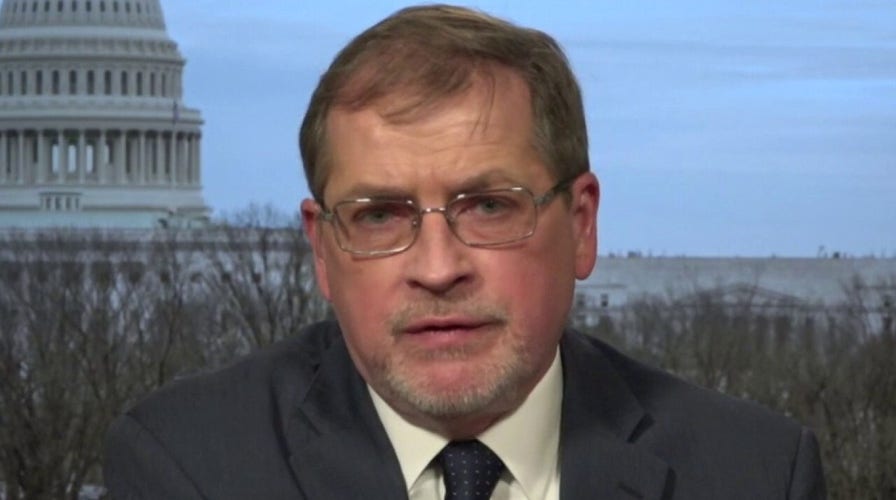
Grover Norquist: Tax hikes coming if Democrats win GA runoffs
Americans for Tax Reform president Grover Norquist says Democrats will abolish the 2017 tax cuts if they win Georgia Senate runoffs
This is a rush transcript from "Your World with Neil Cavuto" December 29, 2020. This copy may not be in its final form and may be updated.
SANDRA SMITH, FOX NEWS ANCHOR: Four o'clock on the East Coast.
President-elect Joe Biden just now taking aim at President Trump's vaccine
distribution plan and announcing a five-point plan of his own.
Welcome, everyone. I'm Sandra Smith, in for Neil Cavuto this evening, and
this is "Your World."
Let's go now to David Spunt with the latest on what we just heard, David.
As far as Biden, not enough testing so far. The vaccine process, he says,
is going slowly, thinks that we are not -- we have not hit the worst part
of this yet. It also struck me that he said -- suggested that we may not
even see improvement overall in this pandemic until at least March.
DAVID SPUNT, FOX NEWS CORRESPONDENT: Yes, Sandra, good afternoon. Good to
be with you.
It appears that president-elect Biden does not want to give somebody a
false sense of hope. He said that he would always be honest with the
American people about the numbers, what the reality is on the ground when
it comes to some of these numbers, some of these COVID numbers, whether it
be infections or deaths.
He said the numbers will go up from the holidays, from Thanksgiving and
Christmas. The president-elect says we haven't even seen the worst from
that yet. He expects -- and I'm reading some notes here from his speech
just a few minutes ago -- he expects soaring death tolls into February,
might not see an improvement, Sandra, until well into March, according to
president-elect Biden.
The Trump administration distributing vaccines has fallen far behind,
according to president-elect Biden. At this point, they expected about 20
million people to be vaccinated by the end of the year, but with just a few
days left until the end of the year -- the new year is on Friday -- we have
only seen a few million people vaccinated.
Here is the president-elect on the current administration's vaccine
rollout. Listen. OK, well, we don't have that.
But, basically, what he said, Sandra, is that he is concerned that, like I
said, we're just a few days away from the beginning of 2021, and we are
nowhere near those 20 million vaccines.
As you mentioned that five-point plan, some of the key points there, he
wants to ensure that 100 million shots are given to people in the first 100
days of his presidency. A few weeks ago, he talked about having masks,
wearing masks for 100 days. He says masks are not political; that's just
something that's patriotic that American should do to stop the spread of
this.
He also wants to have the Defense Production Act in place. That is
something President Trump did several months ago during Operation Warp
Speed. And Biden says that, when he becomes president, he will do this to
have private industry accelerate vaccine production, also help with
effective gear.
He also wants to make equitable distribution of vaccines, no matter the
race, or where someone lives or their income. And he wants to make those
vaccines free.
So, Sandra, that's essentially what the president-elect just said. But he
did take a shot at the current administration. While saying Operation Warp
Speed is a wonderful piece of ingenuity, it was very successful to get
these vaccines developed, he would like to see more inoculations at this
point. And we are well under those 20 million, which was the goal --
Sandra.
SMITH: David Spunt on that for us.
David, thank you.
SPUNT: You bet.
SMITH: Let's get you back to all of this with FOX News contributor Dr.
Marty Makary joining us now.
Doctor, good to see you. You have taken us through this pandemic. You have
weighed in on what we have heard from President Trump, now president-elect
Joe Biden.
He's making the point also, when he suggests that perhaps the worst may
still be yet to come and we won't see overall improvement in the pandemic,
he suggested, until March, he's pointing to the upcoming New Year's Day
holiday, and, of course, the fact that we're coming off of Christmas, and
many of these cases take weeks to show up.
DR. MARTY MAKARY, FOX NEWS CONTRIBUTOR: Well, Sandra, look, I didn't
really hear anything new. There was no really useful information in what I
heard.
But, at the same time, I do think it is valuable for our leaders to talk
about the pandemic, to keep constantly reminding people to take
precautions.
So what we heard about in terms of every American should have the ability
to get a test, to get the vaccine, those are all principles that have been
laid out by Secretary Azar. And I think, come January 21, the best thing
that the Trump folks could do is to keep the current plan in place.
SMITH: Doctor, he stressed wearing masks. Of course, by now, everybody's
heard that this is the best way to stop the spread of the virus.
You're suggesting you heard nothing new there. What can you say that you
have heard so far from the incoming administration about how they're going
to tackle this pandemic, considering mid to late January, we could still
very much be in the position that we are today?
MAKARY: Well, look, I think there's a war of words, Sandra.
Early on, when the Trump COVID task force -- sorry -- the Biden COVID task
force formed, they came up with a talking point that they needed the data.
And the idea was that, if there was not a smooth rollout of the vaccine,
that they could say they didn't have the data they needed.
Well, now we know that the hardest part of the vaccine rollout is in the
last 10 yards. It's in the final stretch. And that's identifying folks,
inviting them in, having them identify their local pharmacies and
hospitals. On their Web sites, they have that information for pharmacies
and hospitals.
And getting people convened is the hardest part of the vaccine rollout.
SMITH: You know, Dr. Makary, we all would think that we're getting to a
better situation in this country, but to the point about the holiday, what
can you tell us that we're seeing so far?
Because there were grim warnings heading into the holiday that families
would still gather. We, of course, saw the airports full. People still
traveled. What so far are we able to determine about how this holiday
season is going and what overall impact it is having on the numbers of
cases and, sadly, deaths?
MAKARY: Well, Sandra, there seems to be a continual consistent growth in
cases, a very concerning trend, almost agnostic to the holidays.
So we saw that after Thanksgiving, a continued consistent escalation in
cases. And we do expect cases to go up a little bit. But, right now, we're
seeing a plateau. And it's unclear if that's from the low reporting from
the holidays, or if that's a real plateau. And I think everybody recognizes
now that January is going to be the toughest month.
And we're going to see a rapid deceleration probably in the month of March.
SMITH: All right, Dr. Marty Makary, always good to talk with you. Thank
you for your time.
MAKARY: Thank you.
SMITH: And have a good holiday. Appreciate it.
MAKARY: You too.
SMITH: We are live in Atlanta, where those crucial run-off races are now
just one week away, more than 2.3 million people already voting early.
I spoke to Republican Senator David Perdue about how he feels heading into
the finish.
(BEGIN VIDEO CLIP)
SEN. DAVID PERDUE (R-GA): We feel good about it. We're out doing 125-stop
bus tour around the state. Kelly is out as well. So, we're driving the idea
that we have got to get our vote. If we get our vote out, we win this
thing.
(END VIDEO CLIP)
SMITH: More from my interview earlier this morning on "America's Newsroom"
with Senator Perdue in just a moment.
First to Steve Harrigan. He's in Atlanta, where all of this is happening,
and the anticipation is certainly building.
Steve, good to see you.
STEVE HARRIGAN, FOX NEWS CORRESPONDENT: Good to see you. Sandra.
It is a very bitter battle. But all four candidates, the two Republicans,
the two Democrats, do agree that it's all going to come down to turnout,
and, as you mentioned, 2.3 million people already voting.
Early voting still going on through Thursday. The pace is about 75 percent
of what it was in the general election, so a very high turnout for run-off
races. One area that's gotten very heavy turnout are the Democratic suburbs
around the city of Atlanta.
Republican Kelly Loeffler says this is simply crucial. The stakes of these
two races for control of the Senate for the next two years could not be
higher.
(BEGIN VIDEO CLIP)
SEN. KELLY LOEFFLER (R-GA): Early voting is open here until Thursday. We
need Georgians to get out and vote, because we have to make sure that we're
the firewall to stopping the radical agenda of Chuck Schumer. He wants to
fundamentally change this country.
(END VIDEO CLIP)
HARRIGAN: Loeffler has attacked her opponent, Reverend Raphael Warnock, as
simply being too radical for the state of Georgia.
Warnock has responded that the governor appointed Loeffler and that she
simply purchased her seat.
(BEGIN VIDEO CLIP)
RAPHAEL WARNOCK (D), GEORGIA SENATORIAL CANDIDATE: Kelly Loeffler has a
problem. The folk who sold her that seat don't own it. That seat belongs to
the people of Georgia. And come January 5, the people are coming to get
their seat back.
(END VIDEO CLIP)
HARRIGAN: President Trump will be back in Georgia on Monday, the eve of
the election. There has been some concern among Republican Party leaders
that the turnout in rural Georgia among Republicans has been light, the
president going to the northwestern part of the state to try and drive that
rural Republican turnout -- Sandra, back to you.
SMITH: Steve Harrigan live in Atlanta.
Steve, thank you.
Gas taxes, income taxes, 401(k), you name it, Grover Norquist is warning,
Democrats will be hiking it if they win those two Georgia Senate seats.
Grover Norquist, president of Americans for Tax Reform, joins us now.
Grover, good afternoon to you. And thank you for joining us.
You're writing in a FOXNews.com piece, an opinion piece that you're
writing, specifically warning how the average American household could be
hit from this. And you really break down the numbers as for how much the
average four-person American family with a median income of $73,000, how
much they will see their income -- their taxes go up under the Biden
administration.
What are you proposing?
GROVER NORQUIST, PRESIDENT, AMERICANS FOR TAX REFORM: Well, we can just
see what happened when the Republican tax cut passed.
The median income family of four got a $2,000 tax cut. So, as Biden and his
vice president have said and both of those liberal Democrats running for
Georgia Senate seats, they have said they're going to abolish the Trump tax
cut, the Republican tax cut day one.
That's a $2,000 increase on the average family of four on day one.
Remember, they also support a tax on energy, a gasoline tax, a carbon tax.
That will increase the cost of buying gasoline to fill up your tank another
$10.
And they put it on automatic pilot. It goes up 5 percent a year every year
out into the future. So it's not just a one-time gas tax and a tax on home
heating oil, a tax on your electricity, a tax on everything that gets
shipped to you by truck or by train. It -- that goes up over year after
year.
In addition, they want to bring back some of the Obamacare taxes. Remember
the Obama penalty tax. If you didn't buy Obamacare, it was $700 tax on a
person, $2,000 on a family. Five million Americans were hit by that, maybe
100,000 in Georgia. The Republicans took that tax to zero.
Biden has repeatedly said he would bring it back. Three-quarters of the
people who pay that tax earn less than $50,000 a year. So, Biden's promise
that he won't tax anyone who isn't rich, that's gone.
(CROSSTALK)
SMITH: Got it.
And we're relying on your analysis. You can also look elsewhere to the
nonpartisan Americans for Tax Reform analysis. Most recent available IRS
data says that middle-class Georgians saw the greatest reduction in tax
liability after the Republican-passed tax cuts happened.
So, there are real consequences for the people down there in Georgia that
are about to cast their votes.
NORQUIST: If they vote for the two liberal Democrats, they are voting to
raise their own taxes, not somebody else, their own taxes.
SMITH: So, Grover, when it comes to corporate taxes, what's your warning
there? We're looking at businesses that are struggling in the middle of the
pandemic. Some haven't even managed to survive.
When you look at the call for the Biden administration to hike the
corporate tax rate to the -- to 28 percent from the current 21 percent,
what are the consequences that you would predict for businesses in America?
NORQUIST: Well, we don't have to guess, because we know that, when Biden
and Obama were running things, that corporate tax was 35 percent.
Communist China's at 25. And Biden says he's going to bring it to 28 or 35.
Sometimes, he says 28. Sometimes, he says 35. Whatever. He wants the taxes
on American businesses to be a higher tax rate than China.
Where do you think the world's investment is going to go? It went to China
when he was vice president. He wants to send it back to China by making
American businesses uncompetitive internationally, because he would take
the corporate rate up above China, above Germany, above France, above
England, above Canada, and make us one of the least competitive nations in
the world, which is where we used to be.
And we came out of it. A hundred million Americans have a 401(k) or IRA; 53
percent of families have an IRA or 401(k). You raise the corporate rate,
you decrease the value of all stocks in the country.
SMITH: And right now, those--
NORQUIST: People's retirement.
SMITH: Right now, those 401(k)s, they're cooking, because we're still
looking at record highs for the U.S. stock market.
NORQUIST: Yes.
SMITH: Bottom of your screen, you will see the Dow. We are on watch, as it
is firmly above 30000, down day today, but we still watch it at record
highs.
Grover, good to see you. Thank you.
NORQUIST: Good to be with you.
SMITH: What something Senator Perdue told me about, the push for $2,000
stimulus checks to go out to struggling Americans, is saying about the
state of the race in Georgia.
We will have that for you next.
(COMMERCIAL BREAK)
SMITH: Putting pressure on the Senate to pass those $2,000 stimulus
checks. Some Republicans say it could hurt the GOP's chances in Georgia,
but Senator Perdue telling me earlier on "America's Newsroom" he supports
the move.
(BEGIN VIDEO CLIP)
PERDUE: The president looked at this. He's very concerned that we didn't
go far enough to bring enough help to help people in the back end of this
COVID crisis.
Look, this should have been done four months ago. And that's what the
president's been saying for the last four months. But we were obstructed in
the Senate by the Democrats, who were playing presidential politics the
first time in November, and now they're playing senatorial politics before
the January 5 election.
So I'm delighted to support the president and his $2,000. It's really a
$1,400 increment over what we have already done. And I think, with the
vaccine coming, I think this is absolutely appropriate.
(END VIDEO CLIP)
SMITH: And we did invite Senator Perdue's opponent, Democrat Jon Ossoff,
to come on the show today. We did not get a response from his team.
So, how will this fight impact the race?
Let's ask Democratic strategist Marjorie Clifton and Patrice Lee Onwuka
with the Independent Women's Forum. Thanks to both of you for being here.
So, Marjorie, The Wall Street Journal's writing about this, this morning on
the potential negative impact that this late-stage negotiation on the part
of Republicans could have on those Senate races. What are you seeing?
MARJORIE CLIFTON, DEMOCRATIC STRATEGIST: Well, a lot of Republicans in
advance -- there was brokering that happens leading up to the first bill,
which was the $600 release. So, obviously, the $2,000 package coming after
that negotiation already happened was quite a surprise.
And it's forced a lot of Republicans into an uncomfortable spot. I mean,
the issue is, this money has to come from somewhere. It either comes from
taxes or it has to come from a larger deficit. So, figuring out how we
balance the need of Americans right now in COVID against how we don't spend
money that we don't have or finding ways to cover that bill is the crux of
it.
And you have a lot of Republicans who are in positions where they cannot
give more on this. They're going to catch flak from their voters. And so
that's the difficulty right now.
SMITH: Patrice, that's really interesting. It's now up to McConnell, who's
got a really important decision to make, potentially -- potentially the
biggest of his career, on whether or not to take this up for a vote on the
floor.
We spoke to Senator Perdue earlier, and we asked him what is at stake in
Georgia, for the country. He said this:
(BEGIN VIDEO CLIP)
PERDUE: Sandra, you just have to listen to Chuck Schumer. Take Georgia,
change America.
What he means by that is, he wants to change the filibuster rule, add two
states, two Democratic states. That would be four Democratic seats. He
wants to stack the Supreme Court and eventually change the way the
Electoral College operates.
That would allow them to perpetrate the agenda that's in the Democratic
platform that was displayed during the presidential election. They want
open borders. They want to defund the police. They want illegal immigrants
to vote. They want to defund our military as well and give us the Green New
Deal, in addition to socializing our medical system.
So this is an aggressive, aggressive liberal plan that's so dangerous.
That's what we're fighting against here.
(END VIDEO CLIP)
SMITH: So, that was his message. It leaves us wondering what McConnell's
next move is to ensure victory for his party in Georgia.
PATRICE LEE ONWUKA, INDEPENDENT WOMEN'S FORUM: Well, it's -- Sandra, I
think it's going to be an interesting move.
I mean, the question is, do you want to cross President Trump before he
visits Georgia for the last time to rally those rural voters in Georgia,
those Republican voters who may not have come out so far in early voting
and who are going to be needed on Election Day?
At the same time, you still want to be fiscally responsible. And I think
Senator McConnell recognizes, yes, the money does have to come from
somewhere. And that's going to come from our grandchildren, future
generations. And so how do you balance that?
And I think maybe he's balancing the short-term impact of a Democratically
controlled Senate, which is -- which would be losing Republican control
would be the only stopgap against an onslaught of aggressive liberal
policies.
And so I think that he's going to make that decision. And I think it's
going to be the right one.
SMITH: Marjorie, there are real -- real struggles happening every single
day in this country right now, struggling families, struggling Americans,
due to this pandemic.
Will those checks go out?
CLIFTON: Will those checks go out?
Oh, gosh, well, we know that $600 is going out. Whether $2,000 goes out, I
-- gosh, I wish I had the crystal ball. What I can tell you is, is that
people are voting with COVID on their mind, with the economy on their mind,
and with health care on their mind.
And there is, regardless of who takes control the Senate, things that need
to be done, institutional things, because, right now, you have Americans,
on average, paying $11,000 per person in health care costs annually. You
have got education systems that need investment for the long term.
You're 84 percent more likely to be unemployed if you do not have a college
degree. So there are systemic things that we're going to have to pay for
somehow that need to be solved. And that's what people are voting for in
these elections.
So, that's the leadership I think we need.
SMITH: Patrice, we have seen Des Moines -- we have seen the Republicans
positioning themselves, like Kelly Loeffler. You hear her time and time
again, every TV appearance, every rally that she's held, that she and her
Republican colleague down there in Georgia are the wall against socialism.
Are they getting that message out? And could that really hurt Democrats, if
they continue to portray the Democratic candidates in this race as
socialists?
ONWUKA: I think it does, especially in a state like Georgia, certainly in
some of those urban centers, where you can talk about a laundry list of
potential goodies that may resonate.
But in the suburbs and in the rural areas, those are hardworking Americans.
Those are small business owners. Those are people who recognize that their
tax dollars should be funding critical needs, but not socialist wish lists.
And I think there are a lot of people who recognize that this nation should
not be a socialist nation, and it will not be. It's built on capitalism.
And capitalism allows the American dream to happen. And so I think that's
going to be what inspires people to come out.
And, sure, certainly, local issues matter, but certain -- but, absolutely,
national issues matter. And this Georgia race is going to be the most
significant race when it comes to -- when it comes to the future of our
country probably in modern history.
SMITH: Marjorie, I will give you last thought, because I gave it to
Patrice earlier on The Wall Street Journal.
CLIFTON: Yes.
SMITH: Their headline this morning, it really grabbed a lot of eyeballs
when they said Trump gives Schumer an assist, right, the $2,000 check to
make Dems majority, suggesting that this is going to -- this fight is going
to improve Democrats' chances in Georgia if it continues like we do, which
makes McConnell's next move ever so important.
So we're left wondering what that is. But do you believe the president's
efforts here to push for the $2,000 is distracting and could actually work
against Republicans in these races?
CLIFTON: I think, right now, people are looking for clear leadership. And
I think it was a confusing move for a lot of people, because Democrats were
lobbying for the $2,000 check for people.
And I think the fact that Trump came out the last minute, after
negotiations that -- already had made, a compromise existed, and that was
something people wanted to see. So it did seem like a confusing move.
And I think that's a hard thing at a time where people are suffering. So, I
think it does have the potential to hurt. I do not pretend to be able to
anticipate Trump's every move, and that's why some people like him. So --
but I would ask people to think about, what does socialism really mean and
what the policies really look like?
Because I think there's a lot of platitudes right now that, when you ask
people what that really means to them, they don't really have the right
answer for it.
So, I think it's good for all of us to kind of question what matters at
this moment.
SMITH: OK, so we will see where it all goes.
I'm sorry. I did ask for your crystal ball, Marjorie.
(LAUGHTER)
SMITH: But it's -- the polls are leaving it that way right now, right?
CLIFTON: If only.
SMITH: Because it's just -- it's so close.
CLIFTON: Yes. Yes.
SMITH: So we will be watching all of it. And we are one week out.
Patrice and Marjorie, thank you.
CLIFTON: Happy new year.
ONWUKA: Thank you.
SMITH: And now look -- to you as well.
Looking live at the scene in Nashville, newly released body cam footage
capturing officers' heroic acts before and after the Christmas Day bombing.
An update on the investigation, as authorities are still searching for a
motive -- next.
(COMMERCIAL BREAK)
SMITH: The pressure is building, another Republican on the House Judiciary
Committee demanding a special counsel for the Hunter Biden probe.
So, with the list growing, is it time for one to be appointed right now?
(COMMERCIAL BREAK)
SMITH: Newly released police body camera footage taken from one of the six
Nashville officers credited with evacuating residents, showing their heroic
efforts before and after the blast that shook that city.
FOX News' own Mike Tobin is at the scene with the very latest -- Mike.
MIKE TOBIN, FOX NEWS CORRESPONDENT: And, Sandra, as we learn more about
the investigation, we learn more about the difficulties faced by
investigators, part of the problem for the investigators on the scene was
that the recreational vehicle in which that bomb was planted was blown to
bits.
So, investigators from the Tennessee Highway Patrol Criminal Investigation
Division, along with agents from the ATF and FBI, painstakingly went
through the debris and found enough parts to produce a 17-digit vehicle
identification number.
That led them to Anthony Warner. DNA evidence from another vehicle that
Warner had given away and a few items from that vehicle helped make the
positive match.
Meantime, a police body camera shows the eerie moments as officers respond
to the evacuation downtown Nashville, with the R.V. blaring a warning in
the distance. Then you hear the blast. After the blast, officers can be
seen running to the danger and getting people out of the danger zone.
Meantime, as parts of Nashville open up, the people, the restauranteurs,
other business here are struggling to get by. Mayor John Cooper has again
extended the curfew downtown by another day.
All the while, we still don't have a good solid idea of what the motive was
for the blast out here -- Sandra.
SMITH: All right, Mike Tobin on the ground with the very latest from
there.
Mike, thank you.
So, what are investigators looking for in this search for a motive?
Our next guest was a commander of the Oklahoma City bombing investigation.
Former FBI Deputy Assistant Director Danny Coulson joins us now.
Thank you for your time this afternoon, sir. We appreciate it.
As a search for a motive continues, what will investigators be looking for?
DANNY COULSON, FORMER FBI AGENT: Oh, they're already looking right now,
clearly his entire history of Internet searches. They will interview
everybody he's ever known. They will do search warrants. They will get some
feedback from if he belongs to any clubs or goes to a bar.
They're going to look very closely. And they will put this thing back
together. But I think you're going to find out that we're not ever going to
really know what the motive was. We still don't know what the motive was
for the Vegas shooter. So, we're always looking for that. But I have a
different idea about it. And I think I know what the motive was.
But it's not anything that's tangent.
SMITH: Well, we won't ask for you to speculate on that. But we will work
with what we have and what we know so far.
So, tell us, as far as the hints that were left behind hinting that trouble
was coming, how that can help search for a motive.
COULSON: Well, the motive will be very unusual way, they will put it
together.
And I will tell you what the motive is right now. The motive was him. The
movie came out of his own brain. I have looked at these guys for years.
Almost all of them are inadequate personalities. They're looking to make a
big show. They don't have very successful lives. They want people to notice
them.
And I think, in this man's demented mind, he was happy having himself
recognized even after death. And I know that's what -- McVeigh was like.
The Unabomber was like that. The motive comes from inside their mind.
And it's difficult for you and I to get inside their mind to understand it.
But I really do believe that's what makes them do these things.
SMITH: You know, the body cam footage that is being released now, it's
telling us a lot about the moments before that explosion took place.
How can that also play into what they will be able to determine as far as a
motive?
COULSON: Well, I don't think it will help us with motive.
I think what it shows us is this whole idea of defund the police is not
going to be coming out of Nashville, Tennessee.
SMITH: Heroes.
COULSON: Those officers were heroes. They did an amazing thing. And I
can't say enough, give them enough accolades.
SMITH: Yes.
COULSON: They're American heroes. And we ought to recognize them as that.
SMITH: Absolutely.
And as we learn more about the body cam footage that gave us so much about
-- that had just been given to the officer, and a short time before all of
this happened.
But you just -- we're looking now at the streets there of this scene, and
the car alarms that went off, the sounds in the background. And it's just -
- it's a horrible thing to relive this moment, sir.
When you talk about, in your mind, coming up, as someone who knows these
type of scenes so well, you're going to the person's mind, but what can
investigators go do to track down specifically his motive, if it was mental
and if it was just a personality trait that led him to do something so
horrific?
COULSON: We all create tracks wherever we go. We leave tracks in our cell
phones. We leave them in our computers. We leave them a lot of places.
And that's what they will be looking for. And they're going to come up -- I
think they may end up agreeing with me someday, although they probably
won't admit that. But it's -- that's where it's going.
SMITH: Well, they're going to -- it's going to be some time, I'm sure, for
the investigation to play out and get the facts behind this and see what
they figure.
We appreciate your time and giving us your expertise on the situation.
Appreciate it. Thank you.
COULSON: Thank you. I enjoyed it. Thank you.
SMITH: OK.
Is a bigger check coming in the mail? Georgia Republican Senator David
Perdue telling me earlier he is ready to sign off on those $2,000 stimulus
checks. That makes five Republicans on board. If this comes up for a vote
in the Senate, does it actually have a shot at passing? That's the big
question.
What Senator Mitch McConnell is now saying.
(COMMERCIAL BREAK)
SMITH: Senate Majority Leader Mitch McConnell saying those $2,000 stimulus
checks passed by the House and supported by the president will be
considered sometime this week.
And considering a growing number of Republicans are in favor of the checks,
could Americans get more relief?
To FOX's Mike Emanuel with the latest on that.
Hey, Mike.
MIKE EMANUEL, FOX NEWS SENIOR POLITICAL CORRESPONDENT: Sandra, good
afternoon.
Senators Chuck Schumer and Bernie Sanders tried to force the issue on those
$2,000 stimulus checks today.
(BEGIN VIDEO CLIP)
SEN. CHARLES SCHUMER (D-NY): Some of my Republican colleagues have said
they support the checks. But there's a major difference in saying you
support $2,000 checks and fighting to put them into law.
SEN. BERNIE SANDERS (I-VT): We should all be very, very clear. The working
class of this country today faces more economic desperation than at any
time since the Great Depression of the 1930s.
And working families need help now, not next year, but right now.
(END VIDEO CLIP)
EMANUEL: Majority Leader Mitch McConnell objected. He is grouping three of
President Trump's priority issues together, passage of $2,000 stimulus
checks, repeal of Section 230 protection for big tech companies, and, of
course, election integrity.
But McConnell's timing is a little vague.
(BEGIN VIDEO CLIP)
SEN. MITCH MCCONNELL (R-KY): The president highlighted three additional
issues of national significance he would like to see Congress tackle
together.
This week, the Senate will begin a process to bring these three priorities
into focus.
(END VIDEO CLIP)
EMANUEL: But, first, Senate leadership wants to vote to override the
president's veto of a $740 billion annual defense bill.
Sanders and perhaps others are signaling they plan to slow that down,
pushing for a stimulus vote too, so this could drag into the New Year's
holiday -- Sandra.
SMITH: Mike, timing is going to be everything with so many people
struggling right now awaiting these checks, if all way -- in the way of the
$2,000 checks getting approved, what would be the timing of those Americans
that would be receiving it actually getting it?
EMANUEL: Yes, that's a great question.
We know that the Treasury was hoping to send out those $600 checks as soon
as this week. And so if potentially they get something done by this
weekend, perhaps they go out sometime next week. It's worth noting we're
not entirely sure if they have the votes to pass it at this point.
There are certainly five Republican senators on the record saying they're
in favor. They need about 12 to get to the 60-vote threshold, but they
haven't said no. They just haven't said for sure they're a yes at this
point, Sandra.
SMITH: That's fair enough.
And Senator Perdue making a lot of news with us earlier, when we did that
interview, saying that he, like the president, supports $2,000 payments.
And Kelly Loeffler on an interview just before that on FOX News was put
into a question where she ultimately supported the $2,000 checks.
So, to your point, the question is, how many more Republicans are out there
willing to support these? Final thoughts, Mike.
EMANUEL: Yes, a spokesperson for Senator Ted Cruz says he's looking at it,
willing to consider it.
And, bottom line, those two senators in Georgia would love to get back out
on the campaign trail.
SMITH: Yes.
EMANUEL: So, they'd like to be able to go home and say, we delivered for
you. Now please support them in the election.
SMITH: So are even making the point that these negotiations are sort of
taking away or distracting from the messages that need to get out in those
races for the Republicans.
Mike, thank you.
EMANUEL: Thank you, Sandra.
SMITH: The list of Republicans calling for a Hunter Biden special counsel
is growing and, when it comes to Joe Biden's pick for attorney general, why
he's not answering.
(BEGIN VIDEO CLIP)
QUESTION: Sir, have you made a decision on A.G.?
(END VIDEO CLIP)
(COMMERCIAL BREAK)
SMITH: Another Republican on the House Judiciary Committee is demanding a
special counsel for Hunter Biden.
Arizona Congresswoman Debbie Lesko confirming with FOX News that she sent a
letter to the attorney general earlier this month calling for it. She says
that's the only way to ensure a complete and thorough investigation.
Joining us now is a former deputy assistant attorney general, Tom Dupree.
Tom, good to see you, and almost happy new year to you. Is the
congresswoman right on this? Do you believe that that is the only way to
make sure a fair investigation happens?
TOM DUPREE, FORMER JUSTICE DEPARTMENT OFFICIAL: Well, Sandra, I wouldn't
say it's the only way to make sure a fair investigation happens.
Certainly, the normal course in the Justice Department is to handle
investigations, even sensitive investigations, through prosecutors who are
career prosecutors and the like. So it's not the only way.
But at the same time, the congresswoman is right that we need to have some
sort of assurance that the investigation of Hunter Biden will continue to
be carried out in a professional and impartial way.
I think that's going to be an absolutely critical element when the new
attorney general nominee is put up for the senators to ask him or her
about, what are they going to do to ensure that this investigation is
carried out in (AUDIO GAP)
SMITH: You go back to Attorney General Bill Barr before he left. There's
an acting A.G. now, of course.
And he was asked this very question. And, Tom, he made it very clear that
there was nothing that he saw or no reason to put a special counsel on
this, if it continued to be responsibly and professionally investigated.
So, if he didn't see reason why, why do these Republicans?
DUPREE: Well, that's the thing, Sandra, is that the attorney general knows
better than anyone how this investigation has been progressing, who they
have been talking, what they're finding.
And in his professional judgment, he said that it is being carried out
appropriately, and he had no reason to appoint a special counsel.
Now, look, that obviously concerns a snapshot in time, and it's possible
things could change with the new administration. You could have new people
coming in who see it differently.
But it seems to me that one thing the incoming Biden administration could
do is commit to keep the same investigators and prosecutors on the case who
have been handling it thus far, rather than removing them, replacing them
with people of the new attorney general's choosing.
SMITH: All right, so let's play what if. What if he doesn't?
DUPREE: Well, if he doesn't, I think we need to understand why.
In other words, if the new attorney general makes the decision to sweep out
the existing prosecutors and put in new people, why is that being done?
That would be certainly raise red flags. And that's the reason why I think
we need to make sure, the Senate needs to make sure, when this new attorney
general nominee is put up, what is he or she going to do to preserve the
independence of this investigation?
Because if they can't provide those guarantees, concrete, ironclad
guarantees of independence, at that point, I think you would need to start
thinking about the possibility of a special counsel.
SMITH: It'd be quite a process to learn more about who he eventually
choose is and who is approved to be in that role.
Tom, but when you look broadly at what we know so far about Hunter Biden's
overseas business dealings, what his father, the incoming president, knew
about those business dealings or didn't know, because he maintains that
they never discussed those business relationships, what strikes you about
what we have learned so far and what you want to know more about when it
comes to those dealings?
DUPREE: Right.
I think what we know so far is that, originally, this was an investigation
that was fairly broad in scope. From media reports, they were looking at a
variety of issues, including possibility of money laundering, improper
transfers and the like. However, over time, the investigators seem to be
focusing on the possibility of tax-related wrongdoing.
The other interesting thing is the connections with the incoming president-
elect. As you point out, Sandra, he has denied adamantly from day one that
he had any involvement with his son's business doings.
But we have also seen some evidence coming in that seems to undercut that.
So I think, as this investigation moves forward, we need to figure out,
number one, what, if anything, Hunter Biden did that may have been illegal,
and, number two, how fear any of that evidence spreads.
Did it involve the president-elect or other people in (AUDIO GAP)
SMITH: And, of course, the investigation into his taxes dating back to
2018, with the Delaware U.S. attorney investigating that.
We're going to continue to watch that, of course, and how the transition
handles that. Based on everything you just said, there's a lot to watch
for.
Tom Dupree, always good to talk to you. Thank you.
DUPREE: Thanks, Sandra.
This is what my next guest's restaurant looked like before the Nashville
blast. And this is it now.
What he is asking of those interested in helping -- next.
(COMMERCIAL BREAK)
SMITH: FOX News Alert, this just into our newsroom.
Colorado Governor Jared Polis is now saying that the same coronavirus
variant found in the U.K., which is considered more contagious, has now
been discovered in Colorado. Based on Dr. Fauci's words, take this very
seriously, as we learn more. They're trying to learn as much as they can
about this.
It is known to be more contagious, but Dr. Fauci says in a new interview
it's not considered to make you any sicker. But the Colorado governor is
now identifying that this case, a case of that variant, has been discovered
in Colorado. So, we will continue to watch that and bring you more on it as
we get it.
Meanwhile, you're looking at before-and-after images of The Old Spaghetti
Factory in Nashville, Tennessee, one of the many businesses that faced
massive devastation after the bombing in Nashville.
Our next guest has told us that he won't be able to survey the damage for
another seven to 10 days.
The Old Spaghetti Factory owner, Chris Dussin, joins us now.
Chris, thank you for being here. I'm so sorry to see and hear what's
happened to your business.
CHRIS DUSSIN, OWNER, THE OLD SPAGHETTI FACTORY: Well, thank you, Sandra.
Pleasure to be on.
SMITH: How are you doing?
DUSSIN: Well, we're doing fine.
These things were so unexpected. You can't prepare for them. And I think
everybody's spirits are good. And we're just thankful that nobody was hurt.
SMITH: Absolutely.
And as we continue to see these scenes of the destruction as a result of
this, how was your building affected? And when are you going to be able to
get in there?
DUSSIN: It sounds like now it's going to be about seven to 10 days before
the police will let us go into the space.
And they have to make sure, structurally, that the building is sound, so --
but, yes, it's -- we were about a half-a-block, I would say, down from the
initial blast. And so you can see from the pictures that the front of the
building has been pretty badly damaged.
And we know that the blast went all the way through the space, which is
kind of long, narrow space, because the back windows as well were damaged.
SMITH: I'm so sure that's so frightening to see and to think about just
how close you were.
And, as we all know, business owners are a community. You all talk to each
other so much, and you learn so much from each other. What are you hearing
from all those businesses that were right there around you?
DUSSIN: Well, I think everybody has the same sentiment. They're just
thankful that there weren't any casualties to what happened on Second
Street.
SMITH: Yes, of course.
DUSSIN: I think it's -- people are just a little bit in shock, I think, by
what happened.
And -- but I know everybody's going to rally together and make the best of
it.
SMITH: Chris, how can people help?
DUSSIN: Well, they can go to OSF.com and go to the Nashville page. And we
have set up a GoFundMe page there for our 51 employees.
SMITH: Well, Chris--
DUSSIN: So, anybody that would like -- yes.
SMITH: Go ahead. No, continue. You get that message out there. It's
important.
DUSSIN: No, anybody that would like to contribute, it would be greatly
appreciated.
And we're doing everything we can to make sure that the team going forward
will have some financial support.
SMITH: And the support of your police is just amazing, when we see those
heroic efforts, efforts of those officers to limit the damage.
DUSSIN: Well, you can't thank the police department, the men and women
that serve, for what they did that day, what they do every day, and that's
look out for all of us.
And they put their lives at risk. And we're thankful that they're there and
appreciative of everything that they do day to day.
SMITH: Chris, your final message as we approach a new year, and we hope
for -- we hope for better times?
DUSSIN: I think everybody's happy to see 2020 go away.
SMITH: Yes.
DUSSIN: And we're looking forward to much better and brighter things for
2021.
And we wish everybody a happy new year and all the best going forward.
(CROSSTALK)
SMITH: Well said.
Chris, thanks for joining us. And our best to you and your business as you
try to recover.
DUSSIN: Thank you, Sandra.
SMITH: Thanks for joining us for "Your World." I'm Sandra Smith.
"The Five" is next.
END
Content and Programming Copyright 2020 Fox News Network, LLC. ALL
RIGHTS RESERVED. Copyright 2020 ASC Services II Media, LLC. All materials
herein are protected by United States copyright law and may not be
reproduced, distributed, transmitted, displayed, published or broadcast
without the prior written permission of ASC Services II Media, LLC. You may
not alter or remove any trademark, copyright or other notice from copies of
the content.
