




Graham: Clintons would be the last people I'd seek legal advice from
Bill and Hillary Clinton criticize AG Barr over Mueller report; Senate Judiciary Committee chairman Sen. Lindsey Graham reacts.
This is a rush transcript from "The Story," April 29, 2019. This copy may not be in its final form and may be updated.
MARTHA MACCALLUM, ANCHOR: All right, good evening, everybody. I am Martha MacCallum, and this is "The Story." So, tonight, a gathering of big Wall Street Democrat donors are reportedly panicking. "Absolutely freaking out about the 2020 candidates."
This graphic in the piece and not the stock market show that some of the candidates are dropping in value. The New York magazine story says, early favorite Cory Booker and Kirsten Gillibrand's weak starts, and newly hostile barbs towards finance are concerning to them, and say this about Biden.
"He had a comforting history in the Obama White House, and a reputation as an establishment Democrat, which struck many bankers as a dubious bet to beat Donald Trump."
Now, in a separate piece, the magazine added this warning. Democrats need to prepare for the possibility that in November of 2020, Donald Trump will be presiding over the longest period of uninterrupted growth in American history. So, today, Joe Biden tried to lay out his economic promises.
(BEGIN VIDEO CLIP)
JOE BIDEN, D-PRESIDENTIAL CANDIDATE: I have regret to rethink how we define what constitutes a successful economy. It's not enough for the stock market to rise, that's not a bad thing, but it's just not enough.
(END VIDEO CLIP)
MACCALLUM: So, what exactly does that reimagining of economic success look like? In moments, Karl Rove, Geraldo Rivera, and Robert Wolf. But we get started tonight with Peter Doocy, who is live in Pittsburgh, the sight of Biden's big campaign kickoff today. Hi, Peter.
PETER DOOCY, FOX NEWS GENERAL ASSIGNMENT REPORTER: Martha, Joe Biden says, he knows that if he is going to beat Donald Trump next year, he needs to win this part of Pennsylvania. And he's trying to get ahead here by arguing before a crowd of about 600 people that some of the president's priorities including tax reform were written more for people on Wall Street than for people in Western PA.
(BEGIN VIDEO CLIP)
BIDEN: All my time in public life, first I've gotten involved, I've been referred to as middle-class Joe. It's not always meant as a compliment, it's usually that I'm not sophisticated, that's why I'm middle-class Joe. But the fact of the matter is I'm awfully sophisticated about why Howard who built this country?
(END VIDEO CLIP)
DOOCY: President Trump is fighting for this state's 20 electoral votes as well. On Twitter where he writes, "Biden is having his first rally in the great state of Pennsylvania. He obviously doesn't know that Pennsylvania is having one of the best economic years in its history with lowest unemployment ever, and now thriving steel industry that was dead-and great future. The dues sucking firefighter's leadership will always support Democrats even though the membership wants me. Some things never change."
The head of the firefighters union that President Trump is upset with, said tonight, they like Biden and endorsed him because they think he cares a lot more about them than Hillary Clinton did.
(BEGIN VIDEO CLIP)
HAROLD SCHAITBERGER, INTERNATIONAL ASSOCIATION OF FIREFIGHTERS: He speaks to and connects with those workers that didn't believe the last democratic nominee heard them.
(END VIDEO CLIP)
DOOCY: Biden spend a lot of time here in Pittsburgh thanking union leaders by name. And he pitched a $15 minimum wage which other Democrats have done, but did not get into a ton of policy specifics. He says there's going to be time for that later. Martha?
MACCALLUM: Peter, thank you very much. Here now, Karl Rove, former deputy chief of staff to President George W. Bush and a Fox News contributor. Geraldo Rivera, Fox News correspondent-at-large. And Robert Wolf, former economic adviser to President Obama and a Fox News contributor. So, welcome gentlemen. Good to have all of you with us tonight.
GERALDO RIVERA, FOX NEWS CORRESPONDENT-AT-LARGE: Hi, Martha.
MACCALLUM: You know, clearly that the union vote and the industrial part of Pennsylvania is something that any candidate who wants to win is going to have to win over. With regard to the unions, here's Kamala Harris also giving a shout out to them on Saturday. Let's watch that.
(BEGIN VIDEO CLIP)
SEN. KAMALA HARRIS, D-CALIF., PRESIDENTIAL CANDIDATE: The barriers to organized labor, being able to organize a strike are something that have grown over a period of time, and we need to address that. It has to be about, for example, banning right-to-work laws.
(END VIDEO CLIP)
MACCALLUM: Banning right-to-work laws which have become popular in some conservative states. So, Karl, talk to us about the importance of the union vote, and you know, who's right on this from what we just saw from Peter?
KARL ROVE, FOX NEWS CONTRIBUTOR: Yes, very important inside the Democratic primary. And in general elections, the labor movement splits. You have a Republican candidates like Donald Trump able to get into the industrial union. People who build things, people who manufacture things, people who construct things, people who protect things.
President did quite well among that part of the union movement. The public service sector unions, however, not only are Democrat in the primaries, they tend to be very Democrat in the general elections.
Now, the response of Biden is a very good general election to -- argument. I'm the guy who's going to be middle class, and I'm going to stand for the firefighters and the construction workers and so forth. Kamala Harris's argument to get rid of right-to-work laws -- first of all, it ain't going to happen. Because a majority of states in the Union now have right-to- work laws, and there's no way that you're going to get 60 votes in the Senate to repeal those laws.
And second of all, it right-to-work sounds good to a lot of people. And people don't want to be forced to join a union in order to get a job. They might like to join a union in order to get the benefits of union membership when they have a job. But they don't like being told, I can't have a job unless I join a union.
MACCALLUM: Yes. As Karl points out, Geraldo, we've seen a lot of separation between the leader of unions and the people who are the working members of the union. A lot of whom really supported President Trump. You look at the unemployment numbers in Pennsylvania now. They've gone from like five percent down to 3.9 percent. Wages are higher now in Pennsylvania. But clearly, this is the area that Joe Biden feels that he can appeal to. And what about the trade deals and where they come down on those?
RIVERA: Well, you know, we have to -- whether the president has to remind voters that he stood a lot closer to Bernie Sanders on say, the trans- pacific partnership, which was very anti-union.
MACCALLUM: Yes.
RIVERA: The original NAFTA, I think that President Trump could make an argument that he's the real labor candidate that he has saved these jobs. But I like Joe Biden and he does resonate in this part of the country. And I remember Conor Lamb, the young Democrat in 2018. He won that special election to the Congress from western Pennsylvania. This area is vulnerable. So, the president has to, and he's right to pay attention to it.
Because Biden is -- you know, for all this awkwardness and his goofiness, and his familiarity, you know, he has grit. And you know, people are -- you know, they appreciate his sincerity while he's been through with his family. The fact that he was such a great wingman for Barack Obama.
But I -- it sounded to me that old-style stuff, I'm not so sure that that's going to work. Because Donald Trump knows how to push the blue-collar buttons. You know, if his base if that Trump base stays secure, and here in the Rust Belt and throughout the near Middle West.
MACCALLUM: Yes.
RIVERA: I think that he is going to be -- he's going to be hard to beat.
MACCALLUM: Robert, I don't know if you attended that meeting of the big financiers who backed Democratic candidates. But can you speak to whether or not that panic that was described in that New York magazine piece is real? And to Joe Biden do anything to us wage it today.
ROBERT WOLF, FOX NEWS CONTRIBUTOR: Well, a few things. One, I guess I'm glad I'm not on Wall Street anymore. And I left being the president UBS in 2012 because I'm not freaking out like the -- like the article said.
A few things, one, the last time I was on with Karl, and you, Martha, collectively was midterm night, and there was a blue wave. And part of the blue wave also took part in governorships where we won Wisconsin, Michigan, and Pennsylvania.
So, there's no question that it's important that Joe is getting back to the Rust Belt to try to take back the blue wave. And I think, actually, speaking to Industrial America. You know, per what Geraldo said, and places like where Conor Lamb win is incredibly smart.
We won 40-plus seats mainly in the moderate places during the midterm. With respect to where Joe is today, he's in a great seat. Because he's checked what I would say those that spectrum of progressive boxes.
Climate change, healthcare, gun reform, immigration reform, and now he has to show why he's someone that can be a commander in chief, and why he's going to be good on the economy? And I actually think it's a smart move. And then, the last thing, where we as Democrats were nervous with Joe, is whether he could raise money and run a campaign. And I think, he certainly passed the first test because he raised north of $6 million. I think he was number one in that 24-hour period of the launch.
MACCALLUM: Yes.
WOLF: So, I think that it feels good. But you know, 18 months is a lifetime.
MACCALLUM: So, Joe Biden's out there appealing to union members today. And, you know, that the blue-collar worker in America, which is a very important part of the vote. Today, you also had Pete Buttigieg, who is trying to break through, and who also has raised a lot of money.
Karl, he did the obligatory meeting with Al Sharpton. It's -- this scene always cracks me up. This is Sylvia's Restaurant, uptown in New York. And they sit right in front of the windows. So that all the photographers can come over and take pictures while they're doing this. But this is a rite of passage for Democratic voters, is Pete Buttigieg going to get anywhere with this?
ROVE: Well, it's a rite of passage. I'm not certain he's going to get anywhere because of them. But if you don't do it, all you're going to hear is carping from Al Sharpton and his allies for months, and months, and months, and months about the lack of respect that you pay.
Why Al Sharpton is a powerbroker inside the Democratic Party after Tawana Brawley is just beyond me, but you're right.
(CROSSTALK)
MACCALLUM: Yes.
ROVE: It's a rite of passage, you have to go and do it.
MACCALLUM: I think a lot of people have very short memories. I think that, that question is a very valid one.
Robert, why is that? And then, to Geraldo, on a second. But, I mean, why do you have to do that, given his past?
WOLF: you know, a few things obviously, the minority vote in the African- American vote is critical for Pete or any candidate to do well. I would say, number two, the National Action Network, which is what Reverend Sharpton runs had their event two weeks ago.
MACCALLUM: Yes.
WOLF: And it was well-received by not just those in the political sphere. But those in the business community. Those in the community service community. And so, I think it's important to make sure that people tell their narrative. Criminal-justice, equal pay. These are all things that are resonating in the party, and you have to explain --
(CROSSTALK)
MACCALLUM: No one is saying that the African-American vote isn't that -- isn't something that has to be sought. Every group's vote has to be sought. The question is whether or not he's the person who should do it. And then, I understand your answer that he has a lot of power through that network.
As far as Buttigieg, he also -- there's also a picture of him lots of pictures of him with a woman named Lis Smith, who is very tightly crafting according to this piece, his campaign. And getting him as much exposure. She says, I want him to be on T.V., whatever media with everyone.
It's a very press heavy campaign that he's pushing right now, Geraldo. What do you think about it?
RIVERA: Well, I think, first of all, or Al Sharpton is popular where it counts. He's popular among African-Americans, Pete Buttigieg is not. I don't think there are very many African-Americans appearing at any of his public events. He followed -- they fired the as I recall the black police chief of South Bend under kind of shaky circumstances. He's not gotten any traction at all, and he's going to be facing this very formidable voting bloc in the -- in the primary campaign.
That's why I think that Joe Biden is really the best hope. Bernie Sanders isn't going to get that vote. Joe Biden, in part because of the loyalty I spoke of earlier to Barack Obama, still has a tremendous magnetic attraction for the African-American community.
I think he's got a good chance of landing a substantial portion. I would bet you that Biden would outpoll Cory Booker in the black community. Because he's seen as more authentic. I think, with Biden is going to depend on whether or not his physical energy. He's going to be the oldest ever president if he wins, 78 years old.
It does -- e have the energy to go head-to-head with the amazing Donald Trump with all of that bounding onto the stage and glad-handing, and high- fiving and all the rest of it. How long can Joe sustain that? I think that remains to be seen then.
MACCALLUM: Yes. Well, he had a lot, lot of energy today.
(CROSSTALK)
WOLF: Martha, can I just in just 30 seconds on Lis Smith?
MACCALLUM: Real quick.
WOLF: Listen, it's very important when you get to the debate stage that you're not introducing yourself. So, having the airwaves free and the media free covering you, it's a smart move by Mayor Pete.
MACCALLUM: All right, thank you.
WOLF: And you know, and so, I think it's the right one.
MACCALLUM: Got it. Thank you very much, you guys. Good to see you all tonight.
ROVE: Thanks, you bet.
MACCALLUM: Freedom of religion is a founding principle of the United States of America. But after another deadly attack on a house of worship, are our most sacred places becoming no longer safe. Senator Tim Scott, exclusively next
(COMMERCIAL BREAK)
MACCALLUM: Church bombings and synagogue shootings are not supposed to happen in America. Growing up, our newspapers were full of horrific stories about attacks in Israel, the persecution of Christians in places like China, killings and destruction of holy places in Egypt and in Iraq.
Recently, we watched in horror as Muslims were slaughtered in two mosques in New Zealand and Christians on Easter in Sri Lanka. But America has always been the land where people came to embrace religious freedom starting with the pilgrims. You could go into any house of worship and feel safe.
But it now appears that those days are gone here as well. So how do we get them back? First, we will inevitably enter an era of armoring up houses of worship. Then, we have to ask ourselves how do we combat the hate that all these killers tap into online, the so-called alt-tech that spews hate towards Jews and the glorification of Islamic radicalism urging on terror.
This little girl and her parents recently fled Israel to live in California where they came to be safe. But she was hit with shrapnel and injured on Saturday at the synagogue in Poway, California. Listen to her.
(BEGIN VIDEO CLIP)
NOYA DAHAN, POWAY ATTACK SURVIVOR: I don't really feel safe because this is not the first thing and definitely not the last time it's going to happen. So now I just know what to watch out and stuff for these things happen.
(END VIDEO CLIP)
MACCALLUM: Here now is Rabbi Abraham Cooper, Director of Global Social Action at the Simon Wiesenthal Center in Los Angeles. Rabbi, good to have you with us, and we are -- we're sorry. We share the grief of all Americans what happened over the weekend in Poway. Talk to me a little bit about what you see as the role of social media in all of this, and what you want from those companies who oversee it.
RABBI ABRAHAM COOPER, DIRECTOR OF GLOBAL SOCIAL ACTION, SIMON WIESENTHAL CENTER, LOS ANGELES: Right. Well, first of all, Martha, thanks for tackling this part of the issue. We've had too many of these moments where we stand in solidarity and light of candle. We also have to try to get practical. And we talk about social media that has provided a subculture of hate for extremists of all types including Islamists as well as people from white supremists, neo-Nazis, etcetera. It gives them a sense of validation, encouragement.
Robert Bowers, the shooter, the mass murderer in Pittsburgh was actually on Gab communicating with his buddies when he finally said I'm going to go out and do the deed. The shooter in New Zealand was on vote.
What we need to do first and foremost is to get the big players starting with Facebook, and YouTube, and Google, and Twitter and make sure that no future attack, god forbid, is ever broadcast live. Facebook told me that they removed 1.5 million postings of the mass murder of 50 Muslims. And what the companies need to do is to begin to rob and bar the extremists from having every sort of bells of and whistles to be able to be part of their deployment in a terrorist fashion.
That's absolutely the minimum. Beyond that, they can do a lot to erode the marketing capabilities of the extremists. You know, the hate is not new. Unfortunately, there are Americans now they're watching the ISIS approach online. They've absorbed some of those lessons. And that is I think one of the reasons why houses of worship are being targeted is there a more important fundamental right that we have to freedom of religion.
So we need the companies who know how to put in those technological tripwires. We need them to be active. If we have to wait for Congress to get involved, it'll to be months or years. They don't even understand the technology. So I think that is job one.
Secondly, our politicians, and I say from the top, our president, Nancy Pelosi, Democrats and Republicans. We have to stop weaponizing hate crimes and create a -- or rediscover the idea of bipartisanship. I was so glad that the president called the Rabbi, offered his condolences. He needs -- he will need to send the tweet through future victims no matter who the perpetrators are.
And as far as Speaker Pelosi, she's still allowing an anti-Semite Congressman Omar to get away with it. So we need a level playing field. We have to get our Congressional leaders back into leadership and away from politics in the fight against hatred or we're all in a lot of trouble.
MACCALLUM: Rabbi, thank you. Very good advice, and I know you also said that people who are in charge of these houses of worship unfortunately and sadly here in the United States of America again need to find ways to protect themselves with police. And I know there was a gun that was hidden away in this synagogue for that purpose for defense and that's something that sadly needs to be considered by all of these places now here as well.
Rabbi, thank you very much. Good to have you with us tonight.
COOPER: Thank you. It is a sad time for America. Thank you.
MACCALLUM: Indeed it is. Exclusively here tonight as well South Carolina Senator Tim Scott. He is also the co-author of Unified: How Our Unlikely Friendship Gives Us Hope for a Divided Country that he wrote with his co- author there Trey Gowdy. Senator, always good to have you with us. Thank you very much for being here tonight.
SEN. TIM SCOTT, R-S.C.: It's Good to be back. Thank you very much.
MACCALLUM: You know, your thoughts on the -- on that introduction. You know, that it used to be in America -- you heard about these stories overseas, and we all grew up watching you know, looking at the newspaper, these horrific scenes that we would see in the Middle East and other places, but it never happened here. And now it clearly is.
SCOTT: No question about it. We are facing some challenges that we've never even dreamt of, not in my lifetime at least of seeing houses of worship attacked and targeted frankly. I remember back to 2015 in my hometown of Charleston, South Carolina when Mother Emanuel Church was targeted by a racist that have killed nine individuals, and in Southerland Texas and beyond.
So this is a growing problem. But the good news is we've seen the kind of response that is necessary to start squelching that kind of hatred. I love the fact that my community came together and remembered Matthew 5:44, the love your enemies and to pray for those who persecute you. But it brought in strength and a courage to confront some of the issues of polarization and hate in this country in a positive and powerful way. And I hope that we see more actions that are that positive confronting hatred.
From my perspective, that's one of the best tools we have when the community at large stands together united and do what the president said at the Wisconsin rally which is he abhors that kind of hatred and stood strong and that was a positive moment for the entire country.
MACCALLUM: What about the role and responsibility of social media that I was just discussing with the rabbi. And you know, I I remember speaking with counterterrorism officials you know, way back and looking at the issues in the Middle East, and they would talk about suicide bombers and how they needed to be sort of amped up by those who were supporting them, and then literally sent across the border or literally sent onto a bus by you know, a group who was specifically designed to get them ready and to push them out there.
And now, I think it's tragic and an interesting on that level. That's what we're seeing happening on social media. So the group that is urging you on are your friends that you can't see, this invisible circle that is supporting you and cheering you on online. It's unbelievable.
SCOTT: No question about it. There's -- if you think about social media, it's like adding oxygen to a fire. It makes it even more explosive. And that could be used as a tool for a really negative heinous acts. It can also be used as it was after the three church burnings in Louisiana as a powerful tool for good because of media, because of the technology of social media, we saw over $2 million raised in a few days to confront that awful atrocity in the state of Louisiana.
So there is a double-edged sword when we think about social media and technology. We can't blame it in and of itself, but we have to recognize that it can be a tool on either side. So the question is how do we use that tool and we have to continue to force the conversation and all of our communities in at large around the use -- the use of technology and the use of community collaboration to push forward positive, powerful resources that can stand against hate.
MACCALLUM: The positive side is great. The negative side, I hope that Congress will continue to press for more accountability on the part of some of these companies that do have the algorithms to try to crack down on some of what's going on there. Senator Tim Scott, always good to see you, sir. Thank you very much.
SCOTT: Thank you. Absolutely.
MACCALLUM: Coming up next, the incredible results of a three-year journey to capture worldwide the essence and the story of capitalism.
(BEGIN VIDEO CLIP)
UNIDENTIFIED MALE: Here's the great times. People across the political spectrum in the wealthiest countries in the world are increasingly turning against the very system that's lifted us out of poverty.
(END VIDEO CLIP)
(COMMERCIAL BREAK)
MACCALLUM: So, since capitalism has become a dirty word in some places these days especially among some of the candidates who are vying for the presidency in 2020.
But tonight, a powerful new documentary tells THE STORY of capitalism's contribution worldwide to society and how it was lifted people out of poverty, unleashed human dignity and human potential in America and, of course, beyond. Watch this.
(BEGIN VIDEO CLIP)
UNIDENTIFIED MALE: Here is the great irony of our times. People in the wealthiest countries in the world are increasingly turning against the very system that has lifted us out of poverty.
UNIDENTIFIED MALE: If India had not adopted economic reforms there would be 375 million poor people more in the country today.
UNIDENTIFIED MALE: Whatever we have got to do to get the American dream honestly, then that's what we are going to do, you know.
UNIDENTIFIED FEMALE: The American dream is always predicated on you work hard, you get the right grade, you go to the right schools. And a lot of times it doesn't work that way.
UNIDENTIFIED MALE: The real poverty exists when a young man or a young woman rose up with no dream. That's poverty, man.
(END VIDEO CLIP)
MACCALLUM: This is so well done. Dr. Arthur Brooks, producer of the new documentary and president of the American Enterprise Institute. Great to see you.
ARTHUR BROOKS, PRESIDENT, AMERICAN ENTERPRISE INSTITUTE: Great to see you, Martha.
MACCALLUM: Thank you so much for being with us. So, given that basic fact that you state in the beginning there about how many millions of people have been lifted out of poverty by capitalism. Why are we even discussing the possibility of another economic model?
BROOKS: Because we are not making the case. Here is the problem, those of us who are very involved in the free enterprise movement we keep talking about businesses, we keep talking about taxes. And the truth of the matter is that two billion of our brothers and sisters have been pulled out of poverty since I was a kid.
Nobody knows this. People think poverty is worse. It's 80 percent better than when I was a child. We kind of shout this from the rooftops we got to get the next two billion. This is the greatest humanitarian achievement in world history.
Look, the people on the left they care like we do about wiping out poverty, about bringing people up in opportunity. We have the best system to get that done.
MACCALLUM: Let's take another clip on free enterprise. Watch this.
(BEGIN VIDEO CLIP)
UNIDENTIFIED MALE: Under our Constitution, a system of free enterprise the American people manage to build the most successful, most innovative and most charitable upwardly mobile society in all of human history.
Across the economic spectrum, people in America generally live materially better lives than almost anywhere else in the world, which is why year after year people continue to come to the United States seeking opportunity.
(END VIDEO CLIP)
MACCALLUM: All right. So, I want to contrast that with I know that in the control room we have an old sound bite of Bernie Sanders talking about how from a young age he was attracted to the idea of what was going on in Cuba. Watch this.
(BEGIN VIDEO CLIP)
SEN. BERNIE SANDERS, I-VT., PRESIDENTIAL CANDIDATE: You remember for some reason being very excited when Fidel Castro made the revolution in Cuba. I was a kid and I am reading that. And it was just seemed right and appropriate that poor people were rising up against rather ugly rich people.
(END VIDEO CLIP)
MACCALLUM: Arthur?
BROOKS: Well, you know the greatest way that poor people have risen up against tyranny and poverty around the world has been the free enterprise system, America's true gift to the world.
It's incredible. People, generation after generation, are struggling to get the United States from poor tyrannical countries. Why? Why do they want to come here from Cuba? The answer is because of capitalism, because of democracy, because of freedom. Look, we got to talk about this. Poor people need us in point in fact.
MACCALLUM: But you know exactly what Bernie Sanders would say to that. He would say but it has not worked for everyone. It works for the wealthy. It works for the 1 percent as he always says. He feels like it is -- the system has failed us.
BROOKS: It has worked for hundreds of millions of people which is why people have thrown off their chance around the world looking at us and saying, I want that freedom and I want that stuff, could would he be better? Yes, for sure.
Here's the problem. Nothing works without human morality. See, markets don't work without morality and socialism doesn't work without morality. Nothing works without morality. We have to think about what's in our human hearts about how to help other people.
And we need a safety net, by the way. We need a strong government safety net. But what pays for that? What pays for that is the Democratic capitalist system that's lifted up everybody. So, let's make it better. Absolutely.
Let's have a big competition of ideas about how big the safety net should be. But let's not throw out the only system that has lifted people up from poverty from tyranny in the history of the world.
MACCALLUM: I want to show everybody another clip that is about graduation. Let's see that.
(BEGIN VIDEO CLIP)
UNIDENTIFIED MALE: Some of my same old friends from my neighborhood walked by me one day while I was cleaning and kicked my bucket and laughed at my uniform but I just kept thinking, I'm a working man. And I'm not going back to prison.
I wanted to get in the kitchen and to Geno's house because in the kitchen, there is love. In the kitchen, you can do something good all day, every day. And I knew that bucket was going to get me there.
(END VIDEO CLIP)
BROOKS: It's fantastic. This is from the Doe Fund which is the homeless shelter in New York based entirely on work. When you're on Fifth Avenue you see these guys in blue jump suits and they're sweeping the streets. What they're doing is they're redeeming their lives through work. And so, this is the secret to everybody is dignity of ordinary work.
And here's the key thing, Martha. People on the left and people on the right, we agree on these things about alleviating poverty, of bringing people into opportunity. And what we need to just discuss is the best way to get that done.
And I believe that left and right can come together around the dig dignity of work the dignity of people's lives. That's why I made this movie with John Papola, the directorate of Emergent Order, a phenomenally creative guy. It's visually interesting to look at. What a fun project.
And the key thing is, look, this is a new way of talking without trashing anybody else's point of view about how we can help others.
MACCALLUM: It's a really interesting documentary and I recommend it to everybody. It's called "The Pursuit." Dr. Arthur Brooks, thank you very much from the American Enterprise Institute. Good to have you here tonight.
BROOKS: Thank you, Martha.
MACCALLUM: Thanks for coming in.
BROOKS: I appreciate it.
MACCALLUM: Coming up, Senator Lindsey Graham responds to the latest drama over Attorney General William Barr's upcoming hearing on the Hill, next.
(COMMERCIAL BREAK)
(BEGIN VIDEO CLIP)
SEN. AMY KLOBUCHAR, D-MINN., PRESIDENTIAL CANDIDATE: When you read that report in detail and you start out with what happened with Russia, to me it looks like obstruction.
SALLY YATES, FORMER DEPUTY U.S. ATTORNEY GENERAL: I personally prosecuted obstruction cases on far, far less evidence than this. And yes, I believe if he were not the president of the United States he would likely be indicted on obstruction.
(END VIDEO CLIP)
MACCALLUM: So more than one month since the conclusion of the Russia probe charges of obstruction of justice still loom over this investigation. Attorney General William Barr's determination that there was not enough evidence to prosecute now pitting well-known legal minds against each other.
Here is Harvard law professor Alan Dershowitz.
(BEGIN VIDEO CLIP)
ALAN DERSHOWITZ, PROFESSOR, HARVARD LAW SCHOOL: I think Judge Napolitano was terrific and we often agree about the law. But in my introduction to the Mueller report --
UNIDENTIFIED MALE: Right.
DERSHOWITZ: I go through the elements of obstruction of justice. The act itself has to be illegal. It can't be an act that is authorized under article two of the Constitution.
UNIDENTIFIED MALE: So, firing the FBI director --
DERSHOWITZ: It can't -- it's not even a close case.
(END VIDEO CLIP)
MACCALLUM: Not even a close case but that is not what Judge Andrew Napolitano said, Fox News senior judicial analyst. So, what's your response?
ANDREW NAPOLITANO, FOX NEWS SENIOR JUDICIAL ANALYST: Well, I was not privileged enough to be one of his students but I am privileged enough to be his friend. And he is right. We do agree on many instances but not on this one.
I would argue, and candidly, he, the good professor recognizes that he and the attorney general are in a camp almost by themselves of virtually all of law enforcement including the Department of Justice is in the camp that says the statute means what it says.
And you can interfere with justice. You can obstruct justice even if the underlying event that's being examined by the -- that you are interfering with is not a crime.
Example, Mayor Kwame Kilpatrick of Detroit was convicted of obstructing justice for interfering with an investigation into his extramarital affair. The extramarital affair is not criminal.
Martha Stewart was famously convicted of obstructing of justice for insider trading even though the insider trading charges against her had been dismissed.
(CROSSTALK)
MACCALLUM: Yes, I got to tell you, I've never understood that and it really piqued my interest during the Martha Stewart case. Because how can you lie about something that didn't happen? So, she didn't -- was not guilty of insider trading but they said that she lied about it.
NAPOLITANO: Correct.
MACCALLUM: Which is it is the insider trading.
NAPOLITANO: So, here's the thing that people choose not to look at. The statute prohibits all attempts to interfere with the government. So, if you think you are interfering with the government. If your purpose is to interfere with the government in order to save yourself, not to help the government. Then you have committed the crime of obstruction. if you do nothing, no crime, because silence is not a crime.
MACCALLUM: Al right. So, if you call up Don McGahn and you rail and you say, you know, he should be gone. He should be gone. Meaning Mueller, right? Robert Mueller who is the special counsel.
And then the next day, which is the way it's portrayed in the report, it just goes away. McGahn says I'm going to leave. I'm going to quit. His, you know, colleagues convinced him not to do that and then he never gets another phone call about it.
NAPOLITANO: And then the president finds out that he told all of this to special counsel and he said go back there and take the testimony back. That's asking McGahn to lie which is classic obstruction of justice.
MACCALLUM: Which he did not.
NAPOLITANO: Which he did not do.
MACCALLUM: And Lindsey Graham is going to be on in a minute. He's going to say, I mean, has said about this, you know, the bottom line is that no one from -- and this was the testimony throughout the course of the investigation, that nobody was interfering with their investigation. They did not have a problem with interference with their investigation.
NAPOLITANO: Which is --
MACCALLUM: They got all the documents they wanted. They got all the cooperation from all the witnesses.
NAPOLITANO: Which is why the statute prohibits attempting to interfere. So, if the president actually said where former colleague K.T. McFarland --
MACCALLUM: Yes.
NAPOLITANO: -- put an untruthful piece of paper in an official government file which we know is going to be subpoenaed by Mueller that is attempted interference.
MACCALLUM: Which she refused to do.
NAPOLITANO: Thank God she did.
MACCALLUM: Yes.
NAPOLITANO: The president should be, thank God that she did as well.
MACCALLUM: Yes, exactly.
NAPOLITANO: Yes, because there was no actual interference, there was an attempt to interfere and that's what the statute prohibits.
MACCALLUM: And why didn't -- well, I got to do this quick. But why didn't Mueller -- why wasn't he able then to say there was obstruction?
NAPOLITANO: Because the attorney general agrees with Professor Dershowitz that where there is no underlying crime --
(CROSSTALK)
MACCALLUM: So, he knew it wasn't going to go anywhere.
NAPOLITANO: So, right, because the attorney general wouldn't permit an indictment. On top of that is the DOJ policy not to indict a sitting president. But that's not what we are talking about.
MACCALLUM: Thank you, Judge.
NAPOLITANO: Pleasure.
MACCALLUM: Good to see you.
NAPOLITANO: My best to Senator Graham.
MACCALLUM: Here he comes. Chairman Lindsey Graham hot off his golf outing with the president over the weekend and lots of big topics to talk about coming up next.
(COMMERCIAL BREAK)
MACCALLUM: Some new fallout tonight as House Democrats and Attorney General William Barr clash over the terms of his testimony this week. The head of the DOJ threatening to skip his hearing before the House judiciary committee on Thursday unless they scrap plans to have a -- have committee staff do the questioning. Barr says the lawmakers should be doing the questioning but Chairman Jerry Nadler says that it is not up to him to decide.
(BEGIN VIDEO CLIP)
REP. JERROLD NADLER, D-N.Y.: It's not up to the attorney general to tell the committee how to conduct its business or we will decide what the most effective way of asking questions are and that's what our decision is. If he doesn't show up on Thursday, we have to go to subpoenas.
(END VIDEO CLIP)
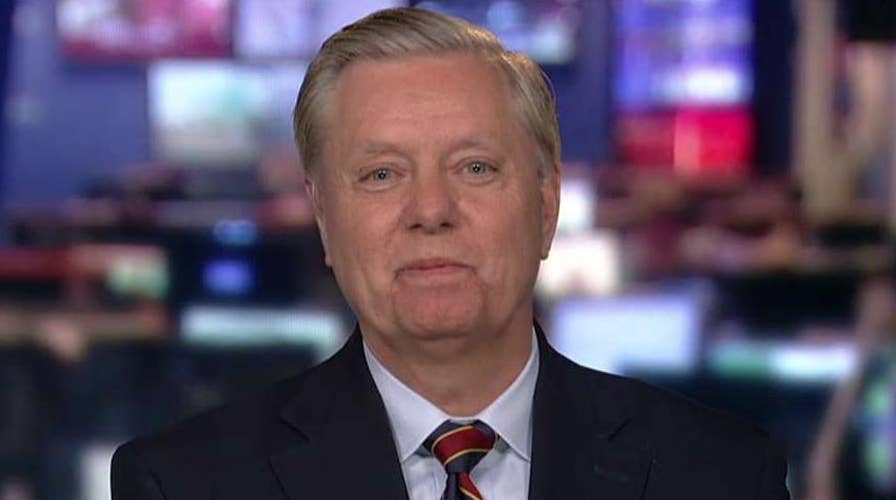
MACCALLUM: Here now chairman of the Senate Judiciary Committee, Lindsey Graham. He is - his committee is expected to question Attorney General Barr on Wednesday. Senator Graham, always good to have you with us. Thank you very much for being here, Mr. Chairman.
SEN. LINDSEY GRAHAM, R-S.C.: Thank you. Without a subpoena by the way.
MACCALLUM: Yes. I know. I want to get to that in a moment. But I also know you wanted to respond to what Judge Napolitano said --
GRAHAM: Yes.
MACCALLUM: -- about his disagreement --
GRAHAM Yes, yes.
MACCALLUM: -- with the attorney general over the issue of obstruction.
GRAHAM: Well, you know, I like Judge Napolitano but is he completely 100 percent wrong. The obstruction of justice pertains to colluding with the Russians. Not firing Comey. The theory is that you fire Comey to stop the Russian investigation.
What do we know after the Mueller report? There was no collusion between the Trump campaign and the Russians. There is no underlying crime. What do we also know? That the Trump administration gave the special counsel a million documents, allowed people to testify, McGahn for 30 hours, and never claimed executive privilege.
To the Sally Yates of the world this ridiculous absurd to charge this president with obstructing justice when there was no underlying crime to obstruct, and he cooperated fully with the special counsel. And finally, name one event that Donald Trump engaged in that impeded the Mueller investigation.
MACCALLUM: All right. Duly noted and we'll register your complaints with Judge Napolitano.
GRAHAM: Good.
MACCALLUM: I want to play this for you. This is something that showed up on Comedy Central with the comedian named Jordan Klepper who had Bill Clinton on one side of him.
GRAHAM: That's right.
MACCALLUM: And Hillary Clinton on the other side of him and they ended up discussing William Barr and legal degrees and going to law school. Watch this.
(BEGIN VIDEO CLIP)
BILL CLINTON, FORMER PRESIDENT: Got to really digest what's in the Mueller report because we know what the attorney general said about it is not true.
JORDAN KLEPPER, COMEDIAN: No.
B. CLINTON: That he misrepresented it.
HILLARY CLINTON, FORMER SECRETARY OF STATE: He should go to law school. Maybe we should send him to law school.
(END VIDEO CLIP)
MACCALLUM: They want to chip in on the charitable fund of Jordan Klepper and maybe send Bill Barr to law school. What do you think about that?
GRAHAM: Of all the people that I would seek legal advice from, Clintons would be at the bottom of my list. They have had enough legal trouble in their life for about 10 people, so all I can say to Bill Barr you can you withstand this criticism go and do your job.
MACCALLUM: You would think with all they've been through --
GRAHAM: Yes.
MACCALLUM: -- and you know, they have (Inaudible) about that. That they would just want to kind of be quiet during this whole moment and not say anything but they keep weighing in. Keep saying, you know, the president should be indicted. It's actually -- it's just a psychologically fascinating thing to watch unfold.
GRAHAM: Well, it's on Comedy Central for a reason because it's funny.
MACCALLUM: Yes. Well, there you have it. There you have it. You know, I want to ask you about Bill Barr and whether or not --
GRAHAM: Sure.
MACCALLUM: -- you agree with him that he is going to testify in front of your committee, of course, the Senate Judiciary Committee --
GRAHAM: He will.
MACCALLUM: -- of which you are a chair. But the question is the House committee and they want him to be questioned by staffer -- staffer attorneys. What do you think about that?
GRAHAM: Well, I think Bill Barr is required by law to receive the Mueller report and report to Congress. We will interview. We will question the attorney general. Each senator will get seven minutes. And if we need a second round, we'll have a short second round.
I can understand his concern. What the House is doing is way over the top. Mueller is the final word on this. I fought like hell to make sure Mueller could do his job without interference. I introduced legislation so that he couldn't be fired without cause.
And I've old everybody in the country if the president colluded with the Russians that would be horrible and terrible but I don't believe he did. And Mueller said he didn't. This is over. This is political revenge. The House is on a witch-hunt truly a witch-hunt to try to make something out of nothing.
Mueller said to Barr, I can't decide about obstruction of justice and since there is no underlying crime it would be hard to prove intent. The president did nothing to impede Mueller, and if the House pursues this it's because they have gone crazy when it comes to Trump.
MACCALLUM: I want to show you Rod Rosenstein's resignation letter, a little piece of it. He said, "I'm grateful." He wrote to the president. "I'm grateful -- he's going to leave May 11. I'm grateful to you for the opportunity to serve for the courtesy and humor you often display in our personal conversations and for the goals you set in your inaugural address, patriotism, unity, safety, education, and prosperity."
And he goes on with more in the letter. I'm just curious what you think about that. You know, in light of Rod Rosenstein is such an interesting character in all of this when I think back to the whole, you know, I will wear a wire, I'll pick up some of what the president says in my next meeting.
GRAHAM: Yes.
MACCALLUM: What do you make of the tone that he has now?
GRAHAM: Well, I think it's a respectful to all -- tone. I like Rod Rosenstein. You've got to remember Rod Rosenstein wrote a letter, a memo to President Trump suggesting he fire Comey because of the way he handled the Clinton e-mail investigation.
MACCALLUM: Right.
GRAHAM: Bernie Sanders, Chuck Schumer said that Comey should be basically fired. Rod Rosenstein agreed with Attorney General Barr. There was no obstructions when it comes to President Trump.
So, I think he served his country well. I think he served his country honorably. I do want to know why he signed the warrant, the FISA warrant application regarding the dossier that was used to get a warrant against Carter Page that's a bunch of garbage.
But generally speaking, I like Rod Rosenstein and he signed off on the idea that the president didn't obstruct justice.
MACCALLUM: All right. Chairman Graham, I want to have you back to talk about your immigration proposals next time. I'd love to talk to you more about that when we have some time.
GRAHAM: Great.
MACCALLUM: Good to see you tonight, sir. Many thanks.
GRAHAM: Thank you. Thank you.
MACCALLUM: More of "The Story" coming up next.
(COMMERCIAL BREAK)
MACCALLUM: That is our story for this Monday night. Thanks for being with us. A new "Untold Story" podcast went up today. Filmmakers of the documentary D-Day at Pointe-du-Hoc." It is so good. Listen to it. I hope you like it. We will see you back here tomorrow night. Good night, everybody.
Content and Programming Copyright 2019 Fox News Network, LLC. ALL RIGHTS RESERVED. Copyright 2019 CQ-Roll Call, Inc. All materials herein are protected by United States copyright law and may not be reproduced, distributed, transmitted, displayed, published or broadcast without the prior written permission of CQ-Roll Call. You may not alter or remove any trademark, copyright or other notice from copies of the content.
