


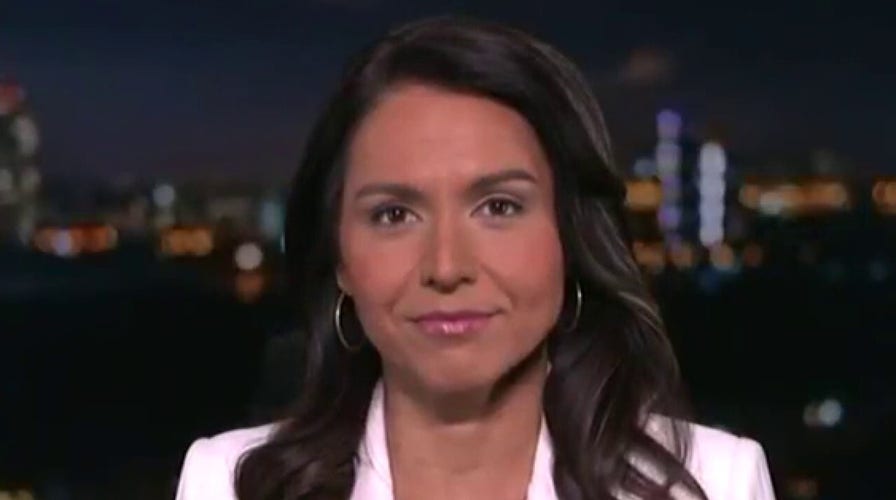
Gabbard: No time for politics in coronavirus fight
Democratic presidential candidate Rep. Tulsi Gabbard addresses preparations that need to be made to protect the U.S. from a coronavirus outbreak.
This is a rush transcript from "Tucker Carlson Tonight," February 28, 2020. This copy may not be in its final form and may be updated.
MARTHA MACCALLUM, FOX NEWS ANCHOR: Take care.
TUCKER CARLSON, FOX NEWS HOST: Good evening and welcome to TUCKER CARLSON TONIGHT. Just a week ago, we were living in what seems like a completely different world.
If you read the news coverage at the beginning of the week, you'd think the two biggest stories on earth were the battle between Mike Bloomberg and Bernie Sanders, and then some mysterious new domestic sabotage operation undertaken by that dastardly Vladimir Putin is always popping up everywhere to subvert elections.
We didn't agree with that. Those didn't seem like the two most important things happening in the world to us. So on Monday, we opened the show by telling you about coronavirus. That seemed like a very serious problem and likely to get much worse.
At the time, when we said that, 12 deaths had been reported in Iran from the virus. Tonight, four days later, well, according to BBC at least 210 are dead in Iran as of today.
Monday night, Italy had 229 cases of coronavirus. Tonight, that figure has quadrupled, it is now 888.
Three days ago South Korea had just under 900 cases of the virus. Today, they have at least 2,300.
Coronavirus has been reported on every continent on the globe apart from Antarctica, and it's spreading faster than authorities can keep track. The virus is in nearly 60 countries so far.
In China, the death toll rises by dozens each day and those are just the official numbers. So what about America where we live? So far, the U.S. has confirmed 62 cases of coronavirus that includes two new cases now of unknown origin.
That's far lower than many places, but keep in mind, we really have no idea how many Americans have coronavirus.
At the beginning of this week, the C.D.C. had tested 426 people for the virus. As of right now, Friday night, the C.D.C. is tested another 33 people -- all week, 33 in a country of 327 million, a country that by the way, effectively is open borders. More open in fact than we may realize.
Earlier today, CBS New York did report on two American girls who have just returned from a canceled Study Abroad Program in Italy. They're sending all the kids home.
The girls said that when they arrived in the U.S., at the airport, and again, they were coming from a place they'd been forced to leave because of coronavirus. But when they got here, they weren't screened at all. They weren't even ask questions about the virus. Why? Because even now with serious week-old epidemics in Italy, Japan and South Korea, our government is still only screening flights from China.
Does anyone really believe this virus will stay under control? Probably not. People with money on the line have already expressed their view of the subject. The Dow Jones dropped another 357 points today. Over the whole week, it fell 3,500 points. That's the biggest drop since the financial crisis. Three of the Dow's five worst days in history happened this week.
Meanwhile, the F.D.A. announced that we're now facing a drug shortage thanks to coronavirus, though weirdly, they didn't name the drug and that is bizarre.
We do know another thing we're short of, though, facemasks. For a pandemic of this scale, the U.S. ought to have 300 million facemasks at least. We have only 30 million. Ten percent.
So what can we expect this weekend and in the weeks to come as this virus develops and spreads? Dr. Syra Madad is Senior Director of the System Wide Special Pathogens Program for New York City's hospital system, and we're happy to have her on tonight.
Doctor, thanks so much for coming on.
DR. SYRA MADAD, SENIOR DIRECTOR OF THE SYSTEM WIDE SPECIAL PATHOGENS PROGRAM FOR NEW YORK CITY'S HOSPITAL SYSTEM: Thanks for having me.
CARLSON: So if you would, either allay our fears or confirm them, but give us the overview of where you think this is going.
MADAD: This is this is a very concerning outbreak on all different fronts, and the numbers continue to mount with every hour every day. Obviously every -- as you mentioned, there's over 60 countries reporting cases, many of them with community transmissions, so certainly very concerning, and we obviously have two potential cases here now in the United States.
So you know, at the weekends, and I think it is fair game, how this is going to play out.
But we do live in the United States, which have one of the best health care systems in the world. We have a very great public health infrastructure. So we're confident that, you know, hopefully, things will not look like China in the United States, hopefully we can get it under control if it starts to spread rapidly here.
CARLSON: Yes, and we certainly have great physicians in this country, the best. But it is odd, it does seem -- from a layman's perspective anyway, that the C.D.C., our first line against the spread of Infectious Disease has tested only 33 people all week, does that strike you as strange?
MADAD: It's very concerning. And actually, that's one of the issues. We really need to increase our diagnostic capabilities. That is the very first thing we should have done weeks ago.
I'm very glad to hear and see that C.D.C. finally expanded their clinical case definition within the past 24 hours. So now clinicians that are on the front lines can now screen for patients and test patients outside of Mainland China that have travel history. We can expand that and test for any patient we think that may have coronavirus disease.
And again that's something that should have been done perhaps weeks ago.
CARLSON: You'd certainly think, a month ago as we started talking about this.
MADAD: Absolutely.
CARLSON: I mean, I guess it's impossible to know. But what do informed people think the real number is of infected, ballpark, in this country now?
MADAD: In this country, it's hard to tell, but we know there's probably many more out there. It's just one of those things that once we ramp up diagnostic capabilities, and we start active surveillance, we'll probably get a little bit of a grasp of how many people in the United States that potentially already have coronavirus disease.
Right now, it's all speculation. But we're hopeful that with the public health measures that will, you know, come into play and those that are already, you know, in play right now, they would help reduce the transmission that's happening.
I think one of the issues we want to look at is what's going to happen in the developing world. That's where the healthcare infrastructure is very weak, and even if we get the coronavirus disease under control here, once it starts, we will probably see receding outbreaks because of the developing countries.
CARLSON: Amazing. Dr. Syra Madad, thanks so much for coming on tonight. I appreciate it.
MADAD: Thank you for having me.
CARLSON: There are major outbreaks of coronavirus in Japan, South Korea and Italy. In Japan, all schools are closed for the next month at least. And yet the United States is still receiving flights from all three of those countries.
In fact, we aren't even screening arrivals for the virus. Congresswoman and Democratic presidential candidate, Tulsi Gabbard of Hawaii says that needs to change. She joins us tonight.
Congresswoman, thanks so much for coming on.
REP. TULSI GABBARD (D-HI), PRESIDENTIAL CANDIDATE: Thanks, Tucker.
CARLSON: So obviously, there's an economic cost to shutting down routes or to inconveniencing passengers. You think we need to do it anyway, tell us why.
GABBARD: We do because first of all, let's look at the first move that was taken by the Trump administration to suspend flights coming from China to protect the safety and health and wellbeing of the American people, to prevent the spread of coronavirus here to our shores.
Similarly, this is what needs to happen with Japan, South Korea and Italy, these other countries who are going through a serious outbreak that they are dealing with. And like you said, there's still no screening taking place, not only on arrival with people coming here, but what I think needs to be done is people should be tested before they get on the plane.
In that case, and in that instance, when people are tested, they come out negative then they can go about their business. This will have some economic impact. There's no doubt about it. But that impact in the short term now by taking this action, will pale in comparison to the economic hardship and challenges we will face in this country if these flights are allowed to continue.
People are coming here potentially infected with this virus, and then it is allowed to continue to spread. The hardship on the lives of the American people and the hardship on our economy will be far reaching and longer lasting.
CARLSON: So just to put this in context for our viewers. You represent, of course, the State of Hawaii, which I would bet has more direct flights to Asia than any other place in the United States. It's a major source of revenue for your state.
GABBARD: Yes.
CARLSON: And so this would mean Hawaii takes a big hit, but you're still in favor of it. That's how concerned you are.
GABBARD: We have to have foresight and recognize the priority for our leaders is to ensure the safety and health and wellbeing of the people of my home state of Hawaii, the people of our country and taking this step now is necessary to be able to accomplish that because if we don't, then it's too late, then the coronavirus may have already taken root.
And again, you're looking at impact on jobs, impact on schools. Impact, yes, on a state like ours that's heavily dependent on tourism that will be far, far more long lasting and devastating.
CARLSON: No, that's right. So what would you say? I mean, this is a conversation that's kind of popped up a couple of times in the last week, but each time it does, the people who raise it are denounced as xenophobic. How would you respond to that?
GABBARD: It's looking at the facts and looking at the reality. Unfortunately, there has been some xenophobia around this outbreak that began in China that must be denounced.
Really what we're talking about is the United States, the American people, as well as how small this global community is, and how essential it is that we work with other countries to be able to prevent this from becoming an all-out pandemic.
And so, look, I want to make a direct appeal to President Trump at this point, to break through the bureaucracy, break through the red tape that we're seeing from agencies like the C.D.C. and the F.D.A. in order to broaden the testing criteria to make it so that anyone who has symptoms can actually get a test and to make sure that these tests are readily available.
Whether it's in a doctor's office, in a hospital, at our airports, or even as they're doing in countries like Scotland and South Korea, have -- there's a drive through station, you can go in and get the test and be in and out in less than 10 minutes rather than having the kind of prolonged testing that we're having now where the C.D.C. only tests have very few people because of their narrow criteria.
And then you've got to wait for days if you're one of those people who gets tested, potentially, if you have the virus, putting you in a place where you're exposing other people and putting them at risk. We've got to get on the ball on this.
CARLSON: It seems like a no brainer for sure. Congresswoman, thank you so much for saying that. You're one of the few. Appreciate it.
GABBARD: Thank you, Tucker.
CARLSON: Americans are getting released from quarantine for coronavirus, but should that make us feel better or more concerned?
One when recent TV interview is getting a lot of attention on this. So our chief breaking news correspondent, Trace Gallagher is here with the details. Hey, Trace.
TRACE GALLAGHER, FOX NEWS CHIEF BREAKING NEWS CORRESPONDENT: Hey, Tucker. Frank Wucinski is from Pennsylvania but he's lived in Hubei Province, China, the epicenter of coronavirus now for 15 years. In fact his father- in-law recently died of coronavirus and Wucinski, his wife and their three- year-old daughter went to Wuhan for the memorial service.
Because Wucinski and his daughter are American citizens, they were evacuated back to the U.S. His wife who is Chinese stayed behind and when dad and daughter got to the Miramar Marine Base in San Diego, they were placed in isolation, but tested negative for coronavirus, so they were let out.
But then the daughter began coughing and back to isolation they went, again testing negative for the virus. Today, Wucinski was on "America's Newsroom" when this happened. Watch.
(BEGIN VIDEO CLIP)
FRANK WUCINSKI, EVACUATED FROM WUHAN: Fortunately, from what I understand, you know, it is contagious but the death rate is pretty low.
So, yes, I understand the fear.
(END VIDEO CLIP)
GALLAGHER: Of course, the coughing prompted a question about his condition which led to a bit as you see there with the water family sharing that raised a lot of eyebrows. Watch again.
(BEGIN VIDEO CLIP)
WUCINSKI: Excuse me. Yes, I'm fine. I got tested twice. Negative both times. The cough probably just the nerves.
(END VIDEO CLIP)
GALLAGHER: Just nerve. Some wondered if the water sharing was the best choice, but again dad and daughter have tested negative twice and it appears they will not be getting a return visit to isolation at least for now -- Tucker.
CARLSON: Trace Gallagher, thanks so much for that. We will have more on the spread of coronavirus ahead from our own Dr. Siegel. He'll demonstrate three things you must do while traveling to protect yourself.
And up next, Michael Bloomberg has been attacked repeatedly for using stop and frisk while mayor of New York City. Some Republicans are eager to attack him from that, too, but they shouldn't be and we will tell you why.
Plus part two on our ongoing exploration of what Bernie Sanders has planned for this country. Bernie Sanders's America. Just ahead.
Donald Trump speaking to supporters tonight in South Carolina. We're monitoring that for breaking news. Of course, we'll bring it to you if it occurs.
DONALD TRUMP (R), PRESIDENT OF THE UNITED STATES: Thank you. Thank you, Senators, Congressmen -- they were the reasons. We are combating the opioid epidemic drug overdose --
(COMMERCIAL BREAK)
CARLSON: Ever since he began his effort to buy the Democratic nomination, Michael Bloomberg has been attacked by all sides for the stop and frisk policies he used for 12 years as mayor of New York City.
Under those policies, police were encouraged to stop and question individuals on the streets of New York and then frisk them if they suspected them of committing criminal activity.
Bloomberg himself has apologized for all this. He says he is embarrassed by the existence of the policy.
The Trump campaign and his many surrogates have joined him in that. They've partnered with the left to call Bloomberg a racist for stop and frisk, and that's understandable, of course, it's election season. And every politician, every campaign knows it's useful to attack an opponent where he is vulnerable.
But let's take three steps back. Politics aside. The only problem Bloomberg has with stop and frisk is that he is apologizing for it. Stop and frisk isn't racist. Even as crime fell on the city, the most dangerous parts of New York were still filled with volatile young men, many of them gang members carrying illegal guns.
Stop and frisk found those guns by the thousands while gang members learn to leave their legal weapons at home if they didn't want to go to jail. Stop and frisk also found a lot of illegal drugs and took them as well as their dealers off the streets.
Did most searches discover a crime? No, they didn't. But 12 percent of all stop and frisk searches, the frisk part did discover a crime. And that's a remarkable number for an otherwise harmless search.
Imagine if 12 percent of all T.S.A. searches discovered a gun or a bomb or other criminal behavior. Would you want T.S.A. abolished as wasteful and excessive? No, you wouldn't. It would be a huge success.
Is stop and frisk racist? Well, unlike Al Sharpton and the Black Lives Matter Movement or the new bail in New York or the Criminal Justice Reform Bill, we're all supposed to like, stop and frisk actually saved lives -- hundreds of lives. And those lives are overwhelmingly young black and Hispanic people.
In 1990, New York City had more than 2,200 murders. That's a lot. The year Rudy Giuliani left office, there were 649 murders. Under Mayor Michael Bloomberg, that number was cut in half again, it dropped to 322 murders a year in a city of eight million.
So New York wasn't just safer. It was the single safest major city in America, maybe in the world outside Tokyo, and you know who agreed with that? Donald Trump. Just four years ago, in a debate with Hillary Clinton, then candidate Trump said this.
(BEGIN VIDEO CLIP)
TRUMP: In New York City, stop and frisk, we had 2,200 murders, and stop and frisk brought it down to 500 murders, 500 murders, it's a lot of murders. Hard to believe, 500 is like supposed to be good.
But we went from 2,200 to 500 and it was continued on by Mayor Bloomberg, and it was terminated by our current mayor. But stop and frisk had a tremendous impact on the safety of New York City, tremendous beyond belief. So when you say it has no impact, it really did. It had a very, very big impact.
(END VIDEO CLIP)
CARLSON: It's so funny because the essence of stop and frisk was taking illegal guns off the street, something Democrats say they are for, but now, they just want to take your guns out of your closet because you didn't vote for them.
In Trump's Republican Convention speech later in 2016, he laid out the consequences of rolling back effective criminal justice policies like stop and frisk.
(BEGIN VIDEO CLIP)
TRUMP: Decades of progress made in bringing down crime are now being reversed by this administration's rollback of criminal enforcement.
In this race for the White House, I am the law and order candidate.
(END VIDEO CLIP)
CARLSON: Man, was that true? Nothing affects the lives of normal people, people without power more than high crime rates. And if you haven't lived it, say a prayer you never have to because it's the worst thing you can imagine.
In 2016, Donald Trump understood that he didn't care about sneering elites in their gated communities calling him racist. He stood behind the law and order policies that made life better for everyone -- everyone of all backgrounds, ethnicities, colors -- all Americans -- and it worked.
Trump did better than Mitt Romney did with black and Hispanic voters, and that's part of the reason. And that could happen again, by the way, Bloomberg is on his apology tour because apparently he thinks he has to say it, because he wants to win non-white voters.
But apparently, he hasn't looked at the real numbers. Data for Progress polled Democratic voters about their feelings of Mike Bloomberg and when they brought up the question of stop and frisk, the only group that didn't like it was white Democrats. Black Democrats felt the same about Bloomberg. Hispanic and Asian democrats said they were more likely to vote for Mike Bloomberg after hearing about stop and frisk.
It's not really surprising. Nobody in America of all races like crime, everyone wants less of it. The only people who feel differently are white liberals. So why are they bossing us around? We shouldn't let them, but for some reason the Republican Party is doing exactly that when they cede stop and frisk to the left.
Where's this going exactly? Four years from now, will Republicans be denouncing bans on public urination as bigotry? Please. All Americans deserve to live in a safe, clean, law-abiding, pleasant country. If there's any reason to vote Republican, it's because they stand up for that. And when they cease standing up for that, what's the point?
Last night, we kicked off our investigation into the policies of Bernie Sanders. We want to give you a sense of what Sanders would be like as President, we take him seriously. Sanders identifies, of course, as a socialist and for most people, socialism has a pretty simple meaning, free stuff from the government. And indeed, Sanders is promising a lot of that.
(BEGIN VIDEO CLIP)
SEN. BERNIE SANDERS (I-VT), PRESIDENTIAL CANDIDATE: We're going to raise that minimum wage to at least 15 bucks an hour.
We're going to build 10 million units of affordable and low income housing.
We are going to transform our energy system away from fossil fuel to energy efficiency and sustainable energy.
We're going to have universal, high quality, affordable childcare for all.
Together, we're going to make public colleges and universities tuition free.
We're going to make trade schools tuition free.
Healthcare is a human right, not a privilege. We're going to bring that to the United States of America.
(END VIDEO CLIP)
CARLSON: We've got to give him this. He's not playing small ball, is he? That's not school uniforms. That's bold. So how much would all of this cost?
Well, even Sanders doesn't actually know the answer to that question.
(BEGIN VIDEO CLIP)
ANDERSON COOPER, CNN HOST: How much will that cost?
SANDERS: Obviously, those are expensive propositions, but we have done our best on issue after issue in paying for them.
COOPER: Do you know how much though? I mean, do you have a price tag for all of this?
SANDERS: We do. I mean, you know, and the price tag is, it will be substantially less than letting the current system go. I think it's about $30 trillion.
COOPER: That's just for Medicare-for-All you're talking about.
SANDERS: That's just for Medicare-for-All.
COOPER: Do you have a price tag for all of these things?
SANDERS: No, I don't. We try to -- no, you've mentioned making public colleges and universities tuition free and canceling all student debt. That's correct. That's what I want to do.
We pay for that through a modest tax on Wall Street speculation.
QUESTION: But you say you don't know what the total price is, but you know how it's going to be paid for. How do you know it's going to be paid for if you don't know how much the price is?
SANDERS: Well, I can't, you know, I can't rattle off to you every nickel and every dime.
(END VIDEO CLIP)
CARLSON: That's a little fuzzy. But if you want more concrete numbers, go to his website. So the cost of Sanders is housing plan $2.5 trillion over the next decade. That's his estimate. His college plan, $2.2 trillion. Universal pre-K, because you can't send your kids to government schools early enough, $1.5 trillion. Green New Deal, $16 trillion.
Now, that's not a number we came up with. Again, that's from his campaign website. So the total cost of Sanders's campaign promises approaching $100 trillion. That's five times the size, not just for government spending, but of America's entire economy.
Where's all that money going to come from? The Fed?
Justin Haskins is Editorial Director of the Heartland Institute. He joins us tonight. Justin, thanks so much for coming in. So approaching $100 trillion. I'm not a math guy or anything, but like at some point you bump up into the limits of physics, right?
JUSTIN HASKINS, EDITORIAL DIRECTOR, HEARTLAND INSTITUTE: You would think so, but apparently not if you're a socialist. The thing that everyone is asking right now is how is Bernie Sanders going to pay for this? What kind of taxes are we going to roll out? Is he going to have to cut spending in other areas? He's going to cut military spending. What is he going to do?
You know, those are actually the wrong questions when it comes to Bernie Sanders, actually, because Bernie Sanders, as he proved in that interview that you just played, is not really interested in coming up with a specific answer, because he believes in a radical economic theory that holds that if you have a Central Bank, and if you print your own currency, and the United States does have those things, then you can print as much money as you want, an infinite amount of money essentially, to pay for whatever programs you want to pay for and manage the entire economy.
It's called the Modern Monetary Theory and Bernie Sanders is a strict adherent to it. I really, truly believe that and in this theory, taxes and regulations are not used to raise money, especially taxes. They're used to punish people that you don't like. Punish industries that you don't like and to take money out of the money supply, if you need to do that to help battle inflation.
But for the most part, it's used to punish industries and then you control the economy by essentially controlling how much money you're printing, and you funnel it into the areas of the economy that you want to grow and then you punish the people you don't like with taxes.
CARLSON: I mean, we're already doing a scaled down version of this with quantitative easing, and the Fed has already pumped trillions into the economy. And it's made the top end richer than anyone has ever been in history, but it hasn't really helped the rest of the country. Why does he think this is going to work when he tries it on a bigger scale?
HASKINS: Well, because he's saying essentially -- that's very true -- but what he's saying is I'm going to do the same thing except on steroids, and then instead of funneling it to rich people, I'm going to punish rich people with taxes and regulations. I'm going to punish businesses that I don't like, like fossil fuel companies, and then I'm going to funnel all this money down to you people, the voters.
That's what he's promising essentially. It's 21st Century socialism, Tucker. That's what it is.
CARLSON: Well, he is really saying I am going to funnel it to myself. It is going to accrue in the form of power. This is really scary, man.
HASKINS: That's exactly right.
CARLSON: Justin, thank you for that explanation. I hope you'll come back. We're going to continue with a forensic look at what he believes because I think it's worth knowing. Great to see you tonight.
HASKINS: Thanks, Tucker.
CARLSON: Well, an American Marine veteran has been trapped in Syria for almost a decade. Why don't we bring him home? Why isn't it a greater priority for this country? It ought to be. We'll talk to his mother in just a minute.
Plus, we'll continue to monitor the President's rally tonight in South Carolina. Stay right here to catch breaking news coming out of it. We'll be right back.
TRUMP: We are tired of winning in South Carolina, can't do it anymore. It's too much. It's too much. We've had years where we weren't winning and it was okay. We couldn't get jobs. We took it easy. But we just want you to go and see your friend, the President. And we want --
(COMMERCIAL BREAK)
CARLSON: Austin Tice is a Marine Corps veteran and a journalist, for eight years since 2012, he has been missing in Syria, but he's believed to be alive held by either the Syrian government or one of its allies.
Our government has been perfectly willing to bomb Syria and get involved, yet according to Austin's mother, Debra Tice, officials are far less interested in bringing her son home and here's the most amazing part.
The Syrian government has invited the U.S. government to send a representative to Damascus to discuss the case, but neocons at the State Department have intervened, and therefore it hasn't happened.
Debra Tice joins us tonight. Debra, thanks so much for coming on.
DEBRA TICE, MOTHER OF AUSTIN TICE: Thank you, Tucker.
CARLSON: So for our viewers who aren't aware, and I think it's a little bit surprising that more Americans don't know the story of your son. Will you just give them a quick overview of what happened and where you think he is?
TICE: Well, Austin was arrested at a checkpoint near Damascus, and he is detained in Syria. And without knowing who is holding him, we still know that the Syrian government has the authority to secure Austin's safe release.
But his only hope for release is through diplomacy, and we also know that the President wants him to be free. It's his will. We have it -- we have his assurance verbally and in writing that he is working hard to bring Austin home and we trust him. We know that this issue is of course, just hard.
CARLSON: Right, so we're putting on the screen, I'm not sure you can see it, but a response to a letter that you wrote the President, and he says we're working hard to bring your son home.
So the obvious way to do that might be to initiate talks with the Assad government, but there are some in our State Department who think that it's like immoral to talk to the Assad government for some reason. What would you say to them, the people who are preventing those negotiations?
TICE: Well, I would say that they're insubordinate to the President of the United States, because it's his will for Austin to walk free. And the only way that he is going to do that is through dialogue, and the Syrians have opened the door.
So it's on us to respond and engage in the conversation that will secure Austin's safe release.
CARLSON: I just -- I feel for your family. Have you had any contact with him in the past eight years?
TICE: We have not had any contact from Austin. And it is difficult. But we know that the President has the will to bring him home, and now we have an open door. The time is now. The question is who is going to stand in the way of the President of the United States bringing our son home?
CARLSON: Well, that is the question.
TICE: And he would want to do that.
CARLSON: That's right. And it's been the question on a lot of policies around Syria, I would say. I sense a theme here. Debra Tice, we're certainly rooting for you, and I hope this helps.
TICE: Thank you and -- you know, you brought up Syria, and here's the thing. Austin has been held through two administrations now.
And President Trump has a much better record for bringing Americans home. And we trust him that he's going to get this done. We know that he has the will and the ability.
CARLSON: I certainly hope he does. Debra Tice, thanks so much for joining us tonight. Godspeed.
TICE: Thank you. Thank you, Tucker.
CARLSON: With bewildering speed, it has suddenly become normal in America to place young children on powerful medications to prevent them from going through puberty. Is it safe to do this? What are the long term effects of it?
Or are we just launching a massive human experiment on this country's children. We will tell you next.
Also, Dr. Siegel is here to demonstrate three important travel tips as the coronavirus continues to spread around the world. Should you fly, if so how? We will tell you. We will be right back.
(COMMERCIAL BREAK)
CARLSON: In early February of this year, a group of lawmakers in South Dakota tried to pass a bill to ban radical medical experimentation on young children.
Under heavy pressure from business groups like the Chamber of Commerce, the Republican dominated legislature voted it down. Why would they do that?
Well, as you probably guessed by now, it's because conducting radical medical experiments on children is now popular. These experiments are justified in the name of transgenderism. The failed South Dakota bill would have barred doctors from performing sex reassignment surgery on children under the age of 16.
Now these are radical, often irreversible procedures that can include double mastectomies, sterilization, and castration.
The bill would have also barred doctors from prescribing hormones to aid in the transition process, once again, only for those under 16. Now it used to be that everyone agreed with this idea. It was commonsense. Adults are free to do essentially what they want, but if you're 15, or nine or 10, you are too young to consent to profound acts.
Too young to consent to sex, too young to have your sex organs cut off. It's simple. This has been an operating understanding in the West for a thousand years.
But the reticence to mutilate children, which was once now morally obvious, is now seen as bigoted. As the transgender movement has grown, activists have pushed to transition children at younger and younger ages.
For children with gender dysphoria at a sufficiently young age, it has now become common to place children on drugs like Lupron which suppress hormone production thereby block the onset of puberty.
At least one Democratic presidential candidate has endorsed providing these drugs, puberty blockers at taxpayer expense. So the question is, are puberty blockers safe? And the answer is, we have no idea if they're safe.
Lupron was initially developed to treat advanced prostate cancer in elderly man, a case in which severe or long term side effects were not much of a concern.
The drug has also been used to treat precocious puberty. That's a rare and harmful condition where children as young as five undergo premature hormonal changes.
But what's the effect of blocking puberty possibly for years on children who don't have any underlying medical cause to do so? We don't know the answer to that.
Activists claim the drugs effect are fully reversible. But we don't know that that's true.
Besides delaying physical maturity, Lupron also affects bone density. There are thousands, literally thousands of young adults who took Lupron as children and now have to battle with bone and joint problems more common in the elderly.
A few small studies also indicate that when used to arrest puberty, Lupron can lower a child's IQ -- cognitive ability -- by seven to nine points, which is a lot.
If that's really the case, it wouldn't be surprising since puberty is crucial to completing the brain's development.
And speaking of the brain, the rush to place children on puberty blockers is justified on the grounds of psychological health, gender dysphoric kids who can't go on hormones right away we are told will likely become depressed or suicidal. Okay? But it turns out that depression is in fact a known side effect of puberty blockers, irony of irony.
In a recent study from the U.K., after a year on puberty blockers, children were dramatically more likely to agree with this statement, "I deliberately tried to hurt or kill myself" while they were taking the drugs.
So far, there is zero long term studies looking at the physical or mental effect of healthy children going on puberty blockers, whether they later go through a full sex change or not.
Similarly, we know almost nothing about the long term prognosis for children who undergo full physical transitions. It is simply too new. We don't know.
We do have studies though on what happens to gender dysphoric children who don't receive puberty blockers. In about 80 percent of those cases, boys who wish they were girls or girls who wish they were boys eventually get over it and turn out fine with no radical treatments necessary.
As adults, many of these children become gay or bisexual, but they still identify with their biological sex and they do not want sex change surgery.
Think about that. That means that most, if not all children with gender dysphoria should wait until adulthood to transition. Otherwise, the vast majority will get expensive, invasive, potentially dangerous, possibly irreversible treatments they never needed, and in the end wouldn't have wanted anyway.
But activists can't wait for adulthood. They want any children with gender dysphoria to be pushed into a full transition as quickly as possible.
In other words, they want doctors to carry out a vast human experiment with this nation's children -- your children -- as its subjects, and it really is a vast experiment.
In 2009, the U.K.'s Gender Identity Development Service or GIDS received 77 referrals for child gender dysphoria. A decade later, they received almost 2,600. That's an increase of more than 3,000 percent.
Notably, while a decade ago, most gender dysphoric children were biologically male, today, a majority are biologically female. So why is that? It seems we are finding out, and despite professional risks, some have tried to do so.
In 2018, Brown University researcher Lisa Littman found that many teenage girls are abruptly identifying as transgender after seeing a friend do so or after being exposed to pro-trans material online and there's an awful lot of that.
In other words, impressionable teen girls may literally be taking part in a fad, a fad that involves irreversible surgery at the end of it. Here's a terrifying quote from "The Times" of London, a mainstream British newspaper, and we're quoting here, "35 GIDS clinicians have resigned in the past three years, many alarmed by the rush to medicalization and the way Instagram trans influencers and the CBBC programme 'I am Leo' present transition as uncomplicated."
"They say they are seeing girls with the panoply of other issues -- anxiety, depression, self-harm, undiagnosed autism, victims of homophobic bullying and sexual views for him transition to a male body was presented online as the universal panacea."
"Often a normal tomboyish disgust at their new breasts, eliciting sudden and unwanted sexual attention from men is interpreted as a certainty that they are in the wrong body."
"Yet instead of instead of interrogating these underlying issues, clinicians are told to affirm a young person's trans-identity and prescribe puberty blockers that trans-campaigners fiercely insist are they're right."
Think about it. That's horrifying. That's not medicine. It's something else.
At this moment, 19 U.S. states ban so called conversion therapy for minors, that's a therapy that claims it's possible for gay people to become heterosexual. Now, the states have banned it, even though it involves no surgery, no medication, and no physical treatments on the grounds that it doesn't work and it could drive gay teenagers into depression or suicide.
In effect -- and this is the key -- those states have said that if you want to provide a risky elective therapy with no proof it'll work, you have to wait until the child has become an adult. That makes sense.
Similarly, many states ban minors from getting tattoos for the same reason. They're permanent, and they can change your life forever. So kids ought to wait till adulthood before they make that choice. This used to be obvious once again.
But on the far more radical treatments used for transgenderism, states are doing nothing at all.
South Dakota lawmakers had the chance to say no and spared their children from this insanity. But they declined to do that. Why? Well, the Chamber of Commerce attacked the bill. They said it threatened the state's economic development.
And apparently Republicans in South Dakota agreed shamefully and by the way, it really was Republicans who did this.
The South Dakota House has 59 Republicans and just 11 Democrats. The Senate is 30 Republicans to five Democrats. And yet a bill to protect children from medical experimentation still couldn't get through the statehouse.
Remember, the Republicans will do almost anything to protect businesses access to cheap labor, but your children, protecting your children, they won't lift a finger.
With coronavirus spreading across the globe, it would seem important to have competent experts running things. Instead, we now have Chelsea Clinton, a Professor of Public Health. We're not kidding actually, that, just ahead.
Plus, how can you stay safe while traveling? Dr. Marc Siegel has three tips you probably ought to be aware of. We will be right back.
(COMMERCIAL BREAK)
CARLSON: If you're going to travel in the next few weeks or months as coronavirus spreads, what are the three things you ought to do to protect yourself? Dr. Marc Siegel has thought it through. Here's his view.
(BEGIN VIDEOTAPE)
DR. MARC SIEGEL, FOX NEWS MEDICAL CORRESPONDENT: With spring break just a few weeks away, a very busy travel time. Here are a few tips to keep you healthy and safe.
I get asked this question all the time. When are you supposed to wear a mask on a plane because people are coughing and sneezing, right?
Actually, the most important time to use a mask as a barrier is if you're sick yourself. If you have a respiratory infection, the mask will prevent the spread of droplets to other people.
But don't wear a mask if you don't have any symptoms at all. You know why? Because the guy next to you can cough right on you who is not wearing a mask. It goes in your eyes, it goes in your face, it goes on your ears. You scratch your nose and then you put it in your eyes, you're going to get infected anyway.
So if you think a mask protects you if you're not sick, it doesn't. What it does do is it decreases the risk that people who are sick will spread the virus to you.
Look how filthy these planes are. Common surfaces on planes are too frequently overlooked, because they build up a lot of viruses and bacteria from all the passengers that come through. So clean yours.
One final tip, use hand sanitizers on planes to kill viruses and bacteria. But one additional idea is make sure your hands are moist because if they're dry, the hand sanitizers could make them even drier and guess what happens then, the bacteria and viruses get in through the cracks.
(END VIDEOTAPE)
CARLSON: Well, just this week, CNN, needless to say published an op-ed by Professor Chelsea Clinton of Public Health at Columbia, attacking the administration's coronavirus readiness and presented her as an actual health expert in the process. Absurd, of course. But it is not just CNN.
At this moment, Columbia University's faculty page identifies Chelsea as an Assistant Professor of Health Policy and Management. How did that happen?
Johnny Burtka is Executive Director of the American Conservative. We're always happy to have him on the show. Johnny, thanks so much for coming on.
So what does this tell us about the state of American society? I thought she was a hedge fund manager and then a documentary film maker and then she was a network news correspondent, then who is this woman and why does she keeps getting promoted?
JOHNNY BURTKA, EXECUTIVE DIRECTOR, AMERICAN CONSERVATIVE: Here's what's going on, Tucker. Back in 2016, there was a lot of talk about American Carnage, these images of the de-industrialized Midwest, but what was really going on that's a lot harder to see is the American carnage of a corrupt ruling class that seeks to hide their sins behind prestigious jobs at foundations by paying lip service to identity politics and by writing op- eds at places like CNN on topics that they know nothing about.
I think it's highly ironic that Chelsea Clinton, whose fame comes solely because her father was President is writing this op-ed when her father's greatest accomplishment in his last term was welcoming China into the World Trade Organization and giving them permanent normal trade relations status.
The consequence of those actions put us in the position where we are today, where once the coronavirus broke out in China, we are overly dependent on them for vital medical supplies and pharmaceuticals, not to mention the stock market that's crashing.
So here you have the daughter of the President who helped to create the problem, lecturing us about how to fix the problem. And let me tell you what will happen. She'll go on, she will get applauded for writing these kind of columns. And this is the way Washington and New York work.
The people that create the problems are the ones that are picked to fix the problems and then they get rewarded with even higher salaries and more honors.
CARLSON: That is such a smart point. And very quickly, there's something wrong with our system if Chelsea Clinton is the product of our so-called meritocracy, isn't there?
BURTKA: That's right. We need a new elite in this country and it's going to take 30 years to build it, but that's the task that's before us.
CARLSON: It is the task that's before us, but I doubt she even read this op-ed. Someone wrote it for obviously, but you should read her Twitter feed, which I think she writes.
That's really a window into excellence in the ruling class. It's illiterate. Johnny, great to see you tonight. And thank you for that. Really smart.
BURTKA: Thanks, Tucker.
CARLSON: We're out of time tonight and this week. We'll be back Monday and every weeknight at 8:00 p.m., the show that is the sworn and sincere enemy of lying, pomposity, smugness and groupthink.
Have a great weekend with the ones you love. Try to enjoy yourself. We will continue to cover the coronavirus, honestly. Jason Chaffetz is in for Sean Hannity next. He takes over. See you Monday.
Content and Programming Copyright 2020 Fox News Network, LLC. ALL RIGHTS RESERVED. Copyright 2020 ASC Services II Media, LLC. All materials herein are protected by United States copyright law and may not be reproduced, distributed, transmitted, displayed, published or broadcast without the prior written permission of ASC Services II Media, LLC. You may not alter or remove any trademark, copyright or other notice from copies of the content.
