


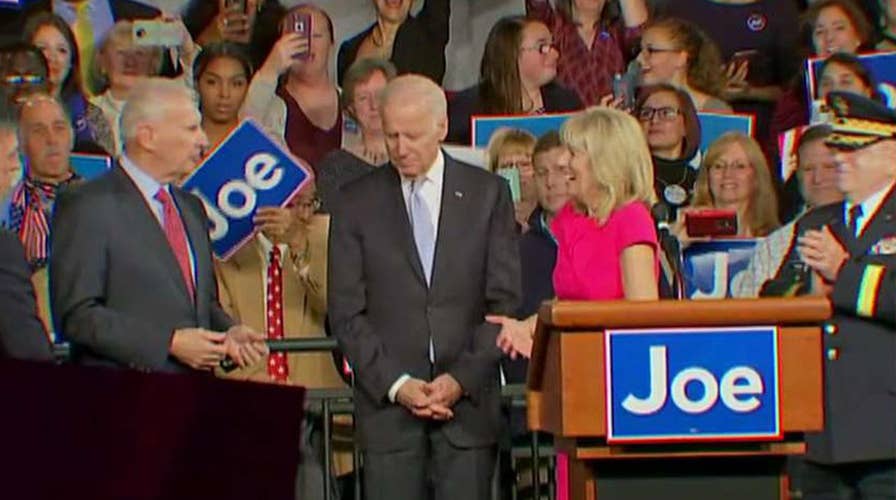
Former Vice President Biden and his wife made $15 million in the two years after leaving office
Ann Berry, David Burstein and Rob Smith weigh in on 2020 hopeful Joe Biden's recently released tax returns.
This is a rush transcript from "Your World," July 10, 2019. This copy may not be in its final form and may be updated.
NEIL CAVUTO, ANCHOR: Well, you think the markets were hanging on every word from this guy?
Try this one, the chairman of the Federal Reserve had a busy news day, because, while the labor secretary, Alexander Acosta, was defending the handling of the Epstein case, Fed Chief Jerome Powell was moving markets, arguing maybe a rate-cutting case. And that won out for the guys who trade stocks.
Welcome, everybody. I'm Neil Cavuto.
Well, stocks moving up, as the Fed chief signals rates could be coming down, and maybe soon. The S&P 500 crossing 3000 for the first time ever, as the Dow and Nasdaq were also hitting records. They ended up coming back a little bit, but impressive nevertheless.
We're all over the implications of all the above with FOX Business' Susan Li on what got the Street cheering, and Kevin Corke at the White House on a Fed chief who, well, just might be blinking -- Kevin.
KEVIN CORKE, WHITE HOUSE CORRESPONDENT: Neil, no matter what the president said, the Fed chair made it clear today he's not going to step away from this job. In fact, he says, look, I'm going to serve each and every year of my four-year term. Bank on it, write it down, unless I decide otherwise.
All right, so that's his word, that despite the criticism from President Trump, the man who appointed him. In testimony -- you may have seen this on Capitol Hill -- the Fed chief was asked by Representative Maxine Waters of California if he would heed a theoretical call by the president to step down.
(BEGIN VIDEO CLIP)
REP. MAXINE WATERS, D-CALIF.: Mr. Chairman, if you get a call from the president today or tomorrow, and he said, I'm firing you, pack up, it's time to go, what would you do?
JEROME POWELL, FEDERAL RESERVE CHAIRMAN: Well, of course I wouldn't do that.
(END VIDEO CLIP)
CORKE: "I wouldn't do that."
So Powell stating clearly he has no intention of leaving -- repeat -- no intention of being forced out or leaving, other than of his own accord. White House officials, by the way, Neil, say Powell's job is safe for now.
(BEGIN VIDEO CLIP)
LARRY KUDLOW, DIRECTOR, NATIONAL ECONOMIC COUNCIL: There is no effort to remove him. I will say that unequivocally at the present time.
(END VIDEO CLIP)
CORKE: Did you notice what Larry said there? At the president time. Got to love Larry Kudlow.
Just last month, of course, the president said he didn't think Powell had done a good job, noting he had the authority to fire him if he wanted.
Also, he denied explicitly threatening his job. Now, to be clear, you can only remove a Fed governor for cause. So it's not like the president can just sort of make it up as he decides to go along.
One other thing, very big story today, obviously, here in Washington. All eyes were over at the Labor Department. Secretary Acosta discussing that case back when he was an attorney in the -- for the Southern District of Florida, talking about the Jeffrey Epstein case, which was just incredibly difficult to even listen to.
He tried to lay out his explanation for his decision-making here today. The president apparently still supports him -- Neil.
CAVUTO: All right. Thank you, my friend, very, very much, Kevin Corke at the White House.
Now to Susan Li on how Wall Street was trying to digest all of these busy news events -- Susan.
SUSAN LI, CORRESPONDENT: Yes. OK.
Well, Neil, we saw a record day for U.S. stock markets. Now, we didn't close at those historical levels. But it was still a positive day, thanks to Federal Reserve Chairman Jerome Powell. His testimony on Capitol Hill has markets now pressing in an over 70 percent chance of a quarter percent cut at the end of this month, and more than a quarter of the market says the Fed might go even bigger and cut half-a-percent off interest rates.
Before Powell started speaking, that probability was at zero. Now, the Fed chair pointing to slowing global growth concerns, also distortions caused by trade disputes as the Fed's main concerns.
(BEGIN VIDEO CLIP)
POWELL: The case for a somewhat more accommodative monetary policy stance had strengthened.
(END VIDEO CLIP)
LI: So we finally saw the S&P 500 crossing through 3000 today. It took five years from when the broader index cross 2000 in August 2014. But we finally got there. Technology, oil stocks the biggest contributors, so the likes of Micron, Apple, Chevron and ConocoPhillips.
We do have oil prices, by the way, closing back up to $60 per barrel once again on falling supply concerns of an impending storm in the Gulf of Mexico, might be draining even more supply from the oil markets, and hence we have this bounce.
And finally Boeing, the plane maker, is set to lose its title as the world's biggest to France's Airbus. And that's because of the 737 MAX, which will be grounded from U.S. flights until at least the end of September. But also the safety concerns have resulted in zero, zero sales of the jets, Neil, over the past three months.
CAVUTO: Susan, great job, as always, my friend, Susan Li of FOX Business Network fame.
If you don't get it, demand it.
And my next guest was demanding answers from the Federal Reserve chief, Texas Republican Congressman Lance Gooden, a member of the House Financial Services Committee.
Very good to have you, sir.
REP. LANCE GOODEN, R-TX: Thanks for having me. It's great to be here.
CAVUTO: You know, I thought the Fed chief comported himself pretty well. He was obviously acknowledging the pressure that he gets from the United States.
GOODEN: Sure.
CAVUTO: He tried to rise above that, but, in the end, he seems to be set to do what the president wants him to do, cut rates.
GOODEN: That's what we heard today. And based on the news report I just heard on your show, it sounds like we're going to go from great to even greater.
And the Fed chairman was very positive today. And he indicated that we were basically what you and I know, we're in the greatest economic time of the last 50 years, and things are supposed to just get better and better.
I think they will. And I think the next few months will be good for America.
CAVUTO: But, you know, we are doing right. You're quite right on that. The numbers indicate that.
It wouldn't seem to warrant a cut in interest rates right now, right? Or how do you feel about it?
GOODEN: You know, I'm not the Fed chairman.
But I think that this economy is growing. The president is certainly on board, I believe, with lower interest rates. And it seems as if the markets today are happy with what they're hearing from Washington.
I think we're going in a great direction. And I'm not going to question the chair's plan, so to speak. But I questioned him today and asked him what he thought about the economy. He said, on a scale of one to 10, he wouldn't give it a 10. But his explanation was a 10 to me.
And I think we're just continuing to grow.
CAVUTO: No, no, you're right. That was an interesting development.
What I noticed, Congressman, which was kind of interesting, is, he took umbrage to the fact that maybe the Fed isn't doing a good job, saying, look at the economy, that's all the proof you need.
GOODEN: Right.
CAVUTO: In other words, not saying it's -- it's not just the president. What did you make of that?
GOODEN: You know, I think it's a culmination of factors.
And he even acknowledged some of the negative -- some of the negative factors, perhaps economic factors in other countries that can be an issue.
CAVUTO: Right.
GOODEN: But I think what we heard today was that, overall, things are going great in the American economy.
The Fed chairman believes that. Certainly, the president believes that. And I think a lot of this back-and-forth tension perhaps is more fake news- driven, certainly not on this network.
But I think it's more of the talking points that I see...
CAVUTO: Well, I don't think it's fake to say that the president wanted to fire the guy or wanted to demote the guy.
And then, apparently, the law is such that he can't. And then you had the Fed chairman saying today, I plan to finish out my term.
(CROSSTALK)
GOODEN: Sure.
CAVUTO: What did you think of that?
GOODEN: You know, I think a lot of that was Democrats enjoying talking up conflict between the president and the Fed chairman.
But I think the president has been frustrated...
CAVUTO: Well, there is conflict. There is conflict. The president is not a fan of him, right?
GOODEN: ... that the rest of Washington is not on board with this great American economy.
All we hear from the other side is how bad everything is, how the president is a racist, the economy is great, but it's not because of the president.
And I think what we saw today was that this economy really is great, and really is moving forward. And I think the chairman of the Fed did a good job today.
CAVUTO: All right. But, just to be clear, Congressman, the president has trashed the Fed chairman, maybe for perfectly valid reasons. So that's not fake news. That's actually happened, right?
GOODEN: I don't believe that the conflict is as great as perhaps the media has played it out to be.
And what I saw today was a chairman who was comfortable with the way this economy is going. And I think the president's probably going to be happy with what he saw today in the hearing.
CAVUTO: All right, because the president has said he regrets choosing the guy. So you think those tensions are over now?
GOODEN: I think the tension tensions are certainly better after today.
CAVUTO: OK.
GOODEN: I won't speak for the president. But I think the president has to be happy with the acknowledgement that we heard today from the Fed chairman that this economy is moving in the right direction, and he seemed to be on board today.
CAVUTO: Got it.
Congressman, thank you for taking the time. I do appreciate it.
GOODEN: Thank you. Thank you.
CAVUTO: Market watcher extraordinaire. I have talked to this man for decades. He's the bible when it comes to just stepping looking at the big picture, Art Hogan, outside the New York Stock Exchange.
You know, Art, I did find it interesting that you had the Fed chairman, saying, I have got a job to do, I'm going to be here for my full four-year term. The president can't fire me, demote me. I'm here, end of story.
Is it end of story?
ART HOGAN, MARKET STRATEGIST: It's interesting that even has to say that or that comes up in conversation.
So if not for that tension between the House in the FOMC and the Fed chair about where we should be on monetary policy, this wouldn't even come up.
Neil, you and I have been around long enough to know that every president has felt like the Fed is working against them at some point in their administration.
CAVUTO: Absolutely. Absolutely.
HOGAN: It's just, in this day and age, it's just easier to broadcast that story. And we have got a president that doesn't mind having every one of his thoughts out there on social media.
So I would say that, going back to Lyndon Johnson, who wasn't crazy about how things went, or George Bush I, who thought he lost the election because of the Fed, there's been plenty of antagonism between presidents and the head of the Fed.
It's just usually more behind closed doors. And now that we all know about this, it becomes more of a story. So, in a real sense, this is just more drama, necessarily, because we know about it than historically has been out there.
CAVUTO: You're probably right. A lot of this stuff has happened behind closed doors in the past.
Art, one of the things that the markets took for granted today and maybe a given today is that interest rates are coming down at the end of this month by a quarter point. That seems to be the consensus. Do you agree with that?
HOGAN: Well, certainly, I agree that that is the consensus. I just don't agree that that necessarily should be the given.
I think the Fed is ready to cut rates, if that's the appropriate thing to do. They pointed towards the things that would cause that, right, so a global economic slowdown, trade tensions, certainly part of that, a natural slowdown in the U.S. economy in the second quarter vs. the first quarter.
CAVUTO: Right.
HOGAN: We all kind of know that.
But the amount of data that they get between now and the 31st is massive. We get a CPI, a PPI, first look at the second quarter GDP. We get three jobless claims numbers, housing starts, industrial production, capacity, utilization.
So there could be enough data that says, you know what, we haven't slowed down enough. We're ready to cut, but we're going to put it off for another meeting. And I think the market is going to be offsides on that.
I'm not saying that's happening, but instead of saying there's 100 percent chance that the Fed is going to cut on July 31, I would rather think of this as being more 50/50 or maybe 75/25. There's never a 100 percent chance the Fed is going to do anything.
And I certainly think the market is a little offsides on that.
CAVUTO: That's interesting.
You know, Art, one other thing I wanted to get your sense of is this idea that normally when you cut rates, well, people welcome it, it's tonics to the markets, I get that, normally, normally, it can lead to a sell-off in the markets because they're -- OK, here comes the slowdown, we got things to worry about.
So not all the time is it just a big victory for the markets. Do you worry that if rates were cut, the very thing the president wants to see doesn't happen, the opposite?
HOGAN: Right. And that is such a good point, Neil.
When you think about the Fed having to go into a cutting cycle or an easing cycle, or even cutting rates one time, it's OK to call this insurance and say, hey, listen, we're a little on the top of normal and we need to pull back, December was probably a bridge too far.
But if this is actually the beginning of a cutting cycle, that means the Fed is seeing an economy that is slowing down enough that we should be concerned about markets.
And I think careful what you wish for here. If, in fact, the trade tensions slow the economy down enough into the second half of this year, and the Fed has to cut more than once, we're at a different place. And that's not a good place for the market. It's certainly not where the president wants to be heading into an election cycle.
CAVUTO: Housing, your quick take on that. Everyone thinks, rates fall down, housing picks up. It's been sort of sputtering a little and I don't quite understand why.
HOGAN: Yes, the supply of housing for millennials that are just entering in the market is too small or too expensive, regardless of the affordability of rates. That's been the problem.
The lower rates have helped the re-fi markets. And the re-fi markets are probably at saturation now. There's not that many more people that can re- fi, but it's just that supply. And, unfortunately, we have to get the homebuilders to a place where they're actually building things for the new growth in the market, which is the younger entrants into the housing market.
So household formation has been picking up, but right now they're renters. And we would love to see that supply come online, where it's you and I leaving our houses because we're deciding to downsize and having that starter home for that population that's starting to come into the market.
I think it's going to adjust itself. It's just going to take a while.
CAVUTO: All right.
Art, my only other point I was going to mention to you is, how is it possible that, in the years we have known each other, you have not aged, but I have? So that's for another interview.
(LAUGHTER)
CAVUTO: All right. Thank you, my friend.
HOGAN: Thank you, sir. Great to see you. Thank you.
CAVUTO: Art Hogan, the bible on the Street here.
Well, say it ain't Joe, a $15 million windfall after former Vice President Joe Biden left office. Does that have some on the left wondering if he's the guy to rally the middle class?
After this.
(COMMERCIAL BREAK)
CAVUTO: All right, out of office and making the money.
According to tax returns just released, the former Vice President Joe Biden and his wife, Jill, they made together more than $15 million in the two years since leaving the public life.
Will all of those millions make it harder, then, for him to make the case he's ordinary Joe? Now, keep in mind, he's open to higher taxes on the wealthy. So, essentially, he would be taxing his own success.
Having said that, we have got Turning Point USA's Rob Smith, Democratic strategist David Burstein, and Cornell Capital Partners' Ann Berry.
Ann, I don't think it's a mystery that he was -- got rich over the last couple of years. A lot of politicians do when they leave. But I do notice the front-runners, they're millionaires in the Democratic group here. So what does that mean?
ANN BERRY, CORNELL CAPITAL: They are all millionaires.
And I think that they're all advocating for policies to help some of the lower-income portions of the population. The median income in the U.S. is $61,000, plus a little bit. Everyone running comes far and above that.
I think what's so interesting, though, is that they're all advocating for policies that would harm themselves. And so I think, as we move into this next part of the race, I think the question becomes, who is really standing behind policies, even if it means that they may see impairment to their own wealth?
What do you think, Rob?
ROB SMITH, TURNING POINT USA: Well, my thing is, look, I love capitalism. I say the more millionaires the better.
There's nothing wrong with the fact that Joe Biden made $16 million after leaving the vice presidency. That's great. The problem comes when you have Joe Biden, you have Elizabeth Warren, you have Bernie Sanders, you have these people that are multimillionaires, saying that capitalism is bad, being a millionaire is bad.
It is these millionaires, they're the reason why you're not doing well. And that's where I think the disconnect comes through with a lot of voters.
CAVUTO: What do you think of that, that, all of a sudden, it's one thing to sort of rail against the globalists and all these others that they go on, but, wait a minute, you're a beneficiary of it?
DAVID BURSTEIN, DEMOCRATIC STRATEGIST: Well, right.
I think, to be fair, though, nobody saying that being -- making money is bad in the Democratic Party. I just want to be clear about that. Elizabeth Warren says she's a proud capitalist.
But the reality is...
(CROSSTALK)
CAVUTO: Do you believe that? Do you believe that?
(CROSSTALK)
BURSTEIN: I do believe that.
But the vast majority of Americans thinks that capitalism needs some reform and can't continue the way it's been continuing.
CAVUTO: But do you think it's fair the way to characterize that anyone with some money is suspicious?
(CROSSTALK)
CAVUTO: That's the way it's sometimes portrayed.
BURSTEIN: But I think the reality is -- I would I would say that is not what Democrats are saying. Democrats are saying...
CAVUTO: No, I actually dragged myself through those debates.
(CROSSTALK)
SMITH: It really is what they're saying.
BURSTEIN: It's about the idea that people should pay their fair share, which is different than saying people are bad or people are suspicious.
I think there is a criticism that people should pay more.
(CROSSTALK)
CAVUTO: So, Joe Biden found vehicles to save some money on. And is that hypocritical?
BURSTEIN: Well, the reality is that everybody does that.
And people who have a certain level of income can do that. And it's allowed under the tax code.
CAVUTO: Yes, but they rail against it.
BURSTEIN: But the reality is, he paid a tax rate which is on par with what people paid.
CAVUTO: Fair enough. Fair enough.
BURSTEIN: Unlike the president, who paid a zero -- who paid zero tax.
(CROSSTALK)
CAVUTO: We don't know that for sure.
(CROSSTALK)
SMITH: ... is this. Joe Biden is going to be kind of less susceptible to this criticism than the Bernie Sanders and Elizabeth Warrens of the world.
The problem with Joe Biden is that he's so rickety right now and he's so weak. I feel like he's going to be pushed.
CAVUTO: You're not referring to his age?
SMITH: No, I'm not referring to his age at all.
I'm referring to the campaign that he is running.
CAVUTO: Understood.
SMITH: But I think that things are looking so weak right now that he is going to be pressured from the far left to adopt some of those same anti- capitalism messages that Bernie Sanders and Elizabeth Warren have made their entire campaign about.
CAVUTO: It's an interesting point.
One of the things that, if you're Joe Biden, you can say, all right, I released my tax returns the last two years as a private citizen. I have released them throughout when I was vice president, throughout when I was senator, so decades of tax returns. And the president hasn't released anything.
BERRY: Yes, exactly.
I think he's into point to having the moral high ground. And I think the question then becomes, does it even matter? Does anyone care?
I mean, I think one thing that the last election showed us is, it doesn't matter. There you have...
CAVUTO: And that will be the president's position.
(CROSSTALK)
CAVUTO: It's not happening. Get over it, right?
BERRY: I think that's exactly right.
And in terms of this question around sort of moral hypocrisy, right, you had a president who won on the path from being a successful billionaire, who appealed tremendously to some of the lowest-income demographics in the country.
So I think the correlation between a candidate's personal wealth and who they appeal to...
(CROSSTALK)
CAVUTO: If that wealth is what he says it is.
SMITH: It is.
And I think that when you talk about Trump, the reason why the president was able to appeal to some of the people that maybe did not have that much money is because it's that whole self-made aspect, and people look up to people that are self-made.
So then you have somebody who's...
(CROSSTALK)
BURSTEIN: He was not self-made.
SMITH: Not self-made, but in terms of somebody that has...
(CROSSTALK)
BURSTEIN: Dad built himself up a little bit.
SMITH: Look, dad gave a million-dollar loan, but he turned it into something.
(CROSSTALK)
CAVUTO: My father gave me 20 bucks and a bus ticket and said, go..
(CROSSTALK)
SMITH: Yes. Right. Same here. Same here.
But I think that Biden, Warren, Sanders can't really appeal to voters in that way.
BURSTEIN: Well, I think the reality is that if you look at -- you look at Biden, he's not as extreme as these other people are on a lot of these things.
(CROSSTALK)
CAVUTO: Is he the one you still think has the best chance just on paper -- and I know it's early -- of beating him, because he seems in some of the latest polls to have kind of stabilized?
(CROSSTALK)
BURSTEIN: Well, the reality is -- and we have talked about this before, Neil -- is that the problem with Biden, I have always thought -- and it showed in the last debate with Harris -- is that he's not the dexterous candidate you need in this political environment.
So he's there now, but what about -- what's going to happen in the next debate? What's going to be the -- I have a feeling that there will be another similar moment.
CAVUTO: But is wrapping success, whether you enjoy it or not, to the status of being a millionaire, is that a winning formula, when they're knocking all this stuff that's happened?
BURSTEIN: Frankly, I think Democrats have been trying this approach for a long time, and it hasn't gotten them where they need to go.
CAVUTO: Doesn't work.
BURSTEIN: And, frankly, delivering results is much better.
CAVUTO: All right guys, thank you all very, very much.
In the meantime here, the border situation firing up again. We will tell you about it after this.
(COMMERCIAL BREAK)
CAVUTO: Apparently, Mexico is making good on a promise. The Department of Homeland Security now reporting border apprehensions were down 28 percent in June. It's still the fourth month in a row we have seen that over 100,000, but this is a start.
Acting Customs and Border Patrol Commissioner Mark Morgan with us.
Commissioner, that's pretty impressive, but still people hearken back to that, we're still over 100,000. But the progress there, what did you make of it?
MARK MORGAN, ACTING IMMIGRATION AND CUSTOMS ENFORCEMENT DIRECTOR: Yes, Neil, that's right.
So, make no mistake, we're still in a full-on crisis. But those numbers are still a dramatic -- 28 percent, as you said, that's a dramatic decrease.
And make no mistake, the president's efforts with Mexico, to include the threat of tariffs, are one of the single most important issues. Mexico has -- they have agreed to and they stepped up. And right now, the past few weeks, they're doing exactly as they said they would agree to do. And it's making an impact.
CAVUTO: So when we look at these numbers, Commissioner, and they talk about it going down 20-some-odd percent, are we talking about what's happening at their -- at their border, that that's the genesis of this, that it started with what they're doing to police those trying to get through their southern border, fewer coming to our border?
MORGAN: So, really all of the above.
Mexico, as they have said, they have agreed to tighten up their southern border, they have agreed to put additional resources to stop the avenues through Mexico, and include additional resources at the U.S.-Mexico border.
But one of the biggest things also is what we have referred to as the MPP, the Migrant Protection Protocol. And that's where Mexico has agreed to keep individuals who are seeking asylum or come to America in Mexico while they're going through the immigration process.
Right now, we have sent back over 17,000 individuals that are residing in Mexico while they're going through the immigration process. That's a game- changer, Neil.
CAVUTO: Commissioner, this is a little bit apples and oranges, but the same issue of those at the border.
The administration wants to begin deportations of those whose cases have been fully adjudicated. They have been told they have to leave. They haven't left. I hear numbers all over the map, 650,000 to upwards of a million.
How will that be executed? In other words, how will they start that process?
MORGAN: Well, Neil, I'm glad you are mentioning this, because, in my former role as director of ICE, I supported this.
Look, we have to do this. One of the greatest pull factors, one of the greatest incentives is, individuals know, you grab a kid, that is your U.S. passport in the United States. Once you get here, nothing happens to you.
We have to address that. We have to enforce the rule of law. We have to address that through consequences. We have to send the message that, once you have had due process, and you have been ordered removed by a judge, that's what needs to happen. That is what ICE is responsible to do.
CAVUTO: You probably heard about Alexandria Ocasio-Cortez. She wants really right now to get rid of the entire Department of Homeland Security, that it's not up to the job.
This is what she said:
(BEGIN AUDIO CLIP)
REP. ALEXANDRIA OCASIO-CORTEZ, D-N.Y.: ICE is not under DOJ. It's under the Department of Homeland Security. And so we have now...
QUESTION: Would you get rid of Homeland Security, too?
OCASIO-CORTEZ: I think so. I think so. I think we need to undo a lot of the egregious -- a lot of the egregious mistakes that the Bush administration did.
(END AUDIO CLIP)
CAVUTO: What do you make of that?
MORGAN: Neil, look, it's this kind of rhetoric from Congress that it's not doing anything to solve the crisis.
It just increases the divisiveness that we're experiencing in this country with this issue. That does nothing to solve the crisis.
What did was that, after months of pleading Congress to pass a supplement, they finally did. And now you're seeing, for example, Border Patrol -- it was just a few weeks ago Border Patrol had over 2,500 unaccompanied minors, children in their custody. And today it's less than 250.
And that's simply because of the supplement that we have been begging Congress to pass for months. That's what we need Congress to do. We don't need them to continue this divisive rhetoric. That solves nothing.
CAVUTO: All right, Commissioner, thank you.
We will see if this progress at the border continues, but it is certainly the first positive sign we have seen that maybe the Mexicans are doing exactly as they said they would.
MORGAN: Yes.
CAVUTO: All right.
Well, as you know, Home Depot founder Bernie Marcus was here a little bit more than a week ago. He was talking up how much he loved the president, how much this environment has made a lot of folks a lot richer.
But it was that support of the president that has apparently roiled this growing group of Home Depot customers that want to boycott the store. Is that fair? Is that right?
After this.
(COMMERCIAL BREAK)
CAVUTO: All right, nothing like a parade, tens of thousands lining New York City's Canyon of Heroes for the U.S. women's national soccer team, cheering, dancing, and calling for equal pay.
After this.
(COMMERCIAL BREAK)
CAVUTO: Vicious and totally crazed, and that was the nice stuff the president had to say about critics of Home Depot founder Bernie Marcus, after the billionaire pledged his support for the president.
Now a lot of customers are saying, you know what, we're going to boycott the store. Now, those critics were probably watching Bernie Marcus with me talking about, well, this.
(BEGIN VIDEO CLIP)
BERNIE MARCUS, CO-FOUNDER, HOME DEPOT: I'm a Republican, but I vote Democratic.
CAVUTO: When's the last time you voted Democrat?
MARCUS: Oh, I could tell you, for members of the House, the Senate within the last eight years.
CAVUTO: OK.
Last Democratic president?
MARCUS: That, I can't tell you, because I haven't -- I certainly didn't vote for Obama. And I certainly didn't vote for Clinton, so, yes.
(END VIDEO CLIP)
CAVUTO: You know, my point with this is, he's not made a mystery or secret of this.
And follow-up newspaper interviews commemorating the 40th anniversary of Home Depot, I mean, he and, of course, his big investor pal friend Ken Langone, none of that warranted a Fox News Alert or anything that hasn't been out there for years now.
Still, the punishment that even the president says goes way too far.
Market watcher Gary Kaltbaum, The Washington Examiner's Tiana Lowe, and "Catalina" publisher Cathy Areu.
All right now, Cathy, do you think a boycott of a store simply because you don't like what the founder does with his money when it comes to politics is right?
CATHY AREU, PUBLISHER, CATALINA: Well, it's the American way. It's exactly how Martin Luther King and the civil rights movement got started. It's silent protesting.
So, by boycotting, you're showing the power of your pocketbook. And if you do not like what the president stands for, or what his supporters stand for, you can make a statement. And by boycotting the Home Depot, you are saying, I do not support this president and you're not going to get a dollar from me.
(CROSSTALK)
CAVUTO: You realize he's no longer actively in management, and hasn't been for a long, long time? He is just the guy who founded the store.
AREU: Right.
CAVUTO: And now you're going to punish him simply because he's exercised his prerogative, his political prerogative, as you do to support whatever?
AREU: He is not being punished because he doesn't belong to that store anymore. He's a co-founder, but his name goes along with the store. He's 90 years old, and he's a co-founder.
He is together with Home Depot, no matter what happens.
CAVUTO: And you would support someone doing that if, during the Obama administration, they didn't like someone giving to Obama, and, as a result, they're not going to honor that store, that establishment?
AREU: Well, President Trump was the first one holding up the birther movement protesting Obama, so...
CAVUTO: No, on, that's apples and oranges. You think there's some consistency there? Because I don't see it.
AREU: It happened during the Obama administration. People boycotted. It's been going on since the '60s, since before that. So, yes.
(CROSSTALK)
CAVUTO: All right, So, Gary, her -- the gist of what she's saying is, that is -- you're free to go to a store, not go to a store.
But to lead an effort to not go to an establishment that benefits Democrats and Republicans, and more bizarre to me, people who are handy, what do you think?
GARY KALTBAUM, CONTRIBUTOR: Neil, here is company and here is Bernie Marcus that have created hundreds of billions of dollars of wealth, millions of jobs, are very over-the-top philanthropic, with hundreds of millions of dollars to children and to health care and to hospitals.
Yet this is who they are choosing to go after? I mean, are you going to just protest and after your family, your friends, 50 million people that voted for Trump, and just not even talk to them anymore?
This for me -- listen, I believe in freedom of speech, protest. But, for me, I think there's better targets out there.
CAVUTO: It is a free country. People obviously can do what they want, Tiana, but what do you make of this?
TIANA LOWE, THE WASHINGTON EXAMINER: So let's just talk about Bernie Marcus specifically. This is someone who's already given away $2 billion of his wealth to charity. He's going to give away 80 percent of the rest of his $5 billion net worth, or so he says.
So he departed from the company 15 years ago. So all this boycott is really doing is punishing the workers and the stakeholders of Home Depot. And Home Depot has made more than 3,000 employees and shareholders multimillionaires.
This isn't touching markets. It's just touching hardworking Americans across the country. And if we're going to talk about boycotts' efficacy, then let's just look at Chick-fil-A. Chick-fil-A used to be the seventh largest food chain in the country. Now it's third.
So, I mean, I'm sure this is a great own to Trump, obviously.
(CROSSTALK)
CAVUTO: Cathy, when you look at what they're doing here, and is it a matter of who you give to that causes the consternation, so you don't like that guy, you don't like who he supports, but you take it out on the organization that employs thousands, and maybe that will show them something?
AREU: Well, the unfortunate part is, isn't it, that people have given -- companies have given and people have given to both parties. You never know who's going to win an election.
CAVUTO: Right.
AREU: So you actually give to both candidates.
CAVUTO: But you're OK with taking it out on Home Depot, because the one -- Home Depot isn't giving this money away. The founder of the company that left over a decade ago is giving it away. That's his call.
(CROSSTALK)
AREU: The co-founder who associates his name, the company of his name with the donation. And the president tweeted about it. They made it public.
If this could have been nice and quiet...
(CROSSTALK)
CAVUTO: Home Depot management -- Home Depot, as an operation, is not giving money to Donald Trump. I don't know...
AREU: The co-founder is. And the president made a point of saying, the co-founder of Home Depot supports me, and how dare all of you boycott?
(CROSSTALK)
CAVUTO: Now, would you be more inclined if he were supporting any one of the Democratic candidates?
AREU: He probably is. He's helping everyone. But the one with the biggest mouth happens to be Donald Trump. He can't be quiet about who gives a donation.
CAVUTO: No, no, no, no, but would you mind it then? No, you wouldn't mind it then, because you're to the left, and that's fine, but to pick and choose who really has a right to give money to anyone.
(CROSSTALK)
AREU: Everyone gives money to everyone. That's the name of the game in politics.
(CROSSTALK)
CAVUTO: No, this guy is giving it just to one guy.
AREU: We don't know.
CAVUTO: Right now, it's the president. He's giving it to Donald Trump.
So, Gary, what I'm saying here is, you can't pick and choose your battles based on your particular politics, and take it out on someone who's giving money to someone else.
I mean, by that virtue, almost all the entertainment companies, we wouldn't be streaming anything, because they're all run by companies and CEOs who are to the left.
KALTBAUM: All I can tell you is, you have a company like Home Depot with 2,300 stores and a few hundred thousand employees that can get affected by this if this goes bigger.
But, look, people think they have a right to do whatever they want to do. And they actually do. And I just say, please pick a better spot. There are worse people out there than this great company and this great man who, by all estimates, is one of the great Americans of the last 50 to 100 years as far as the building of wealth, the building of growth on jobs, you name it.
CAVUTO: Fair enough. Fair enough.
But, Tiana, I think we should give him some extra slack, because he built one of the world's largest aquariums not anywhere near the water in Atlanta.
KALTBAUM: That too.
CAVUTO: So I'm thinking that alone, Tiana, what do you think of that, should give him bipartisan support?
LOWE: Well, absolutely. And also considering he's donated to vets. He's donated to autism foundations.
This is someone who has made a huge impact in his local city of Atlanta, and is well-recognized as being a philanthropic, not just donor, but community member, someone who cares about his people. And it just -- it's a waste of energy.
AREU: Well, Trump canceled it out with that tweet. He canceled it all out.
(CROSSTALK)
LOWE: Canceled out the livelihood of thousands of Americans.
(CROSSTALK)
CAVUTO: We have to start hating less.
AREU: Trump did. Trump did.
CAVUTO: No, you started it.
(LAUGHTER)
AREU: You started it.
CAVUTO: All right, we have a lot more coming up.
KALTBAUM: It's all Trump's fault.
(LAUGHTER)
CAVUTO: It's all Trump's fault.
We have a lot more coming up, including this fuss over the border that now has really his political craziness that makes the Home Depot thing nuts.
(COMMERCIAL BREAK)
CAVUTO: This is incredible video.
Can you imagine in a plane and you're taking images of this? Delta Air Lines investigating what went wrong after passengers were told to brace for on emergency landing.
This video, for those of you listening on radio, shows one of the engines on fire. All right? A broken nose cone of an MD-88 aircraft bouncing inside the engine. That's what produced the fire. No injuries reported, landed safely, but, man, oh, man.
Meanwhile, Homeland Security officials getting grilled on Capitol Hill today over the use of facial recognition technology at the border.
Hillary Vaughn with the latest.
Hey, Hillary.
HILLARY VAUGHN, CORRESPONDENT: Hey, Neil.
well, the Customs and Border Protection and Transportation Security Administration tell lawmakers today that they are not using facial recognition technology or biometric technology to spy on Americans.
In fact, they say this technology is not surveillance at all.
(BEGIN VIDEO CLIP)
UNIDENTIFIED MALE: What we're doing is absolutely not a surveillance program. And we're just replacing the evaluation and scrutiny of the physical I.D. with the computer algorithm.
UNIDENTIFIED MALE: So we don't do surveillance.
(END VIDEO CLIP)
VAUGHN: CBP responded to reports that ICE has been scanning through millions of Americans driver's license photos without their knowledge or consent.
CBP's John Wagner today saying they do scan driver's license photos from states they have a written agreement with DHS that marks citizenship on a license so they don't need a passport to cross the border.
Lawmakers also grilled the CBP and TSA over whether or not facial recognition technology recognizes certain faces more than others. And that can lead to discrimination, because a false positive or an accidental flag could mean certain groups of people are accidentally detained more often.
(BEGIN VIDEO CLIP)
REP. BENNIE THOMPSON, D-MISS.: So the data right now is that women and dark- skinned people are misidentified more than anybody else?
UNIDENTIFIED MALE: Age, race and sex.
THOMPSON: So is that women and dark-skinned people?
UNIDENTIFIED MALE: Yes.
(END VIDEO CLIP)
VAUGHN: The CBP also addressed a data hack that exposed thousands of people's -- travelers' photos. And they said they are investigating the situation. It did happen through a subcontractor. And they are looking and considering taking criminal action against that subcontractor -- Neil.
CAVUTO: All right, Hillary, thank you very much, Hillary Vaughn in Washington.
Well, Nancy Pelosi in a feud right now with the extreme left, particularly one congresswoman in her party. And it's not dying down -- after this.
(COMMERCIAL BREAK)
CAVUTO: All right, well, what fight?
House Speaker Nancy Pelosi saying she has really no regrets about her comments on progressive Democrats. But is this rift a problem for the party going forward? Keep in mind that the target of her wrath, Alexandria Ocasio-Cortez, has more or less acknowledged, yes, it's kind of complicated, but we're dealing with it.
RealClearPolitics' Phil Wegmann. Nothing complicated about Phil.
There's clearly something that's amiss here. And the fact that Nancy Pelosi is trying to gloss it over, saying there's no big deal here, and now you have Cortez saying there is a something here, but it is what it is.
What do you make it?
PHILIP WEGMANN, REALCLEARPOLITICS: Well, I think what we're finding out is the Alexandria Ocasio-Cortez has a very large public persona, but she doesn't have much of a following in the House.
That was essentially Speaker Pelosi's argument when she made those remarks earlier on. And it comes at a moment when Democratic leadership, they don't want to be mediating these disputes between progressives and then some of the more moderate members of their caucus.
Instead, they really want to be focusing their fire on Donald Trump ahead of 2020. They see this sort of thing, all of the tweets, as a distraction.
CAVUTO: You know, I'm beginning to wonder if there is a method to it then, calling her out -- that is, Nancy Pelosi -- in an interview, and then a follow-up interview, and then Cortez following up in her own response to that interview.
There's definitely bad blood there. And there's definitely friction on the part of the Democratic leadership in the House, why weren't you with us on this legislation, this $4.6 billion border funding measure, that would have addressed the very things that you wanted addressed, these kids who are suffering there?
WEGMANN: And that intra-fighting right there, that is absolutely a gift to the Republican Party, because not only does AOC make a sort of circular firing squad possible, she's also the most progressive member of the House of Representatives.
She's pushing the party to the left at a moment when we see that the Democratic electorate, they don't want to go in that direction. This is most obvious by the fact that Joe Biden, a moderate, for the moment, he's the front-runner, and he is very much different. He's a member of the old guard that has more in common with Nancy Pelosi than AOC.
CAVUTO: Well, it's interesting, because Biden has said that Cortez is bright and brilliant, but too far left.
Meanwhile, she seems to be hooking up with candidates who more suit her point of view. Kamala Harris comes to mind. Elizabeth Warren comes to mind. But where is this going?
WEGMANN: Well, I think where this is going and certainly where the Trump campaign hopes this goes is that whoever emerges from the convention in Milwaukee next year, regardless of their politics, their hope is that Alexandria Ocasio-Cortez and others like her during the primary and during the sort of debates that we're seeing right now in Congress, that they will shift the party so far to the left, that whoever actually becomes the nominee, the Trump campaign can sit back and just say, ah, there you go, again, just another Democratic socialist.
CAVUTO: We shall see.
Phil Wegmann, thank you, my friend.
WEGMANN: Thank you, sir.
CAVUTO: All right, it is hurricane season, right? Apparently, there's a doozy. We will tell you about it.
(COMMERCIAL BREAK)
CAVUTO: All right, 'tis the season, a tropical storm now, but Louisiana Governor John Edwards not taking any chances, declaring a statewide emergency, as a potential or again makes its way toward the Gulf Coast. What to expect?
WeatherBELL's Joe Bastardi on Skype joining us now.
What do you think, Joe? What are we looking at here?
JOE BASTARDI, WEATHERBELL CHIEF FORECASTER: Well, I think this thing is a candidate for what we call rapid feedback, where the system starts organizing, and like a skater pulling in its arms, gets -- accelerates quicker and quicker and quicker.
The conditions have been ripe in the Gulf of Mexico. In fact, I was on the business side with you last week, Neil, when we were talking about earthquakes. I said look out in the Gulf this week because of this feature.
It did not originate in the Tropics. It came down across the Ohio Valley. But this is a way Alicia developed, for instance, back in 1983, and that developed to a Category 3 hurricane.
I don't think this will get that strong. But I think there's a real big problem here indirectly caused by the very cold winter in the Northern Plains and the late spring and all the snowmelt and heavy precipitation, because the Mississippi River is higher at New Orleans, much higher, than it usually is.
You start piling a lot of rain in there, and it's not so much the river floods because of what's going on around New Orleans. It's all the stuff coming down streams. But if you get a lot of rain there, Neil, and strong south-to-southeast winds because the hurricane passes close enough to them on Saturday, it's going to be a real problem.
They're already having some problems there now.
(CROSSTALK)
CAVUTO: Then, is this a preview of coming attractions? What do you think? What's the season looking like?
BASTARDI: Well, actually, Neil, again, our WeatherBELL forecast said to look for less than normal activity in the deep Tropics. We put this out in April, but in close development, scattershot and close development.
It's a real pain-in-the-neck year, because the Gulf of Mexico is warm, the Western Atlantic's warm, and even though the deep Tropics are less than -- less than ideal, near the U.S. coast again, these rapid feedback features are a big worry. And you may be seeing a precursor to the season.
CAVUTO: All right, how about the winds that we can expect? What are you looking there?
BASTARDI: Well I think that this will get to a hurricane. It could get to a Category 2 hurricane.
An extreme example, genre of this storm was Alicia, Category 3. But I think this will go to 1 or 2, probably make landfall Saturday near Vermilion Bay, Louisiana, and then come northward, and rather slowly, so that Baton Rouge, New Orleans, area, Lafayette, and those places in there are much more prone to having a bad storm than let's say Beaumont, Port Arthur and Houston.
I think Houston is in pretty good shape with this one.
CAVUTO: I was reading somewhere, might even one of your writings, that expect more activity in the Gulf this season than outside. What do you think?
BASTARDI: Well, yes, we think further north, relative to averages, further north and in close, there's more activity.
You take -- look at Bob in 1991, developed in the Bahamas and came up and hit New England as a Category 2 storm, or Belle in 76. And the thing is that, a lot of these years, the waves are relatively weak in the Atlantic, but, as they can get further north, they can develop.
CAVUTO: All right.
BASTARDI: It's a semi-El Nino year. So that's what the bottom line is.
CAVUTO: Got it.
You're a genius. Thank you, my friend. Good catching up with you.
(LAUGHTER)
CAVUTO: Joe Bastardi follows this stuff like no one else.
All right. In the meantime, just to let know, no record for the Dow today, but we did have one for the NASDAQ.
They're optimistic about interest rates coming down, no matter what storm is coming their way.
Content and Programming Copyright 2019 Fox News Network, LLC. ALL RIGHTS RESERVED. Copyright 2019 ASC Services II Media, LLC. All materials herein are protected by United States copyright law and may not be reproduced, distributed, transmitted, displayed, published or broadcast without the prior written permission of ASC Services II Media, LLC. You may not alter or remove any trademark, copyright or other notice from copies of the content.
