





Bernie Sanders unapologetic for his millionaire status
Democratic presidential hopeful says he won't apologize for writing a bestselling book; reaction and analysis from the 'Special Report' All-Star panel.
This is a rush transcript from "Special Report with Bret Baier," April 15, 2019. This copy may not be in its final form and may be updated.
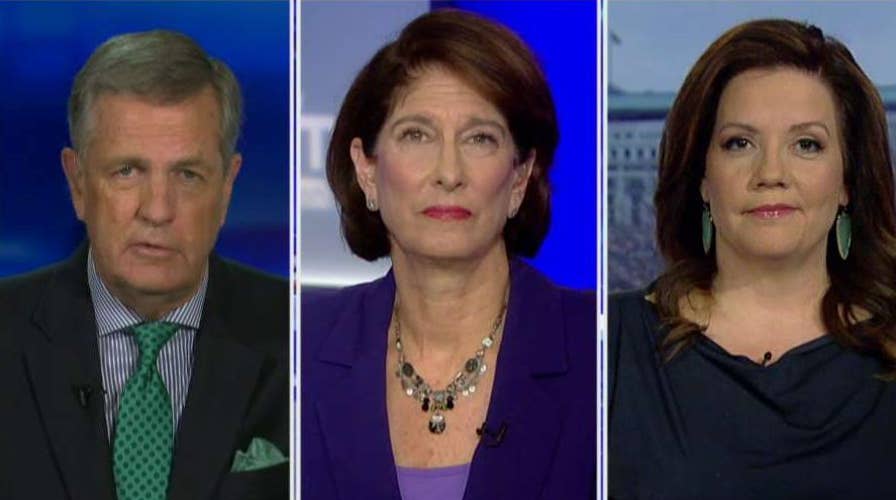
BRET BAIER, ANCHOR: Let's now bring in our panel from Washington and elsewhere: Fox News senior political analyst Brit Hume; Mara Liasson, national political correspondent at National Public Radio; and Mollie Hemingway, senior editor at The Federalist.
Brit -- you're getting the results of these tax returns coming out, real time, as we are. Your thoughts as you hear Susan kind of encapsulate those ten years?
BRIT HUME, FOX NEWS SENIOR POLITICAL ANALYST: Well, I think it's just fine that Bernie Sanders made all that money, and it doesn't bother me in the slightest that he's a millionaire.
It is a little striking that he benefited so richly from the business tax rate afforded him by the Trump tax cut, but other than that I think it's fine. And perhaps in the fullness of time he will come to realize that such proceeds are worth having, worth earning and worth having a tax rate that accommodates them.
(CROSSTALKING)
BAIER: We will see.
HUME: It seems -- the profit motive seems to have stimulated him, doesn't it?
MARA LIASSON, NATIONAL PUBLIC RADIO: Don't hold your breath. BAIER: Yes, take a listen to Bernie Sanders before and just in the past few days.
(BEGIN VIDEO CLIP)
SEN. BERNIE SANDERS: How does it happen that in America today we got 47 million people living in poverty and yet at the same time, we are seeing a proliferation of millionaires and billionaires?
I don't apologize for writing a book that was number three on the "New York Times" bestseller.
(END VIDEO CLIP)
BAIER: Mara -- I think it's fair to say on the campaign trail, he regularly vilifies millionaires and billionaires and he has conceded he is one of them.
LIASSON: Yes, although recently I think he has dropped the millionaires and talked more about the billionaires. But I'm assuming -- and I'm sure he will be asked about this tonight -- I'm assuming Bernie Sanders would say, you know, I paid taxes under the law that exist now but I am looking forward to a new tax system more people like me would pay much, much more.
BAIER: Yes. Mollie -- your thoughts? I mean you look at the results. Again, $561,000 in 2018 but it was really the 26 percent effective tax rate that raised everybody's eyebrows and the donation of 3.4 percent to charity. Your thoughts?
MOLLIE HEMINGWAY, FOX NEWS CONTRIBUTOR: Right. Well, first off, kudos to Bernie Sanders both for selling a product that a lot of people wanted to buy in our system that can make you a millionaire. He wrote a book that a lot of people wanted to buy and he benefited from that.
And also kudos for releasing the tax returns. It's good for Americans to be able to see where his income has come from in the last ten years. It's obviously not something you have to do but it's nice if people do that. It is interesting already to look through these tax returns and see that there was a fairly low charitable giving.
And also I don't think he paid extra on his federal taxes. He thinks people who are millionaires should be taxed at a higher rate. He does not need the federal government to enforce that in order to be able to do it. You are allowed to voluntarily contribute more and I don't think -- I mean I'll have to look through this with a more careful eye but I don't think he did that.
BAIER: Yes. Brit -- what about these Democrat candidates releasing tax returns running on the issue that the President is not? Is that politically, you know, a positive for the Democrats in this race?
HUME: Well, what strikes me today, Bret, more than that really, is the fact that so many people in this country seem to believe that they didn't get a tax cut. And that is a product of two things it seems to me -- Bret.
One of them is that the Republican party, having gotten a tax cut across the finish line and into law seemed to believe that the tax cut would sell itself to people once it started receiving benefits. Democrats, in the meantime, started claiming that nobody really got much of a tax cut, that it all went to the 1 percent, and so on as you've heard people like Bernie Sanders say and many others. That isn't quite true.
But you have to wonder, Bret -- where these brigades of fact-checkers were when the Democrats were making all these false claims. We now know that about -- a least 65 percent of the American populace got a tax cut. Not nearly that many think they did.
So that's something that as we look at this tax issue this tax season, is worth examining it seems to me.
BAIER: Yes. Mara, the "New York Times" had a piece in which it said "Face it, you probably got a tax cut". "If you're an American taxpayer, you probably got a tax cut last year. There's a good chance you don't believe it. To a large degree, the gap between perception and reality on tax cuts appears to flow from a sustained and misleading effort by liberal opponents of the law to brand it as a broad middle class tax increase. The message stuck."
So is this a messaging problem for the GOP?
LIASSON: I think it's more than that because this is exactly what happened during George W. Bush and Barack Obama when the middle class got a tax cut in previous administrations, they didn't believe it.
And one of the reasons is when you get a tax cut in your paycheck based on your withholding, little by little you don't really notice it. If you could get a big publisher's clearing house size check delivered to your house in one lump sum, maybe you'd believe it, but that's not how tax cuts are generally doled out.
BAIER: Mollie?
HEMINGWAY: It is a bit galling to see all these media stories of people saying surprise, surprise, this was a tax cut. Part of the reason why people have a wrong idea about it is not just because Democratic partisans were saying that, but because so many people in the media carried that water and also claimed that what was a tax reform and tax cut bill was actually a tax increase or that it was some kind of apocalyptic change.
That's not just bad because it lies about what the result is on your paycheck. It's bad because we didn't get good stories looking at the effect on the overall economy of what happens when corporations can have more confidence, when the economy gets going.
You know, Bernie Sanders talks about problems with the rich getting richer and the poor getting poorer but having a vibrant economy is one way for the poor to be lifted up. And that's something that's an important story that needs to be told as well.
HUME: That's a key point there, Bret because --
BAIER: Brit -- I only have 30 seconds here but --
HUME: You better take it.
BAIER: Go ahead.
HUME: Well I was just going to say --
BAIER: No, no I just wanted to ask about Bernie Sanders coming to Pennsylvania.
HUME: Well, I'm very much looking forward to hearing you and Martha's questioning of him tonight because I think you will do the kind of job you always do. And you know, in a rising economy where jobs, even in places like Bethlehem, Pennsylvania which has suffered a lot, you know, I'm not sure the case is made for him by that backdrop there. It will be interesting to see how he handles it tonight.
Content and Programming Copyright 2019 Fox News Network, LLC. ALL RIGHTS RESERVED. Copyright 2019 CQ-Roll Call, Inc. All materials herein are protected by United States copyright law and may not be reproduced, distributed, transmitted, displayed, published or broadcast without the prior written permission of CQ-Roll Call. You may not alter or remove any trademark, copyright or other notice from copies of the content.
