











DHS chief warns Congress about border security crisis
Drug trafficking across border among key concerns; reaction and analysis from the 'Special Report' all-star panel.
This is a rush transcript from "Special Report," March 6, 2019. This copy may not be in its final form and may be updated.
(BEGIN VIDEO CLIP)
REP. BENNIE THOMPSON, D-MISS: When it comes to border security, what the American people have heard from the Trump administration is misleading at best. The president declared a nonexistent emergency.
SARAH SANDERS, WHITE HOUSE PRESS SECRETARY: It is absolutely abhorrent that Democrats are still refusing to acknowledge the crisis on the border, particularly when Barack Obama himself even called it a crisis in 2014.
KIRSTJEN NIELSEN, HOMELAND SECURITY SECRETARY: This is not a manufactured crisis. This is truly an emergency. As the secretary of Homeland Security, I can no longer assure you of who is coming into this country that is direct national security threat.
Make no mistake -- this chain of human misery is getting worse.
(END VIDEO CLIP)
BRET BAIER, HOST: The Homeland Security Secretary up on Capitol Hill today with a lot of stats. Total southwest border apprehensions, if you look at 2019, February, 76,103. You look back at the months and where that stands, the southwest border family unit apprehensions, 2019 so far, 136,000. There is 2018 total for the year -- 107,000. It is obviously just March.
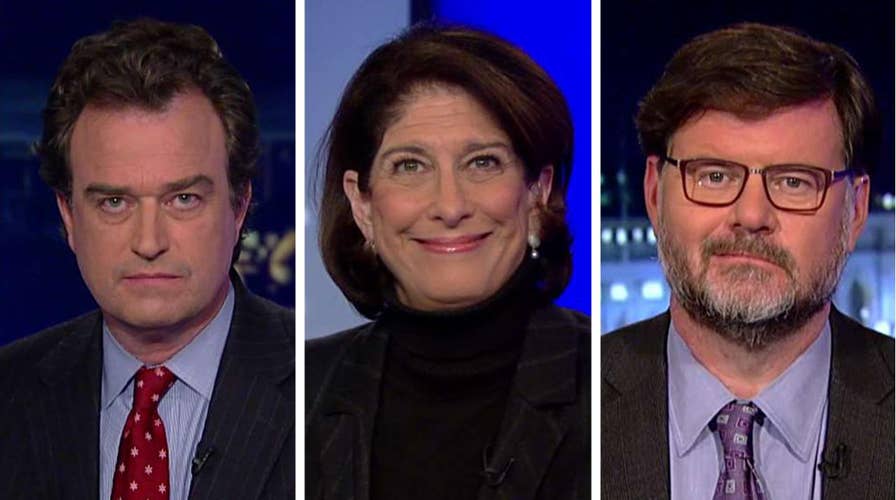
Let's bring in our panel, Charles Hurt, opinion editor for "The Washington Times," Mara Liasson, national political correspondent for National Public Radio, and Jonah Goldberg, senior editor at "National Review." Charlie, obviously these stats are pretty telling. "The New York Times" ran a frontpage piece saying that this in fact is essentially a crisis in its headline.
CHARLES HURT, OPINION EDITOR, "WASHINGTON TIMES": Yes, and the numbers are particularly dizzying because there are just so many ways of measuring it. The one thing that I think everyone can agree upon is that we do not have operational control of the border. The cartels are so in charge at the border, the human smuggling cartels are the same people that smuggle drugs across the border. And they are our stories that we heard over the last couple of days of where the cartels will actually send groups of people that they are smuggling across the border in order to divert attention away from other areas of the border so that they can send the drugs, the more valuable drugs, across in other places and get the drug safely into the country.
It is pretty terrifying. And the idea that we are sitting here in Washington and arguing about whether this is a crisis or whether this is an emergency is, I think, pretty mindboggling to regular Americans who are watching this. And they don't particularly -- aren't necessarily opposed to illegal immigration, but they think that, gee, this is a real problem.
BAIER: There are a number of points, Mara, that were kind of eye-openers in this hearing, one of them was a question about the Fentanyl numbers, the drugs coming over.
(BEGIN VIDEO CLIP)
KIRSTJEN NIELSEN, HOMELAND SECURITY SECRETARY: ICE overall interdicted enough Fentanyl last year to care kill every American twice over, substantial amounts of Fentanyl.
BAIER: And that's enough to kill every single American?
KIRSTJEN: Twice.
(END VIDEO CLIP)
MARA LIASSON, NATIONAL POLITICAL CORRESPONDENT, NATIONAL PUBLIC RADIO: We are not sitting here in Washington having a debate over whether to call it a crisis or call it an emergency. The debate is about whether the president should be allowed to declare it a national emergency, which is a term of law, so that he can build a wall.
BAIER: I will say that some Democrats early on said there is no crisis.
LIASSON: That is a separate argument, to say whether it's not a crisis or not. The border, crossings at border have spiked. Apprehensions of drugs have spiked. The question is, what is the appropriate remedy? Congress had a big debate and they passed a funding bill that included a lot of things, more detention beds, more this and more that. But they didn't give the president one thing that he really wanted, which is money for a wall. And now he has declared a national emergency so that he can spend unobligated Pentagon funds on a wall. That is what we are arguing about.
BAIER: Do these numbers, has this hearing changed, do you think, the calculations for Republicans who say this is going to bleed in to maybe a Democratic president who wants to say national emergency, do this?
JONAH GOLDBERG, SENIOR EDITOR, "NATIONAL REVIEW": I don't think so. These numbers don't change anyone's minds on Capitol Hill, I don't think. I kind of disagree with both of my colleagues here, though, I want to say in that I think part of the problem is why we are arguing about a crisis, and as you pointed out, "The New York Times" pointed out there is a crisis at the border, but it's a humanitarian crisis. It's a huge humanitarian crisis because of the nature of the kind of people who are trying to come across the border has changed over the last 10 years to be these families instead of single, able-bodied Mexican men looking for work.
And yes, I agree there are a lot of anecdotes that are scary about drugs, but that's the problem is that the Trump administration's case about why it is a crisis is sort of factually challenged. He wants to say it's basically an invasion of drug dealing henchmen straight out of Chuck Norris movie, when in reality it is a bunch of babies and kids and whatnot, and some cartels taking advantage of the chaos.
LIASSON: Or asking for asylum.
GOLDBERG: Or asking for asylum, which a wall would not stop. And so part of it is people are just talking past each other because they're defining crisis differently.
HURT: But it is important to remember -- I agree it is a humanitarian crisis. But the way you fix humanitarian crisis is you fix the flow. You stop the flow. And Democrats are absolutely, if you listen to these people running for nomination, they do not believe that that is a problem.
LIASSON: The wall wouldn't stop from someone from going up to a legal port of entry and turning themselves over, as they are doing.
HURT: Just because the wall isn't the only answer doesn't mean that it can't be part of the answer, and it's been part of all of the other successful efforts. And so do the wall and do other things, and do the thing about changing the law so that you can actually detain families until you can turn them back.
BAIER: Let's talk brass tacks about votes. There are now four Republicans who say they are going to vote against this effort.
LIASSON: But not enough to override --
BAIER: Not enough to override a veto. However, there's up to 10, I guess being talked about. But not enough, right?
LIASSON: No, and there won't be enough. And I don't think his veto will be overridden. So the point about this whole exercise is it is going to be decided in the courts, not on Capitol Hill.
BAIER: And the message Congress sends factors into the courts?
GOLDBERG: I think it does. I think it's part of -- because the law is sketchily written and was partially vitiated by the court in the past, all of it gets going into play because it goes to the intent of what Congress wanted, what the president wanted.
BAIER: But if they wind up not able to overcome the veto, then Congress will not have spoken according to the Constitution. But what does that matter?
BAIER: Although we'll have the votes that are on the record going in.
Next up, why Democrats are having such trouble passing a resolution condemning anti-Semitism.
(COMMERCIAL BREAK)
(BEGIN VIDEO CLIP)
UNIDENTIFIED MALE: Congresswoman Omar, it seems like there's some confusion among your colleagues. Are you anti-Semitic?
SEN. CHUCK SCHUMER, D-N.Y.: What congresswoman Omar said I thought was wrong and hurtful, but I also want to say that what happened linking all Muslims to the terrorist attack was wrong and hurtful. And both should be condemned.
UNIDENTIFIED MALE: In my opinion, I think you really need to remove Ilhan Omar from the House Foreign Affairs Committee.
REP. ELIOT ENGEL, D-N.Y.: I don't know that that would do anything except exacerbate the situation even more. I'm looking to get rid of anti-Semitism, not looking to punish anybody.
(END VIDEO CLIP)
BAIER: This probably wasn't on the planning for this week for Democrats to deal with and have a hard time passing, an anti-Semitism resolution. The president tweeting out, " It is shameful that House Democrats won't take a stronger stand against Anti-Semitism in their conference. Anti-Semitism has fueled atrocities throughout history and it's inconceivable they will not act to condemn it!"
Well, "the Washington Post" reporter, many other people on Twitter took issue with that tweet, saying "I try not to quote tweet the tweets so much anymore, but honestly it was literally just 19 months ago that marchers in Charlottesville chanted "Jews will not replace us," and then the president responded by saying there were very fine people on both sides."
So that is both sides on the Twitter-verse. We're back with the panel. Mara, Democrats having a hard time getting their hands around this thing.
LIASSON: Because Democrats have a high standard when it comes to Me Too, when it comes to anti-Semitic remarks. And they also are driven absolutely bonkers when they feel that the president does not get the same kind of criticism that they do. But the point is this criticism is internal. It is one thing to criticize the Netanyahu government or to say the policies of Israel are bad. But it's another thing to say that people who support Israel have an allegiance to a foreign government, which is an age-old anti-Semitic trope.
BAIER: Opponents and Republicans, mainly, are saying that Omar should not be on the Foreign Relations Committee -- Foreign Affairs Committee.
GOLDBERG: First of all, obviously, the global Jewish conspiracy is paying me to say about I'm about to say --
(LAUGHTER)
GOLDBERG: But she shouldn't be. But it is sort of a minor point, but I find it vexing. Remember during the Black Lives Matter thing, when anybody said all lives matter, the immediate response from all of these people was you are diminishing for specific complaints of this group and what they are talking about.
The Democrats now are bending over backwards because they have to include anti-Islamophobic language. And you saw Chuck Schumer talking about I didn't like the language about Muslims either. They are doing the exact same thing they called racist when people did it about Black Lives Matter. And it just shows you that the Democratic Party, this is canary in the coalmine for the Democratic Party. This is going to be a problem of the Corbyn-ization of the Democrats going forward for a while, and they better figure out how to deal with it now.
BAIER: Corbyn, the opposition leader in London --
GOLDBERG: Who loves the Jews.
(LAUGHTER)
BAIER: Sarcastically, sarcastically. Charlies?
HURT: I have to correct one thing, though. Of course when Donald Trump said there were good people on both sides, what he was talking about was, in Charlottesville there were good people on both sides of the debate about whether or not to take down the Lee statue from Lee Park in Charlottesville, which is not the same as --
BAIER: It was interpreted differently. He had a lot of walk back during that time. I got it. I got it.
HURT: But it's an important distinction.
GOLDBERG: Which he could have made.
LIASSON: Which he could have made.
HURT: It's Donald Trump.
LIASSON: That's what drives Democrats nuts. Donald Trump has one standard, and they have another, which they should. They should have a higher standard.
HURT: But it is in a little bit like Richmond watching Democrats who have very much been, it's been very in vogue among them to play these identity politics to wind up with this. Whether Ilhan Omar, what she is saying or what's in her heart, I don't know. She sounds more dumb than anything else.
BAIER: Why couldn't you just say no?
HURT: Exactly.
BAIER: No, and then I'll move on? I'm not sure.
LIASSON: She already apologized for previous -- this is not the first time she said something like this.
GOLDBERG: Nor the last.
BAIER: I think three. Yes. Panel, thanks.
When we come back, a shelter in a time of storm.
(COMMERCIAL BREAK)
BAIER: Finally tonight, a light at the end of the tunnel. Sunday as a tornado ripped through eastern Alabama, Providence Baptist Church of Beauregard served as a shelter from the storm, welcoming dozens of people into its basement. This week it serves as a supply center. Pastor Rusty Sowell says the church has received so many donations from the community that it no longer needs clothing and water.
(BEGIN VIDEO CLIP)
UNIDENTIFIED MALE: What you see behind you is a great, visible picture of people coming together from all over this community and surrounding area to pull together to make a difference in the lives of people who lives have been turned upside down.
(END VIDEO CLIP)
BAIER: That is great stuff. Hopefully the recovery continues.
Thanks for inviting us into your home tonight. That's it for the “Special Report,” fair, balanced, and unafraid on Ash Wednesday.
Content and Programming Copyright 2019 Fox News Network, LLC. ALL RIGHTS RESERVED. Copyright 2019 ASC Services II Media, LLC. All materials herein are protected by United States copyright law and may not be reproduced, distributed, transmitted, displayed, published or broadcast without the prior written permission of ASC Services II Media, LLC. You may not alter or remove any trademark, copyright or other notice from copies of the content.
