


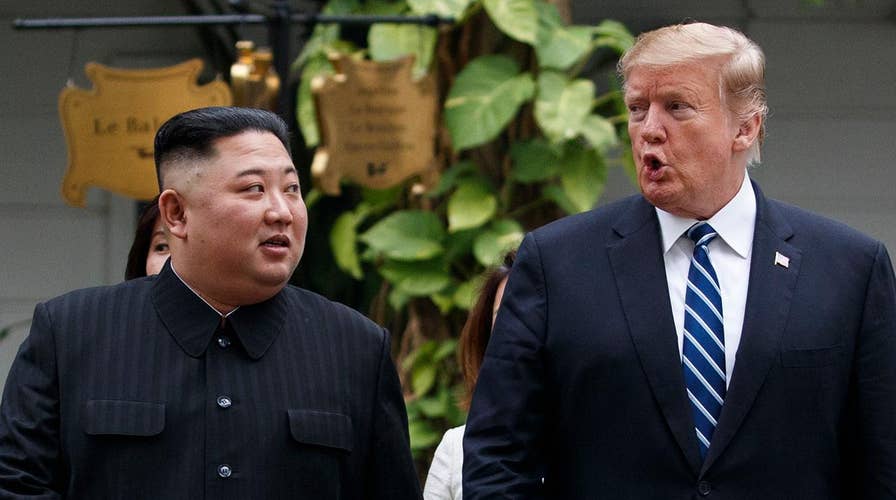
Denuclearization talks in focus as North Korea threatens to end freeze on missile tests
Could Kim Jong Un be rethinking nuclear missile test freeze? Fox News senior strategic analyst Gen. Jack Keane reacts.
This is a rush transcript from "Your World," March 19, 2019. This copy may not be in its final form and may be updated.
NEIL CAVUTO, HOST: A president with everything going his way. Think about it, the economy humming, the markets roaring, ISIS running, and then there's this:
(BEGIN VIDEO CLIP)
DONALD TRUMP, PRESIDENT: He told us hours before that he was going to repeal and replace.
And then, for some reason -- I think I understand the reason -- he ended up going thumbs up.
And, frankly, had we even known that, I think we could have gotten the vote, because we could have gotten somebody else. So, I think that's disgraceful. Plus, there are other things. I was never a fan of John McCain and I never will be.
(END VIDEO CLIP)
CAVUTO: Seven months after John McCain is laid to rest, Donald Trump still can't seem to give it a rest.
Forget about whether a president, any president, should be doing this. Is this one risking losing a second term if he keeps doing this?
Welcome, everybody. I'm Neil Cavuto, and this is "Your World."
And for a president who has a lot of things going his way, is he the one who is ultimately getting in the way of himself and his party, and a message that, on paper at least, has seven in 10 Americans saying, you know what, we like what we see, even though they might not flip over the things that Donald Trump will say, whether he's talking about a deceased senator he clearly doesn't like, or a late-night comedy show he clearly doesn't love, or even a Fox News lineup, we're told, that he clearly doesn't entirely embrace.
So, put another way, is the messenger getting in the way of his own message?
To John Roberts at the White House on whether, in going after John McCain again, the president might be speaking his mind, but this time he might have also just jumped the shark -- John.
JOHN ROBERTS, CHIEF WHITE HOUSE CORRESPONDENT: Well, there certainly were -- there certainly were, Neil, a lot of eyebrows raised yesterday when the president went on that tweetstorm.
It was 29 original tweets. I think it was northwards of 50, or almost 50 in total, over the weekend, when you include retweets, a lot of them aimed at obviously the president's grievances and disagreements that he has with people, including the long deceased Senator John McCain.
It drew the ire of McCain's daughter, Meghan McCain, who said in a tweet that the president should spend his Saturdays with his family, instead of worrying about her family.
And then she went on ABC's "The View" yesterday to say that one thing that President Trump knows is something that the rest of America knows, is that, unlike Senator John McCain, she said, unlike my father, he will never be a great man.
So he's opening up a lot of old battles, old feuds, if you will, when, as you said, so many things are going right with this administration in terms of the economy, the stock market. The president, he has got another round of trade talks with China that is opening up next week. So why is he fighting these old battles?
It certainly plays to the base, but the president's ratings are at 42 percent in a new CNN poll, which is a recent high for him. So to your question of, is he distracting himself from the task at hand, that may be a valid question.
The president trying to get things back on track in terms of foreign policy today, meeting with Jair Bolsonaro, who is the newly minted president of Brazil, a man who fancies himself and has been dubbed the Trump of the Tropics. The two of them have a lot in common, including policy on Venezuela.
Neither one of the leaders when asked today would say whether or not they would use military action in Venezuela to try to topple the Maduro regime, only to say that all options are on the table, and Bolsonaro saying that he wanted to be a strong extra NATO ally of the United States when it comes to military-to-military engagement, opening up the possibility that U.S. troops may be able to be staged in Brazil in the possibility, as they might be in Colombia, the possibility that they would need to go in to do something about the crumbling situation there in Venezuela.
But when the president was asked today whether or not he knew when Maduro would leave, he didn't really have a timetable. Listen here.
(BEGIN VIDEO CLIP)
TRUMP: But we really haven't done the really tough sanctions yet. We can do the tough sanctions. And all options are open. So we may be doing that. But we haven't done the toughest of sanctions, as you know. We have done, I would say, right down the middle, but we can go a lot tougher if we need to do that.
(END VIDEO CLIP)
ROBERTS: And one of the things not being talked about today, Neil, whether or not Juan Guaido, the interim president of Venezuela, and the National Assembly would entertain amnesty for some of the top leaders in the Maduro regime, allow them to hang on to their properties, their fortunes, in order to get them to either step down to leave the country or have a position in the new government.
But that, I'm told, really is the key to whether Maduro stays or goes -- Neil.
CAVUTO: All right, John Roberts, thank you very, very much.
Now to the fallout over the president speaking out and sometimes maybe a bit too much.
Democratic strategist Antjuan Seawright. We have got RealClearPolitics' A.B. Stoddard and Republican strategist Lauren Claffey.
Lauren, I wanted to begin with you, because, as a Republican, do you worry that the president stomps on otherwise good economic market message?
LAUREN CLAFFEY, REPUBLICAN STRATEGIST: Yes, I think all Republicans are always a little concerned about this, especially heading into the 2020, when we really want to portray a sense of strength and unity.
He's got really great things to talk about. It's just a shame that he keeps stepping on his own message with these tweets. And, quite frankly, it also creates confusion within the administration for the employees there that are trying to execute on this really ambitious agenda on what are the priorities of the president at that given time, and how can we support him fully if he's off talking about other things?
CAVUTO: This John McCain fixation, though, A.B., is in a field of its own, though. What's going on there?
A.B. STODDARD, REALCLEARPOLITICS: That's right.
I think that we have known for a while that he very -- President Trump took it very personally when John McCain voted against not a replacement for Obamacare, but something called skinny repeal that was going to begin a process that would bounce back to the House for another vote.
It was very convoluted. But there was reporting at the time, I was told also, that John McCain was not only doing this because of the way he felt, but because they were colleagues around that wanted to vote against it and had to vote for it.
CAVUTO: The president earlier said on that, A.B., not to interrupt you, that...
(CROSSTALK)
STODDARD: I know, that he was going to vote...
(CROSSTALK)
STODDARD: I know.
CAVUTO: I had never heard that, that he was going to vote for that.
STODDARD: I had never heard it either.
But he obviously takes it very personally, Neil. He mentions it at rallies. He mentions it over and over again. And it really is truly offensive. I mean, there are veterans who are supporters of Donald Trump's who will be deeply hurt by these comments, who know that John McCain gave up more in his life for his country than most of us could ever imagine.
This is also known around the world. He is considered in other countries to be one of our great heroes. And this is just -- as you said, it's really shooting himself in the messaging foot.
But to Lauren's point, Republicans had a struggle with this all along. The middle of the midterm campaign last summer, the president literally threw talking points about the tax cut up into the air and said they were boring at an event designed to talk about the tax cut.
CAVUTO: No, I know.
STODDARD: So, he often is really -- he wants to talk about grievances. It is true. He didn't bring it up today. He was asked about it but he shouldn't have gone there.
CAVUTO: Yes, well, he expounds on it maybe a bit too much.
But, Antjuan, obviously, the president is free to think what he will think about John McCain. I know even alive they did not get along. It was always very, very tense. I get that. But I also get the fact that the president is the president of the United States, and it's not very presidential.
Now, having said that, I'm wondering if you're surprised with these poll numbers that show more Americans are liking this economy, more Americans are giving him credit, these comments, personal comments notwithstanding, for that economy, and that the president succeeds despite all of that?
ANTJUAN SEAWRIGHT, DEMOCRATIC STRATEGIST: Well, no, I'm not surprised at all, because, Neil, you and I have talked about this before.
We have seen this movie before. And we have also seen how it played out, i.e., the 2018 midterms, when the Republicans were trying to talk about how hot the economy was, and I was on show shirt debating with you, telling you that that was not going to be the issue that most Americans care about.
CAVUTO: You were talking health care. And that was very much the case.
But do you, as a Democrat who wants to see a Democrat in office, do you just pray the president keeps going off-message, off-topic, talk about stuff like this, like "Saturday Night Live" or the FOX News lineup or God knows what else, John McCain, and that that destroys the message and helps you guys?
SEAWRIGHT: Not only do I pray. I hope that most other Democrats would join me and clog up the prayer line about this issue, because guess what? It gives me Democrats a chance to really talk about the things that most Americans care about.
And that's bread and butter, barbershop and beauty salons and kitchen table issues, like health care, like education, like student loan reform for millennials, like all the things that most of us talk about when we're at home.
CAVUTO: Well, and those issues -- I would respectfully disagree with you, Antjuan, that Republicans aren't resonating there.
And, Lauren, I think, as a Republican here, you -- do you get a sense, though, that people are used to this or the kind of language or the harsh comments the president will make, or berating a staffer, whatever, that a couple of years now, we have all kind of gotten used to it and we accept that at face value?
Or do you fear that it boomerangs in the November '20 elections?
CLAFFEY: I still fear that it boomerangs in the -- in the next election.
But I do think that there is a sense that we have all become numb to the comments and the tweets, and they're not nearly as important as they once were.
SEAWRIGHT: The Republicans have, not Democrats. Be clear. The Republicans have become numb, because you all think that it's OK, and you're not prepared for life after Donald Trump.
But Democrats enjoy it, because when he wants to have personality conversations, we want to talk about policy. And we can have those discussions every day.
CAVUTO: Well, Antjuan, I think you would admit that Democrats are not exactly immune to saying some questionable things.
But I will ask you, A.B., just looking at this and the playing field, whether this is something that is going to come back to bite the president. We might get used to it, but I do believe you do jump that proverbial shark going after a dead war hero.
Whatever you think of John McCain, whatever you think of John McCain, whatever you think of his politics, or whether he did zoom this president on certain things, fine, but you take a huge risk when you do something like that.
STODDARD: Right. I do think that it motivates the other side.
And we saw that in 2018.
SEAWRIGHT: Absolutely.
STODDARD: And I think it makes it very tough for senators in the Republican Party running for reelection next year, which you and I have talked about, Neil.
I know the president doesn't take that -- he doesn't put it high on his priority list, protecting other Republicans, who will have to be asked about his comments about John McCain at their town halls and on the campaign trail and all that kind of thing.
But, yes, it's true. If you're President Trump and you're looking at replicating your math in the Rust Belt, where Democrats did very well in November, you actually want to reach out to the middle and you want to grow your coalition. And this is not how you do it.
CAVUTO: All right, guys, I want to thank you all very, very much.
SEAWRIGHT: Thank you.
CAVUTO: Well, of course, the president likes to say that he is fighting fire with fire and that the media really is out to get him.
Today, fair and balanced now, we might have just gotten, well, his proof, because one social media company just admitted it, and today apologized for it.
(COMMERCIAL BREAK)
CAVUTO: All right, we had a major oops moment for Facebook again, a major admission on the part of the social media giant, revealing that it did indeed temporarily block President Trump's social media chief, Dan Scavino.
Was this just a mistake or something else?
Hillary Vaughn has been following this closely and joins us out of Los Angeles.
Hey, Hillary.
HILLARY VAUGHN, CORRESPONDENT: Hey, Neil.
Well, Facebook personally apologized to Scavino after they say they accidentally banned him from engaging with his followers on his Facebook page. But the president says not enough. He's still pledging to take action against the social media giant for what he thinks is bias.
(BEGIN VIDEO CLIP)
TRUMP: You see the level of in many cases hatred they have for a certain group of people that happen to be in power, that happened to have won the election. You say that that's really unfair. So something's happening with those groups of folks that are running Facebook and Google and Twitter.
And I do think we have to get to the bottom of it.
(END VIDEO CLIP)
VAUGHN: So Facebook admits they froze a feature that lets Scavino reply to his followers because his activity accidentally triggered a tool that's intended to stop bots from spamming people on their site.
Facebook giving us this statement explaining what happened, saying -- quote -- "We cap the amount of identical repetitive activity coming from one account in a short period of time, such as @mentioning people. These limits can have the unintended consequence of temporarily preventing real people, like Dan Scavino, from engaging in such activity, but lift in an hour or two, which is what happened in this case."
Facebook says they are figuring out how to fine-tune their communication to users that may be mistaken for a bot in the future -- Neil.
CAVUTO: All right, Hillary, thank you very, very much.
It's a pattern here that disturbs a lot of conservatives, who say there is indeed a bias against conservatives. And we keep seeing examples of it, this latest Scavino example the latest reminder.
Let's go to Fox Business Network's Ashley Webster, the Foundation for Liberty and American Greatness founder Nick Adams, and Democratic strategist Scott Levenson.
Nick, do you think, as a conservative, that there's a bias against those who think the way you do?
NICK ADAMS, FOUNDER, FOUNDATION FOR LIBERTY AND AMERICAN GREATNESS: I certainly do, Neil. I think that Facebook is the Wild West, and we need the sheriff to come in and implement some order.
I have the great...
(CROSSTALK)
CAVUTO: Wait a minute. A conservative is urging the government to get involved and do something?
VAUGHN: Well, I think that something needs to be done.
I have the great privilege of traveling throughout this country. And every day, Neil, I'm speaking to people all over that tell me that they feel, because they have not fully subscribed to left-wing orthodoxy, they haven't knelt at the altar of political correctness, that they're being targeted.
And this is not just for politically active people. This is for everyday, ordinary, regular Americans.
(CROSSTALK)
CAVUTO: You're doing like an Al Gore thing here.
SCOTT LEVENSON, DEMOCRATIC STRATEGIST: The president is fanning the flames of this cultural warfare.
It's what -- if you ever run into any of these narcissistic personalities, they create this fiction around them. And that's what he's done all weekend. The press is out to get him. Facebook is out to get him.
(CROSSTALK)
CAVUTO: Step back from the president.
Do you think that there is an inherent -- and it's not even -- maybe even deliberate.
Ashley, what do you think?
ASHLEY WEBSTER, BUSINESS CORRESPONDENT: I do, because I think all we hear is unintended consequences.
At what point do you say it's targeting when these unintended consequences seem to happen a lot to conservatives and not to...
(CROSSTALK)
LEVENSON: When you look at the algorithms that Facebook set up, and you look at the actions of the social media people, it's very clear that this guy did repetitive actions again and again, which was intended to stop just the kind of collusion from bots that the president...
(CROSSTALK)
CAVUTO: But it wasn't intended for him to be shut down to respond to the attacks...
(CROSSTALK)
CAVUTO: So, if that were you, and people were attacking you, and you couldn't respond, you would be pissed off.
LEVENSON: But, Neil, what he actually did was, he posted hundreds of posts with name and two American flags in a short amount of time.
That is exactly the kind of algorithm...
CAVUTO: But Facebook admitted it botched it in this case right?
LEVENSON: It did. And there are unintended consequences when you set up algorithms to spot bots.
(CROSSTALK)
LEVENSON: But let's not keep this cultural warfare, fanning the flame.
(CROSSTALK)
LEVENSON: Come on.
(CROSSTALK)
ADAMS: Bottom line is, this wasn't an isolated incident. This is happening all the time.
We're hearing about this all the time.
(CROSSTALK)
LEVENSON: I'm sorry. We're hearing about this. This is kind of an anecdotal discussion, Nick.
(CROSSTALK)
ADAMS: This culture war that has been going on for 60 years, and this is the lightest battleground that has been opened up by the left to enforce conformity.
(CROSSTALK)
LEVENSON: So, you believe this media warfare conspiracy against the president?
ADAMS: Absolutely, without a doubt. It's not a conspiracy.
(CROSSTALK)
WEBSTER: I do, because, look, you have giant tech companies with highly politicized work forces who all 90 percent lean left controlling most of the main access points to the Internet.
LEVENSON: These are public venues. People have access to the venues.
(CROSSTALK)
CAVUTO: Scott, you watch late-night TV.
(CROSSTALK)
CAVUTO: And they all rip the president. And that's fine. That's the way they're finding ratings.
(CROSSTALK)
LEVENSON: He gives us tons of material.
CAVUTO: But my point is, you would have to knowledge that the common theme is bash the right, bash the right, bash the right.
LEVENSON: I don't remember late-night TV when they didn't bash the president.
CAVUTO: To this extreme?
(CROSSTALK)
LEVENSON: Late-night television has always been -- Johnny Carson is a...
(CROSSTALK)
CAVUTO: I do think that it's pretty prolific and heated today.
LEVENSON: In general, there's no doubt about it.
(CROSSTALK)
CAVUTO: You're saying that that Donald Trump deserves it because what he...
LEVENSON: I'm thinking the president gives us news. And that's regardless of who the president is.
CAVUTO: All right, well, I'm just saying that this president then is more depicted unfairly in that sense. Don't you agree, vs. some of his predecessors?
LEVENSON: When -- there's never been a president who is out there on social media as actively and aggressively as the president.
CAVUTO: Barack Obama never got this. He never got this.
(CROSSTALK)
CAVUTO: I think I can be a very fair arbiter about this. I just look at the election of all...
(CROSSTALK)
LEVENSON: Look at his weekend on Twitter, Neil. He gave us so much material.
(CROSSTALK)
CAVUTO: That's a very good point, Nick, that the president feeds the beast, and it gets beastly.
LEVENSON: He does.
ADAMS: Neil, of course he does.
But at the end of the day, this is a president that speaks his mind.
(CROSSTALK)
LEVENSON: No, it's a narcissistic president who is delusional, Nick.
(CROSSTALK)
LEVENSON: That's not just my opinion.
(CROSSTALK)
ADAMS: Well, think it is in a lot of ways.
(CROSSTALK)
CAVUTO: All right, but you're stating something. And that might be a very fair bias that you have through your mind.
LEVENSON: That's your opinion.
CAVUTO: And I was just starting the show out the way the president was saying stuff about John McCain that I thought was idiotic.
That doesn't mean, though, that he doesn't get more of a fair shake, let's say, for the economy.
WEBSTER: Of course he does.
Look, he uses Twitter as a megaphone to go over the heads of mainstream media to reach his base.
(CROSSTALK)
LEVENSON: And then he complains about it as a medium.
So you can't have it both ways.
(CROSSTALK)
CAVUTO: Seriously, guys, I have never known a president who doesn't have a problem with the media. John Kennedy, probably who was treated more favorably by the media than anybody, always railed against the media.
WEBSTER: Can you imagine Kennedy in today's environment?
CAVUTO: I'm just saying that, if there were to be a Democratic president, the proportion of negative stories wouldn't be this high.
ADAMS: Absolutely not, without a doubt. This president doesn't get a fair shake at the sauce bottle. There is no way.
(CROSSTALK)
LEVENSON: And I'm thinking it's in his interests to fan the flames of cultural warfare.
CAVUTO: What if he did? What if he took that back and said, I want to make amends, I want to get people like Scott liking me again?
LEVENSON: I think he could apologize to the McCain family as a start.
CAVUTO: All right. And if he did, would you be complimentary of that?
LEVENSON: I would definitely be impressed that he apologized to the McCain family.
CAVUTO: You would not.
(CROSSTALK)
(LAUGHTER)
CAVUTO: All right, that will do it here.
We have a lot more coming up, including that long-awaited Mueller report. It might have people waiting a little bit longer, because someone wants to look at it first. Hmm. Can you guess?
(COMMERCIAL BREAK)
CAVUTO: All right, sources are now telling Fox News today that there are a few scenarios where the White House may ask to see the Mueller report before the attorney general, Bill Barr, hands it over to Congress.
Now, that has some of the president's critics going ballistic here. And they say that that's not right, that shouldn't be the way it is.
To former Whitewater independent counsel Robert Ray on all of this.
Is there precedent for the White House seeing a report focused on the White House first?
ROBERT RAY, FORMER INDEPENDENT COUNSEL: Well, sure, although a little context.
It was under the independent counsel statute. That was a statute written by Congress which provided that, once the report was finalized, it was submitted to the Special Division of the U.S. Court of Appeals for the D.C. Circuit, and that anyone named in the report had an opportunity before its public release to prepare and file written comments to that report, which would then be included prior to the time that the report was released.
A long way of saying that, obviously, if the president is the focus of attention in that report, generally speaking, the idea is fairness would dictate that he be given an opportunity to see it in advance and prepare a response.
Now, I understand the White House has already been in the process through its -- through the president's lawyers of preparing such a response.
CAVUTO: Do you think they have already seen it?
RAY: I don't think they have seen it.
CAVUTO: OK.
RAY: But I don't know that the attorney general needs my advice. But if I were providing advice, I mean, it's sort of in the concept, generally speaking, of due process and fairness.
He should have an opportunity to respond. In order to effectively do that, I think the better course would be on a limited basis through his lawyers under a very short time frame without recording devices or electronic devices, an opportunity in a room to see an advanced copy of the report.
CAVUTO: But Democrats say by giving him that special attention, he is going to put out his spin first on a report.
(CROSSTALK)
RAY: Well, I think the -- I could imagine the attorney general making a condition of that early access that the White House agrees not to have any comment until such time as the report is released.
CAVUTO: Do you think that the White House or anyone would honor that? It's so tempting not to, right?
RAY: Well, sure. But, I mean, you have to hopefully depend on good faith.
(CROSSTALK)
CAVUTO: Well, how did it go about in the Bill Clinton days?
RAY: Sure.
CAVUTO: When you were handling that, how was that report released? And how did it...
RAY: Well, it was controlled by a court, the Special Division, per the statute that Congress enacted which has since elapsed as of 1999.
But it -- the concerns that animated the whole notion of a final report, I think, are still present, notwithstanding the fact that the statute has lapsed.
CAVUTO: But the White House have -- I know it's a little bit like legal apples and oranges, but did the White House -- the Clinton White House at the time -- have access to that before the general public?
RAY: Yes. In effect, yes.
CAVUTO: And did the White House then try to put its own spin on that first?
RAY: Through its lawyers, those individuals were able to comment.
They didn't jump the gun, so to speak, in commenting in advance of the release of the final report. In other words, they followed the mandate and the directive of a court, which was that there would be no release of the report until such time as everyone had a chance to comment, and if they chose to do so, they could do some writing. And those written submissions would be included as part of the final report.
CAVUTO: But you can't release the entire report, because names and positions would be jeopardized. So how do you handle what gets out there vs. what doesn't?
RAY: Well, in a couple of ways.
Of course, again, the independent counsel statute drove that, because it provided the court with the authority to release the report. Here, this is the attorney general making some determination as to what can be released with regard to grand jury information.
It would behoove the attorney general obviously to seek a court order if it seeks to authorize the release publicly of that -- of any of that information or redact it. And then they're, in this particular investigation, a little more complicated by the fact that there exists at least the potential that there's national security information contained in what Bob Mueller transmits to the attorney general.
Obviously, those materials would have to be redacted. And then, finally, I suppose there's the possibility that there could be a claim of executive privilege and/or information that might have to be redacted because it would potentially jeopardize an ongoing criminal investigation in the Southern District of New York or elsewhere.
CAVUTO: Does public opinion or did it back then weigh on you? And I only mention that because right now half of Americans think this is a witch- hunt, that the president's right.
Does that weigh on however that final report comes out?
RAY: I don't know about public opinion, but certainly public sentiment about their maximizing the likelihood, which is what your object is, that your findings and your determinations will come to be respected and accepted by the general public...
CAVUTO: Right.
RAY: ... however you come out, whether you decided to bring charges or whether you decided not to bring charges.
I think that's still an important consideration. I mean, I wasn't guided by public opinion polls, but I was certainly...
CAVUTO: I don't think that you cared.
RAY: I didn't, but I think I was certainly guided, though, by what I hoped to be public sentiment of people paying careful attention, and hoped that would be a recognition and an acceptance of what it is I had -- I had decided and what I had done.
CAVUTO: You were unflappable in those days. You're still unflappable.
Robert Ray.
RAY: I try.
CAVUTO: The former Whitewater independent counsel, very calm guy. I think you want that in these kind of positions.
Meanwhile, Jeff Bezos might not be so calm anymore. He got some proof about someone who was behind getting those texts release, and a $200,000 check to emphasize the point and open the wound. Inquiring minds want to know.
And you will -- after this.
(COMMERCIAL BREAK)
CAVUTO: Well, this was a classic day for traders, signs of improvement on the trade front with China, and then signs that, well, we're not improving with China. It was a mess, in the end, a 26-point hit for the Dow.
More after this.
(COMMERCIAL BREAK)
CAVUTO: It was the brother?
Well, that could be the case here, as investigators seem to point to a $200,000 check that might have made its way to the paramour of Jeff Bezos' brother.
Now, if that is indeed the case, the case improves mightily for Jeff Bezos against, well, The National Enquirer and its parent company, American Media.
Mercedes Colwin on what kind of legal case is building here.
What do you make of that?
MERCEDES COLWIN, LEGAL ANALYST: Well, it's so interesting.
First of all, God forbid we ever had a brother like Michael Sanchez, right?
Setting that aside, what family gatherings would be like.
CAVUTO: So, the...
(CROSSTALK)
CAVUTO: He pocketed $200,000 to share these text messages between Jeff Bezos and his sister to the world.
COLWIN: Sure. Well, I mean, sure.
And it's really transactional. If there's no criminality, meaning that the text messages weren't obtained somehow criminally, then it's simply a simple transaction between Michael Sanchez and the magazine.
And it's interesting, because, if you look at the agreement, the agreement says, this is not a catch-and-kill type of arrangement, meaning that we have paid this amount of money without the promise of publishing it, like there had been allegations in the past.
CAVUTO: But is there anything illegal about paying someone, even a substantial sum like this, for information?
COLWIN: Only if you know, as a media outlet, that they obtained the information and the documentation illegally. Then, of course, it's in furtherance of a crime.
You're taking something -- it's like purchasing stolen goods, that kind of...
(CROSSTALK)
CAVUTO: I'm taking a stretch here. What if you didn't know it, though?
Like, I have these messages back and forth between Bezos and my sister. But you have to know that the way it was gleaned was illegal.
COLWIN: You have to know, exactly. You would have to know. As the media outlet, you would have to know or at least suspect that there's some criminality.
But no one would think that their brother would somehow obtain this illegally. How else would you get these text messages? It wasn't like he stole her phone. There was no evidence that he stole Lauren Sanchez's phone. He handed him his phone. And then apparently that's what he shared with the magazine.
CAVUTO: All right, so for American Media, then, it shows what?
COLWIN: Well, I mean, for the media itself in terms of what to deal with this?
CAVUTO: No, for the parent company now. It's looking at this. The National Enquirer is looking at this. Is this an uh-oh moment? Do they have to realize, oh, boy, we're...
COLWIN: It is an uh-oh moment for David Pecker.
We know that he has a written agreement with the prosecutors. He had been investigated with a campaign finance issue that arose.
CAVUTO: So, he had to keep his nails clean and everything else.
COLWIN: Exactly.
CAVUTO: And this was long before that, we're told.
COLWIN: Right.
CAVUTO: So if there's proof of this?
COLWIN: But, see, these agreements hanging over your head like a guillotine.
Basically, you go to the prosecutor. I have done nothing wrong in what you're investigating me for, and I will tell you that I'm not engaged any criminality. That's what's guaranteed. It's in your agreement.
What the prosecutors hold over his head, it said, that's fine and good. We will take you on your word. You're going to sign this agreement. But if we find out that you have engaged in criminality, all bets are off, we're going to prosecute you for that crime and the additional crime.
CAVUTO: Do we know how they got this information? Did Jeff Bezos, his investigators pick it up, or who?
COLWIN: I think it's been reported that somehow Bezos was tipped off that it may have been the brother, because we started hearing that it was the very early on. And now it's been allegedly confirmed.
CAVUTO: Hell hath no fury like a billionaire's.
COLWIN: Yes, sir.
CAVUTO: All right, thank you very, very much, Mercedes Colwin.
COLWIN: Thank you.
CAVUTO: A lot more to develop on this story.
In the meantime, forget the head of Brazil, who President Trump just walked away with -- why my next guest says we have new reason to worry about who he just might have walked away from.
(COMMERCIAL BREAK)
CAVUTO: All right, it's another thing when we fear it. It's quite another when North Korea's vice foreign minister is hinting that Kim Jong-un may indeed suspend nuclear talks with the U.S., begin testing again.
That would be obviously a big no-no to the State Department, who has already said, you even do that, all bets are off.
Retired Four Star-General Fox News senior strategic analyst Jack Keane joins us right now.
General, what do you make of this?
JACK KEANE, SENIOR STRATEGIC ANALYST: Well, I think what happened here is, Kim Jong-un went home, having, one, miscalculated, because he thought he'd get sanction relief, because all of his predecessors were able to do that in negotiations with the United States.
He essentially put the same deal on the table that his predecessors had done as well. So I think what led to the miscalculation, Neil, was the personal relationship between both leaders. I think he was counting on that. So he's gone home empty-handed, no sanction relief, long train ride home, for sure.
And what he's trying to do now is regain some leverage, also face-saving. One, we may not continue negotiations. Again, that's for -- to gain leverage. Two, we may resume testing, again to gain some leverage.
I believe he will continue to negotiate because it's in his national interest. He clearly wants sanction relief. He clearly wants some security guarantors, if he's going to move forward.
We still don't have a clue if Kim Jong-un is going to denuclearize and give us up his weapons or not.
CAVUTO: Do you really think he would ever lose that bargaining power?
I mean, if he were to give all of that up, I mean, that is his bargaining chip right there, right?
KEANE: Yes, see, it is all about security.
CAVUTO: Right.
KEANE: And people are talking about, well, it's really economic prosperity. No, he has the nuclear weapons, around 40 to 60. That's a nuclear arsenal, I will say, and ballistic missiles for the preservation of the regime.
Exactly what you're suggesting in your comment. And for him to walk away from that, there would have to be huge amount of progress towards the guarantee of security for that regime. And the threat they believe that they're facing is not so much South Korea, but the United States.
So it is us that would have to give him that assurances. And that's why we're a long way from that reality. So, a step in that direction ,Neil, would be peace treaty, undo the armistice, pull the armies away from each other on a demilitarized zone, eventually a few years from now some reduction in U.S. forces, not total forces.
CAVUTO: But certainly a test of any sort, General, if they were to even consider that, all bets would be off, right? We'd be back to zero. And these guys wouldn't meet each other in the Poconos.
KEANE: Yes, if they resume the testings, then we're back into crisis and hostilities phase again.
CAVUTO: And there is never going to be another meeting?
KEANE: There could be, but it would be unlikely.
I think the -- what has been achieved would be clearly squandered as a result of that. I don't believe they're going to do that, because they clearly need to get unburdened from the sanctions. And I believe what we should be doing right now is calling out China and Russia, who clearly are in violation of their own U.N. resolution which they voted for, because they are providing some assistance to North Korea.
And we should be increasing leverage with them.
CAVUTO: General, it's always a pleasure. I always learn a lot. Thank you, my friend.
KEANE: Yes, good talking to you, Neil.
CAVUTO: All right, General Jack Keane.
All right, the Electoral College back and forth, so many Democrats saying, you got to get rid of that and let every vote count. So now the push to get rid of the Electoral College, as if, if you knew that it was only on popular vote, we would be campaigning differently altogether, wouldn't we?
Anyway, the judge on what they're trying to do -- after this.
(COMMERCIAL BREAK)
(BEGIN VIDEO CLIP)
SEN. ELIZABETH WARREN, D-MASS., PRESIDENTIAL CANDIDATE: Every vote matters. And the way we can make that happen is that we can have national voting. And that means get rid of the Electoral College.
(CHEERING AND APPLAUSE)
(END VIDEO CLIP)
CAVUTO: I always wonder what our founding fathers would think of that, if they were hearing this.
Fortunately, Judge Andrew Napolitano was with them when they conceived this idea.
(LAUGHTER)
CAVUTO: Not really.
Judge Andrew Napolitano, one of my favorite people on the planet.
ANDREW NAPOLITANO, JUDICIAL ANALYST: Oh, I still love you, Neil.
CAVUTO: The Electoral College, now Democrats are saying, because they were cheated, they argue, of the presidency because of it, and back in 2000, the same deal, it's got to end.
NAPOLITANO: They want to transform the philosophical underpinnings of the government, from a representative republic to a pure democracy.
CAVUTO: Right.
NAPOLITANO: We don't have a pure democracy. We don't write the laws. We elect people and our representatives write the laws.
We don't even elect the president. We choose electors and they choose the president.
CAVUTO: Well, they say that system in which we do it is passe and should go away, but easier said than done.
NAPOLITANO: Well, yes, it would require a vote of two-thirds of both houses of the Congress. Dead in the water right there.
CAVUTO: Right. Right.
NAPOLITANO: And it would require the consent, the ratification of three- quarters of the state legislatures, a constitutional amendment, also dead in the water.
Would the Democrats be doing this if Donald Trump had achieved more popular votes than Mrs. Clinton? I don't think so.
CAVUTO: Yes.
The rationale too that, you buy that you don't like the outcome, if we were campaigning for just the popular vote, both sides would campaign a lot differently. Democrats would sort of park themselves in California and New York, Republicans in Texas, other strongholds in the South.
And that would be the way the election would go, right?
NAPOLITANO: The framers were terrified of sectional politics, of one section of the country getting a majority of popular votes and forcing its will on the others.
The genius of the Electoral College, aside from this buffer between the voters and the president, is that it forces the winner to demonstrate numerically substantial support throughout the country, not just in the population centers.
So, as a practical matter, the smaller states are never going to go for this.
CAVUTO: Because no one would visit them, right?
NAPOLITANO: Correct.
As a practical matter, they want the campaign there. They want money spent there. And they want exposure to the candidate. And they will only get that with the electoral system.
CAVUTO: So you don't think this is going anywhere, do you?
NAPOLITANO: No. In fact, I don't even think this is an issue in 2020.
I think this, like a lot of the things the Democrats are saying now -- I almost don't blame them for this. They're testing the waters.
CAVUTO: Sure.
NAPOLITANO: This is a trial balloon. And I don't think we're even going to be talking about it in a couple weeks. Maybe I will be wrong.
CAVUTO: It's a common theme, though.
While I have you here, Florida prosecutors have offered to drop charges against New England Patriots owner Robert Kraft over that massage parlor thing. There's so far no response of Kraft.
What do you make of that?
NAPOLITANO: He should never have been prosecuted in the first place.
CAVUTO: Why?
NAPOLITANO: Because this is -- this is a consensual behavior that the government had absolutely no right taking a moving picture of.
This should never been the subject of a search warrant. There are a lot less intrusive ways to address human trafficking.
(CROSSTALK)
CAVUTO: They were into human trafficking, and along the way, they got some interesting people who visited, right?
NAPOLITANO: Now, as a practical matter, this is what's called a deferred prosecution.
If you admit to the act, which Bob Kraft has denied, and you keep your record clean for six months, there's no prosecution. And if you ask for an expungement, they will give you the expungement. Once you get the expungement, you can answer under oath. I was never arrested and I was never charged.
You get one free expungement for a nonviolent, non-organized type of crime. And it wipes out the record of those crimes.
CAVUTO: All right, but you risk a lot if your Kraft right now and you decide no, no, no, on just the morality of this here, I am going to fight this.
NAPOLITANO: I think he...
(CROSSTALK)
CAVUTO: I don't think I did anything wrong, which has been his argument.
NAPOLITANO: I think he wins if he fights it.
CAVUTO: Really?
NAPOLITANO: But he and his lawyers know far better than I could what is at risk for him if he wins and loses.
He may have a lot of problems.
CAVUTO: What would happen?
NAPOLITANO: Well, there may be an interference with his ownership of the New England Patriots...
CAVUTO: I see.
NAPOLITANO: ... which, after the New York Yankees, is a very expensive professional athletic asset.
CAVUTO: So, for him, it looks like he could wrap this up, call it a day. But what was done here, beyond the human trafficking issue, what started it, was far more offensive for the players involved?
NAPOLITANO: Yes, I think so. We don't know the ending.
I'm actually happy that the government offered this to him. And he probably will accept it, because...
CAVUTO: Some said the government itself felt it overreached.
NAPOLITANO: Profoundly, profoundly overreached. This is -- this is not the way to prosecute human trafficking, to sweep up innocent people in consensual acts, in 2019.
CAVUTO: Fair enough.
Judge, thank you very, very much.
NAPOLITANO: You're welcome.
CAVUTO: In the meantime, all the millions in college scams and the rest, there's something even bigger going on here that the administration is addressing -- right after this.
(COMMERCIAL BREAK)
CAVUTO: All right, the idea is to cut the cost of getting that cap and gown by capping maybe student loans for colleges, especially for grad school and the like. That's what the administration is kicking around.
Here is Charles Payne here to kick it back.
What do you think?
CHARLES PAYNE, CONTRIBUTOR: I love the idea. I like where they're going with this.
You talk about the most out of control situation in this country, it has got to be the student debt situation, which is about $1.6 trillion, and how it's -- how it's occurred.
You got to go back, 2010, President Obama pushed out the banks. He said, you know what, we don't need the banks. We will save billions of dollars because the banks kind of lean on the government ultimately, so why -- remove the middleman.
Well, the middleman had a purpose, right? They weren't going to let someone take out a crazy loan for a poetry degree that they can never repay. So there was a great purpose for that, and it became a free-for- all.
Let me tell you the key number that struck me. Federal student loan debt the year before President Obama got rid of the banks, 2010, was just $154 billion. It's $1.56-$1.6 trillion now.
CAVUTO: But how would cutting back on the loans you get lead to that going down?
PAYNE: The loans, since they were essentially unlimited, meant that students would borrow unlimited money from the government.
CAVUTO: It incentivized the colleges to just ramp up...
(CROSSTALK)
PAYNE: Right. So college keeps raising the price.
OK, tuition is up again. And don't forget, throw in room and board and everything like that, last year, I think it was $48,000, up more than 20 percent in a 10-year period, outpacing inflation.
CAVUTO: What if there's a delay, Charles, with these schools responding by holding off on the big increases, so, in that gap, some kids are really getting gouged and might have to drop out?
PAYNE: Well, execution is always important. There's no doubt about that.
And that's sort of the devil in the details. But I think we need -- I think everyone's sort of now after the last week with this college admissions scandals, everyone's kind of taking a step back and saying, this whole thing has gotten completely out of hand.
CAVUTO: It really has, out of hand.
PAYNE: And we look at this economic data every day, you and I.
And we see one of the main crux with our economy, what's really holding it back is the inability to start a new family, because you had -- it takes you so much longer to pay off debt. So before, in other generations, people were getting married in their early 20s, having children, buying their first home.
And it was a beautiful process. Now you got to wait until your mid-30s. I mean, this is like, last quarter...
CAVUTO: And is that because of the debt?
PAYNE: In part, that's what a lot of these -- the millennials are saying. It's like, we just can't.
Some find themselves in a situation and they get stuck in these high-rent areas, and they can never even get the down payment. But this is considered a major, major crisis, not just the overhang, almost $1.6 trillion, that ultimately could hit some taxpayers.
CAVUTO: A lot of these Democratic candidates just say, forgive it.
PAYNE: Well, yes, but they're acknowledging it's a problem.
I mean, it's a far-fetched thing to do. Someone's got to pay it, right?
CAVUTO: You were in the Air Force, and that that helped pay for...
PAYNE: Yes, it was essentially free.
That's another thing, when I think about it.
CAVUTO: But you also worked your heinie off.
PAYNE: I did.
Neil, I got to tell you something. I wonder about this whole even idea that free college, if you just dangle it out there, is going to be the answer, because I got to be honest. When I was in the Air Force, I was the only person in the barracks that I lived in, the dorms I lived in who took it up.
All my friends -- I would leave for class, everyone's grilling, drinking brews, and I'm kind of like, well, golly. I will see you guys in a couple hours.
CAVUTO: It's an amazing story.
PAYNE: I always caught up, though.
(LAUGHTER)
PAYNE: By midnight, you never knew I went to class.
CAVUTO: Whatever happened to you?
(LAUGHTER)
PAYNE: I lost my weight.
(LAUGHTER)
CAVUTO: Charles Payne, the genuine article. His life story is amazing.
But you see it on his show. You see him every day.
Right now, "The Five."
Content and Programming Copyright 2019 Fox News Network, LLC. ALL RIGHTS RESERVED. Copyright 2019 ASC Services II Media, LLC. All materials herein are protected by United States copyright law and may not be reproduced, distributed, transmitted, displayed, published or broadcast without the prior written permission of ASC Services II Media, LLC. You may not alter or remove any trademark, copyright or other notice from copies of the content.
