



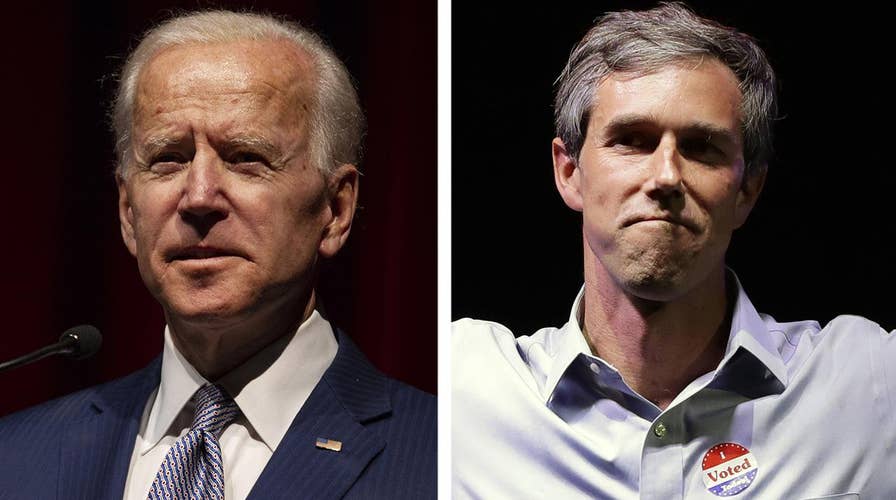
Could we see a Biden versus Beto 2020 Democratic primary?
Former Trump campaign manager Corey Lewandowski and Fox News political analyst Juan Williams debate.
This is a rush transcript from "The Ingraham Angle," December 4, 2018. This copy may not be in its final form and may be updated.
LAURA INGRAHAM, HOST: All right. I'm Laura Ingraham. This is "The Ingraham Angle" on a very busy news night here in Washington. This show has it all for you. We have politics, culture, startling rejection of history, but first.
Breaking news, as I just said in the Mueller probe, as the documents, sentencing documents against former Trump national security advisor Michael Flynn just dropped. These are heavily redacted documents revealing among other things that Flynn, a former three-star general, provided substantial assistance and gave 19 interviews, sat 19 times before the special counsel and other DOJ investigations.
Now, as a result of Flynn's cooperation, Mueller and his team are recommending no jail time. It's important to note, the documents presented tonight do not provide specifics about what exactly Mueller has learned from Flynn, only that he provided documents and communications. Now, what issues those communications refer to tonight is anyone's guess.
Remember, this has been a saga that has enveloped the entirety of Donald Trump's presidency, and in the process destroyed, as Sean said, this good man's life. Even if Flynn does serve no prison time, the judge agrees with the prosecutor here, imagine how his life has been thrown into complete turmoil, and for what?
Was this 18-month process good for the country? Are we better off? Did we stave off future Russian involvement in our elections because a former three-star general had to bow to the altar of Bob Mueller and the special counsel, the special counsel helpers? I think we have to go through this methodically tonight, and we are going to do this. Real questions remain and real questions must be answered as this investigation continues to move forward, although it looks like it is wrapping up.
Here now, two men who have been studying this report. Former deputy independent counsel and Whitewater investigator Sol Wisenberg and former House Oversight Chair and Fox News contributor, Jason Chaffetz, and Victor Davis Hanson, is a senior fellow at the Hoover Institution and author of the forthcoming book, "The Case for Trump," and he joins us now. Sol, let's start with you. Your thoughts after reading these documents?
SOL WISENBERG, FORMER INDEPENDENT DEPUTY COUNSEL: Well, my thoughts are first of all, the general would have received probation no matter what. Whether he cooperated a little or cooperated a lot. Like you say, the key parts of how he assisted have been redacted. What stands out the most is that a lot of people thought Mueller was going to use the sentencing memos to tell the world about his case because he is afraid that his final memo may not be publicized.
He didn't do that here. In fact, he showed remarkable professionalism by keeping redacted. He could have said, here is how he helped and it could've been bombshell, and he didn't do that. So I think to me, that is the big take away. The memo itself is kind of a dud because all the good stuff is redacted.
INGRAHAM: Well Jason, here is part of the memo, ‘Given the defendant's substantial assistance and other considerations set forth below, a sentence at the low end of the guideline range including a sentence that doesn't impose a term of incarceration is appropriate and warranted.’ I guess it is the meaning of ‘substantial assistance.’
JASON CHAFFETZ, CONTRIBUTOR: Well, you can be polite, you can comply. You can answer all of the questions. Donald Trump has answered all their questions. He has been as open and transparent as anything, but I think Sol is right. There was no bombshell because there is no bombshell! It's that simple. If they had him on collusion with Russia to affect the election, then absolutely they would have gone after him. But --
INGRAHAM: He pled to two counts to 1001, right? Two counts of lying to investigators.
CHAFFETZ: But this is a process crime. You should have filled out the proper paperwork. We are not going to hear to excuse it but it is the inconsistent application of the law that drives everybody crazy. I can't tell you how many people came before the oversight committee when I was the chairman and they lied to us.
We referred it to the Department of Justice and said we are not interested.
INGRAHAM: No, we can't do anything about it.
CHAFFETZ: But then it's with Donald Trump, and you bet you. They will go after -- they gave immunity to Hillary Clinton's closest advisor.
INGRAHAM: I was just reading the Cheryl Mills stuff. I mean, these are things that I forgot until tonight.
WISENBERG: But Mueller didn't do that. In fairness to Mueller, that's not his jurisdiction. So, it is unfair. You can say it is unfair --
CHAFFETZ: It is the Department of Justice --
WISENBERG: But Mueller has a specific thing that he is supposed to look at. He is not supposed to look at Cheryl Mills.
CHAFFETZ: But he is not looking at collusion with Russia and the election. This stuff happened after that.
INGRAHAM: Well, it is interesting and VDH, I want to get you in on this because the actions we are talking about here, his conversation with the FBI that they didn't believe included lies. They did not believe -- including Peter Strzok, who did the interview with Flynn.
He went back to headquarters and they didn't think he lied. Those were the 1001 violations, lying reportedly about his conversation with the Russian ambassador. Whether that conversation included a conversation about referenced to easing up on the sanctions, or don't go crazy on the sanctions. In other words, we are coming in, we're going to get rid of the sanctions.
And apparently, he either misremembered or wasn't forthcoming on that. It didn't go into -- well what happened before this in 2016? Were you setting up some deal to make it easier for Russia to interfere in our elections? Which, again, is what the special counsel was set up to examine, that type of collusion.
Even with the redactions, when it comes to Flynn, at least, there wasn't any collusion on his part. The question is whether any of the figures associated with the Trump administration or Trump campaign that could be still as Sol alluded to, caught up in this dragnet.
VICTOR DAVID HANSON, THE HOOVER INSTITUTION: I think just as historian when I look for two things in these Mueller stories. One, does the Logan Act appear and it was referenced in this, and one, does the Foreign Agents Act --
INGRAHAM: FARA.
HANSON: -- the FARA Act appear. And when that appears and tells me they really don't have anything only because we've only had two people prosecuted on the Logan Act. John Kerry all of August and September met with the Iranian foreign ambassador in Paris and he admitted that he was discussing the Iran deal which is antithetical to the efforts of the present administration.
Nobody called that a Logan violation or seriously did. And we have all sorts of the swamp in Washington. Everybody is dealing with foreign agents. I mean, they are representative government so Christopher Steele was not a U.S. citizen. He was a foreign British subject and he was supplying data to the Hillary -- Clinton campaign for money. And he was seeding it throughout the government.
Nobody talked about the agents there. And then more importantly, in that document there is worry that Flynn was working in a way that was unethical with the Turkish government or maybe with the Russian government, but it had no effect because when Donald Trump came in, when you look at Russian sanctions, the oil policy of the U.S., increasing production, arming the Ukraine, attacking Russians in Syria or whether it was ending the Obama romance with Erdogan and Turkey.
We were much tougher on Turkey in much tougher on Russia. And finally, I mean, if you want to reduce everything, you get down to one point, all of these stories, the surveillance, the entire collusion comes back to the Steele dossier, and that was the source of the FISA warrant that was used in part at least to collate testimony with surveillance.
And we know now that although they said it was a bot document, nobody ever told the FISA court judges that it was paid for by Hillary Clinton.
INGRAHAM: Absolutely not.
HANSON: Nobody ever told them that Christopher Steele, the author of that dossier had been let go as unreliable. Nobody ever told the FISA court judges that the news accounts they presented to those courts were circular and were based on the dossier itself. So that was kind of a poison tree and a lot of these people have said things in numerous testimonies not knowing that that would be collated with a surveillance, and then we get into the unmasking.
And then finally -- this is a finally, 25 people in the DOJ or FBI have been reassigned, chose to be retired or were fired in association to this entire mess. Nobody is talking about it. I can't think of any time in U.S. history where the two top intelligence agencies, the head of those agencies, Jim Clapper and John Brennan, not only lied under oath to a congressional committee, admitted they lied under oath, and had entire exemptions.
So, I know it's not YouTube all the time, but that is really disturbing that we have this Mueller trap and then we have all of these violations that -- so when Mueller starts to be so sanctimonious and quote the Logan Act and the Foreign Agent Registration Act and government officials got to be above the law. Well, yes, but that is not happening. So we lose public confidence.
INGRAHAM: Well, it is kind of rich. It wasn't Mueller himself, but what preceded Mueller to set up this entire investigation from the beginning. And so we have gone over this meticulously. The reference to his military service, his exemplary public record, how common is that in a sentencing document such as this, taking that into account as a mitigating circumstance. I mean, it seems to kind of makes sense, but --
WISENBERG: It is very common if you are the defense attorney doing this memo and it's common if you are the government and that client has helped you. But I wanted to say one thing about Flynn, there is nobody in town who really believes that Flynn would have pled guilty unless Mueller had something against one of his family members. Of course, there is --
INGRAHAM: Or threatened his family members.
WISENBERG: Right. And that is often done by prosecutors and I don't know of anybody who thinks that Flynn would have pled if that wasn't out there. And we just don't know what that is. I do want to say in Mueller's defense, there is a mention of the Logan Act here but Mueller does not say in any way that Flynn violated --
INGRAHAM: Yes, but certainly not in there.
WISENBERG: But the other thing to keep in mind -- the other thing to keep in mind is that Mueller does say -- he does not say what it is, but Mueller does say that Flynn provided important information about connections between the Trump campaign and the Russian government or attempts to make connections.
All I'm saying is, you're right, he doesn't say Flynn did that, but he does say that Flynn provided information. So again, if there is nothing there, that may be one reason Mueller is not talking about it, or it may be that Mueller is a professional and it's just not appropriate to release that information.
INGRAHAM: There is a lot of redaction too. The left tonight is going crazy. They are like, OK, it's Downey Jr. I mean, they are -- it is speculation overdrive tonight on the other --
WISENBERG: Collusion.
INGRAHAM: Well, yes. The collusion is all in the redaction.
WISNEBERG: Oh, it's delusion. It's delusion.
INGRAHAM: Delusion, collusion, all in the redaction. But Jason, again, we go to again, what Victor Davis Hanson said. We have proven instances of blatant lying to cover up how this whole thing started in the first place. Lying to federal judges -- and I say it's lying. When you don't reveal who actually started this whole ball rolling on the dossier, that is a lie.
I still think that FISA judges should be a lot more angry about how this all went on from the beginning. From that spawn this entire investigation. From that filing and that surveillance spawn this entire thing. Period.
CHAFFETZ: It was an absolute fabrication. They took -- they planted stories. Remember, a big start of this when we finally --
INGRAHAM: It's like a circular deal. Like, it's in the press and you cite that and then put it in the FISA.
CHAFFETZ: -- plant of the story, take the story, present it to the court. I do think the House judiciary and the Senate judiciary of Lindsey Graham is going to do his job to its fullest. Bring up the FISA court judges. Have them explain how this process works. I was on the House judiciary and when we were going through hearings, they wouldn't let us even go to attend one of those meetings and they wouldn't let us even talk to those judges.
But there was clearly lying, misinformation. I know the inspector general is still doing an investigation of the FISA because it's probably not until mid-next year is best I can tell. It's going to take way too long. But the bottom line here with Mr. Flynn, he didn't have the financial means to fight this.
INGRAHAM: Yes, I would say that. I saw you referenced that, and Jason, picking up on it. He doesn't have a lot of money. I mean, when a prosecutor says, you ever want to see your wife again? You know, your son, your little grandchild? He's never going to see your grandchild. You are going to go to jail -- he's going to go to jail for the next 30 years -- don't worry. It is scary for most people. I mean, I --
WISENBERG: But he never -- he had competent counsel, he never would have gone to jail. If he had fought this and lost he never would have gone to jail for a significant period of time for offenses like this. I believe from what I've --
INGRAHAM: But two false statements?
WISENBERG: Right.
INGRAHAM: A 1001 statements and an article he wrote for "The Hill" about Turkey?
CHAFFETZ: It's because he didn't have any -- he didn't have any --
WISENBERG: This guideline range of zero to six months was -- he would have had that no matter what because that would have been his guideline range. So what's going on here is there was something else. There was a threat that was made against somebody but --
INGRAHAM: It's his son. It's about his son.
WISNBERG: But here is something else though, you can believe two things at the same time. You can believe there was the seat of the FISA court and that that should be investigated and that people should be prosecuted if they had found to have lied about that.
And you can also believe that Mueller should be allowed, even if you don't think he should have been appointed, that Mueller should be allowed to continue his investigation and not be attacked every day by the president. You can actually believe those two things.
INGRAHAM: No, I don't think it's helpful to attack Mueller every day. And I don't. I tend to look at what they produce. After 18 months -- and you've got this guy in a vice grip for 18 months. I mean, unless those redactions are really like knock your socks off, maybe they will be.
CHAFFETZ: I don't think they are.
INGRAHAM: I don't either. I think this is a big zero. I think this Mueller thing and what they did to Flynn is disgusting. And I want to talk to you about this VDH, what they did on the Turkey issue, which is getting almost no play tonight on the other networks. They actually said as you said, the foreign -- the FARA Act, the Foreign Agents Registration -- what is it? I always (inaudible).
The defendant made a second series of false statement to the DOJ concerning his contacts with the Republic of Turkey specifically on March 7th, 2017 after he was no longer in the administration. The defendant made materially false statements in multiple documents that he filed pursuant to the Foreign Agents Registration Act pertaining to a project he and his company had performed for a principal benefit of the Republic of Turkey.
And apparently the false statement was, well, it was more directed by the government of Turkey then you let on. And he wrote a piece in "The Hill" about that minister that the president of Turkey wanted back in Turkey. That came out March! I just find this to be -- like, this is it? You got the FARA and -- I'm sorry, I just think this is ridiculous! I'm so sorry.
HANSON: I don't believe you should attack the special counsel but what Mr. Mueller is doing, he is criminalizing the status quo behavior in Washington. That is what Washington people do. And what we have to ask yourself, does it have any effect? And when Trump came into office, they reversed the so-called special relationship that Obama had developed with Turkey that gave us in part the Muslim Brotherhood in Egypt and et cetera.
So, Trump was harder on the Russians. He is harder on Turks. If you had said, Laura, 18 months ago, $30 million ago, when we were told that there was a new dream team, these were the all-stars, these were Mueller's army. All of these gushing about these wonderful Ivy League lawyers, et cetera.
If you have told them that we were going to start with this bang and we were going to end up with a whimper, they were going after Jerome Corsi of Infowars and Roger Stone, you know, perennial provocateur, I think "The New York Times" would have wept and been humiliated.
That is where we are now. Eighteen months later we are going after minor characters that have always been on fringe activities and they are supposedly going to drop the bomb shell -- every day we hear a bombshell, bombshell, bombshell --
INGRAHAM: Tonight, it was --
HANSON: -- and that this investigation --
INGRAHAM: Victor, tonight it was the president was shaken, rattled by the Flynn memo. Every time something drops.
HANSON: Yes. It's always going to be a watershed (ph). It's going to be a bombshell.
INGRAHAM: They have a camera in the White House and the president is rattled. I'm sure he doesn't like the investigation, I mean, who would?
HANSON: I don't think Mr. Mueller necessarily is culpable himself, but whether he did know so or not, what we have seen now is we've seen the impeachment reach (ph) early in the administration. We saw the emoluments clause. We saw the 25th amendment. We saw the Logan Act and now the Mueller investigation psychologically feels that same need because we don't have any information that the Trump campaign or transition did anything --
INGRAHAM: Collusion! Where is the collision? I got Sol. Sol is I think judicious, you're judicious and you're prudent in your analysis. We do not know what is in these redactions. We don't know -- Michael Cohen has tape recordings that are -- we don't know. This is like a slow roll. The question is when is this ultimately do you think going to wrap up? Do you have any idea?
WISENBERG: I think we are near the end but keep in mind, how you typically determine what a prosecutor's office has is you look at every plea deal, you look at the language of the deal and you look at the statement of the offense. That is where they say, this is what the guy did.
And in every single case, you have nothing to indicate that there is a major collusion/conspiracy case involving Trump or his lieutenants conspiring illegally with the Russians, or conspiring with anybody to hack computers.
Now, I'm just saying, all I can do is read the tea leaves based upon what prosecutors and defense attorneys always look at. If you look at the documents, there is not going to be anything major there. That's just the way it is.
INGRAHAM: So, it's not what everyone thought. Trump is working with, oh, the left -- Trump's working with Putin, working with -- and they are all going to steal the election from Hillary. That is what the average person was led to believe at the beginning of all of this and we will see where we end up. Fantastic analysis by all of you. Thank you so much. There are a lot of stories we are going to cover tonight and one, the war against history? Yes, next.
(COMMERCIAL BREAK)
INGRAHAM: Enemies of American history, that is the focus of tonight's "Angle."
Now back in August, protesters at the University of North Carolina at Chapel Hill took it upon themselves to rip down a confederate statue. Well, it was the "Silent Sam" statue and honored UNC students who had fought for the confederacy in the Civil War. Over the last few years, the statue has been labeled "a celebration of white supremacy" by some, and a piece of history by others.
Well, yesterday, the university board announced a plan to house the statue and a new $5 million history and education center on the edge of campus where it will be properly contextualized. But even as she announced the plan, Chancellor Carol Folt was clearly not entirely on board.
(BEGIN VIDEO CLIP)
CAROL FOLT, UNIVERSITY OF NORTH CAROLINA CHANCELLOR: I have a preference to move it up campus but like everyone here, I sore to obey the law and sometimes you don't agree with laws. But I don't have the privilege of choosing which laws I agree with and which ones I do not.
(END VIDEO CIP)
INGRAHAM: How brave. Well, a 2015 North Carolina law forbids agencies from permanently removing and relocating state owned memorials or statues. And North Carolina likely passed the law to protect against what it saw happening across the country. What's been happening?
Well, nationally since 2015, more than 100 confederate monuments and statues have been removed. Students, protesters, and faculty members at UNC want the same fate to befall "Silent Sam." The North Carolina law be damned. Forget about it. They took to the campus Monday night to protest the plan to house the statue in a new building.
(BEGIN VIDEO CLIP)
UNIDENTIFIED MALE/FEMALE: No cops! No KKK, no fascist USA!
UNIDENTIFIED MALE/FEMALE: Hey hey, ho ho. Silent Sam has to go.
UNIDENTIFIED FEMALE: UNC is not concerned about preserving history. It is concerned about not upsetting its racist donors and the board of trustees and Carol Folt.
UNIDENTIFIED FEMALE: I'm disappointed to be associated with an institution that continuously seeks to protect and glorify the white supremacists who love to hate us.
UNIDENTIFIED FEMALE: To enable white supremacy is to perpetuate white supremacy and that is exactly what the board of trustees, Carol Folt are doing right now.
(END VIDEO CLIP)
INGRAHAM: It's funny how they are reading it off their phones. Well, who needs paper? But the history was so and that cut and dried. There is a movement particularly among the young to hate the past and eradicate anything they find objectionable or troubling. And look, every country, all history has its bad side and good sides. Good stuff, bad stuff. But this recall is a kind of destructive mind-set of let's say ISIS.
Think about ISIS, what they did. They pillaged and they wiped away irreplaceable, historical, and religious monuments. From Palmyra, remember in Syria, simply because they could. It's offensive to them. Now, no matter what one thinks of the way this was all treated after the civil war, where they built these monuments or not. This happened, OK. The confederacy happened, and we owe it to the future to leave history as it existed undisturbed.
Continue to debate it, have conversations about it, but why not allow future generations the opportunity to mark this history, process it, and come to their own conclusions. Put up another statue commemorating the slaves who were abused and killed adjacent to ‘Silent Sam.’ But to destroy instead of engage, to defy the law instead of respect it, is no way to honor the past or the future or to highlight all the gains America has made.
Now, by committing acts of violence to get your own way, and defying laws to remove figures that you find offensive, you start to look a little bit like the thing you are protesting. Should you succeed, by the way, in the future, some other mob might well tear down your statue because they themselves find what you did offensive. So where does it all end?
And you would have, you know, taught them that it's fine to destroy all trace of whatever we find objectionable in the past? Let's hope the board of UNC, North Carolina's Historical Commission has less destructive tendencies. We can hope. And that is "The Angle."
Joining me now, two students from the University of North Carolina Chapel Hill. Magdalena Horsempa (ph), who is a student supporter of the "Silent Sam" statue on campus, and Alana Edwards, she is the president of the UNC Young Democrats, a group adamantly opposed to the statue's presence anywhere on campus. Now Alana, it seems that the first step for critics of these statues was to move them out of the public square and into historical buildings. OK, so that happened -- or that was happening. But now that's offensive. So where does this ever end? What do you propose it be done with the statue? You can't have it out on the public where it always has been, can't move into the building, so what now?
ALANA EDWARDS, PRESIDENT, UNC YOUNG DEMOCRATS: I think with the ‘Silent Sam’ down, it is time to start contextualizing the past of the monument. And one thing I would like to bring up is when you look at when this monument was elected, it was 1913, the height of the Jim Crow era, and the dedication speeches espoused white supremacy. And personally, I am a proud southerner, and I had ancestors fighting on both sides of the war, and I value the lessons to be learned from the Civil War. But I see this monument as destructive, and a symbol of a different era entirely, and not of the actions of UNC student who served at that time, but when it was dedicated in 1913, the era of white supremacy. And so while there is no clear-cut solution, I do think, and state law is very restrictive, I think that it deserves a place off campus where it can be placed within the proper context of which it was erected.
INGRAHAM: So let's go to you, Magdalene, on this. What should happen to this statue? There is a law, a state law, passed unanimously, I believe, in the state. One chamber of the state house, but then ultimately it was signed into law, that exists. You can't just remove things never to be seen again. These are state owned memorials, and it says very clearly, a monument, memorial, or work of art owned by the state may not be removed, relocated, or altered in any way without the approval of the North Carolina Historical Commission. They wanted to basically stop these things from disappearing in the middle of the night as we saw in places like in New Orleans, where statues have been removed never to be seen again. So Magdalene, what happens next?
MAGDALENE HORZEMPA, CHAIRWOMAN, UNC COLLEGE REPUBLICANS: So next, of course, I feel that if these students are going to protest on the north side of campus, they are absolutely going to continue protesting to stop you being in the new museum and education center on the south side of campus. I feel that only placing the monument on the south side of campus in a building allows UNC administration to ignore the problem that is going on on campus, and that is liberal students feeling that they can run a university and encompass -- try and encompass and overthrow the opinions of the majority and only allow the public to see the vocal minority that is taking place.
In my capacity as the chairwoman of the UNC college Republicans, I have said before I do not condone any kind of mob rule or anarchist activity on campus. And for these students to feel that it was OK to take this statue down in the very beginning in August, that's absolutely not OK. Chancellor Folt let them get away with it, UNC police, Chapel Hill police, and the lack of consequences from events in Durham also made students think that they could get away with something like this. And that's absolutely not --
INGRAHAM: Alana, when you look at these images, this is like mob rule. You rip something down, you say I'm offended by it, and we are all supposed to throw you a parade. Welcome to the world. Again, I'm kind of tired of the snowflake line and all the college students are snowflakes, but the real world is filled with complicated, very difficult dilemmas for everyone.
EDWARDS: I agree. And I think --
INGRAHAM: You might not like the lyrics to a song you hear on the radio. Maybe you like the tune but you don't like the lyrics. Well, I guess you could say, well, it offends me, that should be banned, because it objectifies women as just a piece of, you know, sexual gratification or something. Pretty much everybody is offended by something. You know what I'm offended by? I'm offended by students who refuse to see that the progress has been made in the United States of America and seem to want to want to find some type of, I don't know if it's belonging or relevance in a world where moral relativism actually kind of reigns supreme.
But it looks like students, it is kind of a social gathering almost. What can we tear down today? Or how can we get on YouTube? Or how can we -- I'm glad you are on with us tonight to try to explain this. I think most people in the real world are like, kids, don't try this at home, because if you try this at home you will be put in jail. You try this in the real world you will be put in jail. Go ahead.
EDWARDS: I think we see in the civil rights era I think people would have said similar things about people protesting then. I think civil disobedience and peaceful protests are --
INGRAHAM: Does not look peaceful to you what happened last night? Really? That's peaceful?
EDWARDS: I would say last night I believe there were two arrests.
INGRAHAM: That's not Rosa Parks, sweetie. That's not Rosa Parks.
HORZEMPA: That's not peaceful.
EDWARDS: I would like to emphasize that there were two arrests, and they were nonviolent isolated cases. And I think with any group that large there will be people who act in ways that may cause them to get arrested. But what we saw last night, there was no violence. I think that it was just students voicing their opinion.
And one point I would like to bring up that our democratically elected student body president voted no to this proposal. So I don't really agree with the sentiment that this isn't what student want, because I think clearly we see by the numbers gathering, by the student body president, by the 5,000 letters and emails written to the Chancellor Folt when she solicited input from the campus community, I think they are all pretty clear that students don't want Silent Sam on campus.
INGRAHAM: Magdalene, final thoughts, real quick.
HORZEMPA: Absolutely not. This action does not encompass what the campus needs to be. UNC was founded on a Lux Libertas, which is light and liberty, and neither one of these situations encompassed that, neither one of them.
INGRAHAM: More debate.
HORZEMPA: This statue belongs where it was.
INGRAHAM: I think more debate, not less debate. Don't remove historical markers, talk more about them. Guys, thank you for being on.
Something interesting happening in the 2020 race.
(COMMERCIAL BREAK)
(BEGIN VIDEO CLIP)
UNIDENTIFIED FEMALE: Who do you want to see run?
UNIDENTIFIED MALE: We'll have 30 or 40 probably great candidates running for candidate.
UNIDENTIFIED FEMALE: That a lot. Forty, really? Forty candidates?
HORZEMPA: There are a lot of U.S. senators who talking about it, a lot of governors, a lot of people outside of politics. I think we're going to have a big field.
(END VIDEO CLIP)
INGRAHAM: And you thought the GOP field was big in 2016 -- 30 or 40 people. Wow. Just look at these recent developments as Democrats continue to embrace Beto-mania, which goes unabated, old Joe Biden is reemerging to say, wait an Amtrak minute here, OK. I think I am the most qualified person in the country to be president, he said.
There is a new twist on all of this tonight. Just hours ago, it was reported that Beto O'Rourke secretly met with President Obama, who is said to be very excited about his potential candidacy. So how bruising will a Biden-Beto Democrat primary be? Throw in another 28 people or so.
Here to debate, Corey Lewandowski, former Trump 2016 campaign manager, and Juan Williams, FOX News political analyst, co-host of "The Five." Juan, Obama's old staff seems to be prepping an instant kind of plug and play for Beto presidential campaign. Your thoughts?
JUAN WILLIAMS, HOST: Not quite. Rahm Emanuel, the mayor of Chicago, has said you've got to win something. And he thinks the idea that Beto O'Rourke did not win versus Ted Cruz in Texas means that he shouldn't be a contender here. He has got to prove that he can be a winner.
But I see lots of Obama people, to your point, Laura, saying -- Obama people -- saying, hey, you know what, we haven't seen excitement, this kind of charisma, this kind of young people attracted to a candidate since 2008, and that's Barack Obama. And by the way, in Iowa, they have just done a survey and it came back that most of Iowa Democrats say they would like to see a young, energetic new face on the scene. And I don't think there is anyone who fits that bill better than O'Rourke.
INGRAHAM: But of course, his old vice president, Corey. Joe Biden clearly isn't feeling the love here. He is pretty experienced. He was vice president for eight years, and Robert Francis does the shirt sleeve thing, kind of like Obama used to do. He's used to jump on stage in his shirt sleeves, he is young and energetic, and loved by a lot of Democrats. I've never seen anything like it, someone who has never won a big position, looks like the mojo and the energy is moving to him. Never seen anything like it.
COREY LEWANDOWSKI, FORMER TRUMP CAMPAIGN MANAGER: This reminds of Roger De Niro in "Raging Bull" when he says I could have been a contender. I could have been somebody. But you've got to win first is what it comes down to.
Next thing you know you're going to tell me the ticket is two failed candidates, Beto O'Rourke and Andrew Gillum from Florida are going to combine to be two losers who are going to run when we have a, quote, experienced candidate like Joe Biden. That means old to the average person. "Experienced" means old. The frontrunners for the Democrat nomination are both in their mid-70s, and then we've got Elizabeth Warren and Kamala Harris and all these others who can't get out of their own way, who want to run to the far left. And the Democrats are going to nominate a very liberal progressive who Donald Trump is going to walk all over.
INGRAHAM: Juan, there was another guy who ran and won and hadn't run and won anything, Donald Trump. He never won a political office, and he won the presidency.
WILLIAMS: Yes, and also, hey, Corey, Donald Trump is up in his 70s. So Joe Biden is highly experienced. I think when Joe Biden says he is the most qualified, it reminds me of George H. W. Bush, very qualified, lots of experience. You can't argue with Joe Biden's many years in the Senate and also as the head of the Judiciary Committee.
INGRAHAM: They don't want Biden. They don't want Biden. They want Beto.
WILLIAMS: In the polls he's the number one candidate, Laura.
INGRAHAM: I know. We have it. The Harvard Harris poll, we put it up, it's Biden, 25, Bernie Sanders, 15, Hillary Clinton, 13, Beto O'Rourke, nine percent. I don't think any of that means anything right now, because I'm telling you, although Obama is meeting with -- he has met with Bernie Sanders, he has met with Elizabeth Warren, and Mitch Landrieu, speaking of people who like to pull down statues in the middle of the night, or at least countenance that, Mitch Landrieu. So Obama folks and the former president himself, they are kind of running out of patience with Trump, Corey.
LEWANDOWSKI: Of course they are, because --
INGRAHAM: Obama is like, guys, let me show you how it's done. Let me show you how it's done. And Beto is kind of the, as he is described by, what the New York Times or the Washington Post, as the white Obama. They are describing him that way.
LEWANDOWSKI: Look, Obama has seen all of his signature policies reversed under this president. He has seen the economy explode. He has seen the magician that he claimed didn't exist, which is Donald Trump, brings jobs back to this country. He has seen this president renegotiate bad trade deals, and he wants anybody who can challenge him. The problem is, look, in the 2016 election, we had the adult debates and we had the children's debates, which was two separate stages. Now with 30 candidates we are going to have the geriatrics debate, the losers debate, and everybody else on the stage. It's amazing. We're going to have 30 people, you've got to be kidding me!
(LAUGHTER)
INGRAHAM: All right, guys, I want to get your thoughts on something else, though, because tonight we are mourning the passing of a presidential campaign that never got off the ground. Michael Avenatti announcing on Twitter that he will not run in 2020. Could we possibly get the porn star attorney to change his mind and give Joe and Beto and Kamala a run for their money? Juan?
WILLIAMS: I think only if we want to tickle you and Corey, because you guys would have a field day talking about him, and Stormy Daniels and all of that. I think Stormy remains on the scene as kryptonite to Trump, but I think you guys as political people would think, how ridiculous.
Now, I must say, he does reveal an instinct on the Democratic part, which is they want someone who would go toe-to-toe slugging it out with the heavyweight champ, Trump, right. And so Avenatti says that is what he will do. These other people, he says, they are wimps. They are going to get run over by the big heavyweight, Donald Trump. But I think you are going to find that the Democrats have a big appetite for somebody who is a fighter. But to me, Avenatti has just too many deficits, too many flaws going in. He is too much of a target for you guys.
INGRAHAM: He talked about, you need a fighter in 2020. We get that, but you also need someone who comes with some level, I think, of gravitas and experience. Who knows where we will be in two years in the economy, certainly hope the economy is doing well in two years. But you're going to go up against someone who has been through the meat grinder of politics over the last previous six years. And that's not easy. I don't care if you are young and energetic and good looking, you are from Texas and you have a cool name, that doesn't mean you have the political talent of Barack Obama. He had an enormous raw political talent, Obama did. And we will see about whether Beto does. Corey, real quick, close it out.
LEWANDOWSKI: And I agree with Juan. I don't think anybody whose nickname is creepy porn lawyer had a real chance of being the Democratic nominee. I could be wrong, but I don't think it's a great nickname to get into politics with, especially a guy who has been thrown out for not paying his bills, he has all these liens against him. I think creepy porn lawyer had no real chance anyways.
INGRAHAM: All right, guys, thanks so much. And we have long warned about the dangers facing the caravan at our southern border, both during the track and when they arrived. Two shocking developments have proved us right. The report is disturbing and the video next.
(COMMERCIAL BREAK)
(BEGIN VIDEO CLIP)
UNIDENTIFIED MALE: We've got a challenging and still potentially volatile situation in Tijuana. We've got over 7,000 migrants there. They were well organized. They were brought to the border by a group that told him they would able to cross easily into the U.S. to present asylum claims. We do see individuals trying to cross illegally. We saw the scenes of families literally dropping children over the fence.
(END VIDEO CLIP)
INGRAHAM: This is the video that the Customs and Border Protection commissioner was just mentioning. So do the people throwing their children over an 18-foot border fence seem like, I don't know, they're concerned parents, model parents? Some of those kids, not surprisingly, were seriously injured. And all the while, migrants at the border are demanding faster processing into the United States so many can disappear into the mainland.
Here to debate this, Tom Homan, former acting ICE director, and FOX News contributor and immigration attorney Gunther Sanabria. Tom, critics of the caravan are told that we are inhumane for warning of these dire conditions, but to see the numbers of people that are now reported missing from the original caravan, either dead or missing, their family doesn't know where they are and they're actually not at the border crossing, not to be accounted for.
TOM HOMAN, FORMER ACTING DIRECTOR, ICE: For the last year and a half I have said over and over again, illegal immigration is not a victimless crime. They hire a criminal organization to smuggle them to the United States and across the border. These are bad people.
And President Trump tried to do the right thing and put them into a port of entry by saying you can't if you enter illegally, to put them in a port of entry where they're guarded by federal agents 24/7. But because of what the ACLU did when they sued Trump for that, and this judge in the Ninth Circuit, what he basically did was put them back in the hands of the smugglers, you saw just saw the video of a smuggler dropping a child over the wall, they put them back in the hands of criminal organizations, more women will be raped, more people will die because rather than being a port of entry now, they are going to cross illegally with the help of criminal organization.
INGRAHAM: Gunther, the criminal organizations I think in part and other NGOs promised these migrants they were going to get into the country, and I think they didn't believe Trump when Trump said, you're not getting in, not getting in the way you want to. We are going to process you in the way we can. So they were sold a bill of goods.
GUNTHER SANABRIA, IMMIGRATION ATTORNEY: I see a problem here. Telling everybody to just go through a port of entry and not having enough people at the port of entry is creating a problem for a problem. I'm not saying that everybody should just jump the wall, OK. But if you are going to tell people, this is the entrance, have people prepared to receive all those people trying to look for asylum.
INGRAHAM: And 91 percent of them have fraudulent claims for asylum, 91 percent is the government's estimate given the past experience and the surge of asylum claims of the last six years. They have skyrocketed, Gunther.
SANABRIA: I don't think fraudulent is the word. I think that people come to apply for asylum and they don't qualify. The numbers are there. There is no evidence of fraud. There is evidence they don't qualify.
INGRAHAM: Pueblo Sin Fronteras, if I were at the Justice Department, I would open up an investigation just into that one group, Pueblo Sin Fronteras, which are sending representatives down there, and in a very cute and kind of veiled way, this is how you apply for asylum. Well, I want to come work in the United States. OK, but you have to have credible -- it's a scam.
SANABRIA: It's not that simple. It's not that simple. That interview is actually pretty tough. It takes a couple hours. I have seen the pages. I have seen people come with their interviews to my office. And I see 20 pages of questioning. It is not simply saying I want to apply for asylum, I qualify, and then you are in. It doesn't work that way.
INGRAHAM: They're economic migrants, all right? These people want to come to work, or join family members. They want to be in the United States for a variety of reasons.
SANABRIA: Of course.
INGRAHAM: But a very small percentage --
HOMAN: But the fact is that 89 percent of them will pass the first credible fear interview by an asylum officer, but as Laura just said, 90 percent will lose in front of an immigration judge. So the delta is too big. So it is easy to pass. You've just got to know what to say for that first interview. We had criminal investigations into this. American attorneys have been down there teaching and telling them what to say. That is just fact.
SANABRIA: No, I'm sorry, but the attorneys are not teaching them what to say. These are people running from fear, they are running from a country where they are being killed. Their wives and children are being persecuted and killed. To you they are telling the same story. To the attorneys --
INGRAHAM: I saw a lot of them interviewed. They didn't say anything about any of them being killed. They're like, I want to come and work in the United States. I've seen all those -- there is some really interesting freelance reporters down there, YouTube kids interviewing -- and I think they are kind of on your side on this, but people are just saying in Spanish because obviously they don't speak English. And they are like, I've got friends there, I'm not a threat. That is what they say.
I believe most of them are not a criminal threat, but they have made the criminal organizations richer. And they have hurt the people of Tijuana in this process who are, by the way I want play this, this one Tijuana official, Genaro Lopez Moreno. Let's watch.
(BEGIN VIDEO CLIP)
UNIDENTIFIED MALE: When they first got here there were like 360 migrants coming here. Things got out of hand because it kept growing and growing. This is a federal issue. This is not a municipal issue. But we are carrying the load, the financial load of keeping these people with medicine, food, shelter, blankets, and whatever.
(END VIDEO CLIP)
INGRAHAM: Tom, real quick. We've got 10 seconds here.
HOMAN: Mexico should have done more on the southern border. You can't tell me they couldn't have stopped this caravan if they really wanted to and really tried.
INGRAHAM: Gunther, come back. We'll have a longer segment on this. This isn't going away any time soon. Thank you very much. And we will be right back. Stay there.
(COMMERCIAL BREAK)
INGRAHAM: Something lost in a lot of the breaking news coverage of today and everything that has happened in the last week is President Trump's visit with George W. Bush and his wife, Laura, to console them about H.W.'s death even amongst all these heated political debates. That was a lovely moment. And Mrs. Bush went over to the White House, saw the Christmas decorations back in the White House where she spent eight years.
Content and Programming Copyright 2018 Fox News Network, LLC. ALL RIGHTS RESERVED. Copyright 2018 ASC Services II Media, LLC. All materials herein are protected by United States copyright law and may not be reproduced, distributed, transmitted, displayed, published or broadcast without the prior written permission of ASC Services II Media, LLC. You may not alter or remove any trademark, copyright or other notice from copies of the content.
